
Research article · 2022 · Full text
International Journal of Statistics and Applied MathematicsFinding the mathematical overlaps of the axiom of choice in Vipassana meditation
Volume 7(3) · Pages 110–114 · DOI: 10.22271/maths.2022.v7.i3b.829 ↗
Research areasCognitive Science and Education Research
Abstract
Author-writtenHuman beings perceive the world through their mind. Perception is followed by analysis, which is aided by wisdom. Within, Mathematics the Axiom of Choice is one such concept that forms a metaphysical bridge between the facets of nature and the mind, and the foundations of our physical existence. The Axiom of Choice deals with the continuum of unending infinities of set theory which find a parallel similarity with the continuous flow of overwhelming negativities of the mind like anger, ego, passion, hatred, fear etc. which if unchecked and allowed to multiply, can overpower the sense of rational and logical thinking. For the benefit of the suffering humanity, Gautama Buddha discovered the technique of Vipassana meditation, which facilitates the generation of the requisite wisdom or pragya, for purifying the mind from its intrinsic negativities. In this paper, using the exemplar of the Axiom of Choice, I propose some striking analogues between the concepts and methodology of mathematics and Vipassana and discover a deep and meaningful relationship between these two disciplines.
Summary
Source-checkedPlain-language reading of the full paper, prepared with AI and checked against the text. Each point links to the authors' own words.
Why it matters
- Mathematics serves as a fundamental science used by humans to discover the laws of natural phenomena and unravel the mysteries of nature. View evidence ↗
- Vipassana meditation was developed by Gautama Buddha to help humanity purify the mind of intrinsic negativities by generating wisdom, known as pragya. View evidence ↗
- The author posits that the Axiom of Choice's focus on the continuum of infinities in set theory parallels the continuous flow of negative mental states such as anger and fear. View evidence ↗
The question
- The research aims to identify overlaps between the Axiom of Choice and Vipassana to show that both disciplines share a foundation of logic and scientific curiosity. View evidence ↗
What they did
- The author uses the Axiom of Choice as a primary example to provide evidence for the congruence between mathematical concepts and Vipassana fundamentals. View evidence ↗
- The analysis proceeds from a historical background and mathematical formulation of the Axiom of Choice to an exploration of problems related to the infinities of natural and real numbers. View evidence ↗
- The paper employs philosophical illustrations to explain how the Axiom of Choice can be applied to finding solutions for psychological problems. View evidence ↗
What they found
- The author finds a parallel between the gap-free continuum of the mathematical number line and the Anapana meditation technique's focus on the continuous flow of breath. View evidence ↗
- The study concludes that the human mind, as a container of incessant thoughts, behaves like a continuum, which is mathematically analogous to the continuum of real numbers. View evidence ↗
- The author identifies a resonance between the 'faith' mathematicians place in the Axiom of Choice (due to lack of constructive proof) and the innate wisdom (pragya) used by humans to make life choices. View evidence ↗
- The author asserts that detached observation of bodily sensations is the mechanism in Vipassana used to organize the chaos within the continuum of mental thoughts. View evidence ↗
- The paper notes that the Axiom of Choice and the Continuum Hypothesis were proven by Paul Cohen to be independent of Zermelo-Fraenkel axioms, meaning they cannot be proved within that system. View evidence ↗
What it means
- The author concludes that the 'Choice Function' in mathematics and the 'Pragya Function' in Buddhism are analogous tools for navigating complex systems (mathematical sets and the human mind, respectively). View evidence ↗
- The author recommends the practice of Vipassana meditation, viewing inner wisdom (pragya) as a functional equivalent to the mathematical choice function for bringing order to chaotic thought processes. View evidence ↗
Visual summary
1 visualsIllustrations explain the paper; they do not show study data.
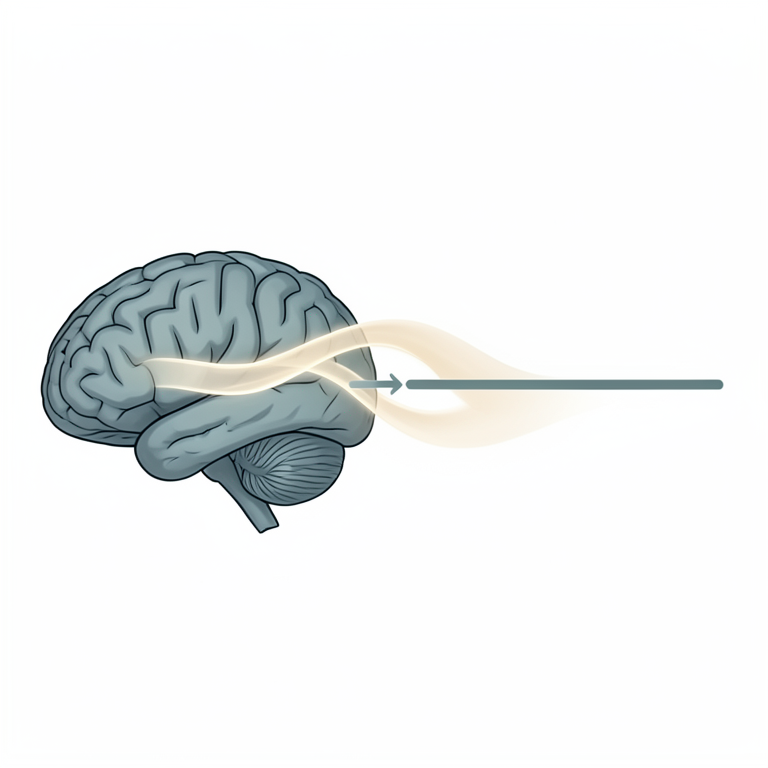
Continuum Analogy
AI-generated conceptual illustration (a human brain and a mathematical number line). It explains the idea and does not show study data.
View source evidence ↗Introduction
Mathematics is the age-old science through which mankind has tried to unravel the mysteries of nature and in the process discovered the laws of the natural phenomena that govern our very existence. While the scientists were exploring the truth about these fundamental principles underpinning the material world, there have been spiritual scientists who were more curious about the abstract inner mind. They wished to explore the abstractions governing the mind and the inter-dependence between mind and matter. These spiritual scientists found their conviction in the belief that our existence is a result of our cumulative actions and reactions of the past. Actions are performed by the body as a consequence of the reactions of the mind towards an external event. Hence, unfurling an inexorable link between the material and the mental worlds. One such spiritual scientist who not only discovered but corroborated this ultimate truth through observing the physical and metaphysical realities was Gautama Buddha. He observed the entire realm of the mind and discovered that all thoughts and emotions which occur in the mind are accompanied by sensations (vedana ̅) that occur on the body. By sensations, the Buddha meant any bodily feeling or perception, whether pleasurable or painful. In other words, the sensations act like windows into the behavioural patterns of the mind. The Supreme Enlightenment of the Buddha lay in the technique of simply observing the sensations without attributing them with any meaning. It meant, experiencing the reality of the present moment, while cutting off the mind from all past conditioning, hate, greed, and delusion, thereby, purifying it and freeing it from all suffering. The Buddha coined this liberating technique as Vipassana meditation [1] . Vipassana meditation is an experiential science about the mind-matter phenomenon. It is neither a philosophy, nor a blind faith nor a mental intellectual exercise. By practicing it, one can comprehend the fundamental laws of nature at an experiential level. Similarly, mathematics as a subject, utilises logic and rationale for discovering the complexities of nature. They both strive to comprehend the fundamental laws of nature. Mathematics begins this at the external level using the tools of truth and logic and finds that every discovery corroborates with the way nature functions at the mental level [2] . I highlight this by using the example of the Axiom of Choice. The Axiom of Choice is a postulate that was first formulated by the German mathematician Ernst Friedrich Ferdinand Zermelo (1871-1953) in a bid to prove the Well-Ordering Principle which states that "Every set X can be well ordered; that is, there is a relation '<' that well orders X" [3] . A proof of Axiom of Choice remains elusive but it is subsequently shown that Axiom of Choice is equivalent to the Well-Ordering Principle and some other axioms as well, which will be discussed later in the exposition. Previous research by Panthi 2017 [4] discusses the link between mathematics and Vipassana by elucidating the three principal steps of Vipassana technique viz., Sheela (morality), Samadhi (concentration) and Pragya (wisdom) through defining the 'mind space' X with the contraction mapping T symbolic of Samadhi and Pragya defined on it and finding the unique solution to the problem occurring in the mind. Inspired by this research, the given paper aims to highlight the overlaps between the mathematical concept of the Axiom of Choice and the principles of Vipassana, thereby establishing that the two disciplines possess a common thread of scientific curiosity and logic. Within the paper, the Axiom of Choice is utilized as a veritable source of evidence for corroborating the congruence between mathematics and the fundamentals of Vipassana, the most important being the element of belief and faith in the philosophy of the concepts. Axiom of Choice relies heavily on intuition and then it delivers implications that are momentous and essential for the growth and development of mathematics, especially in the realm of set theory [5] . The connection between the Axiom of Choice and Vipassana Meditation is substantiated by the words of Giommi and Barendregt et al. 2014 [6] that the "nature of intuition in a meditation of mindfulness and in mathematics is the very same". I have chosen the Axiom of Choice to elucidate the connection between mathematics and 'mindfulness' for it holds great significance in the foundations of mathematics. I shall begin the paper by giving a historical background of the Axiom of Choice followed by its mathematical formulation and then proceed to explicate the problems arising in its comprehension and acceptance due to the nature of infinities (or cardinalities) of the natural numbers and the real numbers. In the exposition of the paper, illustrations are given to explain the philosophy of the Axiom of Choice in finding solutions to psychological problems and in doing so, it follows the path of Dhamma ( Dharma in Sanskrit) as shown by the Buddha through the practice of Vipassana Meditation.
Historical Background of the Axiom of Choice
In the early twentieth century, many mathematicians worked towards axiomatizing set theory, Zermelo being a pioneer in this field [7] . The German mathematician David Hilbert (1862-1943) proposed to formalize all of classical mathematics by giving it an axiomatic foundation. This came to be known as Hilbert's Program. Clearly, this required the axioms to be self-consistent without leading to contradictions. The program was being carried out with great zeal by number of mathematicians: Paul Bernays (1888-1977), Gottlob Frege (1848-1925), John von Neumann (1903-1957), Jacques Herbrand (1908-1931), to name a few. Unfortunately, the program hit a serious roadblock when paradoxes were discovered in set theory, the most famous being the Russell's Paradox presented by the British philosopher and logician Bertrand Russell (1872-1970) [8] .
Russell's Paradox: If M is the set of all sets that do not contain themselves, does 𝑀 contain itself? It is easily seen that, if 𝑀 did not contain itself, then it would belong to 𝑀 and thus would contain itself, which would yield a contradiction [8] . To understand this paradox in simple language, a set is a collection of objects which satisfy a welldefined property. Now, certain sets can be members of themselves whereas others are not. For example, the set containing as its members those sets which are collections of bunches of flowers, itself is a set which is a collection of such bunches and is therefore a member of itself. But a set consisting of spoons is not a spoon and so is not a member of itself [9] . Zermelo, along with the contributions of the German born Israeli mathematician Abraham Fraenkel (1891-1965) proposed a set of axioms in order to formulate theory of sets free of paradoxes such as Russell's paradox. This came to be known as Zermelo-Fraenkel set theory but it also included the controversial Axiom of Choice. The first introduction of Axiom of Choice was given by Zermelo as an equivalent form of the Well-Ordering principle that every set can be well ordered in the sense that every nonempty subset of it has a least element. Although this principle can be easily observed in natural numbers but it is not so obvious in the set of real numbers with the usual order. This is due to the nature of uncountability of real numbers. But the Axiom of Choice implies that real numbers are indeed well ordered and that is further equivalent to the possibility of choosing an element from any collection of nonempty subsets of the real line. The above forms a unique feature of the Axiom of Choice since it asserts the possibility of selecting an element from an infinite collection of sets irrespective of their order. Although this process seems evident for a finite collection or even an infinite collection which is countable, it completely defies logic and rational thinking when it comes to an uncountable collection of sets. (Here, loosely speaking, by a countable set, we mean a set whose elements can be arranged in a sequential order and the numbering 1, 2, 3,… can be accorded to the arrangement and an uncountable set is that which cannot be listed as a sequence. A prototype of a countable set is ℕ, the set of natural or counting numbers and that of an uncountable set is ℝ, the set of real numbers). Since the infinity of real numbers is uncountable, it is not possible to put it in a sequential order and thus making the selection process beyond human cognition. But this seemingly huge lacunae in the structure of Axiom of Choice has not taken away its validity and utility. If the collection is finite, the selection process is easily verified, and this is observed in the case of a countably infinite collection of sets. But the problem arises when the collection is indexed by the set of real numbers which is uncountable, meaning thereby that the infinity of real numbers is much larger than the infinity of natural numbers. With reals, it is the infinity of the continuum whereas for the natural numbers, it is the infinity of the discrete. The continuity and infiniteness of the number line and its congruence with Vipassana meditation is explored in the next section.
Overlapping the Infiniteness and Continuity of the Number Line (Continuum) with Vipassana
With the discovery of real numbers, mathematics has completely transcended finiteness and the infinity of natural numbers turns out to be radically different from the infinity of real numbers in the sense that it is more comprehensible and tangible to our way of thinking whereas the infinity of real numbers has to touch a deep spiritual chord, for comprehension. It was found that where the integers and even the rational numbers could be put in one-to-one correspondence with naturals, it was impossible to do it with the reals. With reals, it was the infinity of the continuum whereas for naturals, it was the infinity of the discrete [9,10] . A fundamental of Vipassana which is explained through this mathematical phenomenon of the real number line, is the meditation of Anapana. Anapana is a technique to improve the faculty of concentration of the mind by maintaining a continuous awareness of the respiration through the nostrils [9] . In the practice of Vipassana meditation, the Buddha gave the Anapana technique as the first step to the ultimate goal of purification of mind of all defilements. The key point to note above is of 'continuity'. Like the number line which is a continuum of numbers without any gaps, the technique of Anapana aims at training the mind to observe the continuous inflow and outflow of breaths. Most individuals find the concept of a continuous gap-free distribution of events and/or numbers as incredulous. But in reality, the number line is a providential example of the continuity that underpins the spiritual path to enlightenment [9] . The truth remains that similar to the number line, natural breathing is a continuous process with no breaks. Just like our respiration, our mind also exhibits the continuity of the number line. Being in a constant state of contemplation, the train of mental thoughts runs incessantly on its tracks without completely coming to a halt. "The mind may slow down at times and also appear to have stopped when we are asleep but that is only an illusion of the conscious mind. The subconscious mind never sleeps and this is proved by the fact that the pent-up emotions resurface in the form of dreams when the defences of the mind are low. Thus, mind, the container of thoughts, behaves like a continuum. The mathematical analogous of which is reflected in the number line, the continuum of real numbers" [9] . The above explanation is explored further with a mathematical interpretation using the Axiom of Choice.
The Choice Function
It can be implicitly derived from the above sections that the concept of infinity is not as simple as it seems. Having something in abundance does not necessarily mean that it gives us the satisfaction or even the power to exercise our choice in the manner we wish to. But all said and done, the faith that a choice can be made, even if hypothetically, should not be lost. This forms the crux of the mathematical theory of Axiom of Choice. Now, let us understand it in complete mathematical terminology [9] . Another formulation of the axiom of choice is in terms of the Cartesian product of sets, that is, the Cartesian product of an indexed collection of sets is nonempty. Mathematically speaking, The totality of all these n-tuples is 𝑋 1 × 𝑋 2 × … × 𝑋 𝑛 , the Cartesian product of all 𝑋 𝑖 . We write it as 𝑋 1 × 𝑋 2 × … × 𝑋 𝑛 = {(𝑥 1 , 𝑥 2 , … 𝑥 𝑛 ) ∶ 𝑥 𝑖 ∈ 𝑋 𝑖 }. It is obvious that the collection of all n-tuples is nonempty. Now, if we take 𝒜 to be a countably infinite set, say for example ℕ, the set of natural numbers, then clearly there are infinitely many sets (here, infinity means the discrete infinity), say 𝑋 1 , 𝑋 2 , … . 𝑋 𝑛 ,…., Again, it is evident that we can pick an element 𝑥 𝑖 from each 𝑋 𝑖 and form an infinite sequence (𝑥 1 , 𝑥 2 , … 𝑥 𝑛 , … . ). It is possible to perform this task (mathematically by induction) because we are dealing with a collection of sets that can be counted. This is so because the natural numbers are also real numbers and can be extracted from the mass of reals and arranged nicely along a string. Thus the collection
gives rise to the Choice function 𝑓 which picks one element 𝑥 𝑖 from the set 𝑋 𝑖 at a given time. Mathematically, we express it as
But if we consider the infinite collection {𝑋 𝛼 } of sets which is indexed by the uncountable infinity of continuum (real numbers), that is, 𝒜 = ℝ, then the answer to the question whether it is possible to pick one 𝑥 𝛼 from each 𝑋 𝛼 is not staring at our faces. The question faced by the mathematicians was whether it is possible to define a choice function on this collection, which would pick exactly one element from each xα? Even though the answer is not immediately evident, it does not imply the non-existence of the choice function. The intuitive power to perceive truth bestowed on man by nature gives him the sense to believe that such a choice function exists.
Although the Axiom of Choice assumes the existence of a choice function for the whole family of nonempty sets, i.e. the ability to arbitrarily choose one element from each set, it offers no methodology to properly construct this function. For this reason, mathematicians who believe that mathematical concepts must be validated by proof and construction, find the Axiom of Choice to be unacceptable. Therefore, amongst the mathematics fraternity, using the Axiom of Choice has become a matter of belief or faith. It is here that I find resonance of this belief with the fact that nature has given us the innate wisdom (pragya) to make the right decision and 'choices' to deal with the vicissitudes of life. But again, an individual has to strive to develop the faculty of pragya and Vipassana meditation gives us a powerful technique to do so.
Ordering the Continuum through Vipassana
The beginning of twentieth century saw a herculean attempt on the part of the mathematicians to combat with the mindboggling infinities of sets which were plaguing their efforts to give a solid axiomatic foundation to set theory. We have already seen the impact the uncountable infinity of real numbers had on the credibility of the Axiom of Choice. For the sake of completeness of this expository paper on Axiom of Choice, I would like to mention an equivalent form of Axiom of Choice called the 'Continuum Hypothesis' which has a lot in common with the philosophy of the axiom and its relevance to both mathematics and metaphysics.
In the last quarter of the nineteenth century, the German mathematician Georg Cantor (1845-1918), the founder of set theory, in a bid to set to prove the Continuum Hypothesis stated as follows:
Continuum Hypothesis: There does not exist any subset of the real numbers whose cardinality lies strictly between the cardinalities of natural numbers (ℵ 0 ) and real numbers (c). The Hungarian mathematician Julius König (1849-1913) disproved the Continuum Hypothesis by establishing its equivalence to the absence of well ordering principle in the real numbers (Mendiola, 2016) [11] . Zermelo discovered inconsistencies in the arguments of König and to smoothen these inconsistencies, he proposed a proof of Axiom of Choice and formulated the axiom as follows [3] : "For any family 𝒜 of nonempty sets, there exists a choice function f such that for each set M in 𝒜, there is an element f(M) belonging to the set M."
In 1939, Austrian mathematician Kurt Gödel (1906-1978) came up with the Undecidability Theorems in which he proved that if the Zermelo-Fraenkel axioms are consistent, then it was not possible to construct a complete and consistent mathematical system based on a finite set of axioms. In other words, this meant that there will always be results that would remain undecidable, i.e. they might be true but cannot be proved to be so and the Axiom of Choice was one of such results. Still the mathematicians in their heart of hearts believed that foundations of mathematics stood on solid grounds because Gödel had only mentioned the possibility of such results but had not actually found any. But another mathematician Paul Cohen (1934-2007) in 1963, struck the final blow when he devised a mechanism through which it was possible to test whether a result is undecidable. Using Cohen's technique, the Continuum Hypothesis and the Axiom of Choice were shown to be independent of Zermelo-Fraenkel axioms and therefore could not be proved within the domain of Z-F axioms [8] . The genius of Paul Cohen had proved beyond doubt that the Continuum Hypothesis could not be deduced from the Zermelo-Fraenkel axiom and this combined with the Undecidability Theorems of Kurt Gödel showed that the Continuum Hypothesis was in fact independent of the Z-F axioms. This was not only a great setback to the credibility of the axiomatic foundations of mathematics but more so it left unanswered the question of how many real numbers are there.
To overcome this obvious loophole in the axiomatic system, the only way out is to keep on adding more axioms till the time they are complete and consistent to prove the Continuum Hypothesis or the Axiom of Choice. This would lead to the establishment of several set theories in some of which these axioms and many other could be proved. Within the Zermelo-Fraenkel Axiomatic set theory, Axiom of Choice is equivalent to the Continuum Hypothesis [11] . Mathematically, this suggests that the Continuum Hypothesis is equivalent to 2 ℵ 0 = 𝑐, 2 ℵ 0 , being the cardinality of the power set of the set of natural numbers. This shows that ℵ 𝟎 is the first infinite cardinal number and the next infinite cardinal number that the mathematicians have discovered is c. But it was Cantor's discovery that showed that not all infinite sets have the same size. In fact, there is a never-ending hierarchy of infinities, each larger than the preceding one. This was only the tip of the iceberg. The ramifications of Cantor's discoveries were wide-ranging, which led to the development of a very sophisticated branch of mathematics [12] . Cantor succeeded in bringing orderliness in the unending stream of numbers by first capturing them as sets and then categorising these sets according to their size. Interestingly, there was also a spiritual scientist who managed to achieve a similar form of orderliness in the deepest vicissitudes of the mind through the technique of Vipassana meditation [9] . Cantor's methodology may have brought a semblance of order and discipline to the number line but the Buddha managed to bring a sense of comprehensibility and wisdom to the mental schema of thoughts, abstractions, and conditionings [9] . Intriguingly, there is a deep spiritual connection between the methodologies adopted by Cantor (and other mathematicians) and the Buddha in bringing a sense of order and systematization to the chaotic scheme of things [9] . The methodology adopted by the Buddha for generating wisdom (pragya) and overcoming chaos lay in the technique of Vipassana which simply means looking at things in a special way with absolute objectivity and detachment. Buddha explained that first and foremost, one needs to develop the wisdom to identify the source of the stock of negativities [9] . "Evidently, it originates in the mind, but mind is an abstract entity and the nature of thoughts and feelings is also abstract. Still one can hope to achieve some sanity by shifting the focus from the thoughts to the body where these thoughts get manifested in the form of sensations. Buddha's words containing the essence of the final, cohesive reality are: vedanā samosaranā sabbe dhammā (Everything that arises in the mind is accompanied by sensation).
According to Buddha, it is the presence of sensations that is the key to making the abstract mind tangible. But then, one must acquire the skill of observing their transitory nature dispassionately by which the hold of the negativities over the mind loosens up and gradually these disappear altogether" [9] . Hence, the mindful and detached observation of bodily sensations is the key to the Buddha's method of Vipassana for taming the chaos inherent in a continuum of mental thoughts. This mindful observation is what eventually culminates into the true wisdom (pragya) for comprehending the causes behind the mental chaos and the means for overcoming them.
Conclusion
To establish the veracity of the title of this paper, I would like to reiterate that just as the Axiom of Choice proposes the existence of a 'Choice Function' without an explicit proof for its construction, similarly the Buddha has given the humanity the path to come out of suffering by exercising the 'Pragya Function'. The implicit overlaps between these functions form a hidden treasure for not only developing the wisdom for exploring the vicissitudes and ramblings of the innermost mind but for bringing a semblance of order and peace in the chaotic thought processes. The paper provides a warranting for the practice of Vipassana meditation and the inner wisdom (pragya) as tools equivalent of the choice function. The commonalities between Vipassana and the Axiom of Choice can be summarised by the following quote by the British Mathematician Keith Devlin [13] . "If the axioms provide a good reflection of some phenomenon in the real world, then the consequences of those axioms will also relate well to the real world and may even provide some useful information which can benefit (or possibly lead to the destruction) of the human race."
In other words, the Axiom of Choice is a beautiful example of a concept that has both utilitarian and philosophical implications, and this is what has been amplified in the paper. This paper further establishes the philosophical significance of Axiom of Choice by providing evidence for its innate congruence with the technique of Vipassana meditation. The juxtaposition between the Axiom of Choice and Vipassana, posits the former as a vehicle through which one can attain the Pragya (wisdom) of the complex workings of the mind. In summary, despite being the most controversial axioms of all, its implications, however unpalatable, cannot be ignored wilfully by mathematicians because on its shoulders, rest some of the most beautiful and esoteric results of mathematics [14] .
References
4 in the original paper- Marwaha A. A comparative study of Buddha's law of ephemerality and Heisenberg's Uncertainty Principle. Jamshedpur Research Review. 2022;2(51):18-27.
- Panthi D. A spiritual fixed point theorem. International Journal of Statistics and Applied Mathematics. 2017;2(5):1-4.
- Snow JE. Views on the real numbers and the continuum. The Review of Modern Logic. 2003;9(1-2):95-113.
- Herrlich H. Axiom of Choice, Lecture Notes in Mathematics, Springer, Berlin; c2006, p 1876.
Cited by 1
From OpenAlex, OpenCitations and reference lists read by Scinovex
- The continuum hypothesis: Its independence from Zermelo-Fraenkel set theory and impact on mathematical foundations ↗
Yaming Zheng · Theoretical and Natural Science · 2023
The Continuum Hypothesis, originally posited by the pioneering mathematician Georg Cantor in the latter part of the 19th century, stands as a cornerstone inquiry in the realm of set theory. This paper embarks on a journey, delving into the rudiments of set theory, before tracing the evolutionary trajectory of the Continuum Hypothesis. Central to this exploration is the Zermelo-Fraenkel set…
❝ 0PDF