
Research article · 2022 · Full text
International Journal of Geography Geology and EnvironmentAccessing the impacts of climate change on South Asia: A study of climate refugees; the ignored victims of climate change
Volume 4(1) · Pages 110–115 · DOI: 10.22271/27067483.2022.v4.i1b.89 ↗
Research areasClimate Change, Adaptation, Migration
Abstract
Author-writtenSitting inside a small room in Dhaka’s largest slum, 46-year-old Nafisa’s voice is breaking from keeping her tears at bay as she shares her experience of migrating from rural Bangladesh. “We used to live on the banks of the Payra river. My house was situated at the embarkments near the river. When the river started breaking, my house was wiped away and I came to Dhaka with my children. We shifted to a slum and it caught fire in 2004. We became destitute again. In 2007, during the cyclone Sidr, and within five minutes, seven members of my family were washed away by the water. My parents were among the seven. Everything became a graveyard and we had nowhere to go. We were not allowed into other countries and thus, I had to come back to Dhaka along with my children.”1Nafisa is just one of lakhs of people who are permanently displaced from their homes due to climate disasters. Climate change is not just an environmental issue but a social and political one too; and it needs to be perceived that way. It’s not just about the nature and the Earth, it’s about people losing their lives, their loved ones, becoming refugees in other countries and being treated like doormats too. With drastic changes in the climate, thousands of people in developing and under-developed countries are facing the wrath of disasters on a scale that has never been witnessed before. These instances leave them fighting for even the basic of all necessities. As a result, they seek refuge in places they feel are comfortable and well enough to support them and their families. Now finding the refugee centres, facing issues like those of human trafficking and rape, is a whole another aspect to the climate refugee complication. Our paper tries to accurately put forward the realities of the climate refugees, the problems faced by them, the support they have and the support they need.
Summary
Source-checkedPlain-language reading of the full paper, prepared with AI and checked against the text. Each point links to the authors' own words.
Why it matters
- Climate change is a complex crisis that extends beyond environmental damage to include severe social and political consequences for human lives. View evidence ↗
- Global warming leads to rising sea levels, which puts various coastal countries at risk of being submerged. View evidence ↗
- South Asia is expected to be one of the most severely affected regions, with the poorest populations facing the highest risks. View evidence ↗
The question
- The study aims to describe the realities and challenges faced by climate refugees and identify the support they require. View evidence ↗
- The researchers sought to evaluate the general level of public awareness regarding the concept of climate refugees. View evidence ↗
What they did
- The authors used a combination of conceptual elaboration, South Asian case studies, and a proposal of solutions. View evidence ↗
- An online awareness survey was conducted among a sample of 167 students using a single question about their awareness of climate refugees. View evidence ↗
What they found
- According to UNHCR data, 21.5 million people have been displaced by climate-related disasters since 2010. View evidence ↗
- The IPCC estimates that by 2050, there will be 150 million environmental migrants caused primarily by shoreline erosion, coastal flooding, and agricultural disruption. View evidence ↗
- Rising sea levels are estimated to displace 18 million people in Bangladesh over the next 40 years. View evidence ↗
- The sinking of Lohachara island displaced 6,000 people, the majority of whom were fishermen and marginal farmers. View evidence ↗
- The authors' survey found that 63% of the 167 students sampled (105 individuals) were unaware of the concept of climate refugees. View evidence ↗
- Data from the International Organization for Migration indicates that over 70% of migrants traveling to Europe via North Africa have been exploited or trafficked. View evidence ↗
- Women are disproportionately affected by climate change, often left to manage livestock, children, and agriculture while men migrate. View evidence ↗
What it means
- The authors conclude that immediate international action is required to formally recognize climate refugees and provide necessary aid. View evidence ↗
- The authors recommend signing the Global Compact for Migration as it is the only framework focusing on all aspects of refugees. View evidence ↗
Visual summary
1 visualsIllustrations explain the paper; they do not show study data.
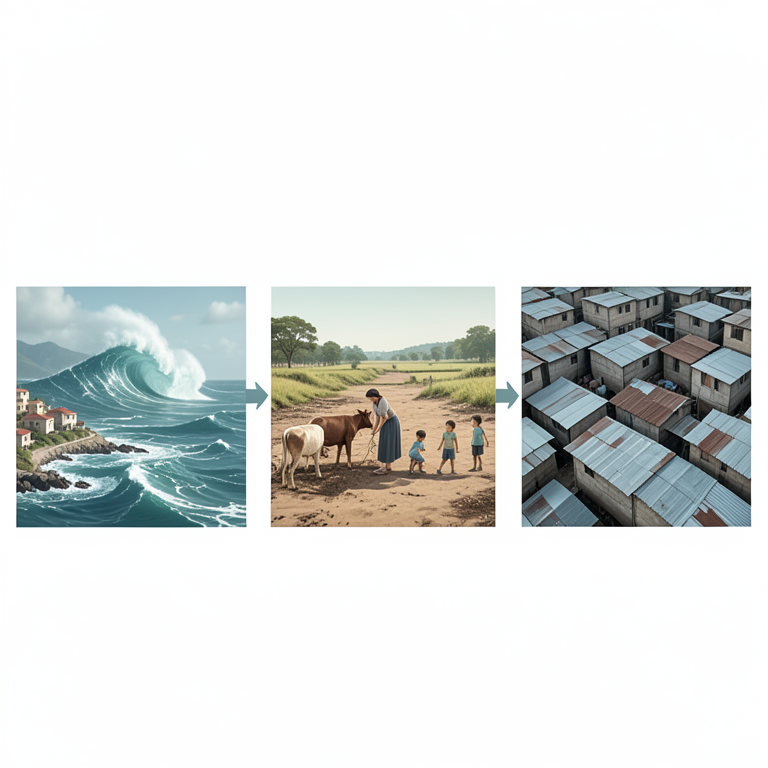
The Social Cycle of Climate Displacement
AI-generated conceptual illustration (South Asian coastal villages and urban slums). It explains the idea and does not show study data.
View source evidence ↗Figures & tables
From the original paper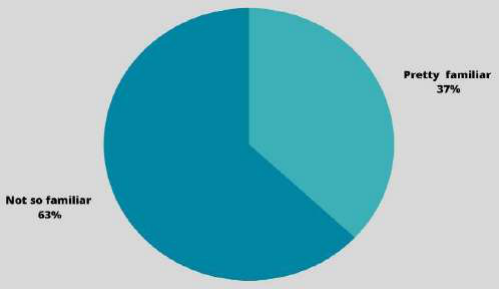 Figure 1
Introduction Research Question and Methodology
Existing literatures tend to focus on just the environmental and political aspect of climate change and thus, refugees. Our paper brings to light, the social side of the scenario. Although it's important to focus on the role of climate change on our surroundings and our environment, it is equally or even more important to focus on the effects it has on the people. Our paper elaborates on the concept of climate refugees, gives an in-depth insight into important case studies of South Asia, brings to light the various livelihood problems faced by them and puts forth solutions to deal with it. Our team also undertook an awareness survey to judge the amount of knowledge, people have on the subject of climate refugees.
Climate Change: A grave concern
Climate of a region refers to the average weather conditions in the area over a long period of time. Therefore, climatic conditions remain stable in a region. However, recently these conditions are changing, and such a change is called climate change. According to United Nations, "Climate change refers to long-term shifts in temperatures and weather patterns. These shifts may be natural, such as through variations in the solar cycle. But since the 1800s, human activities have been the main driver of climate change, primarily due to burning fossil fuels like coal, oil and gas" [2] . Climate change doesn't respect the national boundaries and have serious implications for entire planet and mankind [3] . This makes climate change one of the most important global issues that needs addressal from nations worldwide.
Climate change have created an imbalance in nature and have given a boost to already existing dan gers (disasters) such as floods and forest fires and even created new ones. These disasters cause a great loss to human lives and even disturbs their livelihood [4] . Implications of climate change includes increased average temperature of planet (Global Warming), which in turn lead to increased sea levels, bringing various counties at risk of submergence. It also leads to increased instances of forest fires, causing harm to diversity of flora and fauna and affecting the lives of people living in forest. The process of Climate change has fastened due to increased exploitative activities by humans [5] . For instance, increased deforestation, use of more petroleum-based automobiles and chloro-Fluro carbons (CFCs) have increased amount of Greenhouse gases in the atmosphere, which trap the solar energy in atmosphere itself-leading to increased temperature [6] . In recent times, climate change has gained importance worldwide. Various seminars and meets are conducted to discuss upon the problem of climate change and plan the future course of action. Most recent meet was COP-26 in which 103 countries' representatives met to strengthen their 2030 targets of reducing carbon dioxide emissions.
Climate and people: Understanding "Climate refugees"
Today, all across the globe, many people are being deprived of daily food and basic needs due to Climate Change and its adverse impacts. "Climate refugees/Environmental migrants" includes the section of the population that has been forced to leave their native region due to sudden or long-term changes in the environment. These changes can include increased drought, desertification, sea level rise, and disruption of seasonal weather patterns which can adversely affect people's well-being and livelihood. The term "climate refugees" was first coined to describe the increasing largescale migration and cross-border mass movements of people that were partly caused by such weather-related disasters. The International Organization for Migration (IMO) has proposed three types of environmental migrants [ 7] : Environmental Emergency Migrants: people who flee temporarily due to an environmental disaster or sudden environment event.
Environmental Forced Migrants: people who have to leave due to deteriorating environmental conditions.
Environmental Motivated Migrants: people who choose to leave to avoid possible future problems.
The UN Refugee Agency (UNHCR) defines refugees as people who have fled war, violence, conflict or persecution and have crossed an international border to find safety in another country8. The global 1951 Refugee Convention defined a refugee as "someone who is unable or unwilling to return to their country of origin owing to a well-founded fear of being persecuted for reasons of race, religion, nationality, membership of a particular social group, or political opinion" [9] . Climate refugees do not fit into any of the legal definitions of a refugee due to which people who are forced to flee due to environmental change are still not offered the same legal protection as refugees. Climate activists have been continuously demanding that the people who are displaced by the impacts of climate change should be referred to as 'refugees' and be given similar legal aid [10] .
The recently released data of the United Nations High Commissioner for Refugees (UNHCR) shows that the number of people displaced by climate change-related disasters since 2010 has risen to 21.5 million [11] . The IPCC has estimated that 150 million environmental migrants will exist by the year 2050, due mainly to the effects of coastal flooding, shoreline erosion and agricultural disruption [12] . Amnesty International explains that according to the 1951 convention relating to the Status of Refugees, a 'refugee' is defined as a person who has crossed an international border "owing to well-founded fear of being persecuted for reasons of race, religion, nationality, membership of a particular social group or political opinion". In some contexts, the definition extends to people fleeing "events seriously disturbing public order." It therefore, is unclear whether climate refugees are covered by the protection of the convention.
Where in South Asia are the climate refugees found: A Case Study
Without decisive action, hundreds of millions of climate migrants and refugees might be on the move by 2050, driven from their homes by disasters and the slow-onset impacts of climate change. The poorest, most vulnerable populations are facing the greatest risks, and South Asia will be one of the most severely affected regions. To protect climate migrants and refugees, the international legal framework needs to be expanded and climate events recognised as grounds for refugee status.
Study 1: The Sundarbans Sundarbans refers to mangrove forest in the deltaic region, formed by confluence of 3 rivers-the Ganga, the Brahmaputra and the Meghna in Bay of Bengal [13] . Geographically, it is an area where fresh water from rivers meets with saline water from ocean, thus creating marshy area. The majority of forest, about 60%, lies in Bangladesh and the remaining section of it falls within Indian territory. Sundarbans are named after the primary trees of region, locally known as 'sundri'. Sundarbans are the storehouse of huge diversity of flora and fauna. It is the habitat of birds, shrimps, and other wildlife including Bengal tiger. It acts as home to various endangered species such as estuarine crocodile. Since 1987, it has been recognized as UNESCO world heritage site. Other than its diversity, Sundarbans are famous for the scenic beauty, that is why it is an important tourist attraction [14] . Ordinally, temperature in Sundarbans ranges from 34 °C and 20 °C, and rainfall is extremely high. Weather is always almost moist with humid air. Sundarbans support the livelihood of around 3,00,000 people directly who work as fisherman, wood-cutters, loggers, luberman, etc. [15 16] These are largest mangrove forests supporting livelihood of 7.2 million people. Not only for local people, Sundarbans are of immense importance for economies of both the nations. The complex ecosytem of Sundarbans is under threat due to climate change and related ill-effects, which is induced by both natural causes and human actions [17] .
Increased Salinity
Sundarbans are situated in the delta region, where water supply is based on rivers. From late 19th century onwards, there has been a considerable reduction in supply of fresh water in the region. This reduction can be mainly attributed to diversion of water for various purposes such as agriculture in the upper course of the rivers and construction of dams which obstructs the river flow [18] . Other reasons such as increased evapotranspiration rate due to higher temperature and reduced water flow in dry seasons due to changing rainfall pattern. The reduction in flow of freshwater creates imbalnce in the system and the sunderbans are becoming more saline due to more flow of water from ocean side (due to sea level rise). The salinity leds to more problems, having adverse effects for the people in the region. It affects the agriculture production as land becomes unfit for cultivation. The quality of water in the region drops, making it unfit for human consumption. It affects the terrestrial diversity (flora and fauna) of the area. It further creates more environmental problems such as soil erosion, increased flood risk, etc. Therefore, it completely disrupts the livelihood of people living in Sundarbans.
Sea Level Rise
The problem of increasing sea level due to climate change is known to everyone. It is caused due to melting of glaciers and snow caps. The sea level rise of 3.0mm per year has been recorded in Bangladesh in past two decades. It brings the coastal regions at risk of submergence. Thus, forcing the people in coastal areas to leave their houses and livelihood and settle in other regions. They are known as refugees. Many refugees have moved to India from Bangladesh in search of better livelihood conditions, creating other migration related problems in both India and Bangladesh [19] . These refugees have to deal with a lot of livelihood challenges-politically, economically and even socially. In the past 20 years the two smaller islands of the region Lohachara & Supuridanga have already sunk [20] . Supuridanga was not inhabited, but the sinking of Lohachara displaced 6,000 people, mostly marginal farmers and fishermen. Ghodamara has been steadily sinking for the past 25 years, though local residents say the erosion has slowed down in the recent past [21] . Fifteen to 20 years ago, the island had a population of about 20,000 people according to the 2001 Census, it has 5,236 people left [22] .
Disasters
One of the most common disasters faced by Sundarbans is cyclones. Every year Sundarbans face cyclones of different level. Recently, in 2021, ecosystem and livelihood in Sundarbans was disrupted due to cyclone YAAS and cyclone JAWAD [23] . A 2021 study spatiotemporal analysis of tropical cyclone landfalls in northern Bay of Bengal, India and Bangladesh by the World Bank also underlined the increasing threat of cyclones in the Sundarbans area [24] . Other disasters such as floods and landslides also disrupt the livelihood and create more serious challenges for people in the region.
Impact on Bangladesh
The country is already dealing with challenges of disasters such as flood, cyclones, drought and landslides. Further, rising sea level is making the problem more severe. Climate change will be affecting the economy and its growth and development by creating more challenges such as poverty, reduced resources. One of the most intense impacts will be the forced movement of people throughout Bangladesh as a result of losing their homes, lands, property and livelihoods because of climate change and its effects [25] . According to the estimates, the rising sea levels alone will displace 18 million Bangladeshis within the next 40 years [26] . The vast majority of these people will be displaced domestically-not across international borders. Further, it will be presenting the government of Bangladesh with enormous challenges, particularly when it comes to providing accommodation and work for those who have been displaced. The number of "climate change refugees" in Bangladesh is expected to rise dramatically in the coming decades [27] . If sea levels rise by just 3.2 feet, one-fifth of the country located on the delta, is expected to be covered in water. In such cases, Poor populations are the most vulnerable to the changing conditions as they lack resources to cope up. Bangladeshis have already started to migrate from the lowest-lying villages in the river deltas of the Bay of Bengal; 1.5 million of the five million slum inhabitants in Dhaka, moved from villages near the Bay of Bengal. Biodiversity would be reduced in the most fragile environments of Sundarbans and tropical forests. The wide diversity of ecosystems including mangrove forests at the extreme south of the country will be destroyed. Climate Change impacts will have negative effects on the Ecosystem of the Forest recourses in Bangladesh while the Sundarbans is likely to suffer the most. The climate change in Bangladesh creates insecurities for food, water, life, property, settlement, livelihoods and others. Environmental degradation, degradation of land resources ultimately reduces food and health securities etc. Increased cyclone, storm surges, floods, river, bank erosion destroys and damage people's properties including land, house, cattle, and other livelihood assets and living essentials. Frequent disasters increase damage and loss by many folds. Following the climate change, the river bank and costal erosion are increasing at alarming rate.
Impact on India
It is found that due to climate change, the livelihoods of farmers in west Bengal region are getting affected as their crops are not growing properly. One of the reasons could be increased salinity in the area. Others could be more frequent flood or drought conditions. The change in weather conditions has resulted in existential and survival threats to people living near the coastline. Their source of income as well as health and safety are at risk. Due to the cyclones and extreme weather conditions especially near the coastline fisherman in places like Digha, Mandarmani, and Diamond Harbour are facing life threats daily during their operating times in the Bay of Bengal [28] . The effect of this change is also visible as the weather pattern has also affected the local farmers. Their produce gets affected as the saline water of the Bay of Bengal flows inland mixing up with the fresh river water used for irrigation and takes away the rich soil destroying the crops [29] . This problem is very commonly seen in the Sundarbans Delta in West Bengal followed by coastal regions used for farming in Odisha.
Study 2 -Sri Lanka
As climate change alters long term weather patterns and leads to aggravated natural disasters, thousands and thousands of people all over the world are being displaced and forced to seek asylum and refuge across borders. During 2010 and 2011, climate related disasters have displaced around 42 million people in Asia [30] . A 2015 IDMC report identifies Sri Lanka as the country with the highest risk of being displaced by disaster in South Asia. For every million inhabitants, 15,000 are at the risk of being displaced in Sri Lanka [31 32] . In 2017 alone, the country experienced seven disaster events, mainly floods and landslides, and 135,000 new displacements due to disaster [33] . The small island nation is also at risk from slow-onset impacts like soil degradation, water scarcity, crop failure, etc. Sri Lanka is one of the main countries of origin for migration within Asia. Like the Philippines, Sri Lanka has a robust framework for temporary labour migration, which was solidified with the start of the Colombo Process in 2003. Migrant worker remittances are a key source of income for Sri Lanka and amounted to 8% of the total GDP in 2013. The majority of international Sri Lankan migrants are now women, and while their main driver for migration might be economic, it is undeniable that the changing climate adds pressure and makes other employment options in their home areas unviable.
Why has no one talked about them? -Awareness Survey
Our team undertook an online survey to test the awareness on the subject of climate refugees. A simple question was asked from all of them-"Are you aware of the concept of climate refugees?" We had a sample of 167 students and 105 out of them, voted for "no". The rest 62 voters, on the other hand, claimed to be aware about the term. Our survey reflects that 63% of the people are not even aware of what climate refugees are. This is a very severe result because the future policy makers and administrators and not even aware of the concept, how can we expect things to change in such a scenario. Reaching to the root of the problem, the issue of climate refugees is not a talked about one. There are many conferences and treaties that deal with climate change but only a couple of them focus on the social and humanitarian aspect of climate change, i.e., climate refugees. A thorough understanding of the refugees is highly crucial, especially among the youth or future change makers. On the other hand, existing literatures provide evidence of the fact that awareness about an issue is directly linked to the addressal or steps taken by the government to deal with it [34,35,36,37] . Till the time, people don't aggressively talk about issues, it won't be a powerful push for the government to undertake major and strong steps to deal with the hovering problem.
Source: made by team
Source: made by team
Livelihood challenges: The different aspect Political aspect
The climate refugees often face consequences in political domain, because they aren't the original habitants of the area, rather they are result climate-induced migration. Some of the implications are discussed below. Firstly, climate refugees are often deprived of the rights. The recipient regions of climate refugees-mostly in developing countries-are usually not prepared for the influx of people who need to be integrated into social, economic or political systems. In such cases, there is often lack of legal framework thus are highly vulnerable to exploitation and violence. Earlier academic and political reports on climate change and refugees used the term 'climate refugee'. However, recent policy documents of international organizations clearly avoid the term 'climate refugee' and promote governing what is now known as 'climate-induced migration'.
Secondly, on global level there is a shift of responsibility from North to South. It makes populations that will potentially be affected by climate change responsible for securing themselves. In fact, most climate change-induced migration will be internally displaced, within the borders of their nation state. If they do cross a border, this is usually to enter another developing country. International migration to the industrialized countries requires significant resources, which most climate change induced migrants lack. Unplanned cross-border migration is therefore more of a problem occurring between developing countries. However, such movement may disrupt the flows of global resources and is therefore subject to careful monitoring by industrialized nation. Thirdly, there is a presumption that climate change is unavoidable reality and fact that needs to be lived with. The climate-induced migration of millions of people is rendered as a 'normal', rational and therefore acceptable response to changing environments, which are presented as being beyond human control. In this perspective, climate change is no longer presented as a social problem that can still be tackled by significant emission reductions and lifestyle changes by residents in the major economies. Instead, climate change is naturalized and depoliticized.
Economic aspect
Climate refugees face a number of economic problems making their survival even more tough/ hard. The most problematic or grave issue being unemployment which makes the access of our basic necessities nearly impossible for them. Climate refugees are still not completely accepted in a lot of nations due to which they don't get complete government aid, migrating to a new place leaving everything behind, not having any financial assets leaves them with no option and this leads to their advent exploitation.
The search for a proper shelter or 'housing' is another issue faced by the refugees as it can take sometimes months and even a year to find a stable staying place and a employment for them to make their ends meet.
Solutions proposed
The world's system for protecting refugees is broken. Worldwide, more than 21 million people have been forced to seek refugee abroad [40] . Most of the rich countries treat the climate refugees as somebody else's problem and not as a global crisis of which they are a part of. Before anything else, all the countries need to look at climate change and climate refugees to be not a country's problem, but a major humanitarian crisis in which they all are together and have to act together in order to emerge victorious. A lot has already been done to help the climate refugees, but it's not enough. Many other effective steps can be taken in order to improve the horrendous conditions that the refugees face. Some of the solutions that our team of researchers propose are:
• At the highest level, we need global governmental agreements, such as those being thoroughly thought and processed out at the U.N Conference on climate change in Paris to reduce greenhouse gas emissions and develop accessible technologies for the same.
• Policy level agreements are helpful but not sufficient. Most of the policy decisions are made, taking into consideration, the coming decades and are thus applicable for long term issues only. There however, is a need to work on short-term and immediate complications. Between now and then, we need to address the problems we are facing now and need to come up with preventive measures for the future.
• World leaders need to start putting lives first. If someone has survived the climatic disaster, then he/she must not have to worry about dying. No one should die crossing the borders or even within a refugee camp. Thousands of people fleeing persecution in Myanmar suffered for weeks on board boats while Thailand, Malaysia and Indonesia bickered over who should help them in May 2015 [41] . Extremely strict laws need to be curated in order to prevent evils like human trafficking, racism, rape, etc from entering the refugee camps. There have been many examples where the traffickers killed people on board boats when their families couldn't pay ransom [42,43] . The refugees should no longer be claimed for social, economic and political problems in the host country. They are all victims of circumstances and do not like living away from their homes. National support is a must in these tough times and it can only happen when climate refugees are looked as a part of a bigger humanitarian cause, rather than a burden from another country.
• Establishment of social entrepreneurship cells can also prove to be helpful in urgent and small-scale emergencies.
Needed training should be provided to all the cell members and they could be home to immediate preventive or healing measures.
• Climate refugee discussions should not lose their focus on preventive measures. The key objective of our generation should be to invest in climate and environmental solutions for our planet so that people do not have to leave their homes by force. There obviously, are certain disasters that can't be controlled but the ones that can be prevented, should be no matter how much time or dedication they require. Steps should be taken towards signing the Global Compact for Migration. Although other agreements have mentioned about climate refugees, this is the only compact that focuses on each aspect of the refugees. Importantly, the Global Compact is not legally bound so it does not have to be ratified by any country. It provides a broad international framework for states to coordinate on the issue of climate migration.
Conclusion
The issue of climate refugees has been an urgent one from decades, but no sincere attention has ever been paid to the victims. In times of such desperation and in matter of life and death, aspects like those of economic and political come into the picture. It is highly crucial to realise that life comes first; all the decisions that have to be made in such times, need to be the ones that give priority to people. This is a global humanitarian issue and not something restricted to a particular country. Although some steps have been taken towards dealing with climate change, there barely is anything that has been done for the climate refugees. The latter has been referred to as "the forgotten victims of climate change" [44] . The fatal effects of climate change are clear and there is no immediate evidence of it improving. What is severely needed now is immediate international action to recognize these refugees and give them the aid they need.
Figures and tables from the paper
References
10 in the original paper- Asian Development Bank. Addressing Climate Change and Migration in Asia and the Pacific. 2018.
- Environmental Justice Foundation. Beyond Borders. Our Changing Climate-Its Role in Conflict and Displacement. 2017.
- Ginnetti, Justin, and Lavell, Chris. The Risk of Disaster-Induced Displacement in South Asia. 2015.
- International Organization for Migration. Migration, Environment and Climate Change: Assessing the Evidence. 2009.
- International Organization for Migration. Assessing the Climate Change Environmental Degradation and Migration Nexus in South Asia. 2016.
- Intergovernmental Panel on Climate Change. Climate Change 2014. Synthesis Report. 2014.
- UN Environment Programme. Global Environmental Outlook GEO-6. Regional Assessment for Asia and the Pacific. 2016.
- United Nations Sri Lanka. Sri Lankan Migrant Domestic Workers. The Impact of Sri Lankan Policies on Worker's Rights to Freely Access Employment. 2015.
- World Bank. Groundswell. Preparing for Internal Climate Migration. 2018.
- World Bank. South Asia's Hotspots. Impacts of Temperature and Precipitation Changes on Living Standards. 2018.
Social aspect
Climate change is increasingly forcing people to flee their homes in search of safety and new means to provide for their families. The study found that women are affected far worse than men by climate change impacts. "They are left behind to take care of household chores, agricultural activities, look after children and elderly and manage livestock," it says. "Women who migrate to urban settlements are often then forced to take up work in precarious settings where workers' rights violations are rife." Women bear the brunt of this as being from the minority section they become the ones being in an uncomfortable and unsafe situation migrating from one place to another without any security assurance. Many a times they also face sexual misconduct and behaviour. Rural farmers are often more self-sufficient than many urban dwellers; they may not be familiar with depending on a corporation or other people for employment. Environmental refugees are not protected by international laws. They face greater political risks than refugees who flee their homes due to conflict or political oppression. Unlike traditional refugees, climate refugees may be sent back to their devastated homeland or forced into a refugee camp. Practices like those of Human trafficking, rapes, molestations, assaults and racism need to be kept a track of. Among migrants traveling to Europe through North Africa, alone, more than 70 percent have been trafficked or exploited, according to the International Organization for Migration [38] . Between 2012 and 2015, some Rohingya refugees fleeing genocide in Myanmar boarded ships to Malaysia or Thailand with the promise of lucrative jobs. Instead, traffickers kept them captive at sea in fishing vessels-where they were deprived of water and food, and some were raped, tortured, or killed-or in slave-like camps at the Malaysia-Thailand border, demanding up to $2,000 for their release. In Libya, traffickers have taken advantage of the increased flow of African refugees and migrants on their way to Europe. Some migrants have paid fees to be smuggled to Tripoli, but are then abandoned in the desert or southern cities of the country where they are susceptible to trafficking [39] . Armed groups impose "passage taxes" along the migration routes and some migrants have been bought and sold on "open slave markets" or held arbitrarily in detention centres where they are subject to forced labour and sexual violence.