
Research article · 2022 · Full text
International Journal of Statistics and Applied MathematicsA COVID-19 SEIR model for people living with underlying medical conditions in Kenya
Volume 7(3) · Pages 115–122 · DOI: 10.22271/maths.2022.v7.i3b.830 ↗
Research areasCOVID-19 diagnosis using AIArtificial Intelligence in HealthcareCOVID-19 epidemiological studies
Abstract
Author-writtenIn this study we propose a modified SEIR mathematical transmission model with a focus on Kenyans living with underlying medical conditions. The research will rely on reported data from the Kenya Government’s Ministry of Health to fit the model parameters. The next generation matrix approach is employed to ascertain the level of infection or the stability condition of infection based on the basic reproduction number R0 that the model will determine. Results obtained will give predictions on the impact of the disease on this group of people which will inform government in relation to prioritization of vaccination and other mitigating measures on policy formulation. Numerical simulations will be used to generate results that will support arguments put forth in this paper.
Summary
Source-checkedPlain-language reading of the full paper, prepared with AI and checked against the text. Each point links to the authors' own words.
Why it matters
- COVID-19 is a respiratory disease caused by the SARS-COV-2 virus that primarily affects the lungs. View evidence ↗
- Individuals with chronic medical conditions, including diabetes, hypertension, cancer, and cardiovascular or respiratory diseases, and elderly people are at higher risk for severe illness. View evidence ↗
- In Kenya, approximately one-third of people aged 58 and older have diabetes, hypertension, or both. View evidence ↗
The question
- The study aims to develop a modified SEIR mathematical model to analyze the transmission of COVID-19 specifically among Kenyans with underlying medical conditions. View evidence ↗
What they did
- The model assumes a seven-day incubation period and that recovered individuals develop antibodies that prevent re-infection. View evidence ↗
- The authors used MATLAB's ODE45 solver to determine the best-fit parameter values for the model. View evidence ↗
- The model was calibrated using COVID-19 data from Kenya collected between May 10 and June 30, 2021. View evidence ↗
What they found
- The results indicate that people with underlying medical conditions have a higher infection rate upon exposure and a higher fatality rate compared to those without such conditions. View evidence ↗
What it means
- The authors conclude that mass vaccination is necessary to eradicate the disease. View evidence ↗
- The authors recommend that the Kenyan government implement mass awareness testing for underlying conditions and prioritize the vaccination of these high-risk individuals. View evidence ↗
Figures & tables
From the original paper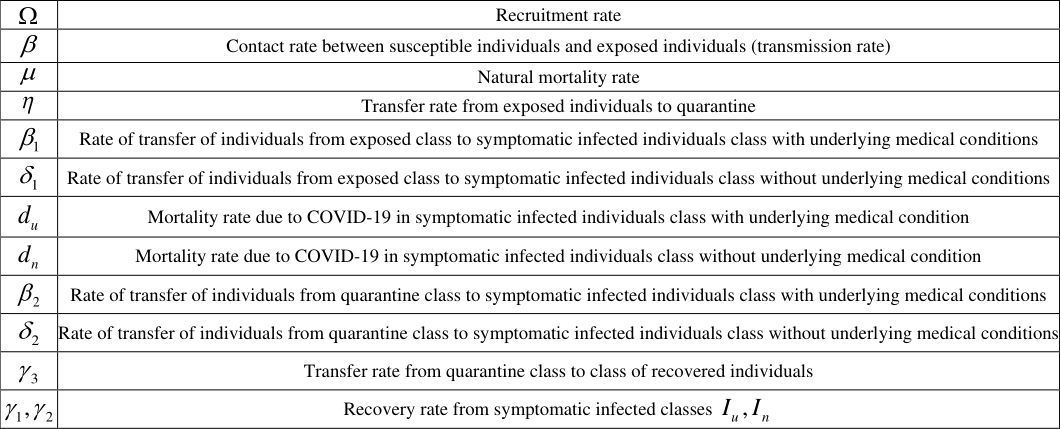 Table 1
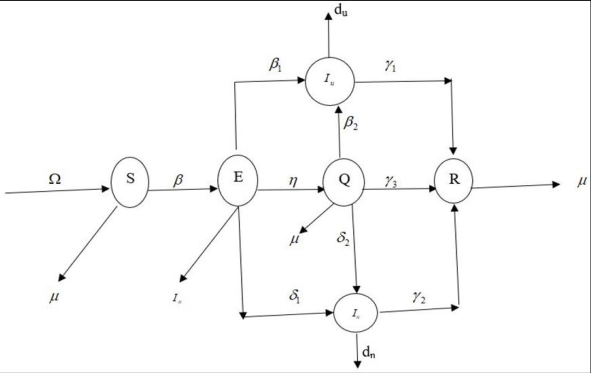 Figure 1
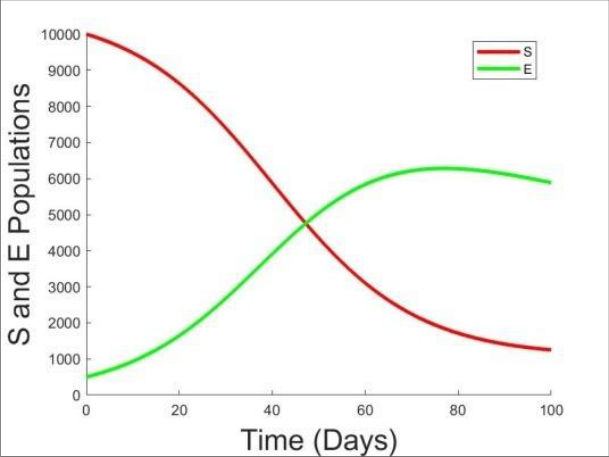 Figure 2
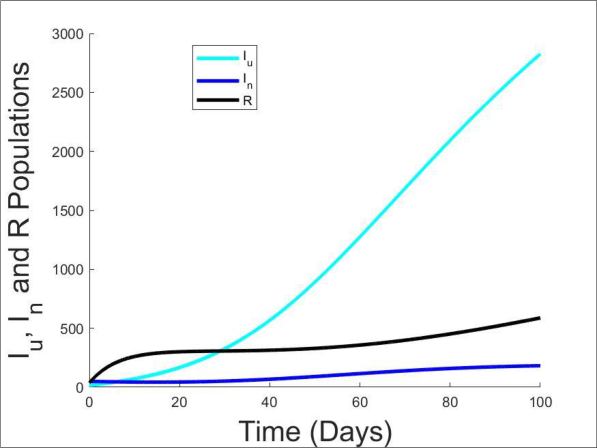 Figure 3
Introduction
A novel corona virus outbreak, popularly known as COVID-19 was first documented in Wuhan, Hubec Province, China in December 2019 (@2021 Lab Manager). In 2020 it spread through several countries and Kenya was not spared with the first confirmed case having been reported on 13 th March 2020. The case was of a Kenyan citizen who had travelled back to Nairobi from the United States of America via London, United Kingdom. COVID-19 is an infectious disease caused by SARS-COV-2, a member of corona virus family. It is a respiratory disease that affects lungs. It is transmitted through droplets when an infected person coughs or sneezes. This mode of transmission and symptoms are similar with those of other diseases caused by influenza viruses Korobeinikov A 2004 [1] . Since the outbreak COVID-19, there has been untold suffering throughout the world impacting negatively on the economic, social and political sectors of most countries, albeit to varying degrees. Global COVID-19 deaths are estimated at 4.056 million, with Kenya contributing 3,723 deaths as of mid-July 2021. Studies have shown that COVID-19 does not affect all population groups equally. We are learning more about the risk factors for severe COVID-19 outcomes every day. Age is the strongest risk factor for severe COVID-19 outcomes. Additionally, some chronic medical conditions occur more frequently in certain population groups and the risk of severe COVID-19 increases as the number of underlying medical conditions increases in an individual. Therefore, old people and those with underlying medical conditions such as cardiovascular disease, diabetes, hypertension, chronic respiratory disease and cancer are more likely to experience serious illness from COVID-19. Severe illness means that a person with COVID-19 may need hospitalization or intensive care. In Kenya, the Ministry of Health-estimates show that 1 out of 3 people aged 58 years and above are either diabetic or hypertensive or both. This group is at a high risk during this corona virus pandemic. Alongside the frontline health workers, the government has prioritized the individuals aged 58 years and above for vaccination and other intervention measures to mitigate against contracting the disease. It is estimated that bulk of the reported fatalities in Kenya comprise of people living with underlying medical conditions and old age Jayanta Mondal 2020 [2] .
Vaccination has made an enormous contribution to global health by greatly reducing the burden of infectious diseases. Two major infections namely smallpox and rinderpest in animals, have been eradicated through vaccination. A number of vaccines for COVID-19 have been developed. Among them are Astra Zeneca, Novavax, Johnson and Johnson which are already being administered. However, there is an emergency of new strains N440K also referred to as the Andhra Pradesh variant as it was first discovered in Kurnool district India, Delta Variant, and B.1.1.28.2 which are at least 15 times more infectious than the earlier virus and highly affect lungs. This new strains seem not to respond to available vaccines and more research is underway. Since the outbreak of COVID-19, several mathematical models have been formulated to discuss its dynamics. A few among the many researchers who have dealt with this are [2,3,4,5] . In this paper we propose a modified SEIR mathematical transmission model and use reported Kenyan data of cases of COVID-19. The target group is the individuals living with underlying medical conditions mainly diabetes and hypertension. We shall use the next generation matrix to determine the o R number that provides the quantification of the disease risk. Assumptions: We assume that all individuals in the population are at risk of infection, and that the recovered population would have developed antibodies and therefore would not be re-infected. We also assume that the incubation period is seven days. The newly established COVID-19 modified SEIR model is defined by a system of first order ordinary differential equations:
Subject to the following initial conditions:
The epidemic data used in this paper comes from the raw epidemic notification data published on the official website 'Coronavirus-Kenya: COVID-19 update (http://www.africanews.com)'.
The Invariant Region
We have to show that the state parameters The Jacobian matrices for infection matrix F and transition matrix V at the DFE are:
12 12 0 0 0 000 00 0 0 0 0 , 0 0 0 0 0 0 0 0 0 0
From which we determine the o R number as the spectral radius of the next generation matrix:
Stability of the equilibrium states Theorem 1
The DFE is locally asymptotically stable if o R <1 and unstable if 0 1 R .
We only need to show that the Jacobian matrix of the system (2.2)-( 2.3) has all the eigenvalues real and negative at DFE point.
The Jacobian matrix at DFE point of the system (2.2)
The endemic equilibrium point for the model (2.2)-( 2.
3) exists and it is locally asymptotically stable if 0 1 R .
Proof
Hence the endemic equilibrium point exists and is unique given by
, E ,Q , I , I , R un S . For the EE point to be asymptotically stable, we only need to show that the eigenvalues of the Jacobian matrix of the model (2.2)
3) are all real and negative. Hence
The characteristic polynomial corresponding to the eigenvalue is:
we obtain the first four roots as
and for the quadratic part
coefficients positive, and hence the corresponding roots must be negative. This brings us to the conclusion that EE point is locally asymptotically stable.
Theorem 3
The endemic equilibrium point
We use the Lyapunov function due to [1] of the form 1 ln
V t t t
. We only need to show that 0 Vt i.e. is negative definite for all , , , 0
Without lose of generality, we temporarily dispense with the last equation involving R and let un I I I so that the model (
The endemic equilibrium point is at
Since the arithmetical mean is greater than or equal to the geometrical mean, we 10
Similar argument is done to the rest and hence . 0 Vt for , , , , , , , 0 , , , : 0
By LaSalle Invariance Principle [7] , the endemic equilibrium point
Numerical Results
We have calibrated our modified SEIR model system (2.2) for the novel corona virus diseases to the daily newly infected cases for the Republic of Kenya. We used ODE45 in MATLAB to estimate the parameter values of best fit for the modified SEIR model. The parameter values obtained from data-fit for Kenya were used to compute the reproduction number,
o R
Which shows that the corona virus disease will not be eliminated from Kenya if preventive measures like vaccination, wearing of masks and social distancing are not practiced.
Application of the model to COVID-19 data in Kenya
The data used was collected from May 10 th to June 30 th 2021 Coronavirus-Kenya: COVID-19 update (http://www.africanews.com). Therefore our time zero in the figures below is May 10 th 2021. The remedy could be for the Kenyan Government to carry out mass tests awareness for underlying medical conditions and to do vaccination of all these individuals to induce resistance against this pneumonia.
Discussion
We have proposed a mathematical model to investigate the effect of novel coronavirus pandemic to the people above 58 years old and those leaving with underlying medical conditions in Kenya. We used the data from the ministry of Health of Kenya to carry out the analysis.
We have shown that the local asymptotic stability of the disease free and endemic equilibria when
Figures and tables from the paper
References
4 in the original paper- Korobeinikov A, Maini P. A Lyapunov Function and Global properties for SIR and SEIR Epidimiological models with Nonlinear Incidence. Research Gate. 2004;1(1):57.
- Jayanta Mondal, Sabhas Khajandi. A Mathematical Model for COVID-19 Transmission Dynamics with a case study in India. Research Gate, 2020;140:110173.
- Peng Peng SHI, Cao Shengli. SEIR Transmission Dynamics Model of 2019 nCOV Coronavirus with considering the weak infectious ability and changes in latency duration. Research Gate; c2020.
- Show Jiang, Qiuyue Li, Chaoqun Li, Shansha Liu, Xiaomeng He, Tao Wang, et al. Mathematical Model for devising the optimal SARs-COV-2 strategy for eradication in China, South Korea, and Italy. Journal of Translation Medicine, 2020 Dec;18(1):1-1.