
Research article · 2022 · Full text
International Journal of Veterinary Sciences and Animal HusbandryA traditional approach to respond climate change: Evidence from Madurese cattle culture
Volume 7(1) · Pages 19–22 · DOI: 10.22271/veterinary.2022.v7.i1a.399 ↗
Research areasLivestock Farming and Management
Abstract
Author-writtenThis study explores the traditional approaches to raising cattle in Pamekasan, Indonesia. We conducted a semi-structured interview with 19 local breeders. During the interview, we asked about their routines when dealing with possible disease, routine cattle management, and their awareness of climate change. This study can be a possible consideration for anticipating climate change and its impact on livestock businesses. One of the significant findings is the use of nitrate supplements to cattle foods. They practiced it because of the recommendation from local governments which is claimed as a strategic step to reduce gas emissions. Moreover the study acknowledges that they consider agroforestry in creating woodland on farms. These results indicate even they are lack of formal education, it does not mean they do not update about their knowledge. They are actively participating in village meetings.
Summary
Source-checkedPlain-language reading of the full paper, prepared with AI and checked against the text. Each point links to the authors' own words.
Why it matters
- Global population growth and increasing wealth are making the future demand for meat and other animal products unsustainable. View evidence ↗
- Cattle raising can cause environmental issues, such as deforestation in the Amazon where trees are cleared to create grazing land. View evidence ↗
- The livestock sector is a significant source of greenhouse gas emissions, necessitating the development of mitigation strategies. View evidence ↗
The question
- The study aims to explore traditional cattle-raising approaches used in Pamekasan, Indonesia. View evidence ↗
- The research seeks to offer a traditional approach to raising high-quality beef cattle. View evidence ↗
What they did
- The researchers used a qualitative approach, conducting semi-structured interviews with 19 local cattle breeders. View evidence ↗
- The study was carried out in Pamekasan, Madura, Indonesia, a region with a positive trend in cattle development. View evidence ↗
- To ensure data validity and reduce bias, the researchers employed a triangulation method. View evidence ↗
- Data was analyzed using descriptive qualitative content analysis rather than statistical methods. View evidence ↗
What they found
- The majority of cattle breeders in the study were aged 41-50 years, representing 60% (7 people) of the participants. View evidence ↗
- The most common education level among the breeders was elementary school, held by 43% (8 people) of the respondents. View evidence ↗
- Local breeders rely on traditional herbal means and plant extracts to treat cattle diseases. View evidence ↗
- Breeders utilize agroforestry, mixing trees with crops and pastures, as a land management strategy to mitigate climate change. View evidence ↗
- Breeders use nitrate supplements in cattle feed following local government recommendations to reduce gas emissions. View evidence ↗
- Environmental awareness is maintained through village environmental committees that educate the community on protecting trees. View evidence ↗
What it means
- The authors conclude that rural breeders in Pamekasan are aware of climate change and stay informed through active participation in village meetings. View evidence ↗
- The authors recommend further research to investigate the potential long-term side effects of using nitrate supplements. View evidence ↗
Visual summary
1 visualsIllustrations explain the paper; charts are replotted from the paper's own table values.
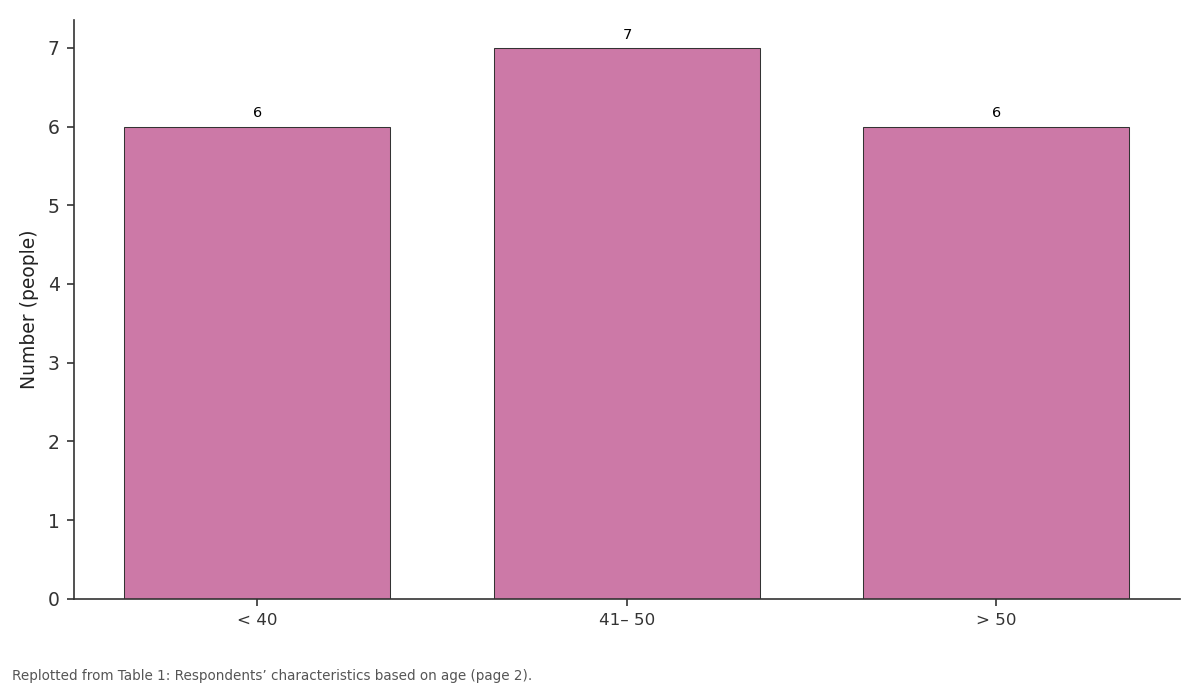
Number (people): < 40 vs 41– 50 vs > 50
Replotted from Table 1 (page 2) of the original paper. Every bar is the paper's own table value.
View source evidence ↗Figures & tables
From the original paper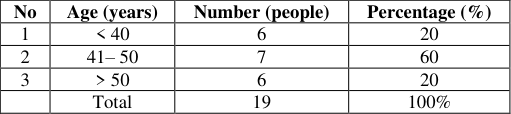 Table 1
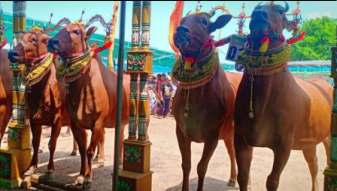 Figure 1
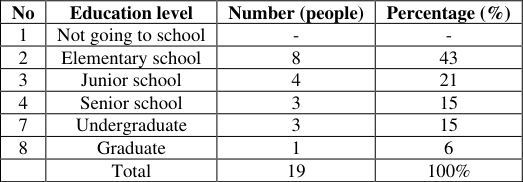 Table 2
Introduction
Livestock farming has become a much-loved business opportunity. But livestock that has good quality and meet market demand is not as simple as it looks. In some cases, a Bureau investigation has found that future demand for meat and other farm animal products would be unsustainable as a result of global population growth and increasing affluence (Wathes, et al. 2013) [16] . To date, the majority of research on the expansion of cattle raising is much more focused on political-economic drivers and resultant deforestation (e.g. Hoelle, 2014) [6] . Hoelle [6] in his paper explores cattle culture, the positive cultural constructions related to cattle raising, and analyses the paths that brought it to one of the "greenest" comers of Amazonia. According to his paper, he warns us that, even though cattle raising is a prospect economic activity, it is well-identified that it also gives environmental problems. Hoelle says, in the Amazon, breeders are pretty much cutting down trees to grow grass, which is aimed to feed the animals/livestock. It is also argued that such land acquisitions are the problem and source of conflict with local indigenous tribes due to farming's contribution to climate change. It is an example case that would increase the risk of the global temperature, which would cause significant damage to the environment. This is not to show that we are over-dramatised, but it is a serious problem that contributes to the climate crisis (Stanley, 2019) [15] . In short, Stanley (2019) [15] urges countries across the world should support climate change adaptation measures. A recent study completed by Grossi et al. (2019) [5] attracted much attention from academia, government, and the livestock industry. Grossi et al [5] . examine the main greenhouse gas emissions sources from the livestock sector and propose the best mitigation strategies for it. They said the increased consumption of beef in the world, along with the increasing population in developing countries and changes in lifestyle will accelerate the rise in temperature on earth. They propose that one of the strategic steps to reduce greenhouse gas emissions in the livestock sector is a control for our consumption patterns with animal-free protein diets. Responding to the challenge of climate change was also announced by prior studies (e.g. Naqvi and Sejian, 2011) [9] , requiring the formulation of appropriate adaptation and mitigation options for the sector.
Here Naqvi and Sejian for example propose diet modification and reduction on the manufacture of livestock products (p. 23). We think it is too naïve or ineffective to control methane gas emissions by reducing meat consumption. We must accept that people need a variety of nutrient intake as energy producers to carry out daily activities and maintain their lives. Nutrient intake can be obtained through food, both derived from plants and animals. And one important nutrient that is needed by humans is protein and amino acids. As common knowledge, meat contains protein which has complete essential amino acids. Animal protein also contains vitamin B 12 , which is not found in vegetable protein, where vitamin B 12 is very useful in the process of forming red blood cells, smoothing the metabolic system, and maintaining the nervous system. So, we have a similar view to Rosegrant et al. (2009) [14] that livestock products are an important agricultural commodity for global food. Furthermore, a study carried out by Rojas-Downing et al., (2017) [13] suggests that the livestock sector is often associated with negative environmental impact. One of the important topics that want to be addressed by Rojas-Downing et al. [13] , is the livestock sector's contribution to climate change and mitigation and adaptation measures to deal with climate change. They claim a key player in the mitigation of GHG emissions and improving global food security are diversification of livestock animals. They are then calling for a switch to a plant-based diet, reducing food waste, and improving agriculture with the help of technology. By suppressing half the amount of food that is wasted, they predict that the impact on the environment can be reduced. On the other hand, The Food and Agriculture Organization (FAO) seems to be doubt to address a wide range of questions, related to growing populations affecting increased demand for livestock products. They report global demand is projected to increase by 70% to feed a population estimated to reach 9.6 billion by 2050 (FAO, 2019) [4] . Based on the above reasoning, therefore, this topic becomes an active research idea that wants to be addressed in this study. Perhaps another important contribution of this study is to offer a new traditional approach to raising good beef cattle.
It is to answer the call for research on 'domestic production systems of veal calves and more adult beef cattle in terms of farm size and location, housing structures, feeding plans, and cattle genotypes' (Cozzi, 2007) [2] .
Material and Methods
This study is conducted in Pamekasan, Madura, Indonesia. One of the considerations for choosing Pamekasan is that the development of cattle in Pamekasan Regency in the last four years shows a positive trend. Another point that is important to note here is that Pamekasan has a good traditional culture -'Sapi Sonok', which is believed that it can produce highquality beef (Zali, 2018) [17] , see Fig. 1.
Data Collection
This study used qualitative research. For the process of collecting information, we conducted semi-structured intinteth 19 people. It is a data collection method that is often used in a qualitative study.
Validity Check
Before we analysed the data, it is necessary first to check the data to ensure whether the data obtained from the informants can be trusted or not. In this study, we used the data testing method with the triangulation method. The basic idea is that the phenomenon under study can be well understood in order to obtain a high level of truth if it is approached from various points of view. Photographing a single phenomenon from different points of view allows a reliable level of truth to be obtained (Naidoo and Rolls, 2000) [10] . Onono et al. (2013) [12] argue that triangulation is an attempt to check the correctness of data or information obtained by the researcher from different points of view by reducing the bias that occurs during data collection and analysis as much as possible. Therefore, triangulation is very important in our qualitative research, although it does need extra time and effort. But it must be admitted that triangulation can increase the depth of the researcher's understanding of the phenomenon being studied and the context in which the phenomenon appears. As we know, a deep understanding of the phenomenon under study is a value that every qualitative researcher must strive for. This is because qualitative research was born to capture the meaning or understand the symptoms, events, facts, events, realities, or particular problems regarding social and human events with their deep complexity, and not to explain the relationship between variables or prove the relationship, cause and effect or correlation of a particular problem. Depth of understanding will be obtained only if the data is rich enough, and multiple perspectives are used to comprehensively capture the focus of the problem.
Analysis Data
In this study, we performed content analysis. It is a technique used to analyze and understand the text. Content analysis can also be defined as an investigation technique that seeks to describe objectively and systematically. The technique used in this research is descriptive qualitative/non-statistical analysis techniques, namely the presentation of data that is not in the form of numbers but in the form of descriptive explanations. These analytical activities include reading, re-reading, identifying data, classifying data, discussing data, presenting data, and drawing inferences.
Result and Discussion Respondent Characteristics
Table 1 reports the distribution of the participants by age. It is known that the majority of respondents who became breeders of the cow are at the age of 41-50 years, 7 people with a percentage of 60%. This shows that the development and potential of the cattle business in Pamekasan Regency is more attractive to older people than young people. Then, it is also believed that farmer education level is the key in developing human resources that may influence the cattle management. In the livestock business, the education factor is expected to be able to help the community in efforts to increase the production and productivity of livestock that are kept. An adequate level of education will have an impact on improving the performance and management capabilities of farm businesses that are run (Díez and Coelho, 2013) [3] . Therefore, we collected information about farmer education levels, as presented in table 2. It can be seen, that the majority of the level of education of the cattle breeders in Pamekasan Regency are elementary, junior high, and high school graduates. Although the majority of respondents are not from colleges or universities, they still keep updated about informal education given by the local government about cattle management. Then, as expected, they in practice maintain the tradition culture for the development of the business of cattle, in which it is the uniqueness that would be discussed in the next discussion. The Interview Results
| No | Education level | Number (people) | Percentage (%) |
|---|---|---|---|
| 1 | Not going to school | - | - |
| 2 | Elementary school | 8 | 43 |
| 3 | Junior school | 4 | 21 |
| 4 | Senior school | 3 | 15 |
| 7 | Undergraduate | 3 | 15 |
| 8 | Graduate | 1 | 6 |
| Total | 19 | 100% |
Table text extracted from the original PDF; superscript letters are shown inline. The original table image is below.
View original table image
| No | Age (years) | Number (people) | Percentage (%) |
|---|---|---|---|
| 1 | < 40 | 6 | 20 |
| 2 | 41– 50 | 7 | 60 |
| 3 | > 50 | 6 | 20 |
| Total | 19 | 100% |
Table text extracted from the original PDF; superscript letters are shown inline. The original table image is below.
View original table image
Routine Cattle Management
In this section, we asked about a specific topic on "regular inspection". The key aspect given by most of the respondents is the human-animal relationship. This point is reflected by some responses from interviewees below: ". . . All animals should be thoroughly inspected at least once a day. At each inspection, special attention should be paid to body condition, movements and posture, rumination, condition of hair, skin, eyes, ears, tail, legs and feet" (Interviewee 3). "Animals must be cared for by a sufficient number of staff having the appropriate ability, knowledge and professional competence. One should be noted that healthy animals have sounds, activity, movements and posture appropriate to their age, sex, breed or physiological condition". (Interviewee 7).
Then another interviewee also added:
"Healthy animals may include: clear bright eyes, good posture, clean and shiny coat, sound feet and legs, normal feeding, ruminating, drinking, sucking or suckling behaviour, normal getting up, lying down, and resting behaviour and otherwise normal movements and behaviour". (Interviewee 9).
When asked the main issue that is forgotten by those who are responsible for working with and caring for cattle, is tied animals.
". . . tied animals should be closely inspected at least twice daily" (Interviewee 2). Then;
"Attention should also be paid to the presence of external parasites, such as lice, to the condition of droppings and to feed and water consumption" (Interviewee 16).
Cattle Diseases Management
In this section, we proposed some questions regarding the specific conditions affecting cattle. How the local cattle breeders deal with cattle diseases. The respondents in the study recognise "traditional herbal means" or traditional plant extracts to be efficacious against some diseases.
"We use plant species collected in the wild or allowed to grow near farm ends. We know these from a socialisation done by the local officers" (Interviewee 11). "We common see diarrhoea in cattle. It is caused by sudden changes in animal diet. We controlled by providing proper forage. We do not provide feed in the form of young leaves or nuts while the cow is still sick.
After the cow has recovered, the feed can only be given back to the cow" (Interviewee 6).
Another informant gives suggestions based on their common traditional means;
"We give herbal ingredients from selected spices that are efficacious for relieving diarrhoea in livestock. To make herbal concoctions is quite easy, you only need to use ingredients such as kencur, temu ireng, turmeric, lempuyang and tempeh that have gone rotten and then mashed. After being mashed, the mixture is put into plastic and left for one night to get fermented water. The fermented water is drunk on the cows with diarrhea at a dose of 3 times a day (Interviewee 2).
Adaptation measures in responses to climate change
From the interview, it is found that agroforestry is an effective method to prevent the significant climate change. It is believed to be able to optimize land use, prevent the expansion of degraded land, and improve the quality of agriculture. This result is supported by prior studies (Jara-Rojas et al. 2020; Cabral et al. 2021) [1] suggesting that agroforestry can improve soil conditions and manage water sources so that they remain sustainable and become better. This result is illustrated in the following quotes.
"I think agroforestry (establishing trees alongside crops and pastures in a mix) as a land management approach can help maintain the balance between agricultural production, environmental protection and carbon sequestration to offset emissions from the sector. From the socialisation given by local government, we should do it. And we do it. You know agroforestry may increase productivity and improve quality of air, soil, and water, biodiversity, pests and diseases, and improves nutrient cycling" (Interviewee 17). It (agroforestry) is good for us, you know, it gives us the agricultural products (livestock or crops) forestrygenerated products (e.g. fruit and nuts)" (Interviewee 8).
In order to make such measures effective, the community's awareness toward the negative effects of climate change is the key. It is because it would lead to self-educating activities.
According to participants, the agenda of environmental conservation was discussed in village meetings. It is captured in the following quotes.
"We do have a village environmental committee that is responsible for educating people on environmental protection, so people are not allowed to cut down trees unnecessarily". (Interviewee 5). "What we do, we try to educate and emphasize to our communities to have a good system on land use and management in which we do separate grazing areas and other land use, so we have specific areas for grazing in the dry season and in wet season". (Interviewee 16). "We educate our people not to cut down trees unnecessarily". (Interviewee 4).
Furthermore, some people added that putting nitrates to the food at a specific rate can optimize rumen fermentation. Then it can also shift hydrogen production from methane to ammonia. Howden et al. (2013) [7] argue that adding nitrates, it is potentially can reduce methane emissions while simultaneously enhancing or maintaining animal performance. The following example quotes give strong emphasis on the use of nitrates. "Yes, we keep feeding nitrates to beef cattle, it was instructed by the regent". (Interviewee 10). "Feeding the herd nitrates instead of urea is what we did, of course at safe levels." (Interviewee 12). "The government said that we have to ensure that nitrates are supplied to cattle as lick blocks with a specified sulfur to nitrate ratio, yes, we have to be aware toward the recommended levels" (Interviewee 4).
The last quote indicates that a number of mitigation techniques that have been recommended by the government were practiced. The suggestion given by Mottet et al. (2017) [11] improvements in breeds to increase animal productivity could be the solution to deal with climate changeis good, but it does not directly help to reduce gas emissions. The participants of this study prefer to use nitrate supplements as a contribution to dealing with significant climate change.
Conclusion
This study explores the traditional approaches to raising cattle in Pamekasan, Indonesia. From the study, we find that even though our participants are from rural areas, they are aware of climate change. They keep themselves updated for example by actively joining village meetings. The use of nitrate supplements is more pronounced for them, which is supported by agroforestry actions. Recommendation for further study is, what are the side effects of nitrate supplements for long-term use?
References
15 in the original paper- Cabral JP, Faria D, Morante-Filho JC. Landscape composition is more important than local vegetation structure for understory birds in cocoa agroforestry systems. Forest Ecology and Management. 2021;481:118704.
- Cozzi G. Present situation and future challenges of beef cattle production in Italy and the role of the research, Italian Journal of Animal Science. 2007;6(1):389-396.
- Díez, Coelho. An evaluation of cattle farmers' knowledge ofbovine brucellosis in northeast Portugal, Journal of Infection and Public Health. 2013;6(5):363-369.
- Grossi G, Pietro G, Andrea V, Drian GW. Livestock and climate change: impact of livestock on climate and mitigation strategies, Animal Frontiers. 2019;9(1):69-76.
- Hoelle J. Cattle Culture in the Brazilian Amazon, Human Organization. 2014;73(4):363-374.
- Howden NJ, Burt TP, Worrall F, Mathias SA, Whelan MJ. Farming for water quality: Balancing food security and nitrate pollution in UK river basins. Annals of the Association of American Geographers. 2013;103(2):397407.
- Jara-Rojas R, Russy S, Roco L, Fleming-Muñoz D, Engler A. Factors affecting the adoption of agroforestry practices: insights from silvopastoral systems of Colombia. Forests. 2020;11(6):648.
- Naqvi SMK, Sejian V. Global Climate Change: Role of Livestock, Asian Journal of Agricultural Sciences. 2011;3(1):19-25.
- Naidoo G, Rolls MJ. A method to investigate agricultural information use by small-scale Mauritian cattle keepers. The Journal of Agricultural Education and Extension. 2000;7(1):53-61.
- Mottet A, Henderson B, Opio C, Falcucci A, Tempio G, Silvestri S, et al. Climate change mitigation and productivity gains in livestock supply chains: insights from regional case studies. Regional Environmental Change. 2017;17(1):129-141.
- Onono JO, Wieland B, Rushton J. Constraints to cattle production in a semiarid pastoral system in Kenya. Tropical animal health and production. 2013;45(6):1415-1422.
- Rojas-Downing MM, Nejadhashemi AP, Harrigan T, Woznicki SA. Climate change and livestock: Impacts, adaptation, and mitigation, Climate Risk Management. 2017;16:145-163.
- Stanley J. British farmers are not the enemy in the battle against the climate crisis, The Guardian, c2019. Accessed in https://www.theguardian.com/commentisfree/2019/nov/0 3/uk-farmers-climate-crisis-livestock-sustainable
- Wathes CM, Henry B, Heather M, Madeleine LC. Livestock Production in the UK in the 21st Century: A Perfect Storm Averted? Animals (Basel). 2013;3(3):574583.
- Zali M. The interplay of traditional cultural events and cattle farm: humans and animals as victims of madurese ancient tradition. Advances in Animal and Veterinary Sciences. 2018;6(9):347-354.