
Research article · 2022 · Full text
International Journal of Veterinary Sciences and Animal HusbandryChromotaxis effect on chemosignal influence by (Z)-9-tricosene and kairomone mixture for the effective attraction of house fly (Musca domestica L.) in traps
Volume 7(1) · Pages 46–48 · DOI: 10.22271/veterinary.2022.v7.i1a.404 ↗
Research areasInsect and Pesticide ResearchInsect Pest Control StrategiesForensic Entomology and Diptera Studies
Abstract
Author-writtenHouse flies (Musca domestica L.) are major disease spreading vectors in variety of both outdoor and indoor conditions, especially near livestock farms and domestic waste disposal landfills. Presently no effective choices available for the effective control of house flies as these flies’ have developed resistance to all available synthetic pesticides. Pheromone traps play a vital role in house fly management both indoor and outdoor conditions. The present study was conducted to investigate, observe and evaluate the influence of different colours (chromotaxis) in choosing trap colours along with pheromone (Z)-9-tricosene, a chemosignal and food bait to attract and kill Musca domestica.
Summary
Source-checkedPlain-language reading of the full paper, prepared with AI and checked against the text. Each point links to the authors' own words.
Why it matters
- House flies (Musca domestica L.) are significant vectors for spreading diseases in both indoor and outdoor environments, particularly near landfills and livestock farms. View evidence ↗
- Current control methods for house flies are inadequate because the flies have developed resistance to all available synthetic pesticides. View evidence ↗
- Pheromone traps are considered essential tools for managing house fly populations in various settings. View evidence ↗
The question
- The study aimed to evaluate how different trap colors, combined with the pheromone (Z)-9-tricosene and food bait, influence the attraction and capture of Musca domestica. View evidence ↗
What they did
- Initial color preference was tested in a wind tunnel (9373.8 cm²) at 26.32 °C, 54.41% relative humidity, 193.41 Lux illumination, and an air velocity of 0.07 m/s. View evidence ↗
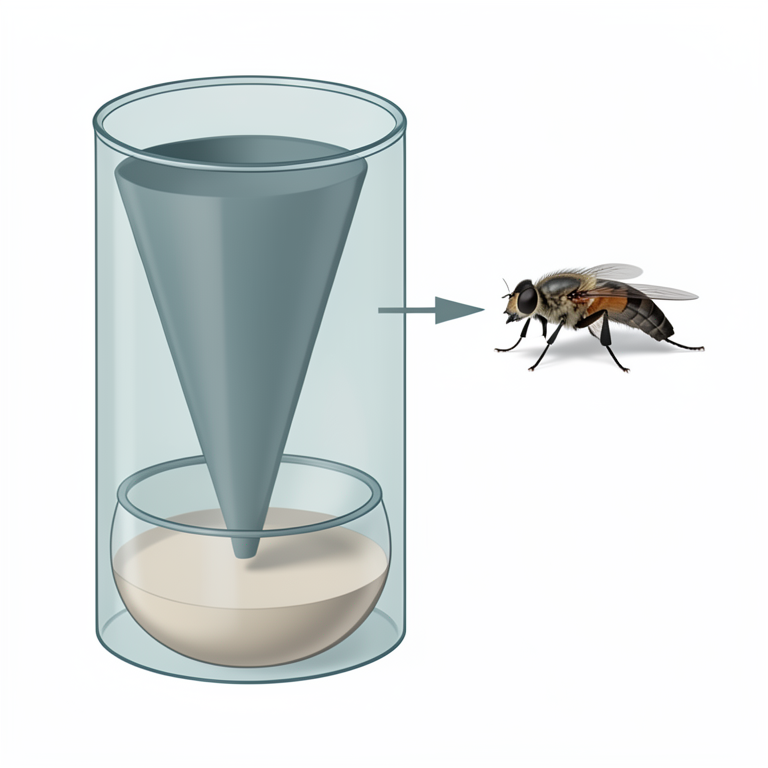
- Traps consisted of a 200 ml base bowl containing 30 g of food bait and 150 ml of water, an inverted cone with (Z)-9-Tricosene pheromone gel on the rim, and a transparent cylindrical enclosure. View evidence ↗
- The number of flies captured in five different colored traps (Blue, Red, Yellow, Green, and White) was recorded daily over a one-week period. View evidence ↗
What they found
- In the wind tunnel assay, blue was the most preferred color (24 flies, max at Pantone 2935C), followed by yellow (18 flies, max at 102C), red (10), green (5), and gray/white (4 each). View evidence ↗
- In field tests, blue traps captured the highest total number of flies (23,653), a result significantly different from all other colors tested. View evidence ↗
- Field observations indicated that while white traps attracted flies to their exterior surface, the flies did not enter the trap. View evidence ↗
What it means
- The authors conclude that mass trapping using a combination of synthetic pheromones, kairomones, and specific trap colors is a potential tool for managing fly populations and reducing disease spread in livestock. View evidence ↗
Visual summary
3 visualsIllustrations explain the paper; charts are replotted from the paper's own table values.
Trap Components Concept
AI-generated conceptual illustration (house fly (Musca domestica) and a mechanical trap). It explains the idea and does not show study data.
View source evidence ↗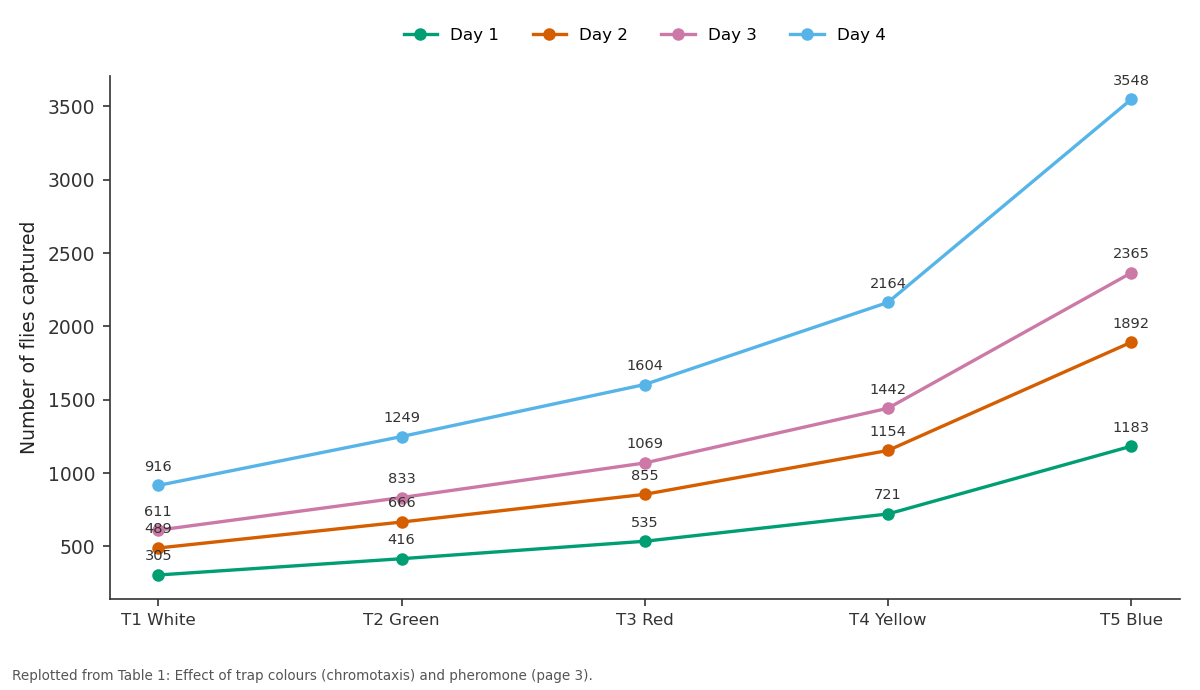
Day 1 and Day 2 and more: T1 White vs T2 Green vs T3 Red vs T4 Yellow vs T5 Blue
Replotted from Table 1 (page 3) of the original paper. Every bar is the paper's own table value.
View source evidence ↗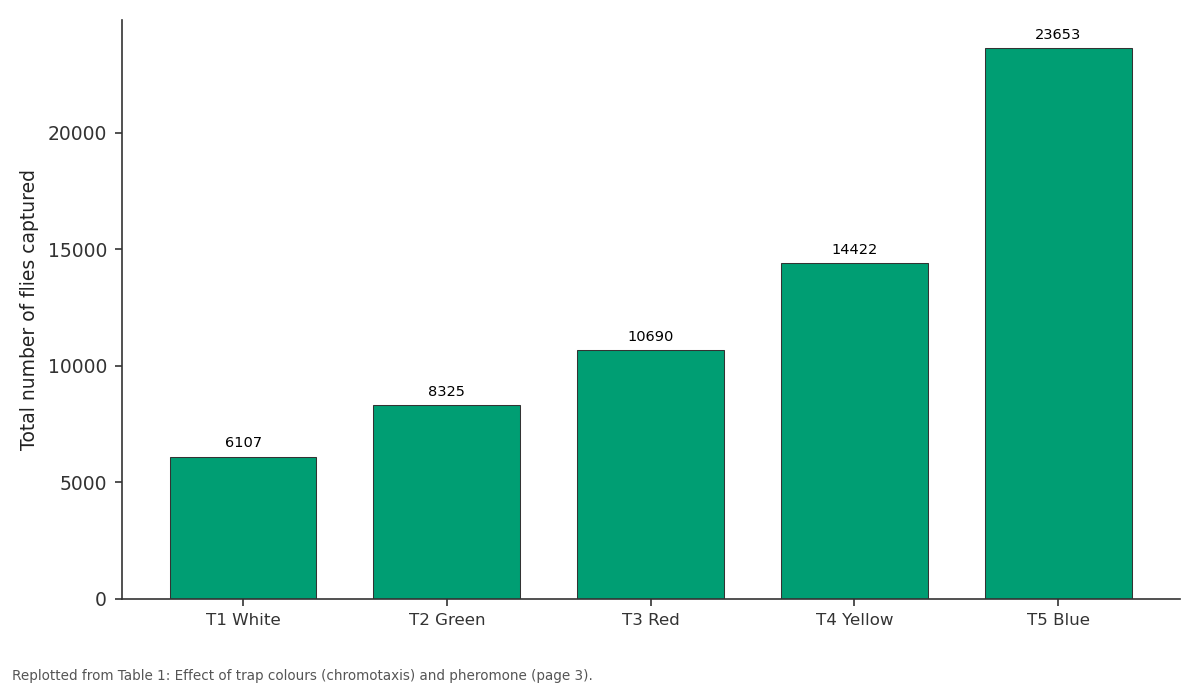
Total: T1 White vs T2 Green vs T3 Red vs T4 Yellow vs T5 Blue
Replotted from Table 1 (page 3) of the original paper. Every bar is the paper's own table value.
View source evidence ↗Figures & tables
From the original paper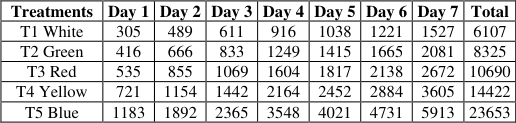 Table 1
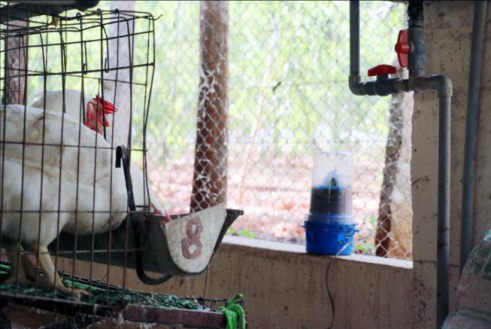 Figure 2
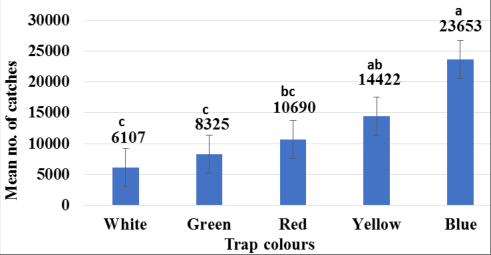 Figure 1
Text
1. Introduction M. domestica are mechanical vector carriers of more than 100 human and animal intestinal diseases [1,3] . Some bacteria can proliferate in the mouth parts of the house fly [4] . Adults feed on faeces, manure and foul their environment with fly specs. These habits degrade the appearance of facilities and contribute to microbial contamination of eggs and milk at points of production. Household waste is favorable for larval development for about one month after disposal [5] . Delay in processing facilitates decomposition and provides ample opportunity for adult flies to locate the waste and lay eggs on it [6] 1500 flies emerged from 1 m² of landfill waste at domestic waste dump yards within one month of its deposition. The abundance supply of food with ambient temperature promotes the rapid proliferation of many fly species. Traditionally, unconventional and unscientific pesticide sprays have been a very popular fly control strategy over the years. This provides rapid but short-term suppression of fly population but fails to effectively control the breed and multiplication of house flies. These methods are not effective as it poses a health risk to human and leads to multiple insecticide resistance in house fly [7] . Pheromone traps are the most popular and widely used tools for pest control and population monitoring. The most important and widespread practical applications of sex pheromones in pest management have been reviewed recently [8] . To understand and ascertain the oculus attraction of house flies to colours (chemotaxis), also to improve the trapping efficiency of the trap by using a pheromone (Z)-9-tricosene (chemosignal) and food bait to attract and kill M. domestica, an experimental study was conducted in deep pit caged layer poultry units.
Materials and Methods
Materials and Methods
Primary investigation to study colour preference and chromotaxis in house flies
In continuation to our research observations, the following experiments were designed and conducted in replicates: Following colours were chosen based on Pantone colour codes for the preparation of specially coloured cellulose paper with a rough surface (ensures and facilitates house flies to cling). 2. Pure white colour (polypropylene without any masterbatch colour) no pantone code Wind tunnel assay was performed using an indigenously built wind tunnel having an area of 9373.8 cm 2 operating temperature 26.32 °C, relative humidity 54.41%, illumination light power 193.41 Lux and air velocity maintained at 0.07 m/s. Preparation of colour wheel (TRIADIC arrangement of colours), specifically coloured) colours as selected as mentioned earlier and coded as per pantone colour code for all the selected colours) cellulose papers are made and are arranged in TRIADIC mode to form a colour wheel. Colours were randomly selected; 10 different colour wheels were designed using analogous colours selected from the list of pantone colour codes as mentioned earlier. Each colour wheel is separately evaluated for the chromotaxis behaviour of the houseflies in the presence of food bait, 30 g [9] , which was placed at midway between the entry of the houseflies and colour wheel in the wind tunnel. Colour wheel is placed at one end of the wind tunnel and 25 adult house flies were introduced at the entrance point of the wind tunnel, maintaining the STP within the wind tunnel. The movement of the houseflies was recorded, at the end of the experiment number of flies clinging to the different colours on the colour, the wheel is counted and averaged. 24 houseflies were found clinging on to the specific blue colour series with a maximum on to the 2935C of pantone colour coded colour in the colour wheel, 18 flies were found in yellow colour series and maximum on to 102C, 10 in red colour series, 5 in green colour series and 4 each in gray series and white colour series of the colour wheel respectively. The results so obtained were outstanding and influenced us to design the trap with specific colours as selected from the pantone colour codes and to identify the specific blend ratios of colour masterbatch and polypropylene to get the desired colour of the Barrix Domo trap and to test the same in outdoor conditions. These experimental observations led to the incorporation of specific blend ratio of blue colour masterbatch, yellow colour masterbatch, red colour masterbatch, green colour masterbatch with polypropylene respectively and white (polypropylene without any masterbatch colour) to get the desired pantone colour code match 3935C blue colour, 102C yellow colour, 1655C red colour, 375C green (established and fixed as per pantone colour code) to develop the blue, yellow, red, green and white (no colour masterbatch added) coloured Barrix Domo traps. 2.7. Study sites Barrix Domo trap (Design no. 293508, Indian Patent) developed with specific blend ratio of colour masterbatch and polypropylene having five different trap colours (Blue, Red, Yellow, Green, and White) were compared to evaluate and ascertain for their chromotaxis effect on the chemosignal attraction ability of the trap to trap house flies. The experiment was conducted in deep pit caged layer poultry unit located in Bangalore (13°11'19.1724"N, 77°47'17.2176"E) with randomized completely block design including six replications.
Trap design and installation
Each fly trap consisted of 1) base bowl, 200 ml capacity with four holes (17*30 mm) for insect entry and pheromone dispersion. 2) collar, flat plate having projections at both sides and a circular hole at the center.3) inverted cone with a height of 120 mm having two outer rims for gel application and 4) an outer transparent cylindrical enclosure with a height of 190 mm. Food bait, 30 g [9] was added to the base bowl along with 150 ml of water and stirred well for 2-3 minutes. (Z)-9-Tricosene, aggregation pheromone in the gel formulation [9] was applied to outer rim of the inverted cone (12 cm) of the blue, red, green, yellow, and white coloured Barrix domo traps in a circular manner. The inverted cone was fixed to the base bowl without spilling the contents. The trap structure completed by closing the base bowl with the outer transparent cylindrical enclosure with a gentle press. Traps were placed on the ground of the poultry shed with 30-40 feet between the traps. Location of the traps was randomized to minimize errors. The number of house flies captured in five different coloured traps was recorded daily for a week. The trapped flies were collected and counted.
Trap colour experiment
A total of 30 traps are used in the studies at two poultry layer farms. Five trap sets (one trap of each colour blue, yellow, red, green, and white respectively) were installed in each poultry (an average area of 3000 Sq.m). The studies were repeated thrice (3 replications) per poultry farm. Each trap contained 30 g of food bait, (Z)-9-Tricosene, aggregation pheromone in the gel formulation [9] as a chemosignal, and 150 ml of water.
Statistical Analysis
The data obtained were subjected to square root transformation, two-way analysis of variance (ANOVA), and the means compared using DMRT (WASP-Web Agri Stat Package, P=0.01).
Results
Significant differences in the daily catch of adult M. domestica occurred among the five trap colours tested (Table 1). Blue coloured traps (Figure 1 & 2), (established and fixed as per pantone colour code) captured maximum number (23653) of M. domestica, and the catch in Blue coloured traps was significantly different from the catch in yellow, red, green, and white traps. The yellow traps captured fewer M. domestica (14422) than blue traps, but significantly more than the red (10690), green (8325) and white (6107) traps respectively. The white traps trapped the least number of M. domestica, but the number was not significantly different from the catch in green traps. One of the interesting observations during the field studies was that the white traps has attracted flies on the exterior surface of the trap, but the flies were not entering the trap.
| Treatments | Day 1 | Day 2 | Day 3 | Day 4 | Day 5 | Day 6 | Day 7 | Total |
|---|---|---|---|---|---|---|---|---|
| T1 White | 305 | 489 | 611 | 916 | 1038 | 1221 | 1527 | 6107 |
| T2 Green | 416 | 666 | 833 | 1249 | 1415 | 1665 | 2081 | 8325 |
| T3 Red | 535 | 855 | 1069 | 1604 | 1817 | 2138 | 2672 | 10690 |
| T4 Yellow | 721 | 1154 | 1442 | 2164 | 2452 | 2884 | 3605 | 14422 |
| T5 Blue | 1183 | 1892 | 2365 | 3548 | 4021 | 4731 | 5913 | 23653 |
Table text extracted from the original PDF; superscript letters are shown inline. The original table image is below.
View original table image
Discussion
Trap colour influences the effective attraction (chromotaxis) of M. domestica pheromone in traps. The results of this study revealed that specific blue (established as per pantone colour code) was the most attractive colour for trapping M. domestica adults. These findings are in accordance with [10] who reported that photo receptors in house fly's compound eye have three absorbance peaks one at 490 nm (blue/green) and the second at 570 nm (yellow). The third (double peak) lies within UV band. Compound eyes of Musca contain visual pigments that maximally respond to blue-green light with sensitivity from 440-540 nm [11] . Blue fabric targets with a maximum reflectance of 466 nm have been shown to be more visually attractive to houseflies than white and black fabric targets [12] . Compound eye and ocellar electroretinogram responses to reflected light were similar, with the largest responses to white and blue followed by yellow, red, green, and black [13] . Visual pigments in fly ocelli have been shown to have maximum absorption of blue light at 425 nm [14] which was reflected by white and visual targets.
Conclusion
This study supports the application of mass trapping with synthetic para pheromone, kairomone, and colour of the trap as a potential tool for the effective management of fly population to livestock and the spreading of diseases.
Acknowledgement
AcknowledgementsThis research was supported by Lokesh Makam, CEO, Barrix Agro Sciences PVT Ltd. Bangalore.
Figures and tables from the paper
References
13 in the original paper- Forster M, Kimpel S, Mehlhorn H, Sievert K, Messler S, Pfeffer K, et al. Pilot studies on synantropic flies (e.g., Musca, Sarcophagi, Calliphora, Fania, Lucilia, Stomoxys) as vectors of pathogenic microorganisms. Parasitol Res. 2007;101(1):243-246.
- Malik A, Singh N, Satya S. House fly (Musca domestica): a review of control strategies for a challenging pest. J Environ Sci Health Part B. 2007;42(4):453-469.
- Kobayashi M, Sasaki T, Saito N, Tamura K, Suzuki H, Watanable H, et al. Houseflies are not simple mechanical vectors of enterohemorrhagic Escherichia coli O157:H7. Am J Trop Med Hyg. J trop Med Hyg. 1999:61(4):625-629.
- Ikeda JK, Watanabe WH, Totama G, Shimoda L. Effects of plastic bags as refuge containers on fly populations. Proc. Hawaiian. Entomol. Soc. 1972;21(2):225-234.
- Goulson D, Hughes WHO, Chapman JW. Fly population associated with landfill and composting sites used for household refuse disposal. Bull. Entomol. Res. 1999;89(6):493-498.
- Champ PA, Morgan CP. Insecticide resistance in Musca domestica L. From eastern England. Pesticide Science. 1992;36(1):35-45.
- Witzgall P, Kirsch P, Cork A. Sex pheromones and their impact on pest management. Journal of Chemical Ecology. 2010;36(1):80-100.
- Kannan S, Lokesh Makam, Remya Kolarath. Evaluation of (Z)-9-tricosene pheromone and food bait for house flies, Musca domestica L. (Diptera: Muscidae) attraction using Domo trap. J. Entomology and Zoology Studies.2020;8(5):1071-1074.
- Hardie RC. The photoreceptor array of the dipteran retina trends Neurosci 1986;9:419-423.
- Salcedo EA, Huber S, Henrich LV, Chadwell W, Chou R, Paulsen SG, Britt. Blue and green absorbing visual pigments of Drosophila: ectopic expression and physiological characterization of the R8 photoreceptor cell-specific Rh5 and Rh6 rhodopsin. J. Neurosci. 1999;19(24):10716-10726.
- Geden CJ. Visual targets for capture and management of houseflies, Musca domestica L. J. Vector Eco. 2006;31(1):152-157.
- Diclaro JW, Cohnstaedt LW, Pereira RM, Allan SA, Koehler PG. Behavioural and physiological response of Musca domestica to coloured visual targets. J Med Entomol. 2012;49(1):94-100.
- Kirschfeld KR, Feiter K. Vogt. Evidence for a sensitizing pigment in the ocellar photoreceptors of the fly (Musca, Calliphora). J. Comp. Physiol. 1988;163(4):421-423.