
Research article · 2022 · Full text
International Journal of Veterinary Sciences and Animal HusbandryEndemicity of urinary schistosomiasis in Ihube Okigwe Imo state
Volume 7(1) · Pages 23–25 · DOI: 10.22271/veterinary.2022.v7.i1a.400 ↗
Research areasParasites and Host InteractionsParasite Biology and Host Interactions
Abstract
Author-writtenStudies on urinary scistosomiasis and its snail vector was undertaken. Of the 1,564 urine specimens examined, 472 (30.2%) comprising 312 (66.1%) males and 160 (34.0%) females were infected, with visible haematuria as their predominant presenting symptoms. Among the infected, 331 (70.1%) were excreting under 100 eggs per 10ml urine while 132 (28.0%) and 9 (1.9%) were excreting 10,500 and above respectively. Statistical analysis revealed the intensity of the infection to be significantly higher (p
Summary
Source-checkedPlain-language reading of the full paper, prepared with AI and checked against the text. Each point links to the authors' own words.
Why it matters
- Urinary schistosomiasis is a significant health issue in Africa and is endemic within Nigeria. View evidence ↗
- The disease is caused by the liver fluke Schistosoma haematobium, which affects the gastro-urinary tract and lower abdomen, often resulting in visible blood in the urine (haematuria). View evidence ↗
The question
- The study aimed to investigate the endemicity of urinary schistosomiasis and identify its snail vectors in the study area. View evidence ↗
What they did
- A descriptive cross-sectional study was conducted from February to April 2021 in Ihube, Okigwe LGA, Imo State, Nigeria, involving a population of 1,564 persons. View evidence ↗
- Researchers used direct parasitological methods, including the examination of urine sediment and wet mounts, to analyze urine and stool specimens for S. haematobium and S. mansoni. View evidence ↗
- Statistical analysis of the collected data was performed using SPSS version 16. View evidence ↗
What they found
- Out of 1,564 specimens examined, 472 (30.2%) were infected, consisting of 312 males (66.1% of the infected) and 160 females (34.0% of the infected). View evidence ↗
- The majority of infected individuals (70.1%, n=331) had light infections (under 100 eggs per 10 ml urine), while 28.0% (n=132) and 1.9% (n=9) excreted 10,500 and above eggs respectively. View evidence ↗
- Infection prevalence was highest in the 11-20 age group (50.0%), followed by the 1-10 age group (39.4%). View evidence ↗
- Occupational groups showed varying rates, with students/apprentices having the highest infection rate (45.0%) and civil servants the lowest (8.0%). View evidence ↗
- Among the snail species collected (Bulinus globosus, B. truncatus, Lymnaea natalensis, and Melanoides tuberculata), only B. globosus was found to be infected with human schistosome cercariae. View evidence ↗
- Visible haematuria was the most common symptom, occurring in 36.8% of the 472 infected individuals. View evidence ↗
What it means
- The authors conclude that urinary schistosomiasis is endemic across eight villages in Ihube, Okigwe LGA, Imo State. View evidence ↗
- The authors recommend administering anti-schistosomal drugs specifically to persons in the first two decades of life to reduce infection rates. View evidence ↗
- The authors state that future vectorial studies should cover two seasons and additional streams to better understand seasonal variations in snail abundance and infectivity. View evidence ↗
Visual summary
1 visualsIllustrations explain the paper; they do not show study data.
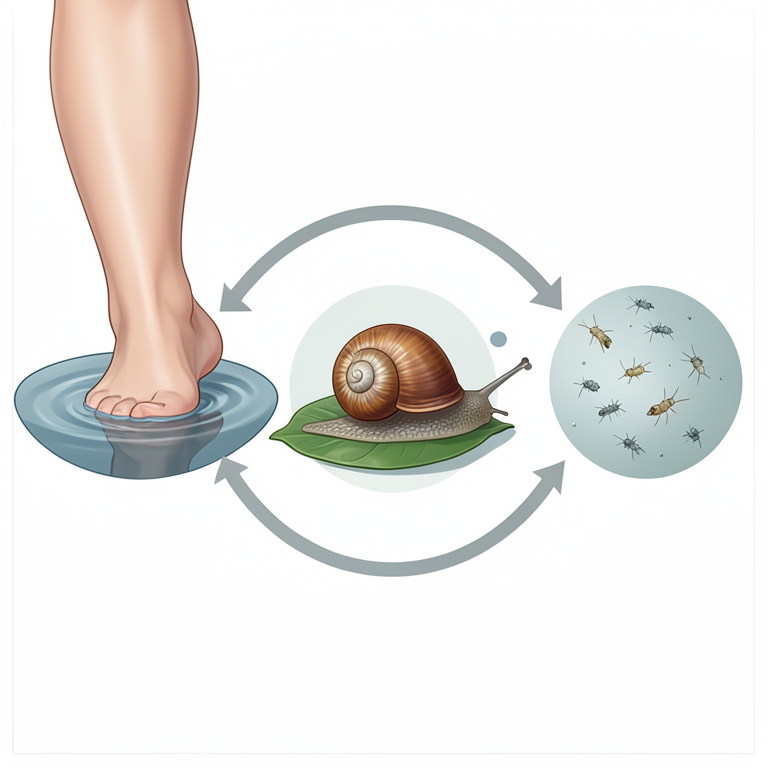
Transmission Cycle
AI-generated conceptual illustration (Bulinus globosus snails and human skin). It explains the idea and does not show study data.
View source evidence ↗Figures & tables
From the original paper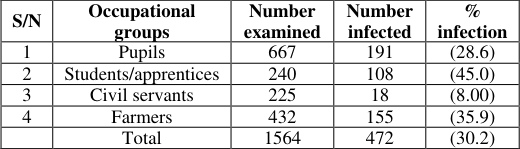 Table 4
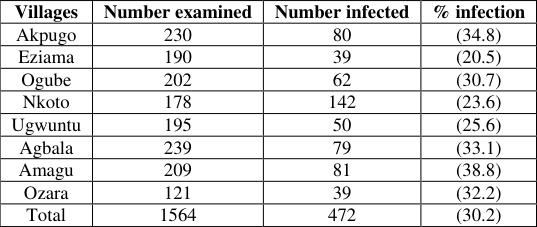 Table 1
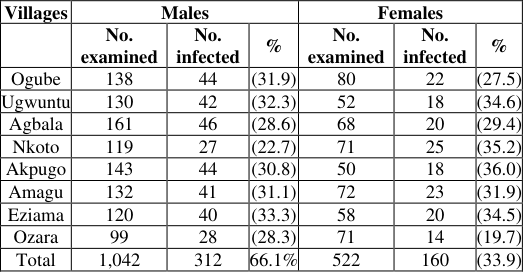 Table 2
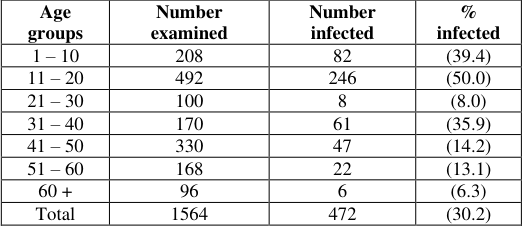 Table 3
Introduction
Urinary schistosomiasis is a major health problem in African countries [1] and it's endemic in Nigeria. It is a chronic and debilitating disease caused by the liver fluke (trematode) Schistosoma haematobium. It affects the lower abdomen and the gastro-urinary track and visible haematuria has been associated with the disease amongst affected persons [2] . Also, the disease has been associated with anatomic infertility [3] as well as subjective changes in ejaculation among male travelers [3] . Inflammation is characterized by frequent urination and haematuria. Accumulation of eggs and resultant histological reaction in the bladder and uterus leads to the formation of granuloma and fibrosis. The bladder may show bilharzial tubercles, which may ulcerate and cause papilloma formation and chronic fibrosis. Calcification of the bladder wall may occur, making the bladder wall rigid and increasing pressure on the uterus and kidneyscausing dilation of the uterus. The ureters, uretha, prostate and seminal vesicles may become involved, and secondary bacterial infection may lead to abscess formation. In women, the vagina, cervix, and uterus may be involved [4] . Schistosomiasis is an acute and chronic disease caused by parasitic worms. People are infected during routine agricultural, domestic, occupational, and recreational activities, which expose them to infested water. Lack of hygiene and certain play habits of school-aged children, such as swimming or fishing in infested water, make them especially vulnerable to infection. Schistosomiasis control focuses on reducing disease through periodic, large-scale population treatment with praziquantel; a more comprehensive approach including potable water, adequate sanitation and snail control would also reduce transmission. Estimates show that at least 236.6 million people required preventive treatment for schistosomiasis in 2019, out of which more than 105.4 million people were reported to have been treated [5] . People become infected when larval forms of the parasite-released by freshwater snailspenetrate the skin during contact with infested water. Transmission occurs when people suffering from schistosomiasis contaminate freshwater sources with their excreta-containing parasite eggs, which hatch in water [5] .
Schistosomiasis is a neglected tropical disease that continues to cause morbidity and mortality in Sub-Saharan Africa. Due to its endemicity, co-infection with malaria is common. The disorders cause anaemia and impaired nutritional status among children [6] .
Materials and Methods
Materials and Methods
Methods
Urine and stool specimens collected from each person were examined for S. haematobium and S. mansoni by direct parasitological methods [7] (examination of urine sediment and wet mount).
Data collection
Data was collected through well-designed results from specimen analysis from the laboratory examinations done.
Data analysis
Data were analyzed using the package for social science (SPSS) version 16.
Results
Out of the 1,564 persons examined, 472 (30.2%) had S haematobium infection (Table 1). Although the infection rate differed from one village to another, statistical analysis revealed no significant difference (p>0.05). Amagu recorded the highest rate of infection (38.8%), followed by Akpugo and Agbala with (34.8%) and (33.1%) respectively, while Nkoto recorded the least infection rate with (23.6%). There was no statistical significance difference (p>0.05).
| Villages | Number examined | Number infected | % infection |
|---|---|---|---|
| Akpugo | 230 | 80 | (34.8) |
| Eziama | 190 | 39 | (20.5) |
| Ogube | 202 | 62 | (30.7) |
| Nkoto | 178 | 142 | (23.6) |
| Ugwuntu | 195 | 50 | (25.6) |
| Agbala | 239 | 79 | (33.1) |
| Amagu | 209 | 81 | (38.8) |
| Ozara | 121 | 39 | (32.2) |
| Total | 1564 | 472 | (30.2) |
Table text extracted from the original PDF; superscript letters are shown inline. The original table image is below.
View original table image
Tables 2 revealed a sex-related prevalence of S. haematobium in the area. Evaluation of the relationship between sex and the prevalence of urinary schistosomiasis (Table 2), revealed that of the 1,564 persons examined, (1,042 males and 522 females), only 312 (66.1%) males and 160 (33.9%) females were infected. However, statistical analysis using the chisquare test revealed that the higher infection rate observed in males was not a significant at the 95% probability level.
| Villages | Males | — | — | Females | — | — |
|---|---|---|---|---|---|---|
| No. examined | No. infected | % | No. examined | No. infected | % | |
| Ogube | 138 | 44 | (31.9) | 80 | 22 | (27.5) |
| Ugwuntu | 130 | 42 | (32.3) | 52 | 18 | (34.6) |
| Agbala | 161 | 46 | (28.6) | 68 | 20 | (29.4) |
| Nkoto | 119 | 27 | (22.7) | 71 | 25 | (35.2) |
| Akpugo | 143 | 44 | (30.8) | 50 | 18 | (36.0) |
| Amagu | 132 | 41 | (31.1) | 72 | 23 | (31.9) |
| Eziama | 120 | 40 | (33.3) | 58 | 20 | (34.5) |
| Ozara | 99 | 28 | (28.3) | 71 | 14 | (19.7) |
| Total | 1,042 | 312 | 66.1% | 522 | 160 | (33.9) |
Table text extracted from the original PDF; superscript letters are shown inline. The original table image is below.
View original table image
An evaluation of the prevalence in age (Table 3) revealed a gradual increase in the number of persons with a decrease in age. More than forty-six percent (46.9%) of infection was recorded in persons within 0-20 years of age. This indicates that the infection was higher in persons within the first two decades of life (p>0.05), ages 21-30 and 60 and above recorded 8% and 6.3%, respectively. This may be a result of low exposure to the infested stream. Table 4: Occupational-related prevalence of human schistosomiasis: The prevalence of human schistosomiasis was not uniform among the various occupational categories. All the occupational categories were infected with S haematobium with the highest rate in students (45.0%), followed by farmers (35.9%), while civil servants had the least infection rate (8.0%). p<0.001)
| Age groups | Number examined | Number infected | % infected |
|---|---|---|---|
| 1 – 10 | 208 | 82 | (39.4) |
| 11 – 20 | 492 | 246 | (50.0) |
| 21 – 30 | 100 | 8 | (8.0) |
| 31 – 40 | 170 | 61 | (35.9) |
| 41 – 50 | 330 | 47 | (14.2) |
| 51 – 60 | 168 | 22 | (13.1) |
| 60 + | 96 | 6 | (6.3) |
| Total | 1564 | 472 | (30.2) |
Table text extracted from the original PDF; superscript letters are shown inline. The original table image is below.
View original table image
| S/N | Occupational groups | Number examined | Number infected | % infection |
|---|---|---|---|---|
| 1 | Pupils | 667 | 191 | (28.6) |
| 2 | Students/apprentices | 240 | 108 | (45.0) |
| 3 | Civil servants | 225 | 18 | (8.00) |
| 4 | Farmers | 432 | 155 | (35.9) |
| Total | 1564 | 472 | (30.2) |
Table text extracted from the original PDF; superscript letters are shown inline. The original table image is below.
View original table image
Discussion of finding
The study has revealed that urinary schistosomiasis is endemic in eight villages in Ihube in Okigwe L.G.A of Imo state, Nigeria. Indeed, the occurrence of urinary schistosomiasis in these villages, and the findings of the snail intermediate host and the transmission site show that this part of Imo state is an established endemic area and a major health problem that calls for necessary attention in the health Programme of Imo state. A close look at the prevalence rate for these villages shows variation which can be interpreted to mean that transmission is higher at Amagu (38.8%) followed by Akpugo (34.8%) and that infection is probably new at Nkoto (23.6%). However, the overall prevalence of 30.2% observed in this study is lower than the figures reported by [8] in the north-central zone of Abia state (42.3%). Udonsi [9] in Igwun river basin north Bende (37.0%), schistosomiasis is the second leading cause of infectious diseases next to malaria in Africa [10] . According to [11] the pooled prevalence of schistosomiasis during pregnancy was 13.2%. Observations of [12] showed that odds of schistosome infections were lowest among people between (15-24 years of age), caregivers (0.1, 95%), and those who used tap water (0.3, 95%) for domestic purposes. Schistosome infections were however higher among those who bathed in river water (17.4, 95% cl). On the other hand, infection was lowest among those who did not play in soil (0.1, 95% cl: 0.51-0.28), which were from households that used tap water for domestic purposes.
Considering the intensity of the infection, it was observed that the majority of persons examined in the study have light to moderate infections. This relationship between prevalence, intensity as well as age gave the same characteristic pattern of S. haematobium as had been previously in some other parts of Africa 13 observed that a total of 339 (84.8%) of children were found to be infected with at least one parasite species. The researchers also observed that out of the 400 persons that were examined, 127 (31.8%) were found to be infected by either S. manson or S. haematobium.
In their research [14] , a hundred and fifty-one individuals (61.7% males and 38.3% females) aged between one and ninety years of age with a median age of 25 years were enrolled in a study. About 38.8% of the participants claimed that they had a past history of schistosomiasis.
According to the WHO, [15] schistosomiasis is prevalent in tropical and subtropical areas especially in poor communities, without access to safe drinking water and adequate sanitation.
It is estimated that at least 90% of those requiring treatment for schistosomiasis live in Africa.
Considering the intensity of infection it was observed that the majority of persons examined in the study have light to moderate infections. This relationship between prevalence intensity as well as age gave the domestic characteristics pattern of S. haematobium infection had been reported in other parts of Nigeria [15][16][17] .
The highest prevalence rate of 50.0% observed in ages 11-20 is seconded by 39.4% observed in age 1-10 years. This being so, for any meaningful control and treatment of urinary schistosomiasis in this part of the Imo state, attention should therefore be paid to persons between the first two decades of life. The picture shows that they are the most infected group of persons.
Visible haematuria was the predominant presenting symptom observed among infected persons. This represents 36.8% of the total infected population of 472 persons. The presence of visible haematuria varied significantly with age as a greater number of persons within the first two decades of life had visible haematuria. The observations conform to the reports of [19, 20] WHO observed a close association between haematuria in the urine and the presence of S. haematobium ova.
The observations conform to the reports of [19,20] who observed a close association between haematuria in the urine and the presence of S. haematobium ova.
A comparative analysis of occupation-related prevalence of urinary schistosomiasis in the study area showed a significant variation (x 2 = 19.09, df = 3). The researchers observed that the high incident rate of infection was a result of the unawareness of the participants. The sources of drinking waters are infested by schistosomiasis infection carried by the snail hosts. As they go on their daily activities in the infested water they keep on being infected.
The study revealed that persons between the first two decades of life mostly the pupils are important in the spread of this disease since they pass the greatest number of eggs, coupled with their low sanitary habit habits. Administration of anti-Schistosomal drugs to this age group could play a great role in the reduction of infection in the study area. The flowing water bodies should be used by the populace more to reduce contact with the vector which transmits the infection. The vectorial studies should be extended to cover two seasons and all the other streams of the area to give a better picture of the seasonal variation in their abundance and the infectivity of the snails.
References
17 in the original paper- Agi PL. Vescical Schistosomiasis at Ochu village in Ahoada Local Government Area, Rivers Nigeria. West Afr. J. Med. 1995;14(1):6-10.
- Ahmed ES, Daffalla A, Christian NO, Madson H. Pattern of Infection and Transmission of Human Schistosoma mansoni and Schistosoma haematobium in white Nile Province, Sudan, Ann. Trop. Med. Parasitology. 1996;90(2):173-180.
- Akinkugbe OO. Urinary Schistosomiasis in Ibadan school children, West Afr. Med. J. 1962;11(3):124-127.
- Rajabu Hussein Mikugwe, Omary Minzi S, Safari Kinunghi M, Appolinary Kamuhabwa A, Eleni Aklillu. Prevalence and correlates of intestinal schistosomiasis infection among school aged children in North Western Tanzania. Journals.plos.org. 2020;15(2):01-17.
- Trig Mohamed Elfaki, Mosab Nouraldein, Mohammed Hamad, Essam Zarrug, Hussein Musa Omar Mohammed, Sally Hussein Mohammed, et al. Prevalence of schistosomiasis among school aged children in Altakamol area, Khartoum state, Sudan. Journal of Microbiology Experimentation. 2020;8(5):167-169.
- Anosike JC, Nwoke BEB, Okere AN, Alozie JI, Okoro UO, Nwosu DC, et al. Endemicity of urinary schistosomiasis in the north central zone of Abia State, Nigeria. International Journal of Environmental Health and α Human Development. 2001;2(2):5-12.
- UDONSI JK. Human Community Ecology of Urinary schistosomiasis in relation to snail vector bionomics In the Lugwun River Basin of Nigeria. Trop. Med. parasitol. Ann. 1990;41:131-135.
- Tamirat Hailegebriel, Endalkachew Nibret, Abaineh Munshea. Prevalence of schistosomiasis Mansoni and S. haematobium in snail hosts in Africa: A systematics Review and meta-analysis. A Journal of tropical medicine. 2020, 01-18.
- Ishag Adam, Nachiah A, Alhabardi, Ammar H, Khamis. Prevalence of schistosomiasis and its association with anaemia among pregnant women: A systematic review and meta-analysis. 2021;14(1):01-10.
- Henigwe Sacolo-Gwebu, Moses Chimbari. Α Chester Calinda. Prevalence and risk factors of schistosomiasis And soil transmitted helminthiasis among preschool aged children (1-5) years in rural KwaZulu-Natal, South Africa: a cross sectional study. Infectious diseases of poverty. 2019;8(1):1-12.
- Hamy Sandy, Hesham M, Al-Mekh Lafi, Mohammed Mahdy AK, Yvonne Lim AL, Rohela Mahmud, et al. Prevalence and associated factors of schistosomiasis among children in Yemen: Implications for an effective control Programme. Journals.plos.org. Neglected tropical diseases, 2013;7(8):01-10.
- Sal'wa Dawaki, Johari Surin. Prevalence and risk factors of schistosomiasis among Hausa Communities in Kano state, Nigeria. Rev Inst Med Trop Sao Paulo. 2016;58(54):01-09.
- Anigbo EV, Nwaorgu OC. Urinary schistosomiasis among school children in Ile -Ife, Nigeria. Afi. J Med. sci. 1990;23(3):249-251.
- Amali O. Estimation of prevalence of urinary schistosomiasis using haematuria centr. Afi. J Med. 1994;40(6):152-154.
- Awogun IA. Comparison of the prevalence of the intensity of Schistosoma haematobium among Secondary school children in Ilorin, Kwara State, Nigeria J Parasitol. 1990;9(11):51-54.
- Paul JF, Verma S, Berry K. Urinary schistosomiasis. Emergency Medicine Journal. 2002;19(5):483-484.
- Konstantina Tzanetou, George Adamis, Eleni Andipa, Charalambos Zorzos, Konstantinos Ntoumas, Konstantinos Armenis, et al. Panagiotis gargalinos Journal of Travel medicines. 2007;14(5):334-337.
Cited by 1
From OpenAlex, OpenCitations and reference lists read by Scinovex
- Assessing urogenital schistosomiasis and female genital schistosomiasis (FGS) among adolescents in Anaocha, Anambra State, Nigeria: implications for ongoing control efforts ↗
Ogechukwu Benedicta Aribodor, Nwadiuto Okwuniru Azugo, Eunice C. Jacob, Uche C. Ngenegbo, Daniel Nnaemeka Onwusulu, Obika Ifeanyi et al. · BMC Public Health · 2024
BACKGROUND: Urogenital schistosomiasis (UgS) remains a persistent health challenge among adolescents in Anambra State, Nigeria, despite ongoing control efforts. Mass praziquantel treatment programs, initiated in 2013, primarily target primary school-aged children (5-14 years old), leaving adolescents (10-19 years old) enrolled in secondary schools vulnerable to urogenital schistosomiaisis. Additionally, the extent of female genital schistosomiasis (FGS), a neglected gynaecological manifestation of…
❝ 15PDF