
Research article · 2022 · Full text
International Journal of Veterinary Sciences and Animal HusbandryEffect of feeding a rumen modifier on cost structure of crossbred heifers
Volume 7(3) · Pages 16–18 · DOI: 10.22271/veterinary.2022.v7.i3a.417 ↗
Research areasRuminant Nutrition and Digestive PhysiologyAgricultural Productivity and Crop Improvement
Abstract
Author-writtenThe goal of this study was to find a cost that will decrease input while also improving animal performance. The project was split into two halves. Phase I included a twenty-one-day pre-experimental trial to prepare the animals for the trial without a rumen modulator. Using an in vitro gas production test, phase II was conducted for 120 days with a mixture of rumen modifiers that included neem seed powder (Azadirachta indica), fennel seed (Foeniculum vulgare), and harad (Terminalia chebula) mixed in a concentrate mixture. The amount of Rumen modifier needed was determined based on the dry matter intake of heifers. There were 21 animals in all in the trial, which was divided into three treatments. The first treatment was a control therapy without the use of a rumen modification. The second treatment used a rumen modification to increase the dry matter intake of the animals by 2%, while the third treatment used a rumen modifier to increase the dry matter intake of the animals by 4%. The treatment that included soybean straw as dry fodder, Lucerne as a green fodder, and a concentrate mixture had no significant (P>0.05) influence on the animals' body weight gain, digestibility coefficient, or dry matter intake. Treatment two, in which seven animals were fed dry soybean straw, green lucerne, and a concentrate mixture with a herbal feed additive, rumen modifier powder, at a rate of 2% of dry matter intake, produced the greatest outcomes of all the treatments. The weight of the animals grew significantly (P0.01) by 63.45 kg, whereas the dry matter intake increased significantly (P0.01) from 6.55 to 7.15 kg. In treatment two, the digestibility coefficient shows excellent results. When compared to the control group, it increases considerably (P>0.01) by 63.45% in treatment two. Feed cost per kg body weight gain in T1, T2 and T3 were Rs. 32.96, 27.92, 37.90, respectively which indicates the cost per kg gain of weight can be reduced by feeding rumen modifier. The cost/kg body weight gain was lowest in rumen modifier @ 2% over another concentrate feeding. However, based on the gain in body weight it can be said that there was the effect of incorporation of rumen modifier with concentrate mixture in the ration of heifer because, the total cost/kg body weight gain (Rs.) is less in T2 followed by T1 and T3 group of treatments, 195.49, 230.76 and 265.32 respectively.
Summary
Source-checkedPlain-language reading of the full paper, prepared with AI and checked against the text. Each point links to the authors' own words.
Why it matters
- Methane production in the rumen is wasteful, as it consumes 2-12% of dietary energy, which reduces the animal's overall feed utilization efficiency. View evidence ↗
- Reducing intestinal methane is important for the environment because methane has a global warming potential 23 times higher than carbon dioxide. View evidence ↗
- Plant secondary metabolites are being explored as natural alternatives to chemical feed additives to avoid issues like antibiotic resistance and residues in animal products. View evidence ↗
The question
- The study aimed to identify a feeding strategy that could reduce input costs while simultaneously improving the performance of the animals. View evidence ↗
What they did
- The rumen modifier used in the study was composed of neem seed powder, fennel seed powder, and harad seed powder. View evidence ↗
What they found
- The digestibility coefficient in treatment T2 increased by 63.45% compared to the control group. View evidence ↗
- The feed cost per kg of body weight gain was lowest in T2 (Rs. 27.92) compared to T1 (Rs. 32.96) and T3 (Rs. 37.90). View evidence ↗
- The total cost per kg of body weight gain was lowest for T2 (Rs. 195.49), followed by T1 (Rs. 230.76) and T3 (Rs. 265.32). View evidence ↗
- While T1 had the lowest absolute total feed cost (Rs. 14,439.04), T2 and T3 were more expensive at Rs. 21,309.4 and Rs. 26,949.04, respectively. View evidence ↗
What it means
- The authors state that a 4% modifier (T3) increases costs too much, while a concentrate-only diet (T1) fails to meet the nutrient and growth requirements of the heifers. View evidence ↗
Visual summary
1 visualsIllustrations explain the paper; they do not show study data.
Treatment Comparison Layout
AI-generated conceptual illustration (crossbred heifers). It explains the idea and does not show study data.
View source evidence ↗Figures & tables
From the original paper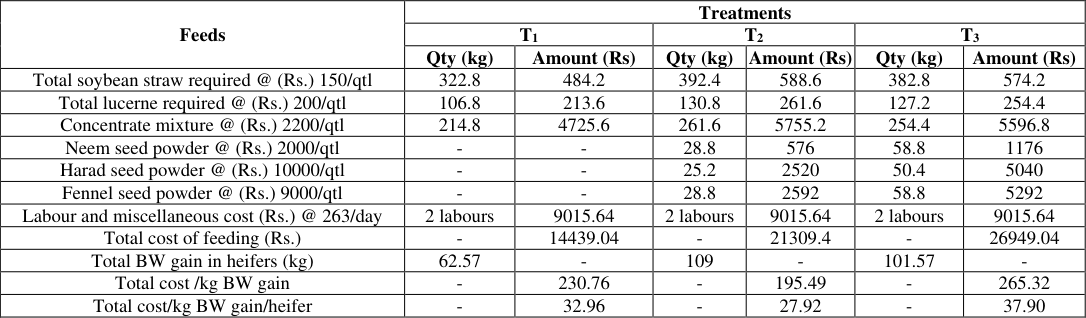 Table 1
Introduction
Ruminants' rumens have a complex microbial ecosystem that allows them to bio-convert lowquality lingo cellulosic diet into important animal products such as milk and meat [1] . The polysaccharides in the feed are transformed into volatile fatty acids and microbial protein, the two main sources of energy and protein for the host animals, in the rumen, thanks to the synergistic activity of bacteria, protozoa, fungus, archaea, and bacteriophages. However, CO 2 and H 2 gases are created as by-products of feed fermentation in the rumen, and rumen methanogenic archaea convert CO 2 to methane by utilizing H 2 that is eructated out through the mouth [2] . Every day, 500-600 liters of molecular hydrogen are created in an adult bovine or buffalo, but due to methanogenesis, it never accumulates in the gaseous phase of the rumen. Methanogenesis is a necessary metabolic process in the rumen to maintain a low H 2 pressure, but it is wasteful because 2-12% of dietary energy is wasted as methane, reducing the potential conversion of dietary energy into metabolizable energy and lowering the animal's feed utilization efficiency [3] . Furthermore, because methane is a powerful greenhouse gas with a global warming potential 23 times greater than CO 2 , intestinal methane production contributes significantly to global warming. As a result, dietitians have been concerned about the inhibition of methanogenesis for a long time, and it is still a problem today owing to global warming and the release of greenhouse gases [4] . The animal can be made more feed efficient and environmental pollution caused by rising levels of greenhouse gases can be decreased by reducing methane production [6] . Animal nutritionists are experimenting with newer nutritional interventions, such as chemical feed additives, to reach their goal. However, as people became more aware of the negative consequences of chemical feed additives, such as residues in animal products and bacterial resistance to antibiotics, researchers began looking for natural products to use as feed additives, and plant secondary metabolites (PSMs) emerged as a viable alternative [7] . Thus, some herbal powders which are having plant secondary metabolite contents are very expensive. Hence, it is important to calculate the cost structure of feeding crossbred heifers [8] .
Materials and Methods
The current study used a randomized block design with three different treatments. A total of twenty-one crossbred heifers were chosen. Three groups of heifers were formed. For the study, each group comprised seven heifers. Concentrate mixture, rumen modulator, green fodder, and dry roughages were employed to feed the experimental heifers. In treatment "T 1 " dry fodder (Soybean straw) was mixed with green fodder (berseem) and a ready-made concentrate combination according to the requirements. In treatment "T 2 ," dry fodder (Soybean straw) was combined with a green fodder (berseem) concentrate mixture and a rumen modifier at a rate of 2%. In treatment "T 3 ", dry fodder (Soybean straw) was combined with a green fodder (berseem) concentrate mixture and a rumen modifier at a rate of 4%. Maize grain seed, cottonseed cake, wheat bran, turchuni, mineral mixture, and common salt make up the concentrate mixture. Harad seed powder, commonly known as harad, fennel seed powder, and neem seed powder are the three constituents in the rumen modifier.
Results and Discussion
To be popular among cow owners, the feed plan must be costeffective. As a result, the feeding economics of the several groups were as specific observations on feeding economics are provided in Table 1. It was concluded that from above all discussion over experimental result the treatment T 2 feeding of rumen modifier @ 2%, shows the better and desirable result as compared to T 1 and T 3 treatments. In T 3 treatment feeding of rumen modifier @ 4% based on dry matter intake of heifers increases the cost of feeding and T 1 feeding of only concentrate mixture hence is not fulfilled to the nutrient requirement and growth of heifers but decreases the cost of feeding. Feeding cost on the daily basis was lowest observed in T 2 .
| Feeds | Treatments | — | — | — | — | — |
|---|---|---|---|---|---|---|
| T1 | T2 | T3 | ||||
| Qty (kg) | Amount (Rs) | Qty (kg) | Amount (Rs) | Qty (kg) | Amount (Rs) | |
| Total soybean straw required @ (Rs.) 150/qtl | 322.8 | 484.2 | 392.4 | 588.6 | 382.8 | 574.2 |
| Total lucerne required @ (Rs.) 200/qtl | 106.8 | 213.6 | 130.8 | 261.6 | 127.2 | 254.4 |
| Concentrate mixture @ (Rs.) 2200/qtl | 214.8 | 4725.6 | 261.6 | 5755.2 | 254.4 | 5596.8 |
| Neem seed powder @ (Rs.) 2000/qtl | - | - | 28.8 | 576 | 58.8 | 1176 |
| Harad seed powder @ (Rs.) 10000/qtl | - | - | 25.2 | 2520 | 50.4 | 5040 |
| Fennel seed powder @ (Rs.) 9000/qtl | - | - | 28.8 | 2592 | 58.8 | 5292 |
| Labour and miscellaneous cost (Rs.) @ 263/day | 2 labours | 9015.64 | 2 labours | 9015.64 | 2 labours | 9015.64 |
| Total cost of feeding (Rs.) | - | 14439.04 | - | 21309.4 | - | 26949.04 |
| Total BW gain in heifers (kg) | 62.57 | - | 109 | - | 101.57 | - |
| Total cost /kg BW gain | - | 230.76 | - | 195.49 | - | 265.32 |
| Total cost/kg BW gain/heifer | - | 32.96 | - | 27.92 | - | 37.90 |
Table text extracted from the original PDF; superscript letters are shown inline. The original table image is below.
View original table image
Conclusion
On average Rs. 14439.04, 21309.04 and 26949.04 were incurred on the total cost of the feeding of heifers under T 1 , T 2 and T 3 treatments respectively. This indicates that there was a decrease in the total feeding cost of the heifers under different concentrate-based diets.
The growth rate of heifers fed on rumen modifier @ 2% was higher than that of rumen modifier @ 4% and concentrate mixture feed. The performance in respect of weight, length, height, chest girth gain was higher in the T 2 feeding group over T 3 and T 1 treatments. It was concluded that from above all discussion over experimental results the treatment T 2 shows the better and more desirable result as compared to T 1 and T 3 treatments. Feeding cost on the daily basis was the highest observed in T 3 .
References
9 in the original paper- Duygu Budak, Aydan Yılmaz. Effects of Aromatic Plants on Rumen Fermentation Macedonian Journal of Animal Science. 2013;3(1):75-80.
- Elizabeth Wina. The use of plant bioactive compound to mitigate enteric methane in ruminants and its application in Indonesia. Wartazoa. 2012;22(1):972-99.
- Faizal Andri, Asri Nurul Huda, Marjuki Marjuki. The use of essential oils as a growth promoter for small ruminants: a systematic review and meta-analysis [version 2; peer review: 2 approved] F1000 Research. 2020;1(9):486.
- Fasae OA, Aganto TO, Jimoh HO. Nutritional potentialities of neem plant parts as supplementary feed in the ruminant production system. Nigerian Journal of Animal Production. 2018;45(3):301-308.
- Franz C, Baserb KHC, Windischc W. Essential oils and aromatic plants in animal feeding: A European perspective. A review. Flavour and fragrance. 2010;25(5):327-340. DOI 10.1002/fj. 1967.
- Gebrehiwot Tadesse. Rumen Manipulation for Enhanced Feed Utilization and Improved Productivity Performance of Ruminants: A review. Momona Ethiopian Journal of Science (MEJS). 2014;6(2):3-17.
- Gupta VP, Kamra DN, Agrawal N, Chaudhary LC. Effect of sulphate and blend of plant parts containing secondary metabolites on in vitro methanogenesis, digestibility and feed fermentation with buffalo rumen liquor. Indian Journal of Animal Sciences. 2017;87(2):199-202.
- Hajalizadeh Z, Dayani O, Khezri A, Tahmasbi R, Mohammadabadin MR. The effect of adding fennel (Foeniculum vulgare) seed powder to the diet of fattening lambs on performance, carcass characteristics and liver enzymes. Small Ruminant Research. 2019;175:72-77. https://doi.org/10.1016/j.smallrumres.2019.04.011
- Hammond KJ, Crompton LA, Bannink A, Dijkstra J, Yá˜nez-Ruiz DR, O'Kiely P, et al. Review of current in vivo measurement techniques for quantifying enteric methane emission from ruminants. Animal Feed Science and Technology. 2016;219:13-30. https://doi.org/10.1016/j.anifeedsci.2016.05.018