
Research article · 2022 · Full text
International Journal of Statistics and Applied MathematicsMixed convection heat transfer effects in a lid driven square cavity
Volume 7(3) · Pages 37–42 · DOI: 10.22271/maths.2022.v7.i3a.822 ↗
Research areasNanofluid Flow and Heat TransferFluid Dynamics and Turbulent FlowsHeat Transfer Mechanisms
Abstract
Author-writtenThis investigation numerically explored the parameters of mixed convection heat transfer in a square cavity with a bottom heated wall. The upper horizontal wall of the cavity is Tc, while the heated lower wall is Th, while the surfaces of the left and right walls are adiabatic. The main approach here is to solve numerically the mass, momentum, and energy flow equation using Galerkin weighted residual finite element method. Here, the Prandtl number (Pr), Richardson number (Ri), and Reynolds number (Re) effects have been investigated. The factors mentioned above have been found to have a significant impact on the temperature and flow fields.
Summary
Source-checkedPlain-language reading of the full paper, prepared with AI and checked against the text. Each point links to the authors' own words.
Why it matters
- Mixed convection flow in cavities is technologically important for industrial applications like oil reservoirs, geothermal reservoirs, and thermal insulation. View evidence ↗
- Lid-driven cavity heat transfer is relevant to various fields, including nuclear reactors, air conditioning, building thermal design, and solar energy collector design. View evidence ↗
- The authors note a lack of significant research regarding time-dependent mixed convection in lid-driven square cavities containing a heat-generating body. View evidence ↗
The question
- The study aims to numerically explore the parameters affecting mixed convection heat transfer within a square cavity that has a heated bottom wall. View evidence ↗
- The research specifically investigates the effects of the Reynolds (Re), Prandtl (Pr), and Richardson (Ri) numbers. View evidence ↗
What they did
- The model uses a 2-D square enclosure with a cold upper wall (Tc), a heated bottom wall (Th), adiabatic vertical walls, and a sliding right vertical wall. View evidence ↗
- The mass, momentum, and energy flow equations were solved numerically using the Galerkin weighted residual finite element method. View evidence ↗
- A grid sensitivity analysis was performed using five grid sizes (3776 to 8506 elements), resulting in the selection of a 5148-element grid for the simulations. View evidence ↗
- The numerical code was validated by comparing results with previous literature (Ching [16]), showing excellent agreement. View evidence ↗
What they found
- As the Reynolds number (Re) increases from 100 to 500, the isotherm lines at the lower walls become significantly more concentrated. View evidence ↗
- Higher Reynolds numbers (up to Re=500) increase the significance of forced convection, leading to larger flow circulation and the appearance of clear inner vortices compared to Re=100 and Re=250. View evidence ↗
- At a low Prandtl number (Pr=1.0), heat transfer resembles conduction with isotherms parallel to heated partitions; as Pr increases, the thermal boundary layer depth near the heat source increases. View evidence ↗
- Variations in the Prandtl number (Pr) have little effect on the overall regularity of the flow field. View evidence ↗
- Increasing both the Reynolds and Prandtl numbers leads to an increase in heat transfer at the bottom heated surface. View evidence ↗
What it means
- The authors conclude that higher Reynolds numbers significantly increase heat transmission from the heated wall. View evidence ↗
- The authors state that in regimes dominated by forced convection, the effects of the Prandtl number on flow behavior are more substantial. View evidence ↗
Visual summary
3 visualsIllustrations explain the paper; charts are replotted from the paper's own table values.
Cavity Configuration
AI-generated conceptual illustration (A 2D square cavity enclosure). It explains the idea and does not show study data.
View source evidence ↗
Reynolds Number Effect
AI-generated conceptual illustration (A square cavity with a moving top lid containing a fluid). It explains the idea and does not show study data.
View source evidence ↗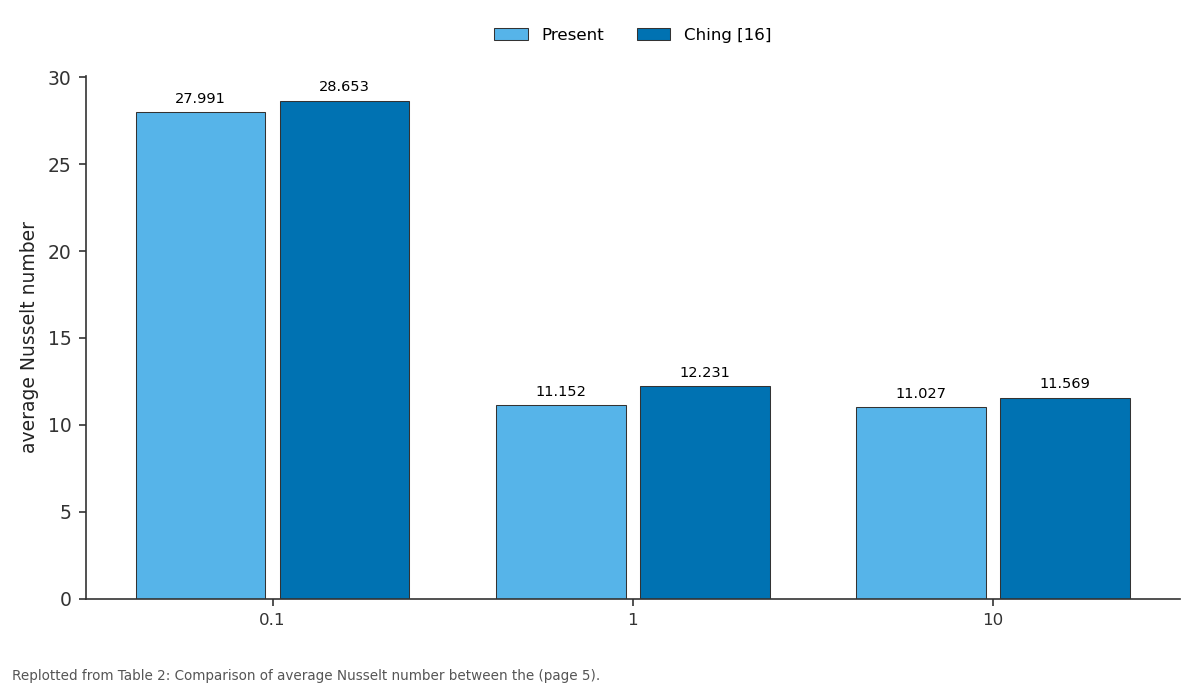
Present and Ching [16]: 0.1 vs 1 vs 10
Replotted from Table 2 (page 5) of the original paper. Every bar is the paper's own table value.
View source evidence ↗Figures & tables
From the original paper Table 1
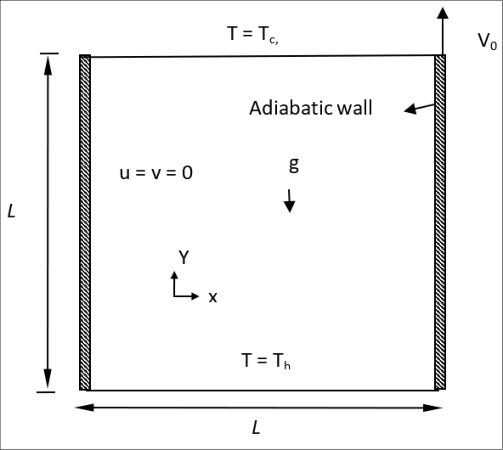 Figure 1
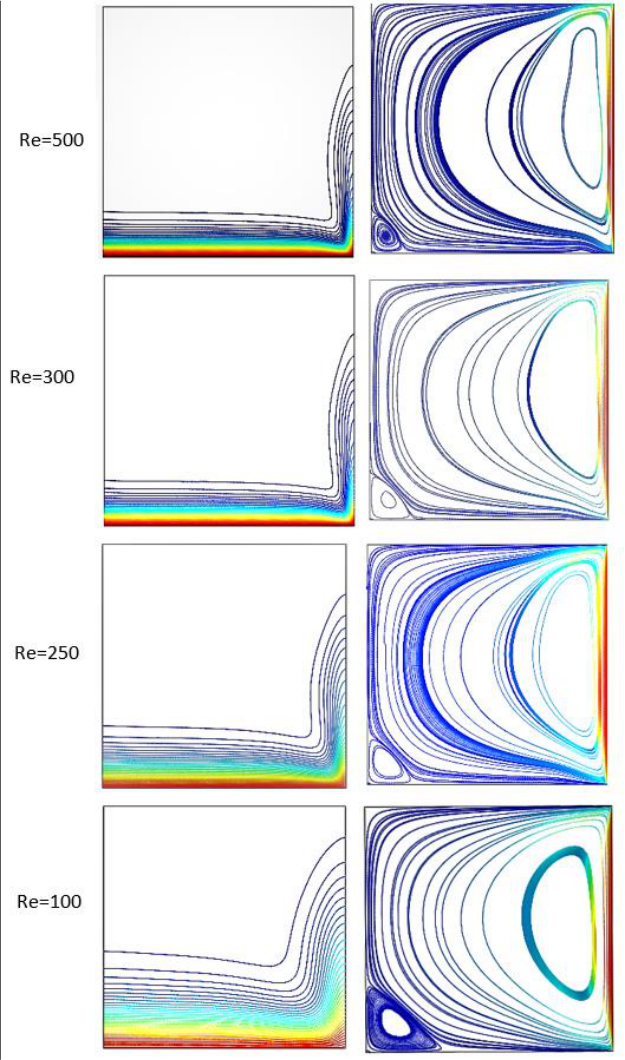 Figure 2
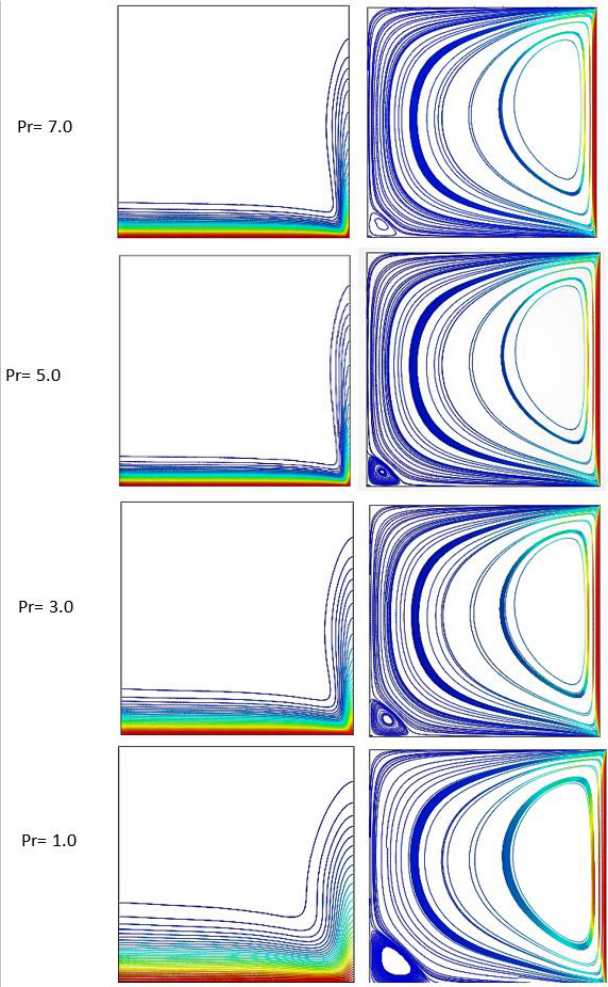 Figure 3
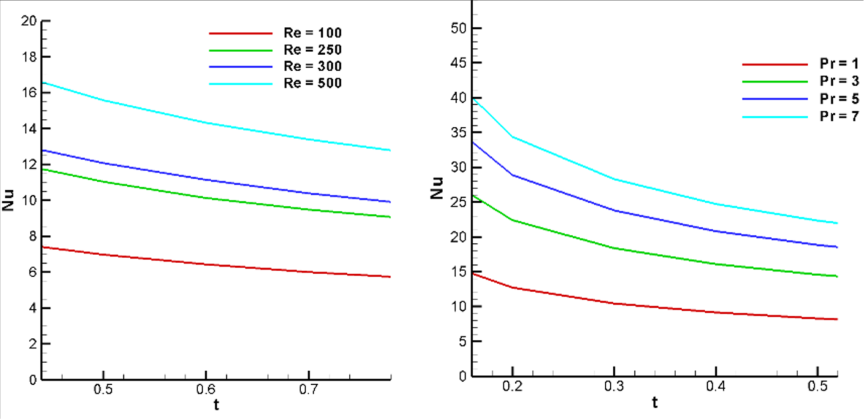 Figure 4
 Table 2
Introduction
A shared forced and free convection flow of conductive fluid in a cavity in the presence of a fluid flow field has outstanding technological importance due to its multiple instances in many industrial applications, such as thermal insulation, geothermal reservoirs, and oil reservoirs. These problems can also arise while using microelectronic devices and electronic packaging. Mixed convective heat transfer through a lid-driven cavity has attracted much attention due to its importance in many technological forms, including solar collector design, crystal growth, thermal design of buildings, nuclear reactors, air conditioning, and more recently, solar energy, and collector design. The two warning regimes should often be considered when studying mixed convective flow [1,2,3] . Mixed convection heat transfer in a cavity determined by the lid was investigated by Prasad and Koseff 1996 [4] . They performed a series of experiments in a water-filled cavity and measured the heat flux at unusual locations on the hot floor of the cavity for a range of Re and Gr. Their review represents that the total heat transfer rate (i.e., area-averaged) is a weak function of Gr. Rahman et al. 2009 [5] considered the complexity of mixed convection flow within a ventilated rectangular cavity with a centered heat-conducting four-sided figure cylinder. The fluid flow characteristic of combined convection in a lid-driven cavity with a circular body where the left wall of the cavity was heated has been analyzed by Oztop et al. 2009 [6] . Saeidi and Khodadadi 2006 [7] presented a constant laminar forced convection flow problem in a square cavity with inlet and outlet ports. Very recently, Prakash and Ravikumar 2013 [8] investigated the thermal calm in a room with windows in the nearby walls together with other complementary elements. Using a velocity-vorticity concept, Senthil Kumar et al. 2009 [12] investigated double diffusion mixed convection in a square cavity by a lid-driven. Non-stationary mixed laminar convective heat transfer in a two-dimensional square cavity was investigated numerically by Aminossadati and Ghasemi 2008 [10] . Vishnuvard hanaraoi and Das 2008 [11] investigated laminar mixed convection in a parallel square chamber with a two-sided lid and differential heating filled with a liquid-saturated porous medium. Kumar et al. 2009 [12] used the multiple lattice approach to investigate mixed convection in a four-sided cavity with a porous medium. Chamkha et al. 2011 [13] numerically investigated the two-dimensional mixed convection of a heat source. Consistent with the previous literature review, there has been little significant work on timedependent mixed convection in a lid-driven square cavity with a heat-generating body. In the current study, thermal flow fields are observed due to the effects of Pr and Re.
Physical Configuration and Mathematical Formulation
We measured a two-dimensional (2-D) square enclosure of length L filled with an incompressible fluid with boundary conditions (Fig. 1). From the demonstration sight, the upper wall is cold at temperature T c and the bottom wall is heated which is kept at heat T h , maintaining T h >T c . The other parts of the two vertical walls are adiabatic and the right vertical wall is a sliding wall.
where, the converted initial and boundary circumstances are: ).
Numerical Implementation
The Galerkin weighted residual finite element method is used to convert the nonlinear governing partial differential equations, such as mass, momentum, energy, and concentration equations, into a system of integral equations.
Zienkiewicz and Taylor 1991 [15] discuss the procedure in detail. The Gauss quadrature method is used to achieve the integration in each term of these equations. With the use of boundary conditions, Newton's technique is used to convert non-linear algebraic equations into linear equations. Finally, we solve these linear equations using the triangular Factorization technique. The convergence of solutions is assumed when the relative error for each variable between consecutive iterations is recorded below the convergence criterion ε such that |Γm + 1 -Γm| ≤ 10 -4 , where m is the number of iterations and Γ is the general dependent variable
Grid sensitivity check
Initially, la grid sensitivity check is conducted to choose the proper grid for the numerical prediction. Five different types of the grid are considered for the grid refinement analysis: 3776, elements, 4934, elements 5148, elements; 6326 elements, and 8506 elements. The deviations among the results are very few as shown in Table-1. Therefore, the grid results with 5148 elements are selected throughout the simulation.
Code Validation
The computational results are compared with the literature Ching [16] for validation of the present numerical code. The physical problem studied by Ching [16] was a lid-driven triangular enclosure. The length and height of the enclosures are depicted by L respectively. The calculated average Nusselt numbers are shown in Table 2. It can be seen from the figures that the present results and those reported in Ching [16] are in excellent agreement. This validation boosts the confidence in the numerical outcome of the present work. Table 2: Comparison of average Nusselt number between the present numerical solution and that of Ching [16]
| Ri | Present | Ching [16] |
|---|---|---|
| 0.1 | 27.991 | 28.653 |
| 1 | 11.152 | 12.231 |
| 10 | 11.027 | 11.569 |
Table text extracted from the original PDF; superscript letters are shown inline. The original table image is below.
View original table image
Results and Discussions
The numerical final results have been offered that installation the effects of the presence of dimensionless parameters in a cavity. The dimensionless governing parameters that have to be designated for the device are Reynolds number (Re), and Prandtl number (Pr). Since such a lot of primary dimensionless parameters are required to characterize a system, a complete evaluation of all combinations of those parameters isn't practical. The numerical outcomes have been used to explain the impact of numerous parameters at a small fraction of the possible conditions via way of means of simplifying the configuration. The shows of the outcomes had been commenced with the streamline and isotherm patterns in the cavity. Demonstrative distributions of the average Nusselt number on the heated wall with inside the cavity have additionally been provided.
Effect of Reynolds number
Effect of Reynolds number
Conclusion
The outcomes of the Re and Pr numbers on mixed convective flows with the thermal field have been explored in this work. According to the findings, better Reynolds numbers bring about a considerable increase in heat transmission from the heated wall. In a place ruled with the aid of using pressured convection, Prandtl variety outcomes in flow behaviors are greater substantial. With growing Reynolds and Prandtl numbers, the heat switch at the bottom heated surface increases.
Figures and tables from the paper
References
16 in the original paper- Schriber R, Keller HB. Driven cavity flows by efficient numerical techniques. J Comput. Phys. 1983 Feb 1;49(2):310-33.
- Ideriah FJK. Prediction of turbulent cavity flow driven by buoyancy and shear. J Mech. Engng. Sci. 1980 Dec;22(6):287-95.
- Moallemi MK, Jang KS. Prandtl number effects on laminar mixed convection heat transfer in a lid-driven cavity. Int. J Heat Mass Transfer. 1992 Aug 1;35(8):1881-92.
- Prasad AK, Koseff JR. Combined forced and Natural convection heat transfer in a deep lid-driven cavity flow. Int. J Heat Fluid Flow. 1996 Oct 1;17(5):460-7.
- Rahman MM, Elias M, Alim MA. Mixed convection flow in a rectangular ventilated cavity with a heatconducting square cylinder at the center. J of Engineering and Applied Sciences. 2009;4(5):20-29.
- Oztop HF, Zhao Z, Yu B. Fluid flow due to combined convection in a lid-driven enclosure having a circular body. Int. J. Heat and Fluid Flow. 2009 Oct 1;30(5):886901.
- Saeidi SM, Khodadadi JM. Forced convection in a square cavity with inlet and outlet ports. Int. J of Heat and Mass Transfer. 2006 Jun 1;49(11-12):1896-906.
- Prakash D, Ravikumar P. Study of thermal comfort in a room with windows at adjacent walls along with additional vents. Indian J of Sci. and Tech. 2013;6(6):4659-4669.
- Senthil Kumar D, Murugesan K, Thomas HR. Numerical Simulation of Double Diffusive Mixed Convection in a Lid-Driven Square Cavity using Velocity-Vorticity Formulation, Numer. Heat Transfer A. 2008;54(9):837865.
- Aminossadati SM, Ghasemi B. Comparison of Mixed Convection in a Square Cavity with an Oscillating Versus a Constant Velocity wall, Numer. Heat Transfer A. 2008;54(7):726-743.
- Vishnuvard hanarao E, Dass MK. Laminar Mixed Convection in a Parallel Two-Sided Lid-Driven Differentially Heated Square Cavity Filled with a FluidSaturated Porous Medium, Numer. Heat Transfer. 2008;53(1):88-110.
- Kumar DS, Dass AK, Dewan A. Analysis of Non-Darcy Models for Mixed Convection in a Porous Cavity using a Multigrid Approach, Numer. Heat Transfer. 2009;56(8):685-708.
- Chamkha AJ, Hussain SH, Abd-Amer QR. Mixed Convection Heat Transfer of Air Inside a Square Vented Cavity with a Heated Horizontal Square Cylinder, Numer. Heat Transfer. 2011;59(1):58-79.
- Shi W, Vafai K. Mixed Convection in an Obstructed Open-Ended Cavity, Numer. Heat Transfer. 2010;57(10):709-729.
- Zienkiewicz OC, Taylor RL. The finite element method, Fourth Ed., McGraw-Hill; 1991.
- Ching YC, Öztop HF, Rahman MM, Islam MR. Ahsan, A. Finite element simulation of mixed convection heat and mass transfer in a right triangular enclosure. Int. J Heat Mass Transf. 2012 May 1;39(5):689-96..