
Research article · 2022 · Full text
International Journal of Agriculture Extension and Social DevelopmentEffects of value addition strategies on competitive advantage of cashew products processed in south-east zone, Nigeria
Volume 5(1) · Pages 21–27 · DOI: 10.33545/26180723.2022.v5.i1b.111 ↗
Research areasGinkgo biloba and Cashew Applications
Abstract
Author-writtenValue addition has gained wide application as a strategy for achieving a competitive advantage in a large-scale enterprise. However, not much is known on how value addition strategies have been used by small-scale agro-entrepreneurs to achieve competitive advantage. Consequently, this study analyses the effects of value addition strategies on the competitive advantage of cashew products processed in the South-East zone, Nigeria. A cross-sectional survey design involving a structured questionnaire was used to generate data from 353 randomly selected respondents from the South-East zone, Nigeria. The findings showed quality improvement strategy and packaging strategy have both significant and positive effects on the competitive advantage of value-added cashew products. The study concludes that quality improvement and packaging strategies are effective for achieving a competitive advantage in a cashew processing enterprise. It is recommended that the government should initiate training programmes for processors on the application of strategies for enhancing quality improvement and innovative packaging to ensure sustainable competitive advantage from value-added cashew products.
Summary
Source-checkedPlain-language reading of the full paper, prepared with AI and checked against the text. Each point links to the authors' own words.
Why it matters
- Value addition in agriculture involves transforming raw produce into new products to expand the customer base and increase revenue. View evidence ↗
- The Nigerian government's Agriculture Promotion Policy (2016–2020) specifically targets the processing and value addition of export crops like cashew. View evidence ↗
- Small-scale agro-entrepreneurs face challenges in competing with large-scale firms due to limited capital and production constraints. View evidence ↗
The question
- The study aims to analyze how different value-addition strategies affect the competitive advantage of cashew products processed in South-East Nigeria. View evidence ↗
What they did
- The study population consisted of 61,037 individuals involved in cashew processing in South-East Nigeria. View evidence ↗
- A sample size of 353 cashew processors was selected for the study. View evidence ↗
- The researchers purposively selected four major cashew-producing states: Abia, Anambra, Enugu, and Imo. View evidence ↗
- Data were analyzed using Stata version 13.1 employing a probit regression model. View evidence ↗
What they found
- Quality improvement strategies significantly increase the likelihood of achieving a competitive advantage by 42.7%. View evidence ↗
- Packaging strategies have a significant positive effect, increasing the likelihood of competitive advantage by 45.5%. View evidence ↗
- Organizational growth strategies were found to be statistically insignificant, with a negative coefficient suggesting a 16.1% decrease in the likelihood of competitive advantage. View evidence ↗
- Sales strategies were statistically insignificant and associated with a 6.3% decrease in the probability of achieving a competitive advantage. View evidence ↗
What it means
- The authors conclude that quality improvement and packaging are the most effective strategies for achieving competitive advantage in cashew processing. View evidence ↗
- The authors recommend that the government provide training for processors on innovative packaging and quality improvement to enhance their capacity for value addition. View evidence ↗
Visual summary
2 visualsIllustrations explain the paper; charts are replotted from the paper's own table values.
Effective Value Addition Strategies
AI-generated conceptual illustration (processed cashew nuts and packaging materials). It explains the idea and does not show study data.
View source evidence ↗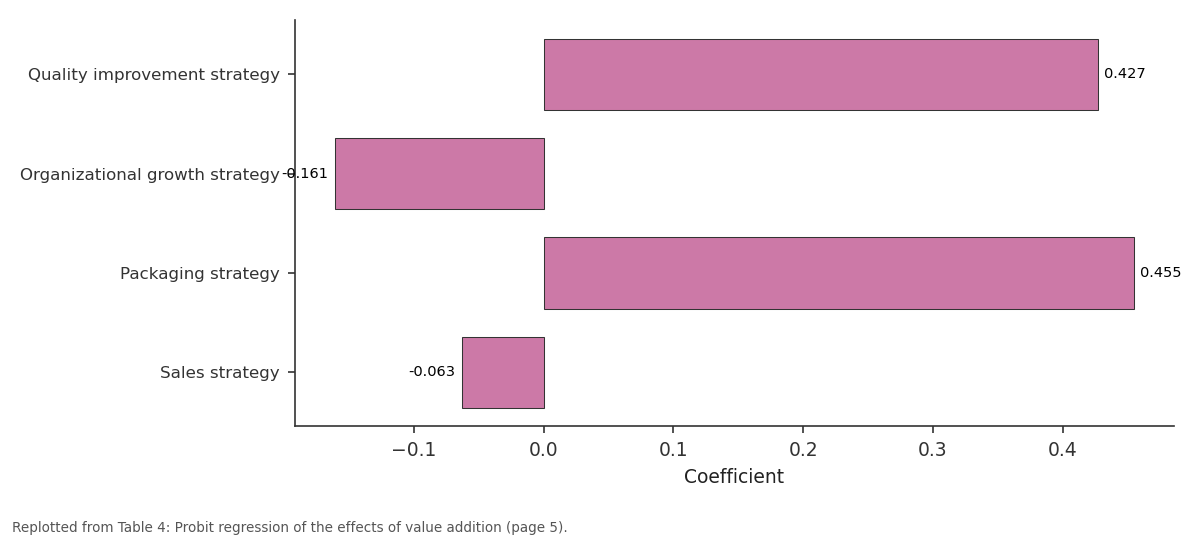
Coefficient: Quality improvement... vs Organizational growth... vs Packaging strategy vs Sales strategy
Replotted from Table 4 (page 5) of the original paper. Every bar is the paper's own table value.
View source evidence ↗Figures & tables
From the original paper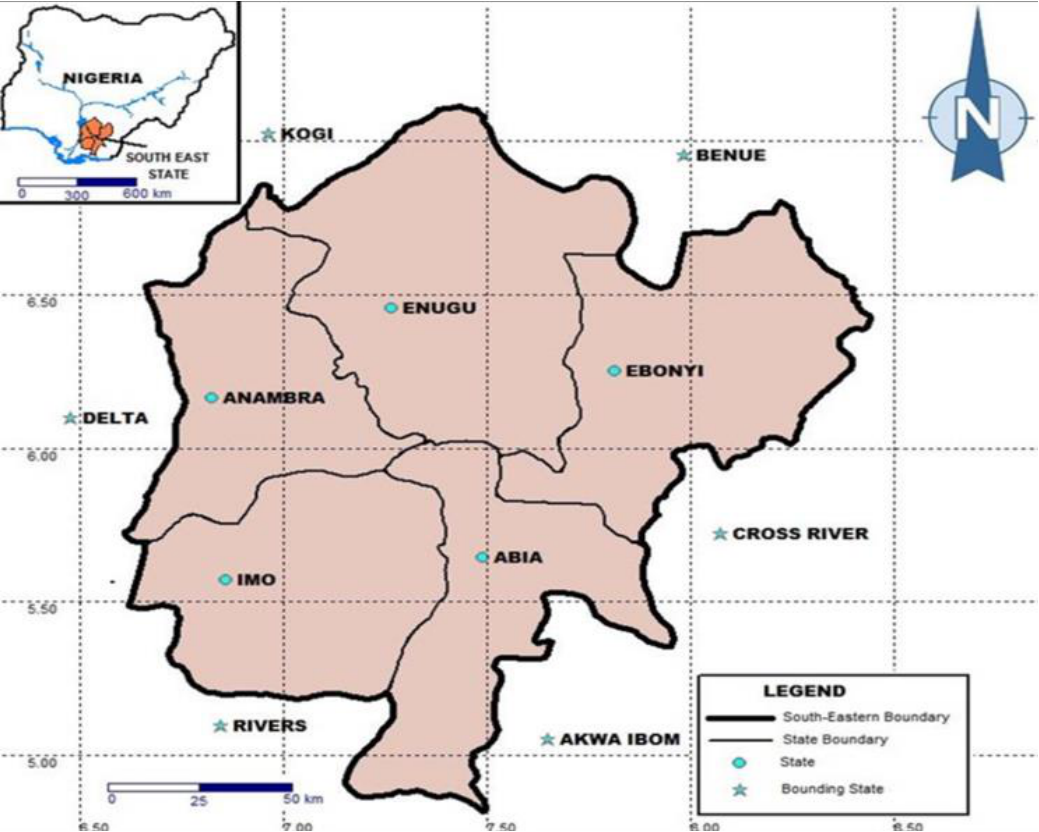 Figure 1
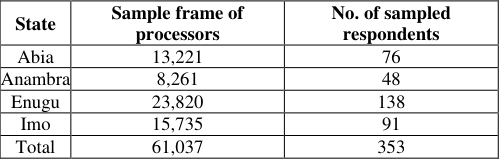 Table 1
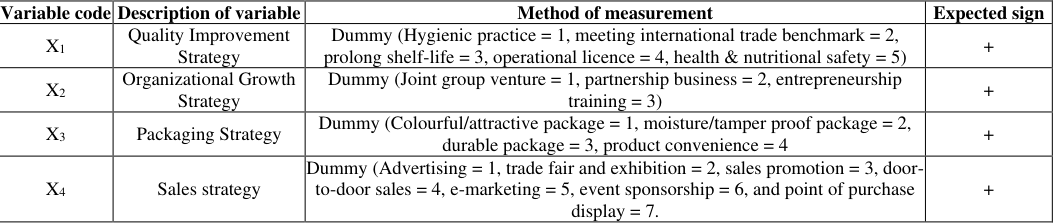 Table 2
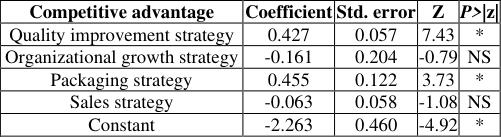 Table 4
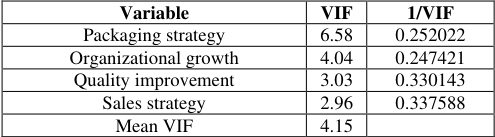 Table 3
Introduction
Value-addition to agricultural commodities entails transforming raw farm produce into a new product(s) via processing, drying, extracting, cooling, packaging or any other type of process that distinguishes the product from the initial one (Matthewson, 2007) [12] . The 2002 United States Farm Bill considers value addition to agricultural commodities as involving the process of transforming the physical state of the commodity through a production technique or handling method of the commodity or produce (USDA, 2013) [25] . The essence of value addition is to expand the customer base for the product, and improve revenue from the sales of the derived product(s), processing, or physical separation of the commodity or product realized by the producer (US Congress, 2002) [22] . In the context of this study, value addition to cashew comprises the process (es) of changing or transforming cashew into a new product(s) that are more acceptable to consumers with better taste and longer shelf-life. Valueadded cashew products are advantageous because it improves income, and create opportunities for new market entry while expanding producers' marketing season and the ability to produce a new identity for their product (Matthewson, 2007) [12] . Coltrain et al. (2000) [3] supported this assertion by stating that value addition is very helpful when analysing the potential of agricultural commodities for profit maximization.
In recognition of this, the Nigerian government through the Federal Ministry of Agriculture and Rural Development (FMARD) (2016) [8] developed a policy document code name "Agriculture Promotion Policy (2016 -2020)". The document which builds on the gains and lessons from the Agricultural Transformation Agenda (ATA) of 2012 to 2015 targets processing and value addition to export crops such as cashew as one of its core components. On the broader basis, the policy seeks to collaborate with agricultural actors to build an agricultural-based economy that can meet the objectives of self-sufficiency in food production, generate foreign export earnings, and support income and job growth at a sustainable level through increased production and processing and value addition to export crops, using improved production and processing technologies. This is predicated on the assumption that integrating the agricultural production system into the supply chain of Nigerian and global industry will drive job creation, increase agricultural contribution to income generation, as well as enhance the nation's capacity to earn foreign exchange from agricultural exports. Fundamentally, a competitive advantage can be achieved when a firm or enterprise is able to add value to its products far beyond that of its competitors. Value in this context is that unique attributes that attract customers to the product, which they are willing to pay for not minding the cost (Mungai, 2010) [13] . Superior value can be achieved through www.extensionjournal.com a firm offering product with a lesser price than its competitors can or offering a unique brand that far offsets a higher price in its competitors' product (Mungai, 2010) [13] . Value addition to agricultural products can be accomplished in many ways, but basically, it falls into two main strategies, namely: creating value and capturing value. There is a distinct difference between a strategy to create value and a strategy to capture the value and each strategy has specific opportunities and risks that can lead to the success or failure of a value-added product (Born and Bachmann, 2006) [2] . Creating value deals with a value-added strategy that meet actual or perceived customer's attributes for a superior product or service. Creating value could be accomplished through innovation, enhancing the product's characteristics, improving services developing unique customer experience and branding (Born and Bachmann, 2006) [2] . The strategy for creating value depends on products or services that are uniquely different from the mainstream equivalent. This could entail improving existing techniques, processes, products and services or innovating new ones. Creating value can present greater production risks than capturing value (Fulton, 2003) [9] . Value chain actors are expected to improve their production and marketing knowledge and skills particularly, in the areas of product quality, health and nutritional safety, creating a brand, packaging, labelling, and other regulations. Capturing value as the name connotes entails capturing some of the value-added by processing and marketing. It involves a strategy for altering the distribution and marketing of value in the food/fibre production chain basically, through coordination (Fulton, 2003) [9] . The strategy for capturing value includes direct marketing, cooperative venture and joint alliance. The extent of value addition to any product is determined by the degree to which the enterprise is able to create and/or capture value. Value is added when an enterprise undertakes one or more series of the above activities, which could be in production, processing, marketing of intermediate and/or finished goods and providing services. Additionally, an enterprise can create a value system in vertical activities such as upstream supplies and downstream channels. However, achieving a competitive advantage entails that the enterprise must be involved in creating one or more activities in a manner that adds more value to the overall benefit than its competitors do. For instance, the cashew processors are creating value to cashew products when they transform raw cashew nut, apple and kernel into more unique forms that attract higher patronage while maintaining an edge over their competitors. Empirical studies have shown that value addition is a veritable strategy for achieving competitive advantage. For instance, de Chematony, Harris and Riley (2015) [6] argued that value addition has gained wide application as a strategy for achieving competitive advantage. Persson (2015) [17] found value addition to agricultural commodities as a potential means of achieving sustainable competitive advantage. More so, Mungai (2010) [13] averred that value addition activities are strategically designed for achieving a firm's competitive advantage. Despite empirical evidence, it appears not much has been done to determine specific value addition strategies that can achieve competitive advantage in processed cashew products, especially among small-scale agro-entrepreneurs. Unlike the large-scale entrepreneurs who are better equipped to undertake large-scale production that enables them to achieve competitive advantage through economies of scale. The small-scale entrepreneurs have limited capital in addition to other production constraints, which makes it difficult for them to match their large-scale competitors. Consequently, this study focuses on determining the effects of value addition strategies on the competitive advantage of cashew products processed in the South-East zone of Nigeria. The outcome of this study will shape policy for designing programmes for equipping smallscale agro-entrepreneurs on value addition strategies for achieving competitive advantage. H0: The cashew value addition strategies employed by cashew processors in the South-East zone, Nigeria do not have a significant effect on competitive advantage.
Methodology Study location
The study was conducted in the South-East zone, Nigeria. The area is one of the six geo-political zones in Nigeria and comprises five States, namely; Anambra, Imo, Abia, Enugu, and Ebonyi (Fig. 1). The area has a population of 16.4 million inhabitants, mostly Igbos (NPC, 2006) [14] . It has a landmass of about 58,214.7 km3, the area lies between longitude 60 50I and 80 30I E latitude 40 30 I and 70 5 I N. South-East zone of Nigeria is bordered in the east by Cross-River State, Delta State in the west, Kogi and Benue States in the north and Akwa-Ibom and Rivers States in the south. The zone lies within the rainforest and derived savannah regions of Nigeria. Two main seasons characterize the zone: namely: rainy and dry seasons. South-East zone, Nigeria is deemed appropriate for this study because of its antecedent as a major cashew producing zone with four out of the five States of the zone being among the major producing States in Nigeria (USAID-Nigeria, 2002; Lawal et al., 2011) [24,11] . Historically, cashew was first introduced into the zone by the Portuguese merchants as a means of checkmating erosion. Since then emphasis has shifted from the use of cashew as a crop for erosion control to economic plant with high potential for livelihood and income generation. www.extensionjournal.com
Sample size determination
To ensure adequate representation for the entire population, the proportional sample size formula developed by Krejcie and Morgan (1970) was adopted. Given that the sample frame is known, the construct is most appropriate for this study because it considered vital parameters for sample size determination like specific margin of error and the desired confidence interval. The formula as developed by Krejcie and Morgan is stated as:
Sampling technique
A quantitative research design involving a cross-sectional survey was adopted for the study. This study adopted www.extensionjournal.com multistage random and purposive sampling techniques. In the first stage, four of the major cashew producing-States in South East, Nigeria were purposively selected. This is based on the assumption that the availability of cashew will stimulate an individual's interest to engage in value addition activities in the area. Based on this, Abia, Anambra, Enugu, and Imo States were chosen. This also conforms to USAID-Nigeria (2002) [24] designation of major cashew producing States in Nigeria. From the four States, one agricultural zone each was purposively selected to give a total of four (4) agricultural zones. This was based on the result of a reconnaissance survey that was conducted to identify the major cashew producing zones in each of the states as well as the concentration of cashew processors in the area. The third stage involved the random sampling of three hundred and fifty-three (353) cashew processors from the lists of processors that were obtained from ADP in the South-East zone, Nigeria (Table 1). The selection of the respondents was proportionately done using Bowley's proportionate allocation technique (equation 2). Bowley's proportionate allocation technique as quoted in Onwubiko et al. (2013) [16] is expressed as follows:
Source of data and instrument of data collection
Data were sourced principally from a primary source. The data were obtained with a structured questionnaire that was administered in person to the sampled respondents. The questionnaire was designed to elicit information related to the value addition strategies that enhance the achievement of competitive advantage. These variables are listed in Table 2. To facilitate the effective distribution and retrieval of the questionnaire, four research assistants who were University graduates were selected and trained to ensure adequate coverage and effective collection of the needed information from the respondents. The criteria for selection and training of the research assistants were based on their knowledge of research activity.
Data analysis
The data were extracted from the questionnaire and captured into an MS Excel worksheet using the assigned code for categorical variables and appropriate values for continuous variables. The data were analysed using Stata (version 13.1, Stata Corp, Texas 77845, USA) tool with the aid of probit regression analysis.
Model Specification for Probit Regression
A probit regression model was used to estimate the effect of value addition strategies employed by cashew processors in the South-East zone, Nigeria to achieve competitive advantage. The use of a probit model is predicated on the fact that the response variableachieving a competitive advantage is discrete and binary/dichotomous (yes or no). Value addition strategies employed by cashew processors can either have an effect (yes) or not (no) on competitive advantage. The choice of probit model for this research is because it assumes standard normal distribution function Φ(⋅). Mathematically, the model assumes that: Equation 3 is used to transform the expectation of the binary response variable (yes = 1, no = 0). The probit regress is modified as:
The above is a population Probit model with predictor variables, X1, X2, X3, X4 and Φ(⋅) is the cumulative standard normal distribution function.
The predicted probability that Y=1 or 0, given the independent variables, X1, X2, X3, X4 can be estimated as:
βj is the effect on 'z' for a unit change in the independent variable 'Xj', given that other variables are held constant (k-1).
Y= The probability that the value addition strategies employed by the cashew processors will achieve competitive advantage (Yes = 1; No = 0); www.extensionjournal.com
Results and Discussion Diagnostic tests of regression assumptions
The analysis began with diagnostic checks to ascertain the model reliability and conformity to binary regression assumptions. The checks carried out were: multicollinearity, autocorrelation, heteroscedasticity, and good fit of the model. The multicollinearity test from the scores of Variance Inflation Factor (VIF) was observed to range from 2.96 -6.58 (Table 3), which is well below 10.0 and the tolerance statistics are far above 0.2. This attests to the absence of multicollinearity in the model, thus, the assumption that the predictor variables are uncorrelated with one another was met. The heteroscedasticity check as provided by the Breusch-Pagan test gave rise to a chi-square value of 2.03, and a P-value of 0.1537, which is greater than 0.05. Based on this, the alternative hypothesis was rejected and the null hypothesis accepted that the variance of the residuals is homogenous in the model and thus, the assumption of homoscedasticity was met. The check for autocorrelation as provided by the Durbin Watson statistics was 1.82. This value is within the acceptable range of ±2, thus, confirming the absence of autocorrelation in the model. To check the probit model fit, the Pearson chi-square value (103.31) and p-value (0.000) were taken into consideration. The significance of the p-value (p< 0.05) attests to the good fit of the model.
| Variable | VIF | 1/VIF |
|---|---|---|
| Packaging strategy | 6.58 | 0.252022 |
| Organizational growth | 4.04 | 0.247421 |
| Quality improvement | 3.03 | 0.330143 |
| Sales strategy | 2.96 | 0.337588 |
| Mean VIF | 4.15 |
Table text extracted from the original PDF; superscript letters are shown inline. The original table image is below.
View original table image
Effects of value addition strategies on the competitive advantage of cashew products processed in South-East zone, Nigeria
The concept of competitive advantage as applicable to this study is the ability of an individual processor to offer services and/or products that meet or exceed customers' preferences more than his/her competitors. This concept suggests that achieving a competitive advantage is possible if a processor is able to create cashew products that measure up with expected customers' values with distinctive attributes that distinguish it from that of its competitors. This is in line with extant literature. For instance, Persson (2015) [17] found value addition to agricultural commodities as a potential means of achieving competitive advantage. Similarly, de Crematory, Harris and Riley (2015) [6] argued that value addition has gained wide application as a strategy for achieving competitive advantage. Probit regression was used to determine the effects of value addition strategies on the competitive advantage of cashew products processed in the South-East zone, Nigeria. The probit regression result yielded a Likelihood Ratio (LR) Chi-Square of 310.99 with a p-value of 0.0000, implying that at least, none of the independents' regression coefficients is equal to zero. In other words, it suffices to say that the model fits significantly better with these predictors than without the variables in the model (empty model without the independent variables) (Table 4).
| Competitive advantage | Coefficient | Std. error | Z | P>|z| |
|---|---|---|---|---|
| Quality improvement strategy | 0.427 | 0.057 | 7.43 | * |
| Organizational growth strategy | -0.161 | 0.204 | -0.79 | NS |
| Packaging strategy | 0.455 | 0.122 | 3.73 | * |
| Sales strategy | -0.063 | 0.058 | -1.08 | NS |
| Constant | -2.263 | 0.460 | -4.92 | * |
Table text extracted from the original PDF; superscript letters are shown inline. The original table image is below.
View original table image
Quality improvement strategy
The coefficient of the quality improvement strategy employed by the processors was positive and statistically significant (P< 0.05). This implies that a quality improvement strategy increases the likelihood of achieving a competitive advantage in value-added cashew products by 42.7 per cent. Additionally, the quality improvement strategy being statistically significant (P<0.05) signifies that it exerts a significant effect on the competitive advantage of value-added cashew products. The result demonstrates that a quality improvement strategy is essential for achieving a competitive advantage in value-added cashew products. Thus, incorporating diverse quality improvement strategies into cashew value addition is critical to achieving a competitive advantage. It is therefore important that cashew processors should evolve a new strategy for improving the quality of cashew products. Besides achieving a competitive advantage, Demang, Salengke and Brasit (2018) [7] averred www.extensionjournal.com that product quality improvement is vital for achieving higher prices while meeting customers' values. US Congress (2002) [22] noted that the essence of value addition is to expand customers' range of choices over a product with the ultimate goal of increasing revenue from the derived product (s). More so, improving cashew product quality can also be seen as a component of processing and marketing strategies that target customers' satisfaction through product innovation for enhancing return to processors. It is important to note that product quality is a core determinant of customer's satisfaction, which guarantees higher prices (Susant, 2013) [21] . The value addition that targets quality improvement strategy can help processors create unique cashew products that satisfy customers' desires, which is vital for achieving competitive advantage.
Organisational growth strategy
The negative coefficient of organisational growth strategy suggests that it decreases the likelihood of achieving competitive advantage by 16.1 per cent and is statistically insignificant (P> 0.05). The result may be due to the inability of processors to employ adequate organizational growth strategy which would have enabled them to achieve competitive advantage.
Packaging strategy
The positive coefficient of the packaging strategy suggests it increases the likelihood of achieving a competitive advantage in value-added cashew products by 45.5 per cent.
The coefficient was equally significant (P< 0.05), indicating that packaging strategy has a significant effect on the competitive advantage of value-added cashew products. This finding indicates that processors can achieve a competitive advantage from value-added cashew products by employing a packaging strategy. Rundh (2009) [9] averred that packaging strategy is essential for achieving competitive advantage because it differentiates a firm's products from other brands and products. For instance, colourful/attractive containers often portrayed in pictures influences processor to gain a competitive advantage because of the picture effect on consumers' perception.
Danielsson and Lundqvist (2011) [5] opined that the use of colourful pictures on product packages enables entrepreneurs to gain a competitive advantage. Similarly, Underwood, Klein and Burke (2001) [23] averred that a product picture is part of a strategy for achieving competitive advantage. This is because pictures can easily communicate information about the product to consumers much faster than words can do. In recent times, business organizations are increasingly realizing the importance of good packaging for creating impressive perceptions on the market sphere. Nikitaeva (2012) [15] pointed out that packaging no longer serves as a mere container and protector of products but contributes positively to sales promotion by attracting the attention of customers to the products. The competitiveness of today's business environment suggests that the use of valuable and attractive packages is critical to influencing customers' purchasing decisions. Supporting this view, Ambrose and Harris (2011) [1] averred that packaging is now another useful means of communicating a product's values to consumers. On the other hand, packaging strategy could also serve dual roles for achieving profitability and competitive advantage from value-added products. This aligns with the view of Czinkota and Ronkainen (2001) [4] , that achieving profitability and competitive advantage requires a sort of packaging strategy that can deliver better value and satisfaction to consumers than that of their competitors. These double-barrel roles can be achieved by offering customers products with greater values, which justifies them paying a higher price. Thus, the packaging is part of the integral cashew value addition strategy for attaining profitability and competitive advantage.
Sales strategy
The coefficient of sales strategy was negative and insignificant (P> 0.05), suggesting that it decreases the probability of achieving a competitive advantage in valueadded cashew products by 6.3 per cent. The finding disagrees with that of Porter (2008) [18] who found a positive correlation between sales volume and competitive advantage.
Test of Hypothesis
The hypothesis was to test whether or not value addition strategies employed by cashew processors in the South-East zone, Nigeria have significant effects on competitive advantage. The test result from the probit regression in Table 4 shows the Likelihood Ratio chi 2 (15) was 365.04, indicating significance (p-value = 0.0000). Judging from the p-value, which is less than 0.05, we conclude that value addition strategies employed by cashew processors in the South-East zone, Nigeria have significant effects on competitive advantage. In other words, the value addition strategies of the cashew processors have significantly influenced the attainment of competitive advantage in valueadded cashew products.
Conclusion and recommendations
The study established that quality improvement and packaging strategies have both significant and positive effects on the competitive advantage of value-added cashew products. Thus confirming the hypothesis that valueaddition strategies increase the likelihood of achieving a competitive advantage on value-added cashew products. Cashew processors are encouraged to improve on quality and packaging strategies if they are to remain competitive. Based on the findings, the study recommends that the government through her agency should initiate training programmes for processors on strategies for enhancing quality improvement and innovative packaging of valueadded cashew products. This will enhance the capacity of the processors to innovate value addition to cashew products. Cashew processors equally are encouraged to focus on enhancing strategies that target quality improvement and innovative packaging of value-added cashew products. For instance, processors can focus on creating colourful/attractive, moisture-proof, and durable packages for attracting increasing customers' patronage of the products.
Acknowledgement
AcknowledgementsThe authors are grateful to the academic staff of the www.extensionjournal.com Department of Agricultural Economics, Kenyatta University for their invaluable contributions that made this research a success. More so, we sincerely appreciate the entire Coordination team of the academy Project, an Intra-Africa Academic Mobility Scheme sponsored by the European Commission in partnership with the Africa Union for awarding a scholarship to the first author and for providing support funds for this research. Finally, our gratitude goes to the respondents for accepting to provide the needed data and the research assistants for being diligent in collecting the data used for this research.
References
14 in the original paper- Ambrose G, Harris P. Packaging the brand: exploring the relationship between packaging and brand identity; c2011. [Internet]. Accessed from: www.books.google.com/books?isbn=2940411417 [Accessed 10.11.2019]
- Born H, Bachmann J. Adding value to farm products: An overview. A Publication of ATTRA-National Sustainable Agriculture Information Service; c2006. p. 1-12. Retrieved from www.attra.ncat.org, Sept 4, 2020.
- Coltrain D, Barton D, Boland M. Value added: opportunities and strategies; c2000. Available at: http://tinyurl.com/ycoxv5m9. Retrieved on 27/12/2018.
- Demang F, Salengke S, Brasit N. The Strategy to improve the Quality of Cashew Commodities. International Journal of Environment, Agriculture and Biotechnology (IJEAB). 2018;3(1):14-17.
- Federal Ministry of Agriculture and Rural Development (FMARD). The Agriculture Promotion Policy (2016 - 2020): Building on the Successes of the ATA, Closing Key Gaps. Policy and Strategy Document, FMARD, Abuja; c2016.
- Fulton J. Value-added business ventures through producer alliances. Purdue University Cooperative Extension Service Publication ID-318; c2003. Retrieved from www.ces.purdue.edu/extmedia/ID/ID318.pdf, Sept. 5, 2020.
- Krejcie RV, Morgan DW. Determining sample size for research activities. Educational and Psychological Measurement. 1970;30(3):607-610.
- Lawal JO, Oduwole OO, Shittu TR, Muyiwa AA. Profitability of value addition to cashew farming households in Nigeria. African Crop Science Journal. 2011;19(1):49-54.
- Matthewson M. Exploring Value-Added Agriculture. 2007;2(2). [Online]
- Onwubiko OF, Asmuni A, Idris K, Othman J. The causes, effects and potential solutions to the deeprooted Niger Delta oil crisis. International Journal of Social and Behavioral Sciences. 2013;1(6):122-129.
- Rundh B. Packaging design: creating competitive advantage with product packaging. British Food Journal. 2009;111(9):988-1002.
- SBM Intelligence. Nigeria's unrealised agricultural prowess: The case of cashew. A report by SBM Intelligence; c2016. Retrieved from www.sbmintel.com on 07 Jan, 2019.
- Congress US. Farm security and rural investment act of 2002. 107 th Congress, 2 nd Session. Public Law (No. 107-171); c2002. Available at: http://tinyurl.com/y93m5hfw.
- Underwood RL, Klein NM, Burke RR. Packaging communication; attentional effects of product imagery. Journal of Product & Brand Management. 2001;10(7):403-422.
Cited by 1
From OpenAlex, OpenCitations and reference lists read by Scinovex
- Value chain of wheat: A case in north western plain zone of India
Anirban Jana, Nishi Sharma, R.N. Padaria, Ashish Kumar Singh, Sitaram Bishnoi, Awadhesh Dixit · International Journal of Agriculture Extension and Social Development · 2025
An assessment was conducted in 2023 to analyse the various value chains of wheat (Triticum aestivum) in North Western Plain Zone of India. In all, 101 respondents were selected using multistage random sampling method. The respondents included 60 farmers, eight traders, eight commission agents, eight millers, eight wholesalers, eight retailers and one FPO. Analysis of value chain was done on the basis of value addition, marketing efficiency and net marketing margin. Moreover, the study also calculated cost of cultivation, net farm income and return on investment from wheat farming. Results demo