
Research article · 2022 · Full text
International Journal of Statistics and Applied MathematicsApplication of integral equations using numerical wavelet methods
Volume 7(1) · Pages 159–162 · DOI: 10.22271/maths.2022.v7.i1b.791 ↗
Research areasImage and Signal Denoising MethodsEarthquake Detection and AnalysisSeismology and Earthquake Studies
Abstract
Author-writtenThe mother wavelet is a prototype function that is adjusted during the wavelet analysis process. A contracted, high frequency version of the prototype wavelet is used for temporal analysis, while a larger, low frequency version of a comparable wavelet is used for frequency analysis. Data activities can be accomplished using the wavelet coefficients since the first signal can be spoken to as a wavelet extension. If we also chose the best wavelet as indicated by the data, the data is meagerly spoken to. Astronomy, nuclear engineering, turbulence, earthquake predictions, acoustics, sub and coding, magnetic resonance, imaging, optics, fractals, speech discrimination, neurophysiology, radar, human vision, signal and image processing, and pure mathematics applications, such as understanding partial differential equations, are all influencing the use of wavelets.
Summary
Source-checkedPlain-language reading of the full paper, prepared with AI and checked against the text. Each point links to the authors' own words.
Why it matters
- Integral equations serve as mathematical models for various physical situations and can be used to restructure other mathematical problems. View evidence ↗
- Wavelets are utilized across a wide array of fields, including astronomy, nuclear engineering, acoustics, and signal and image processing. View evidence ↗
- Wavelets are considered a transformative mathematical tool for time series analysis, geophysics, and approximation theory. View evidence ↗
The question
- The paper addresses the growing interest in applying wavelet methods to solve various types of integral equations. View evidence ↗
What they did
- The research focuses specifically on the use of real-valued functions. View evidence ↗
- The analysis categorizes the most common integral equations into Volterra and Fredholm types. View evidence ↗
- The paper defines singular integral equations as those where the integral extends indefinitely or the kernel becomes unbounded within the integration interval. View evidence ↗
- The paper classifies kernel functions, defining a symmetric kernel as one where K(x, t) equals its complex conjugate. View evidence ↗
- Separable or degenerate kernels are defined as those that can be expressed as a finite sum of products of functions of x and t. View evidence ↗
What they found
- The scaling parameter 'a' determines frequency: values where |a| < 1 relate to higher frequencies (compressed version), while |a| > 1 relate to lower frequencies (larger time-width). View evidence ↗
- The convergence speed of wavelet methods is improved by the sparsity of the matrices and the ability to represent solutions with fewer coefficients. View evidence ↗
What it means
- The authors conclude that wavelet approaches, such as the Haar wavelet collocation and wavelet-Galerkin methods, are highly beneficial for solving real-world problems. View evidence ↗
- Wavelet methods are presented as a viable alternative to traditional numerical and semi-numerical methods. View evidence ↗
Visual summary
1 visualsIllustrations explain the paper; they do not show study data.
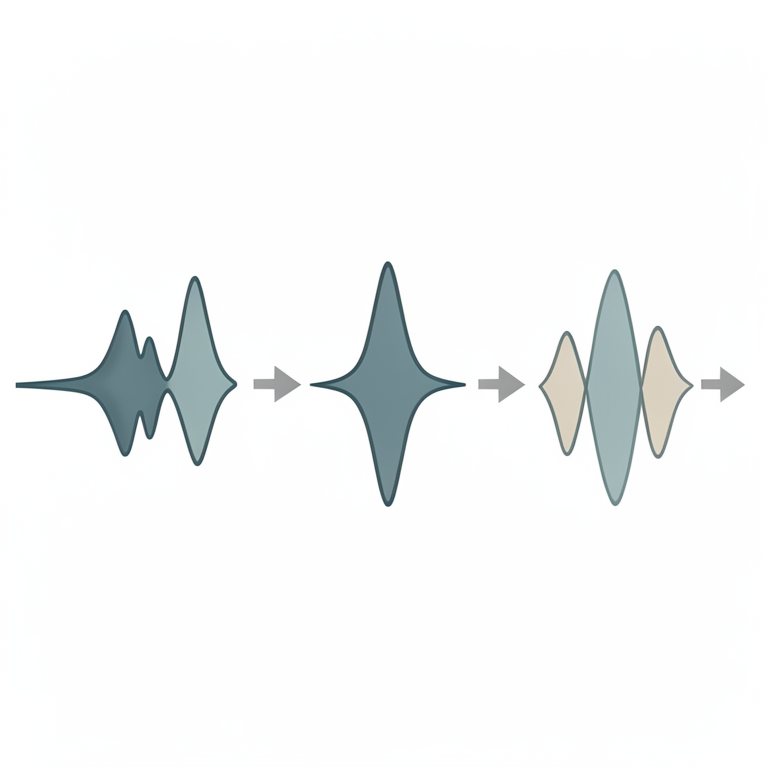
Wavelet Scaling and Frequency
AI-generated conceptual illustration (mathematical wavelet functions). It explains the idea and does not show study data.
View source evidence ↗Introduction
Integral equations are used as mathematical models for a variety of physical circumstances, and they can also be used to reformulate other mathematical issues. In recent years, there has been a lot of interest in using wavelet methods to solve integral equations. The first work that used the Haar wavelet approach to solve an integral equation was published by Beylkin, G 1991 [14] . After that, there has been a slew of questions regarding using this method to illustrate various types of integral equations. In Haar wavelet method is connected to explain various types of linear integral equations (Fredholm, Volterra, integro differential, and pitifully solitary integral equations), as well as the Eigen value issue, while connected the Haar wavelet method to unravel the nonlinear Fredholm integral equation, and used the wavelet for settling Fredholm integral equation demonstrated the application of the Haar wavelet change to fathoming integral and differential equations Kelmanson MA et al. 2018 [1] .
Integral equation
An integral equation is one in which at least one integral sign represents an unknown function. For instance, for a ≤ x ≤ b, a ≤ t ≤ b, the equations ∫ 𝐾(𝑥, 𝑡)𝑦(𝑡)𝑑𝑡 = 𝑓(𝑥) The unknown function y(x) lies on the whole integral equations, while f(x) and K (x, t) are known functions and "a" and "b" are constants. In x and t, the previously described functions might be real or complex valued functions. We have only considered actual valued functions in our research Das P et al. 2015 [2] .
Classification of integral equations
In ordinary and partial differential equations, an integral equation is referred to as a linear or nonlinear integral equation. We've seen how the integral equation can speak to the differential equation in a similar way. As a result, these two equations have a reasonable relationship. When only linear operations are done on the unknown function, an integral equation is called linear. Nonlinear integral equations are integral equations that are not linear. The most often used integral equations can be divided into two categories: Volterra and Fredholm integral equations. We must also classify them as either homogeneous or non-homogeneous integral equations Wazwaz AM 2011 [3] .
1) Fredholm integral equation
The Fredholm integral equation is an integral equation whose solution leads to the study of Fredholm kernels and operators, as well as Fredholm theory. The shape is the broadest type of Fredholm linear integral equations Maleknejad K et al. 2002 [4] 𝑔(𝑥)𝑦(𝑥) = 𝑓(𝑥) + 𝜆 ∫ 𝐾(𝑥, 𝑡)𝑦(𝑡)𝑑𝑡, 𝑏 𝑎 (1.4) The Fredholm integral equation of third kind is defined as follows: a, b are two constants, f(x), g(x), and K(x, t) are known functions, whereas y(x) is an unknown function and is a non-zero genuine or complex parameter. The kernel of the integral equation is known as K (x, t).
2) Volterra integral equation
The Volterra integral equations are a type of integral equation that isn't found anywhere else. They are divided into two groups, referred known as the first and second kinds. The form is the broadest form of Volterra linear integral equations Zou H et al. 2019 [5] 𝑔(𝑥)𝑦(𝑥) = 𝑓(𝑥) + 𝜆 ∫ 𝐾(𝑥, 𝑡)𝑦(𝑡)𝑑𝑡, 𝑏 𝑎 (1.5) The Volterra integral equation of third kind is defined as follows: an is constant, f(x), g(x), and K (x, t) are known functions, whereas y(x) is an unknown function and is a nonzero real or complex parameter. The kernel of the integral equation is known as K (x, t).
3) Singular integral equation
A singular integral equation is defined as an integral that extends as long as possible or when the kernel of the integral becomes unbounded at least once inside the integration interval. The equations below, for example, are singular integral equations Maleknejad K et al. 2021 [6] .
4) Integro-differential equation
Vito Volterra investigated the subject of population growth in the mid-1900s, and new types of equations were created and dubbed integra-differential equations. The unknown function y(x) appears as a blend of the ordinary derivative and the integral sign in these equations. For occurrence Lin XY et al.
Both the second order Volterra integro-differential equation and the first order Fredholm integro-differential equation are used in the preceding equations.
5) Special kind of kernels
The kernel function is a critical component of the integral equation. The following is a classification of kernel functions Mouley J et al. 2021 [8] :
Where the bar implies the complex conjugate A real kernel 𝐾(𝑥, 𝑡) is symmetric if
Separable or degenerate kernel: A kernel 𝐾(𝑥, 𝑡) is entitled dissimilar or decline on the off chance that it very well can be linked as the whole of a finite quantity of terms, every one of which is the consequence of a function of x just and a function of t just, i.e.
𝐾(𝑥, 𝑡) = ∑ 𝑔 𝑖 (𝑥)ℎ 𝑖 (𝑡)
Non-degenerate kernel: A kernel 𝐾(𝑥, 𝑡) is termed nondegenerate if it cannot be isolated as the purpose of x and function of𝑡. For instance, 𝑒 𝑥𝑡 √ 𝑥, 𝑡,are the nondegenerate kernels?
Wavelets
Wavelets are now regarded as a game-changing new mathematical tool in signal and image processing, time series analysis, geophysics, approximation theory, and a variety of other fields. First and foremost, wavelets were used in seismology to provide a time measurement to seismic analysis, where Fourier analysis fails. Fourier analysis is ideal for concentrating stationary data (data whose factual properties are invariant over time), but it isn't appropriate for considering data with transient events that can't be measurably predicted from the data past. Wavelets were created with such no stationary data in mind; their allencompassing statement and solid outcomes have quickly proven to be beneficial to a variety of disciplines. Wavelets philosophy is a abstemiously new and emerging territory in mathematical research Liu CS et al. 2009 [9] . We study, in this section, the space L 2 (ℝ) of calculable functions𝑓, considered on the real line ℝ, that fulfill
Certainly, we exploration for such "waves" that produce L 2 (ℝ), these waves must rot to zero at ±∞; and for all pragmatic aim, the rot must to be fast. That is, we exploration for small waves, or "wavelets", to yield L 2 (ℝ). For this aim, we rise toward a solitary function ψ that makes all L 2 (ℝ). Since, ψ is quick rot, to cover whole real line, we shift ψ alongℝ. For computational efficiency, we have used integral powers of 2 for frequency allocating. Where the quantity 2 j/2 is for normality.
Wavelet transform
Wavelet is an abbreviation for 'small wave.' As a result, wavelet analysis is linked to the examination of signals with small span finite energy functions. They transform the signal under consideration into another portrayal that alters the signal in a more beneficial manner. This signal transformation is known as the wavelet transform. The first is interpreting (change of position). We shift the wavelet's focal point along the time hub. The second is scalability. The wavelet transform fundamentally evaluates the wavelet's neighborhood coordinating with the signal. If the wavelet matches the signal well at a scale and location, an expanded transform value is obtained. The transform value is then shown in the transform plane in two dimensions. The wavelet transform was recorded at several points in the signal and for various wavelet sizes. Continuous wavelet transform is used when the technique is carried out in a smooth and continuous manner. Also, keep in mind that the spectrum is affected by the wavelet type used in the study. Mathematically, we specify a wavelet as Kaneko H et al. 2003 [10] :
Where b is site parameter and 'a' is scaling parameter. The function must be time limited in order to be wavelet. We interpret the wavelet by varying the parameter b for a given scaling parameter a. We characterize wavelet transform as:
For each (a, b), we have wavelet transform coefficient, if |a| < 1, at that point the wavelet in is compressed version (smaller assistance in time domain) of the mother wavelet and relates essentially to higher frequencies. Then again, when |a| > 1, at that point 𝜓𝑎, 𝑏 (𝑡) has a bigger time-width than ψ (t) and associates to bring down frequencies consequently, wavelets have time widths adjusted to their frequencies. This is the opinion purpose behind the accomplishment of Morlet wavelets in signal dispensation and time-frequency signal analysis.
Continuous wavelet transform
Let f (x) be any square integrable function. Then the incessant wavelet transforms W ψf of f ∈ L 2 (ℝ) with respect to ψ is distinct as Delves LM et al. 1988 [11] 𝑊 𝜑 (𝑏, 𝑎) = |𝑎| -1 2 ∫ 𝑓(𝑥)𝜑 (
Where 'a' and 'b' are real, and bar indicates the complex conjugation. Consequently, the wavelet transform is a function of two variables. There normalizing factor 1 √𝑎 a ensure that the energy breaks the similar for all a and b; that is
The finiteness of this continuous (admissibility condition) restrain the class of L 2 (ℝ) function that can be utilized as wavelets this suggests.
See for more details. With the constant Cψ, we have the subsequent reconstruction formula an f. At the point when the suitable response is negative, the utilization of a discrete subset seems a sensible aim.
Notice that the likelihood of reform is ensured by the admissibility condition. Currently we move from CWT to discrete wavelet transform.
Continuous to discrete wavelet transforms
It is legitimate to ponder whether it is important to know Cψ anywhere to progress the thought is as per the subsequent: we think about separate subset of R+ * and R. Give us a accidental to settle a 0 > 1 and b 0 > 0 and take a∈ {𝑎 0 𝑗 } 𝑗∈𝑧 and b∈ {𝑘𝑎 0 𝑗 𝑏 0 } 𝑗,𝑘∈𝑧 Instead of using the family of wavelets
𝜑 𝑎,𝑏 (𝑡) = This is used in multi-resolution analysis including an orthonormal basis for L 2 (ℝ)
Basic scaling function and basic wavelet
The set {𝜙(𝑥 -𝑘)} 𝑘𝜖𝑧 is an orthonormal basis for V 0 by axiom. Currently, it pursues by rehashed request of aphorism that is {𝜙(2 𝑗 𝑥 -𝑘)} 𝑘𝜖𝑧 an orthonormal basis for 𝑉 𝑗 . Note that the function 𝜙(2 𝑗 𝑥) is decoded by 𝑘 2 𝑗 i.e. it changes toward becoming narrower and translations get littler as 𝑗 increments. The L 2 -standard of one of these basis functions is as per the following Mouley J et al. 2020 [15] . Therefore the set {2 1 2 𝜙(2 𝑗 𝑥 -𝑘)} 𝑘𝜖𝑧 is an ortho-noraml basis for 𝑉 𝑗 .We call 𝜙 as the basic scaling function, since we make a whole bunch of basis function by dilation and translation of 𝜙. Likewise it is exposed that there exists a function 𝜓(𝑥) such that {2 1 2 𝜓(2 𝑗 𝑥 = 𝑘)} 𝑘𝜖𝑧 is an ortho-normal basis for𝑊 𝑗 . We call 𝜓 as the basis wavelet or mother wavelet. Note that iot might not be possible to fast either of them (𝜙 𝑜𝑟 𝜓) obviously but there are efficient approaches for calculating the values of 𝜙 𝑜𝑟 𝜓 at some dyadic rational points. For continence, we now present the following notation
Since it pursues that is orthogonal to ask and note that all are mutual orthogonal, and so the wavelets are orthogonal crosswise over scales. All composed we have the associated orthogonally relations.
Where 𝑖, 𝑗 -𝑘, 𝑙 £ 𝑍 and𝑘,' I' is the Kronecker delta defined as:
𝛿 𝑘,𝑙 = { 0, 𝑘 ≠ 𝑙 1, 𝑘 = 𝑙
Conclusion
Higher order nonlinear boundary value problems are effectively solved using the wavelet approach. In addition, innovative wavelet-based numerical approaches for dealing with various types of boundary conditions are being developed. The proposed wavelet approaches, which include the Haar wavelet collocation method, Haar wavelet quasilinearization method, wavelet-Galerkin method, and waveletmultigrid method, have shown to be extremely beneficial in a wide range of real-world issues. In fact, wavelet methods are gaining traction as a viable alternative to classic numerical and semi-numerical approaches. The developed wavelet methods can be used to analyses any nonlinear boundary value problems with finite or infinite domains emerging in engineering and science due to inherent features such as Ortho normalization, compact support, simple explicit expression (in the case of Haar wavelets), and the hierarchy of solution approximation. In fact, the method's speed of convergence is boosted by the method's simplicity, sparsity of wavelet matrices, and solution representation with a substantially reduced number of wavelet coefficients.
References
13 in the original paper- Kelmanson MA, Tenwick MC. Error reduction in GaussJacobi-Nyström quadrature for Fredholm integral equations of the second kind, Computer Modeling in Engineering and Sciences (CMES). 2018;55(2):191-210.
- Das P, Nelakanti G, Long G. Discrete Legendre spectral projection methods for Fredholm Ham-merstein integral equations, J Comput. Appl. Math. 2015 Apr 15;278:293305.
- Maleknejad K, Messgarani H, Nizad T. Wavelet-Galerkin Solution for Fredholm Integral Equation of the Second Kind, Int. J Eng. Sci. 2002;13(5):75-80.
- Zou H, Li H. A novel meshless method for solving the second kind of Fredholm integral equations, Computer Modeling in Engineering and Sciences (CMES). 2019;67(1):55-77.
- Maleknejad K, Nedaiasl K. Application of sinccollocation method for solving a class of nonlinear Fredholm integral equations, Computers & Mathematics with Applications. 2021;62(8):3292-3303.
- Lin XY, Leng JS, Lu YJ. A Haar wavelet solution to Fredholm equations, in Proceedings of the International Conference on Computational Intelligence and Software Engineering, 2009 Dec 11 p. 1-4.
- Mouley J, Panja MM, Mandal BN. Approximate solution of Abel integral equation in Daubechies wavelet basis, Cubo, A Math. J. 2021 Aug;23(2):245-264.
- Liu CS, Atluri SN. A fictitious time integration method for the numerical solution of the Fredholm integral equation and for numerical differentiation of noisy data, and its relation to the filter theory, Computer Modeling in Engineering and Sciences (CMES). 2009;41(3):243-261.
- Kaneko H, Noren RD, Novaprateep B. Wavelet applications to the Petrov-Galerkin method for Hammerstein equations, Applied Numerical Mathematics. 2003;45(2):255-273.
- Richards C. Nonlinear integral equations and their solutions, Boise State University, 2016.
- Mouley J, Panja MM, Mandal BN. Numerical solution of an integral equation arising in the problem of cruciform crack using Daubechies scale function, Math. Sci. 2020 Mar;14(1):21-27.
- Beylkin G, Coifman R, Rokhlin V. Fast wavelet transforms and numerical algorithms I. Comm. Pure Appl. Math. 1991;44:141-183. https://doi.org/10.1002/cpa.3160440202.
- Mouley J, Panja MM, Mandal BN. Numerical solution of an integral equation arising in the problem of cruciform crack using Daubechies scale function. Mathematical Sciences. 2020;14(1):21-27.