
Research article · 2022 · Full text
International Journal of Biology SciencesSeasonal incidence and bioefficacy of insecticides against leaf miner Chromatomyia horticola (Goureau) infesting pea
Volume 4(1) · Pages 209–211 · DOI: 10.33545/26649926.2022.v4.i1c.109 ↗
Research areasAgricultural pest management studiesGenetic and Environmental Crop StudiesAgricultural Practices and Plant Genetics
Abstract
Author-writtenThe present investigations entitled seasonal incidence and bioefficacy of insecticides against leaf miner, (Chromatomyia horticola Goureau) infesting pea (Pisum Sativum L.) was carried out at experimental farm of Agricultural Entomology Section, College of Agriculture, Pune under Mahatma Phule Krishi Vidvapeeth, Rahuri during Rabi-2020-2021. In order to know the effect of weather parameters on incidence of leaf miner on pea, the study was carried out during Rabi 2020-2021. The leaf infestation (%) by leaf miner was recorded during different meteorological weeks on “Bonneville” variety of field pea. The meteorological data were collected from meteorological observatory at College of Agriculture, Pune. The data on leaf miner infestation was correlated with weather parameters to determine the relationship with the pest. The incidence of C. horticola on pea commenced from 3rd week of December i.e. 51th SMW with an average infestation of 4.12 per cent per plant. The leaf miner infestation is gradually increased and reached its peak level i.e. 47.17 per cent during 3rd week of February (8th SMW). Studies on correlation of pea leaf miner infestation with weather parameters revealed that the pea leaf miner infestation exhibited significant, positive correlation with maximum (r=0.639) and non-significant negative correlation with minimum temperature (r= -0.151) non-significant positive correlation with morning relative humidity (r=0.036) and non-significant negative correlation with evening relative humidity (r= -0.471) wind velocity and sunshine hours showed non-significant positive correlation (=0.193) and (r = 0.374) respectively. However rainfall showed non-significant negative correlation (r = -0.102).
Summary
Source-checkedPlain-language reading of the full paper, prepared with AI and checked against the text. Each point links to the authors' own words.
Why it matters
- Garden pea is a critical legume crop grown in temperate regions. View evidence ↗
- India is a major global producer of peas, contributing 21% of the world's total output. View evidence ↗
- Peas are highly nutritious, providing significant amounts of protein (7.3 g/100 g), vitamins, and minerals. View evidence ↗
The question
- The study aimed to determine how various weather parameters affect the incidence of the leaf miner (Chromatomyia horticola) in pea crops. View evidence ↗
What they did
- The study used the 'Bonneville' variety of field pea to record leaf infestation percentages across different meteorological weeks. View evidence ↗
- To measure infestation, ten plants per plot were randomly tagged, and the total number of leaves versus damaged leaves were counted. View evidence ↗
- Infestation data were correlated with temperature, relative humidity, wind velocity, rainfall, and bright sunshine hours. View evidence ↗
What they found
- Leaf miner infestation began in the 3rd week of December (51st SMW) with an average of 4.12% per plant. View evidence ↗
- Infestation peaked at 47.17% during the 3rd week of February (8th SMW). View evidence ↗
- There was a significant positive correlation (r=0.639) between maximum temperature and leaf miner infestation. View evidence ↗
- Minimum temperature (r=-0.151), morning relative humidity (r=0.036), and evening relative humidity (r=-0.471) all showed non-significant correlations with infestation. View evidence ↗
- Wind velocity (r=0.193) and sunshine hours (r=0.374) had non-significant positive correlations, while rainfall (r=-0.102) had a non-significant negative correlation. View evidence ↗
What it means
- The authors conclude that leaf miner infestation in natural conditions is largely dependent on various abiotic weather factors. View evidence ↗
Visual summary
2 visualsIllustrations explain the paper; charts are replotted from the paper's own table values.
Weather Factors and Pest Infestation
AI-generated conceptual illustration (pea plants infested with Chromatomyia horticola leaf miners). It explains the idea and does not show study data.
View source evidence ↗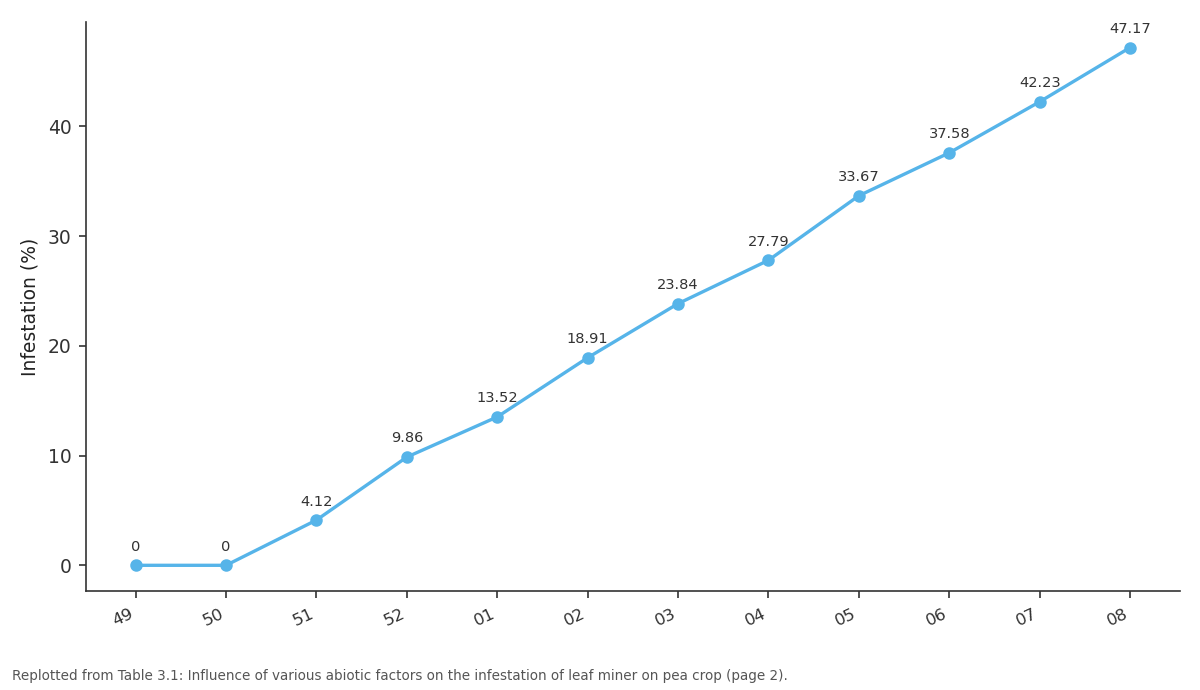
Infestation (%): 49 vs 50 vs 51 vs 52 vs 01
Replotted from Table 3 (page 2) of the original paper. Every bar is the paper's own table value.
View source evidence ↗Figures & tables
From the original paper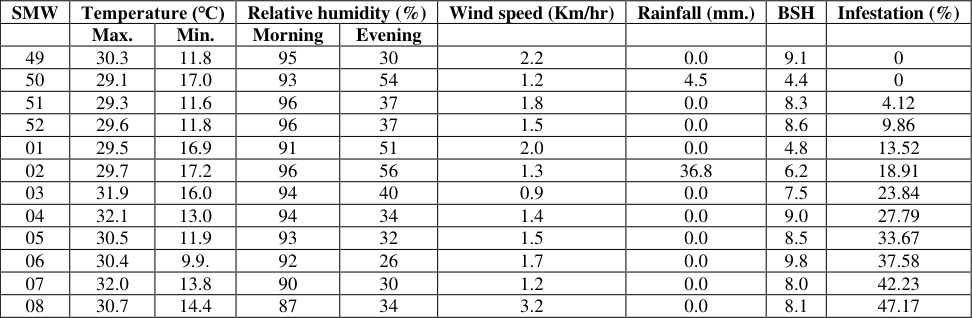 Table 3
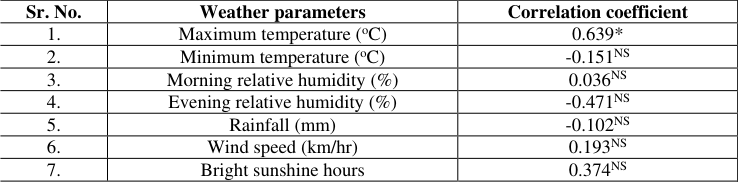 Table 3
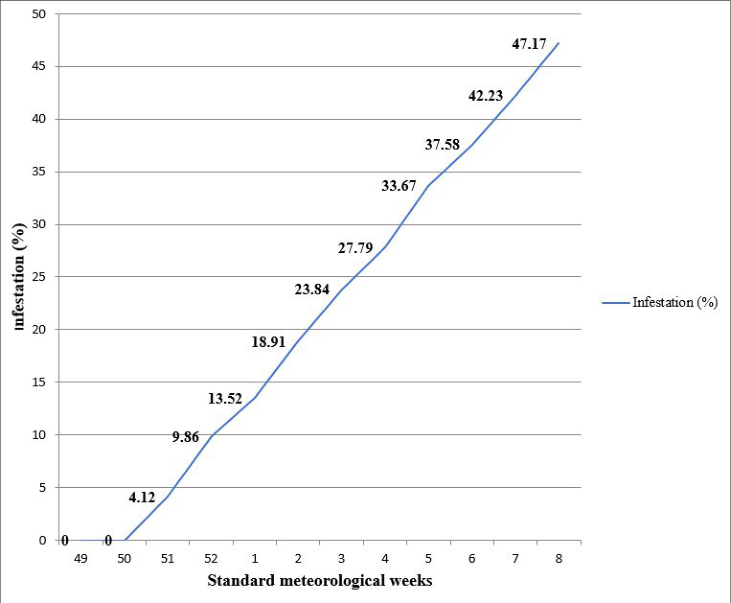 Figure 3
Introduction
Garden pea (Pisum sativum L.) is one of the most important legume crops in temperate climates and its classified by end use into field pea and garden pea. Pisum sativum is an herbaceous annual crop in the leguminaceae family. The crop is cultivated for its tender and immature pods for use as vegetable and mature dry pods for use as a pulse. Peas are highly nutritive and is a popular vegetable produced for its fresh shelled green seeds which are high in protein content (7.3 g/100 g), vitamin A (138 I.U.), calcium (21 mg), phosphorus (140 mg), energy (82 kcal), carbohydrates (14.7 g/100 g) and sugars (5.68 g per 100 g) of edible portion (Peter et al. 2012). It has a higher protein content, which includes critical amino acids like lysine. (Nawab et al. 2008) [8] . Garden Pea (Pisum sativum L.) is one of the most important Winter vegetable crops grown on commercial scale around the world and is consumed either as a fresh succulent vegetable or in processed form. India is the world's second-largest producer of peas, accounting for 21% of global output. Garden pea is a significant grain legume crop in India, which is primarily produced in the Rabi season and produces 54.22 thousand tonnes over an area of 5.40 thousand hectares. Maharashtra ranks 15 th among all states in India in terms of yearly production with 30.60 thousand tonnes. Over an area of 3.06 thousand ha. (Anonymous 2018) [1] .
Materials and Methods
Materials and Methods
Location of experiment
Studies on the seasonal incidence and management of pea leaf miner, C. horticola infesting pea (Pisum sativum. L) was carried out during Rabi season 2020 at experimental field of Entomology Section, College of Agriculture, Pune. This experiment was carried out on "Bonneville" pea variety.
Method of recording observations
The observation were recorded at weekly interval from germination to till harvest of the crop. For recording the leaf infestation percentage randomly ten plants per plot were tagged. Total number of leaves along with damaged or infested leaves of each plant were counted. Leaf infestation (%) was recorded using the formula
In order to know the seasonal incidence and calculation of per cent infestation of C. horticola on pea ten plants per plot were randomly selected and tagged for recording the observations. Numbers of mines and blistered patches on leaves of each tagged plant were recorded at weekly interval starting from the two weeks after germination till harvest of the crop. The obtained data were correlated with weather parameters (Temperature, relative humidity, wind velocity, rainfall and bright sunshine hours) to determine the correlation between per cent Infestation of C. horticola and the various weather parameters.
Results and discussion
Results and discussion
Seasonal incidence of leaf miner on pea crop
The infestation by the leaf miner was recorded from third week of December i.e. 51 th standard meteorological week (SMW) to last week of February i.e. 8 th SMW. The incidence of C. horticola on pea was commenced from third week of December (51 th SMW) and increase gradually end of crop season. The pest first appeared with 4.12 per cent infestation per plant during third week of December and continued up to 3 rd week of February. The infestation of pest ranges from 4.12 per cent in 51th SMW to 47.17 per cent in 8 th SMW. In the present study of leaf infestation (%) of leaf miner Chromatomyia horticola was first observed when the crop was at seedling or nursery stage and was available till maturity. The present findings are in conformity with Hemalatha and Maheswari (2004) [6] they observed that the pest appeared from nursery stage of the crop to the maturity of crop The infestation of leaf miner observed from 3 rd week of December to the last week of February (8 th SMW). In accordance with scientists Galande and Ghorpade (2010) [5] they reported that the maximum incidence of the pest was observed from January to April with highest incidence in the month of February. Mondol and Kumar (2012) [7] they observed the maximum infestation from 3 rd week of February to 2 nd week of March. Srivastava and Singh (1972) also reported maximum population on Pea leaf miner of pea in February and March.
SMW -Standard meteorological week BSH-Bright sunshine hours 3.2 Correlation studies between leaf miner infestation and weather parameters on pea.
The fluctuation in the infestation of leaf miner on pea crop in natural condition is largely depends on different types of abiotic factors like temperature, relative humidity, wind velocity, rainfall and bright sunshine hours etc. To know the effect of various weather parameters on the infestation of leaf miner on pea crop, a simple correlation was worked out between weekly mean infestation of leaf miner and weekly weather data of different weather parameters during research programme are presented in the table 4.2. Studies on correlation of pea leaf miner infestation with weather parameters revealed that the pea leaf miner infestation exhibited significant, positive correlation with maximum temperature (r=0.639) and non-significant negative correlation with minimum temperature (r= -0.151), non significant positive correlation with morning relative humidity (r=0.036), and non-significant negative correlation with evening relative humidity (r= -0.471), Wind velocity and sunshine hours showed non-significant positive correlation (=0.193), and r=0.374), respectively. However rainfall showed non-significant negative correlation (r=-0.102). This finding is in agreement with Mondol and Kumar (2012) [7] who observed negative and non-significant correlation of rainfall As per the result of Tamilnayagan et al. (2017) [10] population of L.trifoli had significant positive correlation with maximum temperature and relative humidity. The study conducted by Choudhary and Rosaiah (2000) [4] on the influence of weather parameters on the leaf miner incidence revealed that minimum temperature and evening relative humidity had negative correlation while wind velocity and sunshine hours showed positive correlation. As per the study of Chen et al. (1998) [3] on infestation of L. sativae on tomato crop and revealed that high temperatures found favourable for its reproduction and its population increased as per the study of Chen et al.
(1998) [3] on infestation of L. sativae on tomato crop and rapidly up to April. Increase in temperature in March 2 nd week onwards reported by Brar and Sandhu (1976) [2] . Rai and Ram (1997) [9] reported that weather parameters appeared to be the major regulatory factors for leaf miner infestation under field conditions. Minimum temperature ( o C) -0.151 NS 3.
Morning relative humidity (%) 0.036 NS 4.
Evening relative humidity (%) -0.471 NS 5.
Rainfall (mm) -0.102 NS 6.
Wind speed (km/hr) 0.193 NS 7.
Bright sunshine hours 0.374 NS
Figures and tables from the paper
| SMW | Temperature (℃) | — | Relative humidity (%) | — | Wind speed (Km/hr) | Rainfall (mm.) | BSH | Infestation (%) |
|---|---|---|---|---|---|---|---|---|
| Max. | Min. | Morning | Evening | |||||
| 49 | 30.3 | 11.8 | 95 | 30 | 2.2 | 0.0 | 9.1 | 0 |
| 50 | 29.1 | 17.0 | 93 | 54 | 1.2 | 4.5 | 4.4 | 0 |
| 51 | 29.3 | 11.6 | 96 | 37 | 1.8 | 0.0 | 8.3 | 4.12 |
| 52 | 29.6 | 11.8 | 96 | 37 | 1.5 | 0.0 | 8.6 | 9.86 |
| 01 | 29.5 | 16.9 | 91 | 51 | 2.0 | 0.0 | 4.8 | 13.52 |
| 02 | 29.7 | 17.2 | 96 | 56 | 1.3 | 36.8 | 6.2 | 18.91 |
| 03 | 31.9 | 16.0 | 94 | 40 | 0.9 | 0.0 | 7.5 | 23.84 |
| 04 | 32.1 | 13.0 | 94 | 34 | 1.4 | 0.0 | 9.0 | 27.79 |
| 05 | 30.5 | 11.9 | 93 | 32 | 1.5 | 0.0 | 8.5 | 33.67 |
| 06 | 30.4 | 9.9. | 92 | 26 | 1.7 | 0.0 | 9.8 | 37.58 |
| 07 | 32.0 | 13.8 | 90 | 30 | 1.2 | 0.0 | 8.0 | 42.23 |
| 08 | 30.7 | 14.4 | 87 | 34 | 3.2 | 0.0 | 8.1 | 47.17 |
Table text extracted from the original PDF; superscript letters are shown inline. The original table image is below.
View original table image
| Sr. No. | Weather parameters | Correlation coefficient |
|---|---|---|
| 1. | Maximum temperature (oC) | 0.639* |
| 2. | Minimum temperature (oC) | -0.151NS |
| 3. | Morning relative humidity (%) | 0.036NS |
| 4. | Evening relative humidity (%) | -0.471NS |
| 5. | Rainfall (mm) | -0.102NS |
| 6. | Wind speed (km/hr) | 0.193NS |
| 7. | Bright sunshine hours | 0.374NS |
Table text extracted from the original PDF; superscript letters are shown inline. The original table image is below.
View original table image
References
10 in the original paper- Anonymous. Peas production. Horti. Stat. at a glance, 2018, pp-10 and 198.
- Brar KS, Sandhu RS. Evaluation of techniques for the screening of different varieties of Brassica species to pea leaf miner. Phytomyza horticola (meigan) Agromyzidae: Diptera, Oilseed J. 1976;13(5):14-15.
- Chen YW, Chen PS. Infestation of Liriomyza sativae and the investigation on natural control. Guangdong Agri. Sci. 1998;9(2):33-35.
- Choudhary DPR, Rosaiah B. Seasonal occurrence of Liriomyza trifoli (Burgess) on tomato crop and its relation with weather parameters. Pest Manage. Econ. Zool. 2000;8(1):91-95.
- Galande SM, Ghorpade SA. Population dynamics of serpentine leaf miner (Liriomyza trifoli (Burgess) on tomato and its relation with meteorological parameters. J Universities. 2010;35(1):89-92.
- Hemalatha B, Maheswari TU. Biology and seasonal incidence of serpentine leaf miner, Liriomyza trifoli (Burgess) on tomato in southern zone of Andhra Pradesh. Indian J Entomol. 2004;66(2):107-110.
- Mondol D, Kumar A. Seasonal incidence of Chromatomyia horticola on pea annals Pl. Protec. Sci. 2012;20(1):225-227.
- Nawab NN, Subhani GM, Mahmood K, Shakil Q, Saeed A. Genetic variability, correlation and path analysis studies in garden pea (Pisum sativum L.). J. Agri. Res. 2008;46(4):333-340.
- Rai S, Ram D. Screening of French bean genotypes against leaf miner Phytomyza horticola Meigen. Vegetables science. 1997;24(1):58-60.
- Tamilnayagan T. Population dynamics of de foliator pests and two spotted spider mite of ash gourd. J Ent. and Zoo. Stud. 2017;5(3):293-296