
Research article · 2019 · Full text
International Journal of Biology SciencesDengue fever outbreak in the world
Volume 1(1) · Pages 23–27 · DOI: 10.33545/26649926.2019.v1.i1a.7 ↗
Research areasMosquito-borne diseases and control
Abstract
Author-writtenHundreds of children have been hospitalised with dengue fever in Phnom Penh and thousands of cases reported across Cambodia amid a major outbreak of the deadly disease. Several other south-east Asian nations are also battling a sharp spike in the number of dengue cases, according to the World Health Organisation, including Laos, Malaysia, the Philippines, Singapore and Vietnam. Cambodian Health Minister Mam Bunheng said on Thursday that 12,000 cases of the mosquito-borne disease had been reported nationwide and that 21 people had already died, according to local media. The Kantha Bopha foundation, which runs five hospitals, said on its Facebook page that as of Monday it had treated 4305 children for dengue as outpatients. A total of 2990 children had been diagnosed with a serious case of dengue and had been admitted for treatment and of that cohort, 577 children had been diagnosed with severe haemorrhagic dengue fever and 89 children had had surgery. Dengue fever is a virus carried and spread by mosquitoes and widespread throughout south-east Asia and in parts of far north Queensland. It causes flu-like symptoms, including high fever, muscle and joint pains, nausea and vomiting. In severe cases of dengue fever, it can cause internal bleeding, bleeding from the mouth and gums and can be fatal if the infection becomes severe and is not treated. Outside one of the Kantha Bopha hospitals in Phnom Penh on Thursday, more than 100 families were waiting for treatment for their children. Thirty-one year old Cambodian man Sophia, who only uses one name, from the provincial town of Pursat, cradled his 2½-year-old son Thearith in his arms. Sophia said his son had been sick with the virus for three days and he had travelled the 200 kilometres to Phnom Penh at the urging of his mother, who lives in the capital. "I got his blood tested, I was told that he got dengue fever his temperature had been up and down, between 37 and 38 degrees celsius," he said. "I got some medication to bring down his temperature. After the medicine had no more effect, he became hot again." It was when his son's temperature began to rise again that he took the decision to come to Phnom Penh and seek specialised care. "One of my siblings once had dengue haemorrhagic fever, and my mother brought him to this hospital. He recovered very quickly after getting medical treatment," he said. Phally, the mother of a four and a half month old baby girl, Noroyanash, had also travelled to Phnom Penh from Tbong Khmom province to seek medical care at the hospital after her daughter had had fever for four days. "Her body temperature was totally abnormal the doctor [in her home town] said that her condition is difficult, so he asked to refer her to the main hospital. He said that this hospital is specialised in treating children," she said. According to the WHO, dengue is a leading cause of serious illness and death in south-east Asia. There is no specific treatment for the virus but early detection and medical care, including maintaining the body's fluid levels and reducing fever with paracetamol, can reduce mortality rates. The WHO recently reported the number of cases in Cambodia was on the rise, compared to last year. In Malaysia, 52,941 cases and 81 deaths have ben reported in the first 22 weeks of 2019, twice the number that occurred in 2018, while in the Philippines 77,040 cases of dengue and 328 deaths have been reported - twice the number for the same period of time in 2018. In Laos, 4216 cases of dengue including 14 deaths - the highest figures for five years - had been reported. Vietnam has seen 59,959 cases and four deaths reported in the first 19 weeks of 2019 - three times the number for the same period in 2018, while Singapore has reported 3886 cases in the first 21 weeks of 2019 - four times the number of cases in 2018. Monash University professor Cameron Simmons, the director of the Oceania hub of the World Mosquito Program, said dengue was a seasonal disease throughout south-east Asia and that every few years, a sharp rise in cases of the virus occurred. "Some years are bigger than others. In the last two or three years, dengue incidents in southern Vietnam, Cambodia and Laos has been lower than average but what happens is it happens in cycles, there is a big epidemic every three to five years. It's quite possible that’s what we are facing at the moment. South Vietnam is also having a bigger year than the last couple of years," he said. "There is one particular mosquito, the Aedes Aegypti mosquito, that is the main domesticated mosquito that loves to feed on us, take blood from us, and it is an effective transmitter of dengue." "For travellers going to Cambodia and other parts of south-east Asia, there is always a risk. Australia typically has 500 to 1500 cases each year of Australian travellers returning from places like Thailand or Bali or Papua New Guinea Png with dengue, and being diagnosed in a hospital [when they return]." However, Professor Simmons said that a major program to stop the spread of dengue in far north Queensland had been largely successful. A report published in the journal Nature Microbiology on Monday warned that climate change could increase the spread of dengue around the world, including to the south-eastern United States, coastal areas of China and Japan and inland regions of Australia. There are 100 million cases of dengue infections reported around the world each year, and about 10,000 deaths. with The New York Times.
Summary
Source-checkedPlain-language reading of the full paper, prepared with AI and checked against the text. Each point links to the authors' own words.
Why it matters
- Dengue fever is recognized by the World Health Organization as a primary cause of severe illness and mortality in Southeast Asia. View evidence ↗
- Globally, dengue fever affects approximately 100 million people annually and results in about 10,000 deaths. View evidence ↗
- Climate change is projected to expand the geographic spread of dengue to new regions, including parts of the US, China, Japan, and Australia. View evidence ↗
The question
- The paper seeks to identify the geographic regions where the risk of contracting dengue fever is highest. View evidence ↗
- The paper examines the transmission mechanisms of the dengue virus and whether it can spread directly between humans. View evidence ↗
What they did
- The authors compiled data from global health organizations, including the WHO and CDC, to review outbreaks in Southeast Asia and other tropical/subtropical regions. View evidence ↗
- The review describes the use of the DENV Detect IgM Capture ELISA blood test as a diagnostic tool for the infection. View evidence ↗
What they found
- In the first 22 weeks of 2019, Malaysia reported 52,941 cases and 81 deaths, and the Philippines reported 77,040 cases and 328 deaths, both roughly double the figures from 2018. View evidence ↗
- Dengue is transmitted to humans through the bites of infected Aedes aegypti and Aedes albopictus mosquitoes. View evidence ↗
- The dengue virus is not contagious and cannot be transmitted directly from one person to another. View evidence ↗
- Typical dengue has a fatality rate under 1%, while dengue hemorrhagic fever (DHF) has a 2.5% fatality rate with treatment, which can rise to 20%-50% if left untreated. View evidence ↗
- In trials with over 40,000 participants, the Dengvaxia vaccine protected 66% of those aged 9+ against dengue, prevented 93% of severe cases, and reduced hospitalizations by 80%. View evidence ↗
What it means
- Because no specific antiviral treatment exists, the authors emphasize that early detection, fluid maintenance, and fever reduction are critical to lowering mortality. View evidence ↗
- The authors conclude that avoiding mosquitoes is the primary method for preventing the contraction of dengue fever. View evidence ↗
Visual summary
1 visualsIllustrations explain the paper; they do not show study data.
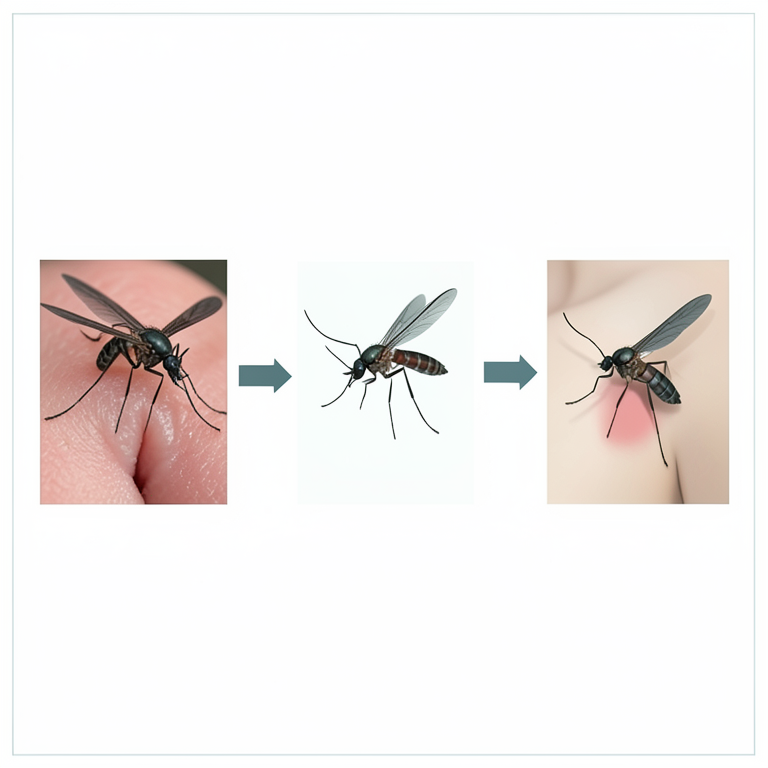
Dengue Transmission Cycle
AI-generated conceptual illustration (Aedes aegypti mosquitoes and human skin). It explains the idea and does not show study data.
View source evidence ↗Introduction
Dengue fever facts Dengue fever is a disease caused by a family of virus transmitted by Aedesmosquitoes. Symptoms of dengue fever include severe joint and muscle pain, swollen lymph nodes, headache, fever, exhaustion, and rash. The presence of fever, rash, and headache (the "dengue triad") is characteristic of dengue fever.
Dengue virus is prevalent throughout the tropics and subtropics.
A virus causes dengue fever, and there is no specific medicine or antibiotic to treat it. For typical dengue fever, the treatment DOI: https://doi.org/10.33545/26649926.2019.v1.i1a.7
is directed toward relief of the symptoms (symptomatic treatment). Papaya leaf extract can treat dengue fever. The acute phase of the illness with fever and muscle pain lasts about one to two weeks. Dengue hemorrhagic fever (DHF) is a specific syndrome that tends to affect children under 10 years of age. This complication of dengue causes abdominal pain, hemorrhage (bleeding), and circulatory collapse (shock). The prevention of dengue fever requires control or eradication of the mosquitoes carrying the virus that causes dengue. The U.S. FDA approved Dengvaxia, a vaccine for dengue fever, in May 2019 for use in dengue-endemic areas.
Dengue symptoms and signs
Primary symptoms of dengue appear three to 15 days after the mosquito bite and include the following: High fever and severe headache, With severe pain behind the eyes that is apparent when trying to move the eyes.
What is the incubation period for dengue fever?
After being bitten by a mosquito carrying the virus, the incubation period for dengue fever ranges from 3 Dengue fever starts with non-specific flu-like symptoms of chills, headache, pain in the back of the eyes that may worsen upon moving the eyes, appetite loss, feeling unwell (malaise), and low backache. Painful aching in the legs and joints occurs during the first hours of illness. The temperature rises quickly as high as 104 F (40 C), with relatively low heart rate (bradycardia) and low blood pressure (hypotension). The eyes redden. A flushing or pale pink rash comes over the face and then to 15 (usually 5 to 8) days before the signs and symptoms of dengue appear in stages disappears. The lymph nodes in the neck and groin are often swollen. High fever and other signs of dengue last for 2 to 4 days, followed by a rapid drop in body temperature (defervescence) with profuse sweating. This precedes a period with normal temperature and a sense of well-being that lasts about a day. A second rapid rise in temperature follows. A characteristic itchy rash (small red spots, called petechiae) appears along with the fever and spreads from the extremities to cover the entire body except the face. The palms and soles may be bright red and swollen.
What tests do health care providers use to diagnose dengue fever?
Medical professionals usually make a diagnosis of dengue fever infection when a patient exhibits the typical clinical symptoms and signs of headache, high fever, eye pain, severe muscle aches, and petechial rash and has a history of being in an area where dengue fever is endemic. Dengue fever can be difficult to diagnose because its symptoms overlap with those of many other viral illnesses and tropical diseases, such as West Nile virus and chikungunya fever. Health care professionals may use a blood test called the DENV Detect IgM Capture ELISA to diagnose people with dengue fever. The FDA notes that the test may also give a positive result when a person has a closely related virus, such West Nile disease.
What is the treatment for dengue fever?
Because a virus causes dengue fever, there are no specific antibiotics to treat it. Antiviral medications are also not indicated for dengue fever. For typical dengue, the treatment is concerned with relief of the symptoms and signs. Home remedies such as rest and fluid intake (oral rehydration) are important. Only take pain relievers such as aspirin and nonsteroidal anti-inflammatory drugs (NSAIDs) under a doctor's supervision because of the possibility of worsening bleeding complications. Acetaminophen (Tylenol) and codeine may be given for severe headache and for joint and muscle pain (myalgia).
Patients hospitalized for dengue may receive IV fluids
In several clinical studies, researchers proved that Carica papaya leaf extract (papaya leaf) is an effective treatment for dengue fever.
What types of doctors treat dengue fever?
A primary care provider (PCP), such as your family practitioner or internist, can treat your dengue fever symptoms. A pediatrician can treat your child. If symptoms are severe, you may see an emergency medicine doctor in a hospital emergency department.
How long does dengue fever last?
The acute phase of dengue with fever and muscle pain (myalgia) lasts about one to two weeks. A feeling of weakness (asthenia) and fatigue accompany convalescence, and full recovery often takes several weeks.
What is the prognosis for typical dengue fever?
The prognosis for dengue is usually good. The worst symptoms of the illness typically last 1 to 2 weeks, and most patients will fully recover within several additional weeks. Typical dengue infection is fatal in less than 1% of cases; however, the more severe dengue hemorrhagic fever is fatal in 2.5% of cases. If dengue hemorrhagic fever is not treated, mortality (death) rates can be as high as 20%-50%.
What is dengue hemorrhagic fever? Dengue hemorrhagic fever (DHF or dengue haemorrhagic fever) is a specific syndrome that tends to affect children under 10 years of age. This complication of severe dengue fever causes abdominal pain, hemorrhage (bleeding), and circulatory collapse (shock). DHF is also called Philippine, Thai, or Southeast Asian hemorrhagic fever or dengue shock syndrome. DHF starts abruptly with continuous high fever and headache. There are respiratory and intestinal symptoms with sore throat, cough, nausea, vomiting, and abdominal pain. Shock occurs 2 to 6 days after the start of symptoms with sudden collapse, cool, clammy extremities (the trunk is often warm), weak pulse, and blueness around the mouth (circumoral cyanosis). In DHF, there is bleeding with easy bruising, red or purple blood spots in the skin (petechiae), spitting up blood (hematemesis), blood in the stool (melena), bleeding gums, and nosebleeds (epistaxis). Pneumonia is common, and inflammation of the heart (myocarditis) may be present. People must closely monitor patients with DHF for the first few days since shock may occur or recur precipitously (dengue shock syndrome). Medical professionals will give cyanotic (having a bluish coloration to the skin and mucus membranes) patients oxygen. Vascular collapse (shock) requires immediate fluid replacement. Blood transfusions can control bleeding. The mortality (death) rate with DHF is significant. With proper treatment, the World Health Organization estimates a 2.5% mortality rate. However, without proper treatment, the mortality rate rises to 20%. Most deaths occur in children. Infants under 1 year of age are especially at risk of dying from DHF.
Is it possible to preventdengue fever with a vaccine?
In April 2016, the WHO approved Sanofi Pasteur's Dengvaxia (CYD-TDV), a live recombinant tetravalent vaccine for dengue fever. Dengvaxia can be administered as a three-dose series in people 9-45 years of age who live in areas where dengue is endemic. In clinical trials in Latin America and Asia involving more than 40,000 children and adolescents, Dengvaxia protected 66% of people aged 9 and older against dengue. Dengvaxia was very effective at protecting against severe dengue, which can be fatal, preventing 93% of severe cases, and reducing hospitalizations due to dengue by 80%. Health officials initially approved Dengvaxia in 2015 for use only in Mexico, the Philippines, Brazil, and El Salvador. In May 2019, the U.S. Food and Drug Administration approved the use of Dengvaxia for the prevention of dengue caused by all dengue virus serotypes (DENV-1, DENV-2, DENV-3, and DENV-4 --sometimes also referred to as DEN-1, DEN-2, DEN-3, and DEN-4) in people ages 9 through 16 who have laboratory-confirmed previous dengue infection and who live in endemic areas. In the U.S., dengue is endemic in the territories of American Samoa, Guam, Puerto Rico, and the U.S. Virgin Islands. Several other vaccines for dengue are undergoing clinical trials, but none have yet been approved for use.
Where can people get more information on dengue fever? "Dengue," Centers for Disease Control and Prevention http://www.cdc.gov/Dengue/
References
38 in the original paper- Ashikujaman Syed. Nipah Virus outbreak in the World. Int. J. Adv. Res. Biol. Sci. 2018; 5(9):131-138.
- Ashikujaman Syed. Up Dated Concepts of Cirrhosis'. Int. J. Adv. Res. Biol. Sci. 2019; 6(3):7-10.
- Ashikujaman Syed. Jaundice it is not a disease, it is a symptom of several possible underlying illnesses. Int. J. Curr. Res. Med. Sci. 2018; 4(11):16-26.
- Md Rashedul Islam Rashed, Ashikujaman Syed, Md Al Sabah, Mia Md Momin. Review of diabetes types and Care. Int. J. Curr. Res. Med. Sci. 2018; 4(11):27-32.
- Ashikujaman Syed. Alzheimer Disease Research. Int. J. Curr. Res. Med. Sci. 2018; 4(11):40-46.
- Ashikujaman Syed. 'Snake Bites Problem in over the world'. Int. J. Curr. Res. Med. Sci. 2019; 5(2):16-19.
- Ashikujaman Syed. 'A review of Filariasis'. Int. J. Curr. Res. Med. Sci. 2019; 5(2):26-30.
- Ashikujaman Syed. Ebola Virus Disease. Int. J. Curr. Res. Med. Sci. 2019; 5(3):18-23.
- Ashikujaman Syed. Antibiotic Use and Resistance. Int. J. Curr. Res. Med. Sci. 2019; 5(4):17-23.
- Ashikujaman Syed. 'Consanguineous marriages & Risk Factors'. Int. J. Curr. Res. Med. Sci. 2019; 5(4):24-30.
- Ashikujaman Syed. New Concepts of Tumour microenvironment. Int. J. Curr. Res. Med. Sci. 2019; 5(6):14-22.
- Ashikujaman Syed. Chikungunya Virus: An Infectious Disease. Int. J. Curr. Res. Biol. Med. 2018; 3(10):20-30.
- Ashikujaman Syed. Mixed Connective Tissue Disease (MCTD)' in the World. Int. J. Curr. Res. Biol. Med. 2018; 3(10):48-54.
- Ashikujaman Syed, Saptarshi Panigrahi, Somnath Surai. 'Body Check up in Diabetes Patients'. Int. J. Curr. Res. Biol. Med. 2019; 4(3):5-22.
- Ashikujaman Syed. Varicella -Zoster virus. Int. J. Curr. Res. Biol. Med. 2019; 4(4):10-14.
- Gubler DJ. Dengue and dengue hemorrhagic fever: its history and resurgence as a global public health problem. In: Gubler DJ, Kuno G, editors. Dengue and dengue hemorrhagic fever. New York: CAB International, 1997, 1-22.
- Wilson GW. Epidemic of dengue in the territory of Hawaii during 1903. Public Health Rep. 1904; 19:67-70.
- Usinger RI. Entomological phases of the recent dengue epidemic in Honolulu. Public Health Rep. 1944; 59:42330.
- Innis BL, Nisalak A, Nimmannitya S, Kusalerdchariya S, Chongwasdi V, Suntayakorn S, et al. An enzyme-linked immunosorbent assay to characterize dengue infections where dengue and Japanese encephalitis co-circulate. Am J Trop Med Hyg. 1989; 40:418-27.
- Kuno G. Factors influencing the transmission of dengue viruses. In: Gubler DJ, Kuno G, editors. Dengue and dengue hemorrhagic fever. New York: CAB International, 1997, 61-88.
- Reiter P, Lathrop S, Bunning M, Biggerstaff B, Singer D, Tiwari T, et al. Texas lifestyle limits transmission of dengue virus. Emerg Infect Dis. 2003; 9:86-9.
- Roehrig JT. Immunochemistry of viruses. In: Gubler DJ, Kuno G, editors. Dengue and dengue hemorrhagic fever. New York: CAB International, 1997, 199-219.
- Gubler DJ, Reed D, Rosen L, Hitchcock JR Epidemiologic, clinical, and virologic observations on dengue in the Kingdom of Tonga. Am J Trop Med Hyg. 1978; 27:581-9.
- Messer WB, Gubler DJ, Harris E, Sivananthan K, de Silva AM. Emergence and global spread of a dengue serotype 3, subtype III virus. Emerg Infect Dis. 2003; 9:800-9.
- Bennett SN, Holmes EC, Chirivella M, Rodriguez DM, Beltran M, Vorndam V, et al. Selection-driven evolution of emergent dengue virus. Mol Biol Evol. 2003; 20:16508.
- Moore CG. Aedes albopictus in the United States: current status and prospects for further spread. J Am Mosq Control Assoc. 1999; 15:221-7.
- Moore CG, Mitchell CJ. Aedes albopictus in the United States: ten-year presence and public health implications. Emerg Infect Dis. 1997; 3:329-34.
- Imported dengue-United States. MMWR Morb Mortal Wkly Rep. 1994; 43:97-9.
- Imported dengue-United States. MMWR Morb Mortal Wkly Rep. 1995; 44:353-6.
- Imported dengue-United States. MMWR Morb Mortal Wkly Rep. 1996; 45:988-91.
- Imported dengue-United States. MMWR Morb Mortal Wkly Rep. 1998; 47:544-7.
- Imported dengue-United States. MMWR Morb Mortal Wkly Rep. 2000; 49:248-53.
- Imported dengue-United States, 1999 and 2000. MMWR Morb Mortal Wkly Rep. 2002; 51:281-3.
- Ashikujaman Syed. In-vivo imaging study of distribution of liposoluble fluorescent drugs after epicardium-in-situ administration by ASD. Int. J. Adv. Res. Biol. Sci. 2019; 6(6):58-70.
- Monath Dengue TP. The risk to developed and developing countries. Proc Natl Acad Sci USA. 1994; 91:2395-400.
- Underdiagnosis of dengue-Laredo, Texas, 1999. MMWR Morb Mortal Wkly Rep. 2001; 50:57-9.
- Ashikujaman Syed. Immunotherapy: Challenges. Int. J. Adv. Multidiscip. Res. 2019; 6(6):26-32.
- Imported dengue-Florida, 1997-1998. MMWR Morb Mortal Wkly Rep. 1999; 48:1150-2.