
Research article · 2020 · Full text
International Journal of Biology SciencesCorona Virus Crices world wide
Volume 2(1) · Pages 01–02 · DOI: 10.33545/26649926.2020.v2.i1a.14 ↗
Research areasSARS-CoV-2 and COVID-19 ResearchAnimal Virus Infections StudiesViral gastroenteritis research and epidemiology
Abstract
Author-writtenCoronaviruses are pathogens with a serious impact on human and animal health. They mostly cause enteric or respiratory disease, which can be severe and life threatening, e.g., in the case of the zoonotic coronaviruses causing severe acute respiratory syndrome (SARS) and Middle East Respiratory Syndrome (MERS) in humans. Despite the economic and societal impact of such coronavirus infections, and the likelihood of future outbreaks of additional pathogenic coronaviruses, our options to prevent or treat coronavirus infections remain very limited. This highlights the importance of advancing our knowledge on the replication of these viruses and their interactions with the host. Interacting with the host cell to create an optimal environment for coronavirus replication, by altering host gene expression or by counteracting the host's antiviral defenses. These coronavirus-host interactions are key to viral pathogenesis and will ultimately determine the outcome of infection. Due to the complexity of the coronavirus proteome and replication cycle, our knowledge of host factors involved in coronavirus replication is still in an early stage compared to what is known for some other +RNA viruses. This review summarizes our current understanding of coronavirus-host interactions at the level of the infected cell, with special attention for the assembly and function of the viral RNA-synthesising machinery and the evasion of cellular innate immune responses
Summary
Source-checkedPlain-language reading of the full paper, prepared with AI and checked against the text. Each point links to the authors' own words.
Why it matters
- Coronaviruses are pathogens that significantly impact human and animal health, primarily causing respiratory or enteric diseases that can be life-threatening. View evidence ↗
- Preventative and treatment options for coronavirus infections are very limited despite their significant societal and economic impacts and the risk of future outbreaks. View evidence ↗
- Coronaviruses are responsible for approximately 15% to 30% of common cold cases. View evidence ↗
The question
- The objective of this review is to examine the types of human coronaviruses, their transmission methods, symptoms, and the specific dangers of SARS and MERS. View evidence ↗
What they did
- The authors conducted a review of current knowledge regarding coronavirus-host interactions, focusing on viral RNA-synthesising machinery and the evasion of the host's innate immune responses. View evidence ↗
What they found
- There are six identified types of human coronaviruses. View evidence ↗
- Common human coronaviruses such as types 229E, NL63, OC43, and HKU1 typically result in mild to moderate upper-respiratory tract illnesses. View evidence ↗
- Lower-respiratory tract illnesses like bronchitis or pneumonia can occur, particularly in infants, older adults, and those with weakened immune systems or cardiopulmonary disease. View evidence ↗
- SARS infected people across 37 countries, originating in China, and resulted in 774 deaths. View evidence ↗
- Reinfection can occur because coronavirus antibodies are short-lived and are often strain-specific. View evidence ↗
What it means
- The authors state that there are currently no available vaccines to protect against human coronavirus infections. View evidence ↗
- Knowledge of host factors in coronavirus replication is still in an early stage due to the complexity of the virus's replication cycle and proteome. View evidence ↗
Visual summary
1 visualsIllustrations explain the paper; they do not show study data.
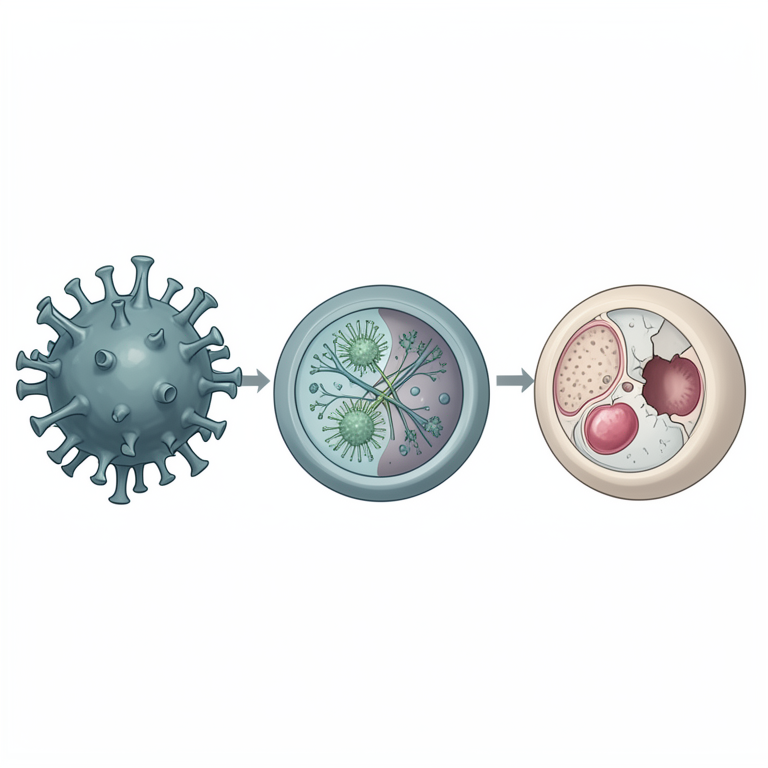
Study overview
AI-generated conceptual illustration (Human respiratory epithelial cells and coronaviruses). It explains the idea and does not show study data.
View source evidence ↗Introduction
Coronaviruses are types of viruses that typically affect the respiratory tract of mammals, including humans. They are associated with the common cold, pneumonia, and severe acute respiratory syndrome (SARS) and can also affect the gut. A coronavirus was first isolated in 1937 from an infectious bronchitis virus in birds that has the ability to seriously devastate poultry stocks. These viruses are responsible for between 15 and 30 percent of common colds. Over the last 70 years, scientists have found that coronaviruses can infect mice, rats, dogs, cats, turkeys, horses, pigs, and cattle [2] . This MNT Knowledge Center article will focus on the different types of human coronaviruses, their symptoms, how they are transmitted, and two particularly dangerous diseases that can be caused by coronaviruses: SARS and MERS. Fast facts on coronaviruses There is no cure for the common cold. A coronavirus causes both SARS and MERS [3] . Coronaviruses infect many different species. There are six known human coronaviruses. SARS spread from China to cause infection in 37 countries, killing 774 people. Coronaviruses Human coronaviruses (HCoV) were first identified in the 1960s in the noses of patients with the common cold. Two human coronaviruses are responsible for a large proportion of common colds OC43 and 229E. Coronaviruses were given their name based on the crown-like projections on their surfaces. "Corona" in Latin means "halo" or "crown." Among humans, infection most often occurs during the winter months as well as early spring. It is not uncommon for a person to become ill with a cold that is caused by a coronavirus and then catch it again about four months later. This is because coronavirus antibodies do not last for a very long time. Also, the antibodies for one strain of coronavirus may be useless against other strains. Symptoms Common human coronaviruses, including types 229E, NL63, OC43, and HKU1, usually cause mild to moderate upper-respiratory tract illnesses, like the common cold. Most people get infected with these viruses at some point in their lives. These illnesses usually only last for a short amount of time. Symptoms may include Runny nose Headache Cough Sore throat Fever A general feeling of being unwell Human coronaviruses can sometimes cause lowerrespiratory tract illnesses, such as pneumonia or bronchitis. This is more common in people with cardiopulmonary disease, people with weakened immune systems, infants, and older adults. Two other human coronaviruses, MERS-CoV and SARS-CoV have been known to frequently cause severe symptoms. MERS Symptoms usually include fever, cough, and shortness of breath which often progress to pneumonia. About 3 or 4 out of every 10 patients reported with MERS have died. MERS cases continue to occur, primarily in the Arabian Peninsula. SARS symptoms often included fever, chills, and body aches which usually progressed to pneumonia. No human cases of SARS have been reported anywhere in the world since 2004.
Transmission
Human coronaviruses most commonly spread from an DOI: https://doi.org/10.33545/26649926.2020.v2.i1a.14 infected person to others through The air by coughing and sneezing Close personal contact, such as touching or shaking hands Touching an object or surface with the virus on it, then touching your mouth, nose, or eyes before washing your hands Rarely, fecal contamination In the United States, people usually get infected with common human coronaviruses in the fall and winter. However, get infected at any time of the year. Most people will get infected with one or more of the common human coronaviruses in their lifetime [4] . Young children are [5] most likely to get infected. However, people can have multiple infections in their lifetime. Prevention and Treatment There are currently no vaccines available to protect against human coronavirus infection. Wash hands often [6] with soap and water for at least 20 seconds. Avoid touching eyes, nose, or mouth with unwashed hands. Protection Stay home while are sick Avoid close contact with others Cover mouth and nose with a tissue when you cough or sneeze, then throw the tissue in the trash and wash your hands Clean [7] and disinfect objects and surfaces
Treatment
There are no specific treatments for illnesses [8] caused by human coronaviruses. Most people with common human coronavirus illness will recover [9] on their own. Take pain and fever medications (Caution: do not give Aspirin to children) Use a room humidifier or take a hot shower to help ease a sore throat and cough Drink plenty of liquids [10] Stay home and rest [11] .
References
10 in the original paper- de Wilde AH, et al., Host Factors in Coronavirus Replication. Curr Top Microbiol Immunol, 2018; 419:142.
- Syed A. Coronavirus: A mini-review. Int. J. Curr. Res. Med. Sci. 2020; 6(1):8-10.
- Syed A. Nipah Virus outbreak in the World. Int. J. Adv. Res. Biol. Sci. 2018; 5(9):131-138.
- Syed A. Chikungunya Virus: An Infectious Disease. Int. J Curr. Res. Biol. Med. 2018; 3(10):20-30.
- Zaki AM, et al., Isolation of a novel coronavirus from a man with pneumonia in Saudi Arabia. N Engl J Med. 2012; 367(19):1814-20.
- Chen Y, Guo D. Molecular mechanisms of coronavirus RNA capping and methylation. Virol Sin. 2016; 31(1):311.
- Syed A. Ebola Virus Disease. Int. J Curr. Res. Med. Sci. 2019; 5(3):18-23.
- Syed, A., Immunotherapy: Challenges. Int. J. Adv. Multidiscip. Res, 2019. 6(6): p. 26-32.
- Syed A. Antibiotic Use and Resistance. Int. J. Curr. Res. Med. Sci. 2019; 5(4):17-23.
- Brian DA, Baric RS. Coronavirus genome structure and replication. Curr Top Microbiol Immunol, 2005; 287:130.
Cited by 2
From OpenAlex, OpenCitations and reference lists read by Scinovex
- Covid - 19 perception conforming its emergence, detection, treatment options and future prospects: A review ↗
Fatema Shorna, Shifat Sehrin Khan Upoma, Timothy Singh, Pritesh Ranjan Dash · International Journal of Pharmacognosy and Life Science · 2021
The sudden and unexpected outbreak of SARS-Covid-2 also known as Severe Acute Respiratory Syndrome- Corona virus disease-2 has nearly killed 2.86M people worldwide and approximately affected 132M lives, thus for humans the situation has become catastrophic. The situation now has become more serious and severe considering the SARS-COV spread in 2003 from camels. A cure or a vaccine still look…
❝ 1PDF - Effectiveness of virtual reality possibilities during COVID-19: A Study ↗
Bhavya HC, Shivakumar Kanasogi · International Journal of Advanced Mass Communication and Journalism · 2023
Life with unheard challenges of the 21st century flooded over the world with the spread of COVID-19 pandemic. This pandemic has not only impacted the physical health but also the living style of every individual. Technology played a vital role in helping us to get over it. As the Corona virus spreads, so do innovations to fight it in other…
❝ 0PDF