
Research article · 2019 · Full text
International Journal of Biology SciencesCoronavirus pandemic world wide
Volume 1(2) · Pages 25–26 · DOI: 10.33545/26649926.2019.v1.i2a.13 ↗
Research areasDiverse Scientific Research StudiesCOVID-19 and Mental Health
Abstract
Author-writtenCoronavirus is causing an outbreak first identified in Wuhan City, Hubei Province, China. Chinese health authorities have reported that patients have experienced fever, cough, difficulty breathing and pneumonia. Coronaviruses are named for the spikes that protrude from their membranes, like the sun’s corona. Such viruses cause several illnesses of the respiratory tract, ranging from the common cold to severe diseases like SARS. According to the World Health Organization, common signs of infection include fever, cough, and respiratory difficulties like shortness of breath. Serious cases can lead to pneumonia, kidney failure and even death.
Summary
Source-checkedPlain-language reading of the full paper, prepared with AI and checked against the text. Each point links to the authors' own words.
Why it matters
- Coronaviruses are viruses that primarily target the respiratory tract in mammals and humans, causing conditions ranging from the common cold to pneumonia and SARS. View evidence ↗
- A specific coronavirus outbreak was first identified in Wuhan City, Hubei Province, China. View evidence ↗
- Coronaviruses are significant contributors to respiratory illness, accounting for 15% to 30% of common colds. View evidence ↗
The question
- The objective of this article is to review the types of human coronaviruses, their symptoms, transmission methods, and the specific dangerous diseases SARS and MERS. View evidence ↗
What they did
- The authors conducted a review focusing on human coronavirus types, symptoms, transmission, and the diseases SARS and MERS. View evidence ↗
What they found
- There are six known types of human coronaviruses. View evidence ↗
- Human coronavirus types 229E, NL63, OC43, and HKU1 typically cause mild to moderate upper-respiratory illnesses such as the common cold. View evidence ↗
- MERS is highly severe, with a reported mortality rate of approximately 3 to 4 out of every 10 patients. View evidence ↗
- The SARS outbreak spread from China to 37 countries and resulted in 774 deaths. View evidence ↗
- Transmission occurs primarily via airborne droplets (coughing/sneezing), close personal contact, or touching contaminated surfaces; fecal contamination is rare. View evidence ↗
- Reinfection is possible because coronavirus antibodies are short-lived and strain-specific. View evidence ↗
- At the time of writing, there are no available vaccines to protect against human coronavirus infections. View evidence ↗
What it means
- The authors state there are no specific treatments for human coronaviruses, and most people with common infections recover spontaneously. View evidence ↗
- Prevention recommendations include frequent handwashing with soap and water for at least 20 seconds and avoiding touching the face with unwashed hands. View evidence ↗
Visual summary
1 visualsIllustrations explain the paper; they do not show study data.
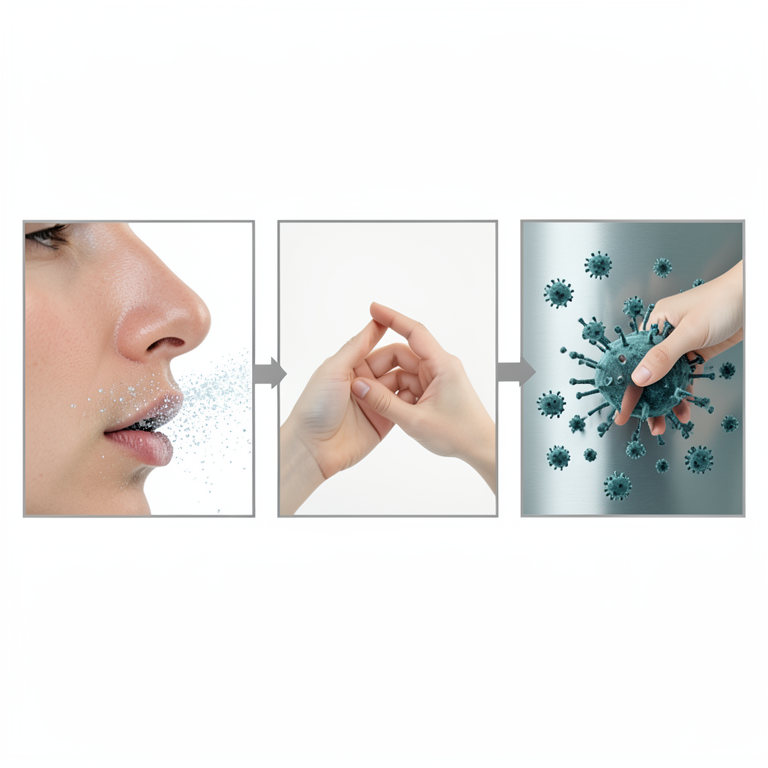
Transmission Pathways
AI-generated conceptual illustration (SARS-CoV-2 virus particles and human respiratory surfaces). It explains the idea and does not show study data.
View source evidence ↗Introduction
Coronaviruses are types of viruses that typically affect the respiratory tract of mammals, including humans [1] . They are associated with the common cold, pneumonia, and severe acute respiratory syndrome (SARS) and can also affect the gut [1] . A coronavirus was first isolated in 1937 from an infectious bronchitis virus in birds that has the ability to seriously devastate poultry stocks [1] . These viruses are responsible for between 15 and 30 percent of common colds [1] . Over the last 70 years, scientists have found that coronaviruses can infect mice, rats, dogs, cats, turkeys, horses, pigs, and cattle [2,3] . This MNT Knowledge Center article will focus on the different types of human coronaviruses, their symptoms, how they are transmitted, and two particularly dangerous diseases that can be caused by coronaviruses: SARS and MERS [1] .
Symptoms
Common human coronaviruses, including types 229E, NL63, OC43, and HKU1, usually cause mild to moderate upperrespiratory tract illnesses, like the common cold. Most people get infected with these viruses at some point in their lives [1] . These illnesses usually only last for a short amount of time [1] . Symptoms may include Runny nose Headache Cough Sore throat Fever A general feeling of being unwell Human coronaviruses can sometimes cause lower-respiratory tract illnesses, such as pneumonia or bronchitis [1] . This is more common in people with cardiopulmonary disease, people with weakened immune systems, infants, and older adults [1] . Two other human coronaviruses [1] , MERS-CoV and SARS-CoV have been known to frequently cause severe symptoms [1] . MERS symptoms usually include fever, cough, and shortness of breath which often progress to pneumonia [1] . About 3 or 4 out of every 10 patients reported with MERS have died [1] . MERS cases continue to occur, primarily in the Arabian Peninsula [1] . SARS symptoms often included fever, chills, and body aches which usually progressed to pneumonia [1] . No human cases of SARS have been reported anywhere in the world since 2004 [1,5] . DOI: https://doi.org/10.33545/26649926.2019.v1.i2a.13
Transmission
Human coronaviruses most commonly spread from an infected person to others through The air by coughing and sneezing Close personal contact, such as touching or shaking hands Touching an object or surface with the virus on it, then touching your mouth [1,6] , nose, or eyes before washing your hands Rarely, fecal contamination In the United States, people usually get infected with common human coronaviruses in the fall and winter [1,7] . However, get infected at any time of the year [1] . Most people will get infected with one or more of the common human coronaviruses in their lifetime [1] . Young children are most likely to get infected. However, people can have multiple infections in their lifetime [1] .
Prevention and Treatment
There are currently no vaccines available to protect against human coronavirus infection. Wash hands often with soap and water for at least 20 seconds [1] . Avoid touching eyes, nose, or mouth with unwashed hands [1] .
Protection
Stay home while are sick Avoid close contact with others Cover mouth and nose with a tissue when you cough or sneeze, then throw the tissue in the trash [1] and wash your hands Clean and disinfect objects and surfaces [1] .
Treatment
There are no specific treatments for illnesses caused by human coronaviruses. Most people with common human coronavirus illness will recover on their own [1] . Take pain and fever medications (Caution: do not give Aspirin to children) [1,5,7,26] Use a room humidifier or take a hot shower to help ease a sore throat and cough Drink plenty of liquids Stay home and rest [1,27] .
Acknowledgement
AcknowledgementsThe author wishes to thank Abu Nayem, National University of Bangladesh; Abu Sayem, Al-Shams, Alamin Bin Golam, Masum Rana, Jiangsu Agri-Animal Husbandry Vocational College, Taizhou, Jiangsu; China and Tajmin Nahar, Hebei College of Industry & Technology, China.
References
14 in the original paper- Syed A. Coronavirus: A mini-review. Int. J Curr. Res. Med. Sci. 2020; 6(1):8-10.
- Syed A. Nipah Virus outbreak in the World. Int. J Adv. Res. Biol. Sci. 2018; 5(9):131-138.
- Syed A. Ebola Virus Disease. Int. J Curr. Res. Med. Sci. 2019; 5(3):18-23.
- Syed A. Updated Concepts of Eclampsia, 2019.
- Syed, A., Therapeutic target of tumor microenvironment. Clin. Oncol. 2018, 15:366-381.
- Syed A. Jaundice it is not a disease, it is a symptom of several possible underlying illnesses. Int. J Curr. Res. Med. Sci. 2018; 4(11):16-26.
- Rashed MRI, et al., Review of diabetes types and Care. Int. J Curr. Res. Med. Sci. 2018; 4(11):27-32.
- Syed A. A review of Filariasis. Int. J Curr. Res. Med. Sci. 2019; 5(2):26-30.
- Syed A. Snake Bites Problem in over the world. Int. J Curr. Res. Med. Sci. 2019; 5(2):16-19.
- Syed A. Alzheimer Disease Research. Int. J Curr. Res. Med. Sci. 2018; 4(11):40-46.
- Syed A. Up Dated Concepts of Cirrhosis'. Int. J Adv. Res. Biol. Sci. 2019; 6(3):7-10.
- Syed A. New Concepts of Tumour microenvironment. Int. J Curr. Res. Med. Sci. 2019; 5(6):14-22.
- Syed A. Consanguineous marriages & risk factors. Int. J Curr. Res. Med. Sci. 2019; 5(4):24-30.
- Syed A. Coronavirus outbreak in the world. Int. J Adv. Res. Biol. Sci. 2019; 6(3):7-10.