
Research article · 2020 · Full text
International Journal of Biology SciencesAntioxidant evaluation of Moringa oleifera leaf extracts
Volume 2(1) · Pages 22–23 · DOI: 10.33545/26649926.2020.v2.i1a.19 ↗
Research areasMoringa oleifera research and applications
Abstract
Author-writtenMoringa oleifera is a promising plant having different therapeutic effects especially its leaf extracts having anticancer, antioxidant activities. In our study, we evaluate the antioxidant activity of Moringa oleifera leaf extracts.
Summary
Source-checkedPlain-language reading of the full paper, prepared with AI and checked against the text. Each point links to the authors' own words.
Why it matters
- Moringa oleifera leaves contain polyphenols and poly flavonoids, which act as antioxidants and may have anticancer properties. View evidence ↗
- Oxidative stress, caused by an imbalance between free radical production and antioxidant elimination, is a contributing factor to cancer. View evidence ↗
- Antioxidants help prevent cancer by reducing oxidative stress and disrupting the formation of free radicals. View evidence ↗
The question
- The study aims to evaluate the antioxidant activity of leaf extracts from Moringa oleifera. View evidence ↗
What they did
- The researchers used two methods to assess antioxidant activity: the DPPH radical scavenging assay and the ABTS radical cation decolourization assay. View evidence ↗
- The study tested leaf extracts prepared using three different solvents: methanol, ethanol, and acetone. View evidence ↗
- For the DPPH assay, optical density (OD) was measured at 518 nm using a double beam spectrophotometer. View evidence ↗
- For the ABTS assay, absorbance was measured at 745 nm. View evidence ↗
What they found
- In the ABTS assay, the IC50 values were 0.97 ± 0.01 mg/ml for methanol, 0.54 ± 0.02 mg/ml for ethanol, and 0.33 ± 0.02 mg/ml for acetone. View evidence ↗
- In the DPPH assay, the IC50 values were 1.74 ± 0.02 mg/ml for methanol, 1.18 ± 0.03 mg/ml for ethanol, and 0.85 ± 0.03 mg/ml for acetone. View evidence ↗
- The differences in antioxidant activity between methanol, ethanol, and acetone extracts in the ABTS assay were all highly significant (p < 0.001). View evidence ↗
- The differences in antioxidant activity between the three solvents in the DPPH assay were also highly significant (p < 0.001). View evidence ↗
What it means
- The authors conclude that the methanolic leaf extract exhibits the highest antioxidant activity among the tested solvents. View evidence ↗
- The authors suggest that because of its high radical scavenging activity, the extract may arrest cancer cell proliferation and serve as a drug source for various diseases. View evidence ↗
- The authors state that more research is needed to further study the antioxidant activities of Moringa oleifera. View evidence ↗
Visual summary
3 visualsIllustrations explain the paper; charts are replotted from the paper's own table values.
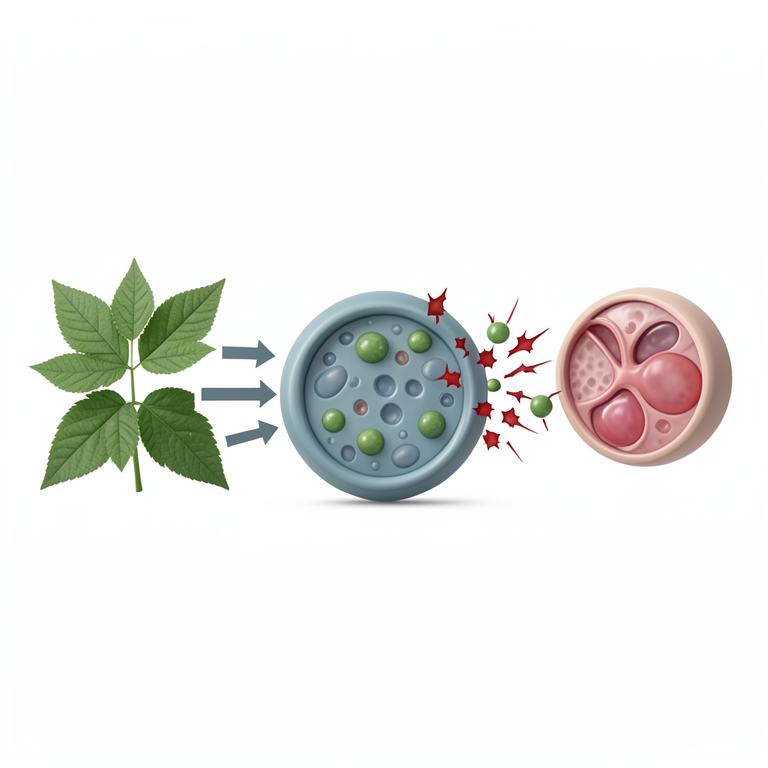
Antioxidant Mechanism
AI-generated conceptual illustration (Moringa oleifera leaves and a generic animal cell). It explains the idea and does not show study data.
View source evidence ↗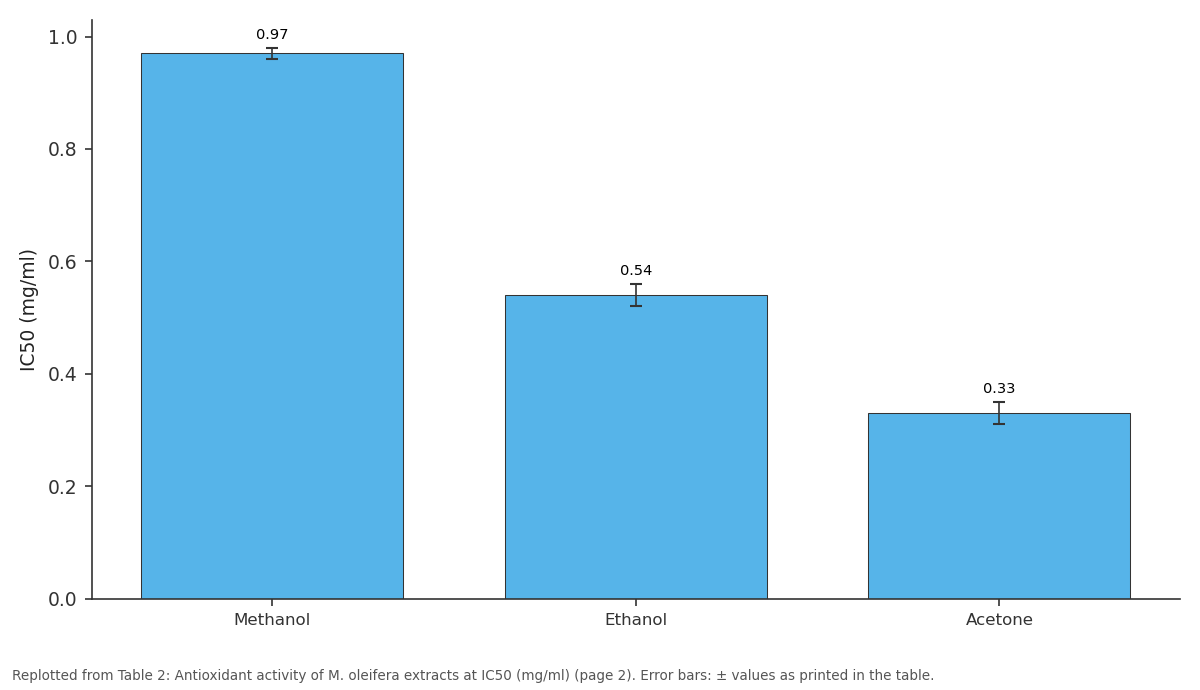
ABTS: Methanol vs Ethanol vs Acetone
Replotted from Table 2 (page 2) of the original paper. Every bar is the paper's own table value.
View source evidence ↗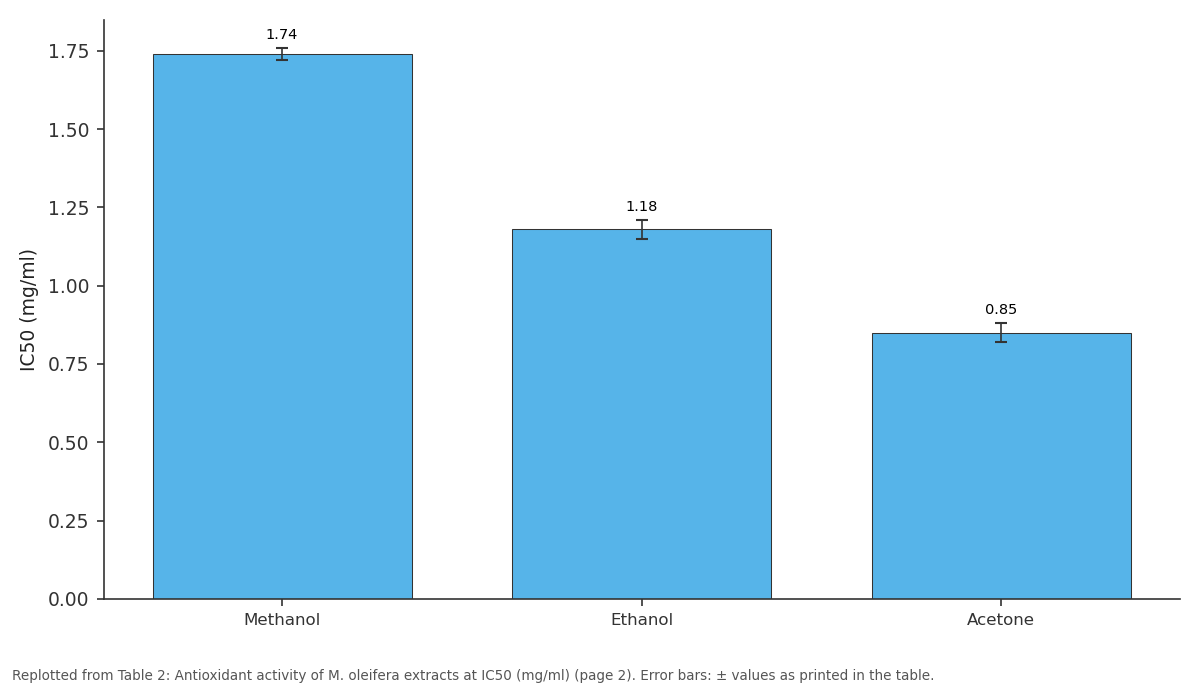
DPPH: Methanol vs Ethanol vs Acetone
Replotted from Table 2 (page 2) of the original paper. Every bar is the paper's own table value.
View source evidence ↗Figures & tables
From the original paper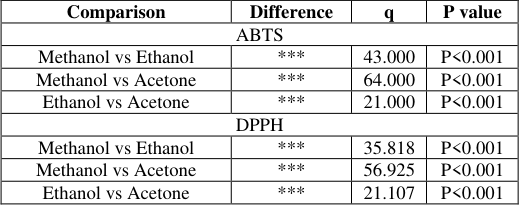 Table 1
 Table 2
Introduction
The Moringa tree is an evergreen that grows new leaves yearround, with a projected production of six tons per hectare per year. The leaves are rich in polyphenols and poly flavonoids, which are antioxidants and potential anticancer compounds (Abdulrahman, K. A. et. al 2015) [2] many researchers start by exploring the antioxidant activity and anti-inflammatory activity of the leaf extracts as a preliminary screening for anticancer activity. One of the factors that cause cancer is oxidative stress which is an imbalance in the production of free radicals and oxidants and their elimination by antioxidants (Abdulaziz Rabiu Abdulkadir et. al 2015) [1] . Antioxidants can disrupt the formation of free radicals and reduce oxidative stress, which ultimately prevents cancer.
Materials and Methods
The antioxidant activity of the leaf extracts was assessed by the following methods like DPPH radical scavenging assay and ABTS radical Cation Decolourization assay.
Antioxidant Activity of Moringa oleifera Leaf Extracts The assessment of antioxidant activities of the Moringa oleifera leaf extracts were evaluated by the following assays DPPH radical scavenging activity
The DPPH free radical scavenging activity for the Moringa oleifera leaf extracts was determined based on the method followed by (Mensor, et. al., 2001). Different concentrations of crude leaf extracts of Moringa oleifera was mixed with the 0.5ml of Methanolic DPPH. The mixture was incubated for 30 minutes at normal room temperature. Methanol alone served as a blank and Methanolic DPPH without the leaf extract served as a positive control for this assay. After incubation, the OD was measured at 518 nm using double beam spectrophotometer. The radical scavenging activity was calculated using the formula, Scavenging activity (%)=A 518 (Std)-A 518 (blank)/A 518 (blank) × 100.
ABTS Radical Cation Decolourization Assay
The ABTS assay for the Moringa oleifera leaf extracts was determined based on the procedure described by (Shirwaikar, et al., 2006). In this, the ABTS cationic radicals were produced when the ABTS solution was mixed with the ammonium persulphate. The solution was incubated in a dark place at room temperature for 12 -16 hrs. 0.5 ml of the leaf extracts were added to the 0.3ml of the ABTS solution and it was made upto 1ml with the ethanol. The absorbance was measured at 745 nm. The % of inhibition of the leaf extracts were calculated using the above formula.
Results and discussion
The antioxidant property of Moringa oleifera leaf extract in different solvents was assessed by two different methods like ABTS and DPPH assays. The inhibitory concentration of the ABTS assay for the different solvents was found to be high in the Methanolic extract followed with the Ethanolic leaf extract whereas it was found to be low in the acetone extract (Figure . 1) and the inhibitory concentration of the DDPH assay was found to be higher in Methanolic extract followed with the ethanol and acetone extracts (Figure . 2). The IC50 values in mg/ml for the ABTS and DPPH assays was found to be high in the Methanolic extract with the range of about 0.97 ± 0.01 and 1.74 ± 0.02 whereas very low in the Acetone extracts with the range of about 0.33 ± 0.02 and 0.85 ± 0.03 and it was found to be 0.54 ± 0.02 and 1.18 ± 0.03 in the Ethanolic leaf extract Comparative analysis antioxidant activity of different solvents of Moringa oleifera leaf was highly significant in all the solvents in the ABTS assay with the p-value of about <0.001 and q value of about 43.000, 64.000 and 21.000 mg/ml whereas significant in all the solvents in the DPPH assay with the p-value of about <0.001 and q value of about 35.818, 56.925 and 21.107 mg/ml DOI: https://doi.org/10.33545/26649926.2020.v2.i1a.19
Conclusion
Though Moringa oleifera was established for its prospective medicinal values, more researches have to be carried out to study its antioxidant activities. Hence, the methanol, ethanol and acetone extracts of Moringa oleifera leaf was evaluated for its antioxidant activities. Another report suggested that the antioxidant activity was found to be higher in the methanolic extract when compared with the other extract used in the previous study (Abdulaziz, et al., 2015). Many plant species possess antioxidant activity due to the presence of phenolic substances. In such way, the leaf sample of the Moringa possesses a high amount of antioxidant properties when compared with the other parts (Chumark, et al., 2008;Sreelatha and Padma, 2009). Ukachi, et al., 2015, reported that the methanolic leaf extract of Moringa oleifera possesses antioxidant activity when compared with the ethyl acetate extract. Hence, due to its high radical scavenging activity, it also possesses the property of arresting the cancer cell proleiferation and it can be used as a drug source for treating many diseases. The antioxidant assays such as ABTS and DPPH radical scavenging activity (Charoensin, 2014). The present study (Table .14) promotes that among the different solvents like methanol, ethanol and acetone the Methanolic leaf extract exhibits the high antioxidant activity with the IC 50 rages about 0.97 ± 0.01 and 1.74 ± 0.02 for the ABTS and DPPH assays)
Acknowledgement
AcknowledgementAuthors wants to thanks all for help and support
Figures and tables from the paper
| Comparison | Difference | q | P value |
|---|---|---|---|
| ABTS | |||
| Methanol vs Ethanol | *** | 43.000 | P<0.001 |
| Methanol vs Acetone | *** | 64.000 | P<0.001 |
| Ethanol vs Acetone | *** | 21.000 | P<0.001 |
| DPPH | |||
| Methanol vs Ethanol | *** | 35.818 | P<0.001 |
| Methanol vs Acetone | *** | 56.925 | P<0.001 |
| Ethanol vs Acetone | *** | 21.107 | P<0.001 |
Table text extracted from the original PDF; superscript letters are shown inline. The original table image is below.
View original table image
| Solvents | ABTS | DPPH |
|---|---|---|
| Methanol | 0.97 ± 0.01 | 1.74 ± 0.02 |
| Ethanol | 0.54 ± 0.02 | 1.18 ± 0.03 |
| Acetone | 0.33 ± 0.02 | 0.85 ± 0.03 |
Table text extracted from the original PDF; superscript letters are shown inline. The original table image is below.
View original table image
References
6 in the original paper- Abdulaziz Rabiu Abdulkadir, Dhiya Dalila Zawawi, Sarwar Jahan MD. DPPH antioxidant activity, total phenolic and total flavonoid content of different part of Drumstic tree (Moringa oleifera Lam). J. Chem. Pharm. Res. 2015; 7(4):1423-1428.
- Abdulrahman KA, Sulaiman MA, Tanwir Athar MD, Abdul QK, Hamoud S. Moringa oleifera as an AntiCancer Agent against Breast and Colorectal Cancer Cell Lines. Journal. Pone, 2015, 01.
- Adam Hermawan, Kholid Alfan Nur, Sarmoko, Dyaningtyas Dewi, Pamungkas Putri, Edy Meiyanto et al. Ethanolic extract of Moringa oleifera increased cytotoxic effect of doxorubicin on HeLa cancer cells. Journal of Natural Remedies. 2012; 12(2):108-114.
- Amaglo NK, Bennet RN, Lo Curto RB, Rosa EAS, Crea F. Profiling selected phytochemicals and nutrients in different tissues of the multipurpose tree Moringa oleifera Lam. grown in Ghana. Food. Chem. 2010; 122:10471054.
- Hermawan A, Nur KA, Sarmoko D, Dewi P, Putri E, Meiyanto et al. Ethanolic extract of Moringa oleifera increased cytotoxic effect of doxorubicin on HeLa cancer cells. J. Nat. Remedies. 2012; 12:108-114.
- Bashandy MA, Ibrahim DF, Hasan HF, El-Sharkawy MA. Effect of Punica granatum seeds on doxo rubicin and gamma radiation-induced hepatotoxicity in Wistar rats. Int J Biol Res. 2019;4:44-50.
Cited by 7
From OpenAlex, OpenCitations and reference lists read by Scinovex
- Moringa oleifera: An edible medicinal plant ↗
Chandreyi Ghosh, Moumita Saha, Amrita Chakraborty, Pranabesh Ghosh, Sirshendu Chatterjee · International Journal of Herbal Medicine · 2023
Moringa oleifera (Family–Moringaceae) is a native plant of India but also seen in tropical and sub-tropical region of the world. It is commonly known as “drumstick tree” but in Bengali it is known as “Sajne.” Every part of the plant is rich in nutritive components. The leaves, bark, roots, pods and flowers are rich in essential vitamins, minerals and phytochemicals.
- Antioxidant activity of Moringa oleifera Lam ↗
Zeeshan Nisar, Manik Sharma, Jagrati Tripathi, Rajendra Chauhan · International Journal of Fauna and Biological Studies · 2022
The leaves of Moringa oleifera Lam were extracted in Methanol, Petroleum ether, and ethyl acetate, and chemical detection of biotic compounds in extracts was carried out. The TLC indicates the presence of quercetin, rutin, and luteolin, and the total flavonoid and antioxidant activity of the extract show high antioxidant activity.
- Formulation and evaluation of herbal hair oil ↗
Melvin Sabu, Oleeviya Sojan, C.K. Prathibha, Kavitha Pn, Saraswathi Cd · National Journal of Pharmaceutical Sciences · 2021
Herbal formulations always have lesser or no side effects comparatively with synthetic. The aim of present study involves preparation of herbal hair oil using the herbal ingredients like, Amla, Hibiscus, Bhringaraj, Watermelon seed, Moringa, Curry leaves, Guava leaves, Papaya leaves, Methi, Mimosa Pudica and Spring onion. Based on the above observations, mixture of crude drugs was prepared in the form
❝ 1Found by Scinovex - Moringa oleifera: Review on herbal healing properties and Nutritional values
Rakhi Das, Ranju Khatiwada, Rezina Pradhan, Rishav Das, Sarashwati Karn, Ravi Bhushan Sharma · International Journal of Advanced Biochemistry Research · 2023
Despite being indigenous to India, Nepal, and the highlands of the Himalayas, Moringa oleifera flourishes in all tropical and subtropical regions of the world. Drumsticks or horseradish trees are frequently used for this plant. The Moringa plant is affordable, readily available, and extremely nutritious, and it is widely used for its therapeutic properties. The little softwood tree Moringa oleifera grows swiftly and adapts well to a dry, sandy environment. Moringa plants include substances that are anti-inflammatory, anti-cancer, anti-tumour, cardiovascular, and central nervous system support.
- Effect of Moringa oleifera soup on selected biophysiological parameters among adult with hypercholesterolemia working in selected tertiary care hospital ↗
Priya A, J. Sheela., Kalaivani ., Malarvizhi S, Mony K, Ravichandran K · International Journal of Advance Research in Nursing · 2023
Background: “Effect of Moringa oleifera soup on selected bio physiological parameters among adult with hypercholesterolemia working in selected tertiary Care Hospital”. Hypercholesterolemia is also called as dyslipidaemia or hyperlipidaemia. In past 20 years it is found that the threat of death related to disorders of abnormal lipid metabolism is increased upto 30%. Moringa oleifera is found to be economically and…
❝ 0PDF - Moringa: Natural gift as a miraculous tree ↗
Maya Y Gaikwad · International Journal of Pharmacognosy and Life Science · 2021
The Moringa species having much more health benefits. It consists of large amount of vitamins, amino acids and minerals. Moringa species contain various phytoconstituents such as alkaloids, saponins, tannins, steroids, phenolic acids, glucosinolates, flavonoids, and terpenes. This review mainly focuses on various species of Moringa along with its pharmacological activity. It also emphasize on the species of Moringa available throughout…
❝ 0PDF - Anticancer evaluation of Moringa oleifera leaf extracts against lung cancer cell lines ↗
M. Sharma, SB Sharma · International Journal of Bioscience and Biochemistry · 2021
Moringa oleifera is a promising anticancer plants especially its leaf extracts having anticancer activities. In our study, we evaluate the anticancer activity of Moringa oleifera leaf extracts against A549 cell lines. The present investigate states that the percentage of cell inhibition of methanolic extract was found to be high against the A549 Cancer cell lines.