
Research article · 2021 · Full text
International Journal of Statistics and Applied MathematicsGenetic algorithm approach to cluster analysis
Volume 6(5) · Pages 147–150
Research areasAdvanced Clustering Algorithms Research
Abstract
Author-writtenIn this paper, performance of Genetic Algorithm based clustering method has been compared with conventional clustering methods that are K-means and Ward’s clustering methods. The cluster quality has been compared using three cluster validity indices that are Calinski-Harabasz, Dunn and Average Silhouette Width. The results showed that genetic algorithm based clustering method performed better than other clustering methods under all the three cluster validity measures.
Summary
Source-checkedPlain-language reading of the full paper, prepared with AI and checked against the text. Each point links to the authors' own words.
Why it matters
- Conventional partitional clustering techniques, like K-means, use a greedy search method to optimize how compact clusters are. View evidence ↗
- A major drawback of conventional clustering algorithms is that they can get stuck in local optimum solutions based on the initial cluster centers. View evidence ↗
- Conventional methods may fail to cover diverse dataset characteristics because they optimize only one validity index and require the number of clusters to be defined beforehand. View evidence ↗
The question
- The study aims to compare the performance of a Genetic Algorithm (GA) based clustering method against conventional K-means and Ward’s clustering methods. View evidence ↗
What they did
- The dataset consisted of 60 genotypes, each characterized by 8 attributes: 5 numeric variables and 3 categorical variables. View evidence ↗
- Cluster quality was evaluated using three specific validity indices: Average Silhouette Width, Dunn, and Calinski-Harabasz. View evidence ↗
- The GA method improves population quality over generations using selection, crossover, and mutation operators. View evidence ↗
What they found
- The GA method achieved a higher Average Silhouette Width (0.428) compared to K-means (0.207) and Ward's method (0.190). View evidence ↗
- The GA method also showed the highest Calinski-Harabasz index (18.482), slightly exceeding K-means (18.462) and Ward's method (17.158). View evidence ↗
- Across all three validity measures, the GA-based clustering method outperformed the conventional K-means and Ward's methods. View evidence ↗
What it means
- The authors conclude that Genetic Algorithms serve as an effective global optimization tool to avoid local optima and find the global optimum for cluster validity. View evidence ↗
- The authors state that GA is superior to K-means and Ward's methods based on the three indices tested. View evidence ↗
Visual summary
3 visualsIllustrations explain the paper; charts are replotted from the paper's own table values.

Local vs Global Optima
AI-generated conceptual illustration (A 3D mathematical landscape of undulating hills and valleys). It explains the idea and does not show study data.
View source evidence ↗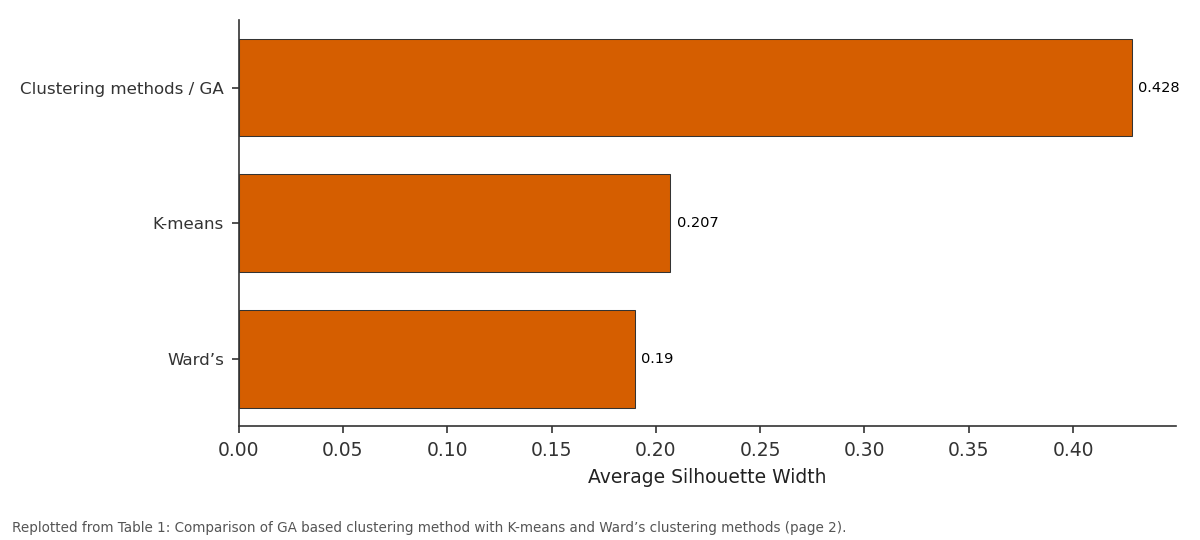
Average Silhouette Width: Clustering methods / GA vs K-means vs Ward’s
Replotted from Table 1 (page 2) of the original paper. Every bar is the paper's own table value.
View source evidence ↗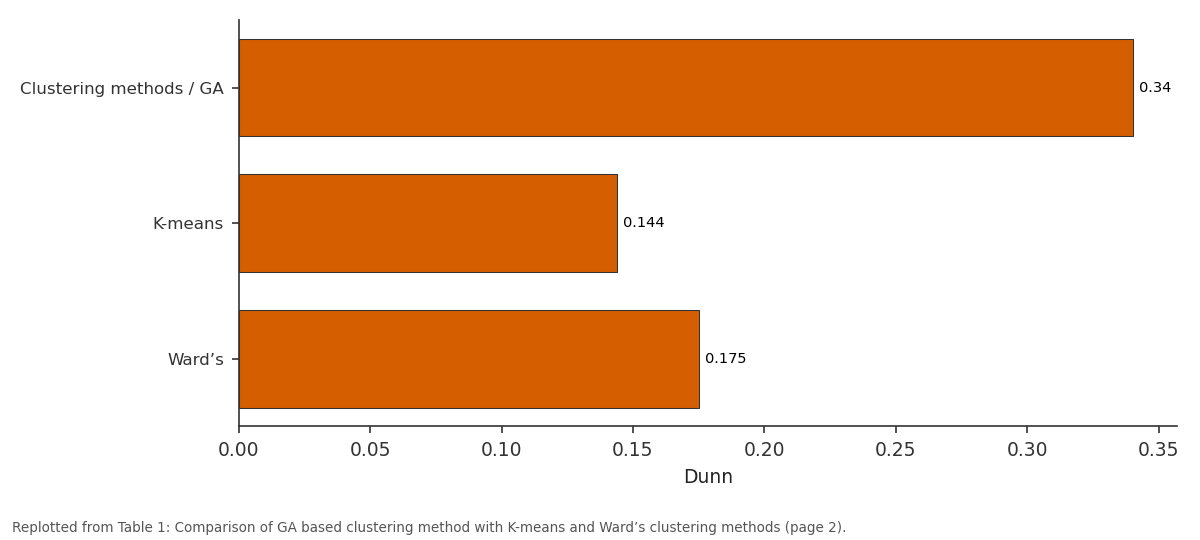
Dunn: Clustering methods / GA vs K-means vs Ward’s
Replotted from Table 1 (page 2) of the original paper. Every bar is the paper's own table value.
View source evidence ↗Figures & tables
From the original paper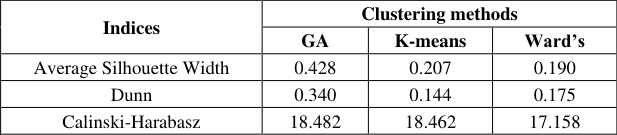 Table 1
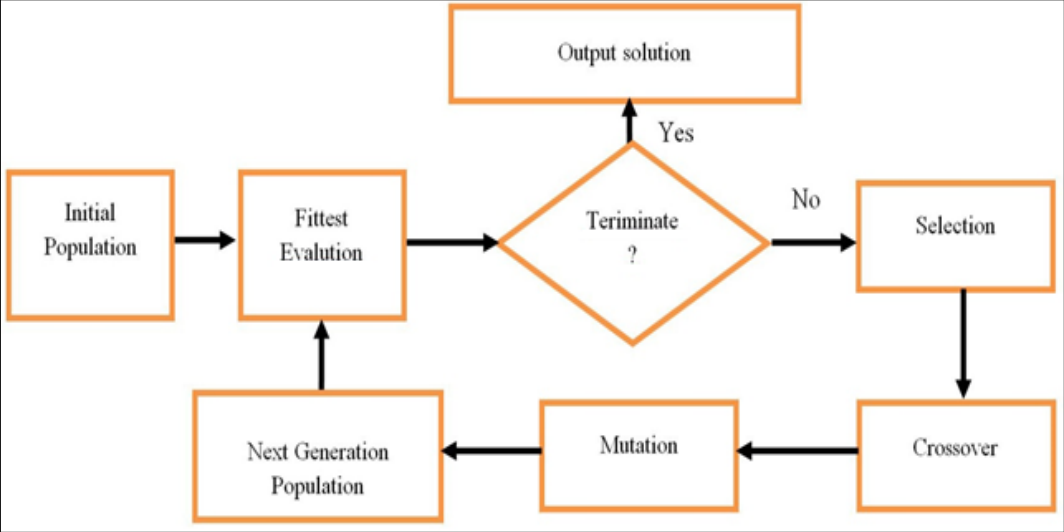 Figure 1
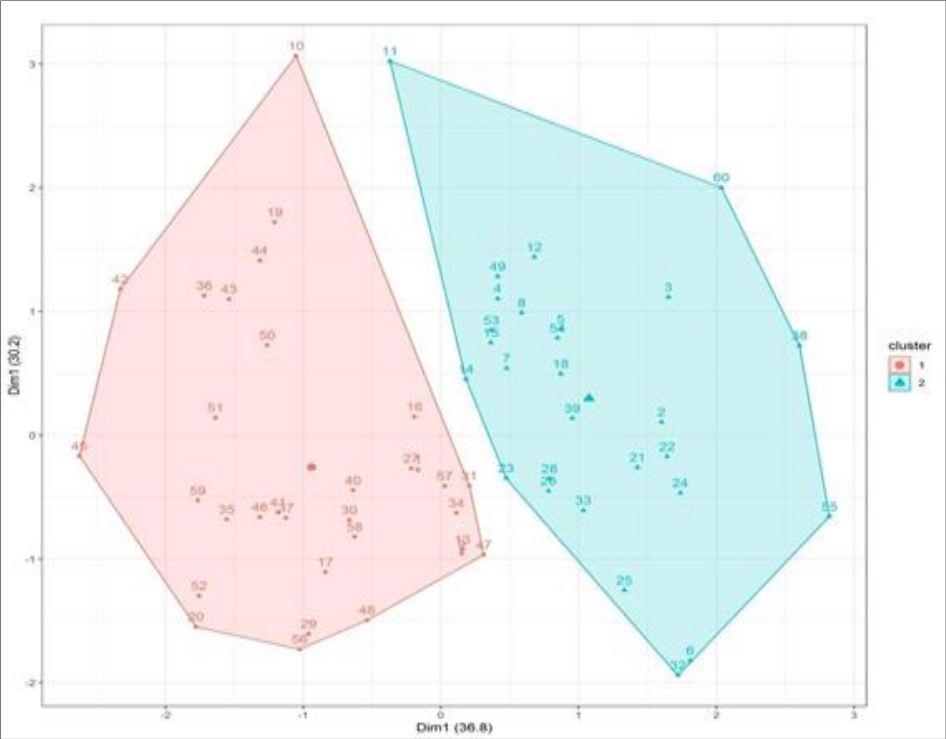 Figure 2
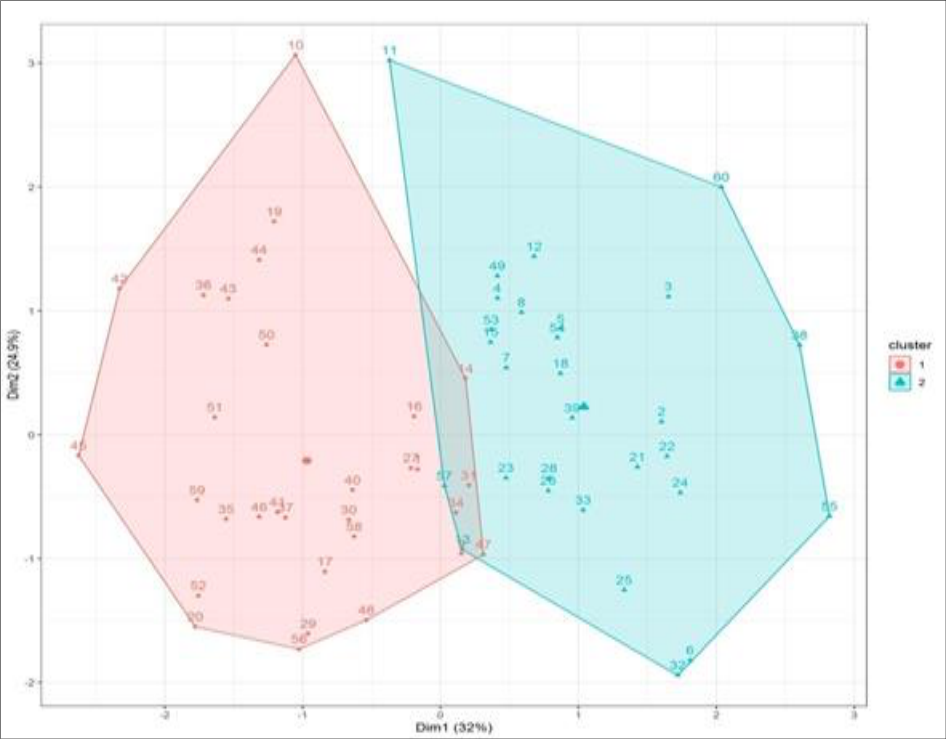 Figure 3
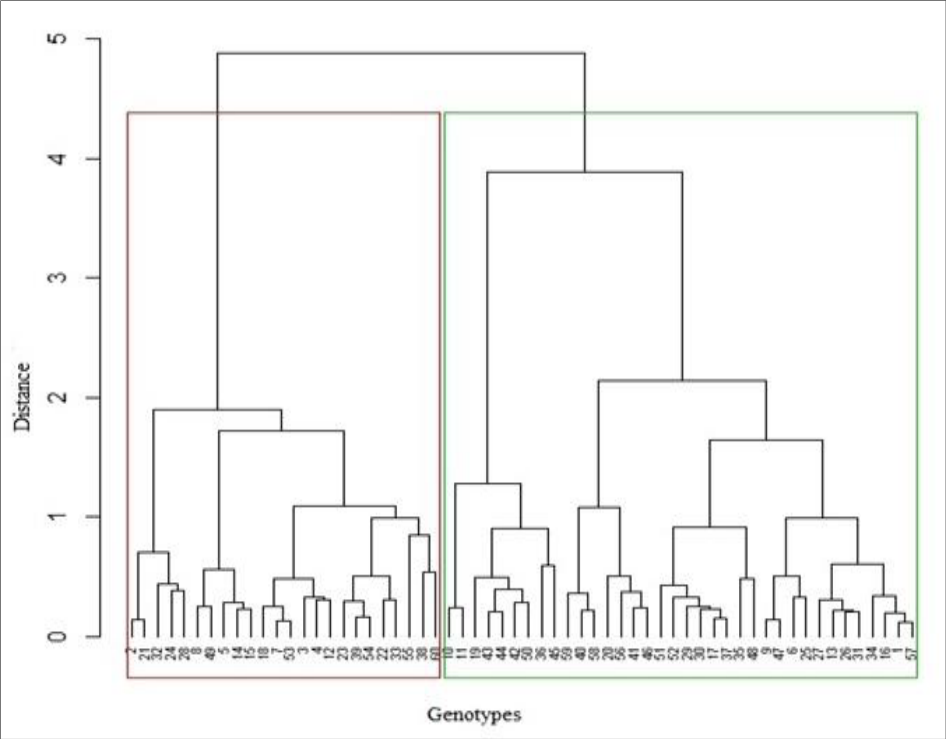 Figure 4
Introduction
Genetic Algorithm (GA) was introduced by Holland (1975) [3] and later it was described by Goldberg (1989) [2]. Goldberg was inspired by the theory of evolution as given by Darwin, which stated that the survival of an organism is affected by rule “survival of the fittest”. Darwin also stated that the survival of an organism can be sustained through the process of reproduction, mutation and crossover. Darwin's theory of evolution was then adapted to the computational algorithm to find a solution to a problem.
This is an optimization approach using GA to find a near global or global optimal solution for a given fitness function. Genetic algorithms are based on the principle of natural genetics and follow the process of evolution as stated by Charles Darwin. To optimize the compactness of the clusters, conventional partitional clustering techniques such as K-means and Fuzzy c-means employ a greedy search method over the search space. While computationally efficient, these algorithms suffer from the following drawbacks: 1.
They get stuck at some local optimum solution, depending on the choice of the initial cluster centers. 2. They optimize a single cluster validity index and may not therefore cover the various characteristics of the datasets. 3. There is a need to define the number of clusters a priori. The global optimization tool, GAs, can be used to overcome the problem of local optima to obtain the global optimum solution of the selected cluster validity measure.
Genetic algorithm based clustering methods present in the literature include Genetic K-means algorithm (GKA) given by Krishna & Murty in 1999 [4], GA-clustering suggested by Maulik & Bandyopadhyay in 2000, Fast Genetic K-means Algorithm (FGKA) proposed by Lu et al. (2004a) [8], Incremental Genetic K-means Algorithm (IGKA) introduced by Lu et al. (2004b) [9], Hybrid GA-based clustering (HGACLUS) introduced by Liu et al. in 2004 [7], Efficient GA based Clustering Technique proposed by Lin et al. in 2005 [5], Genetic Weighted K-means Algorithm (GWKMA) developed by Wu et al. in 2005 [12], Genetic algorithm for clustering gene expression data (GenClust) introduced by Gesu et al., 2005 [1], Improved hybrid genetic clustering algorithm given by Liu et al., 2006 [6] and Hybrid clustering technique that combines a novel genetic algorithm with K-Means was proposed by Rahman & Islam in 2014 [11].
Methodology
The data on pearl millet crop during kharif season 2018-19 respectively was obtained from the Department of Genetics and Plant breeding at CCS Haryana Agriculture University, Hisar, Maths 2021; 6(5): 147-150 Nisha Sumbherwal Department of Mathematics and Statistics, College of Basic Sciences and Humanities, CCS Haryana Agricultural University, Hisar, Haryana, India BK Hooda Department of Mathematics and Statistics, College of Basic Sciences and Humanities, CCS Haryana Agricultural University, Hisar, Haryana, India Nisha Sumbherwal Department of Mathematics and Statistics, College of Basic Sciences and Humanities, CCS Haryana Agricultural University, Hisar, Haryana, India http://www.mathsjournal.com Haryana. The dataset contained 60 genotypes each with 8 attributes. Among them 5 variables are numeric and 3 are categorical. The numeric variables were days to fifty percent flowering, plant height, head length, head diameter and effective tillers per plant and the categorical variables were agronomic score, blast score and compactness score. 2.1 Genetic Algorithm The Genetic Algorithm begins by initializing a population of potential solutions encoded into strings called chromosomes.
Each solution has some fitness value based on which the fittest parents that would be used for reproduction are found (survival of the fittest). The new generation is created by applying genetic operators such as selection (based on natural selection to create the mating pool), crossover (exchange of information among parents) and mutation (sudden small change in a parent) on selected parents. Thus the quality of the population is improved as the number of generation increases. The process continues until some specific criterion is met or the solution converges to some optimized value.
The workflow of Genetic algorithm is presented in form of flowchart (Maulik et al., 2011) [10] in Fig.1. Fig 1: Flowchart of Genetic Algorithm
Results And Discussion
Table 1: Comparison of GA based clustering method with K-means and Ward’s clustering methods Indices Clustering methods GA K-means Ward’s Average Silhouette Width 0.428 0.207 0.190 Dunn 0.340 0.144 0.175 Calinski-Harabasz 18.482 18.462 17.158 The result of the performances of different clustering methods on numeric variables data are presented in Table 1. For clustering numeric data two clustering methods i.e. K-means and Ward’s methods are used and their performances have been compared with GA. The above table reveled that values of Average Silhouette Width, Dunn index and Calinski- Harabasz index are 0.428, 0.340 and 18.482 respectively for GA.
| Indices | Clustering methods | — | — |
|---|---|---|---|
| GA | K-means | Ward’s | |
| Average Silhouette Width | 0.428 | 0.207 | 0.190 |
| Dunn | 0.340 | 0.144 | 0.175 |
| Calinski-Harabasz | 18.482 | 18.462 | 17.158 |
Table text extracted from the original PDF; superscript letters are shown inline. The original table image is below.
View original table image
The values obtained from K-means clustering method are 0.207, 0.144 and 18.462 respectively and for Ward’s method the values are 0.190, 0.175 and 17.158 respectively. Thus it can be clearly seen that genetic algorithm based clustering method outperformed than K-means and Ward’s methods. Figure 2, 3 and 4 depict the cluster plots obtained from GA, K-means and Ward’s clustering methods respectively. http://www.mathsjournal.com Fig 2: Cluster plot of GA clustering method Fig 3: Cluster plot of K-means clustering method http://www.mathsjournal.com 5. Lin HJ, Yang FW, Kao YT.
An efficient GA-based clustering technique. Journal of Applied Science and Engineering 2005;8(2):113-122. 6. Liu Y, Peng J, Chen K, Zhang Y. An improved hybrid genetic clustering algorithm.
In Hellenic Conference on Artificial Intelligence, Springer, Berlin, Heidelberg 2006;2:192-202. 7. Liu YG, Chen KF, Li XM. A hybrid genetic based clustering algorithm. In Proceedings of International Conference on Machine Learning and Cybernetics 2004;3:1677-1682. 8.
Lu Y, Lu S, Fotouhi F, Deng Y, Brown SJ. FGKA: A fast genetic k-means clustering algorithm. In Proceedings of ACM symposium on applied computing 2004a, 622-623. 9. Lu Y, Lu S, Fotouhi F, Deng Y, Brown SJ.
Incremental Fig 4: Cluster dendrogram of Ward’s method
Conclusions
Genetic algorithms are based on the principle of natural genetics and follow the process of evolution as stated by Charles Darwin. To optimize the compactness of the clusters, conventional partitional clustering techniques such as K- means employs a greedy search method over the search space. Also these methods get stuck at some local optimum solution, depending on the choice of the initial cluster centers. Thus, global optimization tool, GAs, can be used to overcome the problem of local optima to obtain the global optimum solution of the selected cluster validity measure.
To evaluate the performances of various clustering methods, three fitness functions i.e. Average Silhouette Width, Dunn and Calanski- Harbasz indices were used. It was found that GA performed better than K-means and Ward’s clustering methods under all three cluster validity measures.
References
7 in the original paper- Gesú VD, Giancarlo R, Bosco GL, Raimondi A, Scaturro genetic K-means algorithm and its application in gene expression data analysis. BMC bioinformatics 2004b;5(1):1-10.
- Maulik U, Bandyopadhyay S, Mukhopadhyay A. D. GenClust: A genetic algorithm for clustering gene expression data. BMC bioinformatics 2005;6(1):1-11.
- Goldberg DE. Genetic algorithms in search, optimization Multiobjective genetic algorithms for clustering: applications in data mining and bioinformatics. Springer Science & Business Media 2011.
- Rahman MA, Islam MZ. A hybrid clustering technique and machine learning. Addison Wesley Publishing Company, Boston 1989.
- Holland JH. Adaptation in Natural and Artificial combining a novel genetic algorithm with K-Means. Knowledge-Based Systems 2014;71:345-365.
- Wu FX, Kusalik AJ, Zhang WJ. Genetic Weighted K- Systems. University of Michigan Press, Ann Arbor 1975.
- Krishna K, Murty M. Genetic k-means algorithm. IEEE means for Large-Scale Clustering Problems. In FLAIRS Conference 2005;5:864-865. Transactions on Systems, Man, and Cybernetics 1999;29:433-439.
Cited by 1
From OpenAlex, OpenCitations and reference lists read by Scinovex
- A hybrid approach using genetic algorithm with k-means in clustering of Indian mustard genotypes
Hemant Poonia, Ramavtar, BK Hooda, Ramniwas · International Journal of Statistics and Applied Mathematics · 2025
The study was carried out to check the applicability of a hybrid approach using a Genetic Algorithm with K-means for clustering of Indian mustard genotypes. The secondary data on growth and yield attributes of 80 Indian mustard genotypes was used for the identification of patterns and best genotypes for plant breeders. A hybrid clustering method was used for getting improved clusters by combining two clustering methods genetic algorithm and k-means. Initially, cluster centres were obtained using the genetic algorithm clustering method, and then cluster centres were used as input for the k-mean