
Research article · 2021 · Full text
International Journal of Agriculture and Food ScienceAn overview of field crops production: The case of Metekel Zone: A review
Volume 3(2) · Pages 42–46 · DOI: 10.33545/2664844x.2021.v3.i2a.56 ↗
Research areasAgricultural Economics and Practices
Abstract
Author-writtenThis review paper was designed to identify the major challenges of producing field crops, mainly cereals, remained the potential of metekel zone in terms of coverage and grain production of cereals, and familiarize the opportunities of producing field crops under the target area (metekel zone). Threats for the production of cereals under study area recognized, and management options suggested. Exploiting the potential of the area for the production of cereals clearly discussed by describing the opportunities linked to the study area. Overall, the information generated can help for further improvement of cereals for the specific area even for the region.
Summary
Source-checkedPlain-language reading of the full paper, prepared with AI and checked against the text. Each point links to the authors' own words.
Why it matters
- Agriculture is the primary driver of Ethiopia's national economy, accounting for approximately 46% of the GDP, more than 90% of exports, and 83% of employment. View evidence ↗
- Field crops like Teff, Maize, and Sorghum are critical for ensuring food security and generating foreign currency in Ethiopia. View evidence ↗
- While cereals are the most produced crops in Ethiopia by area and volume, their average national yield remains very low due to various biotic and abiotic stresses. View evidence ↗
What they did
- The study was designed as a review to identify challenges and opportunities for field crop production, specifically cereals, within the Metekel Zone. View evidence ↗
- The target area for this review is the Metekel Zone, located within the Benishangul Gumuz Regional State of Ethiopia. View evidence ↗
What they found
- In the 2019/2020 main season, grain crops in the Metekel Zone covered 157,896.65 hectares, with cereals accounting for 105,975.29 hectares. View evidence ↗
- Total grain production in the Metekel Zone for the 2019/2020 main season was 3,907,236.26 quintals, of which cereals contributed 3,065,158.00 quintals. View evidence ↗
- Major biotic threats in the region include Maize Lethal Necrosis (MLN) and Fall Armyworm (FAW) on maize, as well as various blights and blotches affecting sesame, groundnuts, and soybeans. View evidence ↗
- Farmers in the Metekel Zone identified weed competition as a primary cause for the reduction in finger millet production. View evidence ↗
- Mechanization is limited in the Metekel Zone, with over 75% of farm work relying on manual labor, which reduces daily productivity. View evidence ↗
- Post-harvest losses for cereal grains in Ethiopia are estimated to be significant, potentially reaching between 30% and 50%. View evidence ↗
- Opportunities for growth in the Metekel Zone include fertile soil, virgin land, abundant water, the presence of government research centers, and the nearby Ethiopian Commodity Exchange (ECX). View evidence ↗
What it means
- The authors conclude that the Metekel Zone is naturally favorable for field crop production, although biotic and abiotic factors currently prevent crops from reaching their full genetic potential. View evidence ↗
Visual summary
3 visualsIllustrations explain the paper; charts are replotted from the paper's own table values.
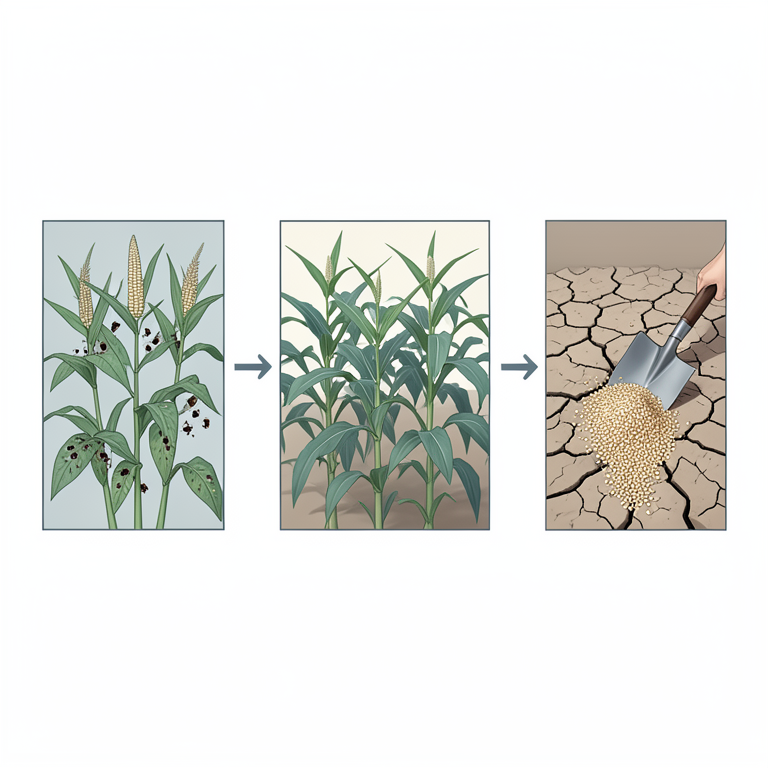
Constraints to Field Crop Production
AI-generated conceptual illustration (Maize and sesame plants in a field). It explains the idea and does not show study data.
View source evidence ↗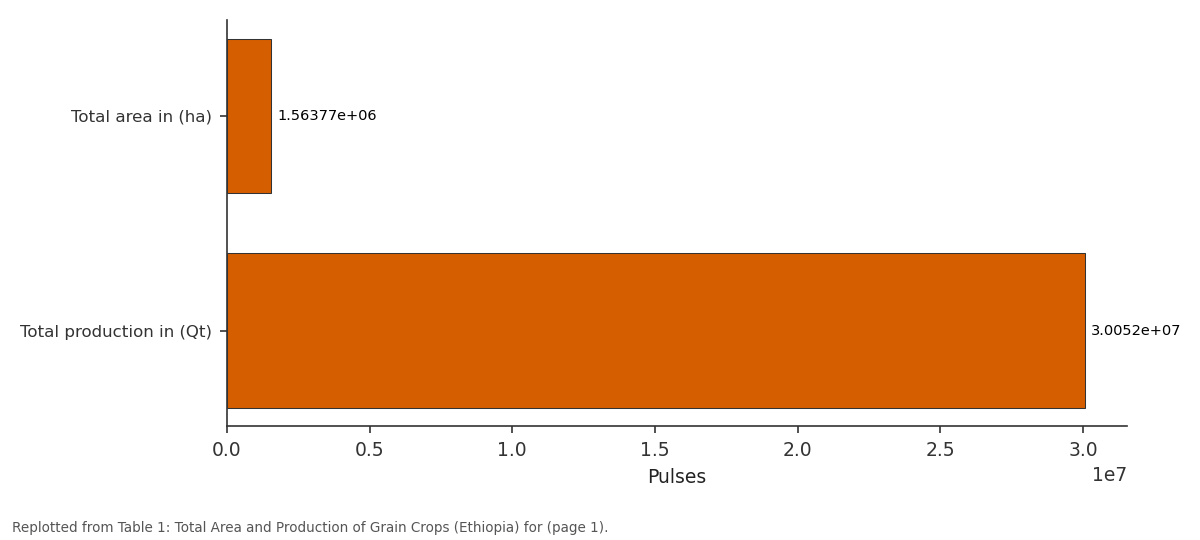
Pulses: Total area in (ha) vs Total production in (Qt)
Replotted from Table 1 (page 1) of the original paper. Every bar is the paper's own table value.
View source evidence ↗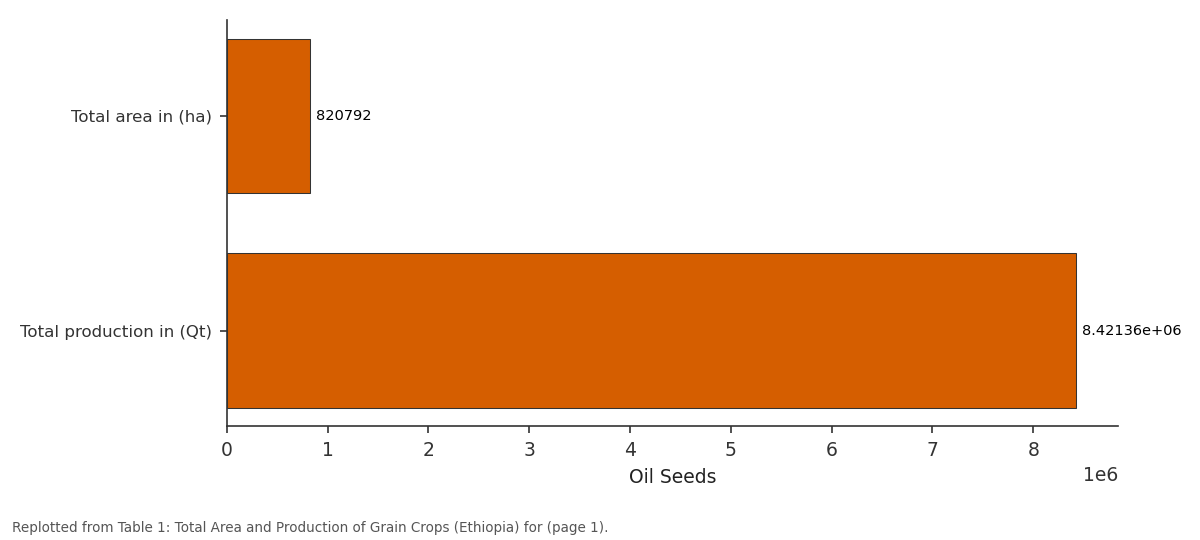
Oil Seeds: Total area in (ha) vs Total production in (Qt)
Replotted from Table 1 (page 1) of the original paper. Every bar is the paper's own table value.
View source evidence ↗Figures & tables
From the original paper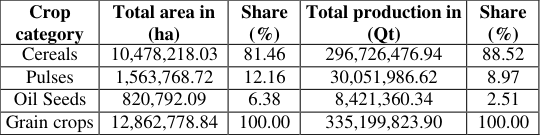 Table 1
 Table 2
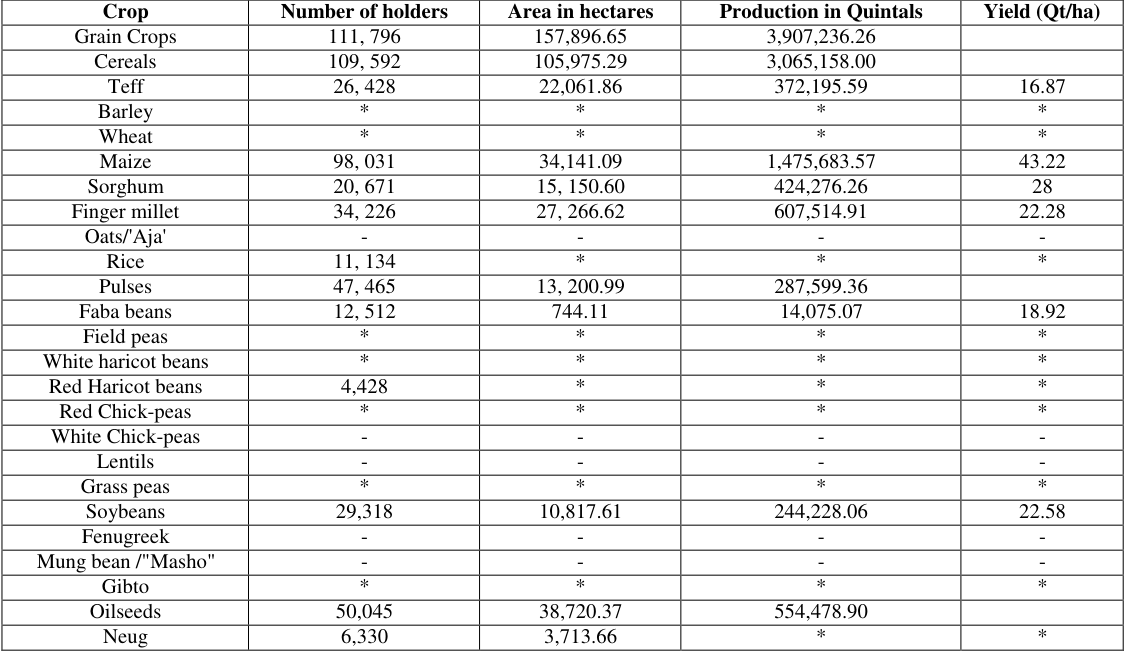 Table 3
Introduction
Ethiopia has a total area of 112 million hectares out which about 45% is arable. Overall, Ethiopia's natural resource base, the soil, the climate, the relative humidity the vegetation types are the foundations of agriculture. The different agro ecological zones, extensive arable land and high population in rural areas made Ethiopia an agrarian country. Agriculture is the mainstay of the national economy contributing about 46% of GDP, over 90% export and 83% of employment. Ethiopia is grouped under populous country in the world. Hence, to feed the people more food is expected to produce. Field crops, other than horticultural commodities, such as Teff, Maize, Sorghum, Rice, Millet, Wheat, Barley, Oat, and others play significant role in satisfying food security and earn foreign currency in the context of Ethiopia. Because these crops utilized by the people in different ways like traditional food preparation; by grinding the grain and obtaining flour; thus the flour is used for making poradge, injera (Ethiopian thin bread),locally made bread("Kita"), traditional drinks including "Tela", "Katikalla", "Borde", "Korefe", Soup, etc. In addition, in agricultural system of the country legume grains have been used in a mixed cropping system with cereals and other crops, mainly in crop rotation and intercropping [3] . The results of the year 2019/20 (2012 E.C.), Meher (Main) Season Post-harvest Crop Production Survey indicated that a total land area of about 12,862,778.84 hectares were covered by grain crops i.e. cereals, pulses and oilseeds, from which a total volume of about 335,199,823.90 quintals of grains obtained, from private peasant holdings (Table 1). The research and development works, for the improvement of field crops, started long time roughly half a century (since 1956). For this intensive work to come up with fruitful output different research and/or development activities undertaken mainly targeting for variety development, pest and disease control management, cropping system management (agronomy),quality improvement, postharvest loss management [10] , agricultural technologies /information extension and adoption, crop technologies maintenance and multiplication(including early generation seeds multiplication), awareness creation and training for different stakeholders particularly small scale farmers, seed growers, agro-processors, policy makers, investors, agricultural experts and supervisors. Metekel zone is one of the administrative zone under Benishangul Gumuz Regional State of Ethiopia. It is potential for the production of field crops, lowland pulses (Common bean, Mungbean, Soybean, Pigeon pea, and Cowpea), Oilseeds (Sesame, Soybean, Groundnut, Noug, Castor) similar survey result was reported by [5] . Cereals dominated area and production of food grains followed by oilseeds and pulses in Metekel zone [1] . The area covered by grain crops during 2019/2020 main season under metekel zone was 157,896.65 hectares from this figure 105,975.29 hectares was shared by cereals. Similarly, the production gained from grain crops in 2019/2020 main season was 3,907,236.26 quintals, simultaneously cereals took great share and 3,065,158.00 quintals obtained [13] . ( Cereals are the principal class of crops in Ethiopia in terms of area coverage and volume of grain production; however, the production and productivity of cereals in Ethiopia has been seriously challenged by a multitude of biotic and abiotic stresses resulted the national average grain yield has been very low [15] . The national average of simulated yields of most crops (except maize) showed an overall decreasing (although not statistically significant) trend induced by past climate variability and changes [17] . Additionally, yield instability could be the result of changes in technology, changes in policy and changes in weather conditions [18] . Those area and production designated by "*" in all tables could not be reported because of high coefficient of variation (i.e. they are less reliable). However, they are consolidated in the total estimates. 2. In all tables "-" indicates not reported.
| Crop category | Total area in (ha) | Share (%) | Total production in (Qt) | Share (%) |
|---|---|---|---|---|
| Cereals | 10,478,218.03 | 81.46 | 296,726,476.94 | 88.52 |
| Pulses | 1,563,768.72 | 12.16 | 30,051,986.62 | 8.97 |
| Oil Seeds | 820,792.09 | 6.38 | 8,421,360.34 | 2.51 |
| Grain crops | 12,862,778.84 | 100.00 | 335,199,823.90 | 100.00 |
Table text extracted from the original PDF; superscript letters are shown inline. The original table image is below.
View original table image
So far, at national level, more than eight hundred crop varieties have been officially registered / either for food or feed. However, the production of field crops in the current agroecological area is limited, due to several constraints mainly related with biological agents (pests and diseases), non-living factors (low or high temperature, frost, erratic rainfall, heat, storm, etc). Similar result was reported by [3] . Therefore, this review paper is initiated with the objective To recall the suitability of the current study area for the production of field crops To identify menace of field crops production under ethiopian condition mainly the region To highlight opportunities of metekel zone agricultural production status
Major Challenges of Producing Field Crops Under Metekel Condition Pests and diseases
Due to climate change at global level currently several types of crop pests and diseases emerged. This phenomenon affected the production as well as the productivity of crops and crop varieties.
When it was compared with the previous years the production of field crops slightly seems declined under the currently assessed location. Based on the observation made so far the identified pests and diseases were MLN on Maize, Blast on rice [6] , FAW on Maize, Sorghum, Midge, Anthracnone on Sorghum [5] , Weevils on Maize, Sorghum, Beans, Blight on Sesame, Cercospora on Groundnut [5] , Leaf blotch on Soybean [5] , CBB on beans, and others. Despite maize's current high productivity, higher than other major cereal crops, it is still below its potential, mainly due to many biotic and abiotic factors causing yield losses [19] . The fall armyworm (FAW, Spodoptera frugiperda) is among the major factors which have contributed to the low productivity of maize in Ethiopia since its introduction in February, 2017 [19] .
Shortage of access to mechanization
Metekel zone is preferred for mechanization because of conducive landscape. More than 75 percent of the farm work was implemented by labor; due to that little work was performed per day per man. However, majority of the small scale even large scale growers were unable to access to mechanization. Points related to this were; the high price of purchasing machineries, lack of skilled personnel on utilization of the machines, lack of access to bank loan to purchase simple machineries, shortage of access to spare parts, etc. The national average grain yield of cereals in Ethiopia is relatively low; this is due to the widespread use of low yielding varieties coupled with unimproved traditional practices that ultimately contribute to the low national average yield of major cereal in the country [15] .
Poor market linkage
Due to lack of standardized marketing system almost throughout the region, most growers (mainly small scale farmers) sell their produce with least price. Creating awareness about the relevance of marketing cooperatives and working more on community based roads development to solve marketing problems were forwarded as recommendations [7] .
Because along with the value chain there were middle men who had more advantage than the growers; they had enough information from end to end unlike to the growers. In Metekel zone, the main soybean value chain actors were producers, traders, unions, truck owners, drivers and input suppliers [20] .
Shortage of reasonable extension coverage
The final aim or goal of any agricultural research and development work is to assure all stakeholders (small scale farmers) become the owners of crop technologies or information generated otherwise mission not attained. This review paper supported the extension coverage of the area is limited to access to improved crop technologies and/or information. Similar research output is reported by [3] . To strengthen the extension services appropriate measures should be taken, such as, provision of related trainings, improvement of existing infrastructures, provision of the required inputs in time and quantity, and more [2] .
Weed competition
Weeds are unwanted plants where the area of crops grown. Because of high rainfall condition, the current locality (metekel zone) has high diversity of weed species, even parthenium hysterophorus L. widely distributed across the country and metekel zone severely affecting the biodiversity, crop, and animal production in the country [11] . The major factors raised by farmers as the cause of reduction of finger millet production in Metekel zone are weeds which can easily be controlled by hand weeding [4] . Thus, application of timely management options for the control of weeds is prerequisite.
Irrigation facility
The area is endowed with both surface and sub-surface water source. We do have yearly flowing rivers with huge volume of water. However, tendency towards the use of irrigation scheme seems limited. But some farmers tried to use gravity based irrigation practice, meaning majority of growers didn't have access to irrigation water due to shortage of money to buy water pumping generators, high cost of fuel and lubricants, chemicals, even the high cost of constructing irrigation canals, etc. Similar recommendation was suggested by [14] . Irrigation is developing rapidly. However, its contribution to the national economy is not significant when compared to rain-fed agriculture [16] .
High cost of agricultural inputs
Agricultural inputs are the engine of any product under agricultural sector. Farmers are advised to use and apply improved crop varieties and other inputs on their farms. However; the price of some commodities particularly hybrids [14] , synthetic fertilizers, chemicals (both insecticides and herbicides) is currently headache (because the cost increases over year). However, the application of inorganic fertilizer on majority of field crops except maize was insignificant [1] . Further, CBSM, training of seed growers (farmers), close follow-up, and monitoring could narrow the gap on utilization of improved crop varieties under metekel condition [8] .
Post-harvest losses
The farming practice of the area is not implemented by modern system; the land is ploughed by live animals, no well-established infrastructure, no planter, no harvester machine, no modern storage, even application of integrated farming sector is not that much developed. Due to these factors the yield loss happened almost every growing seasons. Estimates suggest that the magnitude of postharvest loss in Ethiopia was found tremendous for different cereal grains that can go as high as 30 to 50 percent [10] .
Opportunities
The study area, for the cultivation of field crops, has not only challenges but also bright future (opportunities). Some of the opportunities include participation of farmers on the adoption and use of crop technologies getting improved, the establishment of government owned agricultural research centers, installation of various agro-processing factories, conducive agro-ecology for the cultivation of crops, the nearby establishment of commodity exchange (ECX) [12] , enormous availability of natural resources such as virgin land, excess water source, fertile soil, cheap labor force, direct involvement of youth groups for agricultural works, close follow-up of agricultural experts. Ethiopian agriculture, including metekel zone, is rain fed dependent, however, it was believed that irrigation will play a significant role in the food security enhancement and economic development of Ethiopia, provided the efficient use of water is required [16] . The other golden opportunity particularly for national seed production includes enabling policy environment, strong institutional support for quality seed production, modernization of agriculture and increased seed demand, favorable opportunities for collaborative research partnership, and Capacity building initiatives [9] .
Conclusion
For this assessment task the various field crops for the evaluation area documented. The current study area (metekel zone) is favorable for the production of field crops regardless of biotic and abiotic causes hindrance the crops to express their genetic potential. The major threats for the production of field crops under the regional state (Benishangul Gumuz) specifically metekel zone screened, documented and to be suggested for further evaluations. Opportunities of the study area become an indicator for improving cereals and thereby to secure food deficit even earn hard currency.
Acknowledgement
AcknowledgementThe author thanks those authors who publicize the information targeting the area and Pawe Agricultural Research Center for the facilitation and coordination of the work.
Figures and tables from the paper
| No. | Country | Population (2020) | Yearly change | Net change | Density (P/km2) | Land area (km2) | Migrants (net) | Fertility Rate | Med. Age | Urban Pop | World share |
|---|---|---|---|---|---|---|---|---|---|---|---|
| 1 | China | 1,439,323,776 | 0.39% | 5,540,090 | 153 | 9,388,211 | -348,399 | 1.7 | 38 | 61% | 18.47% |
| 2 | India | 1,380,004,385 | 0.99% | 13,586,631 | 464 | 2,973,190 | -532,687 | 2.2 | 28 | 35% | 17.70% |
| 3 | United States | 331,002,651 | 0.59% | 1,937,734 | 36 | 9,147,420 | 954,806 | 1.8 | 38 | 83% | 4.25% |
| 4 | Indonesia | 273,523,615 | 1.07% | 2,898,047 | 151 | 1,811,570 | -98,955 | 2.3 | 30 | 56% | 3.51% |
| 5 | Pakistan | 220,892,340 | 2.00% | 4,327,022 | 287 | 770,880 | -233,379 | 3.6 | 23 | 35% | 2.83% |
| 6 | Brazil | 212,559,417 | 0.72% | 1,509,890 | 25 | 8,358,140 | 21,200 | 1.7 | 33 | 88% | 2.73% |
| 7 | Nigeria | 206,139,589 | 2.58% | 5,175,990 | 226 | 910,770 | -60,000 | 5.4 | 18 | 52% | 2.64% |
| 8 | Bangladesh | 164,689,383 | 1.01% | 1,643,222 | 1,265 | 130,170 | -369,501 | 2.1 | 28 | 39% | 2.11% |
| 9 | Russia | 145,934,462 | 0.04% | 62,206 | 9 | 16,376,870 | 182,456 | 1.8 | 40 | 74% | 1.87% |
| 10 | Mexico | 128,932,753 | 1.06% | 1,357,224 | 66 | 1,943,950 | -60,000 | 2.1 | 29 | 84% | 1.65% |
| 11 | Japan | 126,476,461 | -0.30% | -383,840 | 347 | 364,555 | 71,560 | 1.4 | 48 | 92% | 1.62% |
| 12 | Ethiopia | 114,963,588 | 2.57% | 2,884,858 | 115 | 1,000,000 | 30,000 | 4.3 | 19 | 21% | 1.47% |
| 13 | Philippines | 109,581,078 | 1.35% | 1,464,463 | 368 | 298,170 | -67,152 | 2.6 | 26 | 47% | 1.41% |
| 14 | Egypt | 102,334,404 | 1.94% | 1,946,331 | 103 | 995,450 | -38,033 | 3.3 | 25 | 43% | 1.31% |
| 15 | Vietnam | 97,338,579 | 0.91% | 876,473 | 314 | 310,070 | -80,000 | 2.1 | 32 | 38% | 1.25% |
| 16 | DR Congo | 89,561,403 | 3.19% | 2,770,836 | 40 | 2,267,050 | 23,861 | 6 | 17 | 46% | 1.15% |
| 17 | Turkey | 84,339,067 | 1.09% | 909,452 | 110 | 769,630 | 283,922 | 2.1 | 32 | 76% | 1.08% |
| 18 | Iran | 83,992,949 | 1.30% | 1,079,043 | 52 | 1,628,550 | -55,000 | 2.2 | 32 | 76% | 1.08% |
| 19 | Germany | 83,783,942 | 0.32% | 266,897 | 240 | 348,560 | 543,822 | 1.6 | 46 | 76% | 1.07% |
| 20 | Thailand | 69,799,978 | 0.25% | 174,396 | 137 | 510,890 | 19,444 | 1.5 | 40 | 51% | 0.90% |
Table text extracted from the original PDF; superscript letters are shown inline. The original table image is below.
View original table image
| Crop | Number of holders | Area in hectares | Production in Quintals | Yield (Qt/ha) |
|---|---|---|---|---|
| Grain Crops | 111, 796 | 157,896.65 | 3,907,236.26 | |
| Cereals | 109, 592 | 105,975.29 | 3,065,158.00 | |
| Teff | 26, 428 | 22,061.86 | 372,195.59 | 16.87 |
| Barley | * | * | * | * |
| Wheat | * | * | * | * |
| Maize | 98, 031 | 34,141.09 | 1,475,683.57 | 43.22 |
| Sorghum | 20, 671 | 15, 150.60 | 424,276.26 | 28 |
| Finger millet | 34, 226 | 27, 266.62 | 607,514.91 | 22.28 |
| Oats/'Aja' | - | - | - | - |
| Rice | 11, 134 | * | * | * |
| Pulses | 47, 465 | 13, 200.99 | 287,599.36 | |
| Faba beans | 12, 512 | 744.11 | 14,075.07 | 18.92 |
| Field peas | * | * | * | * |
| White haricot beans | * | * | * | * |
| Red Haricot beans | 4,428 | * | * | * |
| Red Chick-peas | * | * | * | * |
| White Chick-peas | - | - | - | - |
| Lentils | - | - | - | - |
| Grass peas | * | * | * | * |
| Soybeans | 29,318 | 10,817.61 | 244,228.06 | 22.58 |
| Fenugreek | - | - | - | - |
| Mung bean /"Masho" | - | - | - | - |
| Gibto | * | * | * | * |
| Oilseeds | 50,045 | 38,720.37 | 554,478.90 | |
| Neug | 6,330 | 3,713.66 | * | * |
Table text extracted from the original PDF; superscript letters are shown inline. The original table image is below.
View original table image
References
20 in the original paper- Masresha, Daniel et al. "Determinants of the adoption of improved white haricot beans in East Shewa Zone, SouthEastern Ethiopia." Journal of Development and Agricultural Economics,2017:9(12):355-372.
- Kebede, Erana. "Grain legumes production and productivity in Ethiopian smallholder agricultural system, contribution to livelihoods and the way forward." Cogent Food & Agriculture,2020:6(1):1722353.
- Mulualem, Tafere, Adane Melak. "A survey on the status and constraints of finger millet (Eleusine coracana L.) production in Metekel Zone, North Western Ethiopia." Direct Research Journal of Agriculture and Food Science,2013:1(5):67-72.
- Kebede, Minyahil, Assefa Gidesa. "Survey and Identification of Diseases on Major Crops of Assosa and Kamashi Zones, Ethiopia." Galore International Journal of Applied Sciences and Humanities, 2017, 1. (www. gk publication. in).
- Wubneh, Wasihun Yaregal, Flagote Alemu Bayu. "Assessment of diseases on rice (Oriza sativa L.) in major growing fields of Pawe district, Northwestern Ethiopia." World Scientific News,2016:42:13-23.
- Melak, Adane. "Crop Technologies Scaling up and out Programme and Its Impact on Households Food Security Status in Metekel Zone, Benishangul-Gumuz Regional State, Ethiopia." World Scientific News,2016:60:51-66.
- Assaye, Abebaw et al. "Assessment of seed systems in North Western Ethiopia; with special emphasis on community based seed multiplication scheme." World Scientific News,2015:12:100-110.
- Atilaw, Abebe et al. "Early generation seed production and supply in Ethiopia: Status, challenges and opportunities." Ethiopian Journal of Agricultural Sciences,2016:27(1):99119.
- Befikadu, Dubale. "Postharvest losses in Ethiopia and opportunities for reduction: A review." International Journal of Sciences: Basic and Applied Research (IJSBAR),2018:38:249-262.
- Horo, Jemal Tola et al. "Distribution and Abundance of Parthenium hysterophorus L. in Metekel Zone, Northwest Ethiopia." American Journal of Plant Sciences,2020:11(7):1101-1110.
- Gashaw, Bizualem Assefa, Saron Mebratu Kibret. "The role of Ethiopian commodity exchange (ECX) in crop value chain development in Ethiopia." Int J Bus Econ Res,2018:7:183.
- CSA R. "The federal democratic republic of Ethiopia central statistical agency report on area and production of major." Statistical Bulletin, 2019/2020.
- Bekabil Urgessa Tilahun. "Review of challenges and prospects of agricultural production and productivity in Ethiopia." Journal of Natural Sciences Research,2014:4(18):70-77.
- Dessie, Abebaw. "Cereal crops research achievements and challenges in Ethiopia." International Journal of Research Studies in Agricultural Sciences,2018:4(6):23-29.
- Haile, Gebremedhin Gebremeskel, Asfaw Kebede Kasa. "Irrigation in Ethiopia: A review." Academia journal of agricultural research,2015:3(10):264-269.
- Yang, Meijian et al. "The role of climate in the trend and variability of Ethiopia's cereal crop yields." Science of The Total Environment,2020:723:137893.
- Alemu, Zerihun Gudeta. "Causes of instability in cereal production in Ethiopia.", 2005.
- Assefa, Fenta, Dereje Ayalew. "Status and control measures of fall armyworm (Spodoptera frugiperda) infestations in maize fields in Ethiopia: A review." Cogent Food & Agriculture,2019:5(1):1641902.
- Getahun, Addisu, Erimias Tefera. "Soybean value chain assessment study in northwestern Ethiopia, Metekel Zone." Asian Journal of Agricultural Extension, Economics & Sociology, 2016, 1-14.
- Nasr ME, Zinhoum RA, Lotfy K. Efficacy of cold plasma against three of stored grain insects. Int J Entomol Res. 2020;5:113-7.
Cited by 4
From OpenAlex, OpenCitations and reference lists read by Scinovex
- ANALYSIS OF LAND USE AND LAND COVER DYNAMICS AND ITS IMPLICATIONS ON HOUSEHOLD FOOD SECURITY IN METEKEL ZONE, ETHIOPIA ↗
Mesele Berhanu, Desalegn Yayeh Ayal, WEI WU, WALTER LEAL FILHO · International Journal of Big Data Mining for Global Warming · 2026
Understanding the dynamics of Land Use and Land Cover (LULC) is crucial for assessing environmental impacts on household food security in Ethiopia’s Metekel Zone. This study analyzes spatiotemporal LULC trends and drivers from 1993 to 2023 using multitemporal Landsat imagery processed within Google Earth Engine (GEE). Classification was performed using machine learning algorithms (Random Forest and Support Vector Machine), supported…
❝ 0 - Comparative study of traditional and modern cultivation practices on field crop yield ↗
Shynar M Abisheva, Nurgul M Mussin · International Journal of Advanced Academic Studies · 2023
This comparative study investigates the effects of traditional and modern cultivation practices on the yield of major field crops, including wheat, maize, rice, and soybean, across four distinct agricultural zones. By analyzing yield data and input costs, the research aims to uncover the efficiency, sustainability, and economic viability of each set of practices. The findings reveal significant yield improvements under…
❝ 0PDF - The impact of climate change on field crop productivity
G. Pinna, Mauro Dentali · International Journal of Geography Geology and Environment · 2023
This review paper explores the multifaceted impacts of climate change on field crop productivity, an issue of critical importance for global food security. With the ongoing shifts in temperature, precipitation patterns, carbon dioxide (CO2) levels, and the frequency of extreme weather events, agricultural systems worldwide face unprecedented challenges. This paper synthesizes current scientific understanding of these impacts, drawing on a wide range of studies to highlight the complex interactions between climate variables and crop production. Moreover, it discusses adaptation and mitigation s
- Exposure of kharif crops production to climate change ↗
Dr. Amita Rani · International Journal of Financial Management and Economics · 2022
Present study is an attempt to estimate and forecast the impact of moderate climate change projection on two major food crop- Maize and Rice productivity under the question of providing food security along with sustainability. The study attempted to analysis the impact of moderate rise in Kharif season climatic variables, mean maximum temperature and mean rainfall is 1.63 °C and…
❝ 0PDF