
Research article · 2021 · Full text
International Journal of Agriculture and Food ScienceClimate change adaptation and coping strategies among arable crop farmers in Adamawa state, Nigeria
Volume 3(2) · Pages 23–27 · DOI: 10.33545/2664844x.2021.v3.i2a.53 ↗
Research areasClimate change impacts on agriculture
Abstract
Author-writtenThe study analyzed Climate Change Adaptation and coping Strategies among Arable Crop Farmers in Adamawa State and specifically: described the socio-economic characteristics of the respondents and ascertained the climate change adaptation strategies employed by the respondents in the study area. A multi-stage random sampling technique was adopted to select 232 respondents for the study. Frequency counts, percentages and means were used to analyze the data of the study. Result revealed that, 58% of the respondents were below the mean age (41 years). Majority (66.6%) were male and 69% were married, with 78% of them having acquired one form of formal education or another. The mean farm size, year of farming experience and household size were 4.1 hectares, 16 years, and 8 people respectively. Full-time farmers constituted 66.8%. Most arable crop farmers in the study area had already developed one form of adaptation initiative or another to cope with the effect of climate change but majority of them practiced mixed cropping as the most used adaptation strategy to cope with the effect of climate change. However, insurance cover was not adopted by the respondents as a means of adaptation strategy. It is recommended that, farmers should be educated on the importance of insurance cover as the means of adaptation and coping strategy.
Summary
Source-checkedPlain-language reading of the full paper, prepared with AI and checked against the text. Each point links to the authors' own words.
Why it matters
- Climate change poses a general problem for the agricultural sector, but its impact can be significantly reduced through the implementation of adaptation measures. View evidence ↗
- Adaptive capacity is defined as the ability of a system to adjust to climate change in order to moderate potential damage. View evidence ↗
- Obtaining timely and useful information regarding the adaptation strategies used by farmers is necessary to mitigate the effects of climate change. View evidence ↗
The question
- The study aimed to investigate actual climate change adaptations among farmers in Adamawa state by describing their socio-economic characteristics and ascertaining the coping strategies they employed. View evidence ↗
What they did
- The research was conducted in Adamawa State, located in the North-eastern part of Nigeria. View evidence ↗
- The data were analyzed using descriptive statistics, specifically frequency counts and percentages. View evidence ↗
What they found
- The mean age of the respondents was 41 years, with 58% of the farmers falling below this mean age. View evidence ↗
- A majority of the respondents (66.6%) were male, suggesting men are more involved in arable crop farming in the study area. View evidence ↗
- The majority of respondents (77.2%) had some form of formal education. View evidence ↗
- The average household size among the respondents was 8 people. View evidence ↗
- Farming was the primary occupation for the majority (66.8%) of the respondents. View evidence ↗
- Mixed cropping was the most frequently used adaptation strategy, adopted by 4.52% of the total responses and ranking first. View evidence ↗
- Prayer (4.38%) and seeking off-farm jobs (4.36%) were the second and third most common adaptation strategies, respectively. View evidence ↗
- Insurance cover was the least adopted strategy, with 0% of respondents utilizing it. View evidence ↗
What it means
- The authors conclude that the arable crop farmers in the study area are small-holders who have developed various adaptation initiatives, with mixed cropping being the most prevalent. View evidence ↗
- The authors recommend that farmers be educated on the importance of agricultural insurance as a means of adaptation and coping strategy. View evidence ↗
Visual summary
1 visualsIllustrations explain the paper; charts are replotted from the paper's own table values.
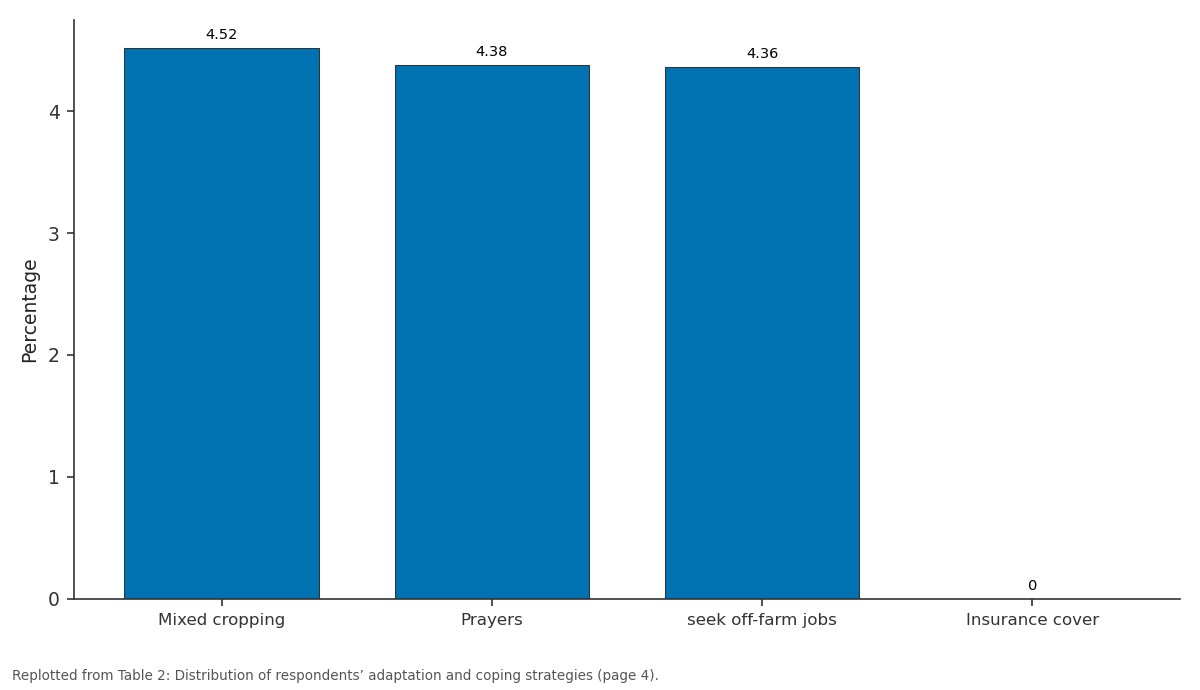
Percentage: Mixed cropping vs Prayers vs seek off-farm jobs vs Insurance cover
Replotted from Table 2 (page 4) of the original paper. Every bar is the paper's own table value.
View source evidence ↗Figures & tables
From the original paper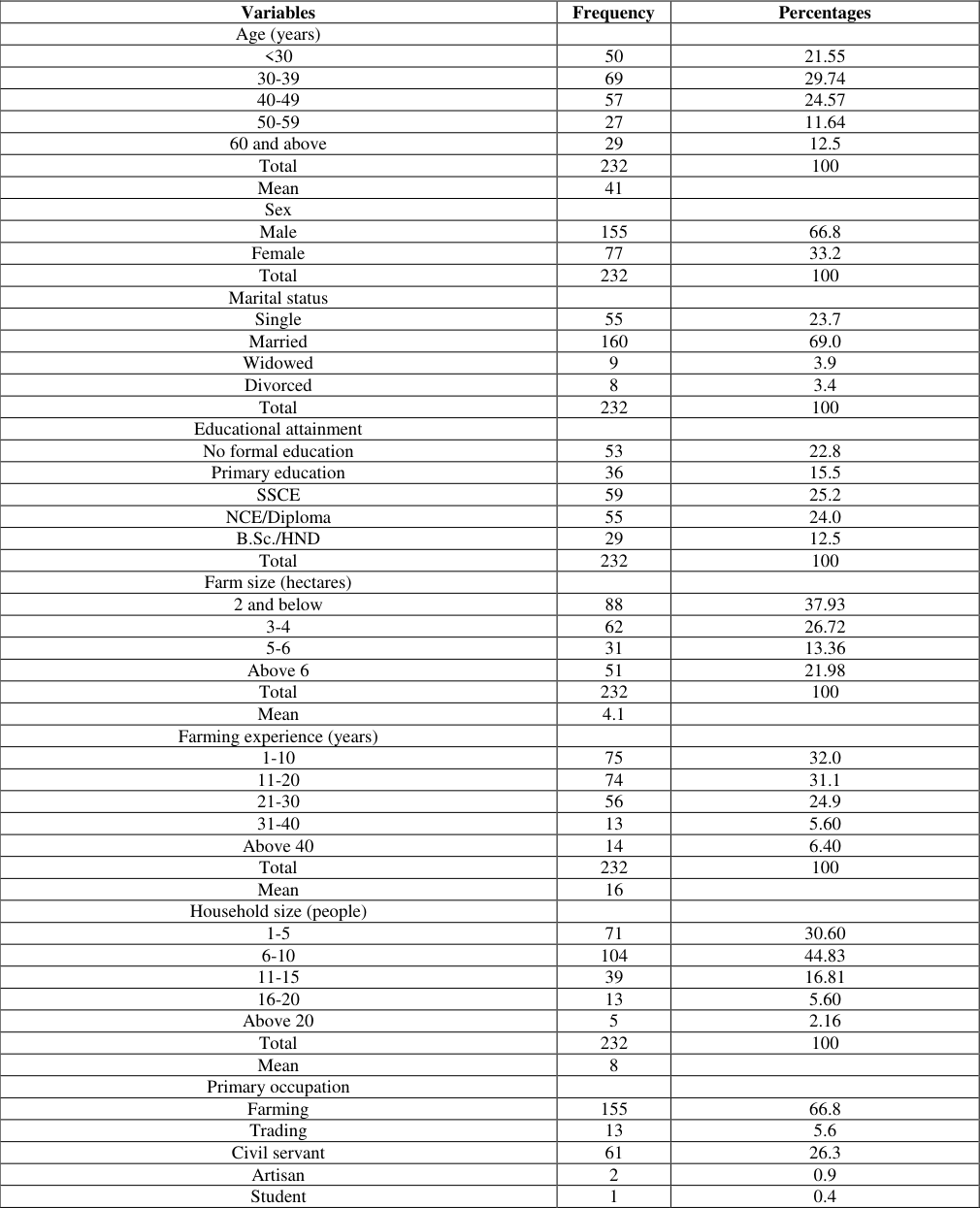 Table 1
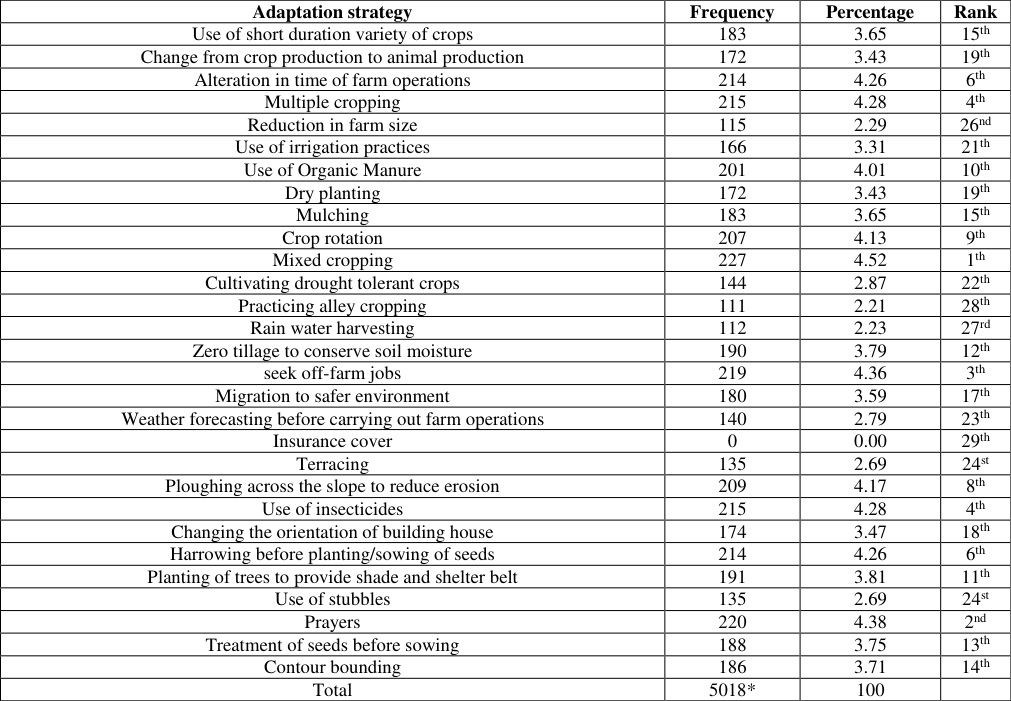 Table 2
Introduction
Adaptation is as a vital component of any policy response to climate change. Studies by Easterling et al. (1993) [7] ; Smit and Skinner, (2002) [4] have shown that, without adaptation, climate change is generally a problem to the agriculture sector, adaptation can significantly be reduced if potential measures is taken. The intensity to which an agricultural sector is affected by climate change depends on its adaptive capacity. Indeed, adaptive capacity is the ability of a system to adjust to climate change to moderate potential damage. (IPCC, 2001) [10] . Thus, the adaptive capacity of a system or society describes its ability to modify its characteristics or behavior so as to cope better with changes in external conditions. In the opinion of Dhaka (2010) [5] adaptation to climate change requires that, farmers first notice that the climate has altered. Farmers then need to identify potentially useful adaptations and implement them. Therefore, climate change adaptation would only be possible with good knowledge of the farming and climatic conditions (Risbey et al., 1999, cited by Belliveau et al., 2006) [4,17] . Thus, climate change impact studies often assume certain adaptations and little explicit examination of how, when, why, and under what conditions adaptation actually occurs in economic and social systems. To mitigate the effects of climate change, timely and useful information is necessary about the possible adaptation strategies employed by farmers. Accordingly, there is need to gain as much information as possible, and learn the positions of farmers and their needs, about what they know about climate change. This research, as part of a more recent strand of adaptation research, seeks to investigate actual adaptations to climate change among farmers in Adamawa state and specifically; 1. Described the socio-economic characteristics of the respondents and 2. Ascertained the climate change adaptation and coping strategies employed by the respondents in the study area.
Methodology
The [1] . Primary data were collected for the study with the use of structured questionnaire which were administered to the respondents. A multi-stage random sampling technique was used to select the respondents. In the first stage; one Local Government Area (LGA), being 20% of the local government areas were randomly selected from each of the Adamawa Agricultural Development Programme (ADADP) zone. This includes Girie, Guyuk, Mubi south and Yola South Local Government areas. In
International Journal of Agriculture and Food Science
the second stage, 25% of the wards in each LGA were selected, in the third stage; proportionate sampling was used to select a total of 24 villages/settlements in the selected wards. In the forth stage, snow ball technique was used to select respondents from each village/settlement. In all 240 questionnaire were distributed, and a total of 232 were finally used for the study. Descriptive statistics such as frequency counts and percentages was used to analyze the data.
Results and Discussion
Table 1 shows the result of the socio-economic characteristics of the respondents. The age revealed that, 21.55% were below the ages of 30 years, 29.74% were between the ages of 30-39 years, 24.57% of the respondents were between the ages of 40-49, 11.64% were between the ages of 50-59, while only a few (12.5%) of them were above the age of 60 years. The mean age of the respondents was 41 years. Farmers that were below the mean age were younger farmers who are at their prime age while those above the mean age were older farmers. In all, 58% were below mean age of the respondents. This corroborates the findings of Akinbile and Ndaghu (2005) [2] that, most of the farmers are between the ages of 20-50 years. So most of the arable crop farmers are in their prime age and are still active farmers that are energetic enough to employ different adaptation strategies to cope with the effect of climate change. Sexes of the respondents revealed that, majority (66.6%) were males. This implies that men were more involved in arable crop farming than women in the study area. According to the prevailing culture, men are to provide for the households needs and may be assisted by other members of the household. This corroborates Olayemi (2012) [15] that, arable crop productions were mostly carried out by men. The finding is also in tandem with Olalaye (2000) who revealed that, female were usually involved in farming as helpers of labour in minor farm operations such as planting, weeding, harvesting, processing and marketing. Marital status of the respondents shows that, majority (69%) were married, 23.7% were single, 3.9% widowed while only a few (3.4%) were divorced. This implies that, majority of the respondents were married. Married individuals are more concerned with fending for food than the singles or divorced individuals who may tend to consider their personal well being alone. They have to diversify sources of livelihood in order to meet their day-to-day household needs. This finding corroborates the work of Ofuaku (2011) [14] who found that, married farmers had responsibilities that must be reflected on their farming activities. Educational attainment revealed that 22.8% of the respondents had no formal education, 15.5% of them had primary education, 25.2% had senior secondary school education, and 24.0% had NCE/Diploma, while only 12.5% had B.Sc/HND. This implies that majority (77.2%) of them has one form of formal education or another. The preponderance of such educated farmers is expected to influence climate change adaptive capacity in the study area. This finding corroborates the findings of Edeoghon et al, (2008) that, most farmers had one form of education or another which should be used to boost agricultural production. Farm size revealed that majority (37.93%) of the respondents have farm size of 2hacters and below, 26.72% have farm size of 3-4hacters, 13.36 have 5-6hacters while 21.98% of the respondents have farm size above 6hacters, the mean farm size was 4.1hacters. This implies that farmers in the study area were small-scale farmers operating at subsistence level. They need to seek other off-farm activities to argument feeding. This corroborates the work of Ofuaku (2011) [14] who asserted that farmers in central Agricultural zone of Delta state whose mean farm size was 3.5 hectares were small-medium holder farmers; they still depend on the use of energy sapping crude implements. Household size of the respondents revealed that 30.60% have household size of 1-5 people, 44.3% of them have 6-10 people, 16.81% have 11-15, 5.60% have16-20 people while, only a few of them (2.16) have more than 20 people in their household. This implies that farmers in the study area have small household size. The mean household size is 8 people. Farmers that have members in their household below the mean have small household size while farmer with household size above the mean have larger household size. Household size is assumed to represent the labour input of the farm; large household size is mostly inclined to divert part of its labour force into non farming activities as a means of adaptation strategies to climate change. This corroborates the work of Gbetibouo (2009) [9] who found that, household size enhance the farmers' adaptive capacity to respond to climate change. Primary occupation of the respondents revealed that, majority (66.8%) were in to farming as their primary occupation, 26.3% were civil servant 5.6% were traders while 0.9% and 0.4% were artisan and students respectively. This shows that majority of the respondents were farmers, this could be as a result of the fact that over 70% of Nigerian population are rural dwellers where farming activities is the major occupation (Mark, 2011) [11] . Farming also is one of the simplest occupations to practice in the study area Table 2 revealed the adaptation strategies employed by the respondents to reduce the effect of climate change on their production. It shows that majority (4.52%) practice mixed cropping which ranked first, prayer (4.38%) ranked second, seeking off-farm jobs (4.36%) ranked third, while multiple cropping and use of insecticide 4.28% each ranked 4 th among the adaptation strategies. Insurance cover 0% ranked the least as it was not taken by farmers. This unfortunately would have been the most effective adaptation strategy to be adopted by the respondents. This may be attributed to the fact that, most of the respondents are subsistence farm operators. Also, farmers in the study area have low awareness of the importance of agricultural insurance. However, the result points to the fact that, respondents employ one form of adaptation or another. The findings is in tandem with several scholars: Spore (2008) [18] ; Molua (2008) [12] and Apata et al, (2009) [3] who found that, the main strategies of reducing climate change risk is to diversify production and livelihood system. However, Mudzonga (2011) [13] advanced that, mitigating climate change effect among farmers goes beyond diversification alone as she stressed that, market, extension and credit service, technology and farm assets are critical for helping African farmers to adapt to climate change.
| Adaptation strategy | Frequency | Percentage | Rank |
|---|---|---|---|
| Use of short duration variety of crops | 183 | 3.65 | 15th |
| Change from crop production to animal production | 172 | 3.43 | 19th |
| Alteration in time of farm operations | 214 | 4.26 | 6th |
| Multiple cropping | 215 | 4.28 | 4th |
| Reduction in farm size | 115 | 2.29 | 26nd |
| Use of irrigation practices | 166 | 3.31 | 21th |
| Use of Organic Manure | 201 | 4.01 | 10th |
| Dry planting | 172 | 3.43 | 19th |
| Mulching | 183 | 3.65 | 15th |
| Crop rotation | 207 | 4.13 | 9th |
| Mixed cropping | 227 | 4.52 | 1th |
| Cultivating drought tolerant crops | 144 | 2.87 | 22th |
| Practicing alley cropping | 111 | 2.21 | 28th |
| Rain water harvesting | 112 | 2.23 | 27rd |
| Zero tillage to conserve soil moisture | 190 | 3.79 | 12th |
| seek off-farm jobs | 219 | 4.36 | 3th |
| Migration to safer environment | 180 | 3.59 | 17th |
| Weather forecasting before carrying out farm operations | 140 | 2.79 | 23th |
| Insurance cover | 0 | 0.00 | 29th |
| Terracing | 135 | 2.69 | 24st |
| Ploughing across the slope to reduce erosion | 209 | 4.17 | 8th |
| Use of insecticides | 215 | 4.28 | 4th |
| Changing the orientation of building house | 174 | 3.47 | 18th |
| Harrowing before planting/sowing of seeds | 214 | 4.26 | 6th |
| Planting of trees to provide shade and shelter belt | 191 | 3.81 | 11th |
| Use of stubbles | 135 | 2.69 | 24st |
| Prayers | 220 | 4.38 | 2nd |
| Treatment of seeds before sowing | 188 | 3.75 | 13th |
| Contour bounding | 186 | 3.71 | 14th |
| Total | 5018* | 100 |
Table text extracted from the original PDF; superscript letters are shown inline. The original table image is below.
View original table image
| Variables | Frequency | Percentages |
|---|---|---|
| Age (years) | ||
| <30 | 50 | 21.55 |
| 30-39 | 69 | 29.74 |
| 40-49 | 57 | 24.57 |
| 50-59 | 27 | 11.64 |
| 60 and above | 29 | 12.5 |
| Total | 232 | 100 |
| Mean | 41 | |
| Sex | ||
| Male | 155 | 66.8 |
| Female | 77 | 33.2 |
| Total | 232 | 100 |
| Marital status | ||
| Single | 55 | 23.7 |
| Married | 160 | 69.0 |
| Widowed | 9 | 3.9 |
| Divorced | 8 | 3.4 |
| Total | 232 | 100 |
| Educational attainment | ||
| No formal education | 53 | 22.8 |
| Primary education | 36 | 15.5 |
| SSCE | 59 | 25.2 |
| NCE/Diploma | 55 | 24.0 |
| B.Sc./HND | 29 | 12.5 |
| Total | 232 | 100 |
| Farm size (hectares) | ||
| 2 and below | 88 | 37.93 |
| 3-4 | 62 | 26.72 |
| 5-6 | 31 | 13.36 |
| Above 6 | 51 | 21.98 |
| Total | 232 | 100 |
| Mean | 4.1 | |
| Farming experience (years) | ||
| 1-10 | 75 | 32.0 |
| 11-20 | 74 | 31.1 |
| 21-30 | 56 | 24.9 |
| 31-40 | 13 | 5.60 |
| Above 40 | 14 | 6.40 |
| Total | 232 | 100 |
| Mean | 16 | |
| Household size (people) | ||
| 1-5 | 71 | 30.60 |
| 6-10 | 104 | 44.83 |
| 11-15 | 39 | 16.81 |
| 16-20 | 13 | 5.60 |
| Above 20 | 5 | 2.16 |
| Total | 232 | 100 |
| Mean | 8 | |
| Primary occupation | ||
| Farming | 155 | 66.8 |
| Trading | 13 | 5.6 |
| Civil servant | 61 | 26.3 |
| Artisan | 2 | 0.9 |
| Student | 1 | 0.4 |
Table text extracted from the original PDF; superscript letters are shown inline. The original table image is below.
View original table image
Conclusion
Based on the findings of this study, it is suffice to conclude that, arable crop farmers in the study area were small-holder farmers. They were in their prime age of production having relatively few years of farming experience. Most of them were full-time farmers. They had already developed one form of adaptation initiative or another to cope with the effect of climate change, mixed cropping ranked highest among the various adaptation strategies adopted by the respondents. However, insurance cover was not adopted by the respondents as a means of adaptation strategy in the study area.
Recomendations
Based on the findings of this research, is recommended that, farmers should be educated on the importance of insurance cover as the means of adaptation and coping strategy. This will be of importance to guide against risk and uncertainty which is associated with agricultural production and to ensure households food security at the time of loss of crops as a result of flooding, drought, insects' infestation and the like.
References
10 in the original paper- Adebayo AA. Climate 11. In: Adamawa State in Maps. Adebayo, A.A. and Tukur, A.L. (eds) 1 st Edition Paraclete Publishers Yola, Nigeria,1999:17-19:81:8396-99.
- Akinbile LA, Ndaghu AA. Access to Extension and Poverty Alleviating Strategies of Farm Families in Adamawa State. Nigeria Journal of Agricultural Extension,2005:8:1-6.
- Apata TG, Samuel KD, Adeola AO. Analysis of Climate Change perception and Adaptation among Arable Food Crop Farmers in South Western Nigeria. Contributed paper prepared for presentation at the international association of Agricultural Economist, Conference, Beijing, China, 2009.
- Belliveau S, Bradshaw B, Smit B, Reid S, Ramsey D, Tarleton M et al. Farm-level adaptationto multiple risks: Climate change and other concerns. Occasional Canada: University of Guelph, 2006, 27.
- Dhaka BL, Chayal K, poonia MK. Analysis of farmers' perception and adaptation strategies to Climate Change. Libyan Center 3 Downie Avenue Belgravia, Harare Zimbabwe, 2011, 1-26.
- Ofuaku AU Rural Farmers' Perception of Climate Change in Central Agricultural Zone of Delta State of Nigeria. Indonesian Journal of Agricultural Science,2011:12(2):2011:63-69.
- Olayemi AO. Determinants of Climate Change and Coping Strategies among Crop Farmers in Ondo State, Nigeria. Journal of Agricultural Research and Reviews,2012:1(4):127-131.
- Olaleye R. Effectiveness of development Intervention for Economic Empowerment of Rural Women in Ondo State, Nigeria. An unpublished Ph.D Thesis submitted to Department of Agriculture and Rural Development, University of Ibadan, Nigeria, 2000, 176.
- Risbey J, Kandlikar M, Dowlatabadi H. Scale, context and decision making in agricultural adaptation to climate variability and change. Mitigation and Adaptation Strategies for Global Change,1999:4(2):137-167.
- SPORE, Climate Change, Spore Special Issue-August, 2008.
Cited by 1
From OpenAlex, OpenCitations and reference lists read by Scinovex
- Assessment of climate change adaptation practices of arable crop farmers in Kwara State, Nigeria ↗
Latifat Kehinde Olatinwo, Olayinka Jelili Yusuf, Zainab Oguntoyinbo, Sola Emmanuel Komolafe · Poljoprivredna tehnika · 2023
This study examined the climate change adaptation practices of farmers cultivating arable crops in Kwara State. One hundred and twenty (120) farmers were drawn for this study using multi stage sampling method. An interview schedule was designed to gather relevant data and analyzed with descriptive and inferential statistical tools. Results reveal that the average years of farming experience was 7…
❝ 0PDF