
Research article · 2021 · Full text
International Journal of Agriculture and Food ScienceEffect of land renting market system on the productivity of smallholder cassava farmers in southwest, Nigeria
Volume 3(2) · Pages 01–08 · DOI: 10.33545/2664844x.2021.v3.i2a.50 ↗
Research areasUrban and Rural Development Challenges
Abstract
Author-writtenThe main intent of the paper is to: (i) compare the profitability of the land renting participating and non-participating smallholder cassava farmers in southwest, Nigeria; and (ii) assess the effect of land renting market system on their productivity. Multistage sampling technique was used to sample 600 respondents (300 land renting participating, and 300 non-participating farmers). The result revealed that the net profit margin ratio for the participating farmers was 38.46%, and non-participating farmers was 30.72%. The study revealed that age,2, household size, fertilizer application, and awareness of land renting had negative value but significant relationship with land renting participation status. The productivity of cassava land renting participating farmers was higher with 58.6% compared to the non-participating farmers. The study recommends that smallholder cassava farmers should be sensitized and encouraged by government at all levels to participate in land renting market system to increase their productivity.
Summary
Source-checkedPlain-language reading of the full paper, prepared with AI and checked against the text. Each point links to the authors' own words.
Why it matters
- Cassava is a critical food security crop in tropical Africa and is the third most important staple food in Nigeria. View evidence ↗
- Smallholder cassava farmers in Nigeria face significant challenges in acquiring land due to an unstructured land tenure system. View evidence ↗
- A lack of capital often prevents smallholder farmers from acquiring the land necessary for agricultural production. View evidence ↗
The question
- The study aims to compare the profitability of smallholder cassava farmers who participate in land renting versus those who do not, and to assess the effect of the land renting market system on their productivity. View evidence ↗
What they did
- The research was conducted in the Ekiti and Ondo States of southwest Nigeria. View evidence ↗
- A multistage sampling technique was used to select 600 respondents, split equally between 300 land renting participants and 300 non-participants. View evidence ↗
- Primary data were gathered using structured questionnaires during the 2018/2019 farming season. View evidence ↗
- The study utilized the Net Profit Margin Ratio (NPMR) and the Endogenous Switching Regression (ESR) model for analysis. View evidence ↗
What they found
- Participating farmers had a higher net profit margin ratio (38.46%) compared to non-participating farmers (30.72%). View evidence ↗
- For farmers who rented land, the cost of rent was the most significant variable cost, accounting for 68.3% of their total variable costs. View evidence ↗
- Factors such as age squared, household size, fertilizer application, farm size, and awareness of land renting were significantly and negatively related to the probability of participating in land renting. View evidence ↗
- Increased farming experience was found to significantly increase the probability that a farmer would participate in the land renting market. View evidence ↗
- Land renting participants achieved significantly higher productivity (2,435 kg/hectare) than non-participants (1,535 kg/hectare), representing a 58.6% increase. View evidence ↗
- Among participating farmers, an increase in family labor was found to significantly increase productivity. View evidence ↗
- For farmers participating in land renting, both increased household size and fertilizer application were found to significantly reduce productivity. View evidence ↗
What it means
- The authors recommend that governments at all levels encourage and sensitize smallholder cassava farmers to participate in the land renting market to boost productivity. View evidence ↗
- The authors suggest that agricultural banks provide smallholder farmers with low-interest credit to enable them to rent more land and purchase necessary inputs. View evidence ↗
Visual summary
2 visualsIllustrations explain the paper; charts are replotted from the paper's own table values.
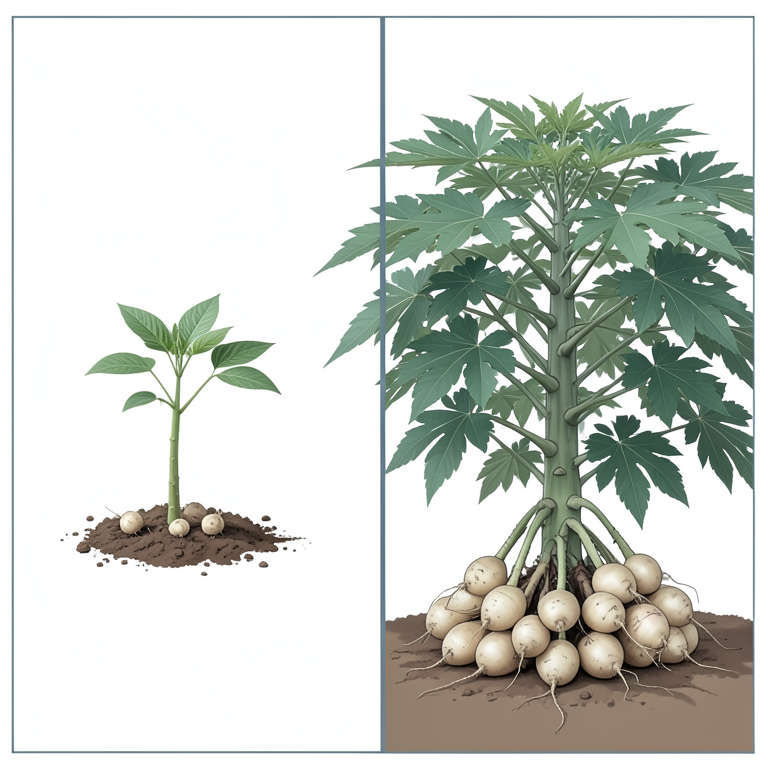
Productivity Comparison
AI-generated conceptual illustration (Cassava plants and tubers in a field in southwest Nigeria). It explains the idea and does not show study data.
View source evidence ↗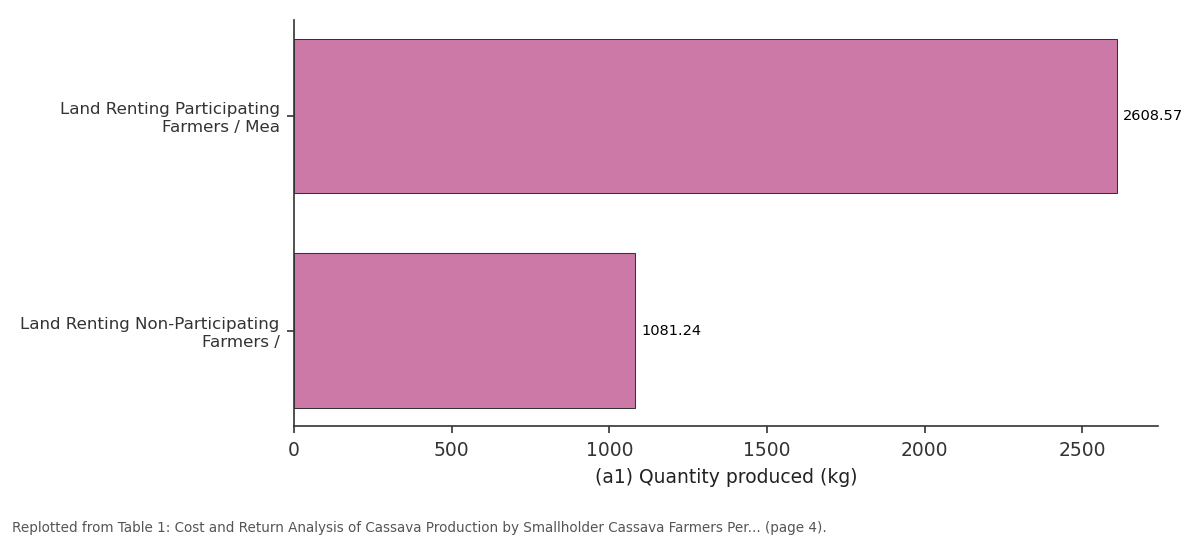
(a1) Quantity produced (kg): Land Renting... vs Land Renting...
Replotted from Table 1 (page 4) of the original paper. Every bar is the paper's own table value.
View source evidence ↗Figures & tables
From the original paper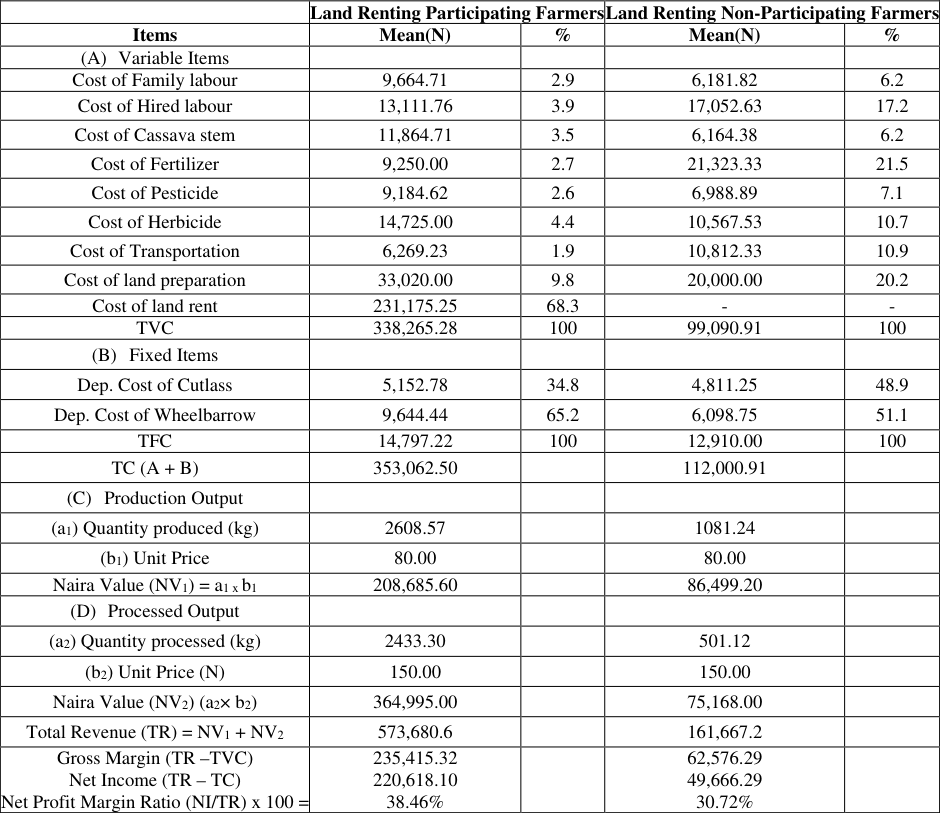 Table 1
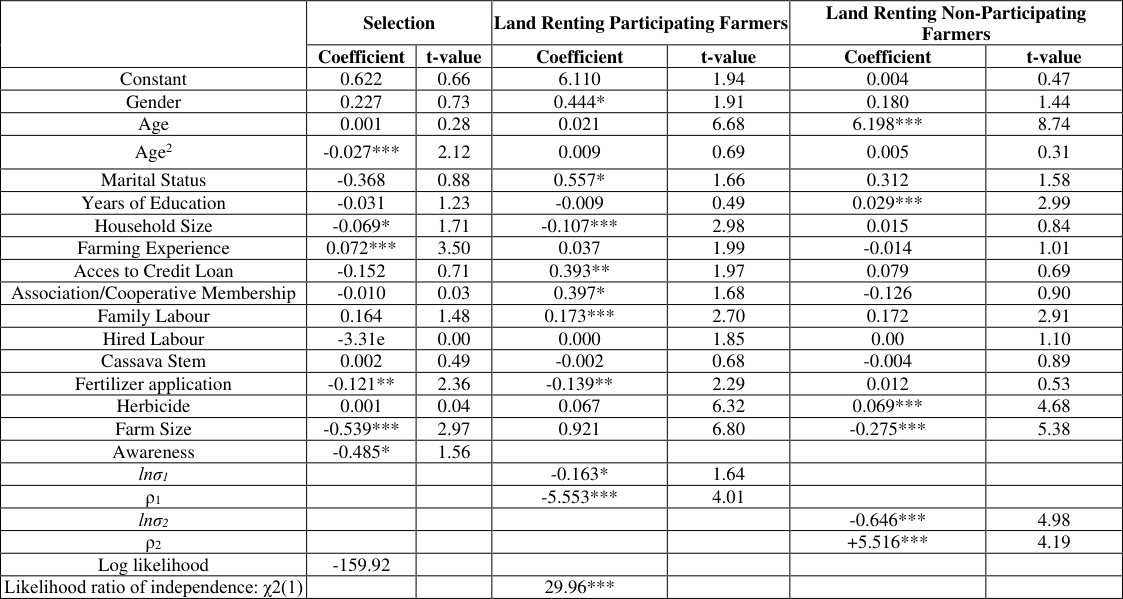 Table 2
 Table 3
Introduction
Cassava (Manhihot esculenta Crantz) is a reputable food security crop in tropical Africa. In Nigeria, it ranks high among the major perennial root crops, and has been described as the third important staple food after rice and maize. The cassava plant grows best in well-drained loamy soils, where the annual rainfall ranges between 1,000 mm and 1,500 mm, temperature between 25C and 29C (Simonyan 2015). Cassava is very rich in carbohydrate, providing about 70% of the total calorie intake for more than one-half of the Nigerian population (Jidda and Anaso 2017). Apart from providing food for Nigeria's dense urban, semi-urban and rural populations, cassava and cassava-based businesses provide income, employment, and raw materials for agro-based Micro Small and Medium-Scale Enterprises (MSMEs). Cassava industrial products are starch, High-Quality Cassava Flour (HQCF), glucose syrup, chips, and ethanol. According to Worldatlas (2017), Nigeria ranks first among world cassava producers. The country's production capacity was onethird more than the production of Brazil, and almost double the potentials of Indonesia, and Thailand. In the same vein, Nigeria's cassava production was deemed higher in comparison to the production of other African countries, including, the Democratic Republic of the Congo, Ghana, Madagascar, Mozambique, Tanzania, and Uganda. The country's actual production for 2008 was put at over 44.5 million Metric Tonnes (MT) (Food and Agriculture Organizations Statistics (FAOSTAT) 2012). However, this figure dropped by 17.30% to 36.8 million in 2009 before rising further to 42.5 million MT in 2010, 54.0 million MT in 2012 and 59.0 million MT in 2017 (FAOSTAT) 2018). Cassava serves as raw material for agro-base industries, and the production of foods such as garri, fufu, starch, cassava flour, and contributes to the increase in foreign exchange of the country, which has been of huge support for the advancement of the economy in Nigeria. However, its production faced many challenges, among the major problems facing the smallholder cassava farmers is land for farming which is due to unstructured land tenure system in Nigeria. Mgbenka [17] and Mbah [17] (2016) reported that the acquisition of land for new entrants into farming is one of the targets that has not been achieved. Smallholder farmers lack capital; hence, they may not be able to acquire land for agriculture. Unavailability of land is one of the serious problems militating against smallholder farmers in Nigeria. Landowners who live on rent are the most parasitical class of bourgeois in Nigeria. On one hand, they appropriate the fruits of the progress of the productive forces of agriculture, because their rent increases as the productivity of agriculture increases (Krishna et al. 2014). They are also enriched by the backwardness of this sector, because the more expensive agricultural products are, the greater the profit of agricultural capitalists, whose excess profit are appropriated by the landowners. The increase in the wealth of the big landowners is reflected in the increase in the price of land. The effect of land renting market participation on smallholders' equity, efficiency, and welfare are, therefore, ambiguous, and new empirical evidence is required (Chamberlin and Ricker-Gilbert 2016). In view of the above, this study investigated the effect of land renting market system on profitability and productivity of smallholder cassava farmers in southwest, Nigeria. A more rigorous approach was adopted using the Net Profit Margin Ratio (NPMR), and the Endogenous Switching Regression (ESR) model. The result of this study will serve as an empirical evidence that will guide the smallholder farmers on whether to embrace land renting market system, or not in the study area. It will also guide policy makers on how best to implement various agricultural interventions in Nigeria, and Sub-Sahara Africa, with respect to land for farming.
Materials and Methods
Materials and Methods
Study area, source of data, sample techniques and size
The study was conducted in southwest, Nigeria, specifically in Ekiti and Ondo States. The two states are made up of 34 Local Government Areas (i.e., Ekiti State has 16, and Ondo State has 18 Local Government Areas). The population of the two states is 5,845,089 (i.e., Ekiti is 2,384,212 and Ondo is 3,460,877). Data for the study were from primary sources. Primary data were collected with the use of a well-structured questionnaire for the period of 2018/2019 farming season. Some of the data that were collected included the socio-economics characteristics, participation in land renting market, cost of production, output, prices, and income from cassava production. The population for the study included land rental, and non-rental smallholder cassava farmers. Multistage sampling technique was used to select the respondents. In the first stage, there was a purposive selection of two states (Ekiti and Ondo) because the two states are known for cassava production in southwest, Nigeria (National Bureau of Statistics (NBS), 2018). In the second stage, two Local Government Areas (LGAs) that are known for cassava production in each state were selected for the study. The third stage involved random selection of five (5) communities in each of the LGAs through the assistance of Agricultural Development Programme (ADP) extension agents. In each community, fifteen (15) cassava farmers who rented land to cultivate cassava, and fifteen (15) cassava farmers who owned the land they are using to cultivate cassava were selected. Therefore, three hundred (300) cassava farmers who were land rental, and three hundred (300) cassava farmers who were non-rental were interviewed for the study.
Methods of Data Analysis Profitability Measurement
Net Income (NI), and Net Profit Margin Ratio (NPMR) analysis was carried out to measure the profitability of cassava production among the land renting participating, and non-participating farmers in the study area.
NI = TR -TC
As used by Tulsian (2014), the NPMR analysis was carried out to determine the effect of land renting participation on the smallholder cassava farmers' profitability. NPMR was used for the study because it gives the big picture of the business profitability, hence, it is a realistic method of comparing business profitability by equating all the variables, and it gives room for empirically comparing the performances of two or more businesses within a period of time, irrespective of their sizes (i.e., large, medium or small scale).
Model for Land Renting System, and Productivity
The assumption is that cassava farmers are risk neutral, and appraise benefits associated with participation, and non-participation in land renting market system. Participation, and non-participation in land renting market system is represented by 끫뢀 끫뢬끫뢬 and 끫뢀 끫뢬끫뢬 , respectively. Also, it is assumed that household net benefits, and other preferences are only known to the cassava farmers, while land renting participation status is known to the person carrying out the research. Therefore, unobserved net benefits of cassava farmer i is expressed as 끫뢀 끫뢬 * = 끫뢀 끫뢬끫뢬 -끫뢀 끫뢬끫뢬 .
The elementary association applied here is that net benefit from land renting participation status is related to a vector of household explanatory variables (X i ) in a latent framework which is described in equation 3.
where M i represents a dummy variable with 1= land renting participating farmer (rental), and 0 = land renting nonparticipating farmer (non-rental), X stands for all observable factors that affect land renting system participation status, ∝ stands for a vector of parameters to be estimated, 끫븀 stands for the error term with mean zero, and variance 끫븜 끫븀 2 that captures measurement errors, and unobserved issues. The association that is being considered in assessing the effect of land rental market system on cassava farmers' productivity assumes that the vector of outcome variable is a linear function of a vector of explanatory variables (K i ), and land renting participation status that is a dummy variable (끫뢀 끫뢬 ) . The association is expressed as follows:
where variable 끫뢆 끫뢬 is a vector of outcome variable, 끫롼 끫뢬 is a vector of farm and household characteristics, 끫뢀 끫뢬 stands for land renting participation status, 끫븎 끫뢬 stands for random error term, while 끫뷺 and 끫뷼 are vector of parameters to be estimated. Following Abdulai [1] (2016); Oparinde [21] (2019), an Endogenous Switching Regression (ESR) model approach, developed by Lokshin [16] and Sajaia [16] (2004), was used to simultaneously estimate the determinants and effect of land renting participation status on productivity, which also accounts for observable and unobservable factors in a well-organised manner. Endogenous Switching Regression (ESR) is very suitable for this study since the outcome variable, productivity, is continuous in nature.
A two-stage estimation procedure was simultaneously estimated while modelling the effect of land renting participation status on cassava farmers' productivity using the ESR framework.
The first stage involved the estimation of factors influencing land renting participation status as shown in equation ( 3). In the second stage, the relationship between the outcome variable, and the explanatory variables specified for two regimes of land renting participants, and non-participants was estimated. The specifications for the two regimes are given as follows; Regime 1 (Land renting participants):
Regime 2 (Land renting non-participants):
where 끫뢆 끫뢬끫뢬 and 끫뢆 끫뢬끫뢬 are outcome variable for land renting participants, and land renting non-participants, respectively; 끫롼 끫뢬 is a vector of farm and household characteristics; 끫븎 끫뢬 stands for random error term, while 끫뷺 is a vector of parameters to be estimated. It is vital to use one or more variables which do not come up in K for identification purposes. This is done such that selection and outcome equations are estimated using the same set of variables, but with additional variable being used as an instrument in the selection equation. The instrument used in this study is awareness about the importance of land renting. Being aware about the importance of land renting is capable of influencing land renting participation status, and not the outcome. Selection bias problem due to unobservable factors within the structure of omitted variable problem can be easily addressed.
According to Heckman (1979), there is an inclusion of selectivity terms used in the selection equation represented by 끫브 끫뢬 and 끫브 끫뢬 for land renting participants, and non-participants, respectively as well as covariance terms 끫븜 끫뢬끫뢬 and 끫븜 끫뢬끫븀 in equation 5a and 5b which brought about equation 6a and 6b:
Where the selectivity terms 끫브 끫뢬 and 끫브 끫뢬 correct for selection bias from unobservable factors and ∅ 끫뢬끫뢬 and ∅ 끫뢬끫뢬 are the error terms with conditional zero means. The approach used in this study is the maximum likelihood approach as proposed by Lokshin [16] and Sajaia [16] (2004), and used by Abdulai [1] (2016), and Oparinde [21] (2019), respectively. The ESR model is used to estimate the effect of land renting participation on cassava farmers' productivity by comparing the expected productivity of cassava farmers who participated with the expected outcome of the counterfactual hypothetical cases that participants did not participate. The expected values of the outcome P on land renting participants, and non-participants are expressed as follows:
Following Lokshin [16] and Sajaia [16] (2004), the average treatment effect on the treated (ATT) is a change in the outcome due to participation, which is expressed in equation 7 as the difference in the expected outcomes from equations 6a and 6b.
Where 끫븜 stands for covariance of the error terms, and 끫브 the inverse mills ratios or selectivity term.
The independent variables that were used in the model are;
Results and Discussion
Estimation of effects of land rental market system on the profitability of smallholder cassava farmers Table 1 shows the costs and return in naira, and dollar per production period for land renting participating farmers, and nonparticipating farmers. The total variable costs for land renting participating farmers and non-participating farmers were N338, 262.28 ($939.62) and N99,090.91 ($275.25), respectively. The cost of renting land accounted for 68.3% of the total variable cost of the rental farmers which was the most significant variable cost. Hence, the need for policy makers, at all levels of government, to come to the rescue of the smallholder farmers by ensuring a land tenure system that will reduce the amount paid by farmers for renting land. This buttresses the findings of Olukunle [20] (2016) that the cost of renting land is a critical cost to smallholder farmers. For land renting non-participating farmers, the cost of fertilizer was 21.5.0% of the total variable cost, and was the most significant variable cost. This could be because non-participating farmers cultivated small hectares of land for cassava production, so, they would like to maximise the land by applying fertilizer to get maximum output. According to Senkoro [23,30,31,32,33,37] et al.
| — | Land Renting Participating Farmers | — | Land Renting Non-Participating Farmers | — |
|---|---|---|---|---|
| Items | Mean(N) | % | Mean(N) | % |
| (A) Variable Items | ||||
| Cost of Family labour | 9,664.71 | 2.9 | 6,181.82 | 6.2 |
| Cost of Hired labour | 13,111.76 | 3.9 | 17,052.63 | 17.2 |
| Cost of Cassava stem | 11,864.71 | 3.5 | 6,164.38 | 6.2 |
| Cost of Fertilizer | 9,250.00 | 2.7 | 21,323.33 | 21.5 |
| Cost of Pesticide | 9,184.62 | 2.6 | 6,988.89 | 7.1 |
| Cost of Herbicide | 14,725.00 | 4.4 | 10,567.53 | 10.7 |
| Cost of Transportation | 6,269.23 | 1.9 | 10,812.33 | 10.9 |
| Cost of land preparation | 33,020.00 | 9.8 | 20,000.00 | 20.2 |
| Cost of land rent | 231,175.25 | 68.3 | - | - |
| TVC | 338,265.28 | 100 | 99,090.91 | 100 |
| (B) Fixed Items | ||||
| Dep. Cost of Cutlass | 5,152.78 | 34.8 | 4,811.25 | 48.9 |
| Dep. Cost of Wheelbarrow | 9,644.44 | 65.2 | 6,098.75 | 51.1 |
| TFC | 14,797.22 | 100 | 12,910.00 | 100 |
| TC (A + B) | 353,062.50 | 112,000.91 | ||
| (C) Production Output | ||||
| (a1) Quantity produced (kg) | 2608.57 | 1081.24 | ||
| (b1) Unit Price | 80.00 | 80.00 | ||
| Naira Value (NV1) = a1 x b1 | 208,685.60 | 86,499.20 | ||
| (D) Processed Output | ||||
| (a2) Quantity processed (kg) | 2433.30 | 501.12 | ||
| (b2) Unit Price (N) | 150.00 | 150.00 | ||
| Naira Value (NV2) (a2× b2) | 364,995.00 | 75,168.00 | ||
| Total Revenue (TR) = NV1 + NV2 | 573,680.6 | 161,667.2 | ||
| Gross Margin (TR –TVC) Net Income (TR – TC) Net Profit Margin Ratio (NI/TR) x 100 = | 235,415.32 220,618.10 38.46% | 62,576.29 49,666.29 30.72% |
Table text extracted from the original PDF; superscript letters are shown inline. The original table image is below.
View original table image
(2018), cassava is highly responsive to fertilizer, it increases its yield when applied appropriately. The total fixed cost for the rental farmers was N14, 797.22 ($41.10), and N12,910.00 ($35.86) for the non-rental farmers. The value shows that both the participating and non-participating farmers were smallholder cassava farmers, who did not use heavy equipment such as tractor for farming. Therefore, they are small scale farmers, and they cultivated small hectares of land using cutlasses and hoes. The total revenue, which is the combination of sales from cassava tubers and processed cassava such as cassava flakes (Garri) or starch, for both land renting participating and non-participating farmers was N573,680.60 ($1,593.56), and N161, 667.20 ($449,08), respectively. The gross margin for participating farmers was N235,415.32 ($653.93), and for the nonparticipating farmers was N62,576.29 ($173.82). The net income of both participating farmers and non-participating farmers, it was estimated as N220,618.10 ($507.27), and N49, 666.29 ($137.96), respectively. Using the gross margin, and the net income to make conclusion will be misleading, since the land renting participating farmers could likely be cultivating more hectares of land than the non-renting participating farmers as reflected in the total variable cost, total fixed cost, total cost, total revenue, gross margin, and net income. The net income value alone is not helpful in determining the efficiency and performance of the business firm, unless it is related to some other figures such as sales. Therefore, to measure the productivity of the capital employed, and to measure operational efficiency, profitability analysis is considered as one of the best techniques (Tulsian 2014). Hence, net profit margin ratio, which reflects the big picture of business profitability showing returns on investment for any business, and allows two or more businesses to be compared over a period, was calculated. The net profit margin ratio for the participating farmers was 38.46%, and 30.72% for the non-participating farmers. So, the participating Farmers profitability was higher (7.74%) than that of the non-participating farmers. Therefore, land renting participating farmers have more returns on their investment than the non-participating farmers during the production period. Also, the higher the net profit margin ratio, the better would be the operational efficiency of the business. A higher net profit margin ratio means that the business has been able not only to increase its sales but also to cut down its operating expenses. This could be because the land renting participating farmers were conscious of the fact that they rented the land, and they would, at the end of the year, pay rent. Therefore, they will likely be more proactive, and operate more like wise businessmen.
Determinants of smallholder cassava farmers' participation in land renting market system.
The results of the factors influencing the smallholder cassava farmers' participation in the land renting market system are presented in Tables 2 (Selection column). The results can be interpreted as normal probit coefficients. From the column, age 2 , household size, fertilizer application, farm size, and awareness of land renting had a negative value, but a significant relationship with land renting participation status. The implication of this scenario is that these variables reduce the probability of smallholder cassava farmers' participation in the land renting market system. The age shows that older (i.e., above 60 years) smallholder cassava farmers will not be willing to rent land for cultivation of cassava. The strength and vigour will not be there again to cultivate a large farm (Fermont [8] et al. 2009). The household size that had a negative coefficient but significantly influenced land renting participation status could be attributed to the small household size in the study area. The mean household size was four for the land renting participating farmers, and five for the non-participating farmers. So, the household size was small, therefore, the smaller the household size, the higher the probability of smallholder cassava farmers' willingness to participate in land renting market system. The reason could be because smaller households will have sufficient money to participate in land renting market system, since the household consumption expenditure would be minimal. The implication of the negative relationship that existed between fertilizer and land renting participation status among the smallholder cassava farmers indicates that an increase in fertilizer application reduces the probability of farmers' participation in land renting market system. Most smallholder cassava farmers believed that the application of fertilizer will increase their productivity, hence, farmers that use more fertilizer will not see the need for renting more land to increase their productivity (Ali et al., 2018). The negative value of farm size and the significant relationship with the renting participation status imply that an increase in the farm size of the smallholder cassava farmers reduces the probability of participation in land renting market system. This is common in agricultural production; a farmer will not see the need to rent land again when they already have a large farm size to cultivate. Awareness of land renting market system has a negative and significant relationship with the land renting participation status. This is probably because most landowners live on rent, and are the most parasitical class of bourgeois. So, they appropriate the fruits of the progress of the productive forces of agriculture, because their rent increases as the productivity of farmers increases. Hence, they will probably discourage most of the farmers who are aware of this attitude of the landlord (Krishna et al., 2014). The positive and significant value of farm experience with land renting participation status indicates that as farm experience increases, the probability of participating in land renting market system increases. The reason for this could be that the years of cassava farming experience assist the smallholder cassava farmers in the study area to opt for more land for cultivation, and participate in the land renting market system.
Effects of household and farm characteristics of smallholder cassava farmers on cassava productivity
Table 2, column four (land renting participating farmers) and six (land renting non-participating farmers) revealed that the likelihood ratio tests for joint independence of the equations in Endogenous Switching Regression (ESR) model were dependent. The Table and columns show that for participating, and nonparticipating farmers, the correlation coefficients 끫븘 1 and 끫븘 2 were respectively statistically significant, suggesting that there was an existence of selection bias in land renting status due to unobservable factors. Hence, the application of ESR model that considered both observable and unobservable issues is suitable for this study (Lokshin [16] and Sajaia [16] , 2004). However, 끫븘 1 was negative while 끫븘 2 was positive, indicating that land renting participating farmers had higher productivity than a random farmer from the sample, while land renting non-participating farmers had lower productivity than a random farmer from the sample. The estimates in the outcome equation in Table 2, column four (4) for participating farmers, and column six (6) for non-participating farmers generally show the effect of household and farm-level characteristics of smallholder cassava farmers on cassava productivity. The effect estimates in the Table and columns show that gender, marital status, access to credit loan, association/cooperative membership, and family labour positively and significantly influenced cassava productivity among the participating farmers (column four). This implies that an increase in these variables will probably increase the smallholder cassava farmers' productivity among the participating farmers. Being a male cassava farmer would bring about an increase in cassava farmers' productivity among the participating farmers. This in line with the findings of Hijbeek et al. (2018) that an increase in male farmers, increases farmers collective productivity because of their strength and vigour to do farm work. The marital status that was significantly different from zero with positive coefficient among the land renting participating farmers implies that being married would lead to a rise in the productivity of cassava farmers among the participating farmers, since this will probably lead to a large family size which will enhance family labour availability to cultivate the rented land for cassava production. Ayoola [4] and Makinde [4] (2008) reported that an increase in the number of married farmers will probably lead to an increase in farmers' productivity. Access to credit, which was positive and statistically significant in the specification among the land renting participating farmers, means that such access will probably increase the cassava farmers' productivity. This confirms the findings of Awunyorvitor [3] (2018) which stated that there is high correlation between access to credit, and farmers' productivity. Membership of association/cooperative, which positive and significantly different from zero among land renting participating farmers, suggests that as the farmer joins an association/cooperative society there is an increase in such a farmer's productivity. Membership of an association/cooperative society enhances access to financial assistance, and access to farm inputs at a cheaper price. These will increase the farmers' productivity among the land renting participating farmers. The quantity of family labour, which was positive and significantly different from zero among the land renting participating farmers, indicates that an increase in family labour will increase the productivity of participating farmers. According to Colnago [6] & Dogliotti [6] (2020), family labour will reduce the cost of production, and this will positively affect the farmers' productivity in the long run. Household size, and fertilizer application negatively and significantly influenced cassava productivity among the participating farmers. This implies that an increase in both household size, and fertilizer application will probably lead to a reduction in the farmers' productivity. An increase in household size could reduce the farmers' productivity, because an increase in household size will increase the expenditure and consumption tendency with the cost of renting land; hence, farmers' productivity will be impinged. Fertilizer application also exhibited negative and significant relationship with land renting participating farmers' productivity. This implies that an increase in the use of fertilizer will reduce the land renting participating farmers' productivity. This is in line with the findings of Howeler (2018) that the application of fertilizer to cassava should be done under the guidance of an extension officer, because cassava as a tuber crop does not need too much fertilizer. Age, years of experience, and herbicide positively and significantly influenced cassava productivity among the land renting non-participating farmers. The positive and statistically significant coefficient of age among the land renting non-participating farmers indicates that an increase in the age of farmers will probably lead to an increase in productivity of land renting non-participating farmers. This is in line with the findings of Danso-Abbeam et al. (2018) that among the factors that have a positive influence on farmers' productivity is their age. The positive coefficient of years of formal education in the outcome equation for the land renting non-participating farmers specification implies that as the years of formal education of land renting non-participating farmers increase, there is an increase in their productivity. Education is a critical factor in crop production, it broadens the mind of the farmers to accept new technology, and make better use of research findings, and this will lead to increase in farmers' productivity (Obisesan [19] 2013). The estimate for the quantity of herbicide used was positive and statistically significant for land renting non-participating farmers, indicating the positive impact of the quantity of herbicide on productivity. As the farmers use more herbicide to control weed on the crop production for land renting non-participating farmers, it will lead to an increase in productivity. Since the land being cultivated will be small hectares, therefore, the efficient use of herbicide will enhance the land renting non-participating farmers' productivity (Gashaw [10] et al. 2017). Farm size negatively and significantly influenced nonparticipating farmers' productivity. This implies that an increase in the farm size of the non-participating farmers will lead to a reduction in productivity. Since they are not renting the land, they will likely be cultivated a small farm size. A large farm size enhances the farmer's productivity, because it gives room for a large scale of production, and enables the application of technology, and research findings (Rada & Fuglie 2018).
| — | Selection | — | Land Renting Participating Farmers | — | Land Renting Non-Participating Farmers | — |
|---|---|---|---|---|---|---|
| Coefficient | t-value | Coefficient | t-value | Coefficient | t-value | |
| Constant | 0.622 | 0.66 | 6.110 | 1.94 | 0.004 | 0.47 |
| Gender | 0.227 | 0.73 | 0.444* | 1.91 | 0.180 | 1.44 |
| Age | 0.001 | 0.28 | 0.021 | 6.68 | 6.198*** | 8.74 |
| Age2 | -0.027*** | 2.12 | 0.009 | 0.69 | 0.005 | 0.31 |
| Marital Status | -0.368 | 0.88 | 0.557* | 1.66 | 0.312 | 1.58 |
| Years of Education | -0.031 | 1.23 | -0.009 | 0.49 | 0.029*** | 2.99 |
| Household Size | -0.069* | 1.71 | -0.107*** | 2.98 | 0.015 | 0.84 |
| Farming Experience | 0.072*** | 3.50 | 0.037 | 1.99 | -0.014 | 1.01 |
| Acces to Credit Loan | -0.152 | 0.71 | 0.393** | 1.97 | 0.079 | 0.69 |
| Association/Cooperative Membership | -0.010 | 0.03 | 0.397* | 1.68 | -0.126 | 0.90 |
| Family Labour | 0.164 | 1.48 | 0.173*** | 2.70 | 0.172 | 2.91 |
| Hired Labour | -3.31e | 0.00 | 0.000 | 1.85 | 0.00 | 1.10 |
| Cassava Stem | 0.002 | 0.49 | -0.002 | 0.68 | -0.004 | 0.89 |
| Fertilizer application | -0.121** | 2.36 | -0.139** | 2.29 | 0.012 | 0.53 |
| Herbicide | 0.001 | 0.04 | 0.067 | 6.32 | 0.069*** | 4.68 |
| Farm Size | -0.539*** | 2.97 | 0.921 | 6.80 | -0.275*** | 5.38 |
| Awareness | -0.485* | 1.56 | ||||
| lnσ1 | -0.163* | 1.64 | ||||
| ρ1 | -5.553*** | 4.01 | ||||
| lnσ2 | -0.646*** | 4.98 | ||||
| ρ2 | +5.516*** | 4.19 | ||||
| Log likelihood | -159.92 | |||||
| Likelihood ratio of independence: χ2(1) | 29.96*** |
Table text extracted from the original PDF; superscript letters are shown inline. The original table image is below.
View original table image
Estimating the effects of land rental market system on smallholder cassava farmers' productivity Smallholder cassava farmers' productivity could be influenced by the household and farm characteristics; hence, this was addressed by estimating an endogenous switching regression model, which gives room for the construction of a valid counterfactual hypothetical case of land renting participating and non-participating farmers. Table 3 presents the effects of land renting market system on smallholder cassava farmers' productivity from the Average Treatments effects on the Treated (ATT) estimates of the endogenous switching regression model specifications. To examine the effect of land renting market system on cassava farmers' productivity, the average treatments effect (ATT) on the expected outcome was estimated. It is important to note that ATT estimates consider other confounding issues such as selection bias ensuing from possible variations between land renting participating and non-participating smallholder cassava farmers. The results showed that land renting participation significantly increased productivity. To be specific, the expected cassava productivity from land renting participating cassava farmers was 2,435 kg/hectare compared with 1,535 kg/hectare from non-participating farmers. This difference represents an increase in cassava productivity from participating farmers by 58.6%. This corroborates the findings of Swaminathan [26] & Bhavani [26] (2013) that an increase in the availability of land for farming will increase the farmers' productivity.
Conclusions and Policy Implications
The study examined the effect of land renting participation on profitability and productivity of smallholder cassava farmers in southwest, Nigeria. The result showed that participation in land renting market system increased the smallholder cassava farmers' profitability and prodcutivity among the respondents. Government at various levels (Federal, State and Local Government Area (LGA)) have put in place a lot of scheme to encourage smallholder farmers in Nigeria. However, there is no empirical study on how land rental market system can increase their profitability and productivity. Therefore, the study contributes empirically to the existing literature on how to increase the profitability and productivity of smallholder farmers, especially cassava farmers in Nigeria, and Sub-Sahara Africa. Using net profit margin ratio, and endogenous switching regression model empirically revealed that smallholder cassava farmers who rented land for cultivating cassava had higher profitability and productivity than those who were landowner. From the study, the following policy implications can be deduced: first, smallholder cassava farmers who rented land to cultivate cassava had more returns on their investment than smallholder cassava farmers who owned the land they were using to cultivate cassava. So, smallholder farmers should be encouraged to participate in land renting market system. Second, aged farmers, as shown in the selection result, are likely not willing to participate in land renting market system, this implies that the youths who are still young and vibrant should be encouraged by government at all levels through policy formulation to participate in land renting market system. Therefore, there is a need for governments, national, and international non-governmental organisations who are willing to encourage the youths on agribusiness to factor into their programme the concept of land renting market system. Third, as shown in the selection result, there was positive relationship between the farm experience, and the land renting participation status. So, government at all levels should assist smallholder cassava farmers with more than ten years farming experience to get land to rent for cultivating cassava. This will enhance their profitability and productivity, as well as guarantee food security generally in the country, and in Sub-Sahara Africa. Furthermore, the study revealed that the productivity of the land renting participating farmers was enhanced by access to credit loan, and membership of association/cooperative society. Government programmes at all levels, national, and international non-governmental organisations that give loan to farmers should equally consider the smallholder cassava farmers, and not only the large-scale farmers. Agricultural banks and agencies should be encouraged to consider the smallholder farmers as well by giving them credit facilities at a unit digit interest. This will enable them to rent more land to cultivate cassava, and assist them in buying fertilizer, and other agrochemicals that will enhance their productivity. Again, in Nigeria there is a cassava farmers association; therefore, smallholder cassava farmers should be encouraged to be active members of the association. Most interventions by the government and non-governmental organisations come through the association. Membership of cooperative society will guarantee access to loan at a cheaper rate. Hence, smallholder cassava farmers should be sensitised on the need to start their own cooperative society, government, and nongovernment organisations should support them. Furthermore, extension agents should visit the smallholder cassava farmers to enlighten them on the expected quantity of fertilizer that will increase their yield. This is necessary since it is an important variable that influenced the productivity of the land renting participating farmers. Hence, if its usage is properly monitored by the extension agents, smallholder cassava farmers' productivity will surely be enhanced generally using the appropriate type, and quantity of fertilizer.
References
27 in the original paper- Abdulai AN. Impact of conservation agriculture technology on household welfare in Zambia. Agricultural Economics,2016:47:1-13.
- Ali EB, Joseph AA, Danso-Abbeam G. Determinants of fertilizer adoption among smallholder cocoa farmers in the Western Region of Ghana, Cogent Food & Agriculture, 2018(4)1:538-589.https://doi.org/10.1080/23311932.2018. 1538589
- Awunyor-Vitor D. Theoretical and Conceptual Framework of Access to Financial Services by Farmers in Emerging Economies: Implication for Empirical Analysis. Acta Universitatis Sapientiae, Economics and Business,2018:6: 43-59.https://doi.org/10.1515/auseb-2018-0003
- Ayoola OT, Makinde EA. Influence of Cassava Population Density on the Growth and Yield Performance of CassavaMaize intercrop with a Relayed Cowpea. Tropical and Subtropical Agroecosystem,2008:8(3):235-245.
- Chamberlin J, Jacob RG. "Participation in Rural Land Rental Markets in Sub-Saharan Africa: Who Benefits and by How Much? Evidence from Malawi and Zambia." American Journal of Agricultural Economics,2016:98(5):15071528.doi: 10.3368/le.94.4.541.
- Colnago P, Dogliotti S. Introducing labour productivity analysis in a co-innovation process to improve sustainability in mixed family farming. Agricultural System, 2020, 177.https://doi.org/10.1016/j.agsy.2019.102732.
- Danso-Abbeam G, Ehiakpor DS, Aidoo R. Agricultural extension and its effects on farm productivity and income: insight from Northern Ghana. Agric & Food Security, 2018(7)74:42-56.https://doi.org/10.1186/s40066-018-0225x.
- Fermont AM, Van Asten PJA, Tittonell P, van Wijk MT, Giller KE. Closing the cassava yield gap: An analysis from smallholder farms in East Africa. Field Crops Research, 2009:112(1):2436.https://doi.org/10.1016/j.fcr.2009.01.009.
- Food and Agriculture Organization of the United Nations. FAOSTAT Database. Rome, Italy. Available at, 2018.https:/www.fao.org/production/crop/cassava. (Accessed on 10 September 2018).
- Gashaw TA, Ayele ZB, Berhanu AA. Effects of Land Fragmentation on Productivity in Northwestern Ethiopia. Advances in Agriculture, 2017. https://doi.org/10.1155/2017/4509605. Available at: https://www.hindawi.com/journals/aag/2017/4509605/
- Hijbeek R, Pronk A A, Ittersum MK, Berge HFM. What drives farmers to increase soil organic matter? Insights from the Netherlands Soil Use and Management, 2018:34(1):5663.doi: 10.1111/sum.12401.
- Howeler R. Mineral nutrition and fertilization of cassava. CIAT, Cali, Colombia, 2018, 254.
- Jidda MB, Anaso AB. Effects of Crop Improvement Technology on Downy Mildew of Pearl Millet (Pannisetum glarucum) (L) R. Br. Academic Journal of Cereals and oilseeds, 2017:8(3):14-22.doi: 10.5897/JCO2017.0172.
- Krishna HK, Ashok KM, Samarendy M. Impact of Land ownership on Productivity and Efficiency of Rice Farmers. A Simulated Maximum Likelihood Approach. Selected Paper Prepared for Presentation at the Agricultural and Applied Economics Association (AAEA) Annual Meeting Minneopolis, MN, 2014, 27-29. doi: 10.13140/2.1.4979.0729.
- Lokshin M, Sajaia Z. Maximum likelihood estimation of Endogenous Switching Regression Models. Stata Journal,2004:4(3):282-89.
- Mgbenka RN, Mbah EN. A Review of Smallholder Farming in Nigeria: Need for Transformation. International Journal of Agricultural Extension and Rural Development Studies,2016:3(2):43-54.
- NBS. National Bureau of Statistics. Quarterly report. Nigeria National Bureau of Statistics, Abuja, 2018:124(4):45-56
- Obisesan AA, Akinlade RJ, Fajimi FO. Determinants of fertilizer use among smallholder food crop farmers in Ondo State, Nigeria. American Journal of Research Communication, 2013:1(7):254-260. Available in: www.usa-journals.com, ISSN: 2325-4076.
- Olukunle OT. Economic Analysis of Profitability and Competitiveness of Sugarcane Enterprise in Nigeria. Academic Journal,2016:8(6):160-171.
- Oparinde LO. Fish Output and Food Security under Risk Management Strategies among Women Aquaculture Farmers in Ondo State, Nigeria. AGRIS on-line Papers in Economics and Informatics, 2019:11(1):93-105. ISSN 18041930. DOI 10.7160/aol.2019.110110.
- Rada N, Fuglie KO. New perspectives on farm size and productivity. Food Policy, 2018. doi: 10.1016/j.foodpol.2018.03.015. Available at:https://www.researchgate.net/publication/323997279_Ne w_perspectives_on_farm_size_and_productivity
- Senkoro CJ, Tetteh FM, Kibunja CN, Ndungu-Magiroi KW, Quansah GW, Marandu AE et al. Cassava Yield and Economic Response to Fertilizer in Tanzania, Kenya and Ghana. Agronomy Journal, 2018:110(4):1600-1606. doi:10.2134/agronj2018.01.0019
- Simonyan KJ. Cassava post-harvest processing and storage in Nigeria: A review. African Journal of Agricultural Research,2015:9(53):3853-3863. doi: 10.5897/AJAR2013.8261.
- Sophia H. Closing the Gender Gap in Agriculture. Gender Technology and Development. Asian Institute of Technology SAGE Publications, 2016:20(2):105111.doi:10.1177/0971852416643872.
- Swaminathan MS, Bhavani RV, 2013. Food production & availability -Essential prerequisites for sustainable food security. Indian Journal of Medical Research,2013:138(3): 383-39.doi. PMC3818607.
- Tulsan M. Profitability Analysis (A comparative study of SAIL & TATA Steel). IOSR Journal of Economics and Finance (IOSR-JEF),2014:3(2):19-22.e-ISSN:2321-5933, www.iosrjournals.org www.iosrjournals.org
- Worldatlas Top Cassava Producing Countries in the Word, 2017. Available at: www:woridatlas.com.articles/topcassava-producing-countries-in-the-world.html.(2017). (Accessed on August 2018).