
Research article · 2018 · Full text
International Journal of Research in AgronomyLand Economy: Sustainability in Agriculture Sector
Volume 1(1) · Pages 40–42 · DOI: 10.33545/2618060x.2018.v1.i1a.83 ↗
Research areasAgricultural Economics and PracticesAgricultural risk and resilience
Abstract
Author-writtenAccording to the Census Bureau, about 70% of Indians live in rural areas. As a result, people living in rural areas face a variety of problems. In recent years, the role of agriculture in the economy has diminished. Former farmers are now considering selling the land to industrialists because they feel that the money, they earn from farming is not enough to support their families. This problem can be addressed by providing farmers with incentives such as subsidies, and minimum prices for crops. To increase their income, some have turned to other farming methods. The result will be significant advances in agricultural technology. This led to the belief that agriculture was profitable.
Summary
Source-checkedPlain-language reading of the full paper, prepared with AI and checked against the text. Each point links to the authors' own words.
Why it matters
- A significant portion of the Indian population, approximately 70%, resides in rural areas. View evidence ↗
- Farmers are selling their land to industrialists because agricultural income is often insufficient to support their families. View evidence ↗
- Rural-to-urban migration is predicted to increase, with 6 out of 10 people migrating by 2030 and 7 out of 10 by 2050. View evidence ↗
The question
- The study aims to analyze the necessity and the challenges associated with Sustainable Agriculture (SA). View evidence ↗
- The research seeks to examine the history, importance, and future trends of agriculture within India's rural economy. View evidence ↗
What they did
- The authors utilized a combination of primary and secondary data sources for their analysis. View evidence ↗
What they found
- Agriculture's contribution to India's GDP saw a sharp decline from 51.81% in 1950 to 17.01% in 2014-2015. View evidence ↗
- Sustainable Agriculture is identified as a solution to rural problems, capable of meeting population needs without depleting natural resources. View evidence ↗
- Drip irrigation is highlighted as an effective water management method that reduces water usage. View evidence ↗
- Certain growing methods are noted to be more resistant to pests, disease, and drought due to lower dependence on imported crops. View evidence ↗
- The lack of strong land lending laws acts as a barrier to investment in rural areas. View evidence ↗
- The growth of India's agricultural sector has been hindered by unfair water distribution and inadequate rural infrastructure. View evidence ↗
- Despite having a network of financial institutions, the rural poor face limited credit access due to inefficiency, weak regulation, and high costs. View evidence ↗
What it means
- The authors conclude that Sustainable Agriculture can increase productivity and create jobs, which is essential for improving the rural economy. View evidence ↗
- The study's interpretations are based on author opinions rather than a statistical approach. View evidence ↗
- The authors state that the research is time-limited, meaning findings may lose relevance over time. View evidence ↗
Visual summary
1 visualsIllustrations explain the paper; they do not show study data.
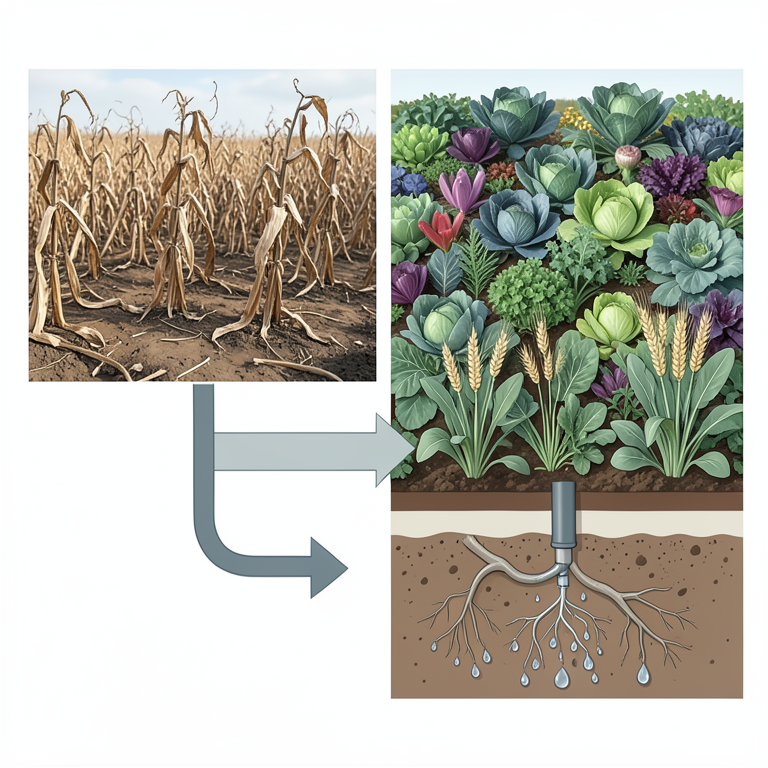
Sustainable Agriculture Components
AI-generated conceptual illustration (Diverse crop fields with drip irrigation systems). It explains the idea and does not show study data.
View source evidence ↗Introduction
In past, agriculture was one of the most common occupations. Farmers are considered the backbone of our economy. Human efforts are based on agriculture. Even villagers sell their property and move to the city to live more comfortably for a variety of reasons. It is predicted that by 2030, 6 out of 10 people will migrate from rural to urban areas, and by 2050, 7 out of 10 will migrate. Everyone wants to live in the city, and as a result farmland is being sold. If this trend continues, there will not be any land left for agriculture. Sustainable Agriculture (SA) can help solve these problems. This technology can also meet the needs of a growing population without reducing natural resources.
Objectives
Analyze the need and challenges for SA. Study the history, importance, and future trends of agriculture in rural economy in India.
Need for the Study
Research is needed to clarify the problems of farmers. Due to the diversity of agricultural production, this food must meet the needs of the population. Studying SA can help solve this problem by revitalizing the rural economy.
Methodology Sources of Data
A combination of primary and secondary data sources is used in the current work.
Limitations
Interpretation is not a statistical approach, and the summary is based on the opinions of the authors. Research is time limited. Research findings can become meaningless over time.
Sustainable Agriculture
This type of agriculture focuses on growing perennial crops and livestock with little impact on the environment. As a result, there generate the need to bring balance between production and healthy ecosystems. Conservation of water resources has reduced the use of pesticides and increased the biological diversity of crops and the ecosystems. All these are the goals of SA. SA aims to improve the economic stability of farmers, skills and the overall quality of life. A variety of agricultural techniques are used to make agriculture more sustainable.
The use of pesticides and herbicides is also reduced by mixing the crops. Drip irrigation is used as a water management method that uses less water. The Food and Agriculture Organization of the United Nations (FAO) defines the SA as "managing and protecting the resource base and managing technological and organizational change to ensure present and future performance and satisfaction of current generations". Thus, SA is described as "an environmentally friendly, technologically appropriate, economically viable and socially acceptable path of agricultural development". This means that future generations can now meet their food and fiber needs without compromising their ability to meet their own needs.
Need for Sustainable Agriculture
Optimal use of resources: SA allows farmers to be more productive with fewer resources. Mixed farming is a strategy that helps farmers use their resources more efficiently by allowing them to make more money with the resources they have.
Renewable and Nutritious Soil: will leads to healthier crops and livestock's, which in turn leads to provide rich nutritious food to humans' beings. Barren soil retains water much better than healthy soil.
Water is protected by Sustainable Agricultural Methods:
Includes mulch, drip irrigation, contour ditching to keep water high in the landscape, replenish groundwater supplies, and contain less used water crops such as deep-rooted perennials. Growing contours and filter strips are two examples of sustainable agricultural practices that helps in protecting water bodies from all types of pollutants and, in the first place, prevent pollution. "
Sustainable
Agricultural Diversity Values: Some monocultures are recommended as a variety of growing methods. They are more resistant to drought, disease, and pests because they are less dependent on imports of one or more important crops. It is also a safe place for humans, pollinators, livestock's' and wildlife.
Sustainability through SA within Climate Change:
As SA reduces the risk of drought by conserving water. Plants in a durable system must be more sustainable than traditional crops as they focus on varieties where a variety of crops are grown and naturally require less water.
Saving energy through SA: Reduce energy consumption at all levels. No toxic chemicals are used, so there is little pollution.
Recent trends in Agriculture and the Rural Economy
This industry has always played an important role in the socioeconomic development of India. Agriculture's contribution to gross domestic product (GDP) has declined over the past decade. In 1950, it was 51.81%, and in 2014-2015, it fell to 17.01%. Despite the sharp decline, farms are still the backbone of the country's economic growth. According to the pie chart above, agriculture is the largest employer in India. Rural homes are larger than urban households. India's population is highly dependent on agriculture and only half of its workforce contributes to its gross domestic product (GDP). All these figures show how closely the rural population is linked to agriculture in terms of employment and food production. Because SA uses more natural resources in agriculture. It is important for people to practice SA to meet the needs of future generations. As part of the environment dimensional framework, effective resource usage is considered, as is satisfying present-day requirements without sacrificing the needs of future generations. By recycling garbage and creating a pollution-free environment, we can also help. Economically, it strives to sustain agricultural raw materials and services for the nonfarm population through measures that offer a reasonable return on land, labour, and capital. There is an equal distribution of material benefits from economic progress in the SOCIAL Dimension.
Issues and Challenges relating to SA
Numerous obstacles impede the expansion and productivity of the agriculture industry. The following are some of the difficulties and challenges associated with SA:
Conclusion
This is important for economic development as it creates many jobs. SA will help increase productivity to meet the needs of the population and create jobs for people. It is important to improve the rural economy, which accounts for 70% of the rural population. Only then can it contribute to the economic prosperity of the country. Not only that, but it will serve a more important purpose without harming the environment and taking into account the needs of future generations.