
Research article · 2021 · Full text
International Journal of Horticulture and Food SciencePassion fruit and its cultivation: A review
Volume 3(2) · Pages 23–25 · DOI: 10.33545/26631067.2021.v3.i2a.69 ↗
Research areasMedicinal Plant Extracts EffectsPineapple and bromelain studies
Abstract
Author-writtenPassion fruit is a tropical fruit that belongs to the family Passifloraceae. It is native to Brazil and South America and widely cultivated. It grows up to the height of 6m. Yellow and Purple Passion fruit are mostly found among which Purple is most popular. This fruit is rich in fiber, Vitamin-C and Provitamin A. It possesses beta carotene that is good for eyesight, fibres for good digestion and reduces the risk of Type 2 Diabetes as well. For its cultivation, seed, cuttings or grafting can be used. Cuttings are used for commercial cultivation and transplanting is done before monsoon. Staking and trellising is done for the support of the vine.
Summary
Source-checkedPlain-language reading of the full paper, prepared with AI and checked against the text. Each point links to the authors' own words.
Why it matters
- Passion fruit is a widely cultivated tropical fruit from the Passifloraceae family, originally native to South America and Brazil. View evidence ↗
- The fruit is valued for its nutritional content, including fiber, Vitamin C, and Provitamin A, which contribute to digestive health, eyesight, and a reduced risk of Type 2 Diabetes. View evidence ↗
- Increased global interest in health and nutrition has led to the growing popularity of passion fruit. View evidence ↗
The question
- The objective of this review is to provide a comprehensive overview of passion fruit and the practices involved in its cultivation. View evidence ↗
What they did
- The authors synthesized information from various sources, including academic publications and agricultural guides, to review the plant's characteristics and cultivation. View evidence ↗
What they found
- The passion fruit plant is a vigorous perennial vine that can reach a height of approximately 6 meters (20 feet). View evidence ↗
- Purple passion fruit, typically 4-5 cm in diameter, is more popular in the export market than the yellow variety due to its superior aromatic flavor. View evidence ↗
- Yellow passion fruit is larger (5-7 cm in diameter) and more resistant to soil-borne pests and diseases, making it suitable as a rootstock for the purple variety. View evidence ↗
- Raw passion fruit consists of 70% water, 22% carbohydrates, 2% protein, and 0.7% fat, and provides significant percentages of Vitamin C (50%) and Vitamin A (25%). View evidence ↗
- The seeds contain piceatannol, which may reduce the risk of Type 2 Diabetes by improving insulin sensitivity. View evidence ↗
- While cuttings are preferred for commercial use, seeds can be used if fermented for 3 days and shade-dried, with germination occurring in 14-21 days. View evidence ↗
- Recommended planting pits are 45x45x45 cm³ spaced at 2x3 m², filled with topsoil, 15kg FYM, and 125g TSP per acre three weeks before transplanting. View evidence ↗
- Plants should receive a top dressing of 100 g NPK per plant prior to the rainy season. View evidence ↗
- The fruits typically reach ripeness 70 to 80 days after pollination. View evidence ↗
What it means
- The authors conclude that passion fruit is becoming increasingly popular due to its high nutritional value, specifically its fiber, Vitamin C, and polyphenols. View evidence ↗
Visual summary
1 visualsIllustrations explain the paper; they do not show study data.
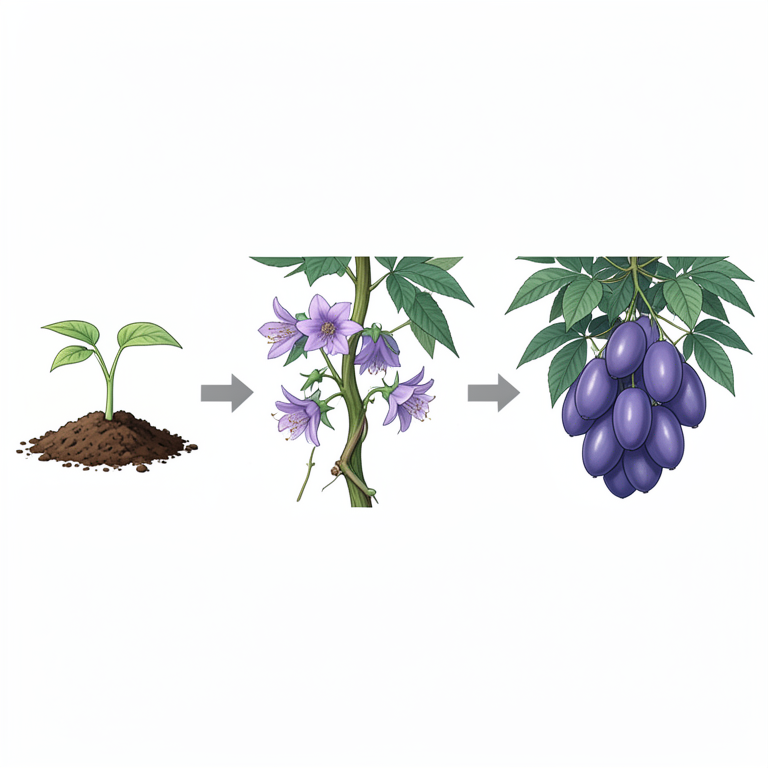
Study overview
AI-generated conceptual illustration (passion fruit vines (Passiflora edulis)). It explains the idea and does not show study data.
View source evidence ↗Introduction 1. Origin and Distribution
Passion fruit (Passiflora edulis) is a tropical fruit belonging to the family Passiflora ceae. It is the native fruit of Brazil, Paraguay and Argentina. It is widely distributed in Asia, Europe, South and North America.
Description.
It is a vigorous, shallow rooted perennial vines that climbs up by the means of tendrils. The plant grows up to the height of about 6m/20ft.Leaves are alternate with 3 lobes about 8-16cm long and dark green in color. The flowers are solitary, has 5 colored tepals and a large corona possessing radial filament that usually curls. It usually fruits in about 5 to 18 months depending upon the variety. Fruiting takes place in early summer. It is tropical fruit (but some varieties survives in subtropical climate) which is round or oval in shape. It has tough outer rind and the juicy edible inner portion filled with seeds. It comes in various colors purple, yellow, red and green of which yellow and purple type are most common.
Varieties
Mainly, this fruit has two varieties • Yellow: Passiflora edule f. flavicarpa • Purple: Passiflora edulis • Others are Sweet granadilia, Gaint granadilia, Cholupa and Banana Passion fruit, these are not so common.
Purple passion fruit
It is mostly found in upper midland to upper highland zones at above 1200-2000m above sea level. It is small, oval or round shaped with purple skin. The fruits are about 4-5cm in diameter. It is superior and possess aromatic flavor which is most popular in export market than yellow fruit.
Yellow Passion Fruit
It is mostly found in midland and lowland zones and has the fruit size slightly larger than the purple variety. The fruits are about 5-7cm in diameter, round or oval with yellow skin. This variety is more tolerant to soil borne insect pests and diseases like Phytopthora root rot, Nematodes and Brown spots so that it is also used as a rootstock for purple variety.
Sweet granadilla (Passiflora ligularis)
It is an oval shaped fruit which is pointed in one of its end. The skin is pale yellowish or grayish in color and has a less acid flavor.
Giant granadilla (Passiflora quadrangularis)
It is thick and elongated fruit that has largest size among all the species of Passion fruit and has light green skin. It is tasteless in comparison to other species.
Cholupa/Gulupa (Passiflora pinnatistipula)
The skin is yellowish green or reddish brown in color and it is similar to yellow passion fruit.
Banana Passion fruit (Passiflora mollisima)
It looks similar to banana and is yellow in color nearly 10 cm long. The pulp is yellow or orange in colour and has sweet or slightly acid taste.
Nutrient Content
It is rich in nutrient content especially fiber, Vitamin C and Provitamin A. Raw passion fruit contains 70% water, 22% carbohydrates, 2% protein and 0.7% fat. It contains Vitamin A (25%), Vitamin C (50%), Calcium (1%), Iron (8%), Vitamin B6(5%) and Magnesium(7%).
Medicinal Properties
It is rich in phytochemicals such as polyphenols, carotenoids, yellow variety is rich in prunasin and cyanogenic glycosides are found in the peel and juice.
• Fibre present in it helps to prevent constipation, improves digestion of food. • It is rich in beta-carotene, body converts this betacarotene into Vitamin -A which is good for eyesight. • Also the beta-carotene present in it cause low risk of prostrate, colon, stomach and breast cancer. • It serves as antioxidants that protect our body from free radicals. • Polyphenols reduces the risk of chronic inflammation and heart disease. • Seeds are rich in piceatannol which helps to improve the insulin sensitivity reducing type 2 Diabetes. • Flower of purple Passion fruit is used in treating insomnia, asthama, anxiety and menopause. • It has high around 5mg of Magnesium that contribute on the brain cells and keep our mood fresh and happy. • Sodium content is low, this reduces the blood pressure level.
Cultivation Practices 3.1 Propagation
Seeds, cuttings, grafting can be used as a medium for propagation. Cuttings are used for commercial cultivation.
For seedling preparation, seeds should be extracted and fermented for 3 days and then shade dried. Seeds should be sown shallowly and germination starts after 14-21 days.
Transplanting should be done in the early morning or late evening at the onset of rain or anytime under irrigation.
Land preparation
It can be conducted one to two months before planting the vines. Perennial weeds should be removed and ploughing followed by pit digging should be done. Pit of size 45*45*45 cm3 with the spacing of 2*3m2 is appropriate. The pits should be filled with the mixture of topsoil, (15kg FYM, 125g TSP) per acre at least 3 weeks before transplanting.
Training (Staking and trellising)
Trellis construction should be done as Passion fruit is a climber. Trellis may be Overhead, Vertical, T trellis or A frame as per the convenience.
Trellising should be done immediately after transplanting. 3m long and 15cm diameter post with 6m apart in the row can be constructed.
Pruning
Passion fruit bears on current season's growth so systematic pruning of vine results in new growth and higher yield of fruits. After the harvest of the crop, the laterals should be cut back to 4-5 buds. Pruning should be done after harvesting of the crop in April and December.
Top dressing
100 g NPK per plant should be top dressed before the start of rainy season. Foliar feed and trace element according to need in every 3 months should be provided.
Intercropping
Beans, cabbages and tomatoes can be intercropped in the first year but these crops should be fed with their own nutrition. Cucurbits, Maize, cowpea, sorghum, okra and other creepers should be avoided.
Harvesting
Mainly fruits are ripened in 70 to 80 days after pollination. This makes the ripening season at the end of summer or early winter. Fruits are ready to harvest when they are plump and are fully colored.
Conclusion
Major exporting countries of Passion fruit are Brazil, Ecuador and Peru. Recently, the world is more concerned about the health and nutrition. Passion fruit, being loaded with nutrition is becoming popular nowadays. It contains fibre, Vitamin-c and Polyphenols that is useful for human health. Purple Passion fruit is more common than yellow Passion fruit. It can be cultivated through seeds, cuttings or grafting. It fruits after 12 to 18 months after sowing or 70 to 80 days of pollination.
References
3 in the original paper- Taiwe GS, Kuete V. (N. D.). (PDF) Passiflora edulis. Retrieved 2021. from https://www.researchgate.net/publication/312689291_P assiflora_edulis
- Mandal G. Production, Preference and importance of Passion fruit (Passiflora edulis): A review, 2017. Https://Www.Researchgate.Net/Publication/319313789
- Tripathi, P. (2012, October). Passion fruit cultivation https://www.researchgate.net/publication/304791434_p assion_fruit_culitvation
Cited by 2
From OpenAlex, OpenCitations and reference lists read by Scinovex
- Influence of drying temperature on the metabolites profile and potential antioxidant pathways of Passiflora edulis peel: Integrating untargeted metabolomics with network pharmacology analyses, molecular docking, and molecular dynamics simulation ↗
Mohamad Norisham Mohamad Rosdi, Mohd Nurhafizam Karuning, Nur Hanisah Azmi, Mohamad Hafizi Abu Bakar, Yanty Noorzianna Abdul Manaf, Feri Eko Hermanto et al. · Computational Biology and Chemistry · 2026
❝ 1 - Effects of Storage Temperatures and Durations on Acidity and Sourness of Winter Harvested ‘Gilis’ Passion Fruit ↗
Florence Kyoyagala, Martin Gitonga, Tahel Wechsler, Ron Porat, Alon Samach · International Journal of Fruit Science · 2026
“Gilis” is a hybrid passion fruit cultivar valued for its large size, excellent aroma, attractive purple peel and self-compatibility. Summer harvested “Gilis” fruit have a balanced taste, however, winter harvested fruit in cold locations consist lower total soluble solids (TSS) and higher acidity levels resulting in a sourer flavor. To address this issue, we examined the effects of different storage…
❝ 0PDF