
Research article · 2021 · Full text
International Journal of Statistics and Applied MathematicsAnalysing mathematical achievement among students
Volume 6(4) · Pages 127–130
Research areasInnovations in Educational MethodsSchool Choice and PerformanceStatistics Education and Methodologies
Abstract
Author-writtenThe present study was carried out to explore the mathematical achievement of government and private school students. The researcher selected 200 respondents with the help of random sampling technique. Whole sample was selected from Anantnag District of the union territory of Jammu and Kashmir. Keeping in view, the researcher found that there is no significant between government and private school students on their achievement towards mathematics. No significant difference has been observed between government and private school students on their awareness towards Set theory, algebra, trigonometry co-Ordinate geometry, calculus and statistics. Thus, researcher can inferred that impact of type of institution is not significant on mathematical achievement.
Summary
Source-checkedPlain-language reading of the full paper, prepared with AI and checked against the text. Each point links to the authors' own words.
Why it matters
- Mathematics is considered a fundamentally important subject in school education. View evidence ↗
- The abstract nature of mathematical concepts can lead to feelings of fear and anxiety among some students. View evidence ↗
- Developing a conceptual understanding of mathematics has the potential to alter general human cognitive behavior. View evidence ↗
The question
- The study aimed to explore and compare the mathematical achievement of students attending government versus private schools. View evidence ↗
What they did
- The researcher used random sampling to select 200 students from the Anantnag District of Jammu and Kashmir. View evidence ↗
- The study was specifically delimited to students in the 9th class. View evidence ↗
- Mathematical achievement was measured using a test developed by Sharma, S. S in 2015. View evidence ↗
- The data were processed using descriptive and comparative statistical analyses. View evidence ↗
What they found
- Private school students had a mean mathematical achievement score of 24.49 with a standard error of 0.67. View evidence ↗
- Government school students had a mean mathematical achievement score of 24.02 and a score range of 41.00. View evidence ↗
- A comparative analysis yielded a 't' value of 0.49, which was not significant at the 0.01 confidence level. View evidence ↗
- No significant differences were found between government and private school students regarding their awareness of specific topics including algebra, calculus, and statistics. View evidence ↗
What it means
- The authors concluded that the type of institution (government vs. private) does not have a significant impact on a student's mathematical achievement. View evidence ↗
Visual summary
1 visualsIllustrations explain the paper; charts are replotted from the paper's own table values.
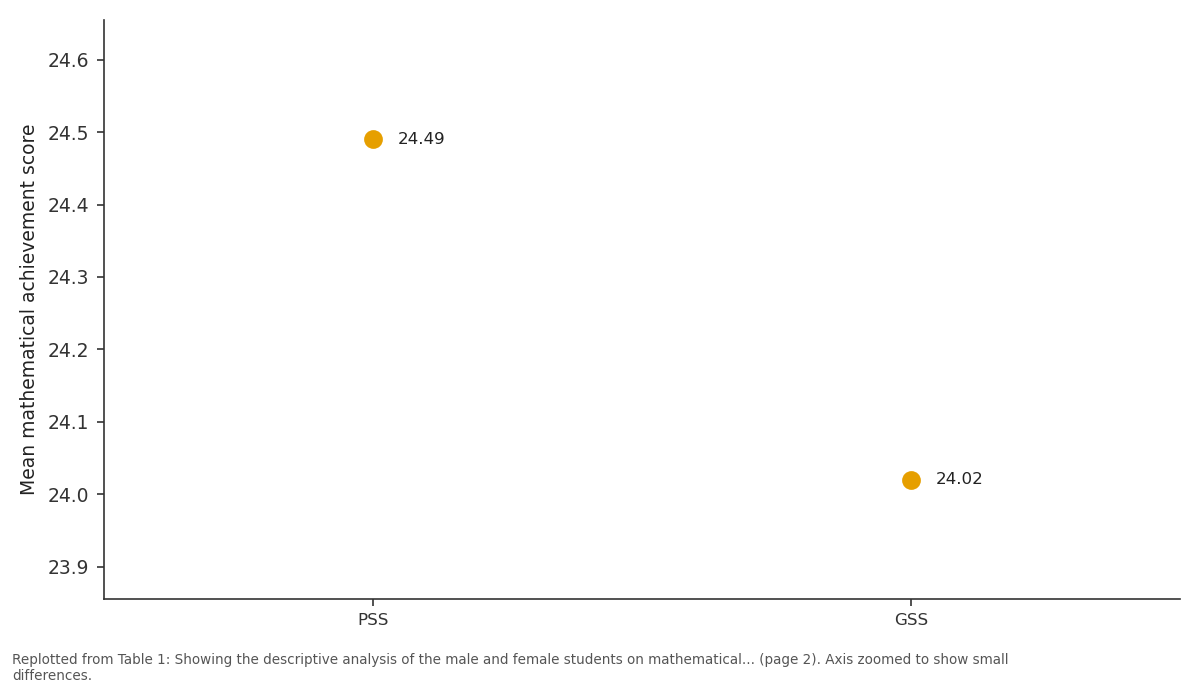
Mean / Statistic: PSS vs GSS
Replotted from Table 1 (page 2) of the original paper. Every bar is the paper's own table value.
View source evidence ↗Figures & tables
From the original paper Table 1
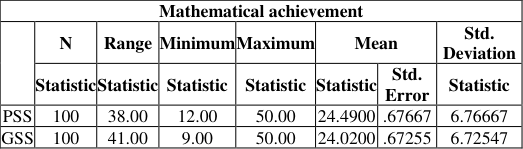 Table 2
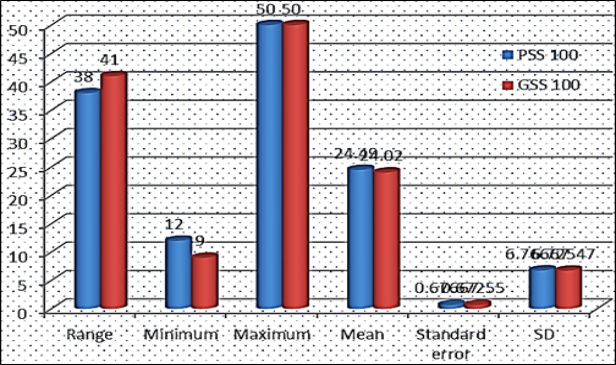 Figure 1
 Table 3
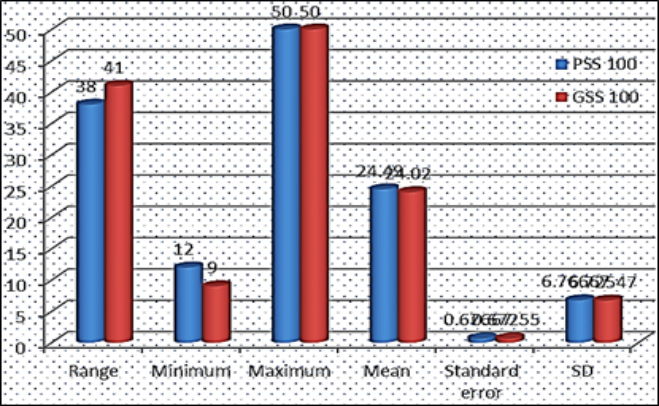 Figure 2
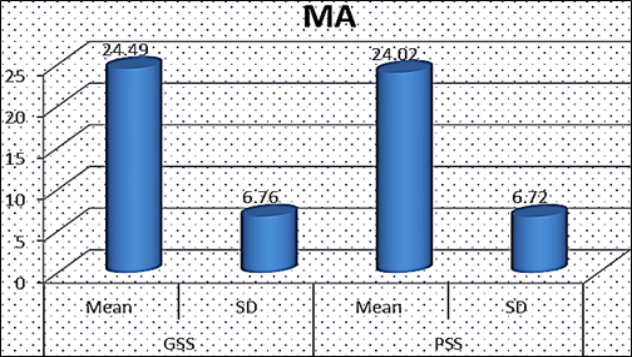 Figure 3
Introduction
Due to present developmental age rapid changes are occurring in all aspects of human activities. To keep pace with the coming changes in the society an individual has to bring some changes in him in anticipation to these societal changes. According to the demand of the changing society every individual needs to play his role significantly in coping with changes of the society. The development of conceptual understanding in Mathematics may change the cognitive behaviour of human beings in general. Significance of any study can be estimated only by observing the contribution of the study in extending the horizon of knowledge. Due to the abstract nature of mathematical concepts some students feel fear and anxiety with this subject. At the same time some students show negligence towards this subject. However, Mathematics is one of the important school subjects since time immemorial. Significance of Mathematics has also been emphasized in the Indian Education Commission (1966) in the following words: "One of the outstanding characteristics of scientific culture is quantification. Mathematics, assumes a prominent position in the modern education. Apart from its role in the growth in physical sciences it is now playing an increasingly important part in the development of the biological sciences. The advent of automation and cybernetics in the century marks the beginning of the new scientific industrial revolution and makes it all the more imperative to devote special attention to the study of mathematics. Proper foundations in the knowledge of the subject should be laid at school." The knowledge of Mathematics is now being applied in many new fields which were never dreamed of in the past. From this point of view also, this study may throw some light on the development of learning capacity of the learners in Mathematics. This study may also help in exploring the problems and probable solutions related to achievement in mathematics. Keeping in view the researcher selected the below mentioned research problem:
Statement of the research problem:
In the present study an attempt has been made by the investigator to study the research problem which reads as:
1.2 Operational definition of the terms: The operation definitions of the terms and variables are reported as under:
1) Mathematics: Mathematics may be briefly defined as that field of knowledge which devotes itself to exploration in number, form, abstract structures and order relationships.
In other words, it is the study of the measurement, relationships and properties of qualities and sets using numbers and symbols at secondary school level. 2) Mathematics achievement: An achievement is a single score obtained by the student on achievement test related to any subject. Here, mathematics achievement is a score obtained by the student on Mathematics Achievement Test (MAT) against the learning and understanding of concepts of class XI mathematics syllabus.
3) Students:
In the present study students refers the class 9 th students reading in selected government and private schools of Anantnag district.
Objectives of the study:
The present study consists of below mentioned objectives: 1) To explore the mathematical achievement of government and private school students.
Hypothesis:
Based on richness background of the knowledge, the investigator speculated the below mentioned research hypothesis: 1) There will be no significant difference between government and private school students on their mathematical achievement.
Delimitations of the study:
During the whole research process lot or constraints were faced by the investigator.
However, investigator made ample efforts to delimit these constraints upto maximum extent. Consequents the research delimited the present study to following domains: a) The present study will be delimited to 200 students.
b) The present study will be delimited to 9 th class students.
c) The present study will be delimited to selected government and private schools of Anantnag district only.
Methodology:
The methodology of the study has been stated in the following sub-headings:
Analysis of the data:
The data has been analysed with the help of suitable statistical treatment. Descriptive and comparative analysis was used for processing the data. The detailed description of the statistical treatment is given as under:
Interpretation:
The results presented in the above reported table give information about the descriptive analysis of government and private school students on the basis of their mathematical achievement. The results reveal that the mean value of private school students has been seen 24.49 and the standard error has been reported 0.67. In pursuance to same, the range has been reported 38.00. Among government school students the mean value was seen 24.02 and the range was found 41.00. According, the among government school students the minimum value was seen 9.00 and maximum value was seen 12.00.
Interpretation:
The results presented in the above reported table give information about the descriptive analysis of government and private school students on the basis of their mathematical achievement. The results reveal that the mean value of private school students has been seen 24.49 and the standard error has been reported 0.67. In pursuance to same, the range has been reported 38.00. Among government school students the mean value was seen 24.02 and the range was found 41.00. According, the among government school students the minimum value was seen 9.00 and maximum value was seen 12.00. Interpretation: The perusal of the above given table (Please refer table 1, Fig. 1) gives information about the mean comparison of government and private school students on their mathematical achievement. The results reveal that the mean value of private school students was seen 24.49 and the mean value of government school students was seen 24.02. When the both group of respondents were comparatively analysed, the 't' value came out to be 0.49, which is lower than table value at 0.01 level of confidence. Thus, it can be said that there is o any kind difference reported between government and private school students on their mathematical achievement. In pursuance to above reported results, the study of the hypothesis is reported as under:
| Mathematical achievement | — | — | — | — | — | — | — |
|---|---|---|---|---|---|---|---|
| N | Range | Minimum | Maximum | Mean | Std. Deviation | ||
| Statistic | Statistic | Statistic | Statistic | Statistic | Std. Error | Statistic | |
| PSS | 100 | 38.00 | 12.00 | 50.00 | 24.4900 | .67667 | 6.76667 |
| GSS | 100 | 41.00 | 9.00 | 50.00 | 24.0200 | .67255 | 6.72547 |
Table text extracted from the original PDF; superscript letters are shown inline. The original table image is below.
View original table image
▪ Hypothesis: There will be no significant difference between government and private school students on their mathematical achievement. ……Status Accepted
Conclusions of the study
The present study was carried out to explore the mathematical achievement of government and private school students. Keeping in view, the researcher found that there is no significant between government and private school students on their achievement towards mathematics. No significant difference has been observed between government and private
Figures and tables from the paper
| Mathematical achievement | — | — | — | — | — | — | — |
|---|---|---|---|---|---|---|---|
| N | Range | Minimum | Maximum | Mean | Std. Deviation | ||
| Statistic | Statistic | Statistic | Statistic | Statistic | Std. Error | Statistic | |
| PSS | 100 | 38.00 | 12.00 | 50.00 | 24.4900 | .67667 | 6.76667 |
| GSS | 100 | 41.00 | 9.00 | 50.00 | 24.0200 | .67255 | 6.72547 |
Table text extracted from the original PDF; superscript letters are shown inline. The original table image is below.
View original table image
| Composite score | GSS | — | PSS | — | ‘t’ value |
|---|---|---|---|---|---|
| Mean | SD | Mean | SD | 0.49** | |
| Mathematical achievement | 24.49 | 6.76 | 24.02 | 6.72 | |
| **= not significant at 0.01 level of confidence |
Table text extracted from the original PDF; superscript letters are shown inline. The original table image is below.