
Research article · 2020 · Full text
International Journal of Veterinary Sciences and Animal HusbandryAcceptability (measured as feed intake) by broilers of red earthworm meal (Eisenia Foetida)
Volume 5(4) · Pages 93–96
Research areasInsect Utilization and Effects
Abstract
Author-writtenRed earthworm meal (Eisenia foetida) are potential to be utilized as feed resource due to their good nutritional composition. However, it is not known whether broilers can consume feeds containing significant levels of earthworm meal. This study determined acceptability of red worms by broiler chickens. Three experimental broiler finisher diets were formulated to be isonitrogenous and isocalorific. Earthworm meal substituted fish meal in experimental diets. Diet 1 (control) containing no earthworm meal, diet 2 earthworm meal replaced 25% of fish meal and diet 3, earthworm meal replaced 50% of fish meal. Acceptability of diet was determined using two-choice test method. In each cage with a single broiler, two diets were offered to the broiler such that there were three combinations; i.e. diet 1 and diet 2; diet 1 and diet 3; diet 2 and diet 3. Feed intake was used to predict the acceptability of the diet. There were no variations (P >0.05) in acceptability of different levels of red earthworm meal. Birds did not show preferences for any of the dietary inclusion levels of red earthworm meal. It is concluded that earthworm meal from E. foetida can replace up to 50% fishmeal in broiler finisher feed without affecting feed intake. Therefore, Eisenia foetida meal is a promising protein source for broilers.
Summary
Source-checkedPlain-language reading of the full paper, prepared with AI and checked against the text. Each point links to the authors' own words.
Why it matters
- In Kenya, the standard protein sources for chicken feed, such as soybean meal and fishmeal, are expensive and limited in supply. View evidence ↗
- Fishmeal usage is limited to under 10% in broiler diets to prevent meat taint. View evidence ↗
- Red earthworm meal (Eisenia foetida) is a potential protein source with a dry weight protein content between 58% and 71%. View evidence ↗
The question
- The study aimed to determine if broiler chickens find red earthworm meal acceptable in their diet. View evidence ↗
What they did
- The experiment used nine mixed-sex broiler chickens, approximately 28 days old with an average weight of 700 g, housed in individual cages. View evidence ↗
- Acceptability was measured via feed intake using a two-choice test method, pairing diets in three combinations (1 vs 2, 1 vs 3, and 2 vs 3). View evidence ↗
- The study included a seven-day adaptation period followed by seven days of feed intake data collection. View evidence ↗
What they found
- There were no statistically significant differences (p > 0.05) in the acceptability of the different levels of red earthworm meal, indicating no bird preference. View evidence ↗
- When comparing Diet 1 (control) and Diet 2 (25% replacement), the mean intakes were 64.1 ± 4.39 g/d and 63.1 ± 4.39 g/d, respectively. View evidence ↗
- When comparing Diet 1 (control) and Diet 3 (50% replacement), the mean intakes were 62.5 ± 5.15 g/d and 60.5 ± 5.15 g/d, respectively. View evidence ↗
- When comparing Diet 2 (25% replacement) and Diet 3 (50% replacement), the mean intakes were 66.0 ± 4.24 g/d and 62.1 ± 4.24 g/d, respectively. View evidence ↗
- The overall average daily intake for Diet 1 was 63.3 ± 2.8 g/d, for Diet 2 was 64.6 ± 2.8 g/d, and for Diet 3 was 61.3 ± 3.9 g/d. View evidence ↗
What it means
- The authors conclude that E. foetida meal is a promising protein source that can replace up to 50% of fishmeal in broiler finisher feed without reducing feed intake. View evidence ↗
- The authors state that further research is needed to test replacement levels above 50% and to evaluate acceptability for broiler starters (0-28 days). View evidence ↗
Visual summary
2 visualsIllustrations explain the paper; charts are replotted from the paper's own table values.
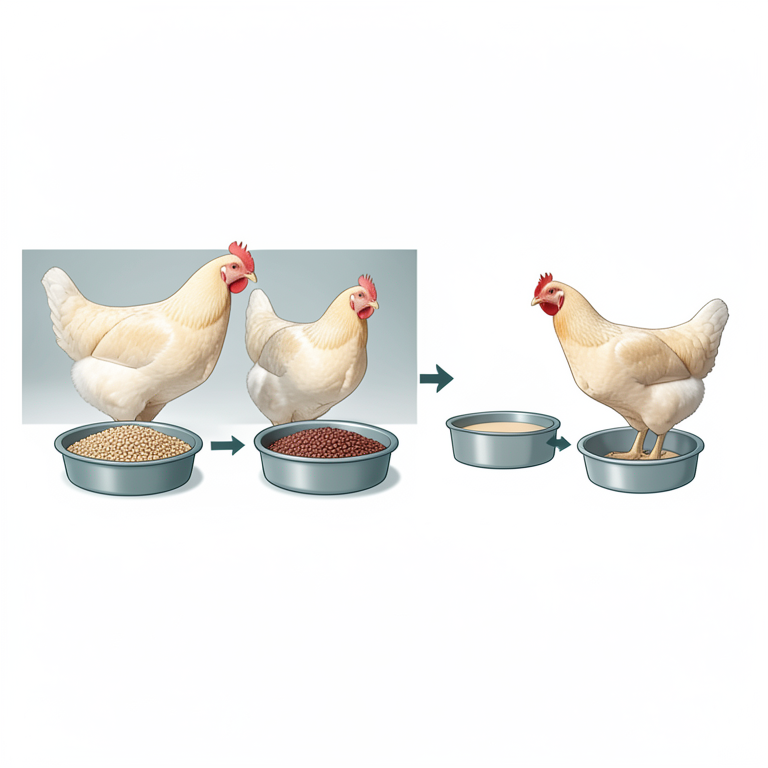
Experimental Diet Setup
AI-generated conceptual illustration (broiler chickens and feed bowls containing fishmeal and red earthworm meal). It explains the idea and does not show study data.
View source evidence ↗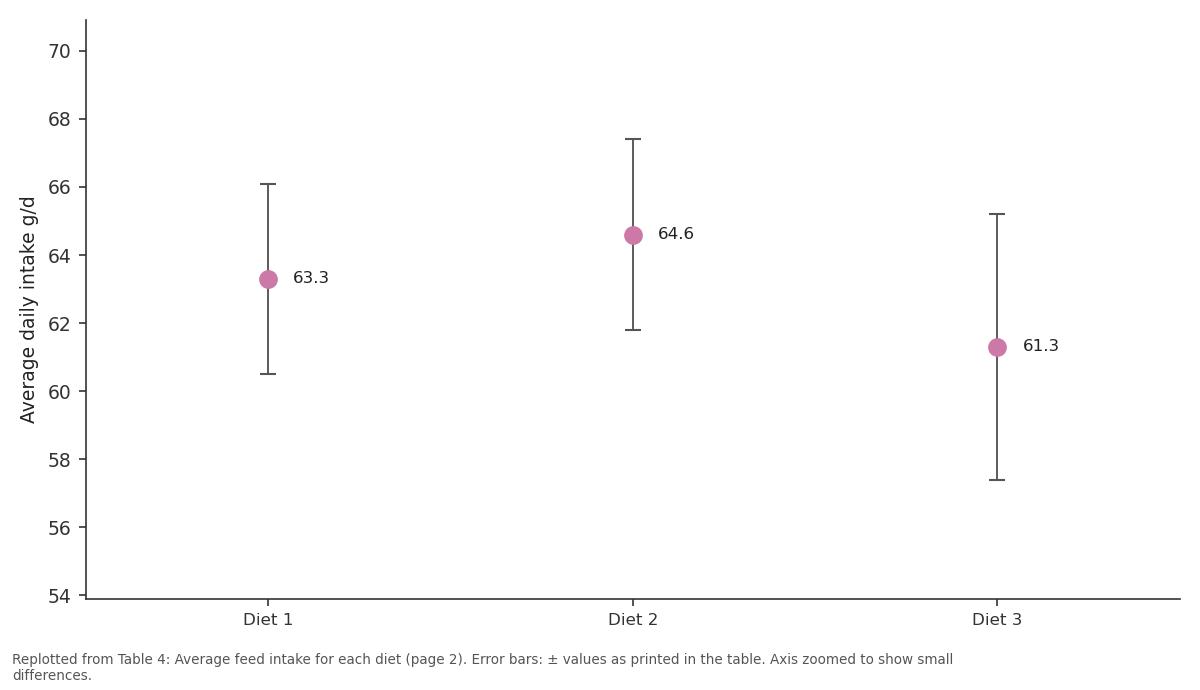
Average daily intake g/d ± SD: Diet 1 vs Diet 2 vs Diet 3
Replotted from Table 4 (page 2) of the original paper. Every bar is the paper's own table value.
View source evidence ↗Figures & tables
From the original paper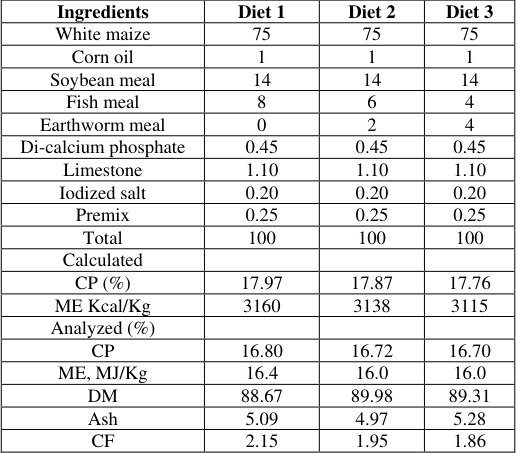 Table 1
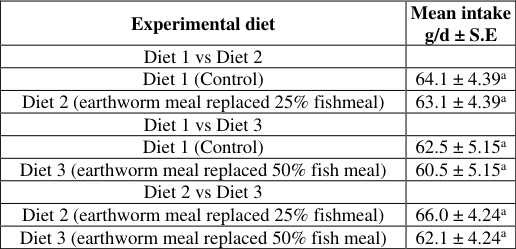 Table 2
 Table 3
 Table 4
Introduction
The common conventional protein feed resources for chickens in Kenya are fishmeal and soybean meal. These conventional protein feedstuffs are restrictive (Veldkamp et al. 2012) [17] because they are expensive. Similarly, fishmeal cannot be included at levels beyond 10% because of the taint passed into broiler meat (Swick 1999) [16] . Therefore, this necessitates a need for alternative or replacement sources of protein that can substitute fishmeal and or soybean meal. One such alternative is the red earthworm meal. The possibility and potential of using red earthworm meal as a feed resource for livestock has been reported by several researchers (Hilton 1983; Sogbesan and Ugwumba 2008; Gunya et al. 2016) [7,14,6] . This is due to its good nutritional composition. The protein quality of earthworm meal is almost similar to that of fish meal which is a conventional protein source used in poultry industry (Gunya et al. 2016) [6] . The protein content of Eisenia foetida ranges from 58 % to 71 % on dry weight basis (Zhenjun et al. 1997; Moreki and Tiroesele 2012) [19,10] . The protein requirements for various classes of broiler chicken is estimated to be between 18-23% for optimal growth (NRC 1994) [12] . In addition, other studies showed that earthworm is rich in essential amino acids, especially lysine. This amount of lysine in earthworm meets the lysine required by growing poultry (Stafford and Tacon 1985; Edwards and Niederer 1988; Vielma et al. 2003) [15,5,18] . It is evident that the nutritional composition of red worms was overemphasized. However, it is not known whether broilers can consume feeds containing significant levels of earthworm meal. This has made it complex to include them into feed formulation by nutritionists and farmers. The acceptability of E. foetida was evaluated using feed intake of feeds containing the earthworm meal. Acceptability of diet was determined by using two-choice test method as described by Kane et al. (1981) [8] . Therefore, the objective of this study was to determine acceptability of red worms by broiler chickens.
Materials and Methods
Materials and Methods
Study site
The feeding experiment was carried out at Poultry unit at Tatton Agriculture Park (TAP) in Egerton University. The University is geographically situated at S 0˚22'11.0", E 35˚55'58.0" within the Kenyan Rift Valley in Njoro, Nakuru County. It has an altitude of 1,800 m above sea level with temperatures ranging between 22 ˚C and 17 ˚C on average. The average annual rainfall in the area is 1,200 mm per year.
Source and processing of red earthworm meal
Fresh red earthworms were obtained from a commercial farm (Kinangop Organics Farm, Kenya), where it is being used in making compost manure. Red earthworms were transported while afresh to Egerton University, department of Animal Sciences and rinsed in water and kept in bowel for 30 minutes to evacuate their guts (Akpodiete and Okagbere 1999) [1] . The worms were passed through boiling water for a minute as described by Bou-Maroun et al. (2013) [3] , thereafter, spread in sunlight on a polythene. The dried red worms were milled into a powder using a mortar and pestle.
Experimental birds and housing
Nine 28-days old mixed sex broiler chickens of average weight of about 700 g were obtained from a commercial farmer in Nakuru and randomly placed in individual cages whose width, length and height were measuring 1 m by 3 m by 3 m respectively. Feed and fresh water were accessible ad libitum throughout the study period. The house floors were covered with six cm of wood shavings as litter material. The experimental cages were constructed within a house in which a 1 m high wall was covered with wire mesh. The wire mesh was allowed for ventilation and natural light.
Experimental diets
Three experimental broiler finisher diets were formulated to be isonitrogenous and isocalorific. Earthworm meal substituted fish meal in experimental diets. Diet one was the control treatment containing no earthworm meal. In the second diet, earthworm meal replaced 25% of fish meal and in diet three, earthworm meal replaced 50% of fish meal (Table 1).
| Ingredients | Diet 1 | Diet 2 | Diet 3 |
|---|---|---|---|
| White maize | 75 | 75 | 75 |
| Corn oil | 1 | 1 | 1 |
| Soybean meal | 14 | 14 | 14 |
| Fish meal | 8 | 6 | 4 |
| Earthworm meal | 0 | 2 | 4 |
| Di-calcium phosphate | 0.45 | 0.45 | 0.45 |
| Limestone | 1.10 | 1.10 | 1.10 |
| Iodized salt | 0.20 | 0.20 | 0.20 |
| Premix | 0.25 | 0.25 | 0.25 |
| Total | 100 | 100 | 100 |
| Calculated | |||
| CP (%) | 17.97 | 17.87 | 17.76 |
| ME Kcal/Kg | 3160 | 3138 | 3115 |
| Analyzed (%) | |||
| CP | 16.80 | 16.72 | 16.70 |
| ME, MJ/Kg | 16.4 | 16.0 | 16.0 |
| DM | 88.67 | 89.98 | 89.31 |
| Ash | 5.09 | 4.97 | 5.28 |
| CF | 2.15 | 1.95 | 1.86 |
Table text extracted from the original PDF; superscript letters are shown inline. The original table image is below.
View original table image
Experimental procedures
The acceptability of broiler chicken diets containing varying levels of red earthworm meal were determined using feed intake in a two-choice test method as described by Kane et al. (1981) [8] . In each cage with a single broiler, two diets were offered to the broiler such that there were three combinations; i.e. diet 1 and diet 2; diet 1 and diet 3; diet 2 and diet 3. Each combination was randomly allocated to an individual bird in cage resulting to three replications per combination. The diets were placed in plates and locations for the two diets in the cage were interchanged daily to avoid association of location with a particular diet. Feed (the two plates in each cage) was available at all times. A seven-day adaptation period was allowed and a seven-day feed intake data collection followed. At the end of the experiment, the feed consumed from each plate was determined on the cage basis. Feed intake was used to predict the acceptability of the diet.
Statistical analysis
The intake of each diet was analyzed statistically using general linear model (GLM) procedure of SAS (2009) and the differences among mean were tested for significance using Tukey test.
Results
Results
Acceptability of red earthworm meal (Eisenia foetida) by broiler chickens
The results for this trial are presented in Table 2. There are no variations (p >0.05) in acceptability of different levels of red earthworm meal. Birds did not show preferences for any of the dietary inclusion levels of red earthworm meal.
| Experimental diet | Mean intake g/d ± S.E |
|---|---|
| Diet 1 vs Diet 2 | |
| Diet 1 (Control) | 64.1 ± 4.39a |
| Diet 2 (earthworm meal replaced 25% fishmeal) | 63.1 ± 4.39a |
| Diet 1 vs Diet 3 | |
| Diet 1 (Control) | 62.5 ± 5.15a |
| Diet 3 (earthworm meal replaced 50% fish meal) | 60.5 ± 5.15a |
| Diet 2 vs Diet 3 | |
| Diet 2 (earthworm meal replaced 25% fishmeal) | 66.0 ± 4.24a |
| Diet 3 (earthworm meal replaced 50% fish meal) | 62.1 ± 4.24a |
Table text extracted from the original PDF; superscript letters are shown inline. The original table image is below.
View original table image
Discussion
Fishmeal (omena) and soybean meal are the most common protein sources in the poultry feed industry in Kenya. However, these protein feedstuffs are both in limited supply and expensive because they are being competed for by other livestock. This has necessitated to look for alternative protein sources for poultry that can substitute fish meal and soybean meal. Some of these alternatives are meat and bone meal, hydrolyzed feather meal, blood meal, snail meal and silkworm pupae. Earthworm meal is another alternative but has not been tried in Kenya although interest is growing in other parts of the world. The evaluation of red earthworms as innovative feed ingredients for poultry (Lourdumary and Uma 2013) [9] has been recently carried out since the meal may be suitable for substituting the conventional protein sources like fish meal. However, palatability and acceptability of red earthworm meal as feed ingredient is still unknown, hence this trial. The current trial represents the first feed choice trial testing the inclusion of an earthworm meal in the diet of broiler chickens. The results of this study deduced that there is no significant difference in acceptability of red earthworm meal when included at 0%, 25% and 50% in broiler diets as a replacement to fishmeal. The average daily intake of about 60 g for the diets is in line with NRC guidelines for broiler feeding considering the growth stage (NRC 1994) [12] . Fed broilers with red earthworm meal at inclusion levels of 0%, 1%, 3%, 5% and 10% replacing fish meal as a protein source. Birds fed on 5% red earthworm meal had superior results in terms of intake. This means that earthworm meal is acceptable to birds at 5% level of inclusion. Similar results were observed where birds did not show any preference when soybean oil was replaced by black soldier fly at 50 % and 100% respectively (Schiavone et al. 2017) [13] . When free-range chicken fed either a control diet or a diet in which gluten meal was replaced with Tenebrio molitor meal, the same average daily feed intake was observed (Biasato et al. 2016) [2] . Similar results were found when a Tenebrio molitor meal replaced soya bean meal with hulls in the diet for broiler chickens (Bovera et al. 2015) [4] . The results of this study are inconsistent with the findings by Ngoc et al. (2016) [11] which concluded that inclusion of earthworm meal at large quantities in chicken diets makes the feed unpalatable due to presence of coelomic fluid in it.
Conclusion
It is concluded that earthworm meal from E. foetida can replace up to 50% fishmeal in broiler finisher feed without affecting feed intake. Therefore, Eisenia foetida meal is a promising protein source for broilers. Further research is necessary to evaluate its acceptability for broiler starters (0-28 d) and replacement levels above 50%.
16. Swick RA. Consideration in using protein meals for poultry and swine, ASA Technical Bulletin, 1999, AN21-1999. 17. Veldkamp T. Insects as a sustainable feed ingredient in pig and poultry diets: a feasibility study =Insecten als duurzame diervoeder grondstof in varkens-en pluimveevoeders: een haalbaarheidsstudie. Wageningen UR Livestock Research, 2012. 18. Vielma J, Koskela J, Ruohonen K, Jokinen I, Kettunen J.
Acknowledgement
AcknowledgementThe authors wish to thank African Development Bank (AFDB) for financial support to carry out this study. Also, much gratitude to the department of Animal Sciences, Faculty of Agriculture, Egerton University Kenya for academic support.
Figures and tables from the paper
| Statistical comparisons | p-values |
|---|---|
| Diet 1 vs Diet 2 | 0.88 |
| Diet 1 vs Diet 3 | 0.79 |
| Diet 2 vs Diet 3 | 0.52 |
Table text extracted from the original PDF; superscript letters are shown inline. The original table image is below.
View original table image
| Diet | Average daily intake g/d ± SD |
|---|---|
| Diet 1 | 63.3 ± 2.8 |
| Diet 2 | 64.6 ± 2.8 |
| Diet 3 | 61.3 ± 3.9 |
Table text extracted from the original PDF; superscript letters are shown inline. The original table image is below.
View original table image
References
15 in the original paper- Akpodiete OJ, Okagbere GN. Feed accessories from animal production. Issues on Animal Sciences. In: A Compendium of Ideas, Fact and Methods in the Science and Technology of Animal Agriculture, Omeje, SI (Ed.). Ran Kennedy, New York, 1999, 71-82.
- Biasato I, De Marco M, Rotolo L, Renna M, Lussiana C, Dabbou S et al. Effects of dietary Tenebrio molitor meal inclusion in free-range chickens. Journal of Animal Physiology and Animal Nutrition. 2016; 100(6):11041112.
- Bou-Maroun E, Loupiac C, Loison A, Rollin B, Cayot P, Cayot N et al. Impact of preparation process on the protein structure and on the volatile compounds in Eisenia foetida protein powders. Food and Nutrition Sciences. 2013; 4(11):1175.
- Bovera F, Piccolo G, Gasco L, Marono S, Loponte R, Vassalotti G et al. Yellow mealworm larvae (Tenebrio molitor, L.) as a possible alternative to soybean meal in broiler diets. British Poultry Science. 2015; 56(5):569575.
- Edwards CA, Niederer A. Production and processing of earthworm protein. Earthworms in Waste and Environmental Management/Edited by Clive A. Edwards and Edward F. Neuhauser, 1988.
- Gunya B, Masika PJ, Hugo A, Muchenje V. Nutrient composition and fatty acid profiles of oven-dried and freeze-dried earthworm Eisenia foetida. Journal of Food and Nutrition Research. 2016; 4(6):343-348.
- Hilton JW. Potential of freeze-dried worm meal as a replacement for fish meal in trout diet formulaions. Aquaculture. 1983; 32(3):277-283. https://doi.org/10.1016/0044-8486(83)90224
- Kane E, Morris JG, Rogers R. Acceptability and digestibility by adult cats of diets made with various sources and levels of fat. Journal of Animal Science. 1981; 53(6):1516-1523.
- Lourdumary AB, Uma K. Nutritional evaluation of earthworm powder (Lampito mauritii). Journal of Applied Pharmaceutical Science. 2013; 3(3):82.
- Moreki JC, Tiroesele B. Termites and earthworms as potential alternative sources of protein for poultry. International Journal of Veterinary Medicine Sciences. 2012; 6:368-376.
- Ngoc TN, Pucher J, Becker K, Focken U. Earthworm powder as an alternative protein source in diets for common carp (C yprinus carpio L) Aquaculture Research. 2016; 47(9):2917-2927.
- National research council (NRC). Nutrient requirements of poultry-ninth revised edition. Journal of Applied Poultry Research. 1994; 3(1):101-101.
- Schiavone A, Cullere M, De Marco M, Meneguz M, Biasato I, Bergagna S et al. Partial or total replacement of soybean oil by black soldier fly larvae (Hermetia illucens L.) fat in broiler diets: Effect on growth performances, feed-choice, blood traits, carcass characteristics and meat quality. Italian Journal of Animal Science. 2017; 16(1):93-100.
- Sogbesan AO, Ugwumba AA. Nutritional Values of Some Non-Conventional Animal Protein Feedstuffs Used as Fishmeal Supplement in Aquaculture Practices in Nigeria. Turkish Journal of Fisheries and Aquatic Sciences. 2008; 8(1):159-164.
- Stafford EA, Tacon AG. The nutritional evaluation of dried earthworm meal (Eisenia foetida, Savigny, 1826) included at low levels in production diets for rainbow trout, Salmo gairdneri Richardson. Aquaculture Research. 1985; 16(3):213-222.