
Research article · 2021 · Full text
International Journal of Agriculture Extension and Social DevelopmentExamination of food accessibility dimensions of household farms in the central region, Ghana
Volume 4(2) · Pages 16–21 · DOI: 10.33545/26180723.2021.v4.i2a.98 ↗
Research areasChild Nutrition and Water AccessFood Security and Health in Diverse Populations
Abstract
Author-writtenThe study aimed at examining the food accessibility dimensions of male and female farm household farms in the Central Region of Ghana. A descriptive survey design was used in this study. A structured interview guide was used to collect data from four hundred and twenty (420) resident farmers from selected districts using a simple random sampling technique. Statistical Package for Service Solution (SPSS) version 20 was used to analyze the quantitative data. The results show that about (73%) of male and female household farms eat limited food due to lack of resources while some could not afford a three square meals a day.
Summary
Source-checkedPlain-language reading of the full paper, prepared with AI and checked against the text. Each point links to the authors' own words.
Why it matters
- Household farms are highly susceptible to poverty, with approximately 46% of them falling below the poverty line according to 2009 data. View evidence ↗
- Challenges for household farms include an over-reliance on rainfall, poor use of synthetic inputs, and a lack of improved crop and animal varieties. View evidence ↗
The question
- The study aimed to examine the dimensions of food accessibility for male and female farm households in Ghana's Central Region. View evidence ↗
What they did
- The researchers used a descriptive survey design and a structured interview guide to collect data from 420 resident farmers selected via simple random sampling. View evidence ↗
- The study was conducted in the Central Region of Ghana, which covers 9,826 square kilometers. View evidence ↗
- Quantitative data were analyzed using SPSS version 20, and two-sample T-tests were used to compare consumption outcomes between male and female households. View evidence ↗
What they found
- Of the 408 respondents analyzed for demographics, 296 were male and 126 were female. View evidence ↗
- Among male respondents, 40% (118 people) reported that they sometimes had to eat a limited variety of food due to a lack of money. View evidence ↗
- A majority of male household members could not afford their preferred foods, with 39% saying they rarely and 39% saying they sometimes ate foods they did not want due to lack of money. View evidence ↗
- Regarding daily meals, 40% of male household farms rarely and 38% sometimes enjoyed three square meals a day due to lack of food and funds. View evidence ↗
- When asked about fasting for a whole day, 44% of female respondents and 23% of male respondents reported sometimes staying the entire day without food. View evidence ↗
- Overall, approximately 73% of male and female household farms eat limited food because of a lack of resources. View evidence ↗
What it means
- The authors concluded that while most respondents had low education levels (no formal to JHS), this diminished the likelihood of extreme food unavailability but expanded food consumption diversity. View evidence ↗
- The authors concluded that the majority of household farms cannot afford three square meals a day due to a lack of funds and food availability. View evidence ↗
Visual summary
1 visualsIllustrations explain the paper; they do not show study data.
Food Accessibility Dimensions
AI-generated conceptual illustration (Small-scale household farms in rural Ghana). It explains the idea and does not show study data.
View source evidence ↗Figures & tables
From the original paper Table 1
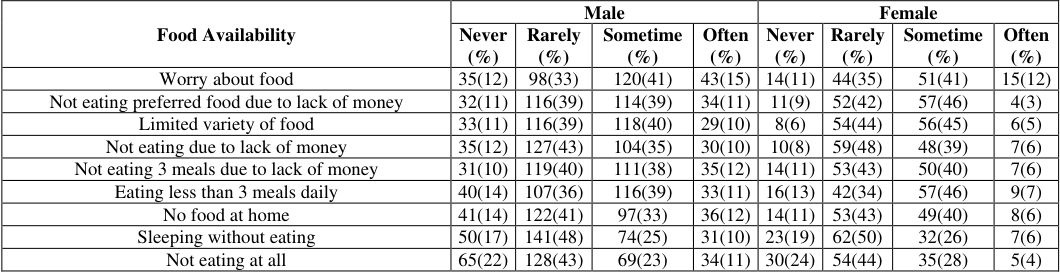 Table 2
Introduction
Food is the fundamental need and need of life that should be fulfilled before some other formative issue. Deficient sustenance is considered as proportion of neediness in numerous social orders or equivalent to destitution (Datt et al., 2000) [10] . Helen (2002) [16] noted that, food security keeps up with political solidness, and guarantees serene conjunction among individuals while food instability brings about chronic weakness and diminished execution of the children and grown-up. Food security is hence characterized "as a circumstance when all individuals, consistently, have physical and financial admittance to adequate, protected and nutritious food to meet their dietary necessities and food inclinations for a sound and dynamic life" (FAO, 1996). Incidentally, farming households are the most influenced as far as food insecurity and neediness in Africa particularly the small farming household, however the remainder of the populace relies upon their production. As indicated by Cruz (2010) [9] and Valdés et al., (2010) [29] , greater part (more than 80%) of the smallholder ranchers on the planet are food unreliable and rely upon land as their essential wellspring of livelihoods. Three out of each four needy individuals leave in rustic regions and rely upon farming either straightforwardly or by implication for their work (World Bank, 2008). In most part of the world and particularly, in the agricultural nations, concerns in regard to food security and its connected issues are fundamental for destitution decrease. Accomplishment of food security is center issue going up against cultivating families, particularly women and farming communities because of low efficiency in staple crop production, occasional changeability in food supply just as value vacillations. These issues confronting household farms occur because of over dependent on rainfall farming activities, none or unseemly utilization of synthetic contributions just as deficient further developed assortments of harvests and animal species. Food security of cultivating families is of genuine concern assuming Ghana needs to combine her macroeconomic additions since; ranchers who are powerless against food and nourishing uncertainty have restricted ability to react to horticultural projects. Regardless of the way that Ghana made critical accomplishment towards meeting the millennium development objective one by dividing destitution from roughly 51.7 percent in 1991-1992, to 28.5 percent in 2005-2006 (Ghana Statistical Service, 2008) the abstrusity of neediness has exacerbated and spread into metropolitan regions (WFP, 2009) [32] . Household farms were perceived as generally influenced by destitution among every one of the financial exercises with practically 50% of them (46%) falling beneath the neediness line (WFP, 2009) [32] . As indicated by the insights of World Food Program (2009), about 1.2 million individuals, addressing 5% of the number of inhabitants in Ghana are food uncertain and 2 million individuals are helpless to become food unreliable in an event of any natural or man-made shock. Food security is a multidimensional concept that mirrors a perplexing cooperation of numerous concerns (Misselhorn 2005; Altman et al. 2009). Outlining food security as a necessary part or a result of an occupation procedure perceives that a large group of stresses can interconnect to influence food security at a family or individual level. Family level grant on food security frequently draws on www.extensionjournal.com livelihood approaches. Indeed, some characterize food security as the achievement of local livelihoods in ensuring access to adequate food at the family level (Devereux and Maxwell 2001) [11] . The focal point of family level food security research is to study the methodologies utilized by individuals to accomplish food security, regardless of whether it be migration (Karamba et al. 2011) [18] , income diversification (Babatunde and Qaim 2010) [3] , or the utilization of technology (Burney and Naylor 2012) [6] , for instance. Food security can be viewed as one element of a more extensive livelihood procedure (Maxwell and Smith 1992) [21] . So, food security scholarship has advanced from a comprehension of food security established in issues of world and local food supply, to issues of family and individual food security that focuses on access (Sen 1981) [26] , supportability (Scoones 1998) [25] , and vulnerability to food insecurity (Chambers and Conway 1991; Watts and Bohle 1993) [7,30] . The concept of food security can be explained in a broader context. It includes more than the measure of food accessible or available. The Food and Agribusiness Association (FAO) characterizes food security as ''a circumstance that exists when all individuals, consistently, have physical, social and access to adequate, protected and nutritious food that meets their dietary necessities and food choices for a functioning, sound and active life'' (World Food Summit 1996). While food security is usually characterized as a dichotomy, it can shift by degree, over the long run, from one family to another, or among networks. The conceptualization of food security mirrors a development in the field. During the 1970s, food security was viewed as to a great extent a component of food production, as clear on the World Food Conference in 1974 (Anderson and Cook 1999; Maxwell 1996; Baro and Deubel 2006) [2,4,22] . Sen (1981) [26] is generally credited for presenting the ideas of qualifications and access to food security grant. The regular meaning of food security lays on three foundations: food availability, food access, and food use (Webb et al. 2006; Ericksen et al. 2011). The study aimed at examining the food accessibility dimensions of male and female farm households in the Central Region of Ghana.
Research approach and methods
A research design is an analytical, excellently-organized procedure used to achieve the research objectives by a researcher or a scientist. This is a systematic cooperation of items already known, and every other related data that contributes to a fair end result according to Bryman (2012) [5] . The study employed the cross section descriptive survey design to collect of information from farmers. The research was conducted in the Central Region of Ghana. Central Region, occupies an area of 9,826 square kilometers or 4.1 per cent of Ghana's land area of Ghana. A total of 2,201,863 populations for the region at 2010 population census, of Ghana's population. The region is divided into administrative districts. The total number of districts is 17. Located in the South -Western center of Ghana, the Central Region shares boundary with the Ashanti Region in the North, Eastern Region to the North-East, Greater Accra Region to the South-East and on the West by the Western Region. It is bounded to the south by the Gulf of Guinea. The region has a coastline of 150Km, and is the longest coastline in Ghana. It is one of the smallest regions in Ghana, only bigger than Upper East and the Greater Accra Regions. Seventeen (17) administrative Metropolis/Municipalities/districts prevail. The largest is Assin North with a land area of 2,375 km 2 and the smallest being Cape Coast/ Efutu. The Temperature is generally high and ranges between 24 o C and 34 o C. The region has a bimodal rainfall pattern averaging 800 mm to 1500 mm with the coast having the least. The major season spans April to July and the minor, September to November. Pictorial view of rainfall distribution. It has a relative humidity of between 50% and 85%. 9,830 km 2 , 4.1% of the Total land area of Ghana. Total cultivable land area is estimated at 7,864 km 2 (about 80% of the Region's Total Land Area). However, only 3,932 km 2 (40% of the Region's Land area) is under cultivation. All resident farmers from selected districts were included in the study. Sampling is a technique through which study respondents were selected from a target population. Given the study's geographic reach, multi-stage techniques were favoured as it provides the researchers with an opportunity to sample a large number of units at a given cost (Kothari, 204). The sampling method entails stratifying the Central Region into an urban and rural eco sustainable farming district that were relied. In order to arrive at a representative sample, the study employed the Yamane formula for sample size determination represented as size n=N/([1+N〖(α)〗^2]) where n=sample size, N= sampling frame and α represent the margin of error or confidence level and other population attributes deemed necessary. The study used structured interview guide as a data collection tool the random sampling technique to select the respondents for the study. A pretest was conducted to assess feasibility, time, cost, adverse events, and improve study design before a full-scale research project is performed. The quality of the tool was tested by both the interviewer and the interviewees in terms of readability, accessibility, validity and representativeness of the interview guide items in the research instrument. Pre testing was to help the researchers in identifying errors that might arise from the research instrument. The necessary corrections and modifications were made before finally administering the research instrument. The researchers together with 5 trained research assistants from the Department of Agricultural Economics and Extension conducted the data collection exercise. The research assistants were trained on the purpose of the study and the administration of the instruments. The respondents were assured of maximum information security of the information they gave to us since the study was main for academical purpose. The selected farms in the various towns/villages were visited for face-to-face interviews following agreed appointments. The survey interviews were coordinated by the researchers, and worked closely with the research assistants to constantly check entries to ensure consistency in responses across and within interview instruments. This was done to also ensure that responses were from the right sources. The instruments were sent to the respondents in their homes and their farmers. The hired research assistants guided the respondents to fill the responses or fill it for them in the of an interview. www.extensionjournal.com Statistical Package for Service Solution (SPSS) version 20 was used to analyze the quantitative data. The raw data were coded and entered directly into the SSPS software. The analysis then began with general critical reading to develop a system of coding for the verbal responses. T-Test (Two sample T-test) was used to determine the difference between male and female household consumption outcome.
Analysis and Discussion
Table 1 shows the educational level and marital status of the respondents. Out of the 408 respondents 296 representing a mean score of 2.67 were male while 126 representing a mean score of 2.209 female. Analysis of gender distribution of the households also revealed majority (296) of the household farmers are males and female households being in the minority (126). Counting on marital status, 293 representing a mean score of 1.102 of household farmers were married as against 121 married female household farmers. It can be further noticed that male household farmers had farming as their major occupation. On the other hand, 46(52.3%) of the male household farmers have had no formal education, 69(71.1%) primary education, 124(75.6%) middle school/JHS, 50(79.4%) O' Level and 7(87.5%) have also gone through tertiary education. Regarding the female household farmers, out of the total number of respondents, 42(47.7%) have had no formal education, 28(28.9%) middle school/JHS, 40(24.4%), 13(20.6) O' Level and 13(20.6) tertiary education. Education is a form of social capital that is supposed to improve household farming activities. According to Shaikh (2007) [28] , educated people have the ability to understand and utilize the information they are given. Them Lower educational levels make it more difficult to obtain better work prospects in the labour market, as well as obstructing more profitable enterprises (FAO, 2012). again, Our outcomes showed that majority (353) of both respondents had attained no formal up to JHS level of schooling diminished the likelihood of extreme and moderate food unavailability of 420 ranch families however expanded the diversity of food consumption. Some degree of training is significant in guaranteeing variety of food utilization in ranch family. The result is similar to Ngema et al., (2018) [23] , whose work was investigation into the Family Food Security Status and Its Determinants in Maphumulo Nearby Region, South Africa where instruction positively impacted the food security status of families.
| Educational level and marital status of respondents | — | — | — | — | — |
|---|---|---|---|---|---|
| Sex of respondent | N | Mean | Std. Deviation | Std. Error Mean | |
| educational level of respondents | male | 296 | 2.6723 | 1.00712 | .05854 |
| female | 124 | 2.2097 | 1.06896 | .09600 | |
| marital status of respondent | male | 293 | 1.1024 | .30368 | .01774 |
| female | 121 | 1.0992 | .30014 | .02729 |
Table text extracted from the original PDF; superscript letters are shown inline. The original table image is below.
View original table image
Food accessibility dimensions
Table 2 revealed the food accessibility dimension of both household male and female farmers. A question was asked about how often do male and female household farmers worry about having enough food and out of the total number of male respondents, 35(12%) said never, 98(33) indicated rarely, 120(41%) revealed sometimes and 43(15%) said often. In the same way, 14(11%) of the female household farmers indicated never, 44(35%) of them chose rarely, 51(41%) of the female respondents said sometimes while 15(12%) said often. Food accessibility is the capability to accumulate adequate food of ensured quality and amount to satisfy dietary demands of all home participants. Rightly, the food needs to reach appropriate location at the right time and other people need to have financial flexibility or buying power to get sufficient and healthy food. Kuwornu et al., (2011) [19] , asserted that food accessibility is identified by physical and funds available to buy social and political elements. Concerning 'how often were households members have to eat a limited variety of foods due to lack of resource', one hundred and eighteen (118) household male respondents representing (40%) indicated that sometimes, they had to eat a limited variety of food items due to lack of money and the least respondents who sometimes eat a very limited food due to lack of resources were tenty nine ( 29) representing (10%). Also, fifty six (56) respondents also were of the view that sometimes they had to eat limited food due to lack of resources representing (45%) while the least female respondents were 6(5%). Per the results, it can be said that majority male of the male respondents eat limited food due to lack of resources and there exists a significance difference between the male respondents who had limited food items and the female household members. Regarding whether the household members have to eat foods that they do not want to eat due to lack of money, 32(11%) of the male household members said never, 116(39%) indicated rarely, 114(39%) revealed 'sometimes' while 34(11%) of the male household members selected often. The results revealed that majority of the male household members could not afford to eat their preferred foods due to lack of money. Likewise, 11(9%) of the female household members were of the view that they eat their prefer food, 52(42%) said rarely, 57(46%) indicated 'sometimes' and 4(3%) indicated 'often'. Per the results, it could be said that majority of the female household members were of the view that not all the time that they get their preferred food. Food Availability alludes to the actual presence of food which might come from own creation, www.extensionjournal.com buys from inward market or import from abroad. Gregory et al., (2005) [14] clarified that food accessibility alludes to the presence of food stocks for utilization.
Respondents were asked them to indicate how often they ate a less food during breakfast, lunch or supper. Per this statement, 31(10%) of the male household farms were of the view that they have never enjoyed a three (3) square meals a day due to unavailability of food and fund, 119(40%) of the respondents indicated rarely, 111(38%) of the respondents said sometimes, 35( 12) also stated frequently. The data from the female household farms show that 14(11%) said they eat three (3) square meals a day, 42(34%) indicated rarely, 50(40) also said that due to lack of money and family size, sometimes they had to eat little food at breakfast, lunch, and supper. The results from both male and female household farms revealed that a majority of the male household farms always eat less food for break, lunch or supper Riely et al.
(1995) [24] emphasized on having adequate assets to get appropriate food for people. It is the manner in which various individuals can get the accessible food. Ordinarily, the authors indicated that food is accessed through a mix of home creation, stocks, buy, deal, presents, getting or food help. Food access is guaranteed when networks and families and all people inside them have sufficient assets, like cash, to get suitable food sources for a nutritious eating routine. Accessibility of food depends on the family available income, the cost of food, and different components.
With regard to whether respondents had food in their various homes, 41(14%) indicated 'never' signifying there do not have food in their homes, 122(41%) also said not frequent, 97(33%) answered 'sometimes' while 36(12%) said 'often' this results were revealed by the male household farms. The results from the female household respondents reveals that 14(11%) said they have no food available at home, 53(43%) indicated 'rarely, 49(40%) indicated that sometimes food becomes scares in their homes but only few respondents 8(6%) said 'often.' Concerning whether respondents sleep without eating; it was realised that, fifty male household farms 50(17%) eat before going to bed, 141(48%) indicated 'rarely' 74(25%) said sometimes they sleep without food while 31(10%) said 'often'. On the other hand, the results from the female respondents show that 23(19%) were of the view that they eat before sleeping, 62(50%) indicated 'rarely', 32(26%) also said sometimes they sleep without food but only 7(6%) of the female respondents stated 'often'. To find out if any of the respondents do not eat the whole day, it surprised to know that the an appreciable number of male respondents 69(23%) sometimes stay all day long without food whereas the female respondents was 54(44%). It was again noticed that 34(11%) of the male household farms frequently stay the whole day without food but a few female household respondents 5(4%) indicated same. It can be said that the number of male household farms who at times find it difficult to get a three square meals a day are more than that of the female.
Conclusion
This study had its main goals to examine food accessibility dimensions of male and female farm households in the Central Region, Ghana. The study assessed household food accessibility consumed over 7-day period. The study concluded that majority (353) of both respondents had attained no formal up to JHS level of education, diminishing the likelihood of extreme and moderate food unavailability of 420 ranch families, however, expanded the diversity of food consumption. In spite of this, majority of household farms were unable to enjoy a three (3) square meals a day due to unavailability of food and fund.
References
32 in the original paper- Aliaga MA, Chaves-Dos-Santos SM. Food and nutrition security public initiatives from a human and socioeconomic development perspective: mapping experiences within the 1996 World Food Summit signatories. Social science & medicine 2014;104:74-79.
- Anderson MD, Cook JT. Community food security: Practice in need of theory?. Agriculture and human values 1999;16(2):141-150.
- Babatunde RO, Qaim M. Impact of off-farm income on food security and nutrition in Nigeria. Food policy 2010;35(4):303-311.
- Baro M, Deubel TF. Persistent hunger: Perspectives on vulnerability, famine, and food security in sub-Saharan Africa. Annu. Rev. Anthropol 2006;35:521-538.
- Becker S, Bryman A, Ferguson H. (Eds.). Understanding research for social policy and social work 2E: themes, methods and approaches. policy press, 2012.
- Burney JA, Naylor RL. Smallholder irrigation as a poverty alleviation tool in sub-Saharan Africa. World Development 2012;40(1):110-123.
- Chambers R, Conway G. Sustainable livelihoodchambers and Conway, 1991.
- Connolly-Boutin L, Smit B. Climate change, food security, and livelihoods in sub-Saharan Africa. Regional Environmental Change 2016;16(2):385-399.
- Cruz L. Responsible Governance of Land Tenure. An Essential Factor for the Realization of the Right to Food. Land Tenure Working Group Discussion Paper 15, FAO. Rome, 2010.
- Datt G, Simler K, Mukherjee S, Dava G. Determinants of Poverty in Mozambique 199697 (FCND Discussion Paper. No.78). International Food Policy Research Institute: Washington, DC, 2000.
- Devereux S, Guenther B. Agriculture and social protection in Ethiopia, growth and social protection. Working paper 03, Future Agricultures and Centre for Social Protections, Nairobi, 2009.
- Food and Agriculture Organization of the United Nations, FAO. Report of the World Food Summit. Rome, Italy, 1996.
- Ghana Statistical Service, GSS. Revised Gross Domestic Product 2011.National Accounting. Accra, Ghana, 2012.
- Gregory P, Ingram JSI, Brklacich M. Climate Change and Food Security. Philosophical Transactions of the Royal Society B-Biological Sciences 2005;360(1463):2139-2148.
- Haggblade S, Theriault V, Staatz J, Dembele N, Diallo B. A conceptual framework for promoting inclusive agricultural value chains. International Fund for Agricultural Development (IFAD), mimeo (online document), 2012.
- Helen HJ. Food Insecurity and the Food Stamp Programme. American Journal of Agricultural Economics 2002;84(5):1215-1218.
- Hoddinott J. Operationalizing household food security in development projects: an introduction. Technical guide 1999;1:1-19.
- Karamba WR, Quiñones EJ, Winters P. Migration and food consumption patterns in Ghana. Food policy 2011;36(1):41-53.
- Kuwornu JK, Mensah-Bonsu A, Ibrahim H. Analysis of foodstuff price volatility in Ghana: Implications for food security. European Journal of Business and Management 2011;3(4):100-118.
- Lang T, Barling D. Food security and food sustainability: reformulating the debate. The Geographical Journal 2012;178(4):313-326.
- Maxwell S, Smith M. Household food security: a conceptual review. Household food security: Concepts, indicators, measurements 1992;1:1-72.
- Maxwell S. Food security: A post-modern perspective. Food policy 1996;21(2):155-170.
- Ngema PZ, Sibanda M, Musemwa L. Household food security status and its determinants in Maphumulo local www.extensionjournal.com municipality, South Africa. Sustainability 2018;10(9):3307.
- Riely F et al. Food security indicators and framework for use in the monitoring and evaluation of food aid programs. Food security and nutrition monitoring project. IMPACT. Arlington 1995.
- Scoones I. Sustainable rural livelihoods: a framework for analysis, 1998.
- Sen A. Issues in the Measurement of Poverty. In Measurement in Public Choice. Palgrave Macmillan, London, 1981, 144-166.
- Statham S. Inuit Food Security: Vulnerability of the traditional food system to climatic extremes during winter 2010/2011 in Iqaluit, Nunavut 2012.
- Suliman AM, Al-Shaikh FN. Emotional intelligence at work: Links to conflict and innovation employee relations, 2007.
- Valdés A, Foster W, Anríquez G, Azzarri C, Covarrubias K, Davis B et al., A Profile of the Rural Poor.A Background Paper for IFAD Rural Poverty Report.IFAD. Rome, 2010. http://www.ifad.org/rural/rpr2010/background/2.pdf
- Watts MJ, Bohle HG. Hunger, famine and the space of vulnerability. Geo Journal 1993;30(2):117-125.
- World Bank. The Growth Report: Strategies for Sustained Growth and Inclusive Development. Washington, DC, 2008.
- World Food Programme WFP. Comprehensive Food Security and Vulnerability Analysis. Accra, Ghana 2009, 168. www.fao.org