
Research article · 2020 · Full text
International Journal of Veterinary Sciences and Animal HusbandrySeven honeybee virus detection on honeybee mites in Thailand
Volume 5(2) · Pages 08–12
Research areasInsect and Pesticide ResearchInsect-Plant Interactions and ControlPlant Virus Research Studies
Abstract
Author-writtenThailand beekeeping has faced two main mites infections, there are Tropilaelaps mercedesae and Varroa destructor mites. They are very important for honeybee health and one of the economic losses factors of beekeeping in Thailand. In this study, we studied virus detection on the Tropilaelaps mercedesae and Varroa destructor by using the RT- PCR in Chiang Mai. Thirty Tropilaelaps mercedesae and Varroa destructor samples were detected with seven honeybee virus such as Deform Wing Virus (DWV), Acute Bee Paralysis Virus (ABPV), Chronic Bee Paralysis Virus (CBPV), Varroa Destructor Virus-1 (VDV-1), Sacbrood Virus (SBV), Kashmir Bee Virus (KBV) and Black Queen Cell Bee Virus (BQCV). We found that Tropilaelaps mercedesae have infected four honeybee viruses. Such as DWV, ABPV, CBPV and VDV-1. At the Varroa destructor, there have three honeybee viruses infected. Such as DWV, ABPV, and VDV-1. The percentage detection of DWV and ABPV are 100% detected and VDV-1 is 77 in Varroa destructor. And the Tropilaelaps mercedesae have DWV is 100% infected, ABPV is 57% infected, CBPV is 30% infected and VDV-1 is 23% detected. When compared the virus infection between the Tropilaelaps mercedesae and Varroa destructor mites, Tropilaelaps mercedesae have more virus infection than Varroa destructor.
Summary
Source-checkedPlain-language reading of the full paper, prepared with AI and checked against the text. Each point links to the authors' own words.
Why it matters
- Beekeeping in Thailand is significantly impacted by Tropilaelaps mercedesae and Varroa destructor mites, which affect honeybee health and cause economic losses. View evidence ↗
- Mites are believed to play a role as vectors for honeybee viruses. View evidence ↗
The question
- The study aimed to detect the presence of honeybee viruses in Tropilaelaps mercedesae and Varroa destructor mites using RT-PCR. View evidence ↗
What they did
- The samples were screened for seven specific viruses: DWV, ABPV, CBPV, VDV-1, SBV, KBV, and BQCV. View evidence ↗
- The detection process involved cDNA synthesis followed by PCR amplification using specific forward and reverse primers for each virus. View evidence ↗
- SPSS software was used to analyze significant differences in virus detection between the two mite species. View evidence ↗
What they found
- Tropilaelaps mites were found to be infected with four different honeybee viruses, while Varroa mites were infected with three. View evidence ↗
- Deformed Wing Virus (DWV) was detected in 100% of both Varroa destructor and Tropilaelaps mercedesae samples. View evidence ↗
- Acute Bee Paralysis Virus (ABPV/ACBP) was detected in 100% of Varroa destructor mites and 57% of Tropilaelaps mercedesae mites. View evidence ↗
- Chronic Bee Paralysis Virus (CBPV) was detected in 30% of Tropilaelaps mercedesae mites but was not detected (0%) in Varroa destructor mites. View evidence ↗
- Varroa Destructor Virus-1 (VDV-1) was detected in 77% of Varroa destructor mites and 23% of Tropilaelaps mercedesae mites. View evidence ↗
- Tropilaelaps mercedesae exhibited a higher number of virus combination infections compared to Varroa destructor. View evidence ↗
- Statistical analysis showed a significant correlation (at 95%, P>0.05) between Tropilaelaps mites and the detected viruses. View evidence ↗
What it means
- The authors conclude that Tropilaelaps mites are more dangerous to commercial beekeeping in Chiang Mai and Nan provinces because they can carry a wider variety of viruses than Varroa mites. View evidence ↗
Visual summary
1 visualsIllustrations explain the paper; charts are replotted from the paper's own table values.
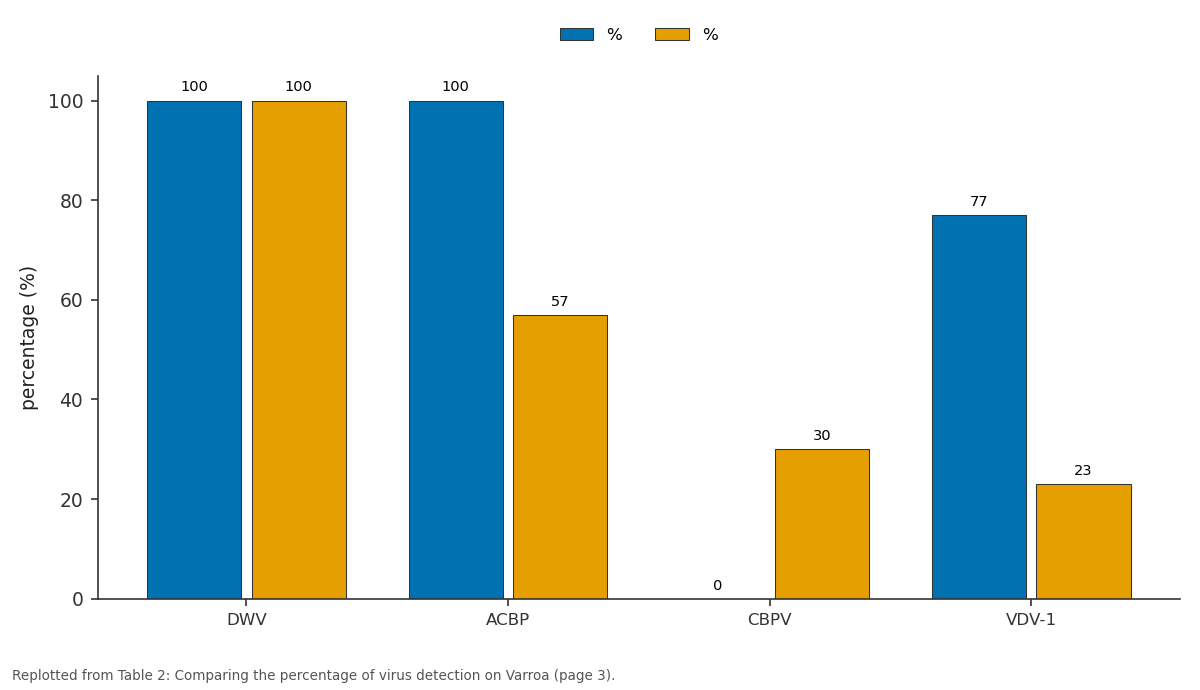
% and %: DWV vs ACBP vs CBPV vs VDV-1
Replotted from Table 2 (page 3) of the original paper. Every bar is the paper's own table value.
View source evidence ↗Figures & tables
From the original paper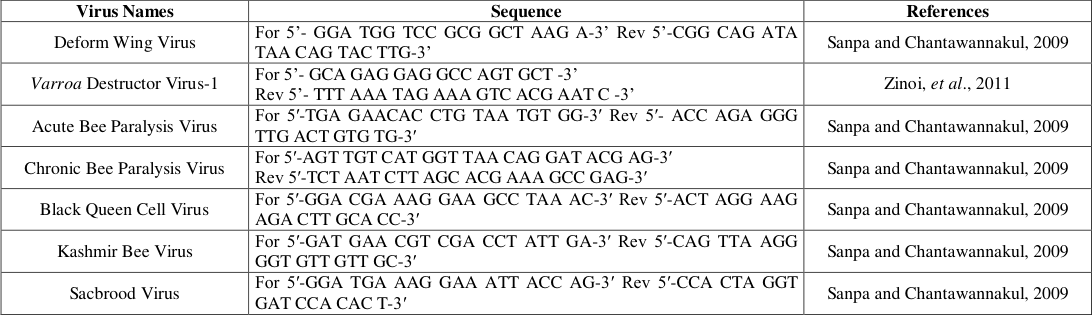 Table 1
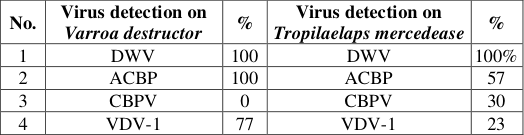 Table 2
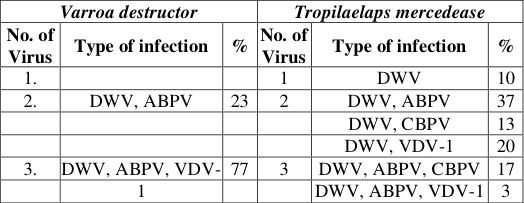 Table 3
Introduction
In Thailand, Apis mellifera L. European honeybee was introduced to Chulalongkorn University, Bangkok Thailand in the early 1940s by Professor Supachai Wattana. In 1953, Professor Saman Worakitta, Introduced European honeybee from Australia to Kasetsart University, Bangkok Thailand (Wongsiri, 1988) [48] . In the 1970s, there were imported large numbers of A. mellifera from Taiwan to Lamphun and Chiang Mai in northern Thailand for commercial purposes (Wongsiri et al., 1995, Akratanakul, 2000) [49,1] . Today, A. mellifera beekeeping record in Thailand has more than 500,000 colonies and 1,000 beekeepers all over the country (Suwannapong et al., 2011) [43] . A. mellifera beekeeping was spread out in northern Thailand, especially in Chiang Mai province (Thapa and Wongsiri, 1997) [45] . And beekeeping has two main mites infections, there are Tropilaelaps mercedes and Varroa destructor mites. Tropilaelaps mites are primary brood ectoparasites of the giant Asian honeybees (Apis dorsata and Apis laboriosa) (Delfinado-Baker et al. 1989) [20] . The mites can only survive in colonies with the presence of brood in which they readily feed and reproduce while inside the cells, and they can live 1-3 days on adult bees (Kiprasert 1984; Woyke 1984; Koeniger and Musaffar 1988; Rinderer et al. 1994) [29,50,30,39] . Tropilaelaps mites were infected with Apis mellifera when imported to Asia regions. The first reports identified Tropilaelaps clareae was the most serious parasite of Apis mellifera colonies in Asia (Burgett et al. 1983; Anderson and Morgan, 2007) [11,6] . It is the most serious threat to Apis mellifera colonies in the Philippines (Cervancia, 1993) [12] . In Thailand, Tropilaelaps mercedesae was found on Apis cerana brood (Anderson and Morgan, 2007) [6] . Varroa mites are originally parasitized mites from the Asian honeybee (Apis cerana) (Anderson and Fuchsm, 1998; Anderson 2000, Anderson and Trueman, 2000) [5,4,3] . The Varroa mite is considered a major pest of honeybees Apis mellifera (Crane, 1978) [14] . And Varroa destructor is the most important pest of A. mellifera and it plays a main role in losses of honeybee colonies (Martin, 2001) [32] . Varroa females entering to the brood cells and reproduction on the worker or drone larvae about 20-40hr before the cells are sealed (Boot, et al., 1992) [10] . The adult female mite and progeny feed on the hemolymph of pupae from a single feeding site (Kanbar and Engels, 2003) [28] . Deform Wing Virus (DWV) infection detected to be widespread throughout the world. The symptoms of DWV in bees have crumpled, vestigial wings and bloated abdomen. Then infected Bees were dead after emergence infection. Sometimes asymptomatic bees can see in bee colonies. It can be seen healthy bee but heavily infected and the other strains of DWV elevated to the bees behaviour aggressive and affected to the sensory response, learning and memory in adults (Tentcheva et al., 2004, Muz and Muz, 2018) [44,36] . Chronic Bee Paralysis Virus (CBPV) detected in adult bees from every continent, except South America. CBPV manifests itself in adult bees through two different type of symptoms, which are the trembling of the wings and bodies, and then they cannot fly and drop down in front of colonies. The other symptoms can be seen hairless, greasy black bees caused by nibbling attacks from healthy bees in the colony. They became flightless, tremble and die. At the larval and pupal stages also infected with the virus. In this condition can be detected in faecal material and is efficiently transmitted by feeding (Dietemann et al., 2012) [21] . Acute Bee Paralysis Virus (ABPV) is a common virus that detected in healthy colonies (Allen and Ball, 1996) [2] and reported in Apis mellifera from North America, Europe, Oceania, Asia, Africa, and the Middle East (De Miranda et al., 2010, Dietemann, et al., 2013, Ellis and Munn, 2005) [17,21,22] . When the bees infected by ABPV, they cannot control their body movement and their flight. The infected bees became hair loss, dark and shiny. The infested bees retreat on top bars and die there having their wings extended (De Miranda et al., 2010) [17] . Varroa Destructor Virus-1 (VDV-1) closely related to DWV but reported more specific to Varroa destructor (Ongus, et al., 2006) [38] . However, DWV and VDV-1 viruses replicate in Varroa mites as well as in honeybees (Ongus et al., 2004; Yue and Genersch, 2005; Zioni et al., 2011) [37,52,53] and both viruses have been detected at high titres in different honeybee tissues (Gauthier et al., 2007; Zioni et al., 2011) [25,53] . VDV-1 and DWV appear to co-exist in bees and mites as part of the same species-complex ( [17,25,34,33] . Many kinds of bee virus are related to honeybee mites such as Varroa and Tropilaelaps mites. When any kind of mites was infected with Apis mellifera colonies, honeybee virus infection was followed. Tropilaelaps mercedes infected colonies were found Deformed Wing Virus (DWV), Black Queen Cell Virus (BQCV), Sacbrood Virus (SBV), Kashmir Bee Virus (KBV), Acute Bee Paralysis Virus (ABPV), and Chronic Bee Paralysis Virus (CBPV) (Forsgren, et al., 2009; Dainat, et al., 2009; Chanpanitkitchote, et al., 2017) [23,13] . Varroa mites infected colonies were found DWV, ABPV, CBPV, BQCV, KBV, SBV, Varroa destructor virus- [18,24,35,41] . Varroa destructor virus-1 (VDV-1) is genetically closely related to DWV but is reported to be more specific to Varroa destructor than to bees (Ongus, 2006) [38] . SBV is the most widely distributed of all the viruses detected in almost colonies throughout the world. SBV infects mainly larvae but also adult bees, although they present no disease symptoms. SBV have the clearest symptoms and appear a few days after capping. The virus was infected in adult bees without symptoms (Lee and Furgala, 1967) [31] . The Asian honey bee, Apis cerana, frequently faced with lethal by various kind of Sacbrood virus. Such as Thai Sacbrood Virus (TSBV), Chinese Sacbrood Virus (CSBV) or Korean Sac brood (Tentcheva et al., 2004) [44] . KBV was first isolated from adult A. mellifera and from Apis cerana in Kashmir, India, and later found in A. mellifera from Canada, the USA, New Zealand and Australia Spain and several other countries in Europe and Oceania. Kashmir Bee Virus (KBV) they did not show symptoms but they have a different lethal dose at individual and colony level. BQCV infection is more prevalent in adult bees than pupae. BQCV infection in honeybee has been reported in North America, Central America, Europe, Oceania, Asia, Africa, and the Middle East. The Black Queen Cell Virus (BQCV) has blackened queen cells walls with dead pupa. When Infected to the larval stage the larvae have a pale yellow colour sac and similar with sacbrood. The virus is present in adult bees but not significant symptoms (Dietemann et al., 2012) [21] . In this study, we take seven virus detections on thirty Tropilaelaps mercedes 15 honeybee colonies in Chiang Mai province and thirty Varroa destructor mites from Nan province in Thailand in 2017.
Materials and Methods
Thirty adults female Tropilaelaps mercedease were collected from a sealed brood of A. mellifera from 15 colonies in Chiang Mai Province and thirty adults female Varroa destructor were from a sealed brood of A. mellifera 15 colonies from Nan province. All mites samples were kept in Eppendorf tube and placed in the ice box for 24-hour safe carrying (de Miranda, et al., 2013) [16] . All mites samples were frozen at -40 °C deep freezer until RNA extraction procedure. Frozen honey bees were crashed in sterilized 1.5 ml tubes and add 1ml of TRIzol (Invitrogen) reagent per 50-100 mg of honeybee tissue, 0.2 ml of Chloroform per 1 ml of TRIzol, 0.5ml of 100% isopropanol and 1 ml of 75% ethanol were add by manufacturer procedure and add 30µl of the RNA free water and kept in -40 ℃ until cDNA synthesis. For the first strand cDNA synthesis system used Invitrogen Super Script RT-PCR kit. Prepared the new 0.2 ml of sterilized PCR tubes and the Invitrogen cDNA extraction kits procedure. For the first standard cDNA synthesis system used Invitrogen Super Script RT-PCR kit. In the order to synthesize cDNA, 3µl of total isolated RNA was mixed with 1 µl of Oligo (dT) 20 50 µM, 1µl of 10mM dNTP mix and 5 µl of DEPC treated water (OmniPur, USA). Then incubated at 65 ºC for 5 min. And add 2µl of 10x RT buffer (200mM Tris-HCl (pH8.4), 500mM KCL), 4 µl of 25mM MgCl2, 2 µl of 0.1M DTT, 1 µl of RNaseOUT TM and 1 µl of Super Script® III RT and incubated at 50 ºC for 50 minutes and 85 ºC for 5 minutes. Finally, add 1 µl of RNase H and incubated at 37 ºC for 20 minutes. And cDNA samples were Kept at -20 ºC for PCR amplification. PCR was conducted using 1µl of cDNA sample, 1µl of 25 nmole DNA oligo primers 1.0µM of each forward and reverse primer showed in table (1) and add 0.25µl of Taq (Invitrogen) DNA Polymerase Recombinant, 0.25µl of 10mM dNTP, 0.75µl of 50 mM MgCl2, 2.5µl of 10x PCR buffer and sterile distilled water were added to total 25µl. PCR reaction was performed using an initial denaturation of 10 min at 95 °C followed by 40 cycles of 10s at 95 °C, annealing step of 16s at 60 °C, and extension for the 20s at 72 °C and Final extension of 10 min at 72 °C.
To analysis, the significant differences between Tropilaelaps mercedes and Varroa destructor mites used SPSS (20). CBPV is 30% infected and VDV-1 is 23% detected (Figure 1). And Varroa mites have infected with DWV, ABPV, and VDV-1. DWV and ABPV are 100% detected and VDV-1 is 77% detected (Table 2). There have four different virus infections were found such as single virus infection, two virus infections, three virus infection and four virus infections.
| No. | Virus detection on Varroa destructor | % | Virus detection on Tropilaelaps mercedease | % |
|---|---|---|---|---|
| 1 | DWV | 100 | DWV | 100% |
| 2 | ACBP | 100 | ACBP | 57 |
| 3 | CBPV | 0 | CBPV | 30 |
| 4 | VDV-1 | 77 | VDV-1 | 23 |
Table text extracted from the original PDF; superscript letters are shown inline. The original table image is below.
View original table image
When the comparing the number of virus combination infection in Tropilaelaps mercedease are more than Varroa destructor mites (Table 3). When we calculated the correlation between virus and mites by using SPSS software, we found that Tropilaelaps mites were significant at the 95% (P>0.05) correlated with the virus. Tropilaelaps mites are mostly related with DWV, ABPV, VDV-1 and CBPV viruses than Varroa mites.
| Varroa destructor | — | — | Tropilaelaps mercedease | — | — |
|---|---|---|---|---|---|
| No. of Virus | Type of infection | % | No. of Virus | Type of infection | % |
| 1. | 1 | DWV | 10 | ||
| 2. | DWV, ABPV | 23 | 2 | DWV, ABPV | 37 |
| DWV, CBPV | 13 | ||||
| DWV, VDV-1 | 20 | ||||
| 3. | DWV, ABPV, VDV- | 77 | 3 | DWV, ABPV, CBPV | 17 |
| 1 | DWV, ABPV, VDV-1 | 3 |
Table text extracted from the original PDF; superscript letters are shown inline. The original table image is below.
View original table image
Discussion
The Tropilaelaps mites breeding on their honeybee hosts are different behaviour with Varroa mites, in that a mature mated female enters a bee brood cell that contains a developing bee larva and the mother mites eat the hemolymph and produces several offspring that all feed on the hemolymph of the developing bee. Tropilaelaps mites have different action unlike Varroa mites, the survival of Tropilaelaps mites was depended to access to bee brood (larvae or pupae) for their feed, their mouthparts and body shape cannot feed on adult bees. Therefore, the Tropilaelaps mites cannot feed or survive for more than about 74 hours (Wilde, 2000) [46] . Varroa mites can feed on adult bees. Tropilaelaps mites can only survive for a few days in the absence of bee brood (Woyke, 1984; Koeniger and Musaffar, 1988; Rinderer et al., 1994) [50,30,39] . This limited food source restricts their ability to disperse, as they can only disperse on adult bees on which they cannot feed. Tropilaelaps mercedesae can be infected 90% of the brood in A. mellifera colonies (Kiprasert, 1984) [29] . Nowadays, there have 18 viruses have been identified from honey bees (Allen and Ball, 1996) [2] ; many of them cause persistent infections in seemingly healthy bee colonies (Tentcheva et al., 2004) [44] . Honeybee viruses in mites support a putative role of mites in vectoring the viruses ( [37,44,42] . The Varroa mite may transmit the viruses among bees and its feeding might induce or activate viral replication in some ways (Ball, 1983; Bailey and Ball, 1991) [9,8] . [19,11] and they becoming reduced body weights (Kiprasert, 1984) [29] . There was no treatment on the infected colonies the Tropilaelaps mites population rapidly increased to high levels and invariably lead to the death of entire colonies (Atwal & Goyal, 1971; Ritter, 1988; Woyke, 1985) [7, 40, 51] . Varroa infestation is an important factor in bee mortality and colony collapses. Sometimes, Varroa kills an apparently healthy colony in a few months. However, little is known about how Varroa mites kill bees. Its frequent cooccurrence with severe viral infections in honeybee colonies, it is considered that mites could activate latent viral infections (Allen and Ball, 1996) [2] .
Conclusion
Conclusion
Acknowledgement
AcknowledgementsI would like to thanks to who support this research Agricultural Interdisciplinary Program, Graduate School, Maejo University, Chiang Mai, CP group Col.td and Syngenta group. Then I would like to Thanks to All my supervisory committees and Prof. Dr. Nikolaus Koeniger for their kindly supervised and support to me.
Figures and tables from the paper
| Virus Names | Sequence | References |
|---|---|---|
| Deform Wing Virus | For 5’- GGA TGG TCC GCG GCT AAG A-3’ Rev 5’-CGG CAG ATA TAA CAG TAC TTG-3’ | Sanpa and Chantawannakul, 2009 |
| Varroa Destructor Virus-1 | For 5’- GCA GAG GAG GCC AGT GCT -3’ Rev 5’- TTT AAA TAG AAA GTC ACG AAT C -3’ | Zinoi, et al., 2011 |
| Acute Bee Paralysis Virus | For 5′-TGA GAACAC CTG TAA TGT GG-3′ Rev 5′- ACC AGA GGG TTG ACT GTG TG-3′ | Sanpa and Chantawannakul, 2009 |
| Chronic Bee Paralysis Virus | For 5′-AGT TGT CAT GGT TAA CAG GAT ACG AG-3′ Rev 5′-TCT AAT CTT AGC ACG AAA GCC GAG-3′ | Sanpa and Chantawannakul, 2009 |
| Black Queen Cell Virus | For 5′-GGA CGA AAG GAA GCC TAA AC-3′ Rev 5′-ACT AGG AAG AGA CTT GCA CC-3′ | Sanpa and Chantawannakul, 2009 |
| Kashmir Bee Virus | For 5′-GAT GAA CGT CGA CCT ATT GA-3′ Rev 5′-CAG TTA AGG GGT GTT GTT GC-3′ | Sanpa and Chantawannakul, 2009 |
| Sacbrood Virus | For 5′-GGA TGA AAG GAA ATT ACC AG-3′ Rev 5′-CCA CTA GGT GAT CCA CAC T-3′ | Sanpa and Chantawannakul, 2009 |
Table text extracted from the original PDF; superscript letters are shown inline. The original table image is below.
View original table image
References
51 in the original paper- Akratanakul P. Apiculture development in Thailand, in: Proc. VIIth Int. Conf. on Tropical Bees: Management and diversity, and Vth Asian Apicultural Association Conf., Chiang Mai, Thailand, IBRA, 2000, pp.395-398.
- Allen MR, Ball BV. The incidence and world distribution of honey bee viruses. BeeWorld. 1996; 77:141-162.
- Anderson DL, Trueman JWH. Varroa jacobsoni (Acari: Varroidae) is more than one species, Exp. Appl. Acarol. 2000; 24:165-189.
- Anderson DL. Variation in the parasitic bee mite Varroa jacobsoni Oud. Apidologie. 2000; 31:281-292.
- Anderson DL, Gibbs AJ, Gibson NL. Identification and phylogeny of sporecyst fungi (Ascosphaero spp.) using ribosomal DNA sequences. Mycological Research. 1998; 102(5):451-547.
- Anderson DL, Morgan MJ. Genetic and morphological variation of bee-parasitic Tropilaelaps mites (Acari: Laelapidae): new and re-defined species. Exp. Appl. Acarol. 2007; 43:1-24.
- Bailey L, Ball BV. Honey bee pathology (2nd Ed.). Academic Press; London, UK, 1991, pp. 31-34.
- Ball BV. The association of Varroa jacobsoni with virus diseases of honey bees. Exp. Appl. Acarol. 1983; 19:607613.
- Boot WJ, Calis NM, Beetsma J. Differential periods of varroa mite invasion into worker and drone brood cells of honey bees. Exp. Appl. Acarol. 1992; 16:295-301.
- Burgett MD, Akratanakul P, Morse RA. Tropilaelaps clareae: a parasite of honey bees in South-East Asia. Bee World. 1983; 64:25-28.
- Cervancia CR. Philippines beekeeping status of research and development. In: Proc. Beenet Asia: Workshop on Priorities in R&D on Beekeeping in Tropical Asia. Kuala Lumpur, Malaysia, 1993, pp. 49-63.
- Chanpanitkitchote Pichaya, Chen Yanping, Evans Jay, Li Wenfeng, Li Jianghong, Hamilton Michele et al. Acute bee paralysis virus occurs in the Asian honey bee Apis cerana and parasitic mite Tropilaelaps mercedesae. Journal of Invertebrate Pathology, 2017, 151. 10.1016/j.jip.2017.11.009.
- Crane E. The varroa mite. Bee World. 1978; 59:164-167.
- Dainat B, Ken T, Berthoud H, Neumann P. The ectoparasitic mite Tropilaelaps mercedesae (Acari, Laelapidae) as a vector of honeybee viruses. Insectes Sociaux. 2009; 56(1):40-43.
- de Miranda JR, Bailey L, Ball BV, Blanchard P, Budge G, Chejanovsky N et al. Standard methods for virus research in Apis mellifera. In V Dietemann; JD Ellis; P Neumann (Eds) The Coloss Beebook, Volume II: standard methods for Apis mellifera pest and pathogen research. Journal of Apicultural Research, 2013, 52(4).
- de Miranda JR, Cordoni G, Budge G. The acute bee paralysis virus-Kashmir bee virus-Israeli acute paralysis virus complex. J Invertebr. Pathol 103 (Supplement), 2010, S30-S47.
- de Miranda Joachim, Gauthier Laurent, Ribière Magali, Chen YP. Honey Bee Viruses and Their Effect on Bee and Colony Health. Honey Bee Colony Health: Challenges and Sustainable Solutions, 2011, 71-102. 10.1201/b11318-9.
- Dejong D, Morse EW, Eickwort GC. Mite pests of honey bees. Annual Review of Entomology. 1982; 27:229-252.
- Delfinado-Baker M, Baker EW, Phoon ACG. Mites (Acari) associated with bees (Apidae) in Asia, with description of a new species. American Bee Journal. 1989; 129(9):609-613.
- Dietemann V, Pflugfelder J, Anderson D, Charrière Jd, Chejanovsky N, Dainat B et al. Varroa destructor: research avenues towards sustainable control. Journal of Apicultural Research. 2012; 51:125-132.
- Ellis JD, Munn PA. The worldwide health status of honey bees. Bee World. 2005; 86:88-101.
- Forsgren E, De Miranda JR, Isaksson M, Wei S, Fries I. Deformed wing virus associated with Tropilaelaps mercedesae infesting European honey bees (Apis mellifera). Experimental and Applied Acarology. 2009; 47(2):87-97.
- Francis RM, Nielsen SL, Kryger P. Varroa-virus interaction in collapsing honeybee colonies. PloS one. 2013; 8(3):e57-540.
- Gauthier L, Tentcheva D, Tournaire M, Dainat B, Cousserans F, Colin ME et al., Viral load estimation in asymptomatic honey bee colonies using the quantitative RT-PCR technique. Apidologie. 2007; 38(5):426-435.
- Highfield AC, El Nagar A, Mackinder LC, Laure MLN, Hall MJ, Martin SJ. Deformed wing virus implicated in overwintering honeybee colony losses. Applied and environmental microbiology. 2009; 75(22):7212-7220.
- Hung ACF, Peng YSC, Shimanuki H. Nucleotide sequence variations in Kashmir bee virus isolated from Apis mellifera L. and Varroa jacobsoni Oud. Apidologie. 2000; 31:17-23.
- Kanbar G, Engels W. Ultrastructure and bacterial infection of wounds in honey bee (Apis mellifera) pupae punctured by Varroa mites. Parasitol. Res. 2003; 90:349354.
- Kiprasert C. Biology and systematics of the parasitic bee mite Tropilaelaps clareae Delfinado and Baker (Acarina: Laelapidae). MSc thesis, Kasetsart University; Bangkok, Thailand, 1984.
- Koeniger N, Musaffar N. Lifespan of the parasitic honeybee mite Tropilaelaps clareae on Apis cerana, dorsata and mellifera. Journal of Apicultural Research. 1988; 27:207-212.
- Lee PE, Furgala B. Viruslike particles in adult honey bees (Apis mellifera Linnaeus) following injection with sacbrood virus. Virology. 1967; 32(1):11-17.
- Martin SJ. The role of Varroa and viral pathogens in the collapse of honeybee colonies: A modelling approach. J Appl. Ecol. 2001; 38:1082-1093.
- Martin SJ, Highfield AC, Brettell L, Villalobos EM, Budge GE, Powell M et al., Global honey bee viral landscape altered by a parasitic mite. Science. 2012; 336(6086):1304-1306.
- Moore Jonathan, Jironkin Aleksey, Chandler Dave, Burroughs Nigel, Evans David, Ryabov Eugene. Recombinants between Deformed wing virus and Varroa destructor virus-1 may prevail in Varroa destructorinfested honeybee colonies. The Journal of general virology. 2010; 92:156-61.
- Muz D, Muz MN. A molecular epidemiological study of black queen cell virus in honeybees (Apis mellifera) of Turkey: the first genetic characterization and phylogenetic analysis of field viruses. Apidologie. 2018; 49:89-100.
- Ongus JR, Peters D, Bonmatin J, Bengsch E, Valk JM, Van Oers MM. Complete sequence of a picorna-like virus of the genus Iflavirus replicating in the mite Varroa destructor. J Gen. Virol. 2004; 85:3747-3755.
- Ongus JR, Roode EC, Pleij CW, Vlak JM, Van Oers MM. The 5′ non-translated region of Varroa destructor virus 1 (genus Iflavirus): structure prediction and IRES activity in Lymantria dispar cells. Journal of general virology. 2006; 87(11):3397-3407.
- Rinderer TE, Oldroyd BP, Lekprayoon C, Wongsiri S, Thapa R. Extended survival of the parasitic mite Tropilaelaps clareae on adult workers of Apis mellifera and Apis dorsata. Journal of Apicultural Research. 1994; 33:171-174.
- Ritter W. Varroa jacobsoni in Europe the tropics and subtropics. In GR Needham; RE Page, Jr; M DelfinadoBaker CE Bow (Eds). Africanized honey bees and bee mites. Halsted Press; Chichester, UK, 1988, 349-359.
- Roberts JM, Anderson DL, Durr PA. Absence of deformed wing virus and Varroa destructor in Australia provides unique perspectives on honeybee viral landscapes and colony losses. Scientific Reports. 2017; 7(1):69-25.
- Shen M, Yang X, Cox-Foster D, Cui L. The role of varroa mites in infections of Kashmir bee virus (KBV) and deformed wing virus (DWV) in honey bees. Virology. 2005; 342(1):141-149.
- Suwannapong G, Yemor T, Boonpakdee C, Benbow ME. Nosema ceranae, a new parasite in Thai honeybees. Journal of Invertebrate Pathology. 2011; 106:236-241.
- Tentcheva D, Gauthier L, Zappulla N, Dainat B, Cousserans F, Colin MF et al., Prevalence and seasonal variations of six bee 148 M. Shen et al. / Virology 342 (2005) 141-149 viruses in Apis mellifera L. and Varroa destructor mite populations in France. Appl. Environ. Microbiol. 2004; 70:7185-7191.
- Thapa R, Wongsiri S. Eupatorium odoratum: A honey plant for beekeepers in Thailand. Bee world. 1997; 78(4):175-178.
- Wilde J, Woyke J, Neupane KR, Wilde M. Comparative evaluation tests of different methods to control Tropilaelaps clareae, a mite parasite in Nepal. In Proceedings of the 7th International Conference on Tropical Bees and 5th AAA Conference, 2000.
- Winston ML. The honeybee colony: Life history. The hive and the honeybee Hamilton Illinois: Dadant & Sons Graham JM. Apicult. Res. 1992; 37:69-78.
- Wongsiri S. The Effect of import of Apis mellifera L. To Thailand. Proceedings of Fourth International Conference on Apiculture in Tropical Climate. Cairo, Egypt, 1988, 162-167.
- Wongsiri S, Chen P. Effects of agricultural development to honey bees in Thailand. Bee World. 1995; 76(1):3-5.
- Woyke J. Survival and prophylactic control of Tropilaelaps clareae infesting Apis mellifera colonies in Afghanistan. Apidologie. 1984; 15:421-434.
- Woyke J. Tropilaelaps clareae, a serious pest of Apis mellifera in the tropics, but not dangerous for apiculture in temperate zones. American Bee Journal. 1985; 125:497499.
- Yue C, Genersch E. RT-PCR analysis of deformed wing virus in honeybees (Apis mellifera) and mites (Varroa destructor). Journal of General Virology. 2005; 86(12):3419-3424.
- Zioni N, Soroker V, Chejanovsky N. Replication of Varroa destructor virus 1 (VDV-1) and a Varroa destructor virus 1-deformed wing virus recombinant (VDV-1-DWV) in the head of the honey bee. Virology. 2011; 417(1):106-112.