
Research article · 2021 · Full text
International Journal of Statistics and Applied MathematicsWord problem solving competencies of BSE 1B – mathematics major students: Basis for remedial and intervention programs
Volume 6(3) · Pages 44–48 · DOI: 10.22271/maths.2021.v6.i3a.686 ↗
Research areasEducational methodologies and cognitive developmentEducational Outcomes and InfluencesEducational Innovations and Technology
Abstract
Author-writtenThis study aimed at determining the word problem solving competencies of the first year Bachelor of Secondary Education major in Mathematics students in the Nueva Ecija University of Science and Technology -San Isidro Campus for the second semester, school year 2020-2021. The study made use of test consisting of 10 word problems to be answered by 33 students with different levels of competency because their different academic backgrounds. The problem-solving competencies of the students were described in terms of their level of comprehension of the problem and the strategies employed in solving. The findings in this study will be used as basis for remedial and intervention programs.
Summary
Source-checkedPlain-language reading of the full paper, prepared with AI and checked against the text. Each point links to the authors' own words.
Why it matters
- Problem solving is considered the central element of teaching and learning mathematics. View evidence ↗
- Mathematics serves as a powerful tool for solving diverse problems across fields such as science, technology, medicine, and finance. View evidence ↗
- Enhancing the problem-solving skills of students who are training to be teachers is critical for their future professional challenges. View evidence ↗
The question
- The study aimed to determine the word problem solving competencies of first-year Bachelor of Secondary Education (BSE) Mathematics students at NEUST-San Isidro Campus during the 2020-2021 school year. View evidence ↗
What they did
- The researchers employed a descriptive research design focused on fact-finding and interpretation. View evidence ↗
- The study involved 33 students who completed a test consisting of 10 word problems. View evidence ↗
- The assessment focused on Algebra word problems covering topics such as age, numbers, rate, time, distance, mixtures, and coins. View evidence ↗
- Interviews were conducted alongside the test to identify the specific difficulties students faced when solving word problems. View evidence ↗
What they found
- The mean comprehension level across the ten problems showed that the largest group of students performed at a 'Poor' level (31.52%), while the smallest group was 'Very good' (9.09%). View evidence ↗
- Problem 8 had the lowest comprehension rate, with 57.58% of students rated as 'Poor' and 0 students rated as 'Very good'. View evidence ↗
- Language barriers were identified as the primary factor contributing to the students' low performance in solving word problems. View evidence ↗
- Students struggled to translate word problems into mathematical form, often failing to select the correct calculation or number sentence. View evidence ↗
- Students exhibited carelessness in basic mathematical operations, including simple addition, leading to errors in final answers. View evidence ↗
What it means
- The authors conclude that students' difficulties in word problem solving stem from inadequate learning during their foundation years. View evidence ↗
- The authors recommend that school administrators integrate remediation and intervention programs into the curriculum to address these competencies. View evidence ↗
Figures & tables
From the original paper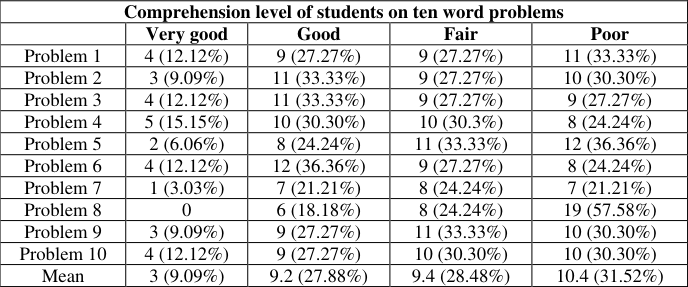 Table 1
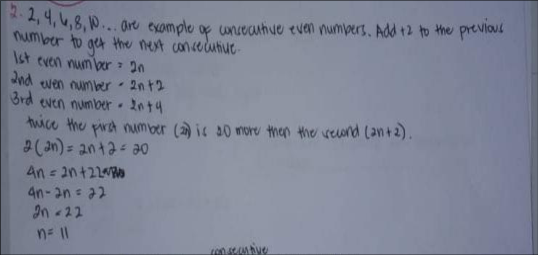 Figure 1
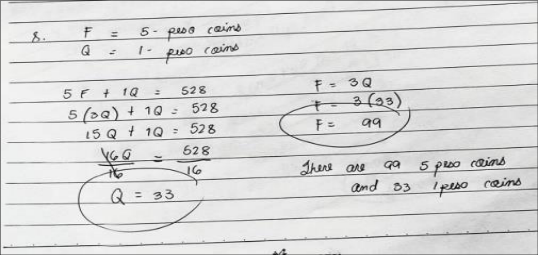 Figure 1
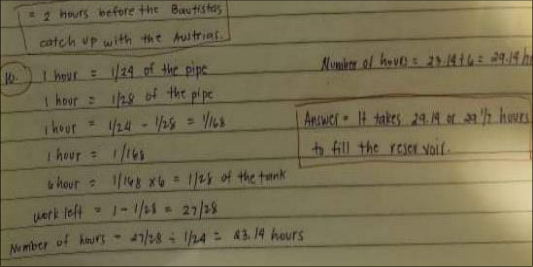 Figure 1
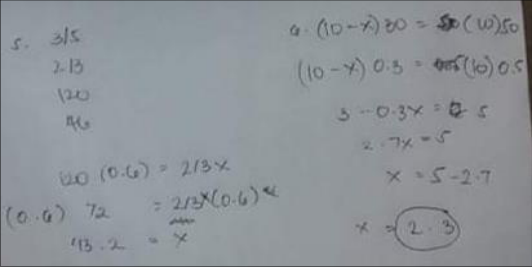 Figure 1
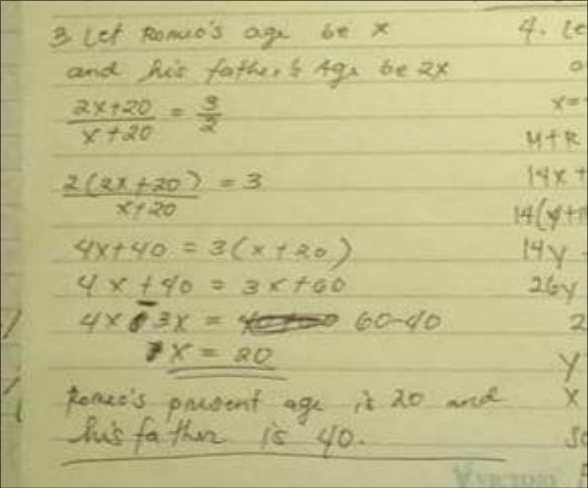 Figure 2
Introduction
According to Stottler (2020) [11] problem solving is at the core of human evolution. It is the methods we use to understand what is happening in our environment, identify things we want to change and then figure out the things that need to be done to create the desired outcome. Problem solving is the source of all new inventions, social and cultural evolution, and the basis for market-based economies. It is the basis for continuous improvement, communication and learning. Problem solving is the center piece of mathematics teaching and learning. The National Council of Teachers of Mathematics (2000) [10] states that instructional programs should enable all students to build new mathematical knowledge through problem solving, solve problems that arise in mathematics and in other contexts, apply and adopt a variety of appropriate strategies to solve problems, and monitor and reflect on the process of mathematical problem solving. Similarly, Kilpatrick (2010) [9] explained that studies in almost every domain of mathematics have demonstrated that problem solving provides an important context in which students can learn about number and other mathematical topics. Problem solving ability is enhanced when students have opportunities to explore and understand what the problem is all about. Problem-solving is the cornerstone of school mathematics. The main reason of learning mathematics is to be able to solve problems. Mathematics is a powerful tool that can be used to solve a vast variety of problems in technology, science, business and finance, medicine, and daily life. It is strongly believed that the most efficient way for learning mathematical concepts is through problem solving. The problem-solving processes could be very useful in mathematics, science, social sciences and other subjects. Students should be encouraged to develop and discover their own problemsolving strategies and become adept at using them for problem-solving. The researchers were prompted to conduct this study to look into the competencies of the BSE 1B-Mathematics Major students. Being the mentors of these students, the researchers viewed word problem solving as a vehicle to improve their mathematical thinking.
It would prepare them for the next higher levels and help them respond and interpret things in their daily living. Improving the problem-solving skills of these future teachers will surely help them face the challenges that they will be encountering once they became teachers. The results of this research will be used as basis for remedial and intervention programs.
Statement of the problem
The researchers sought to: 1. Describe the students' level of competency in solving word problems in Mathematics in terms of problem comprehension. 2. Identify the strategies employed by the students in word problem solving through problem solutions. 3. Determine the students' difficulty in solving word problems.
Materials and Methods
Materials and Methods
Research design
The researchers used the descriptive method of research, which involves fact finding with adequate interpretation. Descriptive research definition: Descriptive research is defined as a research method that describes the characteristics of the population or phenomenon studied. This methodology focuses more on the "what" of the research subject than the "why" of the research subject (Dullock, 2013) [7] .
The descriptive research method primarily focuses on describing the nature of a demographic segment, without focusing on "why" a particular phenomenon occurs. In other words, it "describes" the subject of the research, without covering "why" it happens.
Respondents of the study
This study involved all the first year Bachelor of Secondary Education major in Mathematics of NEUST-San Isidro Campus, School Year 2020-2021.
Instrumentation
The researchers as Mathematics teachers developed a 10-item problem solving questions that focuses on how to work word problems in Algebra. Specifically, the test is composed of word problems about age, numbers, rate, time and distance, mixtures and coins.
Results
The students' level of competency in solving word problems was described in terms of their problem comprehension and solution to the word problems. To further describe the students' level of competency, this study also disclosed the result of interview that revealed the difficulties encountered by the students in solving word problems.
Students' level of comprehension
The students' comprehension on a word problem was described in terms of their ability to tell what the problem is all about, and what is asked for in the problem. Table 1 presents the comprehension level in problems 1-10 of first year students taking up Bachelor of Secondary Education major in Mathematics.
| Comprehension level of students on ten word problems | — | — | — | — |
|---|---|---|---|---|
| Very good | Good | Fair | Poor | |
| Problem 1 | 4 (12.12%) | 9 (27.27%) | 9 (27.27%) | 11 (33.33%) |
| Problem 2 | 3 (9.09%) | 11 (33.33%) | 9 (27.27%) | 10 (30.30%) |
| Problem 3 | 4 (12.12%) | 11 (33.33%) | 9 (27.27%) | 9 (27.27%) |
| Problem 4 | 5 (15.15%) | 10 (30.30%) | 10 (30.3%) | 8 (24.24%) |
| Problem 5 | 2 (6.06%) | 8 (24.24%) | 11 (33.33%) | 12 (36.36%) |
| Problem 6 | 4 (12.12%) | 12 (36.36%) | 9 (27.27%) | 8 (24.24%) |
| Problem 7 | 1 (3.03%) | 7 (21.21%) | 8 (24.24%) | 7 (21.21%) |
| Problem 8 | 0 | 6 (18.18%) | 8 (24.24%) | 19 (57.58%) |
| Problem 9 | 3 (9.09%) | 9 (27.27%) | 11 (33.33%) | 10 (30.30%) |
| Problem 10 | 4 (12.12%) | 9 (27.27%) | 10 (30.30%) | 10 (30.30%) |
| Mean | 3 (9.09%) | 9.2 (27.88%) | 9.4 (28.48%) | 10.4 (31.52%) |
Table text extracted from the original PDF; superscript letters are shown inline. The original table image is below.
View original table image
Problem solution employed by students in word problem
Problem solution employed by students in word problem
Students' difficulties in solving word problems
Based on the interview conducted by the researchers, some of the difficulties encountered the students in solving word problems are the following:
Reading and understanding the language used within a word problem Difficulties in this category involve students not being able to decode the words used in a word problem, not comprehending a sentence, not understanding specific vocabulary and not having confidence or the ability to concentrate when reading. The students were not able to comprehend the problem. This was confirmed by the responses of the students in the followup interview conducted by the researchers. Therefore, language barrier is the prime factor contributing to the low performance of students in solving word problem. They cannot figure out what is being asked in the problem.
Forming a number sentence to represent the mathematics involved in the word problem
Students appear to find it harder to form a number sentence for some word problems structures than others. These difficulties can result in them not being able to select a calculation to perform or selecting an incorrect calculation. The students were not able to translate the problem into mathematical form. The students' answers were partially correct due to inadequate solutions. The strategies used were inappropriate. The students had no idea on how to write the numerical representation of the problem. In fact, there were students who did not even try to solve.
Carrying out the mathematical solution
Difficulties can occur here with student's selection of, and aptitude with calculation strategies (for example formal algorithms, pencil and paper methods and calculators). The context in which a word problem is given and the size of numbers involved can impact on student's choice of a calculation strategy. They were confused as to what operation should be used to solve the problem. The students were not able to comprehend and could not proceed with the solution.
Interpreting the answer in the context of the question
Children have been shown to not consider real-life factors and constraints when giving an answer to word problems which can result in giving an answer that is impossible in the context and therefore incorrect. The students were very careless in performing operations. Even simple addition was not being performed well. Too much confidence of the students in solving simple word problems has led them to commit errors in writing the final answers.
Discussion
The findings of the study were as follows:
On problem comprehension
There are only few students who have "Very Good" level of comprehension in solving word problems. This will have to be addressed since they are future mathematics teachers and word problem solving will always be part of every lesson in the subject.
On problem solution employed by the students in solving word problems
The students employed different styles in solving word problems. This is because of their different academic backgrounds and orientation. Different strategies in solving word problems must be taught to these students so that, they will be able to know which one is suitable for a specific word problem.
On students' difficulties in solving word problems
The difficulties encountered by the students in solving word problems are the following: ▪ Reading and understanding the language used in a word problem ▪ Forming a number sentence to represent the mathematics involved in the word problem ▪ Carrying out the mathematical solution ▪ Interpreting the answer in the context of the question
Conclusions
Based on the findings of this study, the following conclusions were drawn: ▪ The first year BSE-Mathematics students had insufficient skills when it comes to understanding what the problem is all about. ▪ Students' competence and abilities do not fit in their year level. ▪ Students were found to have difficulty in forming a number sentence to represent their solution involved in the word problems exhibited by their inappropriate strategies in solving the problem. ▪ Though the strategies used were correct, they still committed error due to carelessness. ▪ Students were found to have many difficulties in terms of word problem solving due to inadequate learning they acquired in their foundation years. ▪ There was lack of support and guidance from their parents.
Recommendations
Based on the findings of the study, the following recommendations were offered: ▪ For mathematics teachers to assist their students develop their problem-solving ability, it is essential that they are aware of their difficulties, thereby focusing on their students' difficulties during remediation. ▪ School Administrators should also involve remediation programs and interventions in their curriculum so that students with difficulties in word problem solving would be addressed. ▪ It is also recommended that parents should pay attention on the learning habits of their children in developing their competencies specifically in word problem solving.
In general, here is the list that could be done to help students overcome difficulties in mathematical word problems proposed by Joubert (2009) [8] : ▪ Encourage them to read word problems thoroughly to improve their comprehension ability. ▪ Teach the students which kinds of information may be important. ▪ Ensure that students practice solving word problems to allow them to recognize the structure of word problems and therefore know when to use each computation. ▪ Encourage the students to check if their answer satisfies the criteria of a question. ▪ Think of best ways on how word problem solving would be very interesting to them. For instance, create video presentations where problem solving are being useful to real-life situations. ▪ Computer-assisted instruction maybe very useful in teaching the 21 st century learners nowadays. Teachers and school administrators must take a look into it to be part of the curriculum.
Acknowledgement
AcknowledgementsThe researchers would like to thank all the Bachelor of Secondary Education 1B-Mathematics Major students for cooperating in this research work.
Figures and tables from the paper
References
3 in the original paper- Ballew H, Cunningham J. Diagnosing Strengths and Weaknesses of Sixth-Grade Students in Solving Word Problems. Journal for Research in Mathematics Education 2012;13(3):202-210.
- Baroody AJ. Problem solving, reasoning and communicating, K-8: Helping children to think mathematically. New York: Merrill 2003.
- Bernardo A. Overcoming Obstacles to Understanding and Solving Word Problems in Mathematics. Educational Psychology 2009;19(2):149-163.