
Research article · 2018 · Full text
International Journal of Veterinary Sciences and Animal HusbandryPrevalence of hard tick (Acari: Ixodidae) and preliminary observation on Babesia infection on equines in White Nile state, Sudan
Volume 3(3) · Pages 22–28
Research areasVector-borne infectious diseasesViral Infections and VectorsVector-Borne Animal Diseases
Abstract
Author-writtenTowards understanding Sudan tick-borne diseases, a survey was carried out to investigate the prevalence of hard tick species (Acari: Ixodidae) on equine (donkeys mainly) in the White Nile state, Sudan. It is important to know, as a first step, what types of ticks could affect such animals in such geographical region. A total of 907 ticks collected from 520 donkeys and 4 horses from four cities in White Nile state, during November 2014 to October 2015). The prevalence by location, seasonal and animal breed, sex and age were evaluated. The species composition and prevalence of tick species feeding on donkeys in descending order were as follows: R. (B.) decoloratus, R. evertsi evertsi, R. camicasi, R. guilhoni, A. lepidum, Hy excavatum, Hy impeltatum, Hy. anatolicum, Hy rufipes, Hy dromadarii. On horses, only R. guilhoni was not within the collected species. Additionally, same aforementioned equine species' blood samples were collected and determined for the prevalence of tick-borne diseases. The blood smears (524) were examined using Giemsa-stain method. Out of 520 donkeys, 158 samples (30.2%) were positive for Babesia species however, no positives in the 4 horses' samples. The effect of location and season was observed during this study and discussed accordingly. Such results could enlighten the importance of initiating a national program to precisely investigating such animal diseases, successfully monitor and properly manage such diseases vectors.
Summary
Source-checkedPlain-language reading of the full paper, prepared with AI and checked against the text. Each point links to the authors' own words.
Why it matters
- In rural Sudan, donkeys are the primary means of transport for riding and packing due to a lack of motorized options. View evidence ↗
- Ticks and the diseases they carry significantly harm animal health, with animals acting as reservoirs for these pathogens. View evidence ↗
- Riding equines can transmit dangerous viruses to humans, a global concern exacerbated by the lack of available vaccines. View evidence ↗
The question
- The study aimed to determine the prevalence and distribution of ticks on equines in Sudan's White Nile state, analyzing the impact of breed, sex, and age, and screening for Babesia infection. View evidence ↗
What they did
- Ticks were collected from four specific sites in the White Nile state: Eldowaim, Elgitaina, Rabak, and Kosti. View evidence ↗
- Blood samples were collected from the jugular vein and examined for Babesia using Giemsa stain at 1000× magnification. View evidence ↗
What they found
- A total of 907 ticks were collected from 520 donkeys and 4 horses over the study period. View evidence ↗
- Rhipicephalus (Boophilus) decoloratus was the most common tick species found on donkeys, accounting for 38.92% of the total. View evidence ↗
- Tick frequency varied by breed, with Makadi donkeys showing the highest prevalence at 72.9%, followed by Reefawi (15.46%) and Mixed breeds (10.88%). View evidence ↗
- Female donkeys had a significantly higher tick infestation frequency (77.09%) compared to males (22.90%) (p<0.05). View evidence ↗
- The highest tick prevalence by age was observed in donkeys aged 5-10 years (53.82%). View evidence ↗
- Babesia species were detected in 30.2% (158/520) of donkeys, while none of the 4 horses tested positive. View evidence ↗
- Half of the tick species identified in the study belonged to the genus Hyalomma. View evidence ↗
What it means
- The authors recommend implementing training in integrated tick management and disease prevention for homeowners and public health officials. View evidence ↗
- Due to financial constraints, the study only used blood parasitological diagnostics and did not examine the ticks themselves as vectors. View evidence ↗
Visual summary
2 visualsIllustrations explain the paper; charts are replotted from the paper's own table values.
Study Geography
AI-generated conceptual illustration (Horses and hard ticks in the White Nile state of Sudan). It explains the idea and does not show study data.
View source evidence ↗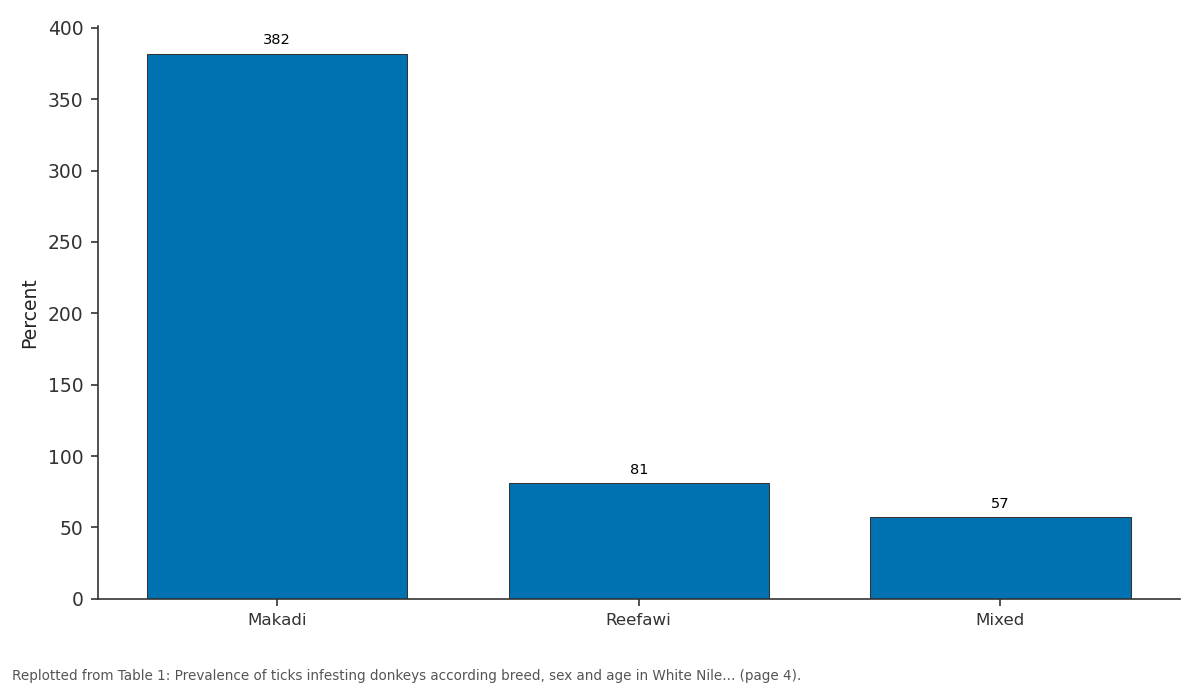
Frequency: Makadi vs Reefawi vs Mixed
Replotted from Table 1 (page 4) of the original paper. Every bar is the paper's own table value.
View source evidence ↗Figures & tables
From the original paper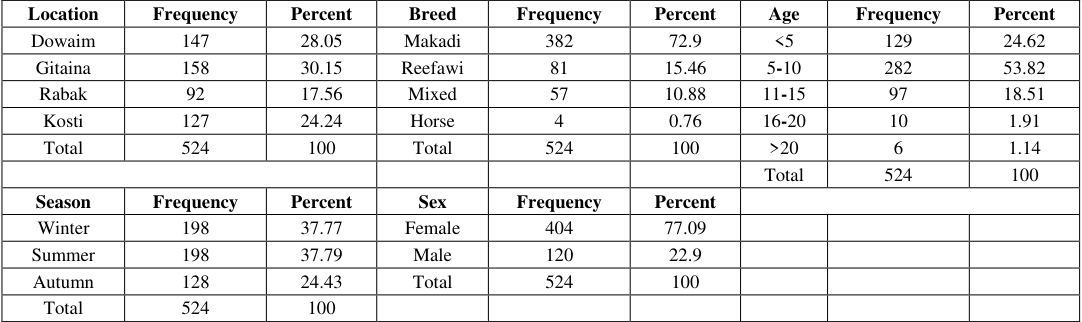 Table 1
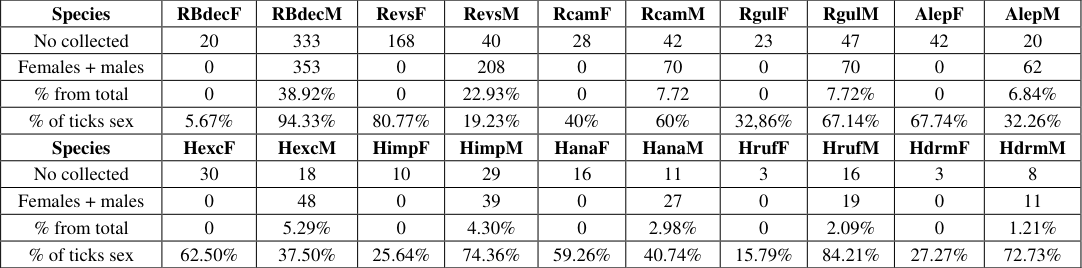 Table 2
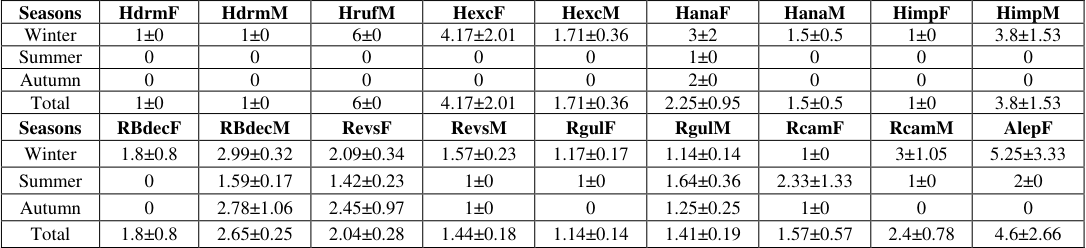 Table 4
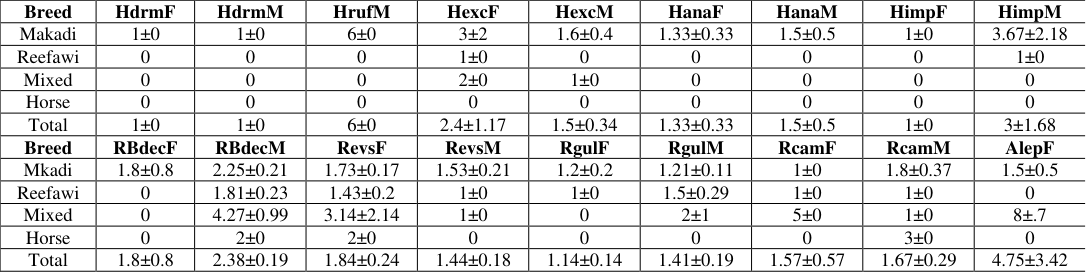 Table 5
 Table 6
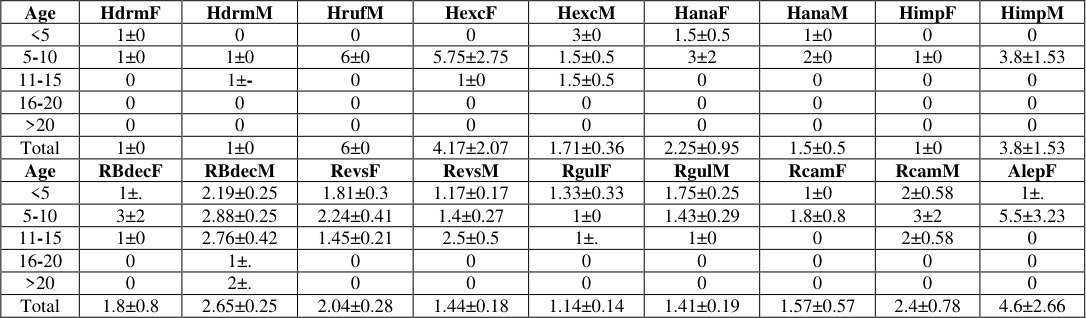 Table 7
 Table 8
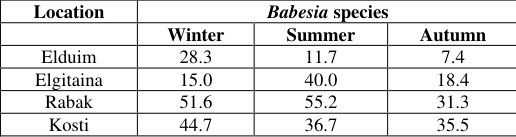 Table 9
Introduction
In Sudan, to a remarkable extent, a combination of agro-pastoral, mobile and sedentary pastoral production in almost every region and state comprise the main sectors of the Sudanese economy. Sudan possesses a large and diversified animal wealth. The donkey population was estimated at more than eight millions and are divided into two main breeds, Makady which are draught donkeys and Refawy which is a riding donkey [1] . In Sudan, equines are found in all ecological zones and the maximum are at the rural areas where there are no motorized transport and virtually donkeys are the preferred means of pack and riding transport. Hence, facilitating raising drinking water and used for farm services in addition to marketing of agricultural products [2,3,4] . However, horses, as in Sudan, have been with humans worldwide and throughout history being served a variety of practical purposes. Ticks and tick-borne diseases cause dramatically harm to the health of animals that play in maintenance of tick populations and as reservoirs of such tick-borne pathogens [5,6] As in Sudan, warm Climatic and socio-economic changes enable ticks to flourish to extend their range of hosts and their spatial and temporal distribution [7] . Additionally, the role played by free-ranging wildlife is also a key point in the occurrence of endemic disease such as ticks and tick-borne diseases of livestock. The complex wildlife-livestock-human in such communal lands increases risk of such disease transmission [8,9] . In tropical regions, the economically most important hard ticks of livestock belong to the genera Hyalomma, Boophilus, Rhipicephalus and Amblyomma [10] . In Africa, while reported that some of ticks constitute threat to human health however, livestock are more affected [9] . In Ethiopia, at the eastern international border of Sudan, several tick species of the genera Amblyomma, Boophilus, Haemaphysalis, Hyalomma and Rhipicephalus have been reported [11,12,13] .
In Sudan, Hyalomma anatolicum is a vector of Babesia equi which causes equine Babesiosis and Boophilus species transmit cattle Babesiosis and Anaplasmosis [14] . Despite these facts, rapid literature scan revealed that in Sudan very few researchers reported the distribution and abundance of tick species on equine in Sudan and there is no systematic research on ectoparasites of equine and just very few sporadic reports [15, 16, 17, 18, 19, 20, 21, 22] . Furthermore, in Sudan, surveys have suggested the presence of various arboviruses in human populations [23,24] . For instance, in Sudan, Crimean-Congo hemorrhagic fever virus (CCHFV) a tick-borne virus has been detected, since 2008, in several sporadic cases and nosocomial outbreaks associated with high case-fatality in the Kordofan region [25] , a region that bordering the White Nile state. Additionally, CCHFV specific antibodies have been detected in animals all of which had been imported to these countries from Sudan. For example, in camels in Egypt, and in sheep and goats in Jeddah, Saudi Arabia [26,27] . Furthermore, Alkhurma is a severe and very closely related virus to Kyasanur Forest disease was first reported in Saudi Arabia [28] . In 2010 the disease was reported in Italian travelers returning from Egypt and tick bite was incriminated as a source of infection while riding on camels. Additionally, the two tick species so far identified as potential vectors of Alkhumra virus [29] are there in Sudan. Therefore, riding on donkeys and horses could transmit such dangerous viruses when exist. Apparently, the problem is serious word-wide because there is no vaccines for such very dangerous pathogens and it is severe in developing countries where the resources even for the management of ticks are very limited. Moreover, the epidemiological factors determine the occurrence and prevalence of such diseases including animal breed, gender and age in addition to tick species available, its densities and the management measures adopted plus the geographical location and season [30,31] . In fact, detailed knowledge of such diseases, the tick population dynamics and exploring the risk factors associated with diseases and ticks' infestation enables to design management strategies. Apparently, in Sudan, however, there is paucity of information on ticks and tick-borne diseases of donkeys. For instance, rare equine Babesiosis disease was reported however, their vectors are not so far well known. Hence, the objectives of the present study were to determine the ticks prevalence on equine, their geographical distribution in the White Nile state, and the effect of the animal breed, sex and age in addition to determination of Babesia in animal blood smears by Giemsa stain as a first step towards a foreseeable future detailed study.
Materials and Methods
Materials and Methods
Study area
The White Nile passes in the mid of this state. The White Nile state borders by Khartoum state in the north, Gezira state in the east, Kordofan region in the west and South Sudan Republic international border in the south. The ticks collection was performed in four sites: Eldowaim and Elgitaina (eastern bank of the White Nile) and Rabak and Kosti on the western bank of the White Nile.
Study animals
Thirty donkeys were randomly selected from each of the aforementioned four locations, every two months, year-round from November 2014 to October 2015 (6 collections). Crosssectional study design was implemented to determine the distribution and abundance of males and females tick species during three seasons: Winter (November to February), summer (March to June) and autumn (July to October).
Ticks collection and identification methods
Ticks were collected from all body of animals using forceps and were preserved with 70% alcohol in universal bottles separately. Date of collections and place of collections were recorded. The taxonomic key of [15,32,33] were used to identify ticks under Stereomicroscope. All data recorded in this study were entered into Microsoft excel and subsequently analyzed using SPSS 16.0 computer program. Descriptive statistics and Chi-square test was used to determine the variation in tick burden between different groups of locations and seasons.
Blood Samples collection and estimation of parasitemias
Blood samples (total 520 donkeys and 4 horses) were collected from four donkeys' markets: Elgitaina and Rabak (Eastern bank of the White Nile) and Eldowaim and Kosti (on the western bank) and animal breed gender and age were recorded. Blood smears were prepared from the donkeys and horses' jugular vein blood and determined for the presence of Babesia by Giemsa stain and 1000× magnification was used for identifying blood parasites as described by [34,35] . Data collected from this study were compiled in Excel and descriptive statistics using software STATISTIX-8 was used. The 95% confidence intervals and p<0.05 were set for significance in all cases.
Results and Discussion
During the present study, a total of 907 ticks were collected from 520 donkeys and 4 horses from four cities in White Nile state, during the period from November 2014 to October 2015). The effects of some factors: location, seasons and animals' breed, sex and age were considered (Tables 1234567). The location's prevalence (frequency) percentage was 28.05% in Eldowaim and 30.15% in Elgitaina (eastern bank of the White Nile) and from the western bank of the White Nile: 17.56% in Rabak and 24.24% in Kosti. Such result could be justified that the region is open directly to Gezira Agricultural Scheme where animals are abundant. Additionally, the seasonal prevalence, in winter (November to February) was 37.77%; in summer (March to June) was 37.79% and in autumn (July to October) was 24.43%. Furthermore, the frequency by donkeys' breed was: Makadi (72.9%); Reefawi (15.46%) and Mixed (10.88%) and only 4 horses representing 0.76% (Table 8). The findings of a trial that made to determine ticks distribution between donkey's breeds indicated that statistically significant difference was observed in infestation rate. Most of equine owners to gain more benefit from such animals and for their prestige look while riding them, they do care about their feed, cleaning such animals by peasants' hands or acaricides and though show good body condition. Moreover, by animal sex, the frequency was 77.09% females and 22.90% males. The difference in tick infestation rate between host sex groups was statistically significant (p<0.05) be attributed by high population of female donkeys which are more easier dealing with than males, that may reduce the number of male examined. Additionally, male donkeys mainly used for transportation and hence they are in close supervision by their owner for tick infestation. Such situations may reduce the number of ticks on animals in general, as observed in the present study. However, the age percentitual frequency was accounted for prevalence as: <5 years (24.62%); 5-10 years (53.82%); 11-15 years (18.51%); 16-20 years (1.91%) and >20 (1.14%). This might be justified as the young animals mostly untied and dwelling around their mothers and homes and have access to contact with other species of animals, therefore, the higher the chance of getting more ticks infestation. The collected 907 ticks were comprising 4 genera: Rhipicephalus (Boophilus), Amblyomma and Hyalomma. The data showed the species composition of ticks feeding on donkeys as: R. (B.) decoloratus (38.92%% of the total) and 5.67% and 94.33% female and males ticks, respectively; R. evertsi evertsi (22.93% of the total) and 80.77% and 19.23% female and males ticks, respectively; R. camicasi (7.72% of the total) and 40% and 60% female and males ticks, respectively; R. guilhoni (7.72% of the total) and 32,86% and 67.14% female and males ticks, respectively; A. lepidum (6.84% of the total) and 67.74% and 32.26% female and males ticks, respectively; Hy excavatum (5.29%of the total) and 62.50%and 37.50% female and males ticks, respectively; Hy impeltatum (4.30% of the total) and 25 [15,18,32] . Regarding this state White Nile (the region of the present study) and the Blue Nile ecosystem state, it was found 24 tick species infesting livestock and wildlife in these areas [19] . Ticks on donkeys and other animals were investigated in Kassala state, eastern Sudan [16] . R. evertsi evertsi and R. sanguineus; Hy. excavatum and Hy. rufipes on equines, and other domestic livestock were reported in eastern Sudan [20] . However, H. anatolicum, H. dromedarii, H. rufipes and R. evertsi evertsi were collected from horses in Khartoum state (on the northern border of the present study region) [21] . Additionally, in Gadarif state (eastern Sudan), reported H. anatolicum (as the predominant species on horses), H. dromedarii, R. evertsi evertsi and R. sanguineus [22] . Furthermore, he also reported the dominant tick species infesting horses in Kosti (White Nile state) as H. anatolicum, H. dromedarii, R. evertsi evertsi and R. sanguineus. Moreover, in El Obeid (Kordofan state, on the western border of the White Nile state), and Khartoum state he identified H. dromedarii, R. evertsi evertsi and R. sanguineus on horses. It seems as the worldwide interest in ticks and tick-borne diseases has increased in recent years because of the direct and indirect effect on their host and hence significantly threat any successful livestock production thus interfere with national economy. Equine, especially donkey, represent an important contribution to human welfare in vulnerable households in Sudan for transportation, bringing water and pull carts. People ride on equine become in direct contact with ticks on animals. Alkhurma hemorrhagic fever was detected in Italian travelers returning from Egypt after biten by ticks while riding on camels [29] . Additionally the CCHFV was reported in Kordofan region, bordering the study region [25] . In fact, the present results stated that 50% of the tick species are Hyalomma. Apparently, Hyalomma species are the main virus vectors. Therefore, the present survey may demonstrate some of the constraints to utilize such animals with precautions. Additionally, such recorded results could enlighten the importance of a national program to precisely investigating the disease and successfully monitor and reduce the population of the vector(s). Finally, it could be recommended to adopt training in integrated tick management and prevention of tick-associated disease for public health officials and control operators in addition to the homeowners. Regarding equine Babesiosis, Table (9) shows that out of the 524 equines, 158 donkeys (30.2%) were detected positives with Babesia spp and non of the 4 horses' samples. However, Table (9) shows that the highest Babesia spp prevalence were diagnosed in eastern bank proportionally more than in the western bank. By site it is higher in Rabak followed by Kosti, Elgitaina and Elduiam. Additionally, in the study animals, Babesia spp was observed frequently in autumn, increases in winter and peaked in summer. Nevertheless, more than twenty one ixodid ticks species, including Hyalomma and Rhipicephalus, are listed as vectors for equine piroplasms [37] however, in the present study, for financial shortage, only blood parasitological diagnostic method was performed and ticks were not examined as vectors. It is crucial however, to examine such ticks' species as vectors in a foreseeable future. The present results show low number of Babesia spp in autumn season may be due to decrease number of sampling in such donkey's markets in this rainy season of the year. In the rainy season donkeys are used in agricultural practices away from such markets, in addition to difficulty in reaching them because of limiting transportation in such rural areas that lacks paved roads. In the present study, Babesia equi was the causal organisms of equine Babesiosis, a febrile tick borne disease of donkeys. It is a hazardous disease that responsible for morbidity and mortality of equines worldwide. It has a considerable veterinary economic importance. For instance, the prerequisite for the import of any horses in the United States, Canada, Australia and Japan is seronegativity for Babesia species [38,39] . Additionally, as infected equines can carry the piroplasms in their blood for some years they may become reservoirs for new infection. Literature survey revealed that rare report documented equine piroplasmosis in Sudan. Using thin blood smears and CF test, the epidemiology of the disease in Khartoum state was studied [21] . Among 80 horses examined they reported 16% with typical clinical signs of piroplasmosis and 20% with Babesial parasites in their blood smears. Therefore, more detailed work is badly needed. Additionally, in Sudan that borders eight countries in addition to free movement of about 140 millions of livestock, there is a serious risk of disseminating such diseases and entrance of novel exotic diseases/pathogens especially in overlooked remote rural area. In fact, several diseases affecting humans are originated from animals, and also endanger the economy via augmenting the cost of safeguarding both humans and animals. For alleviation of poverty in the rural areas in Sudan, sustainable increase in livestock production would be significantly enhance this possibility. To achieve such goal, it is crucial to adopt advance diseases forecasting, beside conventional assays, adoption of novel molecular biological techniques that now frequently used for the rapid and sensitive diagnosis at nano and picogram level [40] . In addition to the availability of suitable drugs to treat equine piroplasmosis and safer and quality vaccination coverage, with reasonable transport facilities for in time delivery of veterinary services beside education of animal's owners and labors [41] . Therefore, in Sudan, serious attention and extra precaution should be concerned of in respect to afford satisfy financial support to have state-wise adequate infrastructure research facilities for wise implementation of such disease and vectors' control measures especially in remote rural areas where the majority of livestock and equines are.
| Location | Age | sex | breed | Season | HdrmM | HrufM | HexcF | HexcM | HanaF | HimpM | RBdecM | RevsF | RcamM | AlepF | Total |
|---|---|---|---|---|---|---|---|---|---|---|---|---|---|---|---|
| Dowaimiwaim | <5 | Female | horse | Winter | 0 | 0 | 0 | 0 | 0 | 0 | 2 | 2 | 3 | 0 | 7 |
| Rabak | 5 to 10 | Male | horse | Winter | 1 | 0 | 0 | 3 | 5 | 7 | 8 | 0 | 9 | 4 | 37 |
| Rabak | <5 | Female | horse | Winter | 0 | 6 | 13 | 0 | 0 | 0 | 16 | 7 | 0 | 0 | 42 |
| Rabak | 5 to 10 | Male | horse | Winter | 0 | 0 | 0 | 0 | 0 | 0 | 16 | 12 | 0 | 0 | 28 |
| Total | 1 | 6 | 13 | 3 | 5 | 7 | 42 | 21 | 12 | 4 | 114 |
Table text extracted from the original PDF; superscript letters are shown inline. The original table image is below.
View original table image
Acknowledgement
AcknowledgmentThe authors would like to thank the University of Gezira and CRDF for provision of financial support: "This publication is based on work supported partially by Award No. 31142 of the U.S. Civilian Research & Development Foundation (CRDF Global) and by the U.S. National Institute of Allergy and Infectious Diseases along with the U.S. National Science Foundation under Cooperative Agreement No. OISE-9531011"; Prof. Mohamed Elsanousi, Vice Chancellor of University of Gezira for his support. We are also grateful to the Faculty of Veterinary Medicine, University of Butana for their cooperation during the field and laboratory work.
Figures and tables from the paper
| Location | Frequency | Percent | Breed | Frequency | Percent | Age | Frequency | Percent |
|---|---|---|---|---|---|---|---|---|
| Dowaim | 147 | 28.05 | Makadi | 382 | 72.9 | <5 | 129 | 24.62 |
| Gitaina | 158 | 30.15 | Reefawi | 81 | 15.46 | 5-10 | 282 | 53.82 |
| Rabak | 92 | 17.56 | Mixed | 57 | 10.88 | 11-15 | 97 | 18.51 |
| Kosti | 127 | 24.24 | Horse | 4 | 0.76 | 16-20 | 10 | 1.91 |
| Total | 524 | 100 | Total | 524 | 100 | >20 | 6 | 1.14 |
| Total | 524 | 100 | ||||||
| Season | Frequency | Percent | Sex | Frequency | Percent | |||
| Winter | 198 | 37.77 | Female | 404 | 77.09 | |||
| Summer | 198 | 37.79 | Male | 120 | 22.9 | |||
| Autumn | 128 | 24.43 | Total | 524 | 100 | |||
| Total | 524 | 100 |
Table text extracted from the original PDF; superscript letters are shown inline. The original table image is below.
View original table image
| Species | RBdecF | RBdecM | RevsF | RevsM | RcamF | RcamM | RgulF | RgulM | AlepF | AlepM |
|---|---|---|---|---|---|---|---|---|---|---|
| No collected | 20 | 333 | 168 | 40 | 28 | 42 | 23 | 47 | 42 | 20 |
| Females + males | 0 | 353 | 0 | 208 | 0 | 70 | 0 | 70 | 0 | 62 |
| % from total | 0 | 38.92% | 0 | 22.93% | 0 | 7.72 | 0 | 7.72% | 0 | 6.84% |
| % of ticks sex | 5.67% | 94.33% | 80.77% | 19.23% | 40% | 60% | 32,86% | 67.14% | 67.74% | 32.26% |
| Species | HexcF | HexcM | HimpF | HimpM | HanaF | HanaM | HrufF | HrufM | HdrmF | HdrmM |
| No collected | 30 | 18 | 10 | 29 | 16 | 11 | 3 | 16 | 3 | 8 |
| Females + males | 0 | 48 | 0 | 39 | 0 | 27 | 0 | 19 | 0 | 11 |
| % from total | 0 | 5.29% | 0 | 4.30% | 0 | 2.98% | 0 | 2.09% | 0 | 1.21% |
| % of ticks sex | 62.50% | 37.50% | 25.64% | 74.36% | 59.26% | 40.74% | 15.79% | 84.21% | 27.27% | 72.73% |
Table text extracted from the original PDF; superscript letters are shown inline. The original table image is below.
View original table image
| Seasons | HdrmF | HdrmM | HrufM | HexcF | HexcM | HanaF | HanaM | HimpF | HimpM |
|---|---|---|---|---|---|---|---|---|---|
| Winter | 1±0 | 1±0 | 6±0 | 4.17±2.01 | 1.71±0.36 | 3±2 | 1.5±0.5 | 1±0 | 3.8±1.53 |
| Summer | 0 | 0 | 0 | 0 | 0 | 1±0 | 0 | 0 | 0 |
| Autumn | 0 | 0 | 0 | 0 | 0 | 2±0 | 0 | 0 | 0 |
| Total | 1±0 | 1±0 | 6±0 | 4.17±2.01 | 1.71±0.36 | 2.25±0.95 | 1.5±0.5 | 1±0 | 3.8±1.53 |
| Seasons | RBdecF | RBdecM | RevsF | RevsM | RgulF | RgulM | RcamF | RcamM | AlepF |
| Winter | 1.8±0.8 | 2.99±0.32 | 2.09±0.34 | 1.57±0.23 | 1.17±0.17 | 1.14±0.14 | 1±0 | 3±1.05 | 5.25±3.33 |
| Summer | 0 | 1.59±0.17 | 1.42±0.23 | 1±0 | 1±0 | 1.64±0.36 | 2.33±1.33 | 1±0 | 2±0 |
| Autumn | 0 | 2.78±1.06 | 2.45±0.97 | 1±0 | 0 | 1.25±0.25 | 1±0 | 0 | 0 |
| Total | 1.8±0.8 | 2.65±0.25 | 2.04±0.28 | 1.44±0.18 | 1.14±0.14 | 1.41±0.19 | 1.57±0.57 | 2.4±0.78 | 4.6±2.66 |
Table text extracted from the original PDF; superscript letters are shown inline. The original table image is below.
View original table image
| Breed | HdrmF | HdrmM | HrufM | HexcF | HexcM | HanaF | HanaM | HimpF | HimpM |
|---|---|---|---|---|---|---|---|---|---|
| Makadi | 1±0 | 1±0 | 6±0 | 3±2 | 1.6±0.4 | 1.33±0.33 | 1.5±0.5 | 1±0 | 3.67±2.18 |
| Reefawi | 0 | 0 | 0 | 1±0 | 0 | 0 | 0 | 0 | 1±0 |
| Mixed | 0 | 0 | 0 | 2±0 | 1±0 | 0 | 0 | 0 | 0 |
| Horse | 0 | 0 | 0 | 0 | 0 | 0 | 0 | 0 | 0 |
| Total | 1±0 | 1±0 | 6±0 | 2.4±1.17 | 1.5±0.34 | 1.33±0.33 | 1.5±0.5 | 1±0 | 3±1.68 |
| Breed | RBdecF | RBdecM | RevsF | RevsM | RgulF | RgulM | RcamF | RcamM | AlepF |
| Mkadi | 1.8±0.8 | 2.25±0.21 | 1.73±0.17 | 1.53±0.21 | 1.2±0.2 | 1.21±0.11 | 1±0 | 1.8±0.37 | 1.5±0.5 |
| Reefawi | 0 | 1.81±0.23 | 1.43±0.2 | 1±0 | 1±0 | 1.5±0.29 | 1±0 | 1±0 | 0 |
| Mixed | 0 | 4.27±0.99 | 3.14±2.14 | 1±0 | 0 | 2±1 | 5±0 | 1±0 | 8±.7 |
| Horse | 0 | 2±0 | 2±0 | 0 | 0 | 0 | 0 | 3±0 | 0 |
| Total | 1.8±0.8 | 2.38±0.19 | 1.84±0.24 | 1.44±0.18 | 1.14±0.14 | 1.41±0.19 | 1.57±0.57 | 1.67±0.29 | 4.75±3.42 |
Table text extracted from the original PDF; superscript letters are shown inline. The original table image is below.
View original table image
| Sex | HdrmF | HdrmM | HrufM | HexcF | HexcM | HanaF | HanaM | HimpF | HimpM |
|---|---|---|---|---|---|---|---|---|---|
| Female | 0 | 1±0 | 6±0 | 2.4±1.17 | 1.8±0.49 | 2.25±0.95 | 2±0 | 1±0 | 4.5±1.75 |
| Male | 1±0 | 1±0 | 6±0 | 13±0 | 1.5±0.5 | 0 | 1±0 | 0 | 1±0 |
| Total | 1±0 | 1±0 | 6±0 | 4.17±2.01 | 1.71±0.36 | 2.25±0.95 | 1.5±0.5 | 1±0 | 3.8±1.53 |
| Sex | RBdecF | RBdecM | RevsF | RevsM | RgulF | RgulM | RcamF | RcamM | AlepF |
| Female | 1.8±0.8 | 2.66±0.29 | 2.15±0.37 | 1.57±0.23 | 1.25±0.25 | 1.39±0.23 | 1.67±0.67 | 2.5±1.31 | 5.25±3.33 |
| Male | 0 | 2.64±0.5 | 1.78±0.31 | 1±0 | 1±0 | 1.5±0.29 | 1±0 | 2.25±0.48 | 2±0 |
| Total | 1.8±0.8 | 2.65±0.25 | 2.04±0.28 | 1.44±0.18 | 1.14±0.14 | 1.41±0.19 | 1.57±0.57 | 2.4±0.78 | 4.6±2.66 |
Table text extracted from the original PDF; superscript letters are shown inline. The original table image is below.
View original table image
| Age | HdrmF | HdrmM | HrufM | HexcF | HexcM | HanaF | HanaM | HimpF | HimpM |
|---|---|---|---|---|---|---|---|---|---|
| <5 | 1±0 | 0 | 0 | 0 | 3±0 | 1.5±0.5 | 1±0 | 0 | 0 |
| 5-10 | 1±0 | 1±0 | 6±0 | 5.75±2.75 | 1.5±0.5 | 3±2 | 2±0 | 1±0 | 3.8±1.53 |
| 11-15 | 0 | 1±- | 0 | 1±0 | 1.5±0.5 | 0 | 0 | 0 | 0 |
| 16-20 | 0 | 0 | 0 | 0 | 0 | 0 | 0 | 0 | 0 |
| >20 | 0 | 0 | 0 | 0 | 0 | 0 | 0 | 0 | 0 |
| Total | 1±0 | 1±0 | 6±0 | 4.17±2.07 | 1.71±0.36 | 2.25±0.95 | 1.5±0.5 | 1±0 | 3.8±1.53 |
| Age | RBdecF | RBdecM | RevsF | RevsM | RgulF | RgulM | RcamF | RcamM | AlepF |
| <5 | 1±. | 2.19±0.25 | 1.81±0.3 | 1.17±0.17 | 1.33±0.33 | 1.75±0.25 | 1±0 | 2±0.58 | 1±. |
| 5-10 | 3±2 | 2.88±0.25 | 2.24±0.41 | 1.4±0.27 | 1±0 | 1.43±0.29 | 1.8±0.8 | 3±2 | 5.5±3.23 |
| 11-15 | 1±0 | 2.76±0.42 | 1.45±0.21 | 2.5±0.5 | 1±. | 1±0 | 0 | 2±0.58 | 0 |
| 16-20 | 0 | 1±. | 0 | 0 | 0 | 0 | 0 | 0 | 0 |
| >20 | 0 | 2±. | 0 | 0 | 0 | 0 | 0 | 0 | 0 |
| Total | 1.8±0.8 | 2.65±0.25 | 2.04±0.28 | 1.44±0.18 | 1.14±0.14 | 1.41±0.19 | 1.57±0.57 | 2.4±0.78 | 4.6±2.66 |
Table text extracted from the original PDF; superscript letters are shown inline. The original table image is below.
View original table image
| Location | Babesia species | — | — |
|---|---|---|---|
| Winter | Summer | Autumn | |
| Elduim | 28.3 | 11.7 | 7.4 |
| Elgitaina | 15.0 | 40.0 | 18.4 |
| Rabak | 51.6 | 55.2 | 31.3 |
| Kosti | 44.7 | 36.7 | 35.5 |
Table text extracted from the original PDF; superscript letters are shown inline. The original table image is below.
View original table image
References
41 in the original paper- Sudan Federal Ministry of Animal Recourse, 2015.
- El Dirdiri NI, Abu Damir H, Wahbi AA. Disease incidence in donkeys (Equus asinus asinus) with emphasis on Strongyle infection. Acta Vet. (Belgr). 1986; 36:313-320.
- Pearson RA. Introduction to the project' Use and management of donkeys by poor societies in Peri-Urban areas in Ethiopia'. In: DG Smith, T Agajie, and L More (eds), Alleviating poverty in Peri-Urban Ethiopia by improving the health and welfare and management of donkeys, (CTVM, Edinburgh, 2000, 2-5.
- Angara TEE, Ismail AA, Ibrahim AM. The role of donkeys in income generation and the impact of endoparasites on their performance. U of K. J Vet. Med. & Anim. Prod. 2011; 2(2):65-89.
- Parola P, Raoult D. Tick born bacterial disease emerging Infection in Europe. Clinical Microbial. 2001; 7:80-83.
- Rizzoli A, Silaghi C, Obiegala A, Rudolf I, Hubálek Z, Földvári G et al. Ixodes ricinus and its transmitted pathogens in urban and peri-urban areas in Europe: new hazards and relevance for public health. Front. Public Health. 2014; 2:251. http://dx.doi.org/10.3389/fpubh.2014.00251.
- Magnarelli LA. Global importance of ticks and associated infectious disease agents. Clinical Microbiology Newsletter. 2009; 31(5):33-37.
- Murphy C, Mulonga S, Suich H. DEA Research Discussion Paper Number 59: The Conflict Continues: Human Wildlife Conflict and Livelihoods in Caprivi. Retrieved, 2013, 4. From http://www.dea.met.gov.na
- Pascucci I, Dondona AC, Camma C, Marcacci M, Di Domenico M, Lelli R et al. Survey of ixodid ticks and two tick-borne pathogens in African Buffaloes, Synceruscaffer, from the Caprivi strip, Namibia. Journal of Zoo and Wildlife Medicine. 2011; 42(4):634-640.
- Frans J. Final Report Integrated Control of Ticks and Tick-Born Diseases (ICTTD), 2000, 4. http://www.uu.nl/ tropical ticks.
- Pegram RG, Hoogstraal H, Wassef HY. Ticks (Acari: Ixodoidea) of Ethiopia I. Distribution, ecology and host relationships of species infesting livestock. Bull. Entomol. Res. 1981; 71:339-359.
- DE Castro JJ. Tick survey, Ethiopia: A survey of tick species in western Ethiopia, including previous findings and recommendations for further tick surveys in Ethiopia. UNDP/FAO, Rome, 1994, 79.
- Seyoum Z. Study of ticks and tick-borne diseases on zebu cattle at Girana Valley in North Wollo zone. J Ethiopian Vet. Assoc. 2001; 16:129-143.
- Julla II, Tingwa NO, Kwajok VL. Theileriosis in the Equatorial Region of Sudan. In: Dolan TT. Ed. Theileriosis in Eastern, Central and Southern Africa. Proceedings of a Workshop on East Coast Fever Immunization held in Lilongwe, Malawi, Nairobi: The International Laboratory for Research on Animal Diseases, 1989, 19-21, 20-22.
- Hoogstraal H. African Ixodoidea. 1. Ticks of the Sudan with special reference to Equatoria province and with preliminary review of genera Rhipicephalus, Margaropus and Hyalomma, US Navy, Washington D.C, 1956.
- Karrar G, Kaiser MN, Hoogstraal H. Ecology and hostrelationship of ticks (Ixodoidea) infesting domestic animals in Kassala Province, Sudan with special reference to A. lepidum Donitz. Bulletin of Entomological Research. 1963; 54(3):509-522. http://dx.doi.org/10.1017/S0007485300048987
- FAO. Sudan (Food and Agriculture Organization/Sudan). Tick and tick-borne disease control project terminal report, Project findings and recommendations, 1983, 5-8.
- Tatchell RJ. Tick and tick-borne diseases control. The Sudan. Tick Ecology and Tick control, technical report, AG: GCP/SUD 024/DEN, Food and Agriculture Organization of United Nations, Rome, 1983.
- Jongejan F, Zivkovic D, Pegram RG, Tatchell RJ, Fison T, Latif AA. Ticks (Acari: Ixodidae) of the Blue and White Nile Ecosystems in the Sudan with particular reference to the Rhipicephalus sanguineus group. Experimental and Applied Acarology. 1987; 3:331-346. http://dx.doi.org/10.1007/BF01193169
- Mohamed AA, Yagoub IA. Outbreaks of babesiosis in domestic livestock in eastern region of the Sudan". Tropical Animal Health and Production. 1990; 22(2):123125. http://dx.doi.org/10.1007/BF02239838
- Abdoon AMO, Osman OM, EL Wasila M. The epidemiology of equine babesiosis in Khartoum District, Sudan. 1-Tick prevalence and their parasite rate. Bulletin of Animal Health and Production in Africa. 1992; 40:1114.
- Salim BOM. Molecular, serological and parasitological detection of piroplasmosis of horses in the Sudan. MVSc thesis, Department of Parasitology, University of Khartoum, 2008.
- Watts DM, Tigani AE, Botros BA, Salib AS, Olson GJ. Arthropod-borne viral infections associated with a fever outbreak in the northern province of Sudan. J Trop Med Hyg. 1994; 97:228-230.
- McCarthy R, Haberberger L, Salib AW, Soliman BA, Tiganil AE. Evaluation of arthropod-borne viruses and other infectious disease pathogens as the causes of febrile illnesses in the Khartoum Province of Sudan. J Med Virol. 1996; 48:141-146.
- Aradaib IE, Erickson BR, Karsany MS, Khristova ML, Elageb RM, Mohamed MEH, Nichol ST. Multiple Crimean-Congo hemorrhagic fever virus strains are associated with disease outbreaks in Sudan, 2008-2009. PLoS Negl Trop Dis. 2011; 5(5):e1159. doi: 10.1371/journal.pntd.0001159
- Morrill JC, Soliman AK, Imam IZ, Botros BA, Moussa MI. Serological evidence of Crimean-Congo haemorrhagic fever viral infection among camels imported into Egypt. J Trop Med Hyg. 1990; 93:201-204.
- Hassanein KM, el-Azazy OM. Yousef HM. Detection of Crimean-Congo haemorrhagic fever virus antibodies in humans and imported livestock in Saudi Arabia. Trans R Soc Trop Med Hyg. 1997; 91:536-537.
- Madani TA. Alkhumra virus infection, a new viral hemorrhagic fever in Saudi Arabia. The Journal of infection. 2005; 51(2):91-97.
- Charrel RN, Gould EA. Alkhurma hemorrhagic fever in travelers returning from Egypt. Emerging infectious diseases. 2010; 17(8):1573-1574.
- Kivaria FM. Estimated direct economic costs associated with tick-borne diseases on cattle in Tanzania. Trop. Anim. Health. Prod. 2006; 38:291-299.
- Magona JW, Walubengo J, Olaho-Mukani W, Jonsson NN, Welburn SW, Eisler MC. Spatial variation of tick abundance and seroconversion rates of indigenous cattle to Anaplasma marginale, Babesia bigemina and Therileria parva infections in Uganda. Exp. Appl. Acarol. 2011; 55:203-213.
- Hoogstraal H. A preliminary annotated list of ticks (Ixodoidea) of the Anglo-Egyptian Sudan. Journal of Parasitology. 1954; 40(3):304-310. http://dx.doi.org/10.2307/3273742
- Walker AR, Bouattour A, Camicas JJ, Estrada Pena A, Horak IG, Latif AA et al. Ticks of domestic animals in Africa: A Guide to Identification of Tick species. Global Veterinaria. 2003; 7(6):527-531.
- Bose R, Jorgensen WK, Dalgliesh RJ, Friedhoff KT, de Vos AJ. Current state and future trends in the diagnosis of Babesiosis. Vet Parasitolol. 1995; 57(1-3):61-74.
- OIE. Equine piroplasmosis, 2008. http://www.oie.int/eng/normes/mmanual/2008/pdf/2.05.0 8-EQUINE-PIROP LAS MOSIS.pdf.
- Carletti F, Castilletti C, Di Caro A, Capobianchi MR, Nisii C, Suter FM et al. Alkhurma hemorrhagic fever in travelers returning from Egypt. Emerging infectious diseases. 2010; 16(12):1979-1982.
- Aphis. Equine piroplasmosis and the 2010 World Equestrian Games, 2008. www.aphis.usda.gov./vsnahss/ equine/.
- Friedhoff KT, Tenter AM, Muller I. Haemoparasites of equines: Impact on international trade of horses. Revue Scientifque ET Tech, OIE. 1990; 9:1187-1194.
- Jr. Knowels D. Equine Babesiosis: A problem in the international movement of horses. Br. Vet. J, 1996; 152:123-126.
- Rather SA, Taka H, Kakrub DK. Seroprevalence of Babesia bigemina and Anaplasma marginale in domestic animals of district Ganderbal. Scientific Journal of Veterinary Advance. 2016; 5(1):74-79.
- Kumar R, Singh SP, Savalia CV. Overview of Emerging Zoonoses in India: Areas of Concern. Journal of Tropical Diseases. 2015; 3:165.
Cited by 1
From OpenAlex, OpenCitations and reference lists read by Scinovex
- INFESTASI CAPLAK PADA TERNAK SAPI POTONG DI KANDANG PETERNAKAN SAPI KAMPUS II POLBANGTAN GOWA DI KABUPATEN BONE, PROVINSI SULAWESI SELATAN ↗
Sri Wahyuni Ruslan, Sri Lestari · Cannarium · 2023
In general, the obstacles experienced by breeders in efforts to increase livestock productivity include management or management of maintenance, fulfillment of feed nutrition, and safeguarding livestock health. One of the obstacles faced by cattle breeders is the emergence of parasitic agents that need to be overcome, namely ectoparasites. Ticks are one of the most common ectoparasites found in livestock and…
❝ 1PDF