
Research article · 2020 · Full text
International Journal of Agriculture Extension and Social DevelopmentRole of women and youth in food security and rural livelihood
Volume 3(2) · Pages 68–70 · DOI: 10.33545/26180723.2020.v3.i2b.57 ↗
Research areasFood Security and Health in Diverse Populations
Abstract
Author-writtenThis study concentrates on the improvement of the household food security through the contribution of rural women. There is a strong relationship between food security and gender in our world. A gender approach to food security can enable shifts in gender power relations, policies and practices to improve food security and nutrition. Our world has committed to end hunger by 2030 by SDG goals. The only way to achieve this goal is by putting women and youth in the centre of the support and assistance. Women play a key role in food production and form a large proportion of the agricultural work force globally. In regard this study has indicated that women throughout the world play a crucial role in improving the household food security, as they contribute to food production, enhance dietary quality and consumption diversity. Therefore by findings of this paper major food policy implication can be implied by countries on food security through the help of rural women.
Summary
Source-checkedPlain-language reading of the full paper, prepared with AI and checked against the text. Each point links to the authors' own words.
Why it matters
- Applying a gender-based approach to food security is important because it can lead to changes in policies and power relations that improve overall nutrition and food security. View evidence ↗
- Centering support on women and youth is presented as the only way to meet the Sustainable Development Goal (SDG) of ending hunger by 2030. View evidence ↗
- Food security is a critical factor for developing countries to improve the general standard of living for their populations. View evidence ↗
The question
- The study aims to explain the various roles that rural women play in ensuring food security. View evidence ↗
What they did
- The paper focuses on how the contributions of rural women improve household food security. View evidence ↗
- The paper utilizes data from the International Labour Organisation (2012) to discuss women's participation in agriculture. View evidence ↗
What they found
- Rural women make up 25% of the global population and perform nearly 43% of the agricultural workforce. View evidence ↗
- According to the FAO, providing women with equal opportunities to men could increase crop yields by 20-30%. View evidence ↗
- Rural women account for more than 25% of the global fish catch. View evidence ↗
- Women produce more than 90% of the food consumed at the household level. View evidence ↗
- In India, gender discrimination prevents women from owning land and accessing credit, education, training, and farming inputs. View evidence ↗
What it means
- The authors conclude that the government must create action plans to ensure the livelihoods of rural women to solve these issues. View evidence ↗
- The authors recommend the elimination of all forms of discrimination, particularly gender discrimination, as the primary measure to enhance women's role in food security. View evidence ↗
Visual summary
1 visualsIllustrations explain the paper; they do not show study data.
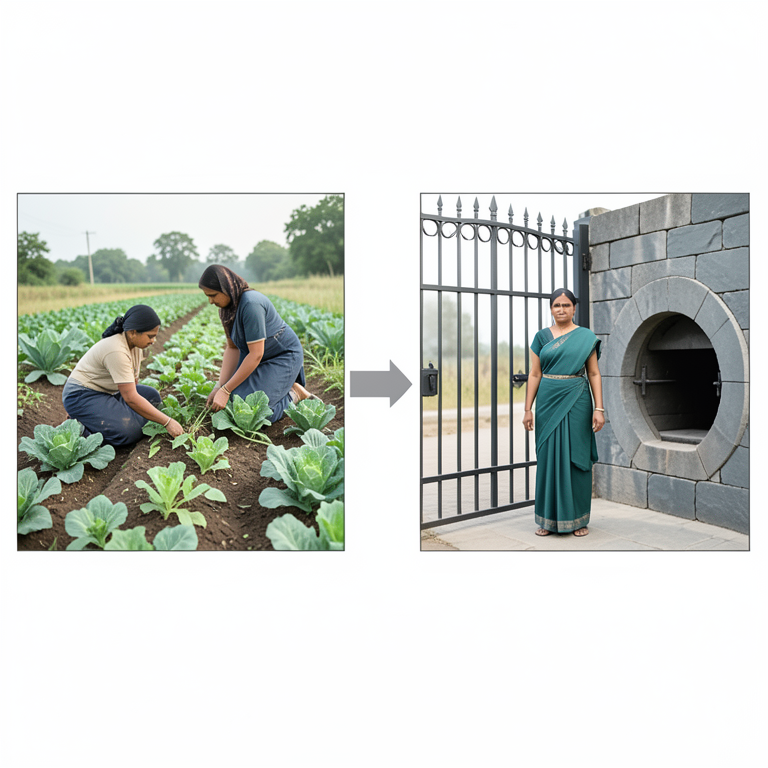
The Paradox of Rural Women's Role
AI-generated conceptual illustration (Rural Indian women in a farming village setting). It explains the idea and does not show study data.
View source evidence ↗Figures & tables
From the original paper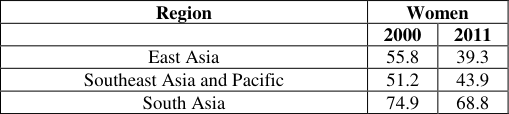 Table1
Introduction
Rural women are the pillars of small scale agriculture, farm labour power and everyday household sustenance. They are the vital producers of food at home with care and affection. They are the keepers of ancient technologies and protector of biodiversity. They are the food processors in household level. Rural women withhold the major pillars of food security such as availability, accessibility, utilization and stability (Gross et al, 2000) [1] . According to World Food Summit 1996 defined food security as a state when all people, at all times, have physical and economic access to sufficient, safe and nutritious food that meets their dietary needs and food preferences for an active and healthy life (Mc Carney, R.A, 1991) [5] . Food security is the important factor to be considered by every developing country in order to enhance the standard of living of their people. It should be developed in all the parts of a country especially in rural areas. To achieve this rural women and youth plays a major role. Among 25% of the world's population consists of rural women and almost 43% of work force is done by them. Since ancient periods itself women were doing all the households works and have a prominent role in agriculture. They gather fuel wood for cooking, rear the livestock which gives them additional income. The number of female headed families is increasing day by day due to the lack of employment for men in rural areas and they have to move to the urban areas in order to earn money for their family needs. Women are accountable to half of the total food production in the world. Women play various roles such as a farm labour, an entrepreneur who generates job opportunities and a caretaker of elders and children. FAO says that if women were given the same chances as that of men they would upsurge the yield up to 20-30%. This increase in the yield would solve many problems faced by the below poverty line people and malnutrition of children in the world can be decreased. Rural women play a vital role in SDG (Sustainable Development Goals) and their part is very important in achieving it by 2030. Hence there is a need to know more about the role of women in rural areas to ensure food security. This study will explain about the various roles of rural women to ensure food security.
Role of Rural Women in Food Security
Since ancient periods men were assigned to do cultivation of crops and to earn income for the family whereas women were assigned to fetch water and to do cooking. Along with this women started to help men with the farm work. Agricultural practices like sowing of seeds, weeding, application of fertilizers and pesticides, harvesting and threshing were done by women. They also did post-harvest food processing such as preserving the food by making them as pickles and pappads. They followed various traditional practices such as storing grains in large pots and storing seeds under the ground. By doing so, it can be used in future during the shortage of grains. Generally women stored food stock in their house due to availability of market was very less in rural area and they were unable to buy goods everyday and to withstand shortage. Women were best in processing and preserving food in their own way. For example, they prepared pickles with seasonal vegetables and fruits for their further use in offseason and drying of vegetables and inland fishes along with salt which preserves them for a longer time. Along with this woman started rearing livestock's such as cattle, pigs and goats. The processing of milk and the milk products were also done by them. Therefore they ensured dairy products availability for www.extensionjournal.com the entire family. They cleaned the shed, milk the animals and also market them. They used the livestock waste as bio compost by preparing a compost pit at their back yard and by decomposing them periodically. Rural women are responsible for more than 25% of world's fish food catch. The processing of fish was also done by them. The major contribution of rural women in food security is maintaining home garden. Usually in home garden they grow traditional varieties of staple food crops, vegetables and spices. They are the protectors of traditional knowledge of indigenous plants and seeds. They preserved the forest which was the major source of water and fuel wood. They have grown saplings and produced fodder and food for their livestock. Therefore they reduced the feed and forage costs for their cattle thus helping the household economy. They also conserved plant genetic resources by storing and exchanging seeds. More than 90% of household food is produced by women. Women prepare the meal with various nutrients distributed in it (Kennedy et al, 2011) [4] . Rural women were doing this from many generations without knowing their role in ensuring the food security all over the world (Mc Carney 1991) [5] . They were the unknown guardian of food security in rural areas. [3] .
Constraints
The major constraint faced by the women in India is gender discrimination. This gender discrimination leads them to a state in which they are unable to have possession to the farm land, access to the resources, availability of credit, access to farming inputs, right of entry to education, training and extension services, right to choice making, access to research and appropriate technology. Rural women are the backbone of agriculture but they don't have any ownership towards their farm. Due to various lawful and traditional practices women were denied of their ownership towards the land especially in the case of divorce or widowhood they are deprived of their right to have the land. Therefore it led to reduction in women labour in agriculture (Table1). In some regulations the registration of the land will be done in the name of the male head of the family. This makes them to get rejected for membership in the cooperative societies, banks and also they cannot get credits from the money lenders which lead to lack of credit. Due to lack of access to the land they cannot get any loans which make them fall in poverty. The major constraint is lack of knowledge among women globally. They don't have much information about the government schemes and funds. The allocation of female members in cooperative societies, farmer's organizations and farmers club were very less. This makes them to fall behind in every aspect. Due to the lack of access to land and knowledge leads them to lose their access to credit also in which they cannot use the credit without any consent and the complete freedom in choosing the agricultural inputs (such as seeds, fertilizers, pesticides) will be lost. The additional constraint is the pre and post pregnancy period in which the focus of women will be towards the kids and their role in food security will be deprived. Women spend higher proportion of their income in food for family than the men. During tough times such as flood or food scarcities women and girls are the ones who eat less. They also do not have their freedom to eat. These are the various constraints faced by the women.
| Region | Women | — |
|---|---|---|
| 2000 | 2011 | |
| East Asia | 55.8 | 39.3 |
| Southeast Asia and Pacific | 51.2 | 43.9 |
| South Asia | 74.9 | 68.8 |
Table text extracted from the original PDF; superscript letters are shown inline. The original table image is below.
View original table image
Measures to be taken to enhance the role of rural women in food security
The first and foremost measure is elimination of all forms of discrimination against women (Pinstrup and Anderson, P. 2009) [6] . Among all gender discrimination is the primary element which should be eliminated. The International Labour Organisation (ILO) regards the gender inequality as a universal matter which must be addressed in all international labour laws and conventions as well as in the recommendations and resolutions of the International Labour Conference (ILC). 2012. Recommendation (No. 202) Concerning National Floors of Social Protection (International Labour Conference, 2012) [2] .
The sustainable measures proposed by FAO are Gender equality should be promoted throughout the world. Employment opportunities should be equally given equally to both men and women in agricultural aspects for ensuring food security. To provide some incentive which ensures increased production of food, thereby helping the nation to achieve food security. To promote Organisations involving women such as SHG, thereby disseminating knowledge about food security to the participating women. To create better employment and income generating opportunities for women in rural areas to ensure their livelihood.
While additional measures can be taken u to boost up the role of women in food security in rural areas such as Awareness of food security should be created among the women through television ad, pamphlets, radios etc. Classes should be conducted to the rural women to enhance their knowledge about food security. Incubation centres should be created in rural areas concentrating on food security therefore various techniques and measures could be taught to the rural women. Government must encourage women who ensure food security in rural areas by providing them some freebies, e-vouchers, gift hampers. Therefore it would increase the curiosity and interest of women towards food security in rural areas. NGO's must reach the rural areas and it must educate them about their role in food security and its importance.
Conclusion
Rural women are responsible for our milestone achievement www.extensionjournal.com in food security. They had contributed an immense amount in food availability by growing crops in the backyard of houses and ensuring their availability to entire family. They have also contributed to household income generation by selling the excess food gained through their food security measures. Although women play a prominent role in food security throughout the world they lag behind due to political, economical and social constraints prevailing in each and every country particularly in India. Therefore it would carve a path for food insecurity in our future. It poses as a major threat to us in achieving the SDG (Sustainable Development Goals) by 2030. While the solution to this problems lies in the hands of government. Action plan must be created by government which must ensure the livelihood of rural women. While rural women are known well for their dietary diversity therefore their survival is essential for ensuring food security.
References
6 in the original paper- Gross R, Schoeneberger H, Pfeifer H, Preuss H. The four dimensions of food and nutrition security: definitions and concepts. SCN New. 2000; 20:20-25.
- In the specific case of rural workers, the ILO has a series of conventions addressing their rights: Convention 141 of 1975 on rural workers organizations, Convention 11 of on the rights of association of agriculture.
- Recommendation (No. 202) Concerning National Floors of Social Protection. Adopted at the 101 st session. 30 May. Geneva: ILO, 2012.
- Kennedy G, Ballard T, Dop M. Guidelines for measuring, household and individual Dietary diversity: FAO, 2011.
- Mc Carney RA. Household food security and the role of women. Third World Legal Studies. 1991; 10:157-179.
- Pinstrup-Anderson P. Food security: definition and measurement. Food security. 2009; 1(1):5-7. Doi: 10.1007/s12571-008-0002-y.
Cited by 2
From OpenAlex, OpenCitations and reference lists read by Scinovex
- Climate Change Awareness and Urban Food Choices: Exploring Motivations for Short Food Chain Engagement ↗
Elena Kokthi, Fatmir Guri, Zenepe Dafku · Urban Science · 2025
This study explores the relationship between Climate Change Awareness and consumer willingness to pay for Urban Short Food Chains, focusing on the mediating role of biospheric, egoistic, and altruistic concerns. Whether driven by egoistic or altruistic motivations, the reduction of ultra-processed food consumption emerges as a key factor in consumers' willingness to pay a premium for products from urban short-food…
❝ 5PDF - Habit and contextual influences on adolescent Fast-Food consumption with implications for sustainable diets ↗
Elena Kokthi, Iliriana Miftari, Arbenita Hasani, Ira Tili, Alerta Basha · Discover Sustainability · 2025
Abstract This study examines the role of habitual behaviour in adolescent fast-food consumption and its implications for the Theory of Planned Behavior (TPB). While TPB traditionally explains behaviour through attitudes, subjective norms, and perceived behavioural control, our findings suggest that habitual automaticity, contextual triggers, and environmental cues are stronger predictors of fast-food consumption. The results show that higher maternal education…
❝ 5PDF