
Research article · 2021 · Full text
International Journal of Agriculture and NutritionPotentiality of sugarcane juice and jaggery for immunity enhancement and creation of employment generation
Volume 3(1) · Pages 05–07 · DOI: 10.33545/26646064.2021.v3.i1a.38 ↗
Research areasNatural Products and Biological Research
Abstract
Author-writtenIn India, more than 65% people live in rural areas. Majority of the rural population suffers under nutrition or malnutrition as the Indian diet is deficient in nutrition. Sugarcane juice contains high amount of Vitamin B1, Vitamin B2, Vitamin B6, Vitamin C and inorganic salts such as iron, phosphorus, calcium and organic acids such as fumaric acid, succinic acid, citric acid and malic acid. It can be consumed as an energy drink, prevent cancer-especially prostate and breast cancer as flavonoids in sugarcane juice inhibits the growth of cancer cells in the milk glands and safe against pregnancy. Jaggery contains lot of vitamins (Vitamin A, B1, B2, B5, B6, C, D2 etc), minerals (Calcium, magnesium, phosphorus, iron, manganese, zinc etc), protein, energy etc. It is popularly known as the “Medicinal Sugar”. It has been used as a sweetener in Ayurvedic medicine for 3000 years. Indian Ayurvedic medicine considers jaggery to be beneficial in treating throat and lung infections. Huge migrant labourers back to their home in lockdown situation after losing their jobs. So, unemployment problem is a major issue in current pandemic situation. To resolve the issues of unemployment and immunity, the current article briefly describe about the potentiality of sugarcane juice and jaggery in creating employment coupled with boosting up the immunity in COVID-19 pandemic situation and its business, which are most appropriate for major portion of West Bengal as well as in India particularly in the rural areas to support the rural health and economy for sustainable development.
Summary
Source-checkedPlain-language reading of the full paper, prepared with AI and checked against the text. Each point links to the authors' own words.
Why it matters
- A significant portion of India's rural population faces malnutrition due to nutritional deficiencies in their typical diet. View evidence ↗
- The COVID-19 pandemic created a major unemployment crisis as many migrant laborers returned to their homes after losing their jobs. View evidence ↗
The question
- The paper aims to describe how sugarcane juice and jaggery can be used to boost immunity and create employment opportunities during the COVID-19 pandemic. View evidence ↗
What they did
- The author provides a descriptive overview of the nutritional potential and business viability of sugarcane products, focusing on rural India and West Bengal. View evidence ↗
- Nutritional compositions for jaggery and sugarcane juice were compiled from existing sources, including ESHA Research and previous literature. View evidence ↗
What they found
- Flavonoids in sugarcane juice are noted to inhibit the growth of cancer cells in milk glands, potentially preventing breast and prostate cancer. View evidence ↗
- Jaggery is described as a tool to boost immunity and treat cold and cough symptoms due to its vitamin and mineral content. View evidence ↗
- India leads global jaggery production in the unorganized agro-processing sector, accounting for 55% of the world's total. View evidence ↗
- Adding up to 10% of dried, grated Amla to jaggery was found to be an acceptable method for value addition to increase Vitamin C content. View evidence ↗
What it means
- The author concludes that sugarcane juice and jaggery are effective for boosting immunity and fighting diseases, including the novel coronavirus. View evidence ↗
- The author recommends that Self Help Groups (SHGs), Farmer Producer Organizations (FPOs), and Farmers Clubs engage in the production and marketing of these products to support the rural economy. View evidence ↗
Visual summary
1 visualsIllustrations explain the paper; they do not show study data.
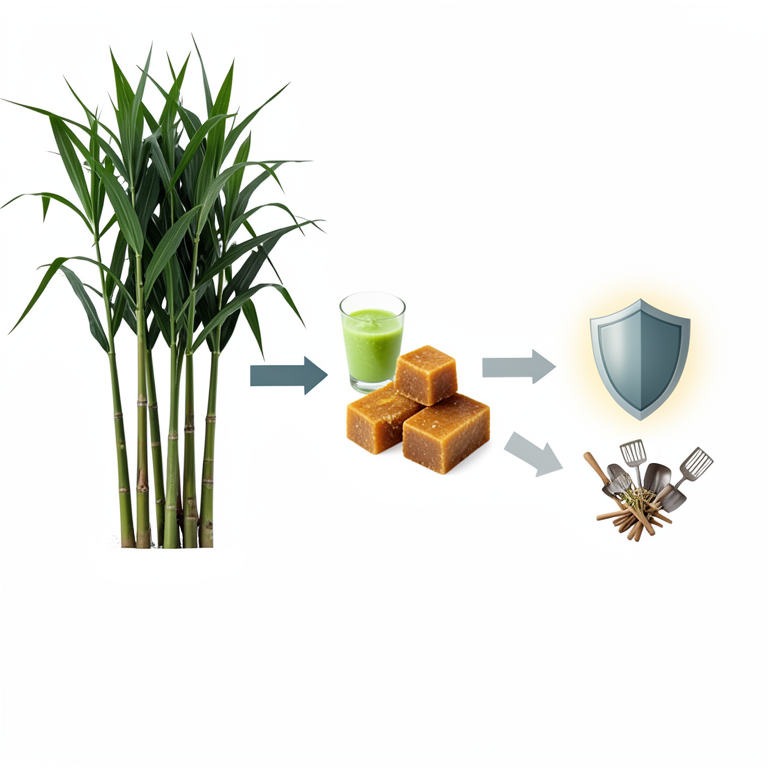
Sugarcane Product Cycle for Rural Development
AI-generated conceptual illustration (Sugarcane plants, sugarcane juice, and jaggery blocks). It explains the idea and does not show study data.
View source evidence ↗Figures & tables
From the original paper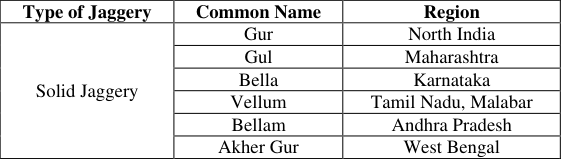 Table 1
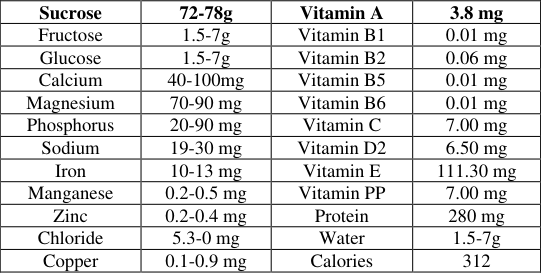 Table 2
 Table 3
Introduction
Sugarcane (Saccharum spp. hybrid) or Ikkshu or Aakh, a poverty reducing traditional crop, provides raw materials to sugar and jaggery industries and having religious values. It can also be eaten as is or consumed in the form of juice, which contains high polyphenols, which are powerful phytonutrients with the qualities of antioxidants and loaded with vitamins & Minerals. The average holding of cane growers is 0.77 ha and more than 90% sugarcane is grown by small and marginal farmers. The second largest agro-based industry after textile, is sugar industry, which provides livelihood to around 7 million sugarcane growers and 10 lakh workers employed in sugar mills & jaggery units in India. The alcohol required for preparation of Hand Sanitizer, an essential commodity in COVID-19 Pandemic situation produced in sugar industry. Production of sugar (around 27 million tonnes during 2019-20) has not gone down but the consumption as well as demand is gone down due to lockdown is around 0.5 to 1.5 million tonnes in india. In West Bengal, it is grown almost all the districts except hill area. The major growing districts are Murshidabad, Nadia, Birbhum, North 24 Parganas, Paschim Medinipur, Malda, Dakshin Dinajpur &Uttar Dinajpur. There is only one sugarmills (Khaitan India Ltd located at Plassey, Nadia) in the state having very poor cane crushing ability (0.69 lakh tone) and recovery (5.1%) leading to poor paying capacity to farmers. In spite of that sugarcane has an area of 17 thousand hectares with average yield of 76.1 tons per hectare and total production of 12.94 lakh tones during 2017-18(Sugar India, Yearbook, 2018) [7] in this state, it is mainly utilized for production of jaggery and juice purpose. The jaggery industry has been one of the most ancient and important rural based cottage industry. According to Panini the word gur is connected with Gour region (East Bengal) (Prakash, 2005) [5] . In the seventh century AD the capital of Gour country is called Gour or Karnasubarna (modern Rangamati, about 7 miles to the south of Murshidabad). The name Gour is supposed to be derived from the word Gur possible because it was famous in ancient time for its production of gur. At present Murshidabad, Malda and Nadia accounts for about 65% of sugarcane area in this state. It provides jobs to unemployed rural people and migrant labors in their vicinity with minimum capital investment. As these are rich in antioxidants, sugarcane juice and Jaggery is very important in boosting immunity. It is produced almost in 25 countries under different names with an estimated production of 13 million tonnes per year. India is the largest producer of jaggery under unorganised agro-processing sector, sharing 55% of the world production, while Colombia is the second largest producer contributing 11% of the world production. Region wise common name of solid jaggery are presented in table 1.
| Type of Jaggery | Common Name | Region |
|---|---|---|
| Solid Jaggery | Gur | North India |
| Gul | Maharashtra | |
| Bella | Karnataka | |
| Vellum | Tamil Nadu, Malabar | |
| Bellam | Andhra Pradesh | |
| Akher Gur | West Bengal |
Table text extracted from the original PDF; superscript letters are shown inline. The original table image is below.
View original table image
Sugarcane Juice
Peoples across the globe look for drinks that quench their thirst. They also expect naturally made drinks like sugarcane juice which is extracted from naturally grown sugarcane stalks. Over the year, you can notice many roadside vendors who sell sugarcane juice and get to see huge crowd rounding the stall waiting to have at least one glass of sugarcane juice, no matter how huge the crowd is, such is the demand for sugarcane juice.
No matter how much you charge a glass of sugarcane juice, people always think it is worth spending money. If the above benefits of sugarcane juice can be displayed near the stall, the demand for sugarcane juice will suddenly be increased and people's choice will magically change from chemical rich drinks to sugarcane juice. None can deny the fact that sugarcane juice is so popular and we come across sugarcane juice bars/outlets/vendors/stalls frequently.
Nutritional value of Sugarcane Juice
Sugarcane juice contains high polyphenols, those are powerful phytonutrients with the qualities of antioxidants. It is also loaded with vitamins and minerals such as calcium, potassium, magnesium, manganese, and iron; along with a complete profile of essential amino-acids that help burn fat and build muscle. Some of these include pipecolic acid, methionine, tryptophan, βalanine, and arginine; along with basic amino-acids like histidine, lysine, arginine, and tryptophan. Sugarcane juice is alkaline to the body and most diseases cannot live in an alkaline environment. It contains high amount of Vitamin B1, Vitamin B2, Vitamin B6, Vitamin C and inorganic salts such as iron, phosphorus, calcium and organic acids such as fumaric acid, succinic acid, citric acid and malic acid. It can be consumed as an energy drink, prevent cancer-especially prostate and breast cancer as flavonoids in sugarcane juice inhibits the growth of cancer cells in the milk glands and safe against pregnancy (Mahata G, 2019) [4] . It is used to prevent several diseases mainly jaundice, constipation and stomach burn, heart and kidney diseases and also use as digestive tonic. Apart from the above benefits, in COVID 19 Pandemic situation, the most important benefits of sugarcane juice consumptions are-1. Improve immunity: As it is rich in antioxidants, sugarcane juice is very important in boosting immunity. This drink works against diseases such as digestive diseases and liver problems. In addition, these antioxidants are also useful for neutralizing bilirubin. 2. Treating Sore Throat: Feeling itchy in the throat, you can drink a glass of sugarcane juice that has been mixed with black salt. The high vitamin C content is a strong reason for treating sore throats.
Employment Opportunities in Sugarcane Juice Business
Few people expect huge profits by investing money in a big business set up but few invest a little amount of money that too in a risk-free business and they gradually keep adding investment to improve business and ultimately aim for huge profits. Sugarcane juice business can be started with very little investment and on the other hand growing potential in this business is also huge. Some people think that this business falls under seasonal business because demand for sugarcane juice is during summer season only. But it is not true. This business is running year the round as the demand for sugarcane juice is high during summer and medium during other seasons in general, but in COVID 19 Pandemic situation, peoples are more interested to improve their immunity that is why the demand for this juice is increasing day by day irrespective of seasons. There are many people in the country who are employed in sugarcane juice business as a best money making business as it is more profitable with less investment of money. In this context, this business has huge scope for creating rural employment and sustainable development.
Jaggery
Jaggery, is a natural sweetener, traditionally referred to sugarcane jaggery, is prepared by the concentration of sugarcane juice without any use of chemicals and is available in the form of solid blocks and semi-liquid form. Besides sugarcane juice, jaggery is being made from other sources, like sap collected from different palm trees. All these jaggery have its own characteristic taste and aroma. 60-70% of the total jaggery comes from sugarcane.
Nutritional Value of Jaggery
Mostly jaggery is produced organically in West Bengal as well as in India. Organic Jaggery (GUR) has more nutritional value and has a characteristic flavour of natural compounds. Compared to Sugar, it is a better sweetener by virtue of it having all the ingredients of sugarcane juice in addition to sucrose but white crystal sugar is only sucrose and all the ingredients go in the byproducts in sugar industry (Keshavaiah, K.V, Swamygowda, S.N & Thimmegowda, P, 2018) [2] . The nutritional value of jaggery is presented in Table 2.
| Sucrose | 72-78g | Vitamin A | 3.8 mg |
|---|---|---|---|
| Fructose | 1.5-7g | Vitamin B1 | 0.01 mg |
| Glucose | 1.5-7g | Vitamin B2 | 0.06 mg |
| Calcium | 40-100mg | Vitamin B5 | 0.01 mg |
| Magnesium | 70-90 mg | Vitamin B6 | 0.01 mg |
| Phosphorus | 20-90 mg | Vitamin C | 7.00 mg |
| Sodium | 19-30 mg | Vitamin D2 | 6.50 mg |
| Iron | 10-13 mg | Vitamin E | 111.30 mg |
| Manganese | 0.2-0.5 mg | Vitamin PP | 7.00 mg |
| Zinc | 0.2-0.4 mg | Protein | 280 mg |
| Chloride | 5.3-0 mg | Water | 1.5-7g |
| Copper | 0.1-0.9 mg | Calories | 312 |
Table text extracted from the original PDF; superscript letters are shown inline. The original table image is below.
View original table image
Benefits of Jaggery
Jaggery is popularly known as the "Medicinal Sugar". It has been used as a sweetener in Ayurvedic medicine for 3000 years. Indian Ayurvedic medicine considers jaggery to be beneficial in treating throat and lung infections. The preventive ability of jaggery on snooker's smoke-induced ling lesions suggest the potential of jaggery as a protective food for workers in dusty and smoky atmosphere; even for those who are engaged in woollen industries, the wool dust clogged in the food pipe could be cleaned with jaggery, that Ayurved prescribed. Many doctors say "it is best consumed during the winter months because winter is the season of fresh jaggery. Since it is rich in many vital vitamins and minerals, jaggery boosts immunity, keeps the body warm, helps treat cold and cough and controls the temperature of the body. This natural sweetener has been a great go-to ingredient in India since time immemorial." Its consumption is helpful to prevents constipation, anaemia and boosts intestinal health and Controls blood pressure and many more. Apart from the above benefits, in COVID 19 Pandemic situation, the most important benefits of jaggery consumptions are-
Treats flu-like symptoms
Fight symptoms of a cold and cough with the help of gur. All you need to do is mix it with warm water and drink up, or even add it in your tea instead of sugar to reap the benefits. Jaggery produces heat in the body, which is why generally people consume it in winters. The warming effect in jaggery makes it an amazing sweet that can treat cold and flu.
Boosts immunity
Jaggery is loaded with antioxidants and minerals such as zinc and selenium, which in turn help prevent free-radical damage and also boost resistance against infections. Jaggery also helps increase the total count of haemoglobin in the blood.
Prevents respiratory problems
By consuming jaggery regularly, you can prevent many respiratory problems such as asthma, bronchitis, etc. Experts recommend eating this natural sweetener with sesame seeds for wonderful benefits for the respiratory system.
Employment Opportunities in Jaggery preparation and value addition.
The difference between consumption and production in West Bengal (Table 3) clearly indicates the shortage of jaggery and thus ample scope for production of jaggery and thus huge opportunities of employment generation in rural areas to cope up the problem of migrant workers coming back to this state due to lockdown in COVID-19 Pandemic situation. In addition to that value addition in jaggery with natural source of vitamin C may create rural employment to a greater extent. All we know the important of vitamin C, an antioxidant, in our daily diet and particularly to prevent stress, cataract, heart diseases and fighting against cold by boosting up our immunity in this Pandemic situation. For this, Amla fruits were cut into small pieces and slice and grated/stredded dried up to 10% were found to be acceptable as per the Anwar SI, Singh RD, J Singh, 2011 [1] . Jaggery samples in which dried Amla was mixed in coarse powder form was found to be the best followed by the sample with grated and fine powder form. Jaggery cocktails like Ginger Jaggery, Turmeric Jaggery and other spices jaggery preparation and marketing have tremendous scope for boosting immunity in our state as well as in other parts.
| Item | Consumption | — | Production | — | Import | — |
|---|---|---|---|---|---|---|
| Quantity (‘000t) | Value (Cr Rs.) | Quantity (‘000t) | Value (Cr Rs.) | Quantity (‘000t) | Value (Cr Rs.) | |
| Gur | 456.5 | 1141.25 | 110 | 275 | 346.5 | 866.25 |
Table text extracted from the original PDF; superscript letters are shown inline. The original table image is below.
View original table image
Conclusion
Sugarcane juice and jaggery provides lot of minerals, vitamins and antioxidant to boost the immunity and able to fight against many diseases including novel corona virus in this pandemic situation. Its juice and jaggery business has huge potentiality in creating rural employment to cope with the rural migrant labourers back to their home during COVID-19 Pandemic situation. Members of SHGs, FPOs, FIGs, Farmers Club may also be involved in these businesses along with marketing for nutritional security and improving immunity power of rural people to fight against COVID-19 and support the rural economy so that sustainable development can be achieved.
Acknowledgement
AcknowledgementI am very much grateful to the Director of Agriculture and Ex-Officio Secretary, Department of Agriculture, Govt. of West Bengal, India for providing fund for conducting the experiment and thankful to the Economic Botanist, SRS, Bethuadahari, Nadia, WB for providing facilities and constant encouragement
References
7 in the original paper- Anwar SI, Singh RD, Singh J. "Process development of Production of Jaggery (GUR), with aonla as a natural source of vitamin C". Journal of the Institution of Engineers, India. 2011; 92:33-35
- October, UAS, GKVK, Bengaluru. 2018; 88-97
- December, 2018, Bidhannagar College, West Bengal, 2018.
- Mahata G. "Sugarcane juice for human health and opportunities of employment generation-An Overview". Indian Farming. 2019; 69(07):09-12.
- Prakash O. "Cultural History of India". New Age International. 2005; 516.
- Singh J, Solomon S, Kumar D. "Manufacturing jaggery, a product of sugarcane, As Health Food". Agrotechnol. 2013; 11:007.
- Sugar India Year Book, 2018. www.anekantprakashan.com
Cited by 3
From OpenAlex, OpenCitations and reference lists read by Scinovex
- Jaggery making reforms, value addition and preservation: A comprehensive review
PD Ukey, VM Ingale, SB Wategaonkar, Jong Pil Park, K Prathapan, JS Ghatge · International Journal of Advanced Biochemistry Research · 2024
Jaggery is a popular conventional Indian sweetener. It is prepared without the use of chemicals by uniformly heating and condensing clear sugarcane juice. Now a day’s people are very conscious of food-related health issues and the quality of food is the focus of consumers. Jaggery is one of the products rich in nutrients including protein, vitamins and minerals. Jaggery can be utilized for various medicinal purposes like blood purification, regulating digestion, beauty treatment, improving metabolism, prevention of different respiratory issues, etc. Due to technological limitations in the proc
- Effect of nutrient management and cultivars on quality of sugarcane juice and liquid Jaggery ↗
M Shivashenkaramurthy, Nayak GV, Rajakumar GR, Channabasappa KS, Shanjaya B Patil · Journal of Pharmacognosy and Phytochemistry · 2021
An experiment was conducted to study the effect of fertilizers levels and cultivars on Sugarcane yield and economics crop at Agriculture Research Station, Kumta, Uttara Kannada of University of Agricultural Sciences, Dharwad during 2018-19 and 2019. The experiment consisted three main plots (Cultivars) viz., C1-SNK635, C2- Co-86032 and C3 – Konanakatte and five sub plots (Fertilizers levels) F1 : 75
- A study on marketing channels adopted by sugarcane jaggery producers for marketing jaggery products in Baghpat district of western Uttar Pradesh
Arun Solanki, Devanshu Tomar, Lalit Verma · International Journal of Agriculture and Food Science · 2022
Marketing of agricultural commodities has assumptive greater importance with the gradual switch over from subsistence farming to commercial farming. In this background, the present study was undertaken in Baghpat district of western Uttar Pradesh, with the objective of Marketing channels preferred by Sugarcane Jaggery producers for Marketing Jaggery products. It was conducted in the Binauli block in this district because the fact, a large number of jaggery processing units are present in the area. The five major distribution channels were identified in the study area. Most sugarcane jaggery pr