
Research article · 2020 · Full text
International Journal of Agriculture Extension and Social DevelopmentDeterminants of crop diversification in Tirunelveli district of Tamil Nadu
Volume 3(2) · Pages 30–32 · DOI: 10.33545/26180723.2020.v3.i2a.53 ↗
Research areasAgricultural Economics and Practices
Abstract
Author-writtenThis paper analyzes the determinants of crop diversification in Tirunelveli district of Tamil Nadu. Knowing the determinants of crop diversification is important for improving agricultural production and for the well being of farmers. We studied about the determinants of crop diversification in Tirunelveli district of Tamil Nadu using the primary data. Non – Experimental Research design was used for this study purpose. A sample size of 120 respondents was fixed for the study purpose using proportionate random sampling technique. The respondents were asked to express the factors which influence the crop diversification. The information gathered from the respondents were analyzed and tabulated. Crop diversification is nothing but a shift in cropping pattern, shift from traditionally grown less benefit crops to more benefit crops to increase the income as well as agricultural sustainability. By this, farmer can grow variety of crops in a given area in order to increase the production and also to lessen the risk. Indian agriculture facing distress due to disparities in the income of the farmers and non-agricultural workers. Crop diversification can be used as a better strategy to achieve this goal and to reduce the disparities in income of the farmers and non-agricultural workers.
Summary
Source-checkedPlain-language reading of the full paper, prepared with AI and checked against the text. Each point links to the authors' own words.
Why it matters
- Crop diversification involves shifting from traditional, low-benefit crops to more beneficial ones to enhance farmer income and agricultural sustainability. View evidence ↗
- Growing a variety of crops in a specific area allows farmers to increase overall production and reduce agricultural risks. View evidence ↗
- Crop diversification is viewed as a strategy to reduce income disparities between farmers and non-agricultural workers in India. View evidence ↗
The question
- The objective of the study was to identify the factors (determinants) that influence crop diversification among selected farmers. View evidence ↗
What they did
- The study employed a non-experimental research design with a sample of 120 respondents selected via proportionate random sampling. View evidence ↗
- The 120 participants were drawn from six villages across three blocks in the Tirunelveli district. View evidence ↗
- Determinants were categorized into five groups: crop production, crop protection, marketing, financial, and social factors. View evidence ↗
What they found
- Irrigation availability was the most significant crop production factor, cited by 90.80% of respondents. View evidence ↗
- Other key production determinants included farm input availability (90.00%), fertilizer usage (89.20%), and the size of hired labor (86.70%). View evidence ↗
- Regarding crop protection, 85.80% of respondents identified the reduction of risk from pests and diseases as a primary determinant. View evidence ↗
- Marketing determinants were led by the availability of marketing strategies (88.30%) and market distance (87.50%). View evidence ↗
- Financial determinants were primarily driven by frequent income generation (87.50%) and lower costs paired with increased remuneration (85.00%). View evidence ↗
- Social factors had the lowest impact, with social cohesion and improved status cited by 39.20% and social recognition by 36.70% of respondents. View evidence ↗
What it means
- The authors conclude that crop diversification can be improved by providing credit/subsidies, ensuring timely input availability, and removing middlemen from marketing. View evidence ↗
- The authors recommend that the government take active measures to encourage farmers to adopt diversification practices. View evidence ↗
Visual summary
2 visualsIllustrations explain the paper; charts are replotted from the paper's own table values.
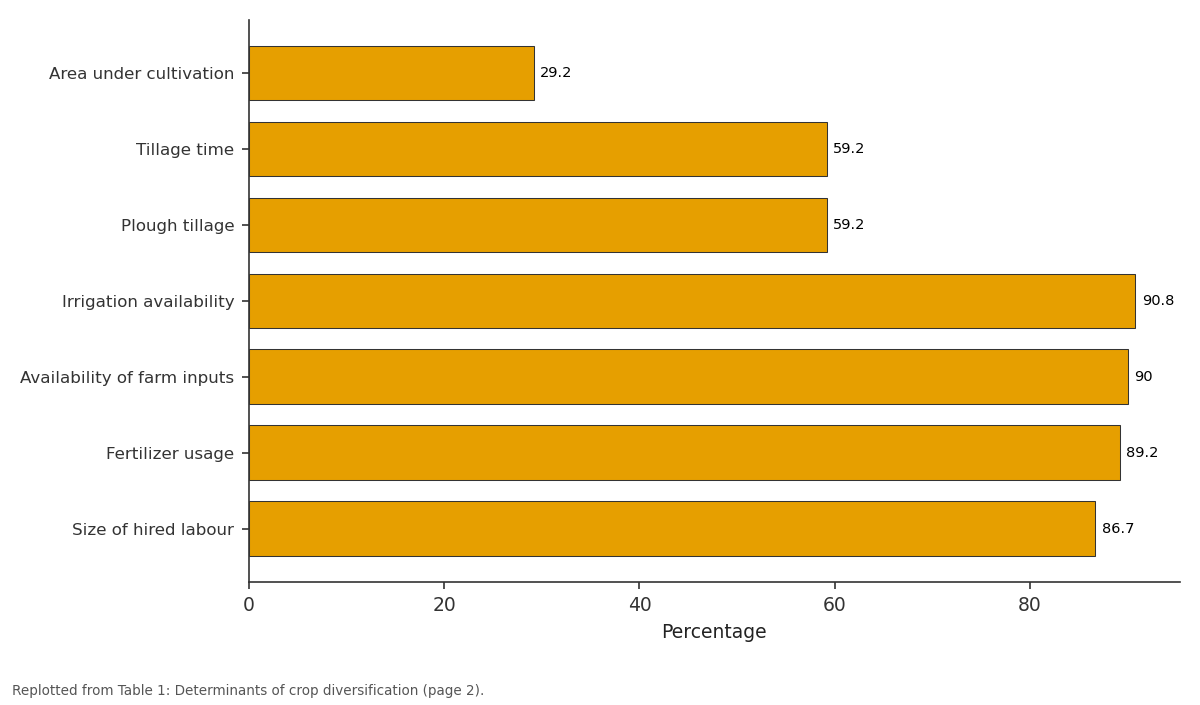
Percentage / Yes: Area under cultivation vs Tillage time vs Plough tillage vs Irrigation availability vs Availability of farm...
Replotted from Table 1 (page 2) of the original paper. Every bar is the paper's own table value.
View source evidence ↗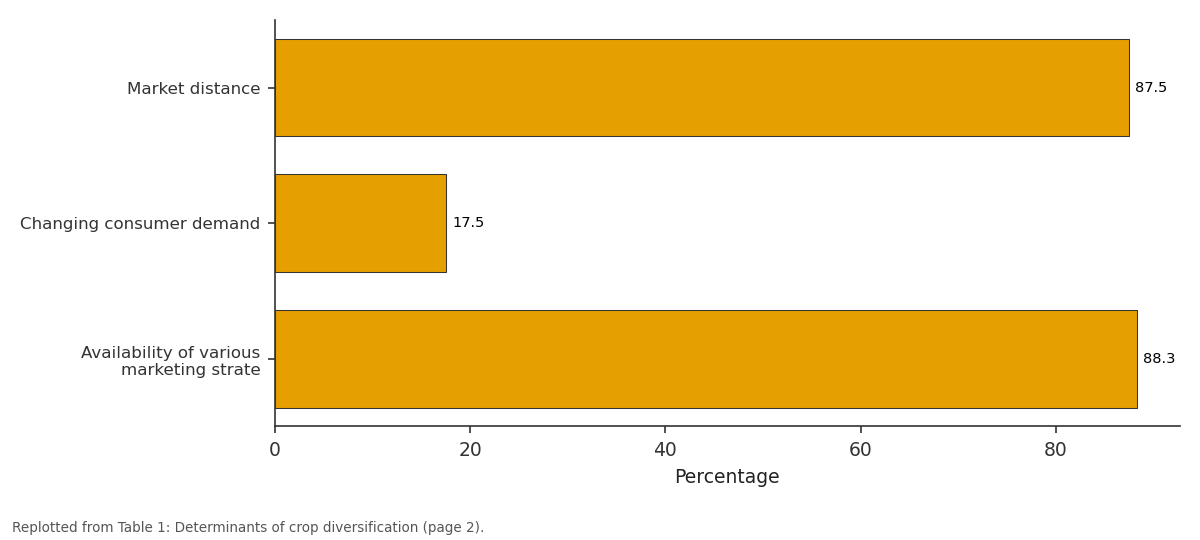
Percentage / Yes: Market distance vs Changing consumer demand vs Availability of various...
Replotted from Table 1 (page 2) of the original paper. Every bar is the paper's own table value.
View source evidence ↗Figures & tables
From the original paper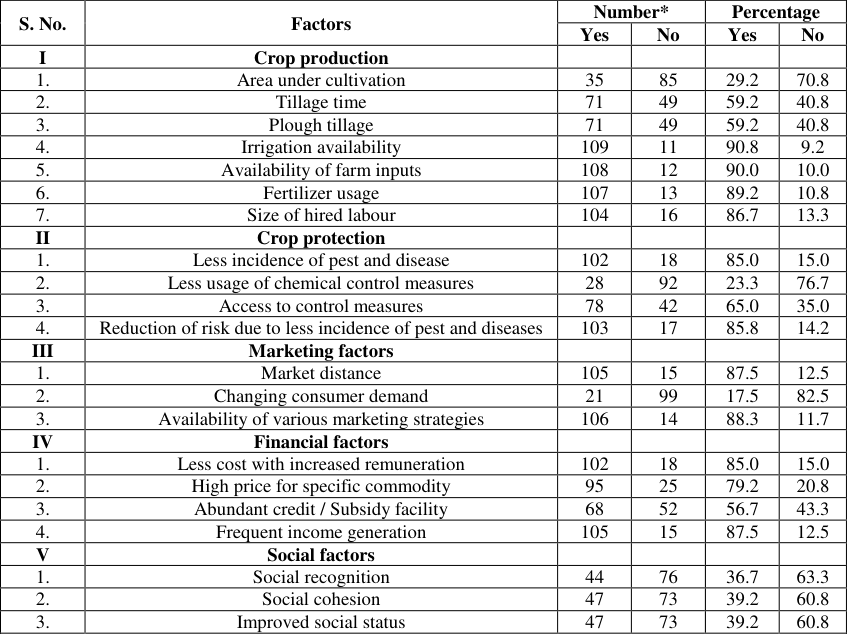 Table 1
Introduction
Tirunelveli district is predominantly an agricultural district and agriculture is the major occupation of the people. Tirunelveli district has a total geographical area of 675850 ha. The total cropped area was 206858 ha (30.61 per cent) and the net area sown was 175087 ha (25.91 per cent). Introduction of Green revolution in the country to meet the food shortage had affected the cropping pattern in the country. Many states in the country were converted into mono crop state due to the advent of fertilizer responsive and high yielding varieties in rice and wheat. Both the Central and State Government introduced many schemes to diversify cropping pattern to maintain food security, after attaining self sufficiency in food grain production The demand for food and agricultural production has been raised due to high population and income growth, as the natural resources too deployed, crop diversification is the main course of future growth of agriculture. Crop diversification ensures employment opportunities for the small farmers as well as for agricultural labourers throughout the year. It provides the farmers with viable options to grow different crops on their land around the year. Crop diversification helps the farmer to avoid risk and uncertainty due to climatic and biological vagaries. To increase the sustainability in agriculture and to improve the agricultural production, crop diversification serves as a viable solution. In this paper an attempt was made to study the determinants of crop diversification in overall Tirunelveli district of Tamil Nadu.
Objective
To study the determinants of crop diversification among the selected respondents.
Review of literature
Birthal et al. (2005) [2] found that in North Eastern Region of India, agricultural diversification was affected by labor, occupation, irrigation, road density, market facility significantly. Ashfaq et al. ( 2008) [1] revealed that the factors including size of land holding, age of respondent, education level of respondent, farming experience of respondent, off farm income of respondent, distance of farm from main road and farm machinery are the variables which influences crop diversification.
Ibrahim et al. (2009) [4] stated that the extension contact, availability of tractor hiring services, returns from crop production and road condition significantly determine the level of crop diversification respectively. Mithiya et al. (2018) [5] stated that the suppplyside factors including infrastructure development, technology adoption, relative income, resource endowments and the demand side factors including size of urban population and per capita income as well a climatic variable (rainfall) influences crop diversification respectively. Sohal (2003) [6] found that socio-economic conditions and www.extensionjournal.com technological development of the region and physical environment determines the crop diversification respectively. Dube and Guveya (2016) [3] reported that the factors including gender of household head, education, number of livestock units, access to irrigation, membership to a farmers group, access to markets, farming experience, farms on flat terrains, farmer to farm extension, routine extension, agro ecological zone and household income determines crop diversification.
Materials and methods
The study was based on the primary data collected among the selected respondents. A sample size of 120 farmers was fixed as respondents. The 120 respondents were identified from the selected six villages from three blocks by applying proportionate random sampling method.
Study area
Tirunelveli district having geographical area of 6759 sq. kms, in the south eastern portion of Tamil Nadu is triangular in shape. It lies between 8°.05' and 9°.30' of the Northern latitude and 77°05' and 78°.25' of Eastern longitude. The district is located in the southern part of Tamil Nadu and surrounded by Virudhunagar district in the north, Western Ghats in the west, Kanyakumari district in the south and Thoothukudi district in the east.
Results and discussions
Determinants of crop diversification was collected from various related sources such as literature, discussion with extension personnel and other stake holders were classified as crop production factors, crop protection factors, marketing factors, financial factors and social factors. The respondents were asked to express the factors which influence the crop diversification. The information gathered from the respondents were analyzed and tabulated as below. It could be seen from the table that regarding crop production factors, most of the respondents (90.80 per cent) considered irrigation availability as the determinant of crop diversification followed by 90.00 per cent of the respondents considered availability of farm input as the determinant of crop diversification, 89.20 per cent of the respondents considered fertilizer usage as the determinant of crop diversification, 86.70 per cent of the respondents considered size of hired labour as determinant of crop diversification, 59.2 per cent of the respondents considered tillage time and plough tillage as determinant of crop diversification, 29.20 per cent of the respondents considered area under cultivation as the determinant of crop diversification. Concerning crop protection factors, 85.80 per cent of the respondents considered reduction of risk due to less incidence of pest and disease as the determinant of crop diversification followed by 85.00 per cent of the respondents considered less incidence of pest and disease as determinant of crop diversification, 65.00 per cent of the respondents considered access to chemical measures as the determinant of crop diversification, 23.30 per cent of the respondents considered less usage of chemical control measures as the determinants of crop diversification. www.extensionjournal.com Concerning marketing factors, 88.30 per cent of the respondents considered availability of various marketing strategy as the determinant of crop diversification followed by 87.50 per cent of the respondents considered market distance as the determinant of crop diversification, 17.50 per cent of the respondents considered changing consumer demand as the determinant of crop diversification respectively. Concerning the financial factors, 87.50 per cent of the respondents considered frequent income generation as the determinants of crop diversification followed by 85.00 per cent of the respondents considered less cost with increased remuneration as the determinant of crop diversification, 79.20 per cent of the respondents considered high price for specific commodity as the determinant of crop diversification, 56.70 per cent of the respondents considered abundant credit / subsidy facilities as the determinant of crop diversification. Concerning the social factors, 39.20 per cent of the respondents considered social cohesion and improved social status as the determinants of crop diversification and 36.70 per cent of the respondents considered social recognition as the determinant of crop diversification.
Conclusion
The overall assessment showed that in regarding crop production factors, most of the respondents (90.80 per cent) considered irrigation availability as the determinant of crop diversification. Concerning crop protection factors, 85.80 per cent of the respondents considered reduction of risk due to less incidence of pest and disease as the determinant of crop diversification. Concerning marketing factors, 88.30 per cent of the respondents considered availability of various marketing strategy as the determinant of crop diversification. Concerning the financial factors, 87.50 per cent of the respondents considered frequent income generation as the determinants of crop diversification. Concerning the social factors, 39.20 per cent of the respondents considered social cohesion and improved social status as the determinants of crop diversification. Providing credit / subsidy facilities to the farmers can improve the crop diversification. Timely availability of inputs and removing the middle man intervention in marketing would improve the crop diversification. Government should take enough measure for encouraging the farmers to adopt crop diversification practices.
Figures and tables from the paper
| S. No. | Factors | Number* | — | Percentage | — |
|---|---|---|---|---|---|
| Yes | No | Yes | No | ||
| I | Crop production | ||||
| 1. | Area under cultivation | 35 | 85 | 29.2 | 70.8 |
| 2. | Tillage time | 71 | 49 | 59.2 | 40.8 |
| 3. | Plough tillage | 71 | 49 | 59.2 | 40.8 |
| 4. | Irrigation availability | 109 | 11 | 90.8 | 9.2 |
| 5. | Availability of farm inputs | 108 | 12 | 90.0 | 10.0 |
| 6. | Fertilizer usage | 107 | 13 | 89.2 | 10.8 |
| 7. | Size of hired labour | 104 | 16 | 86.7 | 13.3 |
| II | Crop protection | ||||
| 1. | Less incidence of pest and disease | 102 | 18 | 85.0 | 15.0 |
| 2. | Less usage of chemical control measures | 28 | 92 | 23.3 | 76.7 |
| 3. | Access to control measures | 78 | 42 | 65.0 | 35.0 |
| 4. | Reduction of risk due to less incidence of pest and diseases | 103 | 17 | 85.8 | 14.2 |
| III | Marketing factors | ||||
| 1. | Market distance | 105 | 15 | 87.5 | 12.5 |
| 2. | Changing consumer demand | 21 | 99 | 17.5 | 82.5 |
| 3. | Availability of various marketing strategies | 106 | 14 | 88.3 | 11.7 |
| IV | Financial factors | ||||
| 1. | Less cost with increased remuneration | 102 | 18 | 85.0 | 15.0 |
| 2. | High price for specific commodity | 95 | 25 | 79.2 | 20.8 |
| 3. | Abundant credit / Subsidy facility | 68 | 52 | 56.7 | 43.3 |
| 4. | Frequent income generation | 105 | 15 | 87.5 | 12.5 |
| V | Social factors | ||||
| 1. | Social recognition | 44 | 76 | 36.7 | 63.3 |
| 2. | Social cohesion | 47 | 73 | 39.2 | 60.8 |
| 3. | Improved social status | 47 | 73 | 39.2 | 60.8 |
Table text extracted from the original PDF; superscript letters are shown inline. The original table image is below.
View original table image
References
6 in the original paper- Ashfaq M, Hassan S, Naseer MZ, Baig IA, Asma J. Factors affecting farm diversification in ricewheat. Pak. J Agri. Sci. 2008; 45(3):91-94.
- Birthal PS, Joshi PK, Gulati A. Vertical coordination in high-value commodities: Implications for smallholders (No. 596-2016-40047), 2005.
- Dube L, Guveya E. Determinants of agriculture commercialization among smallholder farmers in Manicaland and Masvingo Provinces of Zimbabwe. Agricultural Science Research Journal. 2016; 6(8):182190.
- Ibrahim H, Rahman SA, Envulus EE, Oyewole SO. Income and crop diversification among farming households in a rural area of north central Nigeria. Agro-Science, 2009, 8(2).
- Mithiya D, Mandal K, Datta L. Trend, pattern and determinants of crop diversification of small holders in West Bengal: A district-wise panel data analysis. Journal of Development and Agricultural Economics. 2018; 10(4):110-119.
- Sohal KS. Changes in Crop Diversification in Punjab: 1951-2001. The National Geographical Journal of India, 2003, 49.