
Research article · 2021 · Full text
International Journal of Geography Geology and EnvironmentProblems and prospects of tourism in the Kumaun region of Uttarakhand
Volume 3(1) · Pages 42–45 · DOI: 10.22271/27067483.2021.v3.i1a.52 ↗
Research areasDiverse Aspects of Tourism Research
Abstract
Author-writtenIn modern world tourism is emerged as one of the largest service-sector industry and generates national income as well as job opportunities especially for local population and become an avenue of economic and social development and cultural exchange. Tourism is not merely an activity for leisure and entertainment but it also an enriching and energizing activity. Uttarakhand known as Devbhoomi or ‘Abode of Gods’ is a site of temples and pilgrimage, endowed with salubrious climate, exotic greenery, rich flora besides its rich culture. The Kumaon region of the state of Uttarakhand is attracting tourist in large numbers and is becoming one of the preferred choice of visit. Beside all this the tourism industry in the region is facing some problems which need to be considered to capitalize the potential of tourism in the Kumaun region. The present paper tries to analyze the problem as well as prospects of tourism development in the Kumaun region of the Uttarakhand state, the nature of the research is Descriptive and based on the secondary sources of data. The study results reveals that no doubt there are many challenges and problems for tourism development, but with certain improvements and proper planning the prospects for tourism development can be capitalized.
Summary
Source-checkedPlain-language reading of the full paper, prepared with AI and checked against the text. Each point links to the authors' own words.
Why it matters
- Tourism has become one of the world's largest service industries, serving as a key driver for national income, local employment, and socio-economic development. View evidence ↗
- Uttarakhand, referred to as 'Devbhoomi' or the 'Abode of Gods,' is a significant destination due to its temples, pilgrimage sites, and natural beauty. View evidence ↗
- The Kumaon region specifically has become a preferred choice for tourists, attracting large numbers of visitors. View evidence ↗
The question
- The study aims to analyze the existing problems and the future prospects for tourism development within the Kumaun region of Uttarakhand. View evidence ↗
What they did
- The researchers used a descriptive research design based on secondary data sources. View evidence ↗
- The secondary data for this analysis was gathered from government reports, websites, research papers, and books. View evidence ↗
What they found
- An inefficient public transport system forces tourists to rely on private taxis, preventing many destinations from being fully explored. View evidence ↗
- Government agencies often work in isolation, and this lack of coordination hinders the timely completion of infrastructural plans. View evidence ↗
- The tourism industry in the region suffers from a limited use of modern amenities, including outdated informational websites. View evidence ↗
- Eco-tourism is identified as a major prospect for the region, offering mutual benefits to the environment, visitors, and the local community. View evidence ↗
- Village tourism is a relatively new concept in the region but is rapidly increasing in popularity. View evidence ↗
- Home-stay tourism is a viable prospect that provides budget-friendly accommodation and allows guests to experience local hospitality. View evidence ↗
What it means
- The authors recommend the adoption of sustainable tourism practices to ensure environmental preservation for future generations. View evidence ↗
Visual summary
1 visualsIllustrations explain the paper; they do not show study data.
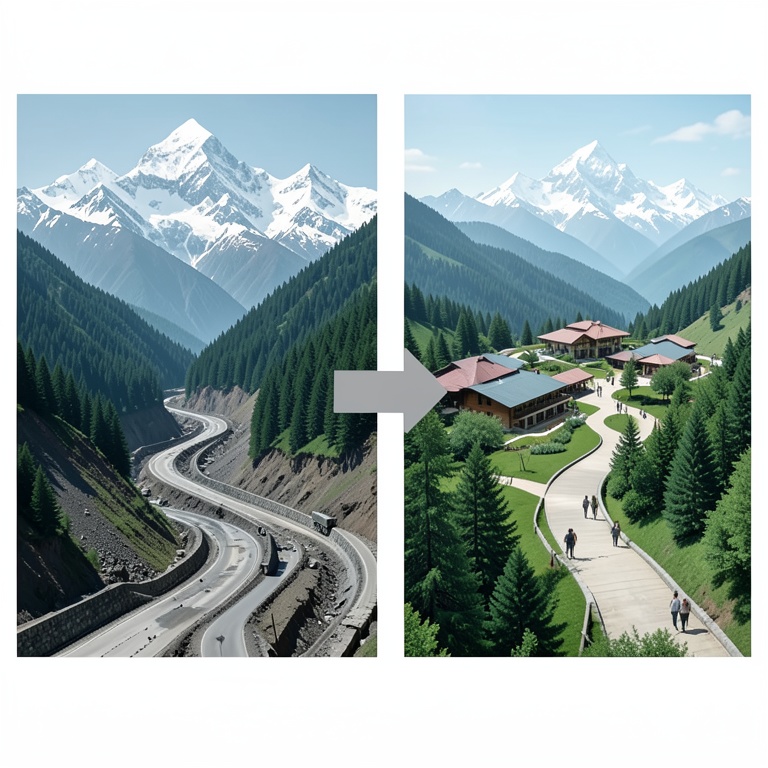
Study overview
AI-generated conceptual illustration (The Kumaun region of Uttarakhand, featuring Himalayan mountain peaks, pine forests, and traditional hill-station stone g). It explains the idea and does not show study data.
View source evidence ↗Introduction
Travel has been a part of human life since time immemorial. Early people used to travel with different needs and motives, the first being travel for search for food. Food searchers are considered the first travelers. This was followed by those who travelled with motive of trade. Many kingdoms were evolved and battles were took place to extend the reign of the emperors of that time. Tourism is not a new phenomenon that evolved overnight rather it took decades to evolve travel and tourism in the shape that we see today. Travel and tourism existed in different ways in different times. Tourism is a multidimensional phenomenon, which have its social, economic, natural, political impacts which are positive as well as negative. Being one of the fastest growing service sector most of the economies are trying their best to capture major share in the tourism industry as a means of getting competitive edge over other countries of the world. Tourism has its testimonies in the earliest records of history and has undergone phenomenal rate of growth during the present century. Yet there is no universally accepted definition of tourism even now. Huniker and Krapf gave the first definition of tourism by defining it as "The sum of phenomenon and relationship arising from the travel and stay of non-resident in so far as it does not lead to permanent residence and is not connected to any earning activity",(Dileep, 2019) [3] . In general tourism can be defined as a process involving a visit performed by a person from his place of residence to some far destination for more than one day and which does not anyhow related to motive of earning. With the advancement in accommodation and transportation facilities which are the two major elements of travel industry, it is very easy to go anywhere anytime to explore destination and to spend leisure time. This development took years and decades to transform the tourism industry, one of the major transformation that took place in the travel and tourism industry is after the world wars and especially the world war 2. The state of Uttarakhand which is also known as "Abode of Gods", is one of the preferred tourist destination across the globe. The state was formed as the 27 th state on 9 th of November 2000. There are two divisions of the state namely the Kumaun and the Garhwal region.
The present study is concerned with the Kumaun region of Uttarakhand and hence main focus will be on the tourism development in the region only. The name "Kumaun" is derived from "Kurmanchal". Thee word Kurmanchal is combination of two words "Kurm" which means tortoise and "Aanchal" which means mountain. The name is after Kurmanchal mountain which got corrupted with the passage of time and in local dialect called as Kumaun or Kumaon. According to mythological belief the mountain is associated with Kurma incarnation of lord Vishnu. There are many other legends which are associated with the Kumaun region.
In "Skand Purana" the region lies in "Manaskhand". The tortoise reincarnation took place near Kali River. The area on the right side of Kali River is known as "Kumaun" in local dialect. There are six district in the Kumaun region namely Almora, Bageshwar, Champawat, Nainital, Pithoragarh and U.S. Nagar. Initially there were only two districts in the Kumaun region. Under the British rule Kumaun was divided into Kumaun and British Garhwal. Blessed with flora and fauna the Kumaun region is visited by tourist in large numbers throughout the year. The tourism industry is emerging as a major sector for the growth and development of the region and locals residing in the region. There are many tourist destinations in the region that are world famous one of them is "Nainital" which is known as the lake district of India. In the Kumaun region tourism of various forms have been developed and promoted like adventure tourism, leisure tourism, trekking, wildlife tourism. Being surrounded by majestic Himalayas the region offers splendid view of mesmerizing snow covered mountain peaks like Trishul, Panchachuli, Nanda Devi, the region attracts nature lovers. Nature lovers and wildlife lovers are majorly attracted by the Jim Corbett Natural Park and Askot wildlife sanctuary. Many beautiful hill stations such as Kausani, Nainital, Munsyari, Ranikhet are located in the Kumaun region which are the best destinations for leisure and holiday tourists. Tourists can enjoy paragliding at Naukuchiyatal and can explore trekking also. The Kumaun region attracts large number of pilgrimage tourists through its historic Hindu remples such as Garjiya temple, Haidakhan temple, Kainchi Dham mandir, Naina devi temple, Gairar golu devata temple and many more. Nanakmatta sahib Gurudwara is a famous Sikh pilgrimage centre situated in Udham Singh Nagar district of the region. Many fairs and festivals held every year like the Kainchi mela, Purnagiri Mela, Jauljebi fair, all these attracts large number of tourists to the region.
Literature Review
Jaiswal and Bisht (2017) [6] in their study assessed the growth of tourism in the state of Uttarakhand. The results revealed that tourism has a great potential in the development of the state but at the same time development of tourism infrastructure should be focused by the government and also by associated sectors. The findings revealed that new tourism products such as rural tourism, eco tourism, water sports should also be developed to attract large number of tourists in the state. In another study Pathak et al. (2017) [8] examined the status of tourism in Uttarakhand. The results revealed that natural beauty, archeological and historical sites are the key attractions for tourists. The Kumaun region caters leisure, recreational tourism whereas the Garhwal region attracts pilgrimage and adventure tourists. Saraswati and Ram (2017) [12] in their study "hill tourism and sustainable development of the destinations" examined the potential of tourism in kumaun region in context if hill tourism as well as to determine factors leading to selection of destination. The results revealed that the region has vast potential for tourism but only few have been explored. Wani and Khan (2017) [13] in their research paper examined developmental competence mapping of Uttarakhand as a tourist destination to ascertain initiative taken by government to evaluate competitiveness of Uttarakhand. The results of the study revealed that government should act in a proactive manner to promote tourist destination through expanding public transport services. Kala and Bagri (2018) [1] In their study used qualitative investigation to understood the barriers for community participation which has direct impact on tourism development. The study emphasizes the need for both greater advocacy of community participation and the need to design particular strategies which can encourage local participation that are customized to emerging destination context. Imran and Nguyen (2018) [4] examined in their study the possibilities of home-stay programs and the willingness of the residents in Uttarakhand on such programs. The results show that the tourism industry has not brought economic benefits for the households involved in the industry; however, this could be owing to the community not being involved in tourism development. In addition, most of the villagers considered that the home-stay program could create opportunities for jobs and improve the income of the local community, but the home-stay program has not yet been developed. Sajwan (2019) [10] examined the importance of rural tourism in the state of Uttarakhand. The result of the study revealed that 69.77% people reside in rural area and 30.23% reside in urban areas. The findings also revealed that to avoid congestion in mass tourism new firms if tourism should be promoted. Tourists visiting the destination are attracted with natural beauty, fresh terrains.
Research Methodology
The present study adopts a descriptive approach to analyze the problems and prospects of tourism industry in the Kumaun region of Uttarakhand. For this the study uses secondary source of data from Books, research papers, websites and government reports. The area of the present study is Kumaun region of Uttarakhand.
Objectives of the study 1. To understand the present scenario and status of tourism in the Kumaun Region. 2. To examine the problems and challenges affecting tourism development in the Kumaun Region. 3. To identify the prospects of tourism development in the Kumaun Region. 4. To suggest some measures that can be taken to overcome from the problems and to capitalize on the prospects of tourism development in the Kumaun Region.
Problems relating to tourism development in Kumaun region 1. Unplanned Development:
The tourism industry in Kumaun region is facing challenge due to unplanned development. There are many tourist destinations which are overdeveloped and as a result the carrying capacity of these destination has been exploited which is a major threat in front of the tourism industry and its associated stakeholders. On the other hand there are some destination which has potential to be developed as a tourist destination but due to lack of proper administrative planning these destinations have not been developed and exploited to their full potential.
Lack of efficient public transport:
The transportation system is an important element in the tourism industry which plays a major role in its development. Due to lack of efficient public transport system in the Kumaun region the tourist destinations have not been explored to the full potential. In most of the destinations tourists have to hire private taxis due to uncomfortable public transport sustem as well as in some cases there is no other means of transport than private taxis and cars.
Limited coordination among government agencies:
Limited coordination among various government agencies is yet another cause that put problems in front of the development of tourism industry. In most of the cases these government agencies work in isolation and plan their activities as per the benefit they presume from tourism. This leads to create challenge in front of the tourism industry as it suffers from loss and face competition from other states and regions. Proper allocation of funds for infrastructural development is essential for tourism development. But due to limited coordination among government agencies these infrastructural plans are not completed on time.
Low level of community participation: In modern era
of tourism it is essential to involve the local community in the tourism planning process as they get in close connection with the tourists and know about the destinations well. With proper community participation tourism developmental activities can be well planned as well as executed. In the Kumaun region this phenomenon is less focused and which as a result creates challenge in front of tourism industry. Community based tourism and village tourism can only be promoted when the local community will be aware about these forms of tourism.
Limited use of modern amenities:
With the change taking place in the environment its necessary to adopt the technology. Use of internet, modern advertising and promotion strategies are playing major role in the development of tourism industry around the globe. In the Kumaun region these modern amenities are not known to many of the associated stakeholders of tourism industry. Websites which have been developed to provide information to the tourists are not updated on regular basis. All this create a challenge in front of tourism industry. destinations should be done so that the destinations having potential for development should be developed to their potential. 2. Efficient and effective public transportation system which link tourist destinations with major cities, railway stations and airports should be enabled. 3. Effective system of coordination among governmental agencies should be developed and regularly monitored so that their coordination enable scope for tourism development. 4. Community based tourism should be promoted so that local community effectively contribute towards planning for tourism development. 5. Government should encourage the associated stakeholders to use modern amenities in tourism, which will contribute in reducing the miscommunication and will provide useful information to the tourists on updated manner.
Prospects for development of tourism in
Prospects for development of tourism in
Conclusion
The Kumaun region of Uttarakhand is rich and blessed with flora and fauna, tourist visit the region and the popular tourist destinations throughout the year. There are many reasons which attracts tourists some of them being the mesmerizing view of snow capped peaks, wildlife conservation parks, pilgrimage centers, fairs and festivals.
References
8 in the original paper- Bagri SC, Kala D. Barriers to local Community Participation in tourism development: Evidence from mountainous state Uttarakhand, India. Tourism: An International Interdisciplinary Journal 2018;66(3):318333. Retrieved from https://hrcak.srce.hr/index.php?show=clanak&id_clana k_jezik=303072
- Dileep MR. Tourism: concepts, Theory and Practice. Dreamtech Press, New Delhi 2019.
- Imran M, Nguyen NTB. A Community response to tourism, focusing on the home-stay program in K village in Nainital, Uttarakhand, India. Journal of Urban and Regional studies on Contemporary India 2018;4(2):55-62. Retrieved from https://core.ac.uk/download/pdf/197310116.pdf
- Jaiswal B, Bisht, Madhu. Tourism Sector in Uttarakhand: A brief Overview after the State Formation. International Journal of Research in Economics and Social Sciences (IJRESS) 2019;7(7):277-295. Retrieved from https://www.academia.edu/34274775/Tourism_Sector_i n_Uttarakhand_A_brief_Overview_after_the_State_For mation
- Pathak Dhiraj, Tiwari Indu, Tiwari Shashi K. Tourism in Uttarakhand: An Introspection. Paper presented at the 6 th International Conference on Present development in Engineering science, humanities and Management, Retrieved from 2017. http://data.conferenceworld.in/ESHM6/P280-287.pdf
- Sajwan R. Rural Tourism in Uttarakhand, Importance, Scope and Challengees. Journal of Emerging technologies and Innovative Research (JETIR) 2019;6(3):281-285. Retrieved from http://www.jetir.org/papers/JETIR1903939.pdf
- Saraswati AK, Ram P. Hill Tourism and Sustainable Development of the Destinations: A Situation Analysis of Kumaon Region of Uttarakhand. International Journal of Marketing & Financial Management 2017;5(1):70-84. http://doi.org/10.5281/zenodo.259324
- Wani A, Khan A. Developmental Competence Mapping of Uttarakhand As a Tourist Destination in India: a Critique. International Journal of Management, IT and Engineering 2017;7(10):293-305. Retrieved from IJMRA-12455.pdf
Cited by 2
From OpenAlex, OpenCitations and reference lists read by Scinovex
- Management of Overcrowding of Tourists at ‘Kainchi Dham Ashram’ in Uttarakhand Through Sensor Technology ↗
Shweta Arora, Saurabh Pargaien, Farha Khan, Asha Gambhir, Kavita Khati, Isha Tewari et al. · International Conference on Circuits, Power and Intelligent Systems (CCPIS) · 2023
The popularity of Neem Karori Maharaj ji's temple at Kainchi Dham in Uttarakhand has recently increased among people and there is mass increase of tourists at this place throughout the year. The aim of the present paper is to address the problem of over tourism at Kainchi Dham, identify the factors of tourist congestion and recommend tourist management tools for…
❝ 2 - Tourism Expansion and Its Impact on Environment of Kumaun Himalaya: An Analysis of 2000-2023 ↗
Meenakshi Papnai, Azzur Rahman Siddiqui · International Journal of Science and Social Science Research · 2026
The present study tries to analyse tourism trends in Kumaun Himalaya from 2000 to 2023 and assess its implications on its socio-economic and natural environment. Tourism is major economic activity in Kumaun, it is an important source of livelihood in the region, it also promotes infrastructural development and regional growth of the Kumaun Himalaya. But due to its ecological sensitive…
❝ 0PDF