
Research article · 2016 · Full text
International Journal of Veterinary Sciences and Animal HusbandryEvaluation of yields and nutritive composition of dual purpose sweet potato vine cultivars for forage use
Volume 1(5) · Pages 05–08
Research areasAgricultural and Food SciencesGrowth and nutrition in plants
Abstract
Author-writtenThe sweet potato vine (SPV) is a widely grown but underutilized feed resource for livestock. The vines have desirable characteristics suitable for fodder production due to high contents of protein and digestible energy. The objective of this study was to evaluate the yield and nutritive composition of five dual purpose cultivars based on vine production for forage use. The experimental design was arranged in randomized complete block design where six cultivars of sweet potato were established in plots of 2.5m x 2.5m in three replicates. The cultivars used were; Kenspot 1, 2, 3, 4, and 5. An improved forage type cultivar (Wagbolige) served as a control. Data was subjected to analysis of variance (ANOVA) using a general linear model (SAS, 2002). Results showed that there was no significant difference (p
Summary
Source-checkedPlain-language reading of the full paper, prepared with AI and checked against the text. Each point links to the authors' own words.
Why it matters
- Growing populations and shrinking land availability have reduced the space for forage production, creating a need for multipurpose crops that serve as both human food and animal feed. View evidence ↗
- Sweet potato is of interest because it adapts well to semi-arid regions and can be used for both human consumption and livestock feed. View evidence ↗
- Sweet potato vines are an underutilized livestock feed resource with high protein and digestible energy levels. View evidence ↗
The question
- The study aimed to evaluate the yield and nutritional composition of five dual-purpose sweet potato cultivars for use as forage. View evidence ↗
What they did
- The research was conducted at KALRO-Lanet in Nakuru County. View evidence ↗
- The experiment used a randomized complete block design with three replicates of six cultivars: Kenspot 1, 2, 3, 4, 5, and Wagabolige (the control). View evidence ↗
- The study utilized 18 plots, each measuring 2.5m x 2.5m. View evidence ↗
- Plants were maintained via hand weeding and harvested at 120 days. View evidence ↗
What they found
- The control cultivar, Wagabolige, had the highest yield at 64.5 t/ha, while Kenspot 2 had the lowest yield at 16.4 t/ha. View evidence ↗
- No significant differences were found among the cultivars for calcium (Ca), phosphorus (P), potassium (K), or magnesium (Mg). View evidence ↗
What it means
- The authors concluded that the five dual-purpose cultivars show excellent quality potential for use as forage. View evidence ↗
- The cultivars are recommended to livestock farmers as high-quality forage supplements. View evidence ↗
- The primary limitation identified for these dual-purpose cultivars was their biomass production. View evidence ↗
- The authors state that further trials are needed to determine how these cultivars perform when fed to livestock. View evidence ↗
Visual summary
2 visualsIllustrations explain the paper; charts are replotted from the paper's own table values.
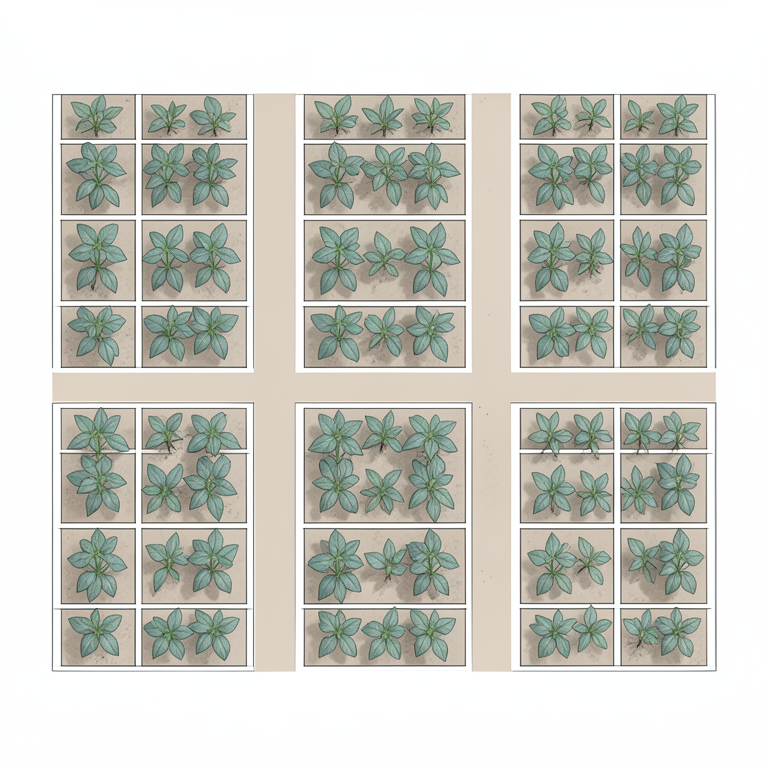
Experimental Layout
AI-generated conceptual illustration (sweet potato plants in a field). It explains the idea and does not show study data.
View source evidence ↗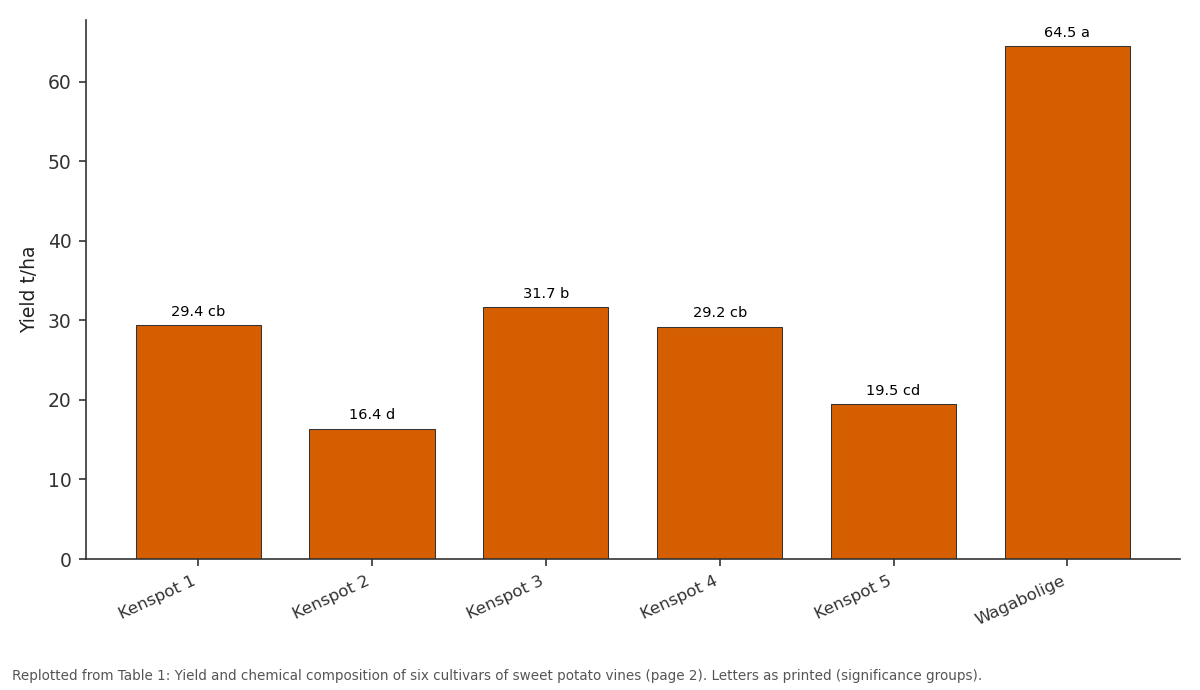
Yield t/ha: Kenspot 1 vs Kenspot 2 vs Kenspot 3 vs Kenspot 4 vs Kenspot 5
Replotted from Table 1 (page 2) of the original paper. Every bar is the paper's own table value.
View source evidence ↗Figures & tables
From the original paper Table 1
Introduction
The increasing population and diminishing land sizes, has reduced the land available for forage production, as the little land available is used for growing food crops [5] . This has necessitated the need to identify multipurpose crops which can be used both as human food and livestock feeds. In recent years, sweet potato (Ipomoea batatas) has elicited a lot of interest from various research organizations and governments due to its adaptability to semi-arid areas and the possibility of being used both as human food and livestock feed. However, there is limited information on its contribution to livestock production in sub-Saharan Africa and as a result its potential as livestock feed has not been fully exploited [26] . Studies conducted at the International Potato Centre (C1P) in 2008 revealed that farmers preferred the dual purpose varieties because they have enough tubers for human consumption as well as fodder for livestock. The dual purpose cultivars are particularly preferred because harvesting can be done throughout the growing season. In Kenya about 59.2 thousand ha of land is grown with sweet potato annually with a production of 12.8t/ha [5] . However, the amount of vines produced alongside has not been documented. Sweet potato vines (SPVs) can play a significant role as a partial replacement for other forages and pastures in the nutrition of dairy cows, goats and pigs in East Africa [26] . A study conducted in Uganda to determine the potential of sweet potato vine-based diets as partial milk substitute (PMS) for dairy calves reduced the amount of milk consumed per calf by 120 litres over the 70-day period [29] . In recent years several sweet potato varieties were released for various agro-ecological zones at Kenya Agricultural and Livestock Research Organization (KALRO), Foods crop Research Institute in Njoro. These included cultivars; Kenspot 1, Kenspot 2, Kenspot 3, Kenspot 4, Kenspot 5 among others. However, studies on biomass and nutritional value for livestock are missing and this study is a step towards filling this knowledge gap.
Materials and Methods
This study was carried out at KALRO-Lanet situated in Nakuru County. The center lies between longitude 360° 09' E and latitude 00° 18' S at an altitude of 1920 m above sea level. The center occupies 1418 hectares of land within two Agro ecological zones (AEZs), where 20% of the land lies within AEZ III and 80% in AEZ IV [8] . The region has a bimodal rainfall season with the (long rains) starting from March to June and the (short rains) falling from November to December. The annual rainfall ranges between 600-1000 mm and temperatures between 10°C and 30°C [8] . Soil pH ranges between 5.5-6.5. Soils are deep sandy loam with good water holding classified as humic nitosols under Food and Agricultural Organization of the United Nations (FAO) classification.
Cultivation of Forage Sweet Potato
The land was prepared into a fine seed bed. The land was divided into 18 plots of 2.5m x2.5m with a 1 meter wide path way between the plots. A randomized complete block design (RCBD) was use to layout the experiment. Six cultivars of SPV namely Kenspot 1, Kenspot 2, Kenspot 3, Kenspot 4, Kenspot 5 and Wagabolige were planted randomly in three replicates. Wagabolige which is an improved forage type sweet potato cultivar [25] was chosen as the control cultivar. The cultivars were planted on their respective plots using 50 cm long cuttings, in holes dug on the flat ground in rows 60 cm apart and the plants were spaced 30 cm apart within rows.
A base fertilizer dressing with Di-ammonium phosphate was done at planting and top dressing at 45 days after planting. The fertilizer was applied according to [33] during planting at the rate of 54 and 20 kg ha-1of nitrogen (N) and phosphorus (P), respectively; and after establishment (45 days after planting), the blocks were cut back and top dressed with 52 kg ha-1N. Potassium was not applied as soils in Lanet area were known to contain adequate potash to meet the requirements for normal growth of forage sweet potato cultivars [33] . These blocks were kept clean by regular hand weeding and the subsequent re-growth was harvested at 120 days.
Results
Results
Yield and Nutrient Composition
The yield and composition of the cultivars are shown in Table 1. Wagabolige, the control cultivar, apparently produced the highest biomass quantity (p<0.05) followed by Kenspot 3, Kenspot 4, Kenspot 1, Kenspot 5 and Kenspot 2 respectively. Kenspot 4 had the highest dry matter (DM) though not significant (p<0.05) from the other cultivars, while Kenspot 3 had the lowest. There was no major significant difference in energy among the cultivar though Kenspot 1 had the highest while Kenspot 2 had the lowest. Crude fibre (NDF and ADF) was highest (p<0.05) in Kenspot 2 and lowest in Kenspot 1.Crude protein (CP) was highest (p<0.05) in Kenspot 1 and lowest in Kenspot 3.There was no significant difference (p>0.05) in Ca, P, K and Mg among the cultivars.
| Cultivar | Yield t/ha | DM% | Crude Protein (%) | Energy(Kcal) | NDF% | ADF% | Ca% | P% | K% | Mg% |
|---|---|---|---|---|---|---|---|---|---|---|
| Kenspot 1 | 29.4cb | 13.02 | 23.70a | 2084.05 | 40.15c | 21.50 | 1.29 | 0.36 | 4.60 | 0.39 |
| Kenspot 2 | 16.4d | 12.93 | 19.23c | 1757.09 | 46.11a | 28.78a | 1.26 | 0.34 | 4.79 | 0.39 |
| Kenspot 3 | 31.7b | 12.92 | 16.84d | 1793.62 | 42.28b | 24.96cb | 1.23 | 0.31 | 4.73 | 0.39 |
| Kenspot 4 | 29.2cb | 13.73 | 21.82b | 1911.84 | 42.85b | 23.29d | 1.19 | 0.37 | 5.33 | 0.31 |
| Kenspot 5 | 19.5cd | 13.50 | 19.78c | 1785.06 | 43.02b | 25.46b | 1.38 | 0.38 | 5.61 | 0.36 |
| Wagabolige | 64.5a | 13.12 | 19.60c | 1846.22 | 42.94b | 24.40c | 1.29 | 0.33 | 4.95 | 0.36 |
| Average | 32.1 | 13.2 | 20.2 | 1863.1 | 42.9 | 24.7 | 1.27 | 0.35 | 4.97 | 0.37 |
| CV% | 13.3 | 3.6 | 2.5 | 0.1 | 0.68 | 1.1 | 11.1 | 13.7 | 9.9 | 12.5 |
Table text extracted from the original PDF; superscript letters are shown inline. The original table image is below.
View original table image
Discussion
Discussion
Yield and Nutrient Composition
The forage type sweet potatoes (SPV) are generally high in biomass production. This presented itself very well in this study. Cultivar (Wagabolige) an improved forage type [25] produced the highest yields (8.5ton/ha). This is more than double the highest among the dual purpose cultivars (4.1ton/ha). The six cultivars had a CP range of 16% to 23%. This agrees with the range given by [4] . All the cultivars were generally of high nutritional quality. They had much higher CP more than the 80 g CP/kg DM, below which forages are considered low in quality [7,26,20] and hence may not limit microbial activity in the rumen [31] . The NDF was also below the 600 g/kg DM usually considered as the threshold for ruminants [7,21] . The low NDF was consistent with the general observation of lower NDF in non-grass forages [22] . The six cultivars had adequate fibre, measured as NDF and defined as total cell wall content which is essential for rumination, saliva flow, rumen buffering and health of the rumen wall. Furthermore, the high energy will enable the animals to obtain adequate ME required for incorporating nitrogen into microbial protein [28, 23 7] . The chemical composition of the six forage sweet potato cultivars was in agreement with available literature on forage sweet potato [29,17,19] . The DM was in agreement with values reported by [3,24,1] . The CP values were also within those reported by [6,18,16] . The fibre content (NDF and ADF) were all in the range reported by [24,15] . However, their values were lower than those reported in the current study and those by [29,13,17] . These higher values may be due to harvesting age, variety used and a site effect [10,11,7] . The low NDF in forage sweet potato cultivars was consistent with the general observation of lower NDF in non-grass fodders [22] . Nonetheless, all forage sweet potato cultivars in the current study had higher NDF than 150 g/kg DM recommended by [30] as being suitable for growing ruminants. Furthermore, these cultivars contained lower than 600 g NDF/kg DM, beyond which a feed is classified as poor quality [21] . Acid detergent fiber is associated with the digestibility of a feed, thus a feed with high ADF is less digestible than that of low ADF and a less digestible feed reduces the intake by animals.
Conclusions
All cultivars were similar in terms of DM, energy and minerals (Ca, P, K and Mg). These cultivars however, differed in yields, CP, NDF, and ADF. The six cultivars had superior feed qualities for livestock as they contained high CP and less fibre compared to common Kenyan forages. They were also high in energy, which classified them as high quality forages. However, the dry matter was low and might not be sufficient to meet the dry matter requirement of the animals if fed solely. They are, therefore, recommended to livestock farmers as high quality forage supplements. Additional trials may be needed to determine their performance on livestock.
Acknowledgement
AcknowledgementThe authors wish to appreciate the Institute Director, KALRO-BRI-Lanet for logistical support.
References
33 in the original paper- AOAC. Official Method of Analysis. 15th Ed. Association of Official Analytical Chemists, Washington, DC., USA 1995.
- AOAC. (Association of Official Analytical Chemists) Official Methods of Analysis. 16 th edition, 4th revision. AOAC, Gaithersburg, MD 1998.
- Chhay T, Borin K, Phiny C. A note on the effect of fresh mulberry leaves, fresh sweet potato vines or mixture of both foliages on intake, digestibility and N retention of growing pigs given a basal diet of broken rice. Livestock Research for Rural Development, article 2007;136:19.
- Dung NNX. Evaluation of green plants and by-products from the Mekong Delta with emphasis on fibre utilization by pigs (Doctoral thesis). Swedish University of Agricultural Sciences: Uppsala, Sweden 2001.
- Food and Agriculture Organization (FAO). Food and Agriculture Organization Statistical database for agriculture. Crops and products domain 2012. http://faostat.fao.org/ (Accessed 19, August 2013).
- Giang HH, Ly LV, Ogle B. Evaluation of ensiling methods to preserve Sweet potato roots and vines as pig feed. Livestock Research for Rural Development 2004;1:45.
- Irungu JW, Kirubi D, Nangayo F, Ndolo PJ, Munga T, Wafula JS et al. Agronomic and virological comparison of sweet potato varieties in different agro-ecological zones in Kenya. Proceedings of the 7th KARI Biennial Scientific Conference, November 2000, Nairobi, Kenya 2000;13-17:413-421.
- Jaetzold R, Schmidt H, Hornetz B, Shisanya C. The Farm Management Handbook of Kenya. Central Kenya. Volume II, 2nd edition. Ministry of Agriculture, Kenya 2006.
- Kaitho RJ. Nutritive value of browse as protein supplements to poor quality roughages. PhD thesis. Wageningen University, Netherlands 1997.
- Karachi MK, Dzowela DH. The potential of sweet potato as dual purpose crop in semi-arid crop/livestock system in Kenya. PANESA/ARNAB, ILCA, Adis Ababa 1990, 518-532.
- Kariuki JN. The potential of improving napier grass under smallholder dairy farmer`s conditions in Kenya. PhD thesis. Wageningen University, Netherlands 1998.
- Kariuki JN, Gitau GK, Gachuiri CK, Tamminga S, Van Bruchem J, Muia JMK. Effect of feeding Napier grass, lucerne and sweet potato vines as sole diets to dairy heifers on nutrient intake, weight gain and rumen degradation. Liv. Prod. Sci 1998;55:13-20.
- Kebede T, Lemma T, Tadesse E, Guru M. Effect of level of substitution of sweet potato vines for concentrate on body weight gain and carcass characteristic of browsing Arsi Bale goats. JCAB 2008;2:36-42.
- Kiragu JW, Tamminga S. Utilization of sweet potato vines as a roughage source in the diet of early weaned Friesian calves. Proceedings of the 5th KARI Scientific Conference, 14-16 October, 1996, Nairobi, Kenya 1997, 562-579.
- Kiragu JW, Mitaru BN, Irungu KRG. Supplementing Napier grass with different proportions of sweet potato vines on growth and rumen development. Paper presented at Joint Tanzania Society of Animal Production and Veterinary Association of Tanzania, 29 November-1 December 2007, Arusha, Tanzania 2007.
- Lam V, Ledin I. Effect of feeding different proportions of sweet potato vines (Ipomoea batatas) and Sesbania gradiflorain the diet on feed intake and growth of goats. Livestock Research for Rural Development 2004;16article77.
- Larbi A, Etela I, Nwokocha HN, Oji UI, Anyanwu NJ, Gbaraneh LD. Fodder and tuber yields and fodder quality of sweet potato cultivars at different maturity stages in West African humid forest and Savanna zones. Anim. Feed Sci. and Techn 2007;135:126-138.
- Leng RA. Factors affecting the utilization of poor quality forages by ruminants particularly under tropical conditions. Nutr. Res. Reviews 1990;3:277-303.
- Meissner HH, Koster HH, Nieuwuodt SH, Coertze RJ. Effect of energy supplementation on intake and digestion of early and mid-season rye grass and panicum/smuts finger hay. S. Afr. J Anim. Sci 1991;21:33-42.
- Minson DJ. Forage in Ruminant Nutrition. Academic Press, London 1990.
- Muia JMK. Use of Napier grass to improve smallholder milk production in Kenya. PhD thesis, Wageningen University, Netherlands 2000.
- Olorunnisomo OA. Yield and quality of sweet potato forage pruned at different intervals for West African dwarf sheep. Livestock Research for Rural Development 2007;19article 36.
- Ondabu N, Irungu KRG, Tarus S, Ontiti S. Sweet Potato Vine selection programme at Lanet. Proceedings of the 9th Triennial Symposium of the International Society for Tropical Root Crops Africa Branch, Mombasa, Kenya, 1-5 November 2007-4, 490-494.
- Ondiek JO, Abdulrazak SA, Tuitoek JK, Bareeba FT. Use of Leucaena leucocephala and Gliricidia as nitrogen source in supplementary concentrates for dairy goats offered Rhodes grass hay. Asian-Australasian Journal of Animal Science 2000;13:1249-1254.
- Peters D. Assessment of the potential of sweet potato as livestock feed in East Africa: Rwanda, Uganda, and Kenya. Report presented to the International Potato Centre (CIP) 2008.
- Preston TR, Leng R. Matching ruminant production systems with available resources in the tropics and sub tropics. CTA publication 1987.
- Snijders PJM, Muia J, Kariuki JN. Yield and quality of sweet potato vines harvested at different stages, Research Report, Naivasha, Kenya 1992.
- Strasia CA, Gill DR. Formulating feedlot diets. Great Plains Beef Cattle Hand book. Animal Science Research Report. Agricultural Experimental Station, Oklahoma State University. Factsheet 1990.
- Taabu HL, Ndyomugyenyi EK, Mutetikka D, Ebong C. Effect of feeding sweet potato vine-based diets as partial milk substitutes for dairy calves in Uganda. Livestock Research for Rural Development, 2016, 28, Article 18.
- Van Soest PJ. Nutritional Ecology of the Ruminant, 2nd ed. Cornell University Press, Ithaca, NY 1994.
- Van Soest PJ, Robertson JB, Lewis BA. Methods for dietary fibre, neutral detergent fibre, and non-starch polysaccharides in relation to animal nutrition. J Dairy Sci 1991;74:3583-3597.
- Van Soest PJ, Robertson JB. Analysis of forages and fibrous foods. AS 613 Manual. Department of Animal Science, Cornell University, Ithaca, 1985, 105-106.
- Wielemaker WG, Boxem HW. Soils of the Kisii Area. Ministry of Agriculture. Kenya Soil Survey, Nairobi, Kenya 1982.