
Research article · 2021 · Full text
International Journal of Statistics and Applied MathematicsMathematical modeling of flow of fertilizer-water mixture through soil and its effect on concentration and plant growth
Volume 6(3) · Pages 37–43
Research areasIrrigation Practices and Water Management
Abstract
Author-writtenIn this research we aim to demonstrate and explore how mathematical modeling can be used to aid people gain knowledge and understanding of plants and, in particular, interactions between plants, fertilizers, soil, and water. The primary objective is to convince members of the agricultural, mathematical and biological culture of the need to work together in establishing mechanistic simulations with quantitative data to help them understand flow of soil solutions and their effect on plant growth. The mathematical models used are based on the fundamental knowledge of fluid flows and plant growth that is necessitated by nutrient absorption from the soil by plant roots. Such models allow for a deeper understanding of plant science at the most basic level and can aid us in dealing with real-world issues such as food scarcity, soil pollution and global warming in developing countries, Kenya as a target. We used mathematical model equations which have been made to describe fertilizer (contaminant) as well as soil water flow, their concentrations, uptake by a plant root system and plant growth then solve the equations by finite difference and volume methods with the help of MATLAB program. The technique of explicit difference was used to solve the governing equations analytically. The results indicate that as time of simulation increases, the concentration of fertilizer also increases thus increasing the growth factor which in turn affects the length of plant growth.
Summary
Source-checkedPlain-language reading of the full paper, prepared with AI and checked against the text. Each point links to the authors' own words.
Why it matters
- Unpredictable changes in rainfall and sunshine seasons have threatened food security in Kenya. View evidence ↗
- The continuous use of soluble chemicals in fertilizers may contribute to environmental changes that affect plant populations and risk the extinction of less adapted species. View evidence ↗
- A lack of government regulation on fertilizer application amounts means there is no control over potential hazards caused by excessive fertilizer use in soil. View evidence ↗
The question
- The research aims to explore how mathematical modeling can improve the understanding of interactions between plants, fertilizers, soil, and water. View evidence ↗
- The study seeks to develop models to monitor the flow rate and concentration of fertilizer-water mixtures in soil and on root surfaces to help control fertilizer use and plant growth. View evidence ↗
What they did
- The authors used MATLAB to solve mathematical equations describing soil water flow, fertilizer concentration, root uptake, and plant growth using finite difference and volume methods. View evidence ↗
- The governing equations were solved analytically using the explicit finite difference method. View evidence ↗
- The data presented in the results are simulation values rather than experimental measurements. View evidence ↗
What they found
- Simulation results show that as time increases, fertilizer concentration increases, which in turn increases the growth factor and the length of the plant. View evidence ↗
- An increase in the diffusion coefficient leads to a higher concentration of fertilizer in the soil over a specific time period. View evidence ↗
- Fertilizer concentration in the soil remains constant for an initial period before rising gradually, reflecting the time needed for flow and accumulation on the root surface. View evidence ↗
- The concentration of the fertilizer solution in the soil increases gradually as the flow time increases. View evidence ↗
What it means
- The authors conclude that increasing fertilizer concentration in soil over time increases the growth mitosis factor, resulting in increased vertical plant length. View evidence ↗
- The authors state that these findings can help improve agricultural practices regarding the use of organic and inorganic fertilizers. View evidence ↗
- The study focused on fertilizer concentration, the growth mitosis factor, and plant length, omitting other potential factors. View evidence ↗
- The authors recommend that future research model the velocity of the fertilizer solution flow to determine how flow speed affects plant growth. View evidence ↗
Visual summary
3 visualsIllustrations explain the paper; charts are replotted from the paper's own table values.
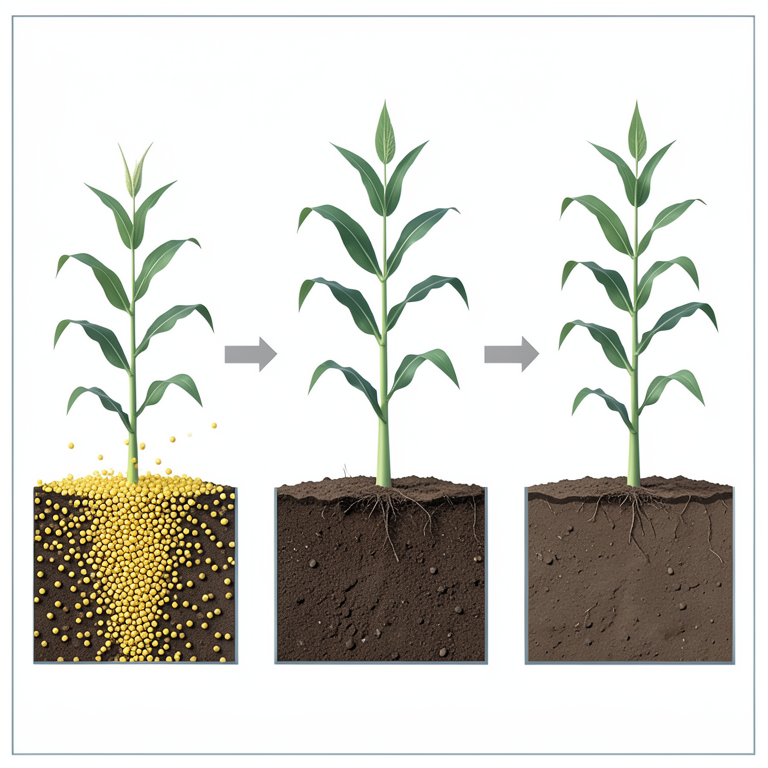
Fertilizer Concentration and Plant Growth Relationship
AI-generated conceptual illustration (maize plants in soil). It explains the idea and does not show study data.
View source evidence ↗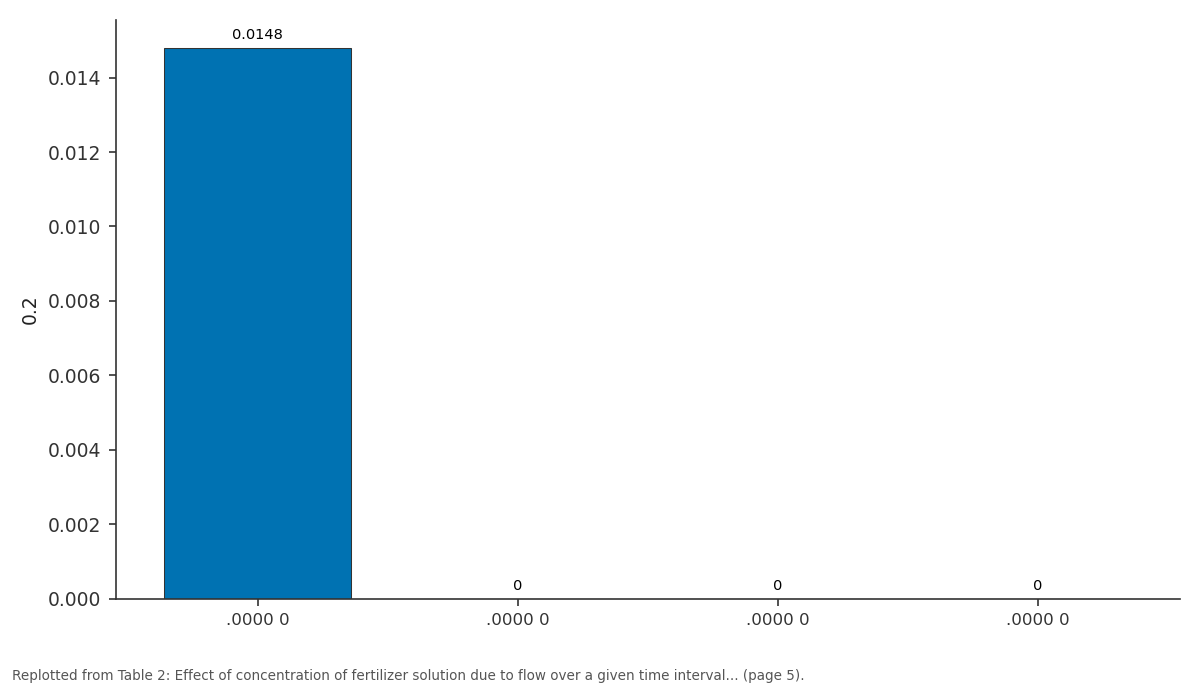
0.2: .0000 0 vs .0000 0 vs .0000 0 vs .0000 0
Replotted from Table 2 (page 5) of the original paper. Every bar is the paper's own table value.
View source evidence ↗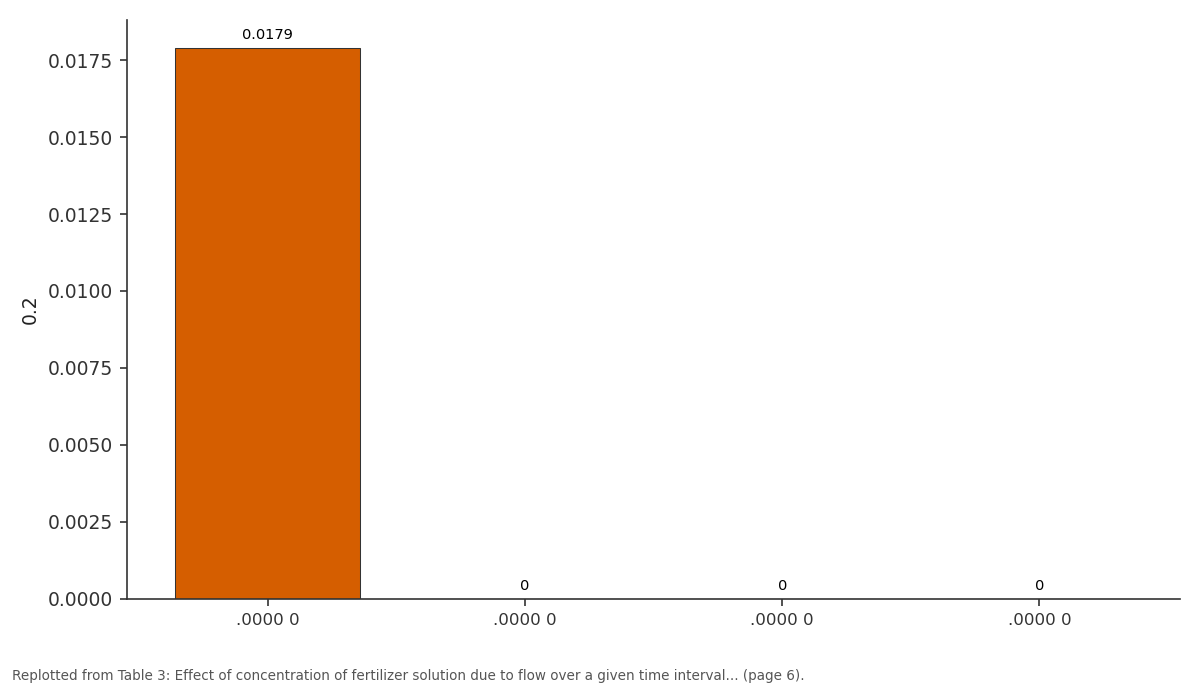
0.2: .0000 0 vs .0000 0 vs .0000 0 vs .0000 0
Replotted from Table 3 (page 6) of the original paper. Every bar is the paper's own table value.
View source evidence ↗Figures & tables
From the original paper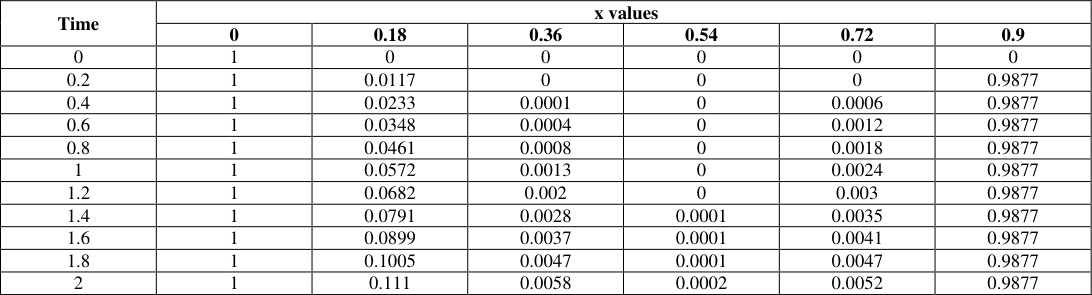 Table 1
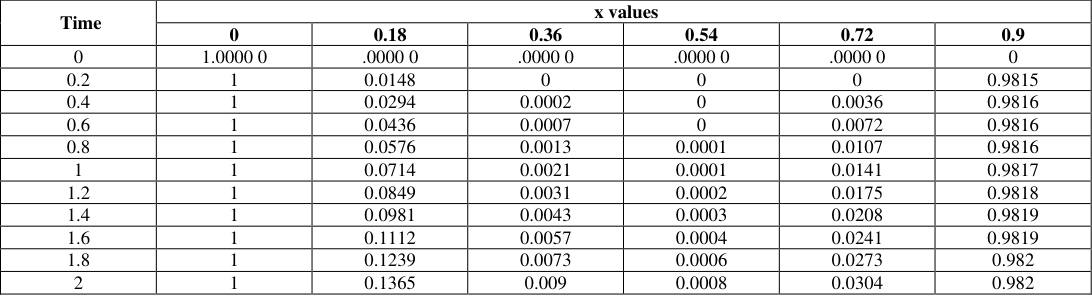 Table 2
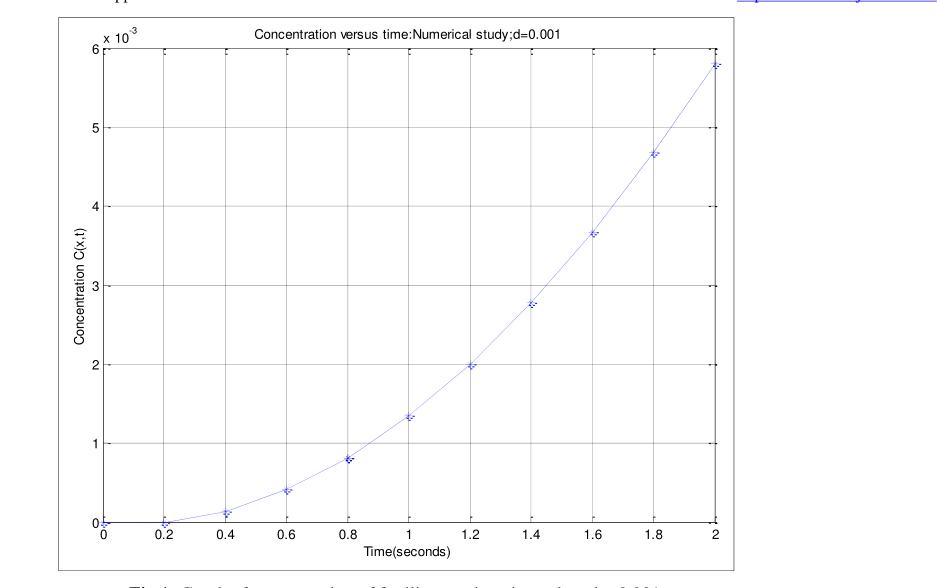 Figure 1
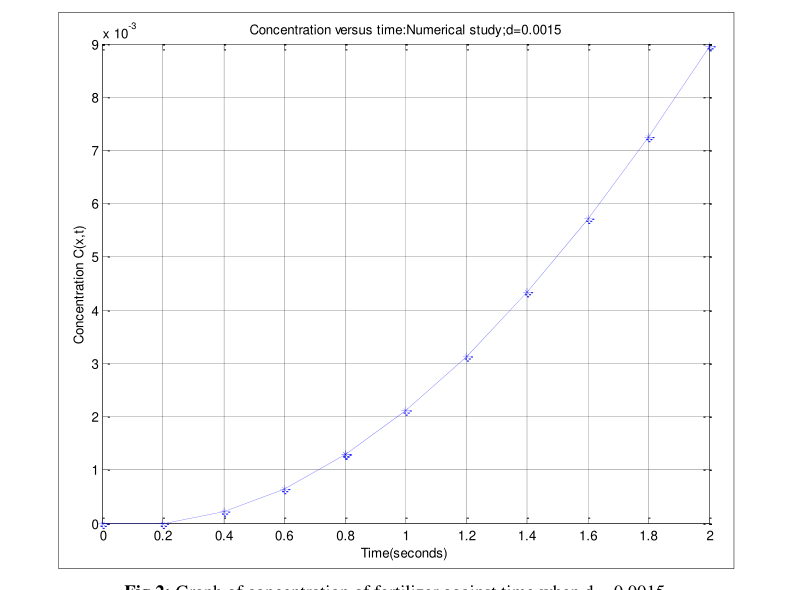 Figure 2
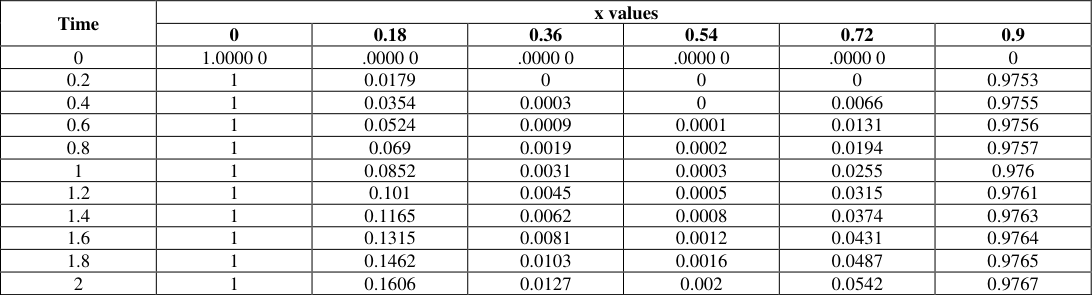 Table 3
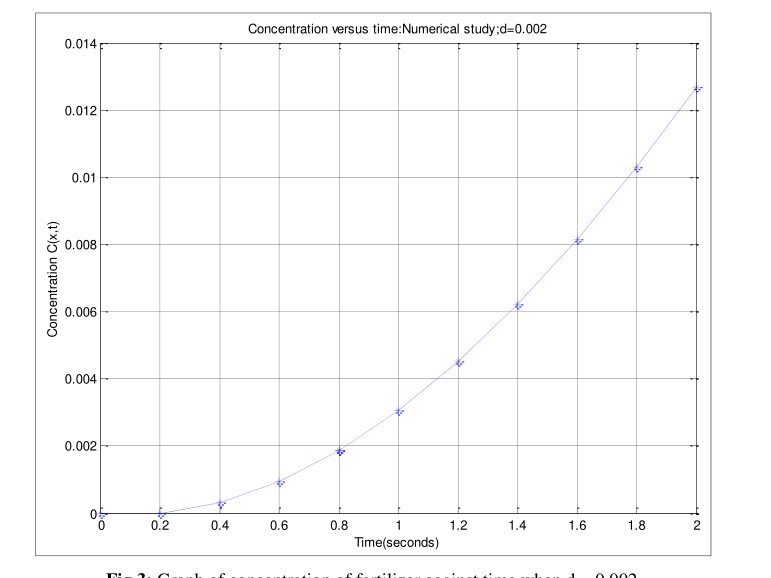 Figure 3
Introduction
In our research, we create a mathematical model to understand how fertilizer-water mixtures flow in soil and how their rates influence plant growth and development. The knowledge of transport of contaminants through soil in ground water is used in this research together with equations describing plant growth caused by the concentration of inorganic fertilizer around the root surface. The model is used to calculate the amount of fertilizer consumed by plant roots in relation to the plant's actual growth size in length or volume. In areas with low soil fertility, large quantities of fertilizer are used, whereas in areas with higher soil fertility, small amounts of fertilizer are used to increase soil fertility. The government has no regulations on the amount of fertilizer to be applied hence no control over the hazards that may be caused on plants as a result of excessive use of fertilizer in soil. In recent years, there has been an unpredictable change in seasons of rainfall and sunshine thus pausing danger on food security in our country Kenya. One of the factors that may lead to such changes is due to continuous use of soluble chemicals present in fertilizer which end up affecting plant populations and possibly causing the extinction of certain less adapted species. This research is based on the fact that in Uasin Gishu County, Kenya maize is a major crop grown in the area. Maize crops thrive well in Loamy soil and in less sloppy land having enough Rainfall supply. Our work presents mathematical models that would be useful in monitoring the rate of flow of fertilizer-water mixture and its concentration in soil and on the root, surface therefore help control amount of fertilizer as well as growth of plants.
Governing equations
The momentum equation, which expresses mass conservation (continuity equation), is generally required for the hydrodynamic definition of a fluid-flow problem and a relationship between states among them: temperature, stress, and density. The problem with the flow is thus described mathematically by a system of partial differential equations, which can be more or less complex, the solution of which necessitates the Boundary conditions and, if the flow is unsteady, initial conditions describing the particular flow situation are specified. The movement of fluids inside the soil can be studied on a minuscule scale by taking the soil into account as a dispersed system and, even if only conceptually, solving the problem using the Navier-Stokes's equations. The Navier-Stokes's equation written in x Cartesian co-ordinates is;
Flow velocities in real time have significant magnitude and direction differences due to the complexities of the paths taken by single fluid particles as they pass through the pores that are intertwined in soil, Consequently, a careful examination of the definition of flow pattern at any point in the domain is virtually impossible. The understanding of flux density, on the other hand, is of greater importance in many applications. As a result, processes of soil movement and transport are usually defined at a macroscopic level by specifying a Representative Elementary Volume (REV) and a collection of averaged values and balance equations. We first make an assumption that the fertilizer is soluble in water and the solution is a homogeneous mixture. The fertilizer is rich in nutrients required by plants during growth and development. The velocity/speed which the fertilizer solution flows in soil has direct effects on uptake by plant root system hence affecting plant growth.
In our research, the model considers the equation that regulates vertical, unsaturated -convective or isotropic -soil water flow and contaminant transport. We use the following equation for transport of contaminants through soil in groundwater:
x: denotes the vertical space co-ordinate (m) t: is time in seconds (s) 𝐷 𝐿 : longitudinal dispersion coefficient V: seepage or pore speeds on average (ms -1 ) T: is retardation factor ∁: is contaminant (Fertilizer) concentration Which supplies nutrients to the plant (cm 3 ).
The hydraulic properties of the studied soil system are used to simulate water flow and solute transport through soil medium.
Direct measurements and tests on soil hydraulic properties can be performed in the laboratory or on the ground through experimentation However, since these approaches can be expensive and take a long time, different methods for estimating soil hydraulic properties have arisen. These properties can be estimated using soil knowledge that is readily obtainable and simple to calculate. Functions in mathematics for estimating soil hydraulic variables using simple soil data for example soil texture, the amount of organic matter, and densities of bulk are applied in this research.
Solute transport modeling
Below are a few of the most important processes which influence transport of solutes in soil. Advection is the average rate of solute mass transportation caused by the flow of water. Advection can be represented by the Darcy's equation as:
If only advection regulated solute transport in the soil, the transport velocity will be the same as the average water flux.
Hydrodynamic dispersion
This process involves a solute spreading through mechanical dispersion and diffusion of molecules in the direction of the flow (longitudinal dispersion) and parallel to the ground (perpendicular or transverse dispersion). The soil undergoes mechanical dispersion resulting from variations in pore size, differences in the length of the flow path, continuous mixing between pores (because of the configuration of the soil's pores), and differences in velocity of pore transport. On both a micro (within pores) and macro (outside pores) scales (preferential flow through soil cracks), this happens in soil medium. Solutes are transferred through molecular diffusion as a result of a concentration gradient. Dispersion by mechanical means and diffusion of molecules are two main processes that cause hydrodynamic dispersion.
Constituents pass from a high-concentration area to a low-concentration area in this process; the greater concentration difference, the faster the diffusion rate.
The equation for advection-dispersion (ADE)
The most widely used mathematical description for transport of solutes through soil is the Advection Dispersion Equation (ADE). The value of the dispersion coefficient is needed for numerical or analytical ADE solutions. Field or laboratory experiments may be used to measure the hydrodynamic dispersion coefficient. Therefore, advection dispersion equation is written mathematically as:
Methodology
In this analysis, we developed a one-dimensional model that can describe water-fertilizer movement, which is used to solve the Richards equation implicitly for unsaturated porous media using the finite element method for volume control, yielding waterfertilizer transport and general expressions for initial and boundary conditions. The rule of conservation of matter governs all water-solute movement in porous media (soil).
Fundamental groundwater flow equations Darcy law
Henry Darcy, who was the publisher of the findings of his experimental research work in 1956, is credited with establishing the theory of groundwater flow. He discovered that total discharge Q is directly proportional to area of cross-section A, inversely proportional to length 𝛥s, and proportional to the head difference ∅ 1 -∅ 2 , mathematically written in the equation called Darcy's equation:
The quantity 𝑄 𝐴 is called specific discharge q and K is the hydraulic conductivity.
If ∅ 1 -∅ 2 = ∆∅ and ∆𝑠 = 0, the equation is converted into q = -𝑘 𝑑∅ 𝑑𝑠 According this equation, the specific discharge q, direct in proportion to the hydraulic gradient 𝑘. Darcy's velocity is another name for the particular discharge. The actual flow velocity (the rate of seepage), V is written mathematically as V =
where n denotes the soil porosity and V denotes the seepage velocity, which is invariably greater than q. In reality, the flow almost never has just one dimension. Darcy's law in its broadest sense is applied, with the assumption that the hydraulic conductivity K is constant in all directions: 𝑞 𝑥 = -𝐾 Darcy's law is substituted into the equation of continuity, yielding:
Transport of fertilizer contaminants through soil in groundwater
The most common source of pollution under agricultural lands is fertilizers. As a fertilizer is injected into groundwater, it spreads out and travels with it due to advection (caused by groundwater flow), dispersion (caused by mechanical mixing), and molecular diffusion. The mathematical relationships that exist between these processes are as follows: C represents concentration of contaminant, 𝑉 𝑖 represents Normal pore water velocity (seepage) in the direction x i , 𝐷 𝑖𝑗 denotes the dispersion coefficient, 𝐾 𝑖𝑗 denotes the hydraulic conductivity, 𝐶 ′ is the fertilizer concentration in the sink fluid, 𝑊 ′ denotes flow rate in volume as a percentage of the sink, n represents the amount of porosity in impact, h is the hydraulic head, T denotes the factor of and x i denotes the cartesian co-ordinate. The equation that describes fertilizer transport in groundwater is represented in one dimension below:
Where C represents fertilizer concentration, V represents the seepage pore water velocity on average, 𝐷 𝐿 is coefficient of longitudinal dispersion and T retardation factor. The above equation can be rearranged and written as:
Finite difference method (FDM)
FDM are a class of numerical techniques for solving ordinary and partial differential equations by approximating derivatives with finite differences. Both the spatial domain and time interval are discretized or broken into a finite number of steps and the value of the solution at these discrete points approximated by solving algebraic equations containing finite differences and values from nearby points.
Explicit finite difference method
Using forward difference at time t n and a second order central difference for the space derivative at position x; (Forward Time Centered Space) applied to diffusion problem e.g.
The FTCS scheme is given by:
Letting r = ∝∆𝑡 ∆𝑥 2 we get:
The equations are solved analytically by the explicit finite difference method and the results are programmed by MATLAB.
Results and Discussions
The values given in the tables below are not experimental values but values used for simulation.
Discussions
In this section, results have been presented in tables then analyzed in graphs obtained from output of the MATLAB software.
In fig 1-3, the concentration of fertilizer in soil is constant for some time before rising gradually. This is because the concentration is dependent on the flow through soil and accumulation on the root surface of the plant that takes sometime before it is realized. The results also indicate that an increase in diffusion coefficient causes an increase in concentration of fertilizer in soil over a given time period.
From the results collected and analyzed above, we find that concentration of fertilizer solution, C in soil increases gradually with time, t of flow.
Conclusion
Food shortage in parts of the Kenya has been a problem for years due to environmental factors and poor innovation. With good agricultural practices that apply scientific research to ensure crops thrive well, the problem can be solved. One of the ways is through Mathematical modelling to simulate and explain agricultural processes by formulating and solving equations of fluid flow and crop growth. In this research, equations of solute (fertilizer) transport through soil in underground water was studied and its findings used to model plant growth. The solute concentration taken as fertilizer concentration in soil media over a given time increases causing an increase in growth mitosis factor and finally results in increase in apical (vertical) length of the plant. Such scientific findings play a big role in explaining processes that can improve agricultural practices especially the use of both organic and inorganic fertilizers.
Recommendations
From our research, concentration of fertilizer and the growth mitosis factor coupled with length of growth of plant were emphasized leaving other factors out. In future research, the velocity of flow of fertilizer solution through soil medium can be modelled and studied to see the effect of the speed of flow of the mixture on plant growth. Again, further research can be carried out to check how a specific fertilizer concentration in a given type of soil affects plant/crop growth.
Figures and tables from the paper
| Time | x values | — | — | — | — | — |
|---|---|---|---|---|---|---|
| 0 | 0.18 | 0.36 | 0.54 | 0.72 | 0.9 | |
| 0 | 1 | 0 | 0 | 0 | 0 | 0 |
| 0.2 | 1 | 0.0117 | 0 | 0 | 0 | 0.9877 |
| 0.4 | 1 | 0.0233 | 0.0001 | 0 | 0.0006 | 0.9877 |
| 0.6 | 1 | 0.0348 | 0.0004 | 0 | 0.0012 | 0.9877 |
| 0.8 | 1 | 0.0461 | 0.0008 | 0 | 0.0018 | 0.9877 |
| 1 | 1 | 0.0572 | 0.0013 | 0 | 0.0024 | 0.9877 |
| 1.2 | 1 | 0.0682 | 0.002 | 0 | 0.003 | 0.9877 |
| 1.4 | 1 | 0.0791 | 0.0028 | 0.0001 | 0.0035 | 0.9877 |
| 1.6 | 1 | 0.0899 | 0.0037 | 0.0001 | 0.0041 | 0.9877 |
| 1.8 | 1 | 0.1005 | 0.0047 | 0.0001 | 0.0047 | 0.9877 |
| 2 | 1 | 0.111 | 0.0058 | 0.0002 | 0.0052 | 0.9877 |
Table text extracted from the original PDF; superscript letters are shown inline. The original table image is below.
View original table image
| Time | x values | — | — | — | — | — |
|---|---|---|---|---|---|---|
| 0 | 0.18 | 0.36 | 0.54 | 0.72 | 0.9 | |
| 0 | 1.0000 0 | .0000 0 | .0000 0 | .0000 0 | .0000 0 | 0 |
| 0.2 | 1 | 0.0148 | 0 | 0 | 0 | 0.9815 |
| 0.4 | 1 | 0.0294 | 0.0002 | 0 | 0.0036 | 0.9816 |
| 0.6 | 1 | 0.0436 | 0.0007 | 0 | 0.0072 | 0.9816 |
| 0.8 | 1 | 0.0576 | 0.0013 | 0.0001 | 0.0107 | 0.9816 |
| 1 | 1 | 0.0714 | 0.0021 | 0.0001 | 0.0141 | 0.9817 |
| 1.2 | 1 | 0.0849 | 0.0031 | 0.0002 | 0.0175 | 0.9818 |
| 1.4 | 1 | 0.0981 | 0.0043 | 0.0003 | 0.0208 | 0.9819 |
| 1.6 | 1 | 0.1112 | 0.0057 | 0.0004 | 0.0241 | 0.9819 |
| 1.8 | 1 | 0.1239 | 0.0073 | 0.0006 | 0.0273 | 0.982 |
| 2 | 1 | 0.1365 | 0.009 | 0.0008 | 0.0304 | 0.982 |
Table text extracted from the original PDF; superscript letters are shown inline. The original table image is below.
View original table image
| Time | x values | — | — | — | — | — |
|---|---|---|---|---|---|---|
| 0 | 0.18 | 0.36 | 0.54 | 0.72 | 0.9 | |
| 0 | 1.0000 0 | .0000 0 | .0000 0 | .0000 0 | .0000 0 | 0 |
| 0.2 | 1 | 0.0179 | 0 | 0 | 0 | 0.9753 |
| 0.4 | 1 | 0.0354 | 0.0003 | 0 | 0.0066 | 0.9755 |
| 0.6 | 1 | 0.0524 | 0.0009 | 0.0001 | 0.0131 | 0.9756 |
| 0.8 | 1 | 0.069 | 0.0019 | 0.0002 | 0.0194 | 0.9757 |
| 1 | 1 | 0.0852 | 0.0031 | 0.0003 | 0.0255 | 0.976 |
| 1.2 | 1 | 0.101 | 0.0045 | 0.0005 | 0.0315 | 0.9761 |
| 1.4 | 1 | 0.1165 | 0.0062 | 0.0008 | 0.0374 | 0.9763 |
| 1.6 | 1 | 0.1315 | 0.0081 | 0.0012 | 0.0431 | 0.9764 |
| 1.8 | 1 | 0.1462 | 0.0103 | 0.0016 | 0.0487 | 0.9765 |
| 2 | 1 | 0.1606 | 0.0127 | 0.002 | 0.0542 | 0.9767 |
Table text extracted from the original PDF; superscript letters are shown inline. The original table image is below.
View original table image
References
17 in the original paper- Bear J, Cheng AHD. Modeling Groundwater Flow and Contaminant Transport 2010. doi:10.1007/978-1-4020-6682-5.
- Casagrande A. Seepage through dams (Harvard University Publication 209). Reprinted from Journal of the New England water Association 1937.
- Cedergren HR. Seepage, drainage and flow nets (New York: Willey Inter-science Publication) 1976.
- Liakopoulos C PhD. Theoretical aspects of the flow of water through anisotropic unsaturated soils, Hydrological Sciences Journal 1964;9(1):62-70. DOI: 10.1080/02626666409493655
- Chu Jia Qiang, Jiao Wei Ping, Jian Jun. Mathematical modelling study for water uptake of steadily growing plant root, Sci. China Ser G-Phy Mech Astron 2008;51(2):184-205.
- Domenico PA, Schwartz FW. Physical and chemical hydrogeology (New York: John Willey and Sons) 2000.
- Vereecken H et al. Modeling soil processes: review, key challenges and new perspectives. Vadose Zone Journal 2016;15(5):57. https: //doi.org/10.2136/vzj2015.09.0131
- Morton KW, Mayers DF. Numerical Solution of Partial Differential Equations, An Introduction. Cambridge University Press 2005.
- Lalehzari R, Tabatabaei SH, Kholghi M. Simulation of nitrate transport and wastewater seepage in groundwater flow system. International Journal of Environmental Science and Technology 2013;10(6):1367-1376. doi:10.1007/s13762-013-0213-4
- Mualem Y. A new model for predicting the hydraulic conductivity of unsaturated porous media. Water Resources Research 1976;12:513-522. DOI: 10.1029/ wr012i003p00513
- Šimunek J, Van Genuchten MTh. Contaminant transport in the unsaturated zone: theory and modeling. In: Delleur J, editor. The Handbook of Groundwater Engineering. 2nd ed. Boca Raton: CRC Press 2006, 22.1-22.46.
- Šimůnek J, Hopmans JW. Modeling compensated root water and nutrient uptake. Ecological modelling 2009;220:505-521.
- Somma F, Hopmans J, Clausnitzer V. Transient three-dimensional modeling of soil water and solute transport with simultaneous root growth, root water and nutrient uptake. Plant Soil 1998;202:281-293.
- Sergey Lemeshevsky, Piotr Matus, Dmitriy Poliakov (Eds). "Exact Finite-Difference Schemes", De Gruyter 2016. DOI: https://doi.org/10.1515/9783110491326
- Tinker PB, Nye P. Solute movement in the rhizosphere. Oxford Univ. Press, Oxford, UK 2000.
- Roose T, Fowler AC. A mathematical model for water and nutrient uptake by plant root systems, Journal of Theoretical Biology 2004;228:173-184.
- Roose T, Fowler AC. A mathematical model for water and nutrient uptake by plant root systems, Journal of Theoretical Biology 2004;228:155-171.