
Research article · 2019 · Full text
International Journal of Agriculture Extension and Social DevelopmentWomen involvement in rural community development in Enugu north senatorial zone of Enugu State, Nigeria
Volume 2(1) · Pages 01–06 · DOI: 10.33545/26180723.2019.v2.i1a.15 ↗
Research areasTourism, Volunteerism, and DevelopmentGender, Education, and Development Issues
Abstract
Author-writtenThe study ascertained the involvement of women in rural community development (RCD). The study was carried out in Enugu north senatorial zone, Enugu State, Nigeria. Sample size of 60 women were used. Data were collected using interview schedule and analysed using percentages and mean scores. The findings revealed that agricultural related projects (96.7%), social projects (91.7%), educational projects (81.7%) and health projects (81.7%) were areas of RCD women were involved in. The agricultural related projects of interest included: animal rearing and sales (96.7%), corn processing outfits (91.7%) among others. Traders association (
Summary
Source-checkedPlain-language reading of the full paper, prepared with AI and checked against the text. Each point links to the authors' own words.
Why it matters
- Rural communities are critical for global poverty reduction and agricultural progress in developing nations. View evidence ↗
- Many rural areas suffer from a significant lack of essential infrastructure, including health, education, and transportation. View evidence ↗
- Government efforts have been insufficient to meet the needs of rural families, leading to a reliance on self-help projects. View evidence ↗
The question
- The study aimed to identify the specific rural community development (RCD) projects women participate in and the factors that enable this involvement. View evidence ↗
What they did
- The research was conducted in the Enugu north senatorial zone of Enugu State, Nigeria. View evidence ↗
- The sample consisted of 60 women randomly selected from four rural communities across two local government areas. View evidence ↗
- Data were gathered via interview schedules and analyzed using mean scores and percentages. View evidence ↗
What they found
- Women were most active in market women groups and traders' associations (both mean = 2.45), while political group involvement was negligible (mean = 0.07). View evidence ↗
- The primary enabling factors for women's involvement in RCD were education (mean = 2.42), urbanization (mean = 2.42), and migration (mean = 2.40). View evidence ↗
What it means
- The authors recommend that government and NGOs focus on enabling factors like education and urbanization to further empower women's contributions to their environment. View evidence ↗
Visual summary
2 visualsIllustrations explain the paper; charts are replotted from the paper's own table values.
Drivers of Women's RCD Involvement
AI-generated conceptual illustration (Rural Nigerian women in a village setting). It explains the idea and does not show study data.
View source evidence ↗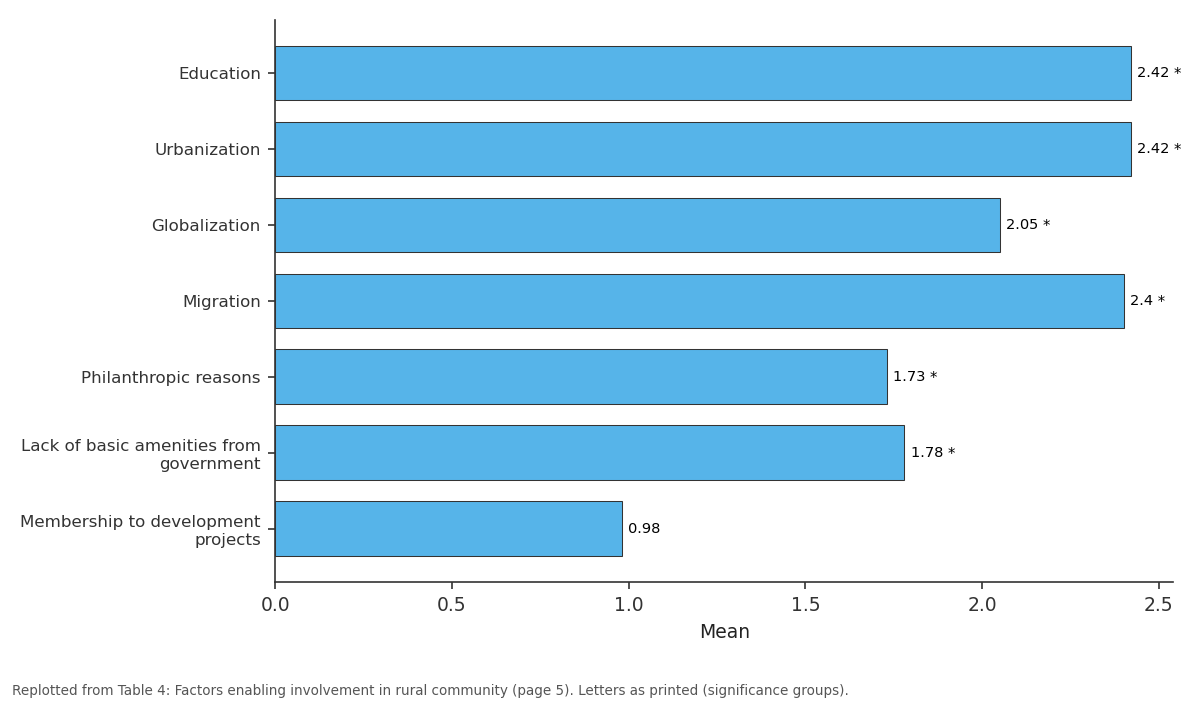
Mean (: Education vs Urbanization vs Globalization vs Migration vs Philanthropic reasons
Replotted from Table 4 (page 5) of the original paper. Every bar is the paper's own table value.
View source evidence ↗Figures & tables
From the original paper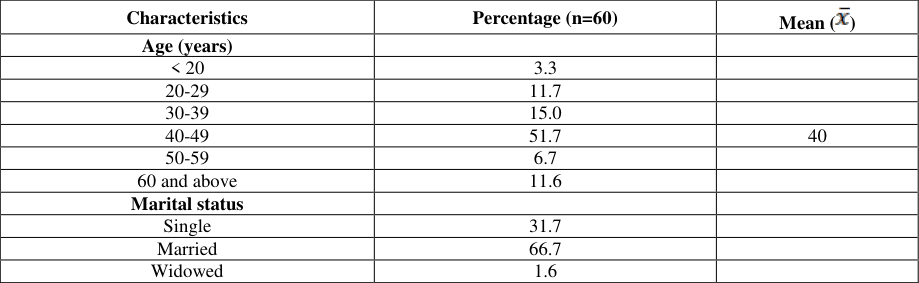 Table 1
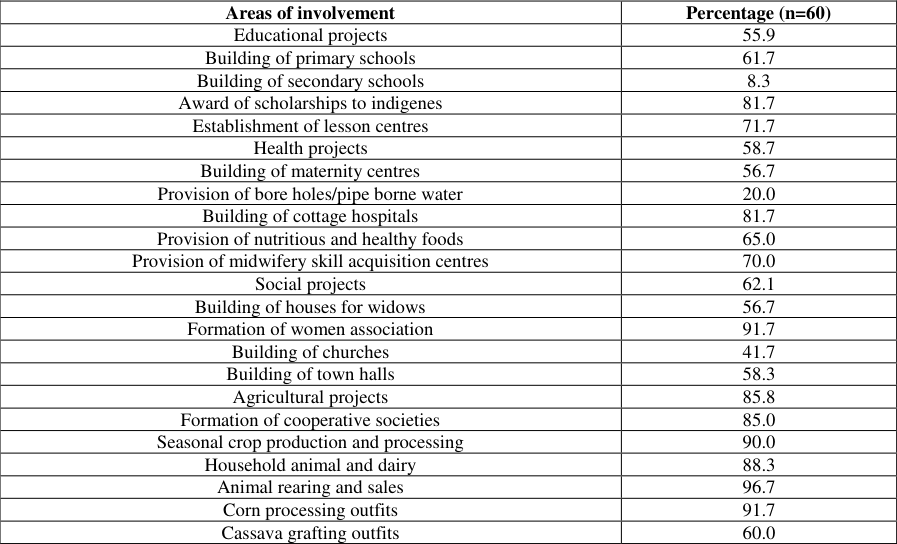 Table 2
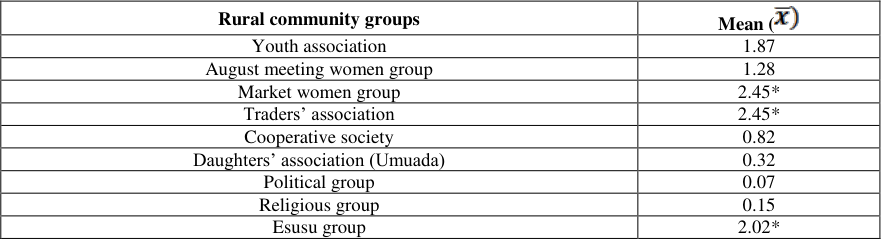 Table 3
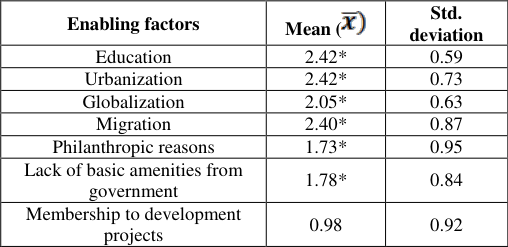 Table 4
Introduction
The rural community has contributed more than 50% to global poverty reduction and plays a key role for agricultural advancement in many developing countries (Dethier and Effenberger, 2012) [1] . They are custodians of a large segment of the world's natural resources; contribute to global food security, economic growth, amongst others. In the developing world, the population of the rural people is far much greater than that of the urban. About 694 million Africans or 59.6% and 95 million or 52.2% Nigerians live and derive their livelihood from the rural areas (United Nations, 2014). Rural communities serve as the country's major market for domestic production because residents of the rural areas engage in primary activities that form the foundation for any economic development (Utuk, 2014) [3] . Despite the importance of the rural community, there is a lack of social, physical and institutional infrastructure like quality education, health facilities, portable water, electricity, transportation, etc. (Haruna & Liman, 2015) [4] . The foregoing has made life difficult for many people living in these rural areas and is also a clear indication that there is need for development. According to Nwosu (2013) [5] , Rural Community Development (RCD) involves the transformation of the rural community into a socially, economically, politically, orderly and materially desirable condition with the purpose of improving the quality of life of the rural population on a self-sustaining basis. It operates with four major principles which include; emphasis on community self-help, attention to communities felt needs, development of community as an integrated whole and technical assistance (Nwosu, 2013) [5] . Concepts of RCD in the third world nations have been a serious issue for debate in the last decade. It has been the preoccupation of academicians, policy makers, practitioners, local, international communities, governments and nongovernmental organizations (Usharani and Mamudu, 2014) [6] . Rural community development gained prominence in developing countries like Nigeria during the colonial era, when the social welfare officers promoted self-help to improve health, nutrition and general community welfare (Ogunleye-Adetona and Oladeinde, 2013) [7] . The federal, state and local governments are some of the principal actors in the establishment of these self-help rural community development programmes and projects. For instance, Yamusa and Adefila (2014) [8] state that the efforts of the federal and state governments in Nigeria to improve the living conditions of the rural people, at various times encouraged the formation of co-operative movements by rural women farmers, craftsmen and women. According to the authors, the government established development centres in all the local governments in the country so as to realize the goal of the development of the rural areas. Some of the many projects of the RCD programmes include; Directorate of Food, Roads and Rural infrastructure (DFRRI), small and medium enterprises (SME) credit schemes, Family Economic Advancement Programs (FEAP), National Directorate for Employment (NDE) and Better Life for rural women programmes amongst others. One of the major aims of rural communities in the developing nations is to attain basic amenities such as roads, health centres, school buildings, good market centres and community facilities. These amenities are important for meaningful agricultural production and better standard of living. www.extensionjournal.com But despite the many and different roles, approaches that the government and non-governmental organizations have employed, the problems of rural development still continue to visibly exist (Egbe, 2014) [9] . It has become very apparent that government cannot satisfy the demands of the rural families and community as a whole, hence the visible lack of amenities needed for comfortable community living. Women and the female members of the rural communities have increasingly embarked on participating in many selfhelp development community projects. Women have become more enlightened and no longer wait on government for support. Also, with the advancement in education, women have become wiser, bolder and actively and passionately involved in saving, sustaining and developing the rural communities through so many important community development programmes and projects. The numerous roles women now play in community development have become more significant, pronounced and important and rural communities can no longer do without their input. For instance, during the colonial days and after the independence various communities through the women's contributions and involvement, mainly financed a number of development projects such as construction of roads, bridges, health centres, primary and secondary schools. Women also awarded scholarships to train their sons and daughters in higher education in Nigeria and abroad (Ukpongson et al., 2014) [10] . Women have also been found to engage in development projects like construction of footpaths, homesteads, clearing of farm lands, roads, group farming, sweeping of community market places especially on market days, maintenance of the king's palace, rotational farming, weeding of community footpaths and provision of other social infrastructural facilities required by the people. Now, due to advancement in education, urbanization, globalization and migration, women are delving into new roles and been involved more in RCD, coupled with the fact that Igbo-eze north senatorial zone is an agrarian zone with so many rural communities, it then becomes so imperative to look at the roles performed by rural women with regard to RCD. What are the RCD projects women do? And what are the factors that enable their involvements?
Materials and methods
The study was carried out in Enugu north senatorial zone of Enugu State, Nigeria. The zone houses two of the six agricultural zones in Enugu State. Enugu north senatorial zone comprises of six local government areas, which are: Nsukka, Udenu, Uzo-Uwani, Igbo-Etiti, Igbo-Eze south, and Igbo-Eze north. The zone is a known agrarian area in the state with numerous rural communities. Population of the study comprised females (from the ages of 20 to 70years) who participate in self-help rural community development projects, hence the small size. Two LGAs were randomly selected from where two rural communities were selected from, giving a total of four communities. Fifteen respondents were selected randomly from each community giving a total sample size of 60 respondents. To ascertain the involvements of women in RCD, respondents were requested to indicate RCD projects embarked on in their communities, which included; building of primary and secondary schools, award of scholarships to indigenes, building of cottage hospitals, building houses for widows, among others. The rural community development groups that women were involved in was ascertained by using a five-point Likert-type scale of very active (4), active (3), moderately active (2), slightly active (1) and not involved (0). The scores were added together and divided by five to get a mean score of 2. Hence, any score that is equal to or above the mean shows high involvement while scores below the mean indicate low involvement. Enabling factors that influenced women's involvements in RCD was determined by listing possible factors such as education, urbanization, women empowerment, globalization, migration, etc. A four-point Likert-type scale of high (3), moderate (2), low (1) and not at all (0) was used. These figures were summed and divided by 4, to obtain a mean of 1.5. Therefore, any factor with a mean of 1.5 and above was regarded as an enabling factor, while that with a mean of less than 1.5 was dropped. Descriptive statistics and mean score were used in data analysis
Results and Discussion
Personal characteristics of respondents Data in Table 1 reveal that the mean age of the respondents was 40 years. The Table also shows that the majority (66.7%) of the women were married with an average household size of 5 persons. About 62.0% were secondary school certificate holders, who were mainly (55%) into trading as a major occupation and had N11, 000 as average monthly income. This implies that women in the area are predominantly in their middle ages, energetic, responsible, literate and income earners. And these are indicators which can give rural community development expression in a place.
| Characteristics | Percentage (n=60) | Mean ( ) |
|---|---|---|
| Age (years) | ||
| < 20 | 3.3 | |
| 20-29 | 11.7 | |
| 30-39 | 15.0 | |
| 40-49 | 51.7 | 40 |
| 50-59 | 6.7 | |
| 60 and above | 11.6 | |
| Marital status | ||
| Single | 31.7 | |
| Married | 66.7 | |
| Widowed | 1.6 |
Table text extracted from the original PDF; superscript letters are shown inline. The original table image is below.
View original table image
Women's involvement in RCD Educational RCD projects
Table 2 shows that women were involved in the provision of educational facilities in the following areas: award of scholarships to indigenes (81.7%), establishment of lesson centres (71.7%), building of primary schools (61.7%), and building of secondary schools (8.3%). This implies that the women work together to develop their communities educationally and also shows that they appreciate the importance of education in community development.
| Areas of involvement | Percentage (n=60) |
|---|---|
| Educational projects | 55.9 |
| Building of primary schools | 61.7 |
| Building of secondary schools | 8.3 |
| Award of scholarships to indigenes | 81.7 |
| Establishment of lesson centres | 71.7 |
| Health projects | 58.7 |
| Building of maternity centres | 56.7 |
| Provision of bore holes/pipe borne water | 20.0 |
| Building of cottage hospitals | 81.7 |
| Provision of nutritious and healthy foods | 65.0 |
| Provision of midwifery skill acquisition centres | 70.0 |
| Social projects | 62.1 |
| Building of houses for widows | 56.7 |
| Formation of women association | 91.7 |
| Building of churches | 41.7 |
| Building of town halls | 58.3 |
| Agricultural projects | 85.8 |
| Formation of cooperative societies | 85.0 |
| Seasonal crop production and processing | 90.0 |
| Household animal and dairy | 88.3 |
| Animal rearing and sales | 96.7 |
| Corn processing outfits | 91.7 |
| Cassava grafting outfits | 60.0 |
Table text extracted from the original PDF; superscript letters are shown inline. The original table image is below.
View original table image
According to Agada (2011) [11] , education affects people's perception of new ideas, and RCD is not an exception.
Health RCD projects
Data in Table 2 show that the majority (81.7%) of the respondents participated in health projects by building cottage hospitals. Seventy percent were involved in providing midwifery skills-acquisition centres, 65.0% provided healthy and nutritious foods, while 56.7% and 20.0% were involved in building of maternity centres and provision of bore holes/pipe borne water, respectively. This is in agreement with the findings of Apesughur, Ashiki., Kim and Yusuf (2013) [12] that community members work together in providing infrastructure in their communities. Similarly, Ehisuoria and Akhimien (2012) [13] report that, communities provide most of their needs through self-help efforts which includes provision of markets, water, maintenance of roads that link settlements. The low involvement in bore hole drilling could be due to high capital-intensive nature of the project. Some drilling could take up to 2 million before it can be put to use.
Agricultural RCD projects
Table 2 shows that women were involved in the provision of agricultural projects in the following areas: animal rearing and sales (96.7%), corn processing units (91.7%), seasonal crop production and processing (90.0%), household animal and dairy (88.3%), formation of cooperative societies (85.0%) and cassava grafting outfits (60.0%). This result implies that women were actively and heavily involved in agricultural activities, especially animal production and marketing. This is in agreement with Yemisi and Idisi (2014) [14] who confirm that women have been known to take active part in agriculture compare to men. The authors reported that women provide an estimated percentage of 60-80% of labour in agriculture, especially in livestock rearing, food production, processing, marketing among other agricultural activities. www.extensionjournal.com
Involvement in Rural Community Development groups
Table 3 shows that the respondents were highly involved in market women group ( =2.45), traders association ( =2.45) and Esusu group ( =2.02). This could be because the majority of the respondents were traders who likely do their businesses in the market square, and as such have high probability of joining traders and market women association. These associations are often cherished by most women, such that any woman who is not part is not considered serious. Market women association especially, is a voice through which women obtain their rights and privileges. They command so much power, so much so that governments listen to them. High involvement in Esusu group could be associated with the fact that most business owner bank on it to build their capital. And considering the difficulties women face in raising capital for business, many of them are most times pushed to join the group for capital security. This is so because with meagre amount, one can access quite a lump sum of money to start or boost a business, which in turn can be paid back gradually. The poor involvement in political group ( could be associated with the disingenuousness attribute of most political groups in Nigeria. Many political platforms don't keep to their words; promising much but delivery little or nothing. It is always the game of survival of the cleverest, which negate the unity and peace-loving features of womanhood.
| Rural community groups | Mean ( |
|---|---|
| Youth association | 1.87 |
| August meeting women group | 1.28 |
| Market women group | 2.45* |
| Traders’ association | 2.45* |
| Cooperative society | 0.82 |
| Daughters’ association (Umuada) | 0.32 |
| Political group | 0.07 |
| Religious group | 0.15 |
| Esusu group | 2.02* |
Table text extracted from the original PDF; superscript letters are shown inline. The original table image is below.
View original table image
Factors enabling women involvement in RCD Projects
The enabling factors for the respondents' participation in RCD projects as shown in Table 4 included Education is mind and opportunity opener; it makes for acceptance of new ideas. When women are provided with equal rights and access to education, they could participate in business and economic activity with rural development is view. Educating women is fundamental to the economic and social development of a nation (Mystory, 2019; India Celebrating.com, 2017) [15,16] . This is in consonance with Olaolu (2016) [17] who affirms that education creates a favourable mental attitude for acceptance of new ideas and www.extensionjournal.com practices. Similarly, Yemisi and Idisi (2014) [14] show that education is one of the important factors that help development to be realized. Urbanization is development. Getting urbanization and rural development right is essentially about sharing prosperity. It is about ensuring that the benefits of development and growth reach all citizens (Indrawati, 2014) [18] whether men or women. The quest for urbanization could engineer women involvement in RCD. Migration avails one the opportunity to see what is obtainable in other places, and such could drive a person to replicate similar thing. People are challenged most times to dare their fears when they move out. Globalization is another trigger to development. Access to global information on developmental projects undertaken by women could spur one into doing same. In many occasions, people remain in their cocoon because of lack of information, but with increasing level of access to what is happening in other places such a barrier is being broken. This is in agreement with Centre for Technology (2014) which stated that technology has transformed human lifestyle and development more rapidly in the last 10 years than ever before. It also added that the world is now like a global village which by implication is a small space in which people live, one where they know everything about everyone and everything that happens. Lack, is another factor that propels people into action. This agrees with Apu, Ekumankama and Unamma, (2012) [19] who said that no government, no matter how abundantly blessed with economic resources, can hope to singlehandedly tackle the problem of rural under-development. The limitation in resources and neglect of most rural communities by government could push women into undertaking basic social developmental projects. Women are generally known as care givers either at home or in the society. They are often ready to give back to the society. Women mostly think contribution. This could explain why they are multifarious in nature; always doing many income generating activities so as to meet up with demands.
| Enabling factors | Mean ( | Std. deviation |
|---|---|---|
| Education | 2.42* | 0.59 |
| Urbanization | 2.42* | 0.73 |
| Globalization | 2.05* | 0.63 |
| Migration | 2.40* | 0.87 |
| Philanthropic reasons | 1.73* | 0.95 |
| Lack of basic amenities from government | 1.78* | 0.84 |
| Membership to development projects | 0.98 | 0.92 |
Table text extracted from the original PDF; superscript letters are shown inline. The original table image is below.
View original table image
References
18 in the original paper- Dethier JJ, Effenberger A. Agriculture and development: A brief review of the literature. Economic System. 2012; 36(2):175-205.
- Utuk IO. The role of non-governmental organizations (NGOs) in participatory and sustainable rural economic development in Nigeria. IOSR Journal of Economics and Finance (IOSR-JEF). 2014; 4(1):22-30.
- Haruna MJ, Liman BM. Challenges facing educating Nigerian child in rural areas: implications for national development. Proceeding of the 3 rd Global Summit on Education GSE, (e-ISBN 978-967-0792-01-1), 9-10 March, Kuala Lumpur, Malaysia, 2015, 262-270.
- Nwosu IE. Theories of rural development. In: N. Ike(ed). Agricultural Extension and Rural Development Promoting Indigenous Knowledge. Lamb House Publications, Umuahia, Abia State, Nigeria, 2013, 226237.
- Usharani R, Mamudu AN. Self-Help Groups as a livelihood development for rural women: Experiences from India and Ghana. Journal of Economics and Sustainable Development. 2014; 5(15):194-200.
- Ogunleye-Adetona CI, Oladeinde C. The role of community self-help projects in rural development of Kwara State, Nigeria. International Journal of Development and Sustainability. 2013; 2(1):28-45.
- Yamusa I, Adefila JO. Farmers' cooperatives and agricultural development in Kwali Area Council, Federal Capital Territory Abuja, Nigeria. International Journal of Humanities and Social Science. 2014; 47(1):161-169.
- Egbe EJ. Rural and community development in Nigeria: An assessment. Arabian Journal of Business and Management Review (Nigerian Chapter). 2014; 2(2):17-30.
- Ukpongson MA, Chikaire J, Nwakwasi RN, EjioguOkereke N, Emeana EM. Problems of Financing Community Development Projects in Obowo Local Government Area of Imo State, Nigeria. Academia Arena. 2014; 6(9):80-86. (ISSN 1553-992X). http://www.sciencepub.net/academia
- Agada MO. Socio-economic and Cultural Analysis of Food Security among Selected Ethnic Groups in North Central Nigeria. A Ph.D. Thesis, Department of Agricultural Extension, University of Nigeria Nsukka, 2011.
- Apesughur DA, Ashiki GM, Kim I, Yusuf K. Assessment of self-help initiatives and the development of rural communities in Agatu local government area of Benue State, Nigeria. Global Journal of Agricultural Economics, Extension and Rural Development. 2014, 2(5):152-160. http://www.globalscienceresearchjournals.org.
- Ehisuoria SE, Akhimien FO. An assessment of community self-help efforts in the development of Emuhi community in south-south region Nigeria: www.extensionjournal.com Confluence Journal of Environmental Studies, 2012; 7:53-58. http://www.journalhome.com/cjes
- Yemisi GM, Idisi DP. Gender inequality and women participation in agriculture development in Nigeria. Merit Research Journals. 2014; 2(11):296-301. www.meritresearchjournals.com
- Mystory. Why is Education Important for Women, 2019? https://yourstory.com/mystory/why-is-educationimportant-for-women-fiqb8hi1ie
- India Celebrating.com. Importance of Education for Women, 2017. https://www.indiacelebrating.com/article/importanceof-education-for-women/
- Olaolu MO. Impact of the Second National Fadama Development Critical Ecosystem Management Project on Beneficiaries' Livelihood in Kwara and Kogi States, Nigeria. A Ph.D. thesis submitted to the Department of Agricultural Extension, University of Nigeria Nsukka, 2015.
- Indrawati SM. Urbanization and Urban-Rural Integrated Development. The World Bank, 2014. http://www.worldbank.org/en/news/speech/2014/03/23/ urbanization-and-urban-rural-integrated-development
- Apu U, Ekumankama OO, Unamma RPA. Assessment of rural peoples' participation in providing safe water supply scheme in Abia State, Nigeria. International Journal of Applied Research and Technology. 2012; 1(6):57-62.
Cited by 2
From OpenAlex, OpenCitations and reference lists read by Scinovex
- Impact of information and communication technology (e-agriculture) on agriculture and rural development ↗
Mamta Vyas, Prashant Sinoriya · International Journal of Chemical Studies · 2020
This paper presents a review of the different study done by different researchers. Regarding impact of information and communication technology on agriculture and rural development after knowing the research done by various researcher, investigator and experts concluded that ICTs play a vital role in sustainable agriculture and rural development; rural community development. ICTs have remarkable contribution towards improvement of economic…
❝ 1PDF - Mela/Fair important channel of marketing of self-help group’s products: Field based cases ↗
Shankar Chatterjee · International Journal of Advanced Academic Studies · 2020
The Melas/Fairs are one important channel to sell the products of Self-help Groups (SHG henceforth SHG will be used) products even individual entrepreneurs product. Further the author feels that after visiting many melas across the country, melas encourage national integration as sellers across the states go irrespective of language, caste, creed and religion with little knowledge of Hindi and English…
❝ 0PDF
Social RCD projects
Table 2 indicates that women were involved in the provision of social projects in the following areas: formation of women associations (91.7%), building of town halls (58.3%), building of houses for the widows (56.7%) and building of churches (41.7%). The result implies that most of the respondents participated more in the formation of women associations which favoured them more because of their difficulties in accessing productive resources. The difference in involvement in social projects could be due to the fact that some of the RCD projects were gender-specific and as a result, women participated more in those projects that favoured them most.