
Research article · 2020 · Full text
International Journal of Agriculture Extension and Social DevelopmentA case study of Income of Cocoa farmers and educational achievement of their children in Akure South west local government, Ondo state southwestern Nigeria
Volume 3(1) · Pages 40–45 · DOI: 10.33545/26180723.2020.v3.i1a.42 ↗
Research areasLivestock and Poultry ManagementAgriculture and Rural Development Research
Abstract
Author-writtenAny lucrative occupation must be able to bring job satisfaction, cater for the basic needs of life of the worker and increase his standard of living beyond poverty line. Cocoa farming is assumed to be a lucrative occupation in south western Nigeria. Hence, A field survey was carried out to assess the Income of Cocoa farmers and educational achievement of their children in Akure South west local government, Ondo state, southwestern Nigeria. A three stage random sampling technique was used to select cocoa farmers for the study. The first stage was a purposive selection of the study area. The second stage was a random selection of six villages each from the local government area making a total number of one hundred and twenty farmers. The third and final stage was a random selection of 20 farmers from each of the selected villages. More male (80%) participated in growing cocoa than the female (20%). The age of farmers who engaged in cocoa production were 50 years and above with no or minimal educational qualification (no formal education 25% and primary six 45%). Average of the respondents cultivate less than one hectare of land (50%). The result showed that the higher the level of education, the lower the number of children that participated. More cocoa grower farmers attended public schools than private schools. The result showed that 79% of the sampled farmers engaged in mixed farming while 11% engaged in petty trading especially during off seasons. The estimated income of cocoa farmers ranged between N200,000 – 5 million naira per annum on cocoa production alone. There is need for cocoa farmers to evaluate their management practices in order to boost their income.
Summary
Source-checkedPlain-language reading of the full paper, prepared with AI and checked against the text. Each point links to the authors' own words.
Why it matters
- Nigeria is a significant global cocoa producer, ranking fourth worldwide and contributing 12% of total production. View evidence ↗
- Cocoa is considered a 'golden crop' and a key export for Nigeria, intended to raise the living standards of farming communities. View evidence ↗
- Agricultural productivity is hindered by poor soil fertility, caused by a lack of sufficient land to practice nutrient-replenishing methods like crop rotation and shifting cultivation. View evidence ↗
The question
- The study aimed to determine if the income generated from cocoa farming is sufficient for farmers to finance their children's education up to the university level. View evidence ↗
What they did
- Data was collected via questionnaires administered to both literate and non-literate farmers, focusing on the academic qualifications of their children. View evidence ↗
- To measure educational achievement, the study used the highest academic qualification attained by any child within each family as the primary metric. View evidence ↗
What they found
- The majority of the sampled cocoa farmers were male (88.3%), while females represented 11.7%. View evidence ↗
- Nearly half of the farmers (49.2%) were aged 50 years or older. View evidence ↗
- The farmers had low educational backgrounds, with 25% having no formal education and 49% having only primary education. View evidence ↗
- To supplement their income, 79% of farmers practiced mixed farming and 11% engaged in petty trading during off-seasons. View evidence ↗
- As the level of education increased, there was a decrease in the number of children attending private institutions. View evidence ↗
- Academic achievement declined as the degree level increased, with more children attaining a first degree than second or third degrees. View evidence ↗
What it means
- The authors conclude that cocoa farmers must evaluate and improve their management practices to increase their income. View evidence ↗
- The authors suggest that low income is limited by small farm sizes, poor pest control, suboptimal cocoa varieties, and poor processing and marketing. View evidence ↗
Visual summary
2 visualsIllustrations explain the paper; charts are replotted from the paper's own table values.
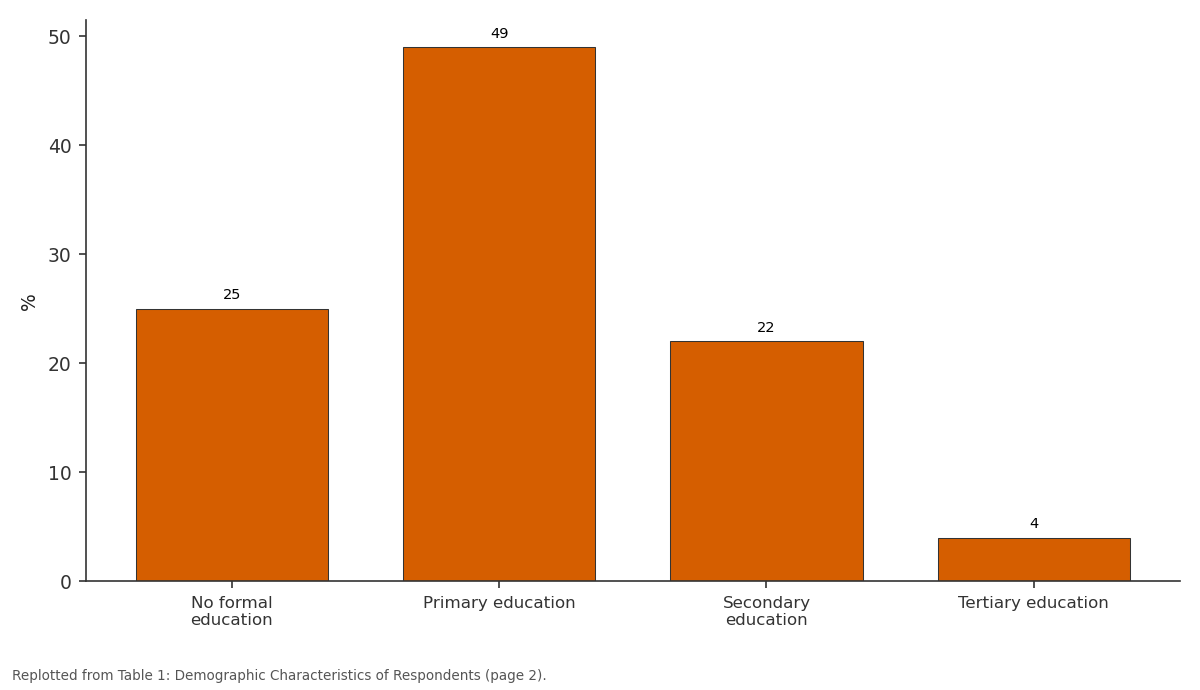
%: No formal education vs Primary education vs Secondary education vs Tertiary education
Replotted from Table 1 (page 2) of the original paper. Every bar is the paper's own table value.
View source evidence ↗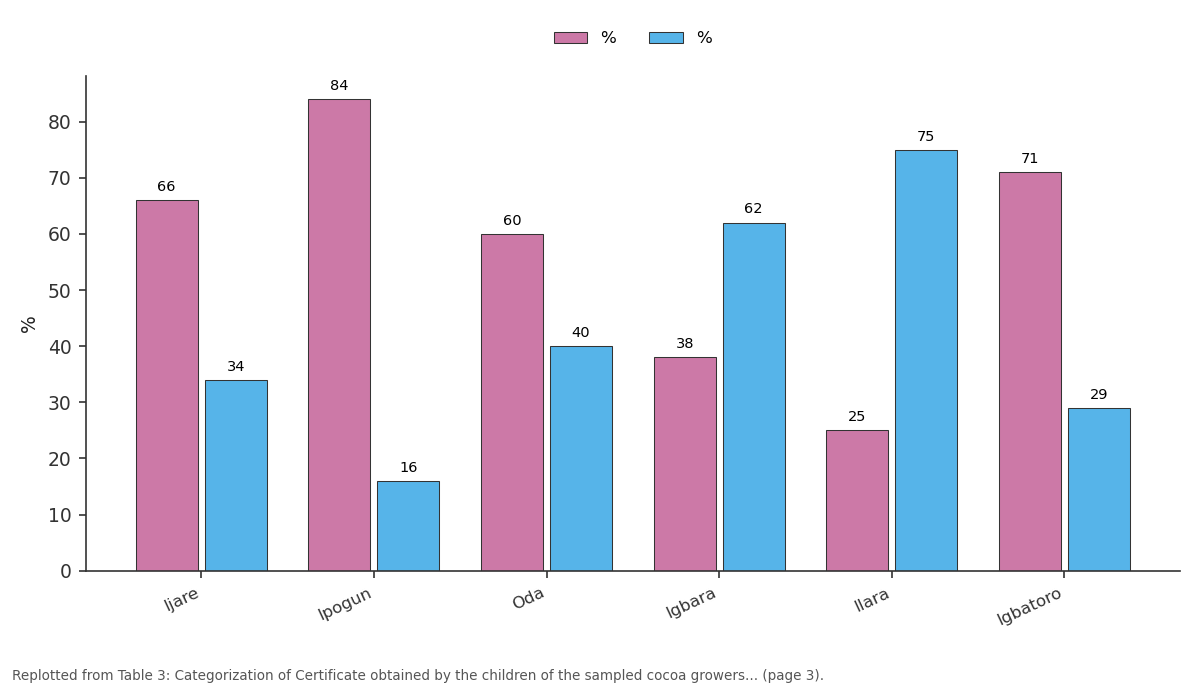
% and %: Ijare vs Ipogun vs Oda vs Igbara vs Ilara
Replotted from Table 3 (page 3) of the original paper. Every bar is the paper's own table value.
View source evidence ↗Figures & tables
From the original paper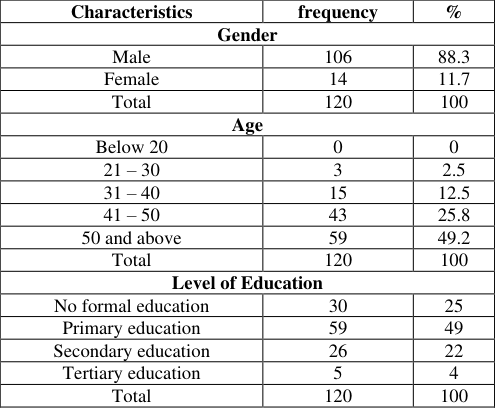 Table 1
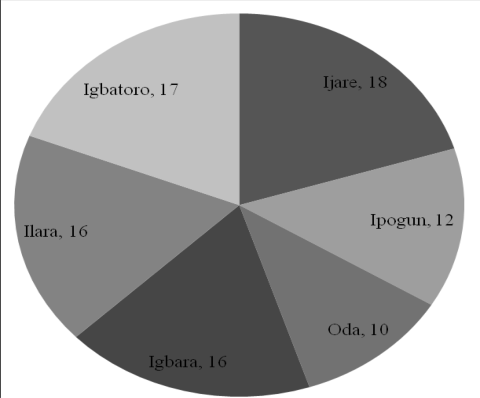 Figure 1
 Table 2
 Table 3
 Table 4
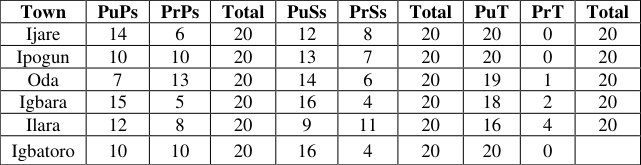 Table 5
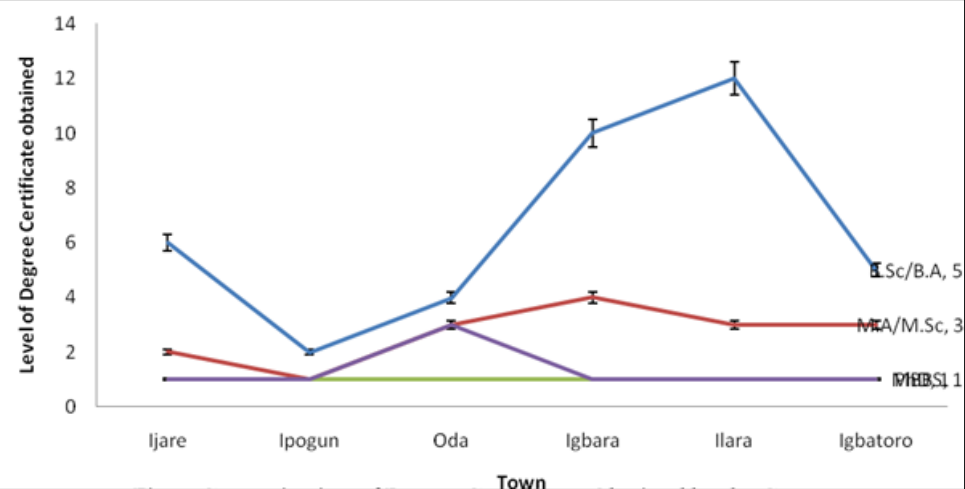 Figure 1
 Table 6
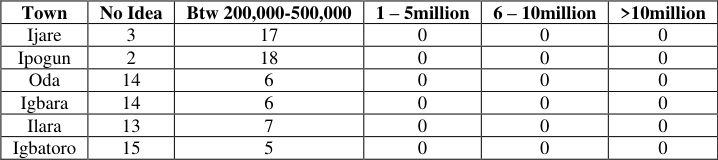 Table 7
Introduction
Nigeria is the fourth largest producer of cocoa after Cote D'ivoire, Ghana and Indonesia contributing 12% of total world production (ICCO, 2014) [6] . About 70% of farmers in South Western Nigeria are cocoa farmers. Many grow cocoa on large hectares of land. Some either mixed cocoa production with arable crops. Cocoa is a golden crop that is expected to produce yield that can increase the standard of living of the farming community. It is a cash crop that serves as export crop for Nigeria. Cocoa has been a major source of income for many Nigerian and a major source of foreign exchange earnings for the country. However, its production has been experiencing a declining trend in recent times Agriculture has a unique impact on the standard of living of human being and economic growth of a country but because of social factors like erection of buildings for residential purpose which has reduced the chances of land availability for agriculture which include the use of land for roads and building of industries. In Nigeria, farmers engage in cocoa production both at subsistence and large scale levels. Cocoa farming is believed to be the major source of livelihood for rural people in the areas where cocoa farming is their dominant occupation. Ondo state is one of the major states in Nigeria where cocoa is produced in large quantities. Among the towns in Ondo state where growing of cocoa is the major occupations are Idanre, Akure, Ondo, Owo and some parts of Akoko. The little soil that remain for agriculture are no more fertile due to the fact that farmers have no sufficient land for farm practices like shifting cultivation, crop rotation and bush fallowing which replenish lost nutrients from the soil. Farmers are expected to be able to finance their children education with no stress. Due to the poor soil fertility, age of the cocoa growers and cocoa output calls for the attention of researchers to evaluate the performance of cocoa at increasing the standard of living of its growers. The objective of this study was to assess the financial disposition of cocoa farmers to finance their children education up to University level within the limit of income generated from cocoa farming. Hypothesis of the study 1. Cocoa farming is lucrative enough to finance the growers' children education to their level of satisfaction. 2. There is no significant relationship between parents' farm size and their children's academic pursuit. Akure South Local Government is located between latitude 7 0 21 1 N and 7 0 50 1 N and Longitude 5 0 50 1 and 7 0 25 1 ; 250m absl (Omotayo, 2018) [14] . The climatic conditions and soil properties are suitable for growing cash crops such as cocoa, kolanut and coffee. The major occupation of the people is farming.
Materials and method
Materials and method
Sample and sampling technique
A three stage random sampling technique was used to select cocoa farmers for the study. The first stage was a purposive selection of Akure South local government area of Ondo state due to being the Headquarters of Ondo state, its large number of cocoa farmers and also the center of business in Ondo State. The second stage was a random selection of six villages each from the local government area making a total number of one hundred and twenty farmers. The third and final stage was a random selection of 20 farmers from each of the selected villages. The sampled villages were Oda, Ipogun, Igbatoro, Ijare, Ilara, and Igbara-Oke. Ballot paper was used to select towns and villages used for the research.
The questionnaire was self-administered to non-literate farmers and the literate farmers were allowed to fill the questionnaires themselves. The sampled cocoa farmers were asked to supply information on the academic qualifications of their children. The child who obtained the highest academic qualification among the children in each family was used as yardstick for data collection, meaning that; cocoa farmer supplied information on academic performance of their children but the child that had the highest academic qualification was selected. The sampled farmers were also interviewed on the mode of sourcing fund for sponsoring their children.
Data Analysis
The data collected were analyzed using frequency counts, percentages and charts.
Results and discussion
The selected demographic characteristics of the respondents are shown in Table 1 below. In Akure South Local Government Area, more males participated in cocoa production than the female. Most of the women in the selected areas might have engaged in other businesses. This might be as a result of the tedious nature of cocoa production that they are not capable of doing.
| Characteristics | frequency | % |
|---|---|---|
| Gender | ||
| Male | 106 | 88.3 |
| Female | 14 | 11.7 |
| Total | 120 | 100 |
| Age | ||
| Below 20 | 0 | 0 |
| 21 – 30 | 3 | 2.5 |
| 31 – 40 | 15 | 12.5 |
| 41 – 50 | 43 | 25.8 |
| 50 and above | 59 | 49.2 |
| Total | 120 | 100 |
| Level of Education | ||
| No formal education | 30 | 25 |
| Primary education | 59 | 49 |
| Secondary education | 26 | 22 |
| Tertiary education | 5 | 4 |
| Total | 120 | 100 |
Table text extracted from the original PDF; superscript letters are shown inline. The original table image is below.
View original table image
It could be seen that people above the middle age were mostly involved in cocoa production. This could be as a result of lack of support for farmers including access to cocoa seedlings, price risk management and pest control training. These in turn lead to a decrease in the number of cocoa farmers. The fact that majority of the respondents were 50 years and above, implies that, they were mature farmers with experience in cocoa production and were expected to be aware of their level of performance and challenges in cocoa production (Akinnagbe and Ajayi, 2012) [3] . [4] that the low level of education of farmers could contribute to the poor adoption of new and improved technology necessary for improvement. The numbers of youths that engage in cocoa production were very few according to the data collected from the field. Federal Republic of Nigeria, (2007) adduced the reason to the urbanization which attract young people to the cities; while Iremiren (2011) [7] adduced the reason of old people domination coca farming to low yield, ageing trees, and inadequate and proper agricultural equipment. was decrease in the level of academic achievements as the level of the Degree increased i.e. 1 st Degree > 2 nd Degree > 3 rd Degree. This might be as a result of financial disposition of their parents, academic performance at lower level or no cognizance reason for many people terminating their education at 1 st Degree level is financial constraints. Many cocoa growers mixed arable crops with cocoa production.
This means sole production of cocoa as a means of livelihood is not guaranteed in the study area. This might be as a result of low income generated from cocoa due to farm small scale size, inability to adequately control pests and diseases, varieties of cocoa grown poor processing and poor marketing of cocoa. The data in Table 5 below showed the type of school the cocoa farmers were able to send their wards to attend. In Ijare, Ipogun, Igbara and Ilara, more children attended public institutions than private institutions up to University level.
| Town | PuPs | PrPs | Total | PuSs | PrSs | Total | PuT | PrT | Total |
|---|---|---|---|---|---|---|---|---|---|
| Ijare | 14 | 6 | 20 | 12 | 8 | 20 | 20 | 0 | 20 |
| Ipogun | 10 | 10 | 20 | 13 | 7 | 20 | 20 | 0 | 20 |
| Oda | 7 | 13 | 20 | 14 | 6 | 20 | 19 | 1 | 20 |
| Igbara | 15 | 5 | 20 | 16 | 4 | 20 | 18 | 2 | 20 |
| Ilara | 12 | 8 | 20 | 9 | 11 | 20 | 16 | 4 | 20 |
| Igbatoro | 10 | 10 | 20 | 16 | 4 | 20 | 20 | 0 |
Table text extracted from the original PDF; superscript letters are shown inline. The original table image is below.
View original table image
In Oda town, more children attended private primary school than the public school. The result showed that the higher the institution, the lower the number of children of cocoa growers that attended private schools. The reasons why the children of cocoa growers attended public schools than the private schools might be as a result of lower school fees paid in public schools than the private schools. Proximity of the school to the children might also contribute to the children attending public schools than the private school. For example, Ilara and Igbara are nearer to Joseph Ayo Babalola University located along Akure-Ife Road than Ijare, Ipogun, Oda and Igbatoro. The distribution of the respondents according to the size of the farm in figure 2 below shows that 10 farmers made use of less than 1 acre of the farm land. 6 made use of 1 -5 acre of land for cocoa production and 3 made use of 6 -10 acre of land for cocoa production and while only 1 had above 10 acre of the farm size. This is in line with the assertion of ADMCR (2017) [2] that an analysis of labour-use patterns among small holder farmers in South-west Nigeria showed that 80% of cocoa growers cultivate 5 hectares and 1% cultivate 10 hectares for cocoa. The problem of land tenure system and low capital might have contributed immensely to the small acreage of farm size. The data also shows that most of the farmers interviewed were subsistence farmers who might have little capital. Reasons elicited for the reduction in production included; less emphasis on agriculture, inadequate government program on agricultural www.extensionjournal.com input subsidy such as chemicals and planting materials, small farm sizes, inadequate capital, inadequate labour availability and most importantly, change in global climate (Oduwole, 2004) [11] .
Table 6 showed the estimated annual income derived from cocoa production. In Ijare, Ipogun, Oda, Igbara and Ilara, largest income of cocoa farmers ranged 1 to 5 million naira while Igbatoro ranged between N200,000 to N500,000.
| Town | No Idea | % | Btw 200,000-500,000 | % | 1 – 5m | % | 6 – 10m | % | >10m | Total |
|---|---|---|---|---|---|---|---|---|---|---|
| Ijare | 3 | 15 | 4 | 20 | 12 | 60 | 1 | 5 | 0 | 20 |
| Ipogun | 2 | 10 | 6 | 30 | 7 | 35 | 5 | 25 | 0 | 20 |
| Oda | 0 | 0 | 7 | 35 | 8 | 40 | 4 | 20 | 0 | 20 |
| Igbara | 0 | 0 | 4 | 20 | 7 | 35 | 6 | 30 | 0 | 20 |
| Ilara | 0 | 0 | 10 | 50 | 8 | 40 | 2 | 10 | 0 | 20 |
| Igbatoro | 1 | 5 | 15 | 80 | 3 | 15 | 1 | 5 | 0 | 20 |
Table text extracted from the original PDF; superscript letters are shown inline. The original table image is below.
View original table image
Compared with other household expenses, the financial disposition of cocoa growers in financing their children education up to PhD level may be low if the farmers depend solely on income derived from cocoa. Fasipe (2012) stated that there is positive relationship between the size of the land and the amount of cocoa harvested, i.e. the larger the land, the higher the money realised by the cocoa farmer.
Cocoa farmers estimated annual income from external sources
The Table 7 below showed the estimated annual income of cocoa farmers from other sources apart from money realized from cocoa production. The estimated income of the farmers falls within N200,000 -N500,000. In South Western Nigeria, many cocoa farmers grow arable crops like maize, yam, cassava and some vegetables to complement money realized from cocoa production. There is off season in cocoa production. Farmers might have engaged in other businesses during the off season periods. Adeniyi and Ogunsola, (2014) [2] maintained that most farmers have other sources of income generation apart from cocoa farming. Some of the farmers still engaged in production of arable crops such as cassava, maize and plantain in addition, oil palm and/or orange plantations. Other sources of income identified included civil service, carpentry, tailoring and merchandize www.extensionjournal.com
| Town | No Idea | Btw 200,000-500,000 | 1 – 5million | 6 – 10million | >10million |
|---|---|---|---|---|---|
| Ijare | 3 | 17 | 0 | 0 | 0 |
| Ipogun | 2 | 18 | 0 | 0 | 0 |
| Oda | 14 | 6 | 0 | 0 | 0 |
| Igbara | 14 | 6 | 0 | 0 | 0 |
| Ilara | 13 | 7 | 0 | 0 | 0 |
| Igbatoro | 15 | 5 | 0 | 0 | 0 |
Table text extracted from the original PDF; superscript letters are shown inline. The original table image is below.
View original table image
Conclusion
A field survey was carried out to assess the financial disposition of cocoa farmers in sponsoring their children education up to tertiary institutions in Ondo State. One hundred and twenty farmers were randomly selected from six villages in Akure South Local Government area. A well structured questionnaire was administered to individual sampled cocoa farmer. The result showed that the higher the level of education, the lower the number of children that participated. More cocoa grower farmers attended public schools than private schools. The result showed that 79% farmers engaged in mixed farming while 11% engaged in petty trading especially in off seasons. The estimated income of cocoa farmers ranged between N200,000 -5 million naira per annum on cocoa production alone. There is need for cocoa farmers to evaluate their management practices in order to boost their income.
Figures and tables from the paper
| Town | No formal education | % | Primary education | % | Secondary education | % | Tertiary education | % |
|---|---|---|---|---|---|---|---|---|
| Ijare | 0 | 0 | 20 | 100 | 20 | 100 | 18 | 90 |
| Ipogun | 0 | 0 | 20 | 100 | 16 | 80 | 12 | 60 |
| Oda | 0 | 0 | 20 | 100 | 19 | 95 | 10 | 50 |
| Igbara | 1 | 5 | 19 | 95 | 19 | 95 | 16 | 80 |
| Ilara | 2 | 10 | 18 | 90 | 16 | 80 | 16 | 80 |
| Igbatoro | 0 | 0 | 20 | 100 | 20 | 100 | 17 | 85 |
Table text extracted from the original PDF; superscript letters are shown inline. The original table image is below.
View original table image
| Town | N | A | Total Respondents | Sub Degree | % | Degree | % |
|---|---|---|---|---|---|---|---|
| Ijare | 2 | 18 | 20 | 12 | 66 | 6 | 34 |
| Ipogun | 8 | 12 | 20 | 10 | 84 | 2 | 16 |
| Oda | 10 | 10 | 20 | 6 | 60 | 4 | 40 |
| Igbara | 4 | 16 | 20 | 6 | 38 | 10 | 62 |
| Ilara | 4 | 16 | 20 | 4 | 25 | 12 | 75 |
| Igbatoro | 3 | 17 | 20 | 12 | 71 | 5 | 29 |
Table text extracted from the original PDF; superscript letters are shown inline. The original table image is below.
View original table image
| Town | N A | A | Total respondents | OND | % | HND | % | PGD | % | NCE | % |
|---|---|---|---|---|---|---|---|---|---|---|---|
| Ijare | 8 | 12 | 20 | 9 | 75 | 2 | 17 | 1 | 8 | 0 | 0 |
| Ipogun | 10 | 10 | 20 | 4 | 33 | 3 | 25 | 2 | 17 | 1 | |
| Oda | 14 | 6 | 20 | 6 | 100 | 0 | 0 | 0 | 0 | 0 | 0 |
| Igbara | 14 | 6 | 20 | 2 | 33 | 1 | 17 | 0 | 0 | 3 | 50 |
| Ilara | 16 | 4 | 20 | 4 | 100 | 0 | 0 | 0 | 0 | 0 | 0 |
| Igbatoro | 8 | 12 | 20 | 7 | 58 | 0 | 0 | 0 | 0 | 5 | 42 |
Table text extracted from the original PDF; superscript letters are shown inline. The original table image is below.
View original table image
References
14 in the original paper- ADMCR. Cocoa production in Nigeria -a literature review. Analysis, Food and Agric Business, 2017, 2.
- Adeniyi O.R, Ogunsola G.O. Cocoa Production and Related Social-Economic and Climate Factors: A Case Study of Ayedire Local Government Area of Osun State, Nigeria. Agricultural Science, Published by Science and Education Centre of North America. 2014; 2(4):01-13.
- Akinnagbe O.M, Ajayi A.R. Impact of Olam organization extension programme on socio-economic life of cocoa farmers in Ondo state, Nigeria J Agric Ext Rural Dev. 2012; 4(2):30-40.
- Fadipe A.E.A, Adenuga A.H, Ilori T.E. Economic analysis of cocoa production in oyo state, Nigeria. Nigerian Journal of Agriculture, Food and Environment. 2012; 8(4):58-63.
- Federal Republic of Nigeria. Official Gazette: Legal notice on publication of the details of the breakdown of the National and State Provisional totals 2006 census, Government Notice Nr 21, 2007; 24:94.
- International Cocoa Organization {ICCO}. International Cocoa organization regional seminar on the functioning of cocoa future markets and econometric modelling of the cocoa market, Indonesia, 2014.
- Iremiren G.O. Soil fertility and ageing cocoa farms in Nigeria, WCF Partnership Meeting and Round Table Session, Accra, 2011, 16.
- Michael D, Nzeka U. Nigeria Cocoa production increases, USDA foreign agricultural service, Global Agricultural Information Networ, 2011.
- Nigeria Agriculture Statistics. The Nigeria agriculture profiles (subcategories), Retrieved from, 2014. http:/www.nationmaster.com/countryinfo/profiles/Nigeri a/Agriculture.
- Nosheen F, T Ali, M. Ahmad. Analysis of gender specific sources of information regarding home and farm practices in Potohar region: a case study, The Journal of Animal and Plant Science 2010; 20(1):56-59.
- Oduwole O.O. Adoption of improved agronomic practices by cocoa farmers in Nigeria: A multi-variate Tobit analysis, Ph.D Thesis (Unpublished), Federal University of Technology Akure, Nigeria, 2004.
- Ogunleye K.Y, Yekinni O.T, Adebo A.A. Farmers' children involvement in cassava production in akure south local government area of ondo state, Nigeria, Agrosearch 2007; 9(1 & 2):61-71.
- Olowolaju P.S. An Assessment of Investment in Technology in Cocoa Processing Industry in Nigeria, Journal of Economics and Sustainable Development. 2014; 5(10):182-188.
- Omotayo B.O. Spatial distribution and accessibility to healthcare facilities in akure south local government area of ondo state, Nigeria Analele Uni versităţii dim Oradea, Serial Geeograffie 07. 2018; 1(.2):7-88. http://istgeorelint.uoradea.ro/Reviste/Anale/anale.htm