
Research article · 2021 · Full text
International Journal of Agriculture Extension and Social DevelopmentAnalysis of wasteland status in India: Targets and reclamation
Volume 4(1) · Pages 120–125 · DOI: 10.33545/26180723.2021.v4.i1b.91 ↗
Research areasMunicipal Solid Waste ManagementWater resources management and optimizationAtmospheric and Environmental Gas Dynamics
Abstract
Author-writtenIndia faces a problem of land degradation due to many land misuse practices, deforestation, water erosion, wind erosion, salinity, alkalinity, and flooding. The land which is not used due to any type of obstruction, whether it is cultivable or non-cultivable is known as wasteland. Management and reclamation of this wasteland is imperative for meeting the growing needs of the ever-increasing population of the country. New technologies, afforestation, deep irrigation, water controlling, strip farming, terrace farming, agri-horticulture, horti-pastures, energy farms are some of the methods of reducing wastelands. Peoples participation at the grassroot level, through community organization and capacity building is important. Every year due to land misuse and deforestation India is degraded by an estimated 2.1 MHA of land. Due to its varied topography different states in India have different factors playing on land degradation and various methods are employed by the state governments to reduce the wastelands. In 2019, at a UN conference to combat desertification, India has set an ambitious target of restoring 26 MHA of degraded land by 2030. The current pace of efforts and steps taken by the government fall short of helping achieve this target of land degradation neutrality. In a country where nearly 30% of the area is hit by degradation, the revival and restoration of wastelands will be one of the biggest environmental achievements.
Summary
Source-checkedPlain-language reading of the full paper, prepared with AI and checked against the text. Each point links to the authors' own words.
Why it matters
- India suffers from significant land degradation caused by factors such as deforestation, land misuse, and various forms of erosion and flooding. View evidence ↗
- Reclaiming wastelands is essential to support the needs of India's growing population. View evidence ↗
- The primary driver of land degradation in India is the unprecedented pressure placed on land by a growing population. View evidence ↗
The question
- The study examines India's progress toward its 2019 UN target of restoring 26 million hectares (MHA) of degraded land by 2030. View evidence ↗
What they did
- The analysis utilizes the National Wastelands Development Board's classification of wastelands into cultivable and uncultivable categories. View evidence ↗
- The authors used linear regression on time-series data from the Wastelands Atlas and land use statistics to predict future wasteland status. View evidence ↗
What they found
- Water erosion is the most significant cause of degradation, affecting 73.27 million hectares (m ha), followed by wind erosion at 12.40 m ha. View evidence ↗
- The grand total of degraded and wasteland area for arable land and open forest is 120.72 million hectares. View evidence ↗
- The total percentage of wasteland area increased from 16.96% (1986-2000) to 20.16% (2015-16). View evidence ↗
- Wasteland status has improved in all Indian states except for Jammu & Kashmir. View evidence ↗
- Based on the regression analysis, India is predicted to miss its 2030 wasteland utilization target by 43.08% (128,240.8206 sq km). View evidence ↗
What it means
- The authors recommend a sustainable integrated ecosystem approach to watershed management to combat desertification. View evidence ↗
- The authors conclude that increasing community organization and people's participation is necessary to accelerate the progress of reclamation schemes. View evidence ↗
- The authors note that their predictions are based solely on available data and may be inaccurate if government policies or environmental conditions change. View evidence ↗
Visual summary
2 visualsIllustrations explain the paper; charts are replotted from the paper's own table values.
Target vs. Prediction Gap
AI-generated conceptual illustration (Degraded Indian landscapes and reclaimed fertile land). It explains the idea and does not show study data.
View source evidence ↗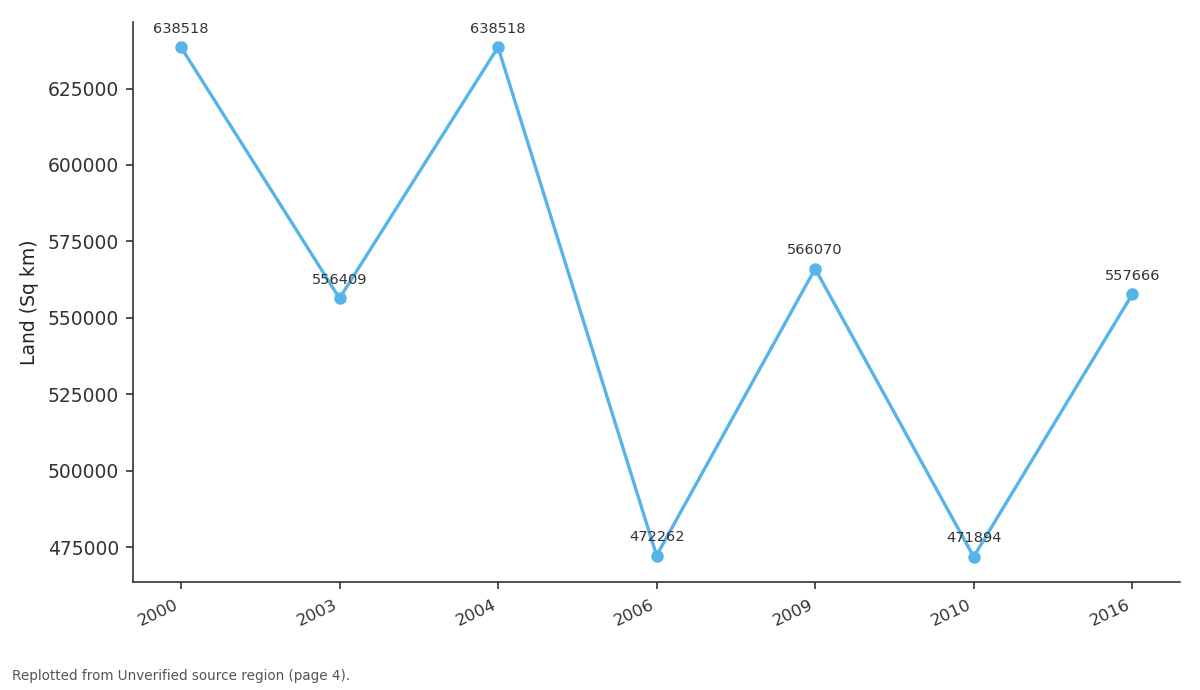
Land (Sq km): 2000 vs 2003 vs 2004 vs 2006 vs 2009
Replotted from a table (page 4) of the original paper. Every bar is the paper's own table value.
View source evidence ↗Figures & tables
From the original paper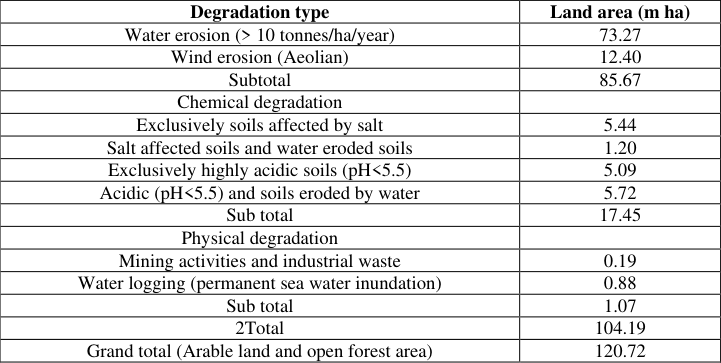 Table 1
 Table 2
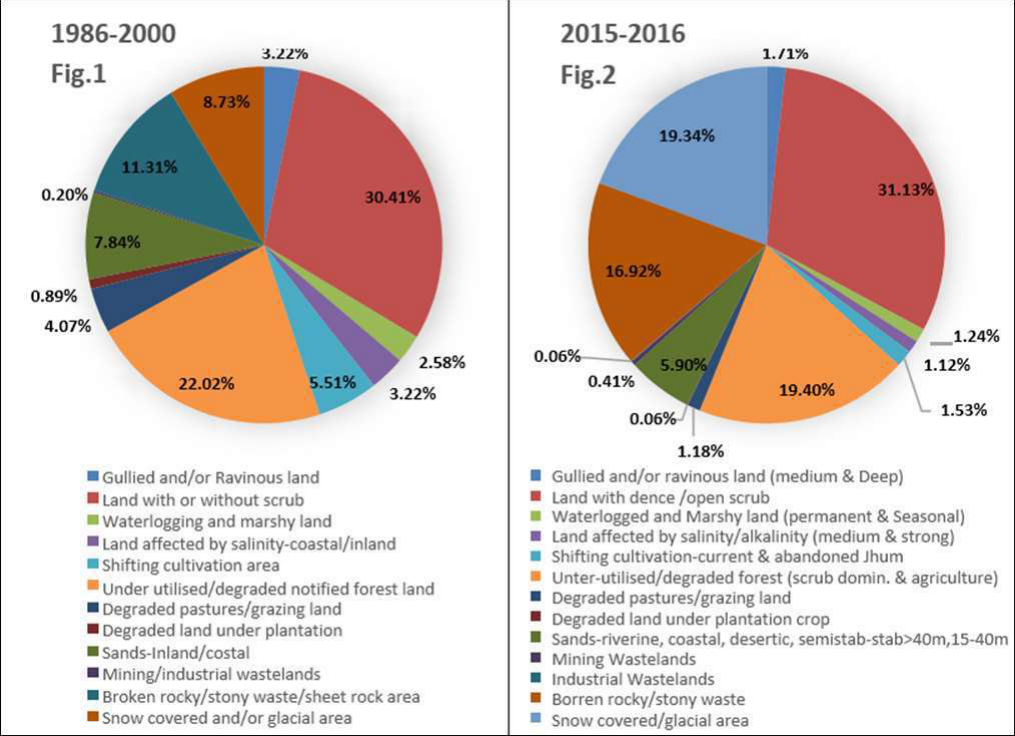 Figure 1
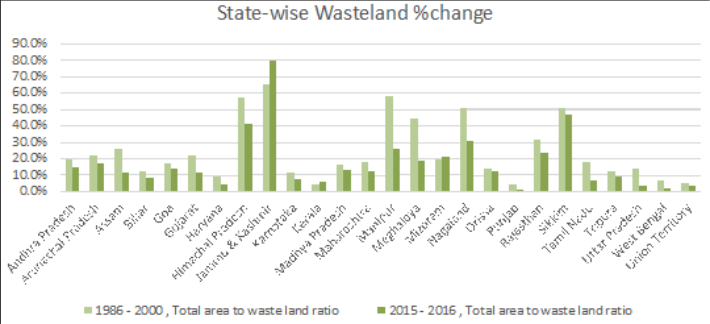 Chart 1
Introduction
Over the years, India's landmass has suffered from various degradations which increased biotic and abiotic pressure on land. An ever-increasing population and unprecedented pressure on the land is the root cause of the degradation of land in the Country. The soil degradation may be physical, chemical, and or biological in nature. The destruction of soil structure, compaction, reduction in infiltration rate, depletion of soil organic matter, reduction in biomass carbon, salt imbalance, and build-up of soil-borne pathogens, etc are some of the factors which result in soil degradation (Lal and Stewart, 1992) [2] . Wastelands are considered degraded when their productivity is diminished, not being used its optimum potential, unproductive. National Wastelands Development Board classifies wastelands primarily into two categories; cultivable wasteland which includes gullied or land having ravines, undulating land without shrubs, marsh land with surface waterlogging, salt-affected land, degraded forestland and plantations, mining and industrial wastes, dunes and strip lands, and uncultivable wasteland which include brown rocky, stony, and shut of rocks, steep sloppy areas and snow-covered or glacier lands. Wastelands mainly consist of culturable and unculturable wastelands. Culturable wastelands are those lands that have the potential for the development of vegetative cover or may be reclaimed at a later stage. It includes gullies and or ravenous lands, wavy upland surface, waterlogged and marshy areas, salt-affected land, shifting cultivation area, degraded forest land, sandy land area, mining, and industrial wasteland, strip land, pastureland, and grazing land. Vegetative cover cannot be developed on unculturable wastelands. These lands being barren cannot be put to significant uses. However, some of the areas of such lands can be converted/changed into pastureland. It includes a rocky barren area, steep mountain slopes, and snow-covered glacial areas. Although no consensus has yet arrived at a comprehensive definition of wasteland, but it is largely accepted that wastelands are basically the areas that are underutilized capacity wise, and which produce less than 20 % of its biological productivity (Mishra et al. 2013) [3] . As per the Special Report on Climate Change & Land of Intergovernmental Panel for Climate Change released in August 2019, land-use change, land-use intensification, and climate change have contributed to desertification and land degradation. The report highlights that climate change, including increases in frequency and intensity of extremes, has adversely impacted food security and terrestrial ecosystems as well as contributed to desertification and land degradation in many regions (PRESS information Bureau, GOI, 2020). In India, eroded lands constitute a major portion (Table 1) than other categories. The main cause of degradation is erosion, which results in the loss of topsoil mainly through the action of water and wind or through waterlogging, which results in soil salinization. Natural occurrence of alkaline chemicals substances, upward movement of subsoil chemicals to the surface, artificial addition of chemicals to soil through fertilizers and www.extensionjournal.com insecticides, physical causes including waterlogging, geomorphological changes in land caused by mining, presence of industrial pollutants, and anthropogenic drivers include livestock-related activities (grazing), heavy biotic pressures (for fuelwood and fodder), land use changes including urbanization, etc. are the reasons for land degradation. In India, wastelands are largely formed due to physical degradation. The loss of clay, silt, and soil organic matter makes these wastelands deprived of nutrients (Bradshaw and Chadwick, 1980) [1] . Physically degraded wastelands are characterized with gravelliness; dominated by coarser fragments such as sand and silt; deprived of soil fines -silt and clay; and depleted of nutrients especially nitrogen and phosphorus. Thus, the overall fertility and hence, the productivity of wastelands are very much limited, and the soil mass provides only physical support for the growing vegetation. Widespread land degradation caused by inappropriate agricultural practices and reckless land use has a direct and adverse bearing on the livelihood and food security of farmers. The burning of crop residue, inadequate organic matter inputs, poor water management and irrigation methods, poor crop rotations practices, overuse of insecticides and pesticides, etc. are also responsible for land degradation. Apart from these, the high rate of population growth and high incidence of poverty in rural areas, overexploitation of natural resources, etc. are also responsible in conversion of agriculture lands into wastelands. A rapid increase in industrial activities, incessant urbanization, and massive infrastructure development is continuously taking away considerable areas of land from agriculture activities, forestry, grassland and pasture, and unused lands with wild vegetation. Reckless Mining activities disturb the physical, chemical, and biological features of the soil and alter the socioeconomic features of a region, and negative effects on water, soil contamination, part or total loss of flora and fauna, air and water pollution, and acid mine drainage. Overburden removal from the mine area results in significant loss of vegetation and rich topsoil (Sahu et al. 2011) [6] . High livestock density in arid regions, which are dry and without water causes overgrazing in these areas, resulting in decreased infiltration and accelerated runoff, and erosion of soil. Due to overgrazing, soil loss is 5 to 41 times greater than normal at the mesoscale and 3 to 18 times greater at the macroscale (Sharma et al. 1997) [7] . A district and state-wise distribution of different categories of wastelands area is provided by the Wasteland Atlas. The atlas includes mapping of about 12.08 Mha hitherto unmapped area of Jammu & Kashmir also. www.extensionjournal.com
| Degradation type | Land area (m ha) |
|---|---|
| Water erosion (> 10 tonnes/ha/year) | 73.27 |
| Wind erosion (Aeolian) | 12.40 |
| Subtotal | 85.67 |
| Chemical degradation | |
| Exclusively soils affected by salt | 5.44 |
| Salt affected soils and water eroded soils | 1.20 |
| Exclusively highly acidic soils (pH<5.5) | 5.09 |
| Acidic (pH<5.5) and soils eroded by water | 5.72 |
| Sub total | 17.45 |
| Physical degradation | |
| Mining activities and industrial waste | 0.19 |
| Water logging (permanent sea water inundation) | 0.88 |
| Sub total | 1.07 |
| 2Total | 104.19 |
| Grand total (Arable land and open forest area) | 120.72 |
Table text extracted from the original PDF; superscript letters are shown inline. The original table image is below.
View original table image
Types of wastelands in different states
Wastelands are typically poor in organic matter and plant nutrients. Humus is the organic component of soil, formed by the decomposition of leaves and other plant material by soil micro-organisms. Geology, topography, climate, vegetation, human activity, and the time shape these factors and, in turn, determine soil fertility, biodiversity, nutrient recycling, physical structure, carbon retention, and other ecological functions that make for soil health. The biomass productivity and biomass turnover among wastelands are much lesser compared to that of other land-use systems. Extensive removal of vegetal biomass for fodder, fuel, and timber purpose further leads to exposure of soil surface for water and wind erosion. Soil surface exposure further Wastelands are typically poor in organic matter and plant nutrients. Humus is the organic component of soil, formed by the decomposition of leaves and other plant material by soil micro-organisms. Geology, topography, climate, vegetation, human activity, and the time shape these factors and, in turn, determine soil fertility, biodiversity, nutrient recycling, physical structure, carbon retention, and other ecological functions that make for soil health. The biomass productivity and biomass turnover among wastelands are much lesser compared to that of other land-use systems. Extensive removal of vegetal biomass for fodder, fuel, and timber purpose further leads to exposure of soil surface for water and wind erosion. Soil surface exposure further To apply a linear regression model on the data, the following is required:
Here 𝑛 = 7 as we have Government targets, plans and policies and environment may change time to time. Therefore, so many aspects are responsible or involved in the target achievement. However, looking back to the statistics, India's effort to reclaim wasteland is somehow successful.
Reclamation
State-wise wastelands % change in India is presented in Chart-1. The extent of land degradation varies from one state to another, depending upon the geographical features, soil characteristics, rainfall, land use, land management practices, etc. Large extents of wastelands are mainly distributed in the states of Rajasthan, Madhya Pradesh, Maharashtra, Uttar Pradesh, Gujarat, Andhra Pradesh, and Karnataka. The state of Rajasthan has large tracts followed by Madhya Pradesh, while Tripura has the least degraded lands (Wasteland Atlas of India, 2000). After prolonging and constant efforts, wastelands have undergone a positive change in all states except Jammu & Kashmir. It is seen that the majority of wastelands in India have been changed into various categories of cultivable land, plantation areas, and industrial areas.
Conclusion
There has to be a sustainable use of resources and energy and self-regulatory practices have to be adopted in order to check and reverse the land degradation process. The task of public policies must include the incentivization of such regulation. A sustainable integrated ecosystem approach in watershed management considering all components would help in combating desertification. Rehabilitation of the degraded land through the sustainable management of soil and vegetation would -minimize siltation and enhance the water yield in the catchment. Multispecies approach with native species in afforestation would be more advantageous from the point of resistance to pests and diseases, meeting the local demand, perennial water source and more efficient utilization of environmental resource. This serves as a better cover to the soil and aids in the regeneration of soil. Soil conservation measures, such as contour ploughing, bunding, use of strips and terraces, can decrease erosion and slow runoff water. Mechanical measures, e.g., physical barriers such as embankments and windbreaks, or vegetation cover (and use of vegetative buffer strips and geotextiles) and soil husbandry are important measures to control soil erosion (Srinivasarao et al. 2014) [9] . All these measures will reduce the threat of land degradation which nearly one-third of the area in India faces.
There is a severe threat to the ecological balance due to the intense strain on the limited land resources. There is a strain of increasing population of humans as well as livestock and strain of rapid momentum which urbanization is gaining. The quality of land resources is continuously deteriorating. The government needs to develop policies, which would lead to the best possible use and sustainable management of land and water resources. Investments in wasteland reclamation at an increased pace can also help to restore ecosystem services such as climate regulation and increase biodiversity. To accelerate the progress under various schemes, there is a need for initiating actions like increased peoples' participation and community organization need to be strengthened by building their capacity through structured training programs to ensure proper planning, implementation, and monitoring that can achieve quantitative and qualitative objectives of the programs. Development of wastelands mainly in non-forest areas aims primarily at checking land degradation of all types. These non-forest wastelands of the country should be put to sustainable use and the bio-mass availability especially that of fuelwood, fodder, fruits, fiber & small timber should be increased. Agroforestry systems are an appropriate www.extensionjournal.com management tool for both acid and salt-affected soils because perennial woody vegetation recycles nutrients, maintains soil organic matter, and protects soil from surface erosion and runoff (Nair 1993) [4] . Sustainable tree plantation is a best practice in wastelands instead of crop production because of the poor productivity of the land. Even though the wasteland is not perfect for food production, the land can be used by adopting good management practices and proper planning.
Figures and tables from the paper
| Type of Land | State |
|---|---|
| Gullied Land areas | MP, AP, Rajasthan, Bihar, UP, Karnataka, Maharashtra, Gujrat, Karnataka |
| Land with or without scrub | MP, AP, Maharashtra, Karnataka, Odisha, Rajasthan, Gujarat |
| Waterlogged land | UP, AP, Gujarat, Maharashtra, WB,TN, Assam, Bihar |
| Saline and Alkaline land | Gujrat, UP, Rajasthan, TN, AP, Haryana, Maharashtra |
| Degraded Forest land | AP, MP, Maharashtra, Bihar, Rajasthan, Odisha, TN, Karnataka |
| DegradedPastures/Grazing land | Rajasthan, HP, Assam, Arunachal Pradesh, Maharashtra, Haryana, AP |
Table text extracted from the original PDF; superscript letters are shown inline. The original table image is below.
View original table image
References
8 in the original paper- Lal R, Stewart BA. Need for Land Restoration. In: Lal R., Stewart B.A. (eds) Soil Restoration. Advances in Soil Science, vol 17. Springer, New York, NY 1992. https://doi.org/10.1007/978-1-4612-2820-2_1
- Mishra CSK, Rath Monalisa. Wasteland reclamation: novel approaches. Ecoscan 2013;3:99-105.
- Nair PKR. An Introduction to Agro Forestry; Kluwer Academic Publishers: Dordrecht, The Netherland 1993.
- Press Information Bureau (PIB), Ministry of Agriculture & Farmers Welfare, Government of India, March 2020.
- Sahu HB, Dash S. Land degradation due to Mining in India and its mitigation measures. In Proceedings of the Second International Conference on Environmental Science and Technology, Singapore, 26-28 February 2011.
- Symposium of the Fifth Scientific Assembly of the International Association of Hydrological Sciences (IAHS), Rabat, Morocco 1997, 119-123.
- Srinivasarao CH, Venkateswarlu B, Lal R. Long-term manuring, and fertilizer effects on depletion of soil organic stocks under Pearl millet-cluster vean-castor rotation in Western India. Land Degrad. Dev 2014;25:173-183.
- Wastelands Atlas. Department of Land Resources, Ministry of Rural Development, Government of India 2000-2019, ttps://dolr.gov.in/en/integrated-wastelanddevelopment-programme http://mospi.nic.in/pib.gov.in/