
Research article · 2019 · Full text
International Journal of Agriculture Extension and Social DevelopmentBank of agriculture (BOA) perspectives on financing agricultural cooperatives in Ogun state
Volume 2(1) · Pages 15–20 · DOI: 10.33545/26180723.2019.v2.i1a.18 ↗
Research areasMicrofinance and Financial Inclusion
Abstract
Author-writtenThis study focused on Bank of Agriculture (BOA) perspectives on financing Agricultural Cooperatives in Ogun State. The three zones of the bank operation were sampled using multistage sampling techniques. Primary and secondary data were utilized for the study and obtained with the use of a well structured questionnaire from 120 respondents only out of which One hundred and nine (109) were returned, and acceptable for data analysis. The results obtained on the socio-economic characteristics of the beneficiaries revealed that majority of them were male (58.7%), aged less than 50 years (75.2) with an average age of 42.51 years per beneficiary, married (75.2%), had moderate household size of 5 (mean) per household, literate with vast majority (98.2%) possessing one form of formal education or the other, (71.6%), engaged in farming as main occupation had an average of 5 years of farming experience and (64.2%) practiced Christianity as religion. An evaluation of the factors determining the amount of loan obtained revealed that age, education, farm size, amount repaid, past record and annual net income are the important factors determining the loan amount obtained from the Bank. The age of the respondents, negatively influenced the amount obtained while farm size and amount repaid positively influenced the loan amount obtained. Household size, education and loan size were found to have significant relationship with loan repayment rate. While household size had negative relationship with loan repayment, education and loan size have positive relationship with it. In terms of constraints to the BOA loan acquisition. High interest rate, bureaucracy and inability to provide a guarantor were adjudged as the major constraints to loan acquisition in the Bank of Agriculture in Ogun State.
Summary
Source-checkedPlain-language reading of the full paper, prepared with AI and checked against the text. Each point links to the authors' own words.
Why it matters
- The Bank of Agriculture (BOA) is a specialized credit institution designed to support agricultural development by providing loans with longer repayment periods than typical commercial banks. View evidence ↗
- Agricultural cooperatives allow farmers to pool resources for joint cultivation, access subsidized inputs, and secure better prices for their products. View evidence ↗
- Public agricultural loan schemes in Nigeria have faced sustainability threats due to high default rates caused by loan diversion, poor management, and a lack of willingness to repay. View evidence ↗
The question
- The study aims to identify the factors that influence the willingness of rural farmers to meet their credit needs through the Bank of Agriculture. View evidence ↗
What they did
- The research was conducted in Ogun State, Nigeria. View evidence ↗
- The study initially sampled 120 respondents, but 109 were used for the final data analysis after field editing. View evidence ↗
- The researchers used descriptive statistics for socio-economic data and multiple regression analysis to determine factors affecting loan amounts and repayment. View evidence ↗
What they found
- The majority of beneficiaries were male (58.7%), married (75.2%), under 50 years old (75.2% with a mean age of 42.51), literate (98.2%), and primarily engaged in farming (71.6%) with an average of 5 years of experience. View evidence ↗
- The amount of loan obtained was positively influenced by farm size and previous repayment records, but negatively influenced by the age of the respondent. View evidence ↗
- Higher levels of education were associated with a greater likelihood of securing larger loan amounts. View evidence ↗
- Loan repayment rates were positively related to education and loan size, but negatively related to household size. View evidence ↗
- The primary constraints to acquiring BOA loans were high interest rates (26.6%), bureaucratic protocols (15.6%), and the inability to provide a guarantor (11.0%). View evidence ↗
What it means
- The authors conclude that BOA management must implement practical risk mitigation measures to improve the overall quality of the bank's loan portfolio. View evidence ↗
- The authors recommend that the BOA reduce interest rates to increase loan accessibility and facilitate easier repayment for farmers. View evidence ↗
- The authors suggest reviewing the guarantor policy and potentially adopting group lending to replace individual guarantor requirements. View evidence ↗
Visual summary
1 visualsIllustrations explain the paper; charts are replotted from the paper's own table values.
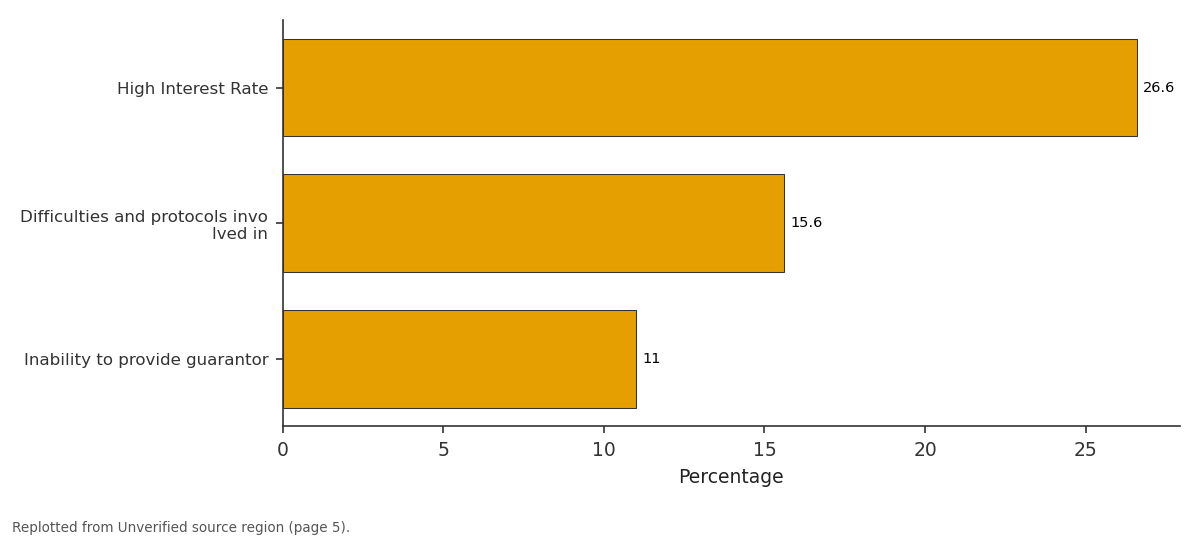
Percentage: High Interest Rate vs Difficulties and... vs Inability to provide...
Replotted from a table (page 5) of the original paper. Every bar is the paper's own table value.
View source evidence ↗Introduction
The Central Bank of Nigeria (CBN 2014) [3] defined the Bank of Agriculture (BOA) as a type of bank that lends money to farmers for longer a periods of time and charges them less interest. Therefore, the Bank of Agriculture (BOA) is described as credit bank expressly established in accordance with the provision of law to assist agricultural development across the globe, particularly by granting loans for longer periods than is usual with commercial banks. In his words, Adesina (2012) [1] , an Economist and Social commentator succinctly conceptualized Bank of Agriculture (BOA) as bank that lends money to individuals, basically farmers. Bank of Agriculture (BOA) is the nation's foremost agricultural and rural development finance institution. It was incorporated in 1972 as Nigerian Agricultural Cooperative Bank Limited (NACB) to reflect the inclusion of cooperative financing into its broader mandate. In October, 2001, following the Federal Government effort to streamline the operations of its agencies, that were believed to be performing overlapping functions, three institutions, Nigerian Agricultural Cooperative Bank (NACB) Peoples Banks of Nigeria (PBN) and the risk assets of the Family Economic Advancement Programme (FEAP) were merged to form Nigerian Agricultural, Cooperative and Rural development Bank (NACRDB) in October 2010, following the rebranding of the bank to reflect its institutional transformation Programme, the Bank adopted the new name Bank of Agriculture (BOA) in the year 2013. Co-operatives are autonomous associations of persons who unite voluntarily to meet their common economic and social needs through a jointly owned and democratically controlled enterprise (ICA, 1995) [7] . Co-operatives are established by like-minded persons to pursue mutually beneficial economic interest and they provide a unique tool for achieving one or more economic goals in an increasingly competitive global economy. Agricultural cooperative also known as farmers' cooperatives is a cooperative where farmers pool their resources in certain area of activities thereby encouraged members to engage in joint cultivation of food and cash crops, purchase farm inputs at subsidized price and create better producers' price for their farm products (Poulton, et al. 2006) [10] . In view of the low financial capacity and high level of under-development, an individual farmer cannot achieve the desires for large-scale production. It is therefore in the farmers' interest that resources are pulled together so as to gain a tremendous collective advantage and thus widening the industrial base of the economy and the management techniques (Epetimehin, 2006) [4] . For instance, www.extensionjournal.com farmers' co-operative societies are formed to bring in more agricultural inputs and product marketing services to members, increase competition in the agricultural service sector and provide savings and loan to members, among many other functions. Small holder farmers stand a better chance with the formation of agricultural co-operatives. Awoke (2004) [2] reported that high rate of default arising from poor management procedures, loan diversion and unwillingness to repay loans has been threatening the sustainability of most public agricultural loan schemes in Nigeria; thus warranting an empirical probing and the need to critically assess factors affecting the rate of loan allocation to societies by bank of agriculture. A detailed understanding of these factors may provide necessary information towards designing a more effective and sustainable loan system that can serve resource poor farmers better. Against this backdrop, this study is being undertaken to supplement existing literature and also serve as a bridge pillars between the bank of agriculture and farmers in ascertaining factors that influence their willingness or unwillingness to meet credit need of rural farmers. ) [9] .
Objectives of the study
Objectives of the study
Sources and Methods of Data Collection
Both primary and secondary data were used for this study. They were obtained through well structured questionnaire which was administered by trained enumerators. The following information were collected from the respondents' socio-economic characteristics, amount of loan given to farmers, whether or not farmers were able to repay for their loans on time, interest charged on loans given to them, timeliness of disbursement of loans, farm size and other factors influencing loan repayment of beneficiaries of BOA in Ogun State.
Sampling Techniques
Multistage sampling technique was used in selecting the beneficiaries. The first stage was a purposive selection which indicates the three zones. This ensures that all the operative bases of the Bank were all covered. The second stage was a random selection of four Local Government Areas from each of the three zones that where BOA branches are located. The last stage was random selection of 10 beneficiaries from each of the 12 Local Government Areas LGAs, forty farmers from each zone which are Abeokuta zone, Ijebu zone, and Imeko Afon zone from the list of farmers that were made available. In all, a total of one hundred and twenty (120) respondents were randomly sampled. However, after thorough field editing only one hundred and nine (109) were useful for the study.
Methods of Data Analysis
Descriptive statistics such as frequency distribution tables, percentages and measures of central tendency were used to describe socioeconomic characteristics of the respondents and identify reasons for loan default. While, multiple regressions was used to examine factors that determined the amount of loan obtained, repaid and defaulted by the farmers.
Ascertain the factors that determine the amount of loan obtained by the beneficiaries. Amount Obtained:
The model is implicitly specified as follows;
The model is explicitly specified as follows;
Problems encountered by the BOA beneficiaries in the study area.
Descriptive statistics such as (frequency distribution tables, percentages and measures of central tendency) was used to achieve this objective.
Results and discussions Socio-economic characteristics of the respondents
The socio-economic characteristics of the respondents are presented under this sub-heading. An assessment of the socio-economic characteristics of the respondents becomes important because of its tendency to influence their borrowing and repayment behaviours. As stated below, Sex www.extensionjournal.com of borrowers could have implications on loan repayment and by implication, default. It is important to understand how the respondents' sex would likely influence loan repayment. This could facilitate credible loan administration. The results revealed that the majority (58.7%) of the respondents were male. It is evident that majority (75.2%) of the respondents were younger than 50 years with mean age and standard deviation of 42.51 and +11.03 years respectively. Result on marital status reveals that majority (75.2%) of the respondents were married. This is an indication that married people were the predominant beneficiaries of the BOA loan. The table also revealed that the vast majority (83.5%) of the respondents had at most 6 individuals in their households with an average of 5 individuals per household. This household size is considerably moderate and may not have substantial effect on the use of borrowed fund for unintended household consumption expenditure. In other words, the level of the household size may not have significant effect of repayment. The results on education of respondents analyse that only minority (1.8%) of the respondents had no any form of formal education. This implies that the vast majority (98.2%) had one form of formal education or the other. Besides, substantial number (39.4%) of the respondents had HND/BSC certificates. Obtained results revealed that vast majority (71.6%) of the respondents were farmers. With the high level of education among the beneficiaries, there is the tendency that if they invest the loan in farming, reasonable profit could be generated that will enable repayment of the loan. Also an evaluation of the farming experience of the beneficiaries revealed that the majority had between 1-5 years of experience with an average of 5 years per beneficiary. This experience level is relatively low and might not be unconnected to the high level of education that might have accounted for substantial years in the beneficiaries' lifespan. Evidence on the table below shows that the majority (66.0%) of the respondents earned at most N100,000 per month. The mean farm income and standard deviation revealed high level of variation in income of the beneficiaries. The results on Religion revealed that the majority (64.2%) of the respondents were Christians. Notwithstanding, the number of Muslim beneficiaries were also substantial (35.8%).
Socio-economic Characteristics Distribution of Respondents
Socio-economic Characteristics Distribution of Respondents
Characteristics
Characteristics
Factors determining the amount of loan obtained by the beneficiaries
Multiple regression model was employed to analyse the determinants of BOA loan obtained by the respondents. Age of respondents (X1), level of education (X2), farm size (X3), loan experience (X4), household size (X5), amount repaid (X6) and annual net income (X7) served as independent variables. The adjusted R 2 of 0.682 indicates that about 68% of the variation in loan obtained is captured by the variables included in the model. The remaining 32% is due to unexplained variation in the amount of loan obtained by the respondents. The significant F-value (at 1% level) also shows that the model is a good fit to the data.
The data in the table, revealed that the coefficients of age, education level, farm size and amount repaid (in the past) significantly influenced the amount of loan obtained by the respondents. The age of the respondents, negatively influenced the amount obtained while farm size and amount repaid positively influenced the loan amount obtained. The implication of these findings is that the youths have better access to higher amount of loan than the aged and those that had better repayment in the past, will receive relatively higher loan amount than those with relatively less repayment record. Besides, the more educated an aspiring beneficiary, the higher the likelihood of securing higher loan.
Multiple regression analysis of determinants of loan obtained by beneficiaries
Multiple regression analysis of determinants of loan obtained by beneficiaries
Constraints to Agricultural Loan Acquisition through BOA
Constraints refers to the problem faced towards achieving a particular goal. In this case, the usual goal of the beneficiaries is to continuously have access to the BOA loan. This also applies to prospective beneficiaries who may want to secure the loan for the first time. Understanding the constraints faced by the current beneficiaries will enable the prospective beneficiaries to be better prepared. This may ease the process of the loan procurement. Besides, the BOA could also improve on its loan disbursement processes with the knowledge of the constraints faced by the current beneficiaries. An attempt to provide this knowledge informs the analysis of the constraints being faced by the current beneficiaries of the BOA loan. It is evident from the findings that substantial percentage (26.6%) of the respondents considered high interest rate as the most important constraint to the use of the BOA loan www.extensionjournal.com while others, considered bureaucracy, inability to provide the required guarantor, harsh loan recovery methods being used and untimely disbursement of loan as the most important constraints to procurement and/or use of the BOA loan. A follow up interview with the management of BOA in charge of loan revealed that the interest rate was relatively lower than what obtained in the mainstream financial sector like commercial and microfinance banks (between 20-40%). According to the BOA official, the interest rate for smallholder and SME loan beneficiaries for agricultural purposes is 12% and 14% respectively for non-agricultural purposes, the interest rate was 18% across board (all non-agricultural loan). Intending beneficiaries of Bank of Agriculture (BOA) are required to have 20% of the desire loan amount as savings before they are requested. The smallholders are not required to provide collateral. For instance, a beneficiary that intends to borrow N100,000 must have at least N20,000 savings in the Bank. This is not a necessary condition for the SMEs who are required to provide collateral before securing the loan. The SMEs can, however, have both savings and collateral.
References
10 in the original paper- Adesina. Evolution of Bank of Agriculture in Nigeria (BOA) Newsletter publication, 2012, 5.
- Awoke. Factors affecting loan acquisition and repayment patterns of small holder farmers in Ika North West of Delta State, Nigeria. Journal of Sustain. Trop. www.extensionjournal.com Agric. Res. 2004; 9:61-64.
- CBN. Central Bank of Nigeria. Publication on Bank of Agriculture (BOA) Article, 2014.
- Epetimehin FM. Understanding the Dynamics of Cooperatives, Tadon Publishers, Ibadan, 2006, 30
- Federal Government of Nigeria (FGN). The Merger of the Nigeria Agricultural and Cooperative Bank, Peoples Bank of Nigeria and Family Economic Advancement Programme, 2000.
- Food and Agricultural. Organisation (Ed.). Women in agriculture: closing the gender gap for development. Rome: FAO, 2011.
- ICA. International Cooperative Alliance (ICA). Review of international cooperatives, 1995; 4:85-86, 7.
- Nigeria Agricultural Cooperative Rural Development Bank NACRDB. Journal of Development and Agricultural Economics, 2010, 20-40.
- National Population Commission NPC. The National Population Office. Abeokuta, Ogun State, Nigeria. Nation Master 2012. Brief Information about Nigeria Agriculture, 2006.
- Poulton C, Kydd J, Dorward A. Overcoming market constraints on pro-poor agricultural growth in subsharan Africa. Development Policy Review. 2006; 24(3):243-277.