
Research article · 2021 · Full text
International Journal of Research in AgronomyGrain yield and economically feasible maize common bean intercropping and tillage practices at Omonada Woreda, Jimma zone
Volume 4(1) · Pages 64–69 · DOI: 10.33545/2618060x.2021.v4.i1a.70 ↗
Research areasAgronomic Practices and Intercropping SystemsAgroforestry and silvopastoral systems
Abstract
Author-writtenA field experiment was carried out to determine the optimum ratio of intercropping maize with common bean under two tillage systems in Omonada Woreda of Jimma Zone during 2017 and 2018 main cropping season. The experiment was laid out in a strip plot design with three replications. The treatments consisted of two tillage methods (conventional tillage (CT) and reduced-tillage (RT) and five levels of at 1:1, 1:2 and 1:4 maize to common bean ratio, sole maize and common bean) Across season result showed that significant (P
Summary
Source-checkedPlain-language reading of the full paper, prepared with AI and checked against the text. Each point links to the authors' own words.
Why it matters
- Intercropping can increase yields on a specific area of land and improve soil fertility and conservation compared to monoculture. View evidence ↗
- Intercropping serves as a financial and food security insurance against market instability and extreme weather events. View evidence ↗
- Conservation Agriculture is viewed as a sustainable practice that can be applied across various land sizes and agro-ecologies. View evidence ↗
The question
- The study aimed to evaluate the agronomic advantages of intercropping maize with common bean at different ratios in the Omonada woreda of the Jimma zone. View evidence ↗
What they did
- The field experiment was conducted during the 2017 and 2018 main cropping seasons in Omonada Woreda, Jimma Zone. View evidence ↗
- The study used a strip plot design with three replications, testing two tillage methods (conventional and reduced) and five planting ratios (1:1, 1:2, 1:4, sole maize, and sole common bean). View evidence ↗
- The researchers used the BH661 maize hybrid and the Nasir common bean variety. View evidence ↗
- Data analysis was performed using ANOVA via SAS version 9.3 software. View evidence ↗
What they found
- The 1:2 intercropping ratio was the most economically beneficial, yielding a net benefit of 26,758 ETB (conventional tillage) and 20,277 ETB (reduced tillage). View evidence ↗
What it means
- The authors conclude that a 1:2 maize to common bean ratio is the economically optimum and compatible practice for both tillage systems. View evidence ↗
- The researchers recommend the 1:2 intercropping ratio for Omonada and similar agro-ecologies, depending on the farmer's available labor and inputs. View evidence ↗
Visual summary
2 visualsIllustrations explain the paper; charts are replotted from the paper's own table values.
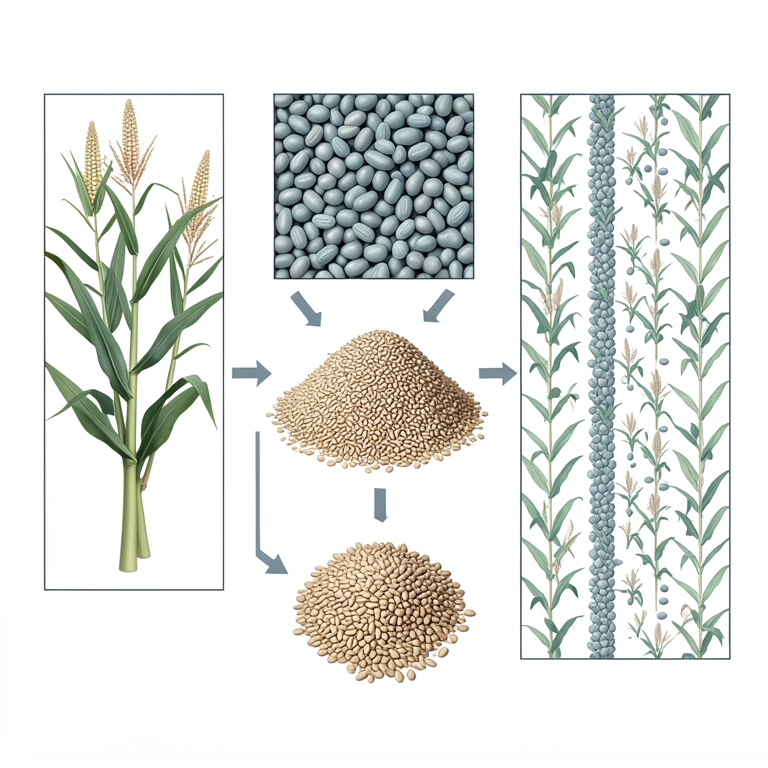
Intercropping Ratio Comparison
AI-generated conceptual illustration (Maize and common bean plants in a field). It explains the idea and does not show study data.
View source evidence ↗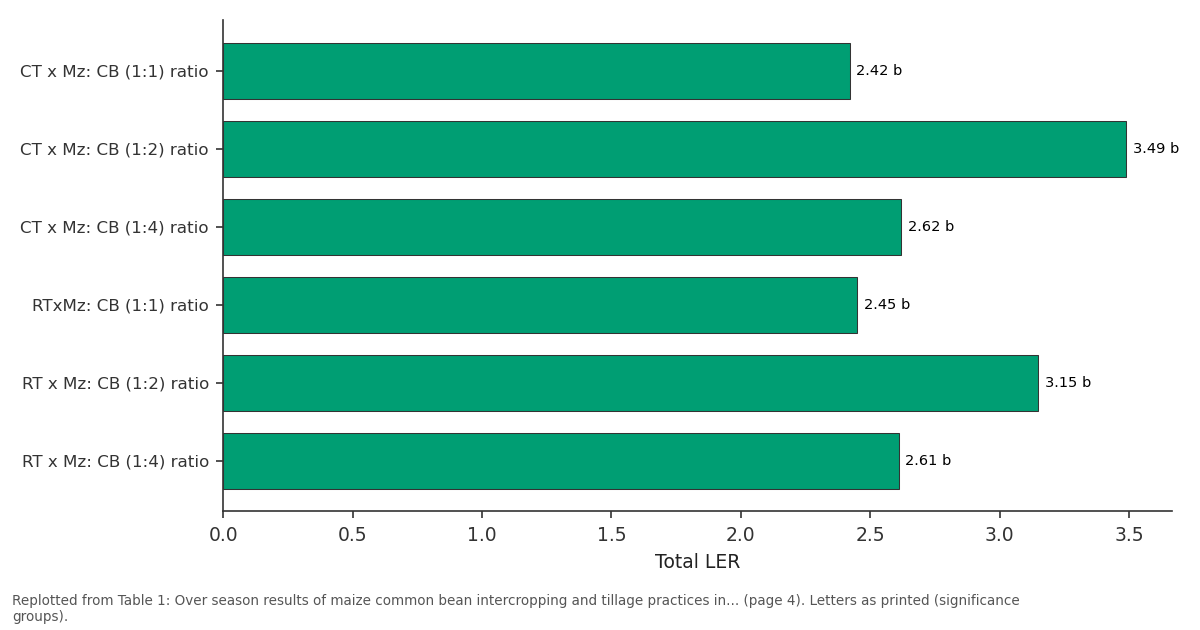
Biomass (ton/ha): CT x Mz: CB (1:1) ratio vs CT x Mz: CB (1:2) ratio vs CT x Mz: CB (1:4) ratio vs RTxMz: CB (1:1) ratio vs RT x Mz: CB (1:2) ratio
Replotted from Table 1 (page 4) of the original paper. Every bar is the paper's own table value.
View source evidence ↗Figures & tables
From the original paper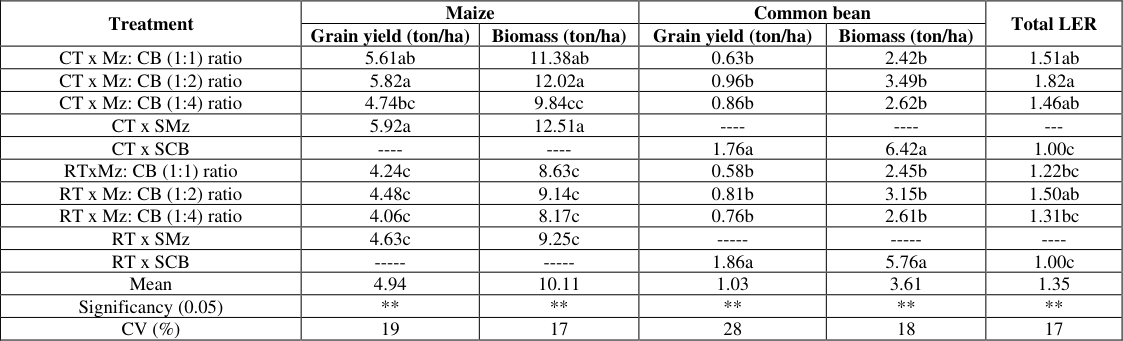 Table 1
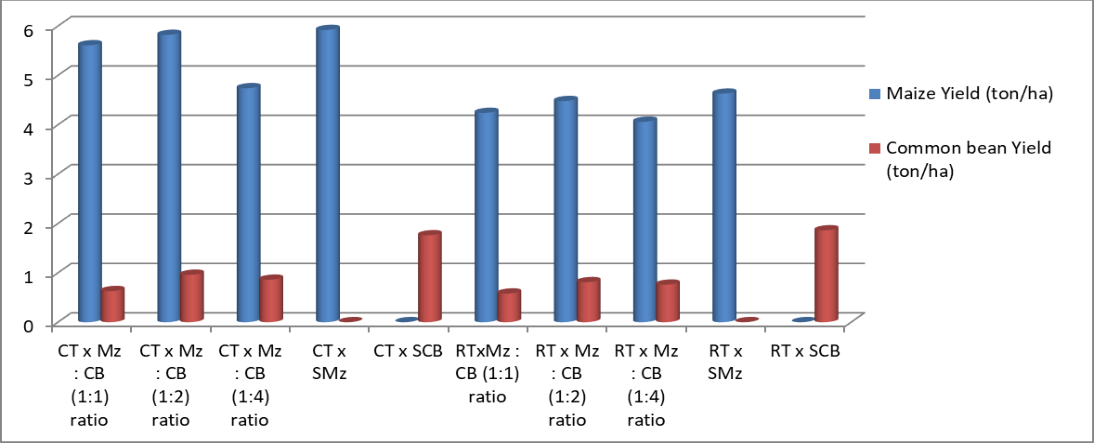 Figure 1
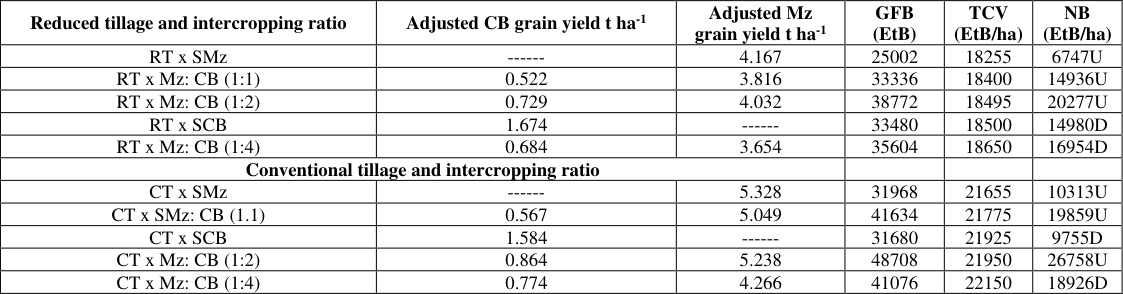 Table 2
 Table 3
 Table 4
Introduction
Intercropping is a type of mixed cropping and defined as the simultaneous cultivation of more than one crop species on the same piece of land (Hauggaard-Nielsen et al., 2008) [9] which aims to match efficiently crop demands to the available growth resources and labor. The most common advantage of intercropping is the production of greater yield on a given piece of land, improves soil fertility through biological nitrogen fixation with the use of legumes, increases soil conservation through greater ground cover than sole cropping, and provides better lodging resistance for crops susceptible to lodging than when grown in monoculture. Intercrops often reduce pest incidence and improve forage quality by increasing crude protein yield of forage. Intercropping also provides insurance against crop failure or unstable market prices for a given commodity, especially in areas subject to extreme weather conditions such as frost, drought, and flood. Thus, it offers greater financial stability than sole cropping, which makes the system particularly suitable for labor-intensive small farms. Moreover, intercropping allows lower inputs through reduced fertilizer and pesticide requirements, thus minimizing the environmental impacts of agriculture (Lithourgidis et al., 2011) [11] . For the success of the intercropping system, several aspects need to be taken into consideration before and during the cultivation process (Seran and Brintha, 2010) [18] . Those considerations include maturity of the crop, compatible crops, time of planting and plant density. The choice of compatible crops depends on the plant growth habit, land, light, water and fertilizer utilization (Brintha and Seran, 2009) [3] . When two or more crops are grown together the peak period of growth of components do not coincide to make their major demands on resources at different times. Plant competition could be minimized not only by the spatial arrangements but also by choosing compatible crops which are can exploit soil nutrients (Seran and Brintha, 2010) [18] . The primary rationale for this combination of practices is to protect the natural resource base for agriculture (preventing soil erosion) thereby contributing to the maintenance of long-run agricultural productivity. Conservation Agriculture is proposed to be widely applicable to areas and regions where it is not currently practiced. It is also believed to effectively be applicable irrespective of the size of land area and agroecologies (FAO, 2010) [7] . Therefore it is, containing a combination of tested scientific technologies, and its practice in Africa is now taking roots with increasing demand for more sustainable agricultural practices and better natural resources management and conservation (Thiombiano and Meshack 2009) [20] and it is increasingly promoted in Africa as an alternative for coping with the need to increase food production based on more sustainable farming practices. However, research has not been conducted concerning identification of ratio of maize to common bean intercropping and land management particularly in the study area so that growers could not get enough information on the productivity of the intercropped component crops. Therefore, initiated to evaluate the agronomic advantages of maize intercropping with common bean ratio in Jimma zone Omonada woreda.
Materials and Methods
Materials and Methods
Description of the study area
A Field experiment was conducted on farmer field Jimma zone Omonada Woreda in main cropping seasons. The Omonada site was located on 7º46' N and 36º 00'E and laid at an altitude up to 53 m.a.s.l. with soil type of the area is Upland: Chromic Nitosol and Combisol. The average maximum and minimum temperature are 9ºC and 28ºC respectively and reliably receive good rains 1561 mm per annum cropping season. The farming system of the study site is cereal crops dominated with maize, teff and sorghum also have a warm and cold climate, also convenient topography is very suitable for all agricultural practices. It was situated in the tepid to cool humid-mid highlands of southwestern Ethiopia. The soil type of the experimental area was Eutric-nitisols (reddish-brown).
Experimental procedure and field management
The conventional tillage plots were ploughed, disked, and harrowed by oxen while the reduced tillage plots were nonselective herbicide (roundup) chemical was applied 20 days before planting to control weeds and one seed was planted per hole at the specified Intra and inter-row spacing and sown in 1 st to 15 th May of each year. Harvesting was done manually when the crop reached harvest maturity from the net plots and sample of the stalk was allowed to sundry until it gains constant moisture to adjust biomass yield and calculate harvest index.
Experimental design and treatments
The experiment was established using a strip plot design, replicated three times. The treatments were consists of two tillage methods Conventional tillage (CT), Reduced-tillage (RT) and the intercropping treatments of maize common bean consisted three levels based on placement ratios of 1:1, 1:2, 1:4 respectively which was for one maize plant to one common bean plant in maize intra row (1:1); one maize plant to two common bean plant in maize intra row (1:2) and one maize plant to four common bean plant in maize intra row spacing (1:4) ratios and sole maize and sole common bean. Two maize seeds were planted per hill and then thinned to one plant per hill after the good establishment of seedlings to maintain a single healthy plant per hill. Common bean also thinned and maintained according to the treatments. Maize hybrid (BH661) and common bean (Nasir) varieties were used as test crops, which were widely adopted, produced and high yielder varieties at the study area. For maize recommended phosphorus rates (P 2 O 5 ) 69 kg ha - 1 at planting and 92 kg ha -1 nitrogen fertilizer rate was applied during planting and another half at the knee height growth stage to increase the nitrogen use efficiency. All other agronomic practices were applied uniformly for both crops and to all experimental plots in the study area.
Crop data collected Maize components
Grain yield (t ha -1 ) Grain yield per plot was recorded using an electronic balance and then adjusted to 12.5% moisture and converted to a hectare basis.
All above ground biomass was harvested from the net plot and weighted, ears were removed and weighted separately, sample stalks were selected, chopped and sundried till getting uniform weight.
Land equivalent ratio (LER)
Calculated using methods of Mead and Willey (1980) [14] , and Willey and Rao (1980) [21] . LER = (Yab/Yaa) + (Yba/Ybb) Where Yaa and Ybb are yields as sole crops and Yab and Yba are yields in intercrops. LER values greater than 1 indicate the advantage of intercropping over monoculture.
It was measured from each plot using an electronic balance and then adjusted to 7.0% moisture and converted to hectare basis.
All above ground biomass was harvested from the net plot and weighted, sample plants were selected dried till getting uniform weight.
Land equivalent ratio (LER)
Calculated using methods of Mead and Willey (1980) [14] , and Willey and Rao (1980) [21] . LER = (Yab/Yaa) + (Yba/Ybb)
Data analysis
Analysis of variance (ANOVA) for all collected data was computed using SAS version 9.3 statistical software. Whenever the ANOVA results showed the significant differences between sources of variation, the means were compared using the least significant difference. The homogeneity test was done as suggested by Gomez and Gomez, (1984).
Economic analysis
To assess the costs and benefits associated with different treatments (maize common bean intercropping and tillage practices), the partial budget technique as described by CIMMYT (1988) was applied. Economic analysis was done using the prevailing market prices for inputs at planting and outputs, at the time the crop was harvested. All costs and benefits were calculated on the ha -1 basis of Ethiopian Birr (EtB). The inputs and/or concepts used in the partial budget analysis were the mean grain yield of each treatment in both years, the field price of BH661 maize and common bean grain (sale price grain yield minus the costs of fertilizer, seed, labor) the gross field benefit (GFB) ha -1 (the product of field price of the mean yield for each treatment), the field price of Seed kg ha - 1 , chemical, fertilizer and wage rate, the total costs that varied (TCV) which included the sum of field cost of seed, chemical, fertilizer and its wage for planting and application. The net benefit (NB) was calculated as the difference between the GFB and the TCV. The actual yield was adjusted downward by 10% to reflect the difference between the experimental yield and the yield farmers could expect from the same treatment. There were expected plant population density, timely labour availability, and better management (e.g. weed control, rainfall) under the experimental conditions CIMMYT, (1988) [5] . The dominance analysis procedure as detailed in CIMMYT (1998) [5] was used to select potentially profitable treatments from the range that was tested. The discarded and selected treatments using this technique were referred to as dominated and undominated treatments, respectively. The undominated treatments were ranked from the lowest to the highest cost. For each pair of ranked treatments, the percent marginal rate of return (MRR) was calculated. The MRR (%) between any pair of undominated treatments was the return per unit of investment in all inputs. To obtain an estimate of these returns the MRR (%) was calculated as changes in NB divided by changes in cost. Thus, the MRR of 100% was used indicating for every one EtB expended there is a return of one EtB for a given variable input. Sensitivity analysis for different interventions was also carried out to test the recommendation made for its ability to withstand price changes. Sensitivity analysis simply implied redoing marginal analysis with the alternative prices. Through sensitivity analysis, the maximum acceptable field price of input was calculated with the minimum rate of return as described by Shah et al. (2009) [19] .
Results and Discussion
Results and Discussion
Grain yield
Across season effect of both tillage and intercropping were significant (P<.001) on grain yield in both maize and common bean. The highest 5.92 t/ha maize grain yield was recorded from conventional tillage sole but due to the effect of intercropping the higher maize mean grain yield of 5.82 and 4.74 t/ha were recorded from conventional and reduced tillage respectively with (1:2) maize to common bean ratio (Fig 1). While the lowest grain yield 4.74 and 4.06 t/ha was recorded from conventional and reduced tillage respectively with (1:4) maize to common bean ratio intercropped. Generally, maize grain yield was sowed a kind increase with common bean intercrop ratio and gradually decline with a further increase. The maize to common bean (1:2) ratio intercropped under conventional tillage practice maize grain yield was significantly increased from 5.82 t ha -1 to 4.74 t ha -1 which means increased by 22.78% over the highest common bean (1:4) ratio or over the highest common bean density. The same trend of advantage was observed from reduced tillage intercropping ratio by 10.32%. (Table 1). Generally due to the effect of conventional tillage with maize to common bean (1:2) ratio intercropped maize showed 43.35% grain yield advantage over reduced tillage maize to common bean (1:4) ratio intercropped (Fig 1). This is due to a high density of common bean results computations to moisture, nutrients, and other resources. The aim of this cropping system is to optimize factors and environmental resources usage, thus leading to an increased yield or output of the mixture (Li w., et al., 2005; Dwivedi et al., 2015) [6] . In addition to maximization of crop productivity, intercropping is much less risky in that if one crop fails another or the others may still be harvested. Similarly, Abera et al. (2016) [1] reported that intercropping advantage may come from better resources (moisture, light, and nutrient) utilization with low interspecific interaction and better complementary effect. In the case of common bean, the highest 1.86 t/ha grain yield was recorded from reduced tillage sole but due to the effect, common bean intercropped the higher mean grain yield 0.96 and 0.81 t/ha were recorded from conventional and reduced tillage respectively with (1:2) maize to common bean ratio (Table 1). The effect of conventional tillage with maize to common bean (1:2) ratio intercropped maize showed 65.52% grain yield advantage over reduced tillage maize to common bean (1:1) ratio and by 18.52% the same maize to common bean (1:2) ratio conventional over reduced tillage. While the lowest common bean grain yield 0.63 and 0.58 t/ha was recorded from conventional and reduced tillage respectively with (1:1) maize to common bean ratio intercropped. Similarly, (Bedoussac et al., 2015; Giller, 2001) [2,8] the mechanisms associated with an increase in yield due to enhanced nitrogen nutrition of the cereal crop sown in association with a grain legume are widely reported.
| Treatment | Maize | — | Common bean | — | Total LER |
|---|---|---|---|---|---|
| Grain yield (ton/ha) | Biomass (ton/ha) | Grain yield (ton/ha) | Biomass (ton/ha) | ||
| CT x Mz: CB (1:1) ratio | 5.61ab | 11.38ab | 0.63b | 2.42b | 1.51ab |
| CT x Mz: CB (1:2) ratio | 5.82a | 12.02a | 0.96b | 3.49b | 1.82a |
| CT x Mz: CB (1:4) ratio | 4.74bc | 9.84cc | 0.86b | 2.62b | 1.46ab |
| CT x SMz | 5.92a | 12.51a | ---- | ---- | --- |
| CT x SCB | ---- | ---- | 1.76a | 6.42a | 1.00c |
| RTxMz: CB (1:1) ratio | 4.24c | 8.63c | 0.58b | 2.45b | 1.22bc |
| RT x Mz: CB (1:2) ratio | 4.48c | 9.14c | 0.81b | 3.15b | 1.50ab |
| RT x Mz: CB (1:4) ratio | 4.06c | 8.17c | 0.76b | 2.61b | 1.31bc |
| RT x SMz | 4.63c | 9.25c | ----- | ----- | ---- |
| RT x SCB | ----- | ----- | 1.86a | 5.76a | 1.00c |
| Mean | 4.94 | 10.11 | 1.03 | 3.61 | 1.35 |
| Significancy (0.05) | ** | ** | ** | ** | ** |
| CV (%) | 19 | 17 | 28 | 18 | 17 |
Table text extracted from the original PDF; superscript letters are shown inline. The original table image is below.
View original table image
Above ground biomass yield
The effect of both tillage and intercropping were significant (P<.001) on above ground biomass. The highest 12.51 t/ha was recorded from conventional tillage sole maize but due to the effect of intercropping the higher 12.02 and 9.14 t/ha maize above ground biomass yield was recorded from conventional and reduced tillage respectively with 1:2 maize to common bean ratio. While the lowest grain yield 9.84 and 8.17 t/ha was recorded from conventional and reduced tillage respectively with 1:4 maize to common bean ratio. The above ground biomass yield result showed that an increase with common bean intercrop up to 1:2 ratio and decline with a further increase under both tillage practices The maize to common bean (1:2) ratio under conventional tillage practice above ground biomass was significantly increased from 12.02 t ha -1 to 9.84 t ha -1 which means increased by 22.15% over the highest common bean (1:4) ratio (Table 1). This is due to a high density of common bean computation to resources. In the case of common bean the highest 6.42 and 5.76 t/ha above ground biomass was recorded from conventional and reduced tillage with sole common bean but due to the effect of intercropping the higher mean above ground biomass yield of common bean intercropped was 3.49 and 3.15 t/ha was recorded from conventional and reduced tillage respectively with (1:2) maize to common bean ratio intercropped (Table 1). The effect of maize to common bean (1:2) ratio intercropped maize showed 44.21% above ground biomass yield advantage over common bean (1:1) ratio under conventional tillage. While the lowest common bean biomass yield 2.42 and 2.45 t/ha was recorded from conventional and reduced tillage with 1:1 respectively. Generally, the above ground biomass yield was increased due to intercropping two crops per unit of land and their positive relationship. The result is in agreement with (Giller, 2001) [8] the overall productivity of intercrops is attributed to the differences in acquisition and utilization of growth resources such as nutrients, moisture, and light interception.
Total land equivalent ratio
The effect of both tillage and intercropping were significant (P<.001) on total LER. The total land equivalent ratio ranges from 1.22 for reduced tillage with maize common bean (1:1) ratio to 1.82 for conventional tillage with maize common bean (1:2) ratio indicating 22-82% relative yield advantage of intercropping over sole cropping (Table 1). Total LER values were higher than one showing the advantage of intercropping over sole stands in regard to the use of environmental sources for plant growth (Mead and Willey, 1980) [14] . Similar results were reported for mix-proportions of pea-barley (Chen et al., 2004) [4] and maize-faba bean (Li et al., 1999). In both cases of intercropping consistently increase with increased common bean ration and decline with further increased
Economic viability of maize common bean intercropping and tillage practices
Analysis of variance (Table 2) of maize common bean intercropping and tillage practices showed a significant (P = 0.001) effect on the grain yield maize and common bean whereas interaction was not significant. An economic analysis of the combined results using the partial budget technique was thus appropriate (CIMMYT, 1988) [5] . The result of the partial budget analysis and the data used in the development of the partial budget is given in (Table 2). It was performed by considering fertilizer, chemical, seed, application costs, and labor as the main input, mean grain yield obtained across the season. The total costs of fertilizers (NPS = 15.90 EtB/kg and urea = 12.65 EtB/kg were calculated based on store sale prices of both woreda's farmers' Cooperative in May, 2017/8 and sale of maize and common bean grain at Omonada open market average price (6 and 20 EtB/kg) respectively. Dominance analysis (Table 2) led to the selection of treatments RT x SMz, RT x Mz: CB (1:1), RT x Mz: CB (1:2) from Reduced tillage and CT x SMz, CT x Mz: CB (1:1) and CT x Mz: CB (1:2) intercropping from Conventional tillage were ranked in increasing order of total costs that vary. There were no treatments having MRR below 100% was considered and unacceptable to farmers; were eliminated (CIMMYT, 1988) [5] (Table 3). This was because such a return would not offset the cost of capital (interest) and other related deal costs while still giving an attractive profit margin to serve as an incentive. partial budget analysis based on the field prices of inputs and maize and common bean grain yield showed that, The maize common bean (1:2) ratio intercropped gave the highest net benefit 26758 ETB with acceptable MMR 3942% and 20277 ETB with MMR 5622% obtained from conventional and reduced tillage respectively. Market prices are ever-changing and as such a recalculation of the partial budget using a set of likely future prices i.e., sensitivity analysis, was essential to identify treatments that may likely remain stable and sustain satisfactory returns for farmers despite price fluctuations. The sensitivity analysis study indicates an increase in the field price of the total variable costs, and a fall in the price of maize and common bean grain, which represented a price variation of 15% (Table 4). The price changes are sensitive under market conditions prevailing at Omonada which was all RT x Mz: CB (1:1), RT x Mz: CB (1:2) from Reduced tillage and CT x Mz: CB (1:1) and CT x Mz: CB (1:2) intercropping from Conventional tillage gave above the minimum acceptable MRR of 100% which means not sensitive to price fluctuations. Therefore, this investigation remained RT x Mz: CB (1:2) and CT x Mz: CB (1:2) with changes maize and common bean were promising new practices with a highest net benefit of 20277 ETB with acceptable MMR 5622% and 26758 ETB with MMR 3942% respectively for farmers at Omonada under the prevailing price structure since they gave more than 100% MRR. These results agree with Bekele, H. (2000).
| Reduced tillage and intercropping ratio | TCV (EtB/ha) | NB (EtB/ha | Raised cost | Raised benefit | MRR (%) |
|---|---|---|---|---|---|
| RT x SMz | 20993 | 5735 | --- | --- | --- |
| RT x Mz: CB (1:1) | 21160 | 12696 | 167 | 6961 | 4168 |
| RT x Mz: CB (1:2) | 21269 | 17235 | 109 | 4539 | 4164 |
| Conventional tillage and intercropping ratio | |||||
| CT x SMz | 24903 | 8766 | --- | --- | --- |
| CT x Mz: CB (1:1) | 25041 | 16880 | 138 | 8114 | 5880 |
| CT x Mz: CB (1:2) | 25243 | 22744 | 202 | 5864 | 2903 |
Table text extracted from the original PDF; superscript letters are shown inline. The original table image is below.
View original table image
| Reduced tillage and intercropping ratio | TCV (EtB/ha) | NB (EtB/ha | Raised cost | — | Raised benefit | MRR (%) |
|---|---|---|---|---|---|---|
| RT x SMz | 18255 | 6747 | ---- | ---- | ---- | |
| RT x Mz: CB (1:1) | 18400 | 14936 | 145 | 8189 | 5648 | |
| RT x Mz: CB (1:2) | 18495 | 20277 | 95 | 5341 | 5622 | |
| Conventional tillage and intercropping ratio | ||||||
| CT x SMz | 21655 | 10313 | ---- | ---- | ---- | |
| CT x Mz: CB (1:1) | 21775 | 19859 | 120 | 9546 | 7955 | |
| CT x Mz: CB (1:2) | 21950 | 26758 | 175 | 6899 | 3942 |
Table text extracted from the original PDF; superscript letters are shown inline. The original table image is below.
View original table image
| Reduced tillage and intercropping ratio | Adjusted CB grain yield t ha-1 | Adjusted Mz grain yield t ha-1 | GFB (EtB) | TCV (EtB/ha) | NB (EtB/ha) |
|---|---|---|---|---|---|
| RT x SMz | ------ | 4.167 | 25002 | 18255 | 6747U |
| RT x Mz: CB (1:1) | 0.522 | 3.816 | 33336 | 18400 | 14936U |
| RT x Mz: CB (1:2) | 0.729 | 4.032 | 38772 | 18495 | 20277U |
| RT x SCB | 1.674 | ------ | 33480 | 18500 | 14980D |
| RT x Mz: CB (1:4) | 0.684 | 3.654 | 35604 | 18650 | 16954D |
| Conventional tillage and intercropping ratio | |||||
| CT x SMz | ------ | 5.328 | 31968 | 21655 | 10313U |
| CT x SMz: CB (1.1) | 0.567 | 5.049 | 41634 | 21775 | 19859U |
| CT x SCB | 1.584 | ------ | 31680 | 21925 | 9755D |
| CT x Mz: CB (1:2) | 0.864 | 5.238 | 48708 | 21950 | 26758U |
| CT x Mz: CB (1:4) | 0.774 | 4.266 | 41076 | 22150 | 18926D |
Table text extracted from the original PDF; superscript letters are shown inline. The original table image is below.
View original table image
Conclusion and Recommendations
Across season effect of both tillage and intercropping were significant (P<.001) on grain and above ground biomass yield of maize and common bean under both conventional and reduced tillage practices. Generally, the maize common bean (1:2) ratio intercropped gave the highest grain and above ground biomass yield of maize and common bean under both tillage practices. That is the an optimum intercropping for both crops grain yield result in economically visible Besides this, it gave the higher net benefit 26758 ETB with acceptable MMR 3942% and 20277 ETB with MMR 5622% obtained from conventional and reduced tillage respectively was taken as optimal even not sensitive under changing the price. So that both conventional and reduced tillage with maize to common bean 1:2 ratio was compatible and economically optimum practice optionally for those maize and common bean producing areas. Therefore, for the future production of maize hybrid, (BH661) with Common bean (Nasir) variety intercropping in Omonada and adjacent woredas with similar agro-ecologies a maize common bean intercropping under both conventional and reduced tillage practice with maize common bean ratio (1:2) intercrop can be recommended based on farmers inputs and labor availability.
References
21 in the original paper- Abera Habte, Mesfin Kassa Adera Sisay. Maize (Zea mays L.) Common Bean (Phaseolus vulgaris L.) Intercropping Response to Population Density of Component Crop in Wolaita Zone Southern Ethiopia. Journal of Natural Sciences Research 2016.
- Bedoussac L, Jensen ES, Carlsson G, Journet EP, Justes E, Hauggaard-Nielsen H. Enhancing yields in organic crop production by eco-functional intensification. Sustain. Agric. Res 2015;4:42-50.
- Brintha I, Seran TH. Effect of paired row planting of radish (Raphanus sativus L.) intercropped with vegetable amaranthus (Amaranthus tricolor L.) on yield components of radish in sandy regosol. Journal of Agricultural Science 2009;4:19-28.
- Chen C, Westcott M, Wichmann K, Knox D. Row configuration and nitrogen application for barely-pea intercropping in Montanan. Agron. J 2004;96:1730-1738.
- CIMMYT (International Maize and Wheat Improvement Center). Partial budget analysis for mean grain yield 1988.
- Dwivedi A, Dev I, Kumar V, Yadav RS, Yadav M, Gupta D, Singh A, Tomar SS. Potential Role of Maize-Legume Intercropping Systems to Improve Soil Fertility Status under Smallholder Farming Systems for Sustainable Agricultu re in India. Int. J Life Sci. Biotech. Pharm. Res 2015;4:3.
- FAO (Food and Agriculture Organization). Fertilizers and their use. International Fertilizer Industry Association. Food and Agriculture Organization of the United Nations Rome, Italy 2010.
- Giller KE. Nitrogen Fixation in Tropical Cropping Systems, 2nd edition. CAB International, Wallingford, UK 2001.
- Hauggaard-Nielsen H, Jørnsgaard B, Kinane J, Jensen ES. Grain legume-cereal intercropping: the practical application of diversity, competition and facilitation in arable and organic cropping systems. Renewable Agriculture and Food Systems 2008;23 (1):3-12.
- Hurni H. Soil Formation rates in Ethiopia. Working Paper 2. Ethiopian High land Reclamation Study, Ministry of Agriculture, Addis Abeba, Ethiopia 1983.
- Lithourgidis AS, Dordas CA, Damalas CA, Vlachostergios D. Annual intercrops: an alternative pathway for sustainable agriculture. Australian journal of crop science 2011;5(4):396.
- Li L, Yang S, Li X, Zhang F, Christie F. Interspecific complementary and competitive interactions between intercropped maize and faba bean. Plant Soil 1999;212:105114.
- Li W, Li L, Sun J, Guo T, Zhang F, Bao X, Peng A, Tang. Effects of intercropping and nitrogen application on nitrate present in the profile of an Orthic Anthrosol in Northwest China. Agriculture, Ecosystems and Environment 2005;105:483-491.
- Mead R, Willey RW. The concept of a land equivalent ratio and advantages in yields for intercropping. Exp. Agric 1980;16:217-228.
- Oelsligle DD, McCollum RE, King BT. Soil Fertility Management In Tropical Multiple Cropping Systems, PP275-295. In: Multiple Cropping (R.T. Papendick and P.A. Sanchez (Eds)) Am.Soc. Agron Publ 1976, 27.
- Pretty J, Bharucha ZP. Sustainable intensification in agricultural systems. Ann. Bot 2014;114:1571-1596.
- SAS Institute. SAS/STAT guide for personal computers, SAS Institute Inc., North Carolina, USA 2003.
- Seran TH, Brintha I. Review on maize based intercropping. Journal of agronomy 2010;9(3):135-145.
- Shah H, Sharif M, Majid A, Hayat U, Munawar A. From experimental data to farmer recommendation: an economic analysis of on-farm trial of UMMB feed for milking animals in rain-fed Pothwar, Pakistan. Livestock Research and Rural Development 2009;21(8):1-8.
- Thiombiano L, Meshack M. Scaling-up Conservation Agriculture in Africa: Strategy and Approaches. FAO Subregional Office for Eastern Africa. Addis Ababa 2009.
- Willey RW, Rao MR. Competitive Ratio for Quantifying Competition between Intercrops. Expt. Agric 1980;16:117125.