
Research article · 2020 · Full text
International Journal of Veterinary Sciences and Animal HusbandrySwiss cheese model as an instrument for identification of risks, weaknesses and shortcomings in the animal health system
Volume 5(4) · Pages 132–135
Research areasAnimal Disease Management and Epidemiology
Abstract
Author-writtenThe "Swiss cheese" model can reveal the presence of many small defects or errors in the system, which creates the preconditions for the emergence of danger. In an ideal world, each layer of protection should be intact. In the model, each slice of cheese represents a specific safety barrier or a safety measure associated with a specific hazard. In the present study we used the "Swiss cheese" model as a tool to identify key weaknesses in the program for prevention, control and eradication of highly pathogenic avian influenza (HPAI) in Bulgaria for 2017. In the analysis of the institutional risks we used the OIE criteria for assessment of the Veterinary Services (OIE PVS Tool, 2010). Recommendations were made on the need to comply with good administrative practices and maintain an adequate system for documenting and reporting their activities throughout the hierarchical chain.
Summary
Source-checkedPlain-language reading of the full paper, prepared with AI and checked against the text. Each point links to the authors' own words.
Why it matters
- In this model, each slice of cheese represents a specific safety barrier or measure designed to prevent a hazard. View evidence ↗
- Accidents happen when gaps (holes) in multiple safety layers align, allowing a hazard to pass through all barriers. View evidence ↗
What they did
- Institutional risks were analyzed using the OIE PVS Tool (2010) criteria for assessing veterinary services. View evidence ↗
- The study used Kirwan's (1998) taxonomy of mistake mechanisms to categorize the identified shortcomings. View evidence ↗
What they found
- The HPAI program suffered a 6-month delay at the start due to late contracting of labs, reagents, and private veterinary practitioners. View evidence ↗
- Many animals, particularly those on 'back yard farms,' were excluded from surveillance because private veterinary practitioners were unfamiliar with their assigned service districts. View evidence ↗
- The national reference laboratory lacked the necessary diagnostic materials and reagents to differentiate between high and low pathogenic avian influenza strains. View evidence ↗
- The program faced financing issues and lacked an analysis of previous years' performance, including cost-benefit ratios and prevention methods. View evidence ↗
What it means
- The authors conclude that the Bulgarian Food Safety Agency (BFSA) must implement good administrative veterinary practices and maintain a proper record-keeping system across its hierarchy. View evidence ↗
- The authors recommend that the BFSA map and categorize regions by HPAI risk, considering migratory bird paths, ponds, farm concentrations, and biosecurity. View evidence ↗
Visual summary
1 visualsIllustrations explain the paper; they do not show study data.
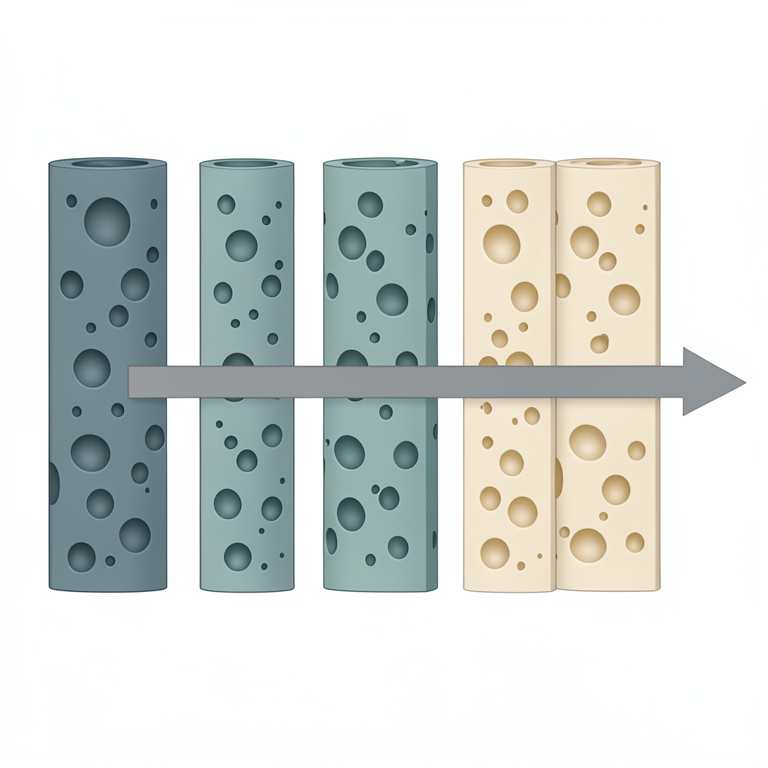
Conceptual Swiss Cheese Model
AI-generated conceptual illustration (slices of Swiss cheese). It explains the idea and does not show study data.
View source evidence ↗Figures & tables
From the original paper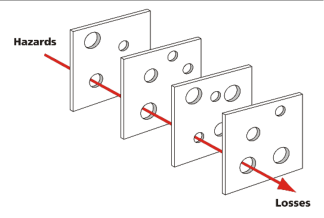 Figure 1
Introduction
In its part for risk assessment, the risk management standard ISO 31010 [1] lists various methods that are related to the identification and characterization of existing and potential hazards, the implementation of which due to the gaps in the system of prevention, monitoring and control can lead to negative consequences and failure to achieve the set goals. A model often used in the investigation of major accidents and disasters in complex technological systems is better known as the "Swiss cheese" model. This model can reveal the presence of many small defects or errors in the system, which creates the preconditions for the emergence of danger. Reason J. (1990) [2] assumes that there are different barriers and precautionary measures between the danger and the possibility for its introduction. In the model, each slice of cheese represents a specific safety barrier or a safety measure associated with a specific hazard. Accidents occur when the holes in the different layers are arranged in such a way as to allow the trajectory of danger to pass unimpeded through each barrier. In the model, each piece of cheese represents certain precautionary measure or barrier associated with a certain danger. Incidents occur than when the holes in the different layers arrange themselves in a way to facilitate the trajectory of the dangers to pass unlimitedly through each barrier (Fig. 1). The risks are objective and are present in all businesses and activities. That's why it is not realistic to consider that they would reduce to zero. The risks rarely are independent and oftener they influence each other. All this requires the risks and the dangers to be analyzed and assess in complex. Analysis and the management of the risk is a part of the internal control systems of every organization. The competent body for the official veterinary control in Bulgaria is the Bulgarian Food Safety Agency (BFSA). The different external and internal factors in the activity of the BFSA present source of different risks. As external ones are the insufficient financing, not finalized contracts with external organizations et cet. The internal ones are generating from the system itself such as losing the public trust, when the tasks are not performed according the legislative requirement as well as when there is deviation from the strategic and operative targets as a consequences from wrongly formulation of the priorities or due to wrong distribution of the human and financial resources. Risk could occur in association with the mistakes in official veterinarians' training, imprecise tasks performance or analysis of the epidemiological situation.
Material And Methods
With the aim at the "Swiss cheese" model we try to identify the weaknesses, imperfections and shortcomings in the animal health system and the fertilization measures as laid down in the programs for prevention, limitation and liquidation of the infection animal diseases, which could threaten their goals achievement to answer to the following questions: What could be happened? (to define the concrete risk) How it could happen? (what are the possible scenarios) When (the time of happening) To whom or what is concerned? ( when the bioterrorism is concerned and what is the probable range of this attack) How we recognize the insignificant and tenacious from the big serious risks (risk prioritization) What are the consequences in case that something goes wrong ( direct, indirect, material, non-material, damages associated with followed up effects and in what time frame) What is probability to happen? What could be done to prevent or diminish probability something to go wrong and all the consequences to be reduced to minimum, if it happens? How effective and efficient are the counteraction measures at different scenarios (what is their technical, social, organizational, institutional, infrastructural, financial and economic performance) To what extend the achievement of the goals as laid down in the programs for prevention, limitation and liquidation of the infection animal diseases is threaten?
In the present analysis we used the Swiss cheese model as an instrument for identification of the key shortcomings in the program for prevention and control of highly pathogenic avian influenza (HPAI) in Bulgaria 2017.
Analyzing the institutional risks we used the OIE criteria for the veterinary services assessment (OIE PVS Tool, 2010) [3] , having impact on the risks associated with BFSA activity. The analysis was focused on: Data for the epidemiology HPAI Н5N8 evolution at national, regional and global aspect for the 2016-2017 period Strategic and operative goals as laid down in the prevention, limitation and liquidation of HPAI in birds q the measures' range, the time frame and the steps for the program measures' implementation Legislation, the status of the animal health system's functional components among the participants in the program (the horizontal and the vertical tights between the private veterinary practitioners, official veterinarians and the labs) Monitoring and control on the quality of performance, criteria for results' assessment, commitment of the results to the end and intermediate goals of the program, critical points and corrective actions Technical social, organizational, institutional, financial and economic performance of the program, for instance the activity expediency in accordance with the results achieved toward the goals set or as an degree of certain goals achievement related to then actual and expected results from the activity), resource security-financial and human resources and et cet.
Commission Directive 2005/94/ЕО [4] lays down the minimum measure to control the disease applied by the official veterinary services of the EU member States in case of HPAI outbreak. Commission Decision 2005/734/ЕО [5] lays down the biosecurity measures and additional measures for limitation of the risk with aim at reducing the risk of HPAI subtype H5N1 spread between the wild and domestic birds and other birds, kept in close premises as well as some preventive measures associated with the surveillance and early HPAI detection.
The decision obligates the EU Member States to introduce systems for early HPAI detection so that the farmers have opportunity to report immediately to the official veterinarian about any sign of HPAI infection in domestic bird flocks as the official veterinary service is obligate to undertake concrete parameters as well as the smallest changes in the on-going working data. Decision 2010/367/ЕС [6] distinguishes the directions for mandatory implementation of the HPAI eradication and control program, including the samples' taking. It says that the competent bodies should be notifying immediately about any presence of the higher than normal mortality or any important diseases or mortality among the wild birds. Regulation (ЕС) № 2016/429 [7] lays down rules for prophylactic and control of zoonosis. According to the regulation of outmost importance is that the competent body has a surveillance system for early animal diseases' notification which system is monitored by the body. The surveillance methodology, the frequency and the intensity hence should be adapted to each concrete animal disease and to monitor the concrete surveillance goal, animal health status in the region in question and any additional monitoring exercised by the owner of the animals. Regulation (EС) 2017/625 introduces the common frame of the official control and other official activity exercised to guaranty implementation of the food chain legislationofficial control on food and feed safety animal and plant health and animal welfare [8] . Ordinance № 44 as of 2006 [9] introduces the veterinary medicine requirements for the animal premises and farm where the animals are rearing. Another important Bulgarian legislation is Ordinance №16 от 2006 [10] regarding the animal welfare at rearing the domestic animals and the Law of Veterinary Activity [11] .
The measure described in the above mentioned legislative documents were used as a basis for the critical points' determination in the HPAI prevention and control program. They are representing graphically in Fig 1 as slice of cheese represents a specific safety barrier or a safety measure associated with a specific hazard.
The taxonomy of the mechanism of the mistake elaborated by Kirwan (1998) [12] served to us for mistakes' conclusion: Shortcomings: task or step from the tasks omissions Time: the action undertook too late, too early or coincided by time with other event Sequence: wrong sequence, the activity is repeated or hidden mistake prevent the performance Quality: too much, insufficient, wrong direction, exchange or another quality and accuracy mistake Mistakes in choice: right action, but wrongly subject chosen, wrong action, but rightly subject chosen, wrong action, wrong subject or exchange omission Mistakes on information exchange which is not announced, wrongly submission of information or unclear information Legislative requirements' violation Other mistakes
Results And Discussion
During the second half of 1014 and in the beginning of 2015 the HPAI, subtype H5N8virus has spread was introduce to the EU by wild birds. After 2016 the HPAI virus penetrated in 20 EU Member States, among them was also Bulgaria. In the context of the changed situation BFSA had strictly to monitor the performance of the HPAI surveillance and control program. And instead of straitening the role of the active monitoring as it is recommendable in this situation, it continued to relay on the passive monitoring. The analysis of the performance of the HPAI surveillance and control program during the last few years revealed serious shortcomings. They were mainly linked to delay of 6 months from the start of the program due to late contracting of the private veterinary practitioners, reagent and consummative delivery, labs which had to elaborate the samples. It led on practice to miss the seasonal and cyclic occurring diseases in which all the program was flawed. The private veterinary practitioners did not know their districts of service so that the big number of animals, especially those from "back yards farms" remained out of the surveillance and control activity. The national referent lab found itself without necessary reagents and diagnostic materials for type differentiation of high and low pathogenic avian influenza virus' strains. Having in mind that the Bulgarian animal health legislation is fully harmonized with the EU ones, there were some shortcomings found in implementation at the time of the epidemic. For instance, in Ordinance № 44 introducing the veterinary medicine requirements for the animal premises and farm where the animals are rearing, it was found, that the biosecurity measures for the waterfowl farms were deleted, no matter that these farms present highest degree of the risk. In addition in Ordinance №16 there were not included the measures for the waterfowl hatcheries. These shortcomings in the national legislation created a number of problems associated with limitation and control of HPAI disease as the poultry farmer's responsibilities weren't clearly defined. Some of them weren't agreed among the different animal health legislative acts on one side and the others were interpreted in different way by different institutions.
The analysis revealed also problems with the financing the HPAI surveillance and control program. It found out that there was no analysis of the results and problems linked to the performance from the previous years and the ways of their prevention (efficiency and cost benefit ratio). It means that when the program was agreed it wasn't done together with then financial frame, which guaranties its financial security. The efficient bio-security measures in the agry holdings have to be important criteria in deciding free diseases status of the farms and zones as well as for the type and lengthiness of the control measure implemented that linked to trade with live animals and their products.
Conclusions
On the basis of the analysis done we could conclude that the BFSA has to introduces and stick to the good administrative veterinary practices and to keep adequate system for records keeping alongside all hierarchic chain. The BFSA in future needs to map and categorize the regions according to the degree of HPAI risk on the basis of complex assessment of the migratory birds' pathways, the natural and artificial ponds, that serve the wild birds as the temporary habitats, the concentration of the poultry farms and waterfowl farms and last but not at least their bio-security.
Acknowledgement
AcknowledgmentsMy acknowledgement goes to the colleagues of Risk Assessment Center on Food Chain and Ass. Prof. Dr. Yanko Ivanov.
References
12 in the original paper- IEC 31010:2019, Risk management-Risk assessment techniques: Risk management --Risk assessment techniques
- Reason J. "Swiss Cheese" Model, 1990, Cambridge: University Press, Cambridge, 1990.
- The OIE, Tool for the Evaluation of Performance of Veterinary Services (OIE PVS Tool) 2019. https://www.oie.int/fileadmin/Home/eng/Support_to_OIE _Members/docs/pdf/2019_PVS_Tool_FINAL.pdf :
- Directive 2005/94/EО of 20 December 2005 on the Community measures for the control of avian influenza and repealing Directive 92/40/EEC, OJ L 10, 2006; 14(1):16-65
- 2005/734/EC: Commission Decision of 19 October 2005 laying down biosecurity measures for reducing the risk of transmitting highly pathogenic avian influenza caused by avian influenza virus type A subtypeH5N1 from birds living in the wild and other captive birds and providing for an early detection system in areas in particular risk, OJ L 274, 2005; 20(10):105-107
- 2010/367/EC: Commission Decision of 25 June 2010 on implementation by Member States of surveillance program of avian influenza in poultry and wild birds, OJ L 166, 2010; 1(7):22-32
- Regulation (ЕU) 2016/429 of the European parliament and the Council of 9 March 2016 on transmissible animal disease and amending and repealing certain acts in the area of animal health (Animal Health Law), OJ L 84, 2016; 31(3):1-208
- Regulation (EС) 2017/625 of the European parliament and the Council of 15 March 2017 on official control and other activities to ensure the application of food and feed law, rules on animal health and welfare, plant health and plant protection products, amending Regulations (ЕО)
- Ordinance regarding the veterinary medical requirement for the animal holdings, SG 41, last amended SG 44 of 10, 2016
- Ordinance №16 of 2006 regarding the animal welfare at rearing the domestic animals, SG 18 of 18 February 2006, last amended SG 61 of 28, 2017
- Law on Veterinary Activity, SG 87 of 2005г, last amended SG 52 of 29, 2020
- Kirwan B. Human error identification techniques for risk assessment of high-risk systems, book, 1998. University of Birmingham, 1998.