
Research article · 2019 · Full text
International Journal of Agriculture Extension and Social DevelopmentImpact of different growing media and varying pot sizes on growth of pepper (Capsicum annuum L.) Under greenhouse conditions
Volume 2(1) · Pages 28–31 · DOI: 10.33545/26180723.2019.v2.i1a.20 ↗
Research areasPlant Growth and Agriculture TechniquesGrowth and nutrition in plants
Abstract
Author-writtenThe objective of this study was to determine the effect of different soil media and varying pot sizes on the early growth of capsicum annum. Nine treatments were used for the study and these were replicated 3 times. The various soil media used are as follows: Topsoil, clay soil, river sand while the varying pot sizes were 1kg, 2k and 3kg. The experiment was 3x3 factorial experiment laid out in completely randomized design (CRD). Parameters assessed were leaf count, plant height (cm) and collar diameter (mm), each parameters were assessed for ten weeks. The data collected at the end of ten weeks were subjected to Analysis of Variance (ANOVA) and means were separated using Duncan test showed that plant sown in 3kg pot of topsoil (T9) had the highest performance in the seedling height, leaf production and collar diameter with mean values 9.45 am, 6.63, 0.210mm respectively while the least was observed in (T1) 1kg clay soil with mean values of 6.44, 3.43, and 0.164 in seedling height, leaf production and collar diameter respectively. It is therefore recommended that 3kg of polythene pot size of top soil be adopted for the raising of Capsicum annum seedlings at nursery stage.
Summary
Source-checkedPlain-language reading of the full paper, prepared with AI and checked against the text. Each point links to the authors' own words.
Why it matters
- Peppers are valued for their nutritional content, specifically vitamin A, which increases as the fruit becomes redder. View evidence ↗
- In humid regions, soils are often sandy and low in organic matter, meaning improper soil management can negatively impact pepper productivity. View evidence ↗
- Global demand for Capsicum has risen, with production increasing by 40% between 1990 and 2000. View evidence ↗
The question
- The study aimed to determine how different soil media and various pot sizes affect the early growth of Capsicum annuum. View evidence ↗
What they did
- The researchers tested three soil media (topsoil, clay soil, and river sand) across three pot sizes (1kg, 2kg, and 3kg). View evidence ↗
- The study used a 3x3 factorial experiment in a completely randomized design (CRD) with nine treatments, each replicated three times. View evidence ↗
- Growth was measured over ten weeks based on leaf count, plant height (cm), and collar diameter (mm). View evidence ↗
What they found
- Analysis of variance showed significant differences among treatments for height, stem diameter, and leaf production at the 5% probability level after ten weeks. View evidence ↗
- The poorest growth was observed in the 1kg clay soil treatment (T1), with mean values of 6.44 cm for height, 3.43 for leaf production, and 0.164 mm for collar diameter. View evidence ↗
- Seedlings in river sand showed yellowing and leaf drop due to low nutrient content, which negatively impacted height, stem diameter, and leaf production. View evidence ↗
What it means
- The authors recommend using 3kg polythene pots filled with topsoil for raising Capsicum annuum seedlings during the nursery stage. View evidence ↗
Visual summary
3 visualsIllustrations explain the paper; charts are replotted from the paper's own table values.
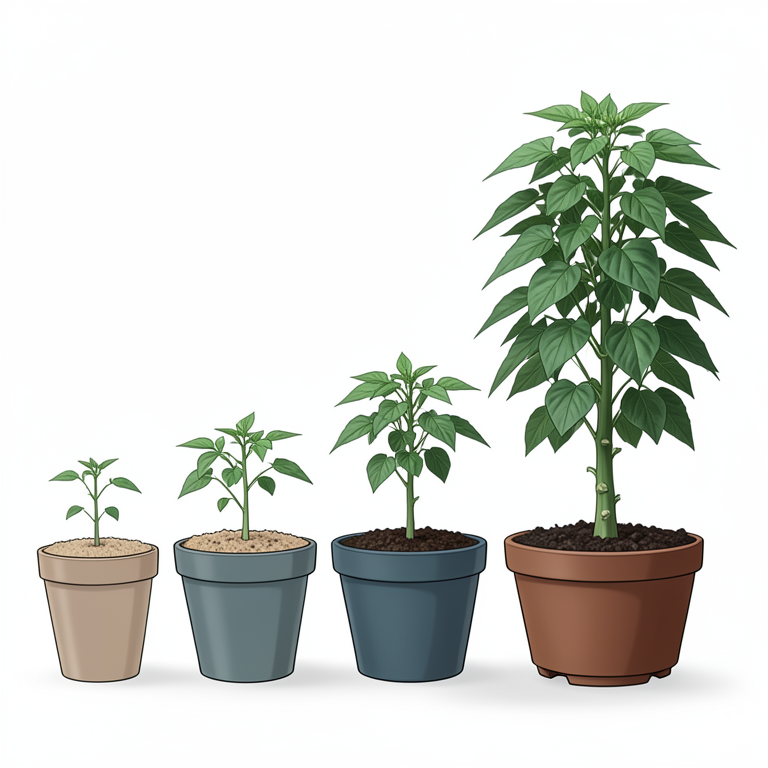
Comparison of Growth Media and Pot Sizes
AI-generated conceptual illustration (pepper plants (Capsicum annuum L.) in pots). It explains the idea and does not show study data.
View source evidence ↗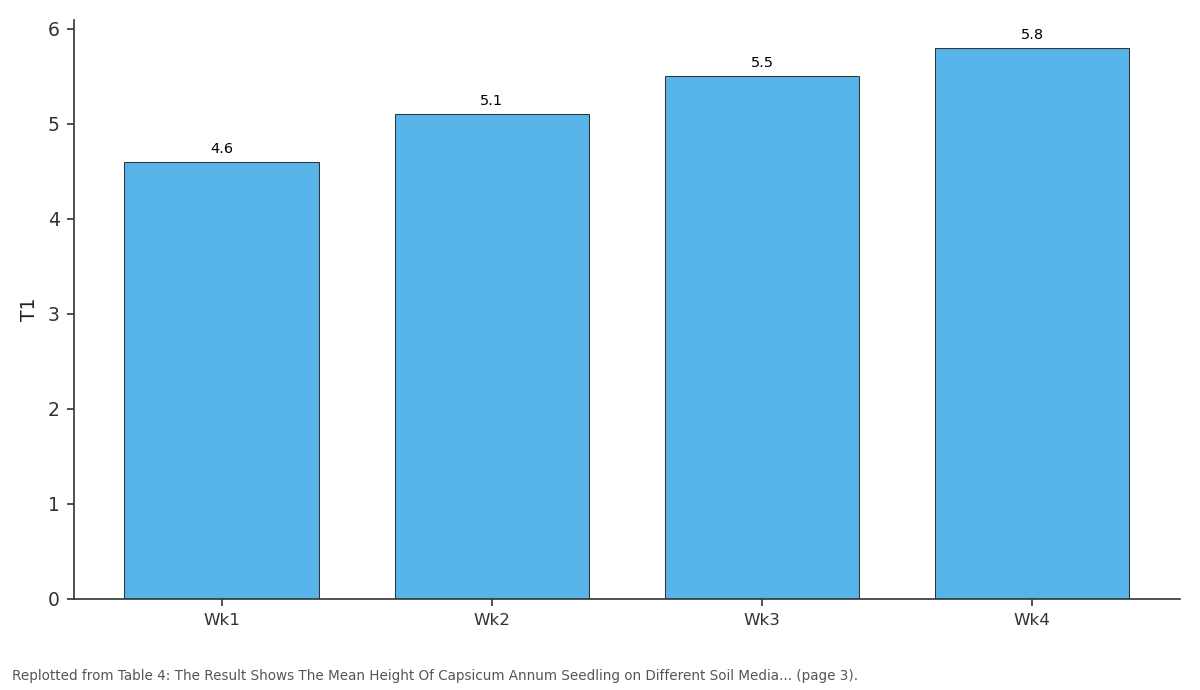
T1: Wk1 vs Wk2 vs Wk3 vs Wk4
Replotted from Table 4 (page 3) of the original paper. Every bar is the paper's own table value.
View source evidence ↗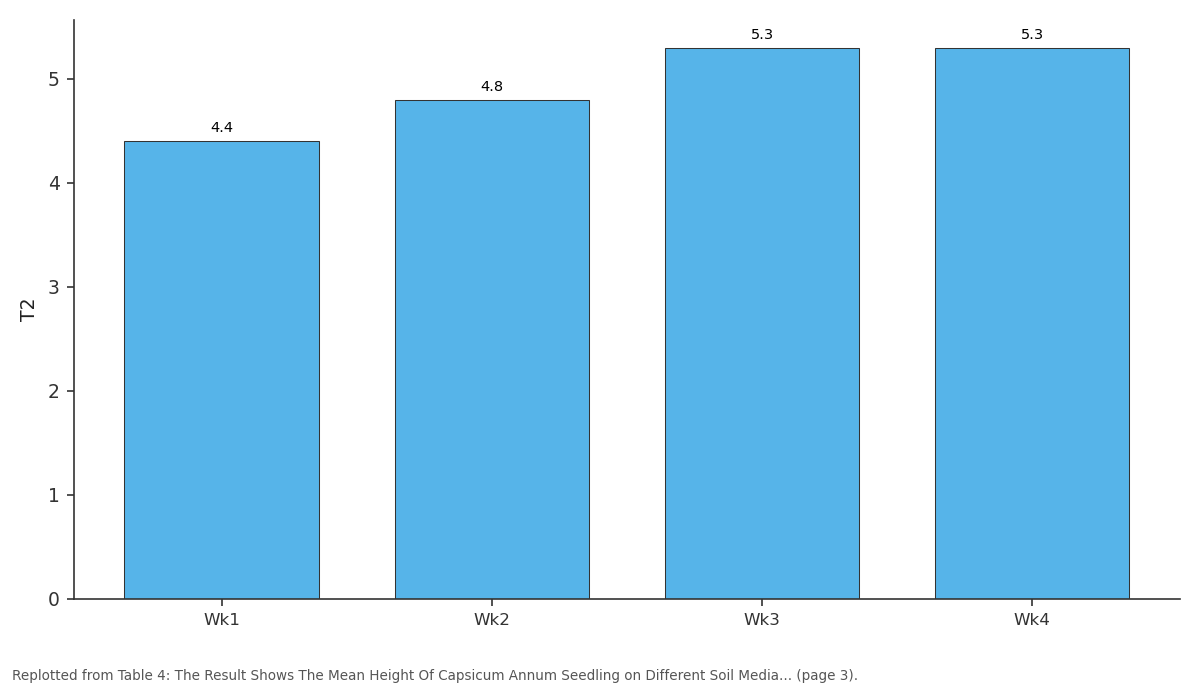
T2: Wk1 vs Wk2 vs Wk3 vs Wk4
Replotted from Table 4 (page 3) of the original paper. Every bar is the paper's own table value.
View source evidence ↗Figures & tables
From the original paper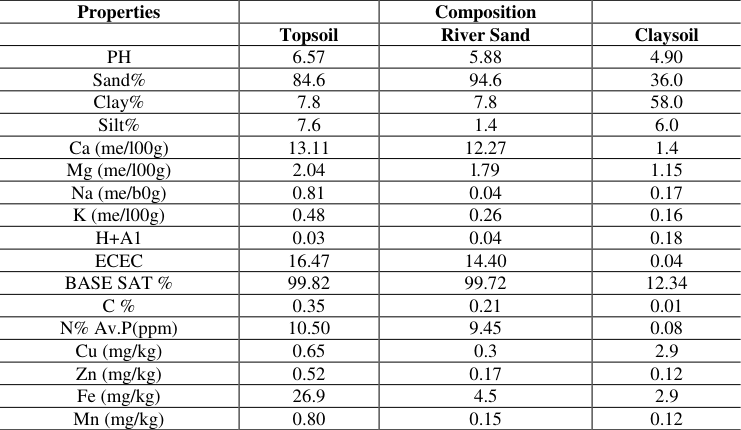 Table 1
 Table 2
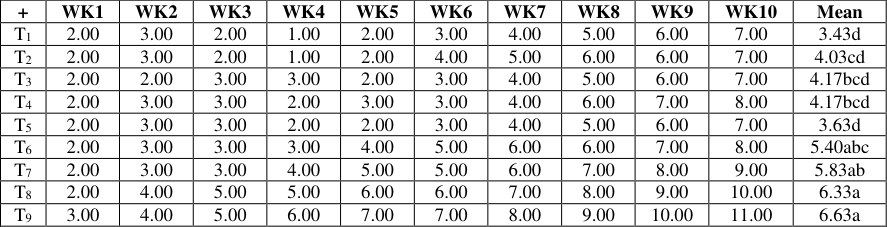 Table 3
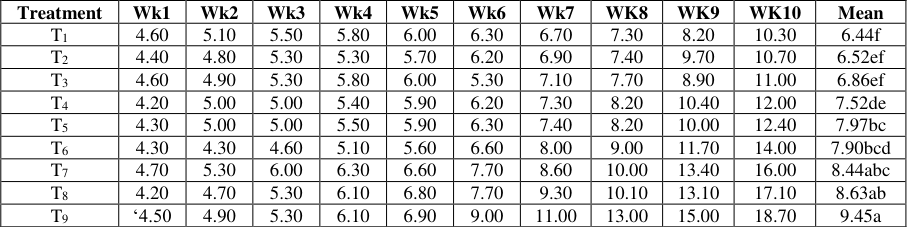 Table 4
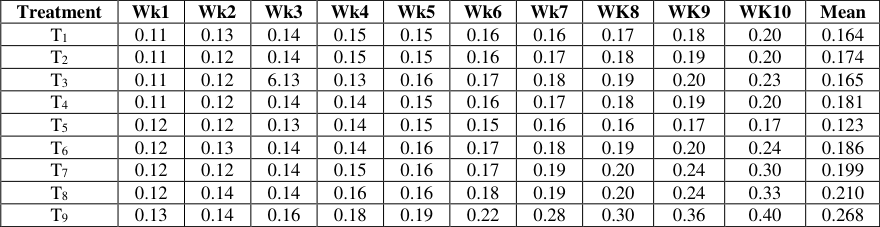 Table 5
Introduction
Peppers (Capsicurn species) are grown in many countries in the world. They are usually classified by their fruit characteristics pungency colour, fruit shape as well as their uses (Miller, 2003) [10] . It grows upright from 60-120cm high depending on the variety Capsicum species can also produces from two to four year depending on the variety. These vegetable is Biennial crop which is cultivated as annual crops. Unripe pepper exhibit colour ranging from green to dark, shapes of yellow or even brown while the red one are considered ripe. Size, shape, flavor and pungency from variety to variety but can also differ among fruits of the same bush; they are well grown in a humid climate. It requires temperature of 2l-25°c. (Dewith and Bosland, 2003) [3] . Pepper are known to be rich in vitamin A and thus varies with the colour of the pepper that is the redder the pepper the higher the vitamin A contain (Miller, 2003) [10] Mature peppers may have as much as ten times the amount of green peppers. It is well grown in many types of soil and welldrained soil is best suitable for it. They are tolerant to slight acidic condition with a pH of 5.5 to 5.6., rainfall levels of 600-1200mm are also considered adequate. The Africa climate favours the cultivation of peppers but in the humid region most soils are sandy, highly weathered, and low in organic matter content and susceptible soil to erosion and compaction. Pepper and improper soil management however, leads to either fertility or infertility of soil which invariably affect the productivity of the soil (Romans and Rearnaekan, 2001) [15] . The world demand for Capsicurn has been continuously increasing recently and production increased by 40% between 1990 and 2000 with about 1.4 million heaters cultivated (FAO, 2000) [5] . Capsicurn is ranked in the middle range of vegetable in terms of popularity with a world annual output of 1.8million and 1.4rnillion hectares of cultivated land used for their production. Asian production of fresh production accounts for 56.4% of world production followed by southern European region with about 1 5% of world production in 2000 (Wien, 2002) [19] .
Materials and Methods
The experiment was carried out within the premises of Federal College of Forestry, Jericho, Ibadan, and Oyo State. The College is situated in Ibadan South-West Local Government at latitude 7°9N and longitude 3°58E c the Greenwich meridian. It has an annual mean rainfall of about 13 0mm-1500mm and average relative humidity of about 80% -85% (FRIN, 2011) [6] .
Sample Preparation:
The seeds were extracted from the fruits the extracted seeds were washed with tap water in the process of washing the non-viable seeds seen floating were discarded while that of the viable seeds remained at the lower part of the water. The river sand was collected from a nearby steam in the college. The top soil and clay soil was collected from the nearby forest plantation which is about 5km away from the nursery site. The soils were air dried and later sieved with 2 mm sieve to remove clods and debris. The samples of the www.extensionjournal.com soil collected were taken to the laboratory for particle size analysis in order to determine their textural classes, (Table 1). River sand was used to raise seedlings in a germination box and watering was done twice daily to enhance seed germination. Sprouting of seeds was first noticed on the sixth day after sowing. After germination 27 healthy seedlings were carefully selected and transplanted into polythene pots filled with the different treatments of the growth media. There were nine treatments, T1:1Kg of clay soil, T2: 2kg of clay soil, T3: 3kg of clay soil, T4: 1kg of River sand, T5: 2kg of River sand, T6: 3kg of River sand, T7: 1kg of Top soil, T8: 2kg of Top soil and T9: 3kg of Top soil respectively.
| Properties | — | Composition | — |
|---|---|---|---|
| Topsoil | River Sand | Claysoil | |
| PH | 6.57 | 5.88 | 4.90 |
| Sand% | 84.6 | 94.6 | 36.0 |
| Clay% | 7.8 | 7.8 | 58.0 |
| Silt% | 7.6 | 1.4 | 6.0 |
| Ca (me/l00g) | 13.11 | 12.27 | 1.4 |
| Mg (me/l00g) | 2.04 | l.79 | 1.15 |
| Na (me/b0g) | 0.81 | 0.04 | 0.17 |
| K (me/l00g) | 0.48 | 0.26 | 0.16 |
| H+A1 | 0.03 | 0.04 | 0.18 |
| ECEC | 16.47 | 14.40 | 0.04 |
| BASE SAT % | 99.82 | 99.72 | 12.34 |
| C % | 0.35 | 0.21 | 0.01 |
| N% Av.P(ppm) | 10.50 | 9.45 | 0.08 |
| Cu (mg/kg) | 0.65 | 0.3 | 2.9 |
| Zn (mg/kg) | 0.52 | 0.17 | 0.12 |
| Fe (mg/kg) | 26.9 | 4.5 | 2.9 |
| Mn (mg/kg) | 0.80 | 0.15 | 0.12 |
Table text extracted from the original PDF; superscript letters are shown inline. The original table image is below.
View original table image
Experimental design:
The experiment was a 3x3 factorial experiment carried out in a Completely Randomized Design (CRD) with three replications. Parameters measured are: plant height (cm), stem diameter and number of leaves.
Statistical Analysis
Data collected were subjected to one-way analysis of variance (ANOVA) procedure for Completely Randomized Design (CRD) and the significant levels for the mean separations were assigned according to Duncan's Multiple Range Test (P ≤ 0.05).
Result and Discussion
Result and Discussion
Characterization of the nursery soils
The soils used in this study exhibited the result (Table1), revealed that the top soil, river sand and clay soil substrate have a slightly acidic pH which seems to be best to promote the availability of plant nutrients for the growing medium.
Leaf Production Plant height
Analysis of Variance table 2 above shows that there was significant difference among the treatments at 5% level of probability at the end of 10 weeks period of assessment. The result in table 3 showed that capsicum annum seedling planted in 3kg of top soil (T9) performed best with mean www.extensionjournal.com value of 6.63 with respect to the numbers of leaves produced, followed by 2k of top soil 6.63cm (T8) while plant sown in 1kg of clay soil (T1) showed the least performance with mean value of 3.43. This implies that the 3kg of top soil is suitable for raising capsicum annum seedlings at the nursery stage. This was in support of the work of Oni and Bada (1991) [12] who stated that due to the presence of organic matter and the nutrient in the right proportion in it. Riaz et al., (2008) [13] reported that different growing media can be used to grow zinnia while the physical and chemical properties of media, like structure, texture, pH as well as nitrogen, phosphorus and potassium are the dominant factors for the growth and development of plant. Euonymus juponicu grown in larger containers had a high mean relative growth rate than those grown in smaller containers (Dubik et al., 1992) [4] . The consensus is that as container size increases, plant growth, leaf area and shoot dry weight are increased (Richard 1980) [14] . 2 shows that there is significant difference among the treatments at 5% of probability assessment period of 2 to 10 weeks among the treatments. The result on plant height (table 4) indicates that plant sown in 3kg top soil (T9) gave the highest height with the mean value of 9.45 cm followed by 2k of top soil 8.63 cm (T8) while 1kg of clay soil (T1) had the least performance with mean value of 6.44cm. This also implies that top soil had the highest among the treatment. This supported the findings of money (1998) which stated that topsoil had the highest nutritive value due to the presence of micro-organisms that live in it. It was reported that; Plants grown in larger containers are taller than plants grown in smaller containers of top soil (Wu Y et al., 1998) [20] , because they grow faster ( Van Israel, 1997) due to more space and water nutrients (Scarratt, 1972) [16] grew white spruce seedlings 2 above, ANOVA result showed no significant differences (p ≤ 0.05) for seedling collar diameter at the end of 10 weeks in all the treatments. Result on collar diameter (table 5) indicate that capsicum annum planted in 3kg of top soil produced the best stem diameter with the mean value of (T9) 0.26 8 mm Followed by 2kg of top soil (T8) 0.210mm while plant sown on 1kg (T1) of clay soil had the least performance with the mean value of 0.1 64mm. This means that topsoil with 3kg of topsoil played an important role among the treatment suitable for raising capsicum annum seedling at nursery stage. This support the finding of Dwatmaji et al. (1992) that topsoil is the best media, due to the nutritive value presence in it. These results are in agreement with the findings of (Landis, 1989, Funk et al., 1980 and Kinghorn, 1974) [9,7,8] who reported that the shoot, root and total dry weight as well as shoot height increased significantly with increasing container volume of top soil. Sturmheit (1989) [17] also found that the northern red oak seedlings biomass was reduced as the volume of the container medium with top soil was reduced. In general, as cell size increases transplant leaf area, shoot biomass and root biomass increases (Cantliffe, 1993) [1] .
| Treatment | Wk1 | Wk2 | Wk3 | Wk4 | Wk5 | Wk6 | Wk7 | WK8 | WK9 | WK10 | Mean |
|---|---|---|---|---|---|---|---|---|---|---|---|
| T1 | 0.11 | 0.13 | 0.14 | 0.15 | 0.15 | 0.16 | 0.16 | 0.17 | 0.18 | 0.20 | 0.164 |
| T2 | 0.11 | 0.12 | 0.14 | 0.15 | 0.15 | 0.16 | 0.17 | 0.18 | 0.19 | 0.20 | 0.174 |
| T3 | 0.11 | 0.12 | 6.13 | 0.13 | 0.16 | 0.17 | 0.18 | 0.19 | 0.20 | 0.23 | 0.165 |
| T4 | 0.11 | 0.12 | 0.14 | 0.14 | 0.15 | 0.16 | 0.17 | 0.18 | 0.19 | 0.20 | 0.181 |
| T5 | 0.12 | 0.12 | 0.13 | 0.14 | 0.15 | 0.15 | 0.16 | 0.16 | 0.17 | 0.17 | 0.123 |
| T6 | 0.12 | 0.13 | 0.14 | 0.14 | 0.16 | 0.17 | 0.18 | 0.19 | 0.20 | 0.24 | 0.186 |
| T7 | 0.12 | 0.12 | 0.14 | 0.15 | 0.16 | 0.17 | 0.19 | 0.20 | 0.24 | 0.30 | 0.199 |
| T8 | 0.12 | 0.14 | 0.14 | 0.16 | 0.16 | 0.18 | 0.19 | 0.20 | 0.24 | 0.33 | 0.210 |
| T9 | 0.13 | 0.14 | 0.16 | 0.18 | 0.19 | 0.22 | 0.28 | 0.30 | 0.36 | 0.40 | 0.268 |
Table text extracted from the original PDF; superscript letters are shown inline. The original table image is below.
View original table image
| Treatment | Wk1 | Wk2 | Wk3 | Wk4 | Wk5 | Wk6 | Wk7 | WK8 | WK9 | WK10 | Mean |
|---|---|---|---|---|---|---|---|---|---|---|---|
| T1 | 4.60 | 5.10 | 5.50 | 5.80 | 6.00 | 6.30 | 6.70 | 7.30 | 8.20 | 10.30 | 6.44f |
| T2 | 4.40 | 4.80 | 5.30 | 5.30 | 5.70 | 6.20 | 6.90 | 7.40 | 9.70 | 10.70 | 6.52ef |
| T3 | 4.60 | 4.90 | 5.30 | 5.80 | 6.00 | 5.30 | 7.10 | 7.70 | 8.90 | 11.00 | 6.86ef |
| T4 | 4.20 | 5.00 | 5.00 | 5.40 | 5.90 | 6.20 | 7.30 | 8.20 | 10.40 | 12.00 | 7.52de |
| T5 | 4.30 | 5.00 | 5.00 | 5.50 | 5.90 | 6.30 | 7.40 | 8.20 | 10.00 | 12.40 | 7.97bc |
| T6 | 4.30 | 4.30 | 4.60 | 5.10 | 5.60 | 6.60 | 8.00 | 9.00 | 11.70 | 14.00 | 7.90bcd |
| T7 | 4.70 | 5.30 | 6.00 | 6.30 | 6.60 | 7.70 | 8.60 | 10.00 | 13.40 | 16.00 | 8.44abc |
| T8 | 4.20 | 4.70 | 5.30 | 6.10 | 6.80 | 7.70 | 9.30 | 10.10 | 13.10 | 17.10 | 8.63ab |
| T9 | ‘4.50 | 4.90 | 5.30 | 6.10 | 6.90 | 9.00 | 11.00 | 13.00 | 15.00 | 18.70 | 9.45a |
Table text extracted from the original PDF; superscript letters are shown inline. The original table image is below.
View original table image
| + | WK1 | WK2 | WK3 | WK4 | WK5 | WK6 | WK7 | WK8 | WK9 | WK10 | Mean |
|---|---|---|---|---|---|---|---|---|---|---|---|
| T1 | 2.00 | 3.00 | 2.00 | 1.00 | 2.00 | 3.00 | 4.00 | 5.00 | 6.00 | 7.00 | 3.43d |
| T2 | 2.00 | 3.00 | 2.00 | 1.00 | 2.00 | 4.00 | 5.00 | 6.00 | 6.00 | 7.00 | 4.03cd |
| T3 | 2.00 | 2.00 | 3.00 | 3.00 | 2.00 | 3.00 | 4.00 | 5.00 | 6.00 | 7.00 | 4.17bcd |
| T4 | 2.00 | 3.00 | 3.00 | 2.00 | 3.00 | 3.00 | 4.00 | 6.00 | 7.00 | 8.00 | 4.17bcd |
| T5 | 2.00 | 3.00 | 3.00 | 2.00 | 2.00 | 3.00 | 4.00 | 5.00 | 6.00 | 7.00 | 3.63d |
| T6 | 2.00 | 3.00 | 3.00 | 3.00 | 4.00 | 5.00 | 6.00 | 6.00 | 7.00 | 8.00 | 5.40abc |
| T7 | 2.00 | 3.00 | 3.00 | 4.00 | 5.00 | 5.00 | 6.00 | 7.00 | 8.00 | 9.00 | 5.83ab |
| T8 | 2.00 | 4.00 | 5.00 | 5.00 | 6.00 | 6.00 | 7.00 | 8.00 | 9.00 | 10.00 | 6.33a |
| T9 | 3.00 | 4.00 | 5.00 | 6.00 | 7.00 | 7.00 | 8.00 | 9.00 | 10.00 | 11.00 | 6.63a |
Table text extracted from the original PDF; superscript letters are shown inline. The original table image is below.
View original table image
| — | — | Height | Stem diameter | Leaf production |
|---|---|---|---|---|
| Sources of Variation | Df | P-Value | P-Value | P-Value |
| Treatment | 8 | <0.01** | <0.0026** | 0.0042** |
| Error | 18 | |||
| Total | 26 | |||
Table text extracted from the original PDF; superscript letters are shown inline. The original table image is below.
View original table image
Conclusion and Recommendation
Many media have been used to obtain growing media for Capsicum Annum seedling production. The raw materials used vary according to their local availability in the world. Different media have several gradient which could have direct and/or indirect effects on plant growth and development. Therefore based on findings obtained from the study showed that different media have significant effects on growth rate. But the result of the study indicated that top soil of 3kg of polythene pot is appropriate for raising www.extensionjournal.com seedling of in the nursery, with respect to seedlings height, number of leaves and collar diameter. River sand of 21kg and 3kg of polythene pot could have performed better but due to its low nutrient content, leaves seedling planted in them were seen to turn yellow and leaves drop during the experiment, thus there was negatively affecting the leaf production, stem diameter and seedlings height. Furthermore, to raise capsicum annum seedling at the nursery stage 3kg of top soil is suitable for raising capsicurn annum seedling. It is therefore recommended that 3kg of top soil should be used for the raising of capsicurn annum at nursery stage.
References
20 in the original paper- Cantliffe DJ. Pre-and postharvest practices for improved vegetable transplant quality. Hort. Technology. 1993; 3(4):415-8.
- Brady NC, Weil RR. The nature and properties of soils (No. Ed. 11). Prentice-Hall Inc, 1996.
- Dewith D, Bosland R. The peppers garden speed press, 2003, 35.
- Dubik SP, Krizek DT, Stimart DP, McIntosh MS. Growth analysis of spreading euonymus subjected to root restriction. Journal of Plant Nutrition. 1992; 15(4):469-86.
- FAO. Chile and Peppers; Infao bulletin of statistics (EC. Fao) Rome, 2000.
- FRIN. Agro-metrological station report Forestry Research Institute of Nigeria, 2011, 97.
- Funk DT, Roth PL, Clemer ML. The influence of container type and potting medium on growth of black walnut seedlings. North Central Forest Experimental Station. Forest service. USDA. Research note NC, 1980, 253.
- Kinghorn JM. Principles and concepts in container planting. In Proceedings of the North American Containerized Forest Tree Seedling Symposium. Great Plains Agricultural Council, Denver, Colorado. 1974; 26(8-18).
- Landis TD. The container tree nursery manual. Agriculture handbook (USA), 1989.
- Miller M. The great Chile book, 2003, 204.
- Money DC. Climate Soil Vegetation University of tutorial press Limited 9-10 (great situation street London E.C.I), 1998, 169.
- Oni O, Bada SO. Journal of Forest Science. 1991; 4(3):215-224.
- Riaz A, Arshad M, Younis A, Raza, Hameed M. Effects of different growing media on growth and flowering of Zinnia elegans cv. blue point. Pak. J Bot. 2008; 40(4):1579-1585.
- Richard MP. Effect of nursery media particle size distribution on container-grown woody ornamental production (Doctoral dissertation, Faculty of the Louisiana State University and Agricultural and Mechanical College in partial fulfillment of the requirements for the degree of Master of Science in The Department of Horticulture by Michael Paul Richard BS, Louisiana State University), 1980.
- Roman H, Raemackens H. Crop production in tropical Africa, 2001, 402 460.
- Scarratt JB. Container size affects dimensions of white spruce, jack pine planting stock. Tree Planters' Notes, 1972.
- Sturmheit P. Alley cropping in southern Zambia: the potential of alley cropping in Mazabuka district, 1989.
- Van Israel M. Root restriction effects on growth and development of salvia (Salvia splendens). Hort. Science. 1997; 32(7):1186-90.
- Wien HC. Pepper. In the physiology, of vegetable crops (Ed. Wian H. C) (CAB International New York), 2002, 250-293.
- Wu Y, Mishima K, Fujii E, Nakayama K, Yabuuchi H, Ogawa G et al. Studies on the growth character of Nakai in containers with varied volume and shape. Technical Bulletin of Faculty of Horticulture-Chiba University (Japan), 1998.