
Research article · 2019 · Full text
International Journal of Agriculture Extension and Social DevelopmentEffect of different growing media on the early growth of Cucumis sativus (Cucumber) Seedlings
Volume 2(1) · Pages 32–35 · DOI: 10.33545/26180723.2019.v2.i1a.21 ↗
Research areasGrowth and nutrition in plants
Abstract
Author-writtenThis project investigated the effect of selected soil media on the early growth of Cucumis sativus (cucumber) seedlings. Sixteen healthy seedlings were transplanted in two kg polythene pot which was filled with 2kg of different soil. There were four treatments T0 [top soil] serve as control, T1 [clay soil], T2 [river sand], T3 [river sand + clay soil]. Each treatment was replicated four times making a total of sixteen seedlings. The Experiment was set in a completely randomized design (C.R.D). The variables assessed were plant height, number of leaves and stem girth. Data collected were subjected to analysis of variance [ANOVA] and the means were separated using Duncan Multiple Range Test (DMRT). From the result, T0 (top soil) had the best performance in terms of plant height [8.23], numbers of leaves (7.70), and stem diameter (0.765) units. The least performance was recorded in T3 (river sand + clay soil). From the study, it is therefore recommended that top soil should be used in growing Cucumis sativus.
Summary
Source-checkedPlain-language reading of the full paper, prepared with AI and checked against the text. Each point links to the authors' own words.
Why it matters
- Vegetable crops are considered highly important because they offer high nutritional value, low production costs, and high yield potential. View evidence ↗
- Cucumbers are nutritionally valuable due to their high mineral content and reported antioxidant and drug detoxification properties. View evidence ↗
The question
- The study aimed to investigate how different selected soil media affect the early growth of cucumber (Cucumis sativus) seedlings. View evidence ↗
What they did
- Sixteen healthy seedlings were transplanted into 2 kg polythene pots using four treatments: top soil (control), clay soil, river sand, and a 50:50 mixture of river sand and clay soil. View evidence ↗
- The study utilized a Completely Randomized Design (CRD) as a 3x3 factorial experiment with three replications. View evidence ↗
- The growth of the seedlings was measured based on three parameters: plant height in centimeters, stem diameter, and the number of leaves. View evidence ↗
- Data analysis was performed using one-way ANOVA and Duncan's Multiple Range Test to determine significant differences at a P ≤ 0.05 level. View evidence ↗
What they found
- Top soil produced the highest mean plant height (8.23 cm), followed by river sand (6.96 cm), while the river sand and clay mixture performed the worst (5.05 cm). View evidence ↗
- In terms of leaf production, top soil resulted in the highest mean (7.70), followed by river sand (6.48), and the river sand and clay mixture resulted in the lowest mean (4.35). View evidence ↗
- Top soil yielded the best stem diameter mean (0.75 mm), followed by river sand (0.59 mm), with the river sand and clay mixture showing the lowest mean (0.33 mm). View evidence ↗
- There was a statistically significant difference among the soil treatments regarding leaf production at the 5% probability level. View evidence ↗
- The analysis revealed no significant difference among the soil treatments for stem diameter at the 5% probability level. View evidence ↗
What it means
- The authors conclude that cucumber seedlings perform best in top soil and recommend its use for both small and large-scale farmers. View evidence ↗
Visual summary
3 visualsIllustrations explain the paper; charts are replotted from the paper's own table values.
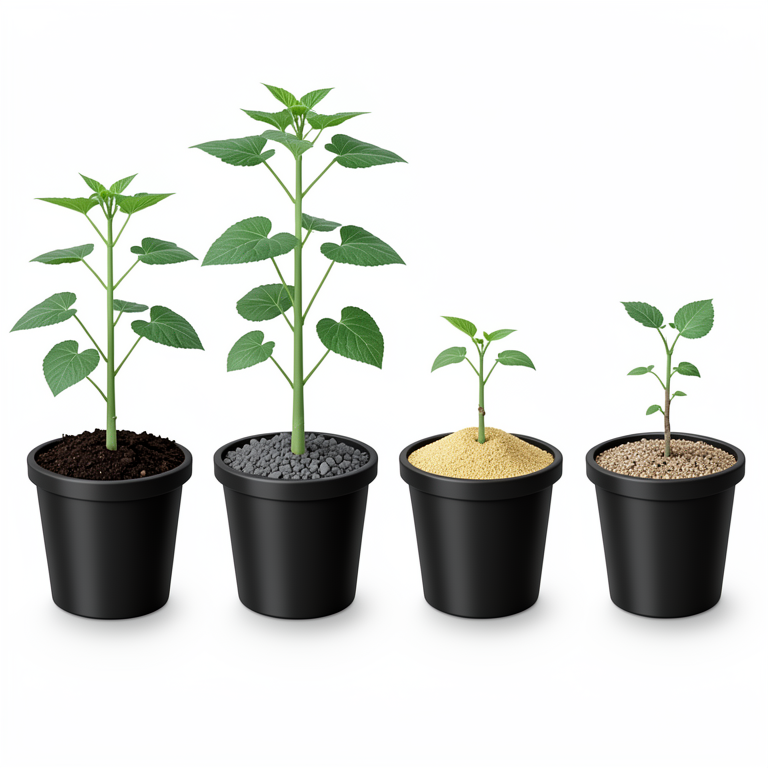
Comparison of Cucumber Growth by Soil Type
AI-generated conceptual illustration (Cucumis sativus (cucumber) seedlings in polythene pots). It explains the idea and does not show study data.
View source evidence ↗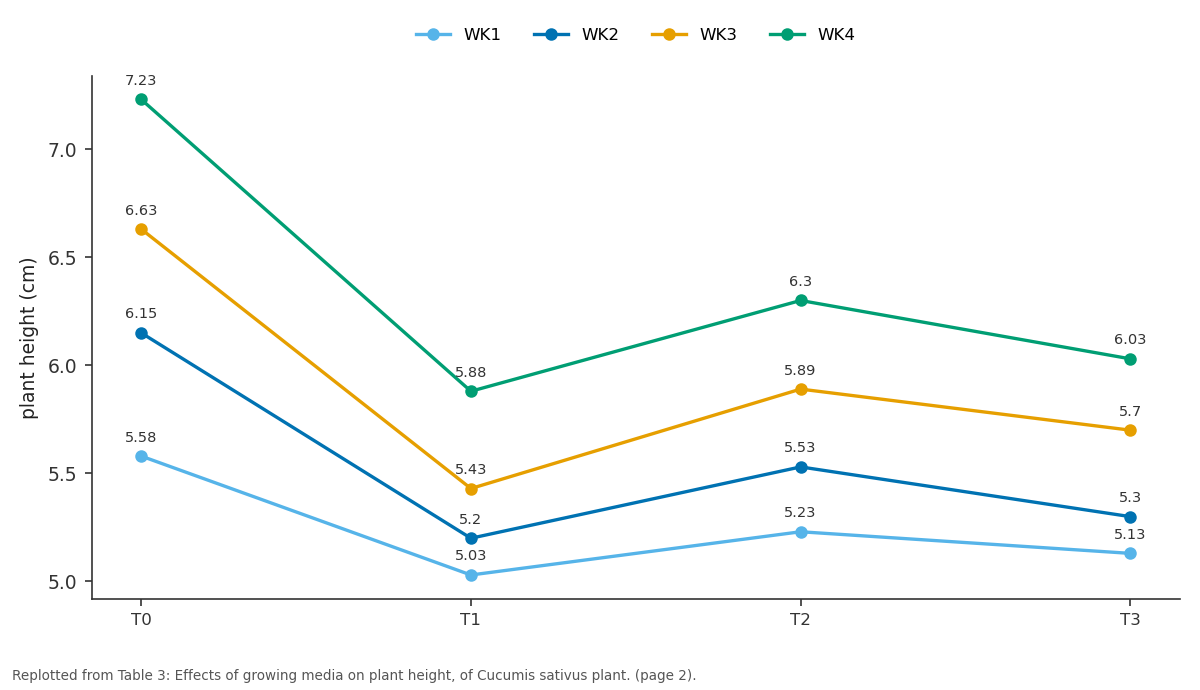
WK1 and WK2 and more: T0 vs T1 vs T2 vs T3
Replotted from Table 3 (page 2) of the original paper. Every bar is the paper's own table value.
View source evidence ↗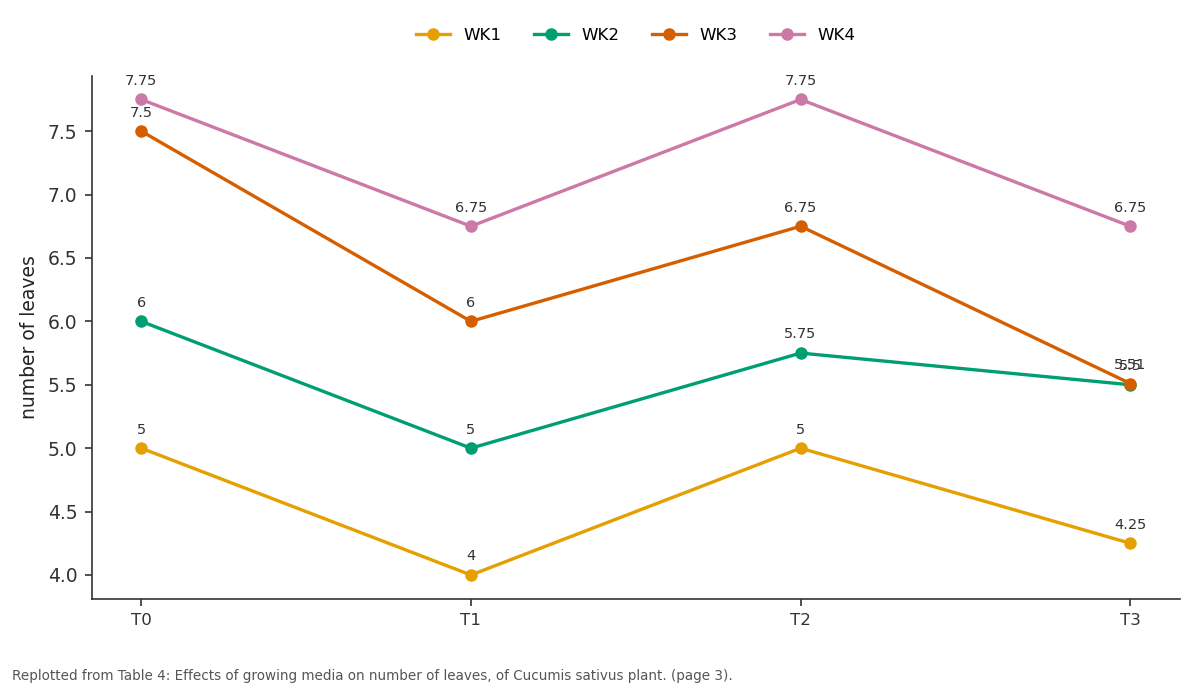
WK1 and WK2 and more: T0 vs T1 vs T2 vs T3
Replotted from Table 4 (page 3) of the original paper. Every bar is the paper's own table value.
View source evidence ↗Figures & tables
From the original paper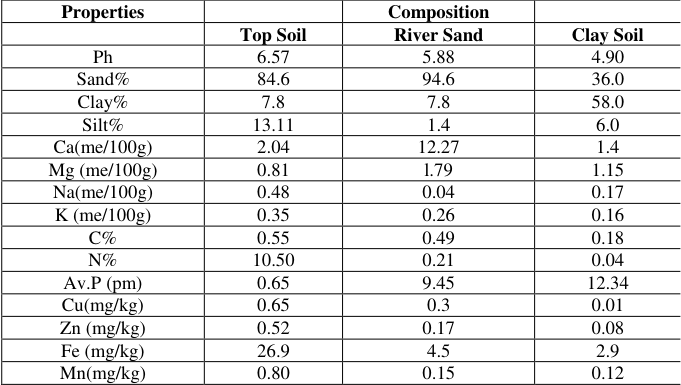 Table 1
 Table 2
 Table 3
 Table 4
 Table 5
Introduction
Agriculture is the cultivation of animals, plants, fungi, and other life forms for food, fiber, and other products used to sustain life. Agriculture was key to development in the rise of sedentary human civilization. The word agriculture is the English adaptation of latin agriculture, from 'ager'a field and 'cuture'tending/cultivating meaning cultivating or tending the field. (ILO, 1999) [6] . Vegetable crops are very important due to their higher yield potential, low cost of production and higher nutritional value. Vegetables are comparatively rich source of some vitamins and minerals, which are essential for the maintenance of good health and resistance against diseases. Due to progressive development in the country, the level nutrition and demand for a variety of food are increasing (NARC, Islamabad 2008) [11] . Vegetable crop means an edible plant or part of a plant, but usually excludes seeds and most sweet fruit. This typically means the leaf, stem, or root of a plant. Cucumbers originated in India. Where a great many varieties of cucumber have been observed, it has been cultivated for at least 3,000 years, and was probably introduced to other part of Europe by the Greeks of Romans (Doijode, 2001) [3] . Cucumber is an important cultivated species of cucurbitaceae. It has significant values as food crop in tropics, subtropics and milder portions of the temperate zones of both hemispheres. Nutritionally, the cucumber has a relatively high mineral content and it has been reported as a functional food to enhanced drug detoxification effect and antioxidant activity. Cucumber belongs to the Cucurbitaceae, the gourd plant family, of the order Violales, subclass Dilleniidae, and class Magnoliopsida. It is sometimes placed in its own order, Cucurbitales. Melon generation refers to cucumis; citrullus; or momordica. (Mesh, 2007) [10] . The Cucurbitaceae or vine crop family is a distinct family without any close relatives and includes many important vegetables such as cucumber, melon, watermelon, squash, pumpkin and gourds. (Maynard, 2000) [9] . The family cucurbitaceae includes a large group of plant which are medicinally valuable. It is a family of about 130 general and about 800 species. Seeds or fruit parts of some cucurbits are reported to possess purgatives, emetics and antihelmintics properties due to the secondary metabolite cucurbitacin content. Some of the important plant of the family Cucurbitaceae that have been extensively studied are Cucurbita pepo, Aeucurbita andreana, Cucurbita ficifolia, Cucum sativus, Cucumis melo, Citrus colocynthis. Luffa echinata, Trichosanthes kirilowii, etc. (Dhima, et al, 2012) [2] . Cucumbers are a good source of various vitamins and minerals that are involved in bone health, blood clothing and in deriving energy from the food one eats. (Jane, et al, 2010) [7] . Cucurbitaceae is a plant family commonly known as melons, gourds or cucurbits and crops like cucumber, squashes [including pumpkins], luffas, melons and watermelon. Most plants in this family are annual vines but there are also woody lianas, thorny shrubs and tree (dendrosicyos). Many species have large, yellow or white flowers. The stems are hairy, tendrils are at present 90 to the leaf petoles at nodes. (Mesh, 2007) [10] . The Cucurbitales are an order of flowering plants, included in the rosid group of dicotyledons. The order mostly blongs to tropical areas with limited presence in subtropic and to www.extensionjournal.com tropical areas, with limited presence in subtropic and temperate regions. The order includes shrubs and trees, together with many herbs and climbers. One of major characteristics of cucurbitales is the presence of unisexual flowers, mostly pentacycle, with thick pointed petals (whenever presents). (Mattew and Endress, 2004) [8] . The pattern of speciation in the cucurbitales is diversifies in a high number of species. They have a pan tropical distribution with center of diversity in Africa, South America and Southeast Asia. The effect of some selected soil media on the early growth of Cucumis sativus seedlings however needed to be well established in order to have a full understanding on the best soil media for its generation.
Materials and method
The experiment was carried out at the back of AGT Department within the premises of Federal College of Forestry, Ibadan, Oyo State. The College is situated at Jericho area in Ibadan North West Local Government area of Oyo State. The area lies between latitude 7 0 26'N and longitude 3 0 36'E, relative humidity is about 85%. The area experiences two distinct seasons which are dry usually commence from November to March and rainy season from April to October (FRIN, 2010) [5] .
The seeds of Cucumis sativus were purchase from seed section, Federal College of Agriculture (Moor Plantation). Seed of Cucumis sativus were sown into seed tray filled with top soil, watering was done daily. After germination, sixteen (16) healthy seedlings were carefully selected from the germination box and then transplanted into polythene pots filled with 2 kg of different soil i.e. T0 -Top soil (Control), T1 -Clay soil, T2 -River sand and T3 -River sand + Clay (soil ration of 50:50) and watering was done once daily. The experiment was a 3x3 factorial experiment carried out in a Completely Randomized Design (CRD) with three replications. Parameters measured are: plant height (cm), stem diameter and number of leaves. Data collected were subjected to one-way analysis of variance (ANOVA) procedure for Completely Randomized Design (CRD) and the significant levels for the mean separations were assigned according to Duncan's Multiple Range Test (P ≤ 0.05).
Result and Discussion
Result and Discussion
Characterization of the nursery soils
The soils used in this study exhibited the result (Table1), revealed that the top soil, river sand and clay soil substrate have a slightly acidic pH which seems to be best to promote the availability of plant nutrients for the growing medium. The results in table 2 for plant height shows that there is no significant difference among the treatments at 5% level of probability. However, plant sown in top soil as control had the best performance in height with mean value of 8.23com followed by River sand with mean value of 6.96cm while plant sown on a mixture of River sand and clay sand had the least performance in height of Cucumis sativus seedlings with the mean value of 5.05cm. The result indicated that the effect of top soil on Cucumis sativus seedlings is highly significant by carrying the first letter "a" when compare with other soil media (table 3). This is in agreement with the discovery of Vincent and Carl (2009) [13] which stand that cucumber are hardly plants and can be grown on many different types of soil, but they grow best when they can develop an extensive root system in loose, moist soil that are slightly acidic with pH between 6 and 6.5. [12] also proved the technique of raising seedlings for early harvesting of cucurbit in India. Table 2 shows the result for stem diameter, it revealed that there is no significant different among treatment at 5% level probability. However, plant sown into top soil gave a better performance with the mean value of 0.75mm followed by River sand (0.59mm) while plant sown on a mixed soil of River sand and clay had the least performance with the mean of 0.33mm. Duncan test also revealed that top soil had high significant effect on the growth of Cucumis sativus seedling when compared with all other treatments (table 5). This supports report by Adegoke et al. (2016) [1] stated that however, for optimum seedling germination for the purpose of plantation establishment, seedlings raised with humus rich top soil is recommended.
| Trmt | WK1 | WK2 | WK3 | WK4 | WK5 | WK6 | WK7 | WK8 | WK9 | WK10 | Mean |
|---|---|---|---|---|---|---|---|---|---|---|---|
| T0 | 0.30 | 0.35 | 0.41 | 0.44 | 0.50 | 0.58 | 0.94 | 1.13 | 1.35 | 1.50 | 0.75a |
| T1 | 0.21 | 0.26 | 0.30 | 0.32 | 0.33 | 0.43 | 0.38 | 0.52 | 0.63 | 0.68 | 0.41b |
| T2 | 0.30 | 0.32 | 0.38 | 0.46 | 0.43 | 0.54 | 0.53 | 0.75 | 0.98 | 1.13 | 0.59ab |
| T3 | 0.22 | 0.29 | 0.34 | 0.38 | 0.31 | 0.32 | 0.23 | 0.24 | 0.50 | 0.55 | 0.33b |
Table text extracted from the original PDF; superscript letters are shown inline. The original table image is below.
View original table image
| Trmt | WK1 | WK2 | WK3 | WK4 | WK5 | WK6 | WK7 | WK8 | WK8 | WK10 | Mean |
|---|---|---|---|---|---|---|---|---|---|---|---|
| T0 | 5.58 | 6.15 | 6.63 | 7.23 | 7.43 | 8.13 | 8.30 | 8.88 | 11.78 | 12.03 | 8.23a |
| T1 | 5.03 | 5.20 | 5.43 | 5.88 | 6.38 | 6.73 | 5.25 | 5.38 | 4.03 | 4.13 | 5.34b |
| T2 | 5.23 | 5.53 | 5.89 | 6.30 | 6.93 | 7.65 | 5.90 | 6.10 | 6.82 | 6.95 | 6.96ab |
| T3 | 5.13 | 5.30 | 5.70 | 6.03 | 4.83 | 5.90 | 4.10 | 4.13 | 4.68 | 4.73 | 5.05b |
Table text extracted from the original PDF; superscript letters are shown inline. The original table image is below.
View original table image
| — | — | Height | Stem diameter | Leaf production |
|---|---|---|---|---|
| Sources of Variation | Df | P-Value | P-Value | P-Value |
| Treatment | 8 | 0.0729 ns | 0.635ns | 0.0729* |
| Error | 18 | |||
| Total | 26 |
Table text extracted from the original PDF; superscript letters are shown inline. The original table image is below.
View original table image
| Properties | — | Composition | — |
|---|---|---|---|
| Top Soil | River Sand | Clay Soil | |
| Ph | 6.57 | 5.88 | 4.90 |
| Sand% | 84.6 | 94.6 | 36.0 |
| Clay% | 7.8 | 7.8 | 58.0 |
| Silt% | 13.11 | 1.4 | 6.0 |
| Ca(me/100g) | 2.04 | 12.27 | 1.4 |
| Mg (me/100g) | 0.81 | l.79 | 1.15 |
| Na(me/100g) | 0.48 | 0.04 | 0.17 |
| K (me/100g) | 0.35 | 0.26 | 0.16 |
| C% | 0.55 | 0.49 | 0.18 |
| N% | 10.50 | 0.21 | 0.04 |
| Av.P (pm) | 0.65 | 9.45 | 12.34 |
| Cu(mg/kg) | 0.65 | 0.3 | 0.01 |
| Zn (mg/kg) | 0.52 | 0.17 | 0.08 |
| Fe (mg/kg) | 26.9 | 4.5 | 2.9 |
| Mn(mg/kg) | 0.80 | 0.15 | 0.12 |
Table text extracted from the original PDF; superscript letters are shown inline. The original table image is below.
View original table image
Conclusion and Recommendation
The result of this study showed that Cucumis sativus seedlings responded very well in top soil. The plant in this treatment also displayed a more healthy growth in terms of plant height, leaf production, and stem diameter. This study therefore revealed that as a plant grown in height, there is an increase in leaves numbers as well as in the diameter. Moreover, the least performance was observed in T3 (river sand + clay soil) as seedlings showed the appearance of nutrient deficiency, this may be due to the fact that there is little nutrient in the soil to support the growth of the plant. Data collected in the study however indicated that Cucumis sativus seedlings performed best in of top soil, it is therefore recommended that top soil be used by both small and largescale famers in raising Cucumis sativus seedlings. It is also recommended that further research should be made on this study so as to further k now the effect of these selected media on the early growth of Cucumis sativus seedlings. Finally, famers should be encouraged in the planting of Cucumis sativus as this can serve in various purposes such as medicines and nutritional benefits.
Figures and tables from the paper
| Trmt | WK1 | WK2 | WK3 | WK4 | WK5 | WK6 | WK7 | WK8 | WK9 | WK10 | Mean |
|---|---|---|---|---|---|---|---|---|---|---|---|
| T0 | 5.00 | 6.00 | 7.50 | 7.75 | 8.75 | 9.75 | 8.25 | 8.00 | 7.25 | 8.75 | 7.70a |
| T1 | 4.00 | 5.00 | 6.00 | 6.75 | 8.25 | 9.25 | 6.00 | 5.00 | 2.25 | 2.75 | 5.53bc |
| T2 | 5.00 | 5.75 | 6.75 | 7.75 | 8.50 | 9.50 | 6.50 | 6.75 | 3.75 | 4.50 | 6.48ab |
| T3 | 4.25 | 5.50 | 5.51 | 6.75 | 5.25 | 5.75 | 3.00 | 3.10 | 2.00 | 2.50 | 4.35c |
Table text extracted from the original PDF; superscript letters are shown inline. The original table image is below.
View original table image
References
13 in the original paper- Adegoke FF, Ogunwande OA, Odewo SA, Ajani BA, Adepoju OD. Proceedings of the 1st Commonwealth Forestry Association (CFA) Conference, Nigeria Chapter Forestry Research Institute of Nigeria (FRIN), Jericho, Ibadan, Nigeria, 2016.
- Dhiman K, Gupta A, Sharma DK, Gill NS, Goyal A. A review on the medicinally important plant of the cucurbitaceae. Asian journal of clinical Nutrition. 2012; 4:16-26.
- Doijode SD. Seed storage of horticultural crop. Haworth Press, 2001. ISBN 1-58022-901-2
- Enestina Parziale CH. A review on the medicinal importance of cucumber, 2001 & 2006, 4. ISSBN 143321
- FRIN. Forestry Research Institution of Nigeria, Annual Metrological Report, 2010.
- International Labour Office. Safety and health in agriculture, 1999, 77. ISBN 978 92-2-11151
- Jane Higdon. Nutritional value and importance of cucumber | Livestrong.com, 2010. ISBN 5-43259-675-9
- Mathews ML, Endress PK. Comparative floral structure and systematics in cucubitales. Botanical Journal of Linnean Society. 2004; 145(2):128-185.
- Maynard DN. Cucumner, melons and watermelon" in: kiple kf and ornelas kc [eds]. The Cambridge World History of Food, Cambridge: Cambridge University www.extensionjournal.com Press, 2000, 2.
- Mesh. Description of cucurbitaceae. Last update, 2007, [0:54].
- NARC. Islamabad Vegetable Crop. Research Paper Published In Journals 77/Reports of Proceedings 23/ Article Leaflets, 2008, 29.
- Singh B, Tomar BS, Hasan M. Plug tray nursery raising technology for off season cucurbits cultivation. Acta Horticulture, (ISHS). 2010; 871:279-282.
- Vincent Fritz A, Carl Rosen J. University of Minnesota Extension; Growing cucumbers in Minnesota Home Gardens, 2009.