
Research article · 2019 · Full text
International Journal of Agriculture Extension and Social DevelopmentImproving agripreneurship in India: The impact of training and incubation programme
Volume 2(2) · Pages 59–63 · DOI: 10.33545/26180723.2019.v2.i2a.35 ↗
Research areasIndian Economic and Social DevelopmentEntrepreneurship Studies and Influences
Abstract
Author-writtenAgriculture forms the backbone of the Indian economy. Agripreneurship can help in the growth and development of the economy in a variety of ways. However, the sector is faced with problems relating to credit, infrastructure, marketing, technology, legal formalities and regulations etc. among which insufficiency of finance being the most important one. From the study, it becomes clear that despite the continuous efforts, there exists a substantial gap between the requirement of credit and supply of agricultural credit. The findings suggest that agripreneurs should be provided finance at concessional rates of interest and on easy repayment basis. Agripreneurs who are supported through training programmes have been actively participating in agricultural activities within the identified surveys. Entrepreneurial levels amongst the farmers were assessed as well as the problems that they believe hinder entrepreneurial spirit within the demography of the nation. Motivation into self employment include the need for independence, need for challenge, existing opportunities, need high job security, insufficient family income, role models and difficulty in finding jobs. Impediments to entrepreneurship have been indicated as follows: Lack of education and training, limited competency in managerial expertise, inadequate entrepreneurial services, inaccessible and distant markets, lack of infrastructure, financing, lack of business network, and limited access to information. Since this study aimed to develop an entrepreneurial framework to encourage agricultural entrepreneurship, the following recommendations have been made through this research paper to:. Enhance the environment for entrepreneurship by creating the right culture and conditions for entrepreneurship. . Create the right agricultural entrepreneurial policy.. Invest in a high quality, integrated system of support services. . Foster entrepreneurship education at all levels to ensure capacity building for diverse enterprises.. Strengthen business to business networking opportunities. . Monitor and evaluate entrepreneurship support interventions.
Summary
Source-checkedPlain-language reading of the full paper, prepared with AI and checked against the text. Each point links to the authors' own words.
Why it matters
- Agriculture is the fundamental pillar of the Indian economy. View evidence ↗
- The agricultural sector faces several hurdles, with a lack of finance being the most critical issue. View evidence ↗
- Because two-thirds of India's population works in agriculture, creating sustainable agribusiness opportunities is vital for national employment. View evidence ↗
The question
- The study aims to create a framework to encourage and promote agricultural entrepreneurship (agripreneurship). View evidence ↗
What they did
- The proposed training programme lasts 6 months, consisting of 1 month of theoretical instruction and 5 months of practical training. View evidence ↗
- The method involves using a test business incubator to provide practical management knowledge and simplified employment for participants. View evidence ↗
- A mentor network is utilized during the training to provide continuous support and help participants overcome difficulties. View evidence ↗
- Counsellors are employed to provide participants with administrative, legal, financial, and marketing assistance. View evidence ↗
What they found
- Roughly 90% of business failures are strongly linked to a deficiency in managerial skills, including planning and financial management. View evidence ↗
- Research shows that most farmers possess at least a basic primary education and some informal farm management training. View evidence ↗
- There is a positive correlation between farmer training and agripreneurship, identifying training as a key determinant of success. View evidence ↗
- Most individuals who benefited from farmer training were able to successfully add value to their farming businesses. View evidence ↗
What it means
- The authors conclude that agripreneurship results from a combination of internal personal attributes and external factors like training, finance, and market access. View evidence ↗
- The authors recommend providing adequate credit and infrastructural support to promote agripreneurship. View evidence ↗
- The authors note that empirical research on rural entrepreneurship specifically within India remains relatively sparse. View evidence ↗
Visual summary
1 visualsIllustrations explain the paper; they do not show study data.
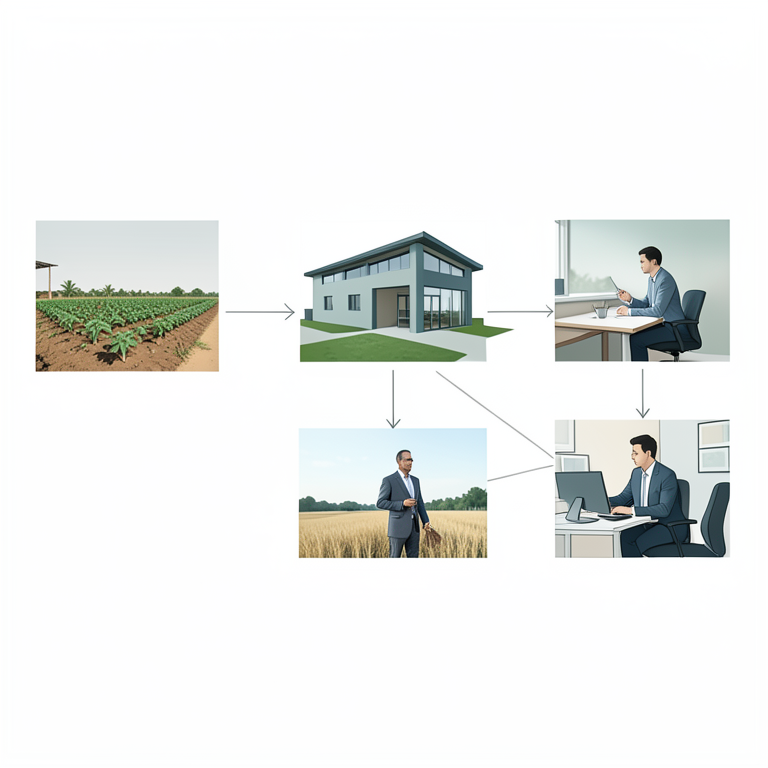
Agripreneurship Support Ecosystem
AI-generated conceptual illustration (Indian agricultural entrepreneurs and farming infrastructure). It explains the idea and does not show study data.
View source evidence ↗Introduction
Agriculture all over the world is going through a phase of transition. In this changing scenario, agriculture is taking new shape and expanding its scope beyond the limits of mere crop cultivation and animal husbandry for livelihood of rural population. Agriculture and allied sectors are considered to be mainstay of the Indian economy because these are important sources of raw materials for industries and they demands for many industrial products particularly fertilizers, pesticides, agriculture implements and a variety of consumer goods. Due to the changing socio, economic, political, environmental and cultural dimensions over the world, farmers' and nations' options for survival and for sustainably ensuring success in changing their respective economic environments has become increasingly critical. It is also worth noting that the emergence of the free market economies globally has resulted in the development of a new spirit of enterprise "Agripreneurship" and the increased individual need for responsibility for running their own businesses. Entrepreneurship is connected with finding ways and means to create and develop a profitable farm business. The terms, entrepreneurship and agripreneurship are frequently used in the context of education and small business formation in agriculture. Entrepreneurship in agriculture is the creation of innovative economic organization for the purpose of growth or gain under conditions of risk and uncertainty in agriculture. In recent years, there has been a considerable emphasis on crop diversification towards horticulture (fruits, vegetables, ornamental crops, medicinal and aromatic plants and spices), plantation crops (coconut, cashew nuts and cocoa) and allied activities. The problems of unemployment, underemployment and disguised unemployment have swamped the country, especially the rural common people. Considering that 2/3rd of the Indian population is employed in the agriculture sector, providing viable and sustainable business opportunities in Indian agribusiness is essential for generating employment in the country. Agripreneurship is an employment strategy that can lead to economic self-sufficiency of rural people. An agripreneur www.extensionjournal.com may be defined as someone who undertakes a variety of activities in agriculture and its allied sectors. A farmer to become a successful agripreneur needs to be active, curious, determined, persistent, visionary, hard working, come up with ideas, communicative with strong management and organizational skills, recognize suitable marketing opportunities, and manage the optimum resources or bearing the risk. Agripreneurship is greatly influenced by three factors namely the economic situation, education and culture in India. Various studies indicate that if the right environment is created and farmers are provided with good infrastructure, technology and timely availability of credit through financial institutions it can enhance food production and can ensure food security, income and quality of life for the farmers. Rapid growth of the world's population coupled with rising unemployment has contributed to a large gap among different income groups. Moreover, lack of business opportunities and insufficient income in rural areas have encouraged developing countries to consider new strategies such as creating job opportunities and enhancing rural livelihood. To meet the above challenges, entrepreneurship strategy as a new paradigm has been proposed by many countries. Due to its global recognition as a driver for economic growth, entrepreneurship is generally focused as an action-oriented phenomenon with immense creativity and innovativeness that ranges from opportunity or necessity entrepreneurship Entrepreneurs add great value to local economies. This conclusion is widely evident in a number of communities that have initiated entrepreneurial development strategies over the past two decades. Still the entrepreneurs are now recognized as vital drivers of economic growth to local communities, and this has spawned the new entrepreneurship programmes in some countries such as America. The value of entrepreneurs is evident at both the national and local levels. At the national level, nations with more entrepreneurial activity have stronger GDP growth. Entrepreneurship accounts for one-third of the difference in the economic growth rates between developing and developed countries. At the community level entrepreneurs create new jobs, increase local incomes and wealth and connect the community to the larger, global economy.
Training Development Programme
The aim of the training programme element is to provide the involved jobseeker clients, the 'test entrepreneurs' with theoretical and practical training concerning the legal, economical and marketing environment of the entrepreneurial activity as a result of which they will be able to start up their own, viable company by the end of the programme. The duration of the test business incubator training programme is 6 months in the course of which theoretical training is provided for 1 month, while practical training is provided for 5 months. The selected persons, the 'test entrepreneurs' remain in jobseeker status during the training, therefore they are provided with wage supplementary benefit while participating in the theoretical and practical training. The supports covered by the programme: wage supplementary benefits and training costs. Since the involved clients are in jobseeker status, they can be provided with reduced accommodation fares during the training. During the training the participants are provided with answers to the solution of problems arising in the everyday life of entrepreneurship, besides that, they are performing their professional activities, too. For the execution of the professional activityby taking into consideration the international practice of the Start-up Model and adapting it to the national relationscooperation with a test business incubator organisation is necessary. This test business incubator organisation provides an opportunity for carrying out professional activity in the frames of simplified employment, as well as for practical training connected with the practical acquisition of the Start-up company management knowledge.
Supporting mentor activity:
A mentor network is operated during the period of the training programme element and the support of becoming an entrepreneur. Its aim is to provide the clients participating in the project with continuous help, to help overcome the arising difficulties and to elaborate possible solutions to unknown situations during the whole programme. The availability of mentors could be ensured outside the labour market programme, together with the partners participating in the transfer of innovation, from the resource of the project.
Supporting counselling activity: It provides place and
opportunity for the test business incubator activity. The selected counsellors provide the programme participants, the clients carrying out 'test business entrepreneurial activity' with financial, legal, marketing and administrative help. The counsellor's task during the period of the training:
• keeping contact with the training organisation,
• keeping contact with the test business incubator organisation,
• coordinating the mentoring network,
• providing the 'test entrepreneurs' with financial, legal, marketing and administrative help. The counsellor's task following to the training: following up and helping the activity of the clients stepping out from the training and those who became independent entrepreneurs.
Awareness campaign activity: Through this
programme the agripreneurs are made aware of the various provisions available for them. It is necessary to make them understand that loans are advanced for undertaking entrepreneurial activities. The agripreneurs should be provided finance at concessional rates of interest and on easy repayment basis. The cumbersome formalities should be avoided in sanctioning the loans to agripreneurs. Banks may consider providing adequately qualified and trained personnel in rural and semi urban branches to accomplish the targeted mission. Banks should establish customer support relations with borrowers rather than simply lending to the agripreneurs. This will help to reduce the risk associated with lending to entrepreneurs.
Defining Agripreneurs
Agripreneurs are defined as those occupied on a part-time or full-time basis employed on a range of activities, which are www.extensionjournal.com primarily dependent on the farm and agriculture in the practice of cultivating the soil, growing crops and raising livestock as the main source of income. For the purpose of the study, the definition is also extended to agripreneur who are involved in value addition activities such as packaging, processing and distribution. The role of entrepreneurship and innovation has been given little emphasis in agricultural economics; however, it has become a priority with policy makers and is a critical aspect of value added agriculture. The development of agripreneurship means also a change of quality of management in the process of agriculture. The necessary condition for risk reduction in activities other than farming in rural areas necessitates the organisation and support of local community government. The entrepreneurial development in rural areas has been connected with a progressive modernisation of agriculture and is connected with multifunctional rural development.
The aims of entrepreneurial development in agribusiness are modernisation and reconstruction of fragmented agriculture, building an agriculture environment and creating new jobs in rural areas. The changing environment of farming necessitates farmers to develop their businesses and its activities in economic terms in order to survive and be successful. Worthy of note is the division of farming businesses into three strategic orientations: conventional, value-adding and non-food diversification, which describe the ongoing responsive changes on farms. The definition of entrepreneurship in agriculture has changed over the years. Agripreneurship is needed in order to recognise and exploit business opportunities in agriculture sector since it is connected with finding ways and means to create and develop a profitable agribusiness. As this research aims to develop a framework to encourage agricultural entrepreneurship, then it is defined as the activities and processes in the agri sector when starting a business or exploring industries with a view to profiting from the investment. These business activities can be conducted either informally by individuals and families or by business organization such as companies, self employed entrepreneurs or intermediaries. When pursuing an investment profit, farmers make decisions and take full responsibility for their profits and losses. They decide what products or services they wish to provide to meet market demands and face investment and management risks, which is the main distinction between agripreneurs and farmers.
Traits of Agripreneurs
Many researchers define personality traits as enduring dispositions that are relatively stable over time and across situations. In the realm of entrepreneurship, traits explain entrepreneurial behaviour. In the psychological literature on entrepreneurship as well as in some theories by economists, entrepreneurs are often described as individuals with certain kinds of stable and enduring characteristics. Therefore, one approach to fostering agripreneurship is to strengthen the entrepreneurial traits of individuals. An agripreneur is a complex combination of interacting factors. The combination and interaction of the following factors determine both the way in which an entrepreneur engages in enterprising activities, and ultimately the degree of success that must be achieved.
• Personality -in terms of possessing resilience, tenacity, opportunity spotting and taking, and risk-taking;
• Attitude -having awareness of the importance of customer focus, the application of creativity and imagination, defines personal standards and values, the perception of enterprise as a positive activity;
• Skills -such as the ability to network, to think strategically, business knowledge and acumen, interpersonal skills and people management, to gain access to resources; and
• Motivation -personal drive and ambition, the dire to make an impact, need for achievement or selfsatisfaction, desire for status, to create and accumulate wealth, social responsibility. Regardless of variations in economic development, entrepreneurs with high motivation will almost always find ways to maximise economic achievement.
Personal qualities of an agripreneur significantly affect the agribusiness. The successful farmer entrepreneurs differ from others in terms of three personality traits. They have more belief in their ability to control events, problemsolving abilities, social initiative, expressed through dominance, liveliness and social skills boldness. On this issue, it has to be focused and riveted on the breeding of local agripreneurs, who are not just farmers, but are also thinkers, risk-takers and business people. Achievement motivation is the most important factor that contributes in explaining variation of growth rates and entrepreneurship.
Where resources are constrained such as in rural areas, innovations are more important Organizations with high entrepreneurial orientation distinguish themselves by:
• Constant innovation in their products and markets;
• Proactive decision-making and aggressive competition with other companies, and
• Risk bearing ability in business These three dimensions have also been recognized as important entrepreneurial attitudes in the agricultural sector. Numerous studies show that entrepreneurial attitudes towards autonomy, risk, work and income are more important in determining the success of a firm. Researchers identify numerous traits, such as risk propensity, creativity, problem-solving and overcoming obstacles, achievement orientation, self-efficacy, and high sense of responsibility as key characteristics of a successful entrepreneur which are remarkably consistent from country to country.
• Opportunity seeking and initiative; Agripreneurs are proving to be at the heart of that promise, and a key weapon in the fight against poverty. It is therefore necessary for India to be entrepreneurial and create new businesses that will, in turn, create more job opportunities and raise the standard of living for the society.
Issue and Challenges of Agripreneurs Lack of education and skills:
The rural areas are seriously disadvantaged. Literature often cites a lack of business skills and training as a major cause of business failure. Approximately 90% of business failure relates strongly to a lack of managerial skills such as financial skills, planning, managing of credit and recordkeeping. Generally, Small Enterprises suffer from a lack of market information, management skills and technology which leave them at a competitive disadvantage in the marketplace. Unless entrepreneurs are well equipped with technical and business skills, they may not be able to overcome various problems they encounter at different stages of their business development.
Finance: Finance has been identified in many business surveys as the most important factor determining the growth and survival of Small Enterprises in both developing and developed countries. Financial services are critical in enabling Small Enterprises to scale up operations, upgrade technology and change or improve products and services. However, traditional financial service providers such as banks often regard such enterprises as high risk, and the costs involved in assessing creditworthiness and making loans or investments can make it unprofitable. In addition, access to finance is the major problem for South African SMMEs and this issue must be addressed if an environment promoting entrepreneurship and SMME development is to be encouraged.
Government policies and programmes: Entrepreneurship is still not a well defined concept and the differences between Small Enterprises and entrepreneurship policies are unclear, as such efforts to become a more entrepreneurial economy tend to be impeded. Instead of assuming an integrated approach to stimulating a higher level of entrepreneurial activity, governments tend to add on projects and activities in a piecemeal incremental fashion. Though government has invested considerable resources into supporting small enterprises, reach of these programmes is very limited and most businesses are either unaware of or have not used any of the government's programmes and structures. As a result, small enterprises are largely unimpressed with the direct support offered by government.
Physical Infrastructure: Infrastructure is critical to both growth and poverty reduction to the extent that some people consider infrastructure to be at the top of the poverty reduction agenda
Business Information Services: In India, the availability of accurate and meaningful information is still a problem for the entrepreneurial sector.
Access to markets: Distant markets confine farmers to selling their farm products mainly to hawkers and within the district. With limited opportunities open to them, they remain firmly rooted in the subsistence economy. Accessibility to proper marketing facilities could help towards better production planning, expansion and better prices, lower risk and better utilisation of resources. Limited coordination amongst farmers and failure to fully utilise local logistics capacity also inhibit the district economic growth.
The majority of agribusinesses are struggling mainly due to improper planning, poor business and management practices, low level of skills due to low levels of education; lack of access to information; underdeveloped infrastructure and lack of entrepreneurial culture These developments have created a situation in which farmers with high levels of production do not automatically have an acceptable level of income. Nowadays, farmers have to produce and sell products that the customers want to pay for, and they are responsible for their own income.
Government support programmes:
Recent studies have indicated a new concept of agripreneurship, which sheds more light on the role of government. As a system necessary for economic growth, entrepreneurship consists of three components: entrepreneurs that desire to achieve their goal of economic survival and advancement; the social constitution that grants the right for forming and operating free enterprises and government that has the ability to motivate entrepreneurial behaviour toward social development and growth, and to adjust the constitutional system that works at its best to protect each individual agripreneur. Therefore, a productive local economy with excellent infrastructure, educated, skilled and flexible people, competitive local markets and good governance is required to create a prosperous future. There is a need for an environment conducive to create conditions to allow people to access opportunities that could reduce poverty and create jobs. Fostering entrepreneurship, the creation and support of rural businesses is a crucial goal for the survival and integrated development of rural local economies. However, despite the recognition of entrepreneurship as a primary facet for achieving rural economic development, empirical research on rural entrepreneurship in India is relatively sparse and this concept remains largely unknown as well as the role and the function of rural entrepreneurs, the driving force behind birth, survival and growth of rural enterprises.
Conclusion and Recommendations
Agripreneurship is the need of hours to make agriculture a more attractive and profitable venture. It is clear that there is a great scope for entrepreneurship in agriculture and this potentiality can be tapped only by effective support to this sector. The agriculture sector has large potential to contribute to the national income while at the same time providing direct employment and income to the numerically larger and vulnerable section of the society. Agripreneurship is not only an opportunity but also a necessity for improving the production and profitability in agriculture and allied sector. Hence, adequate infrastructural support including credit is highly desirable for promotion of agripreneurship. The scheduled commercial banks can play a pivotal role to augment for promotion of agripreneurship Based on the research findings and discussion in this paper, it is concluded that agripreneurship is a product of both internal and external factors such as personal attributes, financial support, trainings, and market access among others. The research indicated that most of the farmers have at least basic primary education. Most of them have also received some informal training on farm management. Furthermore, Farmer training has a positive correlation with the dependent agripreneurship. Therefore, Farmer training is a determinant of agripreneurship. Clearly, most of the beneficiaries of the farmer trainings have managed to add value to farming business.
References
11 in the original paper- Basso O, Fayolle A, Bouchard V. Entrepreneurial orientation: the making of a concept. The International Journal of Entrepreneurship and Innovation. 2009; 10(4):313-321.
- Bergevoet RH, Giesen GWJ, Saatkamp HW, van Woerkum CMJ, Huirne RBM. Improving entrepreneurship in farming: the impact of a training programme in Dutch dairy farming. In 15th Congress of the International Farm Management Association, Developing Entrepreneurship Abilities to Feed the World in a Sustainable Way. Campinas, Brazil, August. 2005, 14-19.
- Busenitz LW, Page W, Shepherd GD, Nelson T, Chandler GN, Zacharakis A. Entrepreneurship research in emergence: past trends and future directions. Journal of Management. 2003; 29(3):285-308.
- Carter SL. Entrepreneurship in the farm sector: indigenous growth for rural areas. In Entrepreneurship in Regional Food Production Bodo, Norway: Norland Research Institute. 2003, 23-50.
- County Government of Trans Nzoia First County Integrated Development Plan. County Government of Trans Nzoia, 2013.
- Haugen MS, Vik J. Farmers as entrepreneurs: the case of farm-based tourism. International Journal of Entrepreneurship and Small Business. 2008; 6(3):321336.
- Kaburi SN, Mobegi VO, Kombo A, Omari A, Sewe T. Entrepreneurship Challenges in Developing Economies: A Case of Kenyan Economy. In Scientific Conference Proceedings, 2013.
- Kader RA, Mohamad MRB, Ibrahim AAHC. Success factors for small rural entrepreneurs under the onedistrict-one-industry programme in Malaysia. Contemporary Management Research, 2009, 5(2).
- Kahan D. Entrepreneurship in farming. Food and Agriculture Organization of the United Nations, 2012.
- Kallio V, Kola J. Maatalousyritysten menestystekijät: Aluetutkimus Etelä-Karjalassa, Etelä-Savossa ja Kymenlaaksossa. Helsingin yliopisto, 1999.
- Kanyari J, Namusonge S. Factors That Influence the Kenyan Youth Entrepreneurs towards the Youth Enterprise Development Fund: A Case Study of Gatundu South District, Kenya. International Journal of Education and Research, 2013;
Cited by 4
From OpenAlex, OpenCitations and reference lists read by Scinovex
- Marketing and Operational Issues Faced by First Generation Agripreneurs in Managing Agribusiness: A View Point of Haryana ↗
Garima, Komal Bhardwaj, Deepa Sharma, Atul Dhingra · International Journal of Professional Business Review · 2023
Purpose: The purpose of this study is to investigate the significance of improved marketing of agricultural produce in the context of enhancing farmers' livelihoods and rural development. Specifically, it aims to identify market-related challenges faced by agribusinesses at their inception. The study seeks to understand how marketing practices can impact the success of various agribusiness ventures, such as mushroom farming,…
❝ 1PDF - Agri-Business in India: A Gender-Based Analysis of Key Upliftment Areas for Empowering Women Entrepreneurs ↗
G. Gopish, Kavya Shabu, Nayana Prabhash, K. Sunil Kumar · Emerald Group Publishing Limited eBooks · 2026
Abstract Entrepreneurs in the agricultural sector, particularly women, face numerous challenges stemming from structural barriers, limited resources and social constraints. Agri-business initiatives have emerged as a potential strategy for addressing these issues by fostering economic, social and personal empowerment. This study investigates the impact of agri-business participation on male and female entrepreneurs, with a focus on gender-based differences in outcomes.…
❝ 0 - Diversification & Expansion of MARDI Premium Plant Varieties at the State of Selangor: A Case Study ↗
I. Khairol, Nur Atifah K. · Mediterranean Journal of Basic and Applied Sciences · 2024
This research was written to ascertain the situation of Malaysian Agriculture Research And Development Institute (MARDI) plant variety diversity in Selangor. Several plant varieties, including MDUR 88 Durian, Melomas lime, Mutiara Wangi/Merah Rambutan, and MKL coffee, have been chosen for the project. This reward was announced on social media (via MARDI Selangor's Facebook page). The announcement contains a Google form.…
❝ 0PDF - Economic Development of Women Agripreneurs Through Interventions of Government Livelihood Programmes- a Study of Selected Districts of Jharkhand, India ↗
Bipin Bihari, Anusha Priya · SSRN Electronic Journal · 2024
❝ 0PDF