
Research article · 2020 · Full text
International Journal of Veterinary Sciences and Animal HusbandryManagement of nutrition in captive Asian elephants
Volume 5(4) · Pages 160–163
Research areasLivestock and Poultry ManagementLivestock Farming and Management
Abstract
Author-writtenNutritional management with proper supplement of mineral and vitamins are not only protecting the animal from metabolic disorders but also defend from infectious diseases. They may also enrich the immune system to shield the unpleasant situations. Looking to the important of captive elephant, their health monitoring, disease diagnosis and nutritional management as well as concern veterinary officers. The most common non-infectious disease has been ruled out in captive elephants owing to mineral and vitamin deficiencies followed by metabolic disorders. Therefore to overcome such diseases burden is important, it will not only ruled out the possibilities of non-infectious diseases, but sometimes important for avoiding infectious disease by supplementary the nutritional food and regular balance diet to captive elephants.
Summary
Source-checkedPlain-language reading of the full paper, prepared with AI and checked against the text. Each point links to the authors' own words.
Why it matters
- Proper nutritional management, including mineral and vitamin supplements, is essential for protecting captive elephants from both metabolic and infectious diseases. View evidence ↗
- Mineral and vitamin deficiencies, followed by metabolic disorders, are the primary causes of non-infectious diseases in captive elephants. View evidence ↗
- Captive Asian elephants are utilized in Indian National Parks and Tiger Reserves to assist in wildlife conservation, particularly in areas inaccessible to vehicles. View evidence ↗
The question
- The paper aims to address the urgent need for comprehensive nutritional management to improve the health, strength, and ability of captive elephants. View evidence ↗
What they did
- The paper incorporates feeding guidelines established by the Central Zoo Authority. View evidence ↗
- The review bases its nutritional analysis on the elephant's digestive system, which is noted to be similar to that of the domestic horse. View evidence ↗
What they found
- The Asian elephant has a significantly longer intestine (33 m) compared to the African elephant (19.6 m). View evidence ↗
- Nutritional requirements for concentrates differ by age, with calves requiring 30% on a dry matter basis compared to 10% for adults. View evidence ↗
- Green fodder and concentrate requirements scale with body weight; for example, a 500 kg elephant requires 35 kg of fodder and 3 kg of concentrates, while a 4000 kg elephant requires 225 kg of fodder and 6 kg of concentrates. View evidence ↗
- Asian elephant cow's milk is more nutrient-dense than Enfamil formula, with higher total solids (19.7% vs 12.5%), fat (7.6% vs 3.7%), and protein (3.4% vs 1.5%). View evidence ↗
- Elephant milk contains four times the level of vitamin C compared to cow's milk. View evidence ↗
- Aging Asian elephants face mastication issues due to tooth transition, which impacts their already low normal digestion rate of 45%. View evidence ↗
- Zinc deficiency in elephants is linked to epidermal lesions (hyperkeratosis and vesicles) and potential secondary immune deficiency. View evidence ↗
What it means
- The authors conclude that nutritional management is critical not only for the health of captive elephants but also for the survival of other wild species they assist in protecting. View evidence ↗
Visual summary
2 visualsIllustrations explain the paper; charts are replotted from the paper's own table values.
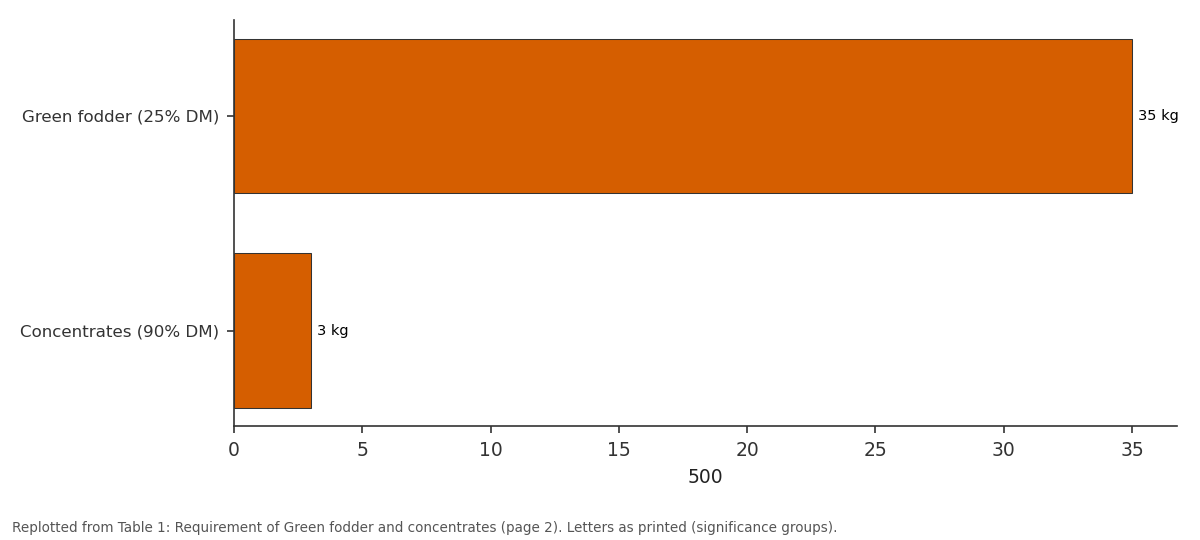
500: Green fodder (25% DM) vs Concentrates (90% DM)
Replotted from Table 1 (page 2) of the original paper. Every bar is the paper's own table value.
View source evidence ↗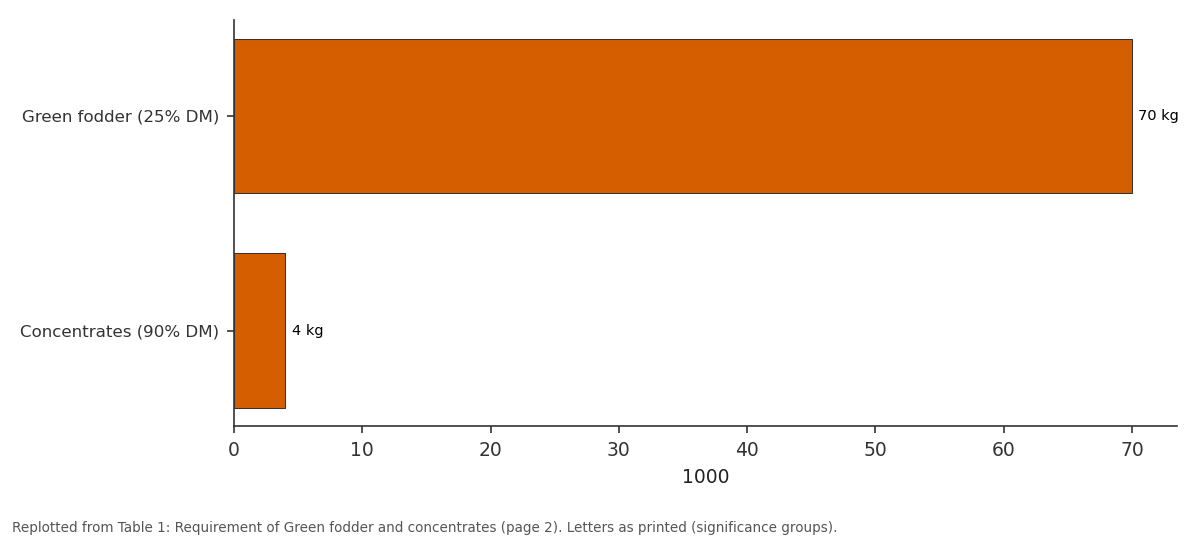
1000: Green fodder (25% DM) vs Concentrates (90% DM)
Replotted from Table 1 (page 2) of the original paper. Every bar is the paper's own table value.
View source evidence ↗Figures & tables
From the original paper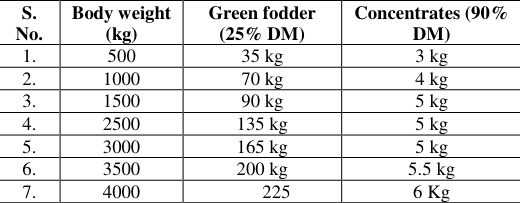 Table 1
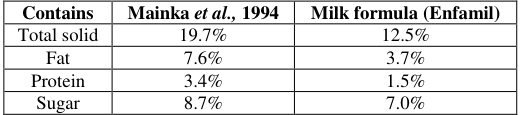 Table 2
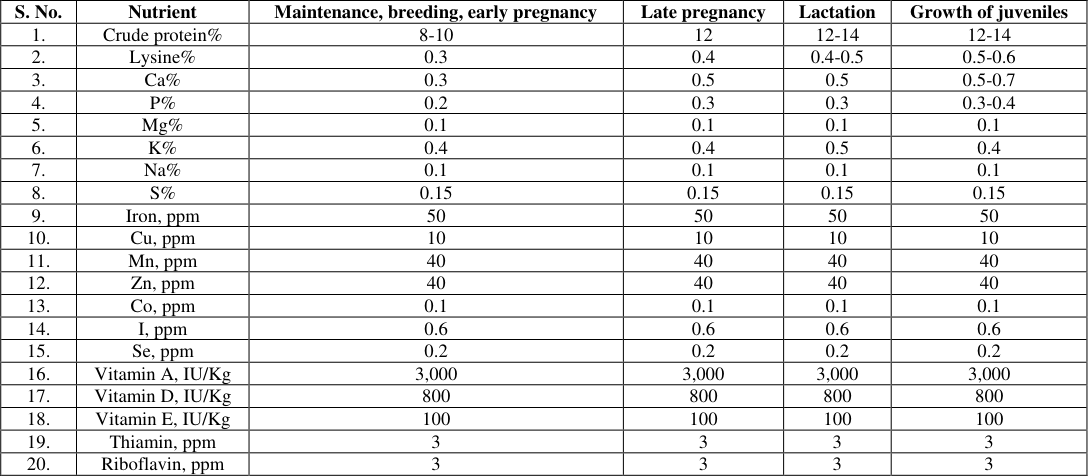 Table 3
Introduction
Elephants are known as the largest terrestrial animal on the earth and can live in a variety of habitat whilst naturally found in Asia (Elephas maximus) and Africa (Loxodonta africana). The Asian elephants spread over the Indian sub-continent including India, Bangladesh, Bhutan, Burma, China, Cambodia, Indonesia, Malaysia, Nepal, Sri Lanka, Thailand and Vietnam etc. They are enlisted under the threatened species of schedule-I of Wildlife Protection Act 1972. Taming of elephants in captivity in India began with Indus Valley Civilization for multifaceted assets. In the recent past, potentials of Asian Elephants have been also utilizing in the National Parks and Tiger Reserves for the success of wildlife conservation programme as they helps in the visit of distant places where vehicle mobility is not possible. Even for searching of apex species, restraining of wild animals for health monitoring, diseases diagnosis and other forest management oriented works, the assistance of captive elephants has been utilizing since wildlife conservation programme was launched in India. (Shrivastav, 2015) [17] . Elephants live in a herd and cooperate with each family member for their survival and struggle for the existence. Some time they becomes problematic leading to stress, behavioral changes and limitations of feed availability, thus suffers with nutritional deficiencies and metabolic diseases. Hence, their nutritional management is the need of hours for better understanding of their strength and ability.
Elephants: Digestive system
The digestive system of the elephant is similar to that of the domestic horse (Clauss, 2007) [7] . The saliva composition, which plays an essential role during initiation of digestion in mammals. Saliva is mainly released by the three major glands (parotid, submandibular, and sublingual). Salivary enzymes, i.e., lysozyme and peroxidase, in both elephant species are lacking. Urea, glucose, and creatinine are present in the saliva of African elephants, but, sodium and albumin are absent. (Boehlke et al. 2016) [3] The elephant has a separate distensible pharyngeal pouch that terminates into sphincter from which it can control the flow of food or fluid into the esophagus (Shoshani, 2000) [16] . The liver is large, and there is no gall bladder. (Fowler, 1986) [9] . Total length of intestine in Asian elephant (33 m) is longer than African elephant (19.6 m) In elephants, enzymatic digestion of grasses and browses material even takes place in the small intestine. Stomach and esophagus of elephants are similar to those in mono-gastric species like human and pig (Owen-Smith, 1988) [14] .
Aswegen (1994) [1] observed, in elephants, mucosa of the stomach bears endocrine cells that are immunoreactive to gastrin, somatostatin, chromogranin A and serotonine. In the stomach, absence of glucagons cells and presence of immunereactive endocrine cells are in contrast to other mammals. Auboiron (1995) [2] studied that, those animals in which gut bacteria hydrogenate dietary fatty acids before lipid absorption have a lower proportion of polyunsaturated fatty acids in their body lipids. Similarly, Asian elephants seem to have a lower proportion of polyunsaturated fatty acids in their spermatozoa and blood cells than African elephants due to longer retention of the ingesta in a longer small intestine with bacterial activity (Clauss et al., 2003) [4] . Recently, by the IImberger (2014) [11] , a metagenomic survey of the fecal microbiota of a breast-and a plant-fed Asian elephant was done which reveals high diversity of glycoside hydrolase family enzymes. They observerd that, GH2 family enzymes (ß-galactocydase) is most likely linked to the breastfeeding and the high contents of lactose in the mothers' milk. But, metagenome sequencing in other age group of elephants revealed a very high GH diversity including bacteroidetes and firmicutes which are mainly responsible for the degradation of cellulose in hind gut of elephant. The young elephant calves eating the stool of their mother or other adult females by which the young one's digestive system develops to its full potentials. The elephants have well developed caecums which help them to derive the benefit of microbial digestion of the ingesta. Elephants pick up these healthy microorganisms from the dung of their mothers (Sarma, 2011) [15] . After absorption of nutrients through small intestine, undigested excreta defecate by elephants up to 20 times daily, with 4 -6 boluses per defecation (Sukumar, 1990) [18] .
Suggested Guidelines for Feeding By Central Zoo Authority
Concentrates should not be fed as the first meal of the day. First meal of the day may be cultivated cereal fodder. Concentrates may be fed during noon/afternoon. High moisture feed may be fed any time, particularly during night. 1. Elephants are very prone to obesity. Body condition should be regularly monitored. Each animal should be fed individually (at least concentrate portion). 2. Grasses should be the main component of elephant diet.
Leguminous fodder may be included in the diet of young animals to increase the protein content of the diet. Low calorie roughages like reed grass banana stem may be fed ad lib. 3. For sub-adult should include pulse and cereals in 2:1 ratio, which could be supplemented with 100 g of common salt and 50 g of rock salt. For adult elephants, the ratio of pulses: cereals could be just reverse at 1:2 4. Growing animals require more protein and other nutrients in comparison to adult animals. Hence, proportion of concentrates should be higher in the diet of growing elephants. 5. A calf diet may contain 30% of concentrates on dry matter basis, whereas, 10% of concentrates in the diet of adult elephant is sufficient of meet nutrient requirements. [8] . Till 3 month of age fed should be 2 hourly intervals, gradually shifted to a 3 hourly interval, 4-6 months of age solid foods are introduced, barley+ oat+ shredded coconut, shifted to cereals+ coconut, at 5 years of age the keeper should encourage the calf to eat green grasses.
Nutritional care of Musth Elephant
When in musth, the mahouts cool the elephant by spraying water on its body. After musth, elephants are provided with a special diet, to improve their health. 3kg of gingelly and Jaggery mixed together can be fed to the elephant after musth, to improve its health. While under medication, the animal must not be allowed to work. Another mixture consisting of gingelly, a certain variety of fish, small onions can be given for five days. This helps in improving vigour.
Gingelly must be used in small quantities only, otherwise it can raise body temperature. (Shrivastav, 2015) [17] . Riboflavin, ppm 3 3 3 3 Adult maintenance, 8% CP, Breeding bull, pregnant cow (1 st two-thirds of pregnancy), 10% CP First year of lactation, 14% CP, 2 nd year of lactation, 12% CP Weanling, 14% CP, 3-year-old, 13% CP, 4-year-old to 12-year-old, 12% CP (Clauss, 2007) [7] 3.4 Geriatric care 3.4.1 Observation of teeth Asian elephant get more problems than Africans on the whole life, mainly because of teeth transition. Asian elephants teeth as they get older they tend to fill up the mouth creating mastication issues at the plain of occlusion, that's where the teeth meet on the cutting face. The bigger the teeth there seems to be less space inside the mouth for chewing and moving food around, now if the teeth are bent like the elephant to the left, the cutting edges are less effective and that means less nutrition to the elephant, which normally only has a 45% digestion rate (Clauss, 2007) [7] . African elephants tend to have less tooth problems because the teeth transition is different and the teeth are cast with less root attached making them easier to remove when it is time to fall out.
Nutritional care of Pregnant Elephant
Nutritional care of Pregnant Elephant
Observation of feacal bolus length
Elephant becomes older the size of the boluses can have a critical effect on its health, slow gut transit time, large bolus, lack of exercise an elephant can develop colic and have real trouble with stomach pains. At this point should not introduce too many fibrous plants like palm or banana tree trunks; it has a way of binding and blocking (Sarma, 2011) [15] 4. Nutritional deficiency diseases 1. Calcium-Vitamin D Metabolism Imbalance > Rickets (In young calves), fibrous osteodystrophy (adult female) Osteomalacia (adult), hypocalcaemia tetany in Elephants
Iron deficiency anemia in Elephants
> Deficiency of iron due to inadequate iron in the diet and lack of access to iron-containing water or soil, anaemia may also occur secondary to other diseases such as gastrointestinal parasitic infections, liver fluke infection and salmonellosis in elephants. Iron deficiency anaemia has been reported in both growing and adult elephants.
Scurvy in Elephants (Vitamin C deficiency)
> It has been reported that, compared to cows' milk, elephant milk contains four times the level of vitamin C.
Vitamin E -Selenium Deficiency 5. Zinc Deficiency (Nutritional dermatitis)
Zinc deficiency in elephants has been associated with possible secondary immune deficiency and epidermal lesions such as hyperkeratosis and vesicles
Common metabolic disorders reported in captive Asian
Elephants 1. Glucose-insulin ratio and leptin foot and musculoskeletal conditions, reproductive acyclicity, obesity, stress 2. Protein Excess in Growing Elephants 3. Fatty acid imbalance
Conclusion
Nutritional management of captive elephants is very important for their health and survival of other wild species. So it is necessary to keep healthy and happy environment for elephants in captivity.
Acknowledgement
The author acknowledge The Director, School of Wildlife Forensic and Health, Jabalpur, faculty members of SWFH, Jabalpur, to carry out the study successfully.
Figures and tables from the paper
| Contains | Mainka et al., 1994 | Milk formula (Enfamil) |
|---|---|---|
| Total solid | 19.7% | 12.5% |
| Fat | 7.6% | 3.7% |
| Protein | 3.4% | 1.5% |
| Sugar | 8.7% | 7.0% |
Table text extracted from the original PDF; superscript letters are shown inline. The original table image is below.
View original table image
| S. No. | Nutrient | Maintenance, breeding, early pregnancy | Late pregnancy | Lactation | Growth of juveniles |
|---|---|---|---|---|---|
| 1. | Crude protein% | 8-10 | 12 | 12-14 | 12-14 |
| 2. | Lysine% | 0.3 | 0.4 | 0.4-0.5 | 0.5-0.6 |
| 3. | Ca% | 0.3 | 0.5 | 0.5 | 0.5-0.7 |
| 4. | P% | 0.2 | 0.3 | 0.3 | 0.3-0.4 |
| 5. | Mg% | 0.1 | 0.1 | 0.1 | 0.1 |
| 6. | K% | 0.4 | 0.4 | 0.5 | 0.4 |
| 7. | Na% | 0.1 | 0.1 | 0.1 | 0.1 |
| 8. | S% | 0.15 | 0.15 | 0.15 | 0.15 |
| 9. | Iron, ppm | 50 | 50 | 50 | 50 |
| 10. | Cu, ppm | 10 | 10 | 10 | 10 |
| 11. | Mn, ppm | 40 | 40 | 40 | 40 |
| 12. | Zn, ppm | 40 | 40 | 40 | 40 |
| 13. | Co, ppm | 0.1 | 0.1 | 0.1 | 0.1 |
| 14. | I, ppm | 0.6 | 0.6 | 0.6 | 0.6 |
| 15. | Se, ppm | 0.2 | 0.2 | 0.2 | 0.2 |
| 16. | Vitamin A, IU/Kg | 3,000 | 3,000 | 3,000 | 3,000 |
| 17. | Vitamin D, IU/Kg | 800 | 800 | 800 | 800 |
| 18. | Vitamin E, IU/Kg | 100 | 100 | 100 | 100 |
| 19. | Thiamin, ppm | 3 | 3 | 3 | 3 |
| 20. | Riboflavin, ppm | 3 | 3 | 3 | 3 |
Table text extracted from the original PDF; superscript letters are shown inline. The original table image is below.
View original table image
References
17 in the original paper- the preruminant calf, Bos spp. Journal of Reproduction, Nutrition, Development. 1995; 35:167-178
- Boehlke C, Pötschke S, Behringer V, Hannig C, Zierau O. Does diet influence salivary enzyme activities in elephant species? Journal of Comparative Physiology, 2016; 187(1):213-226.
- Clauss M, Polster C, Keinzle E, Wiesner H. Studies on feed digestibility in captive Asiatic elephant (Elaphas maximus). Journal of Animal Physiology and Animal Nutrition. 2003; 87:160-173.
- Clauss M, Polster C, Keinzle E, Wiesner H, Katrin B, Van Houwald F et al. Energy and mineral nutrition and water intake in captive Indian Rhinoceros (Rhinoceros unicornis). Zoo Biology. 2005; 24:1-14.
- Clauss M, Hatt JM. Feeding Asian (Elephas maximus) and African elephants (Loxodonta africana) in captivity. International Zoo Yearbook. 2006; 40(1):8895.
- Clauss M, Steinmetz H, Ellenberger U, Ossent P, Zingg R, Hummel J et al. Observations on the length of the intestinal tract of African (Loxodonta Africana) and Asian elephants (Elephas maximus). European Journal of Wildlife Research, 2007; 53(1):68-72.
- Das A. Standardization of Animal Diets in Indian Zoos, 1st Edn, Printing Palace, Tiwari Market, Janakpuri, Bareilly, 2013, 85-93.
- Fowler ME. Zoo and Wild Animal Medicine, 2 nd Edn, WB Saunders Company, Philadelphia, 1986, 516-532.
- Hume ID, Rubsamen R, Engelhardt WV. Nitrogen metabolism and urea kinetics in the rock hyrax (Procavia habes-sinica). Journal of Comparative Physiology. 1980; 138:307-314.
- Ilmberger N, Gullert S, Dannenberg J, Rabausch U, Torres J. A ComparativeMetagenome Survey of the Fecal Microbiota of a Breast-and a Plant-Fed Asian Elephant Reveals an Unexpectedly High Diversity of Glycoside Hydrolase Family Enzymes. Stefan Bereswill, Charite´- University Medicine Berlin, Germany, 2014; 9(9):45-49.
- Lynch M, McGrath K, Raj K, McLaren P, Payne K. Hereditary factor vii deficiency in the asian elephant (elephas maximus) caused by a f7 missense mutation. Journal of Wildlife Diseases, 2017; 53(2):78-81
- Mainka S, Cooper RM, Black RS, Dierrenfeld ES. Asian elephant (Elephas maximus) milk composition during the first 280 days of lactation. Zoo Biology, 1994; 13:389394.
- Owen-Smith RN. Megaherbivores: The Influence of very large body size on ecology. Cambridge University Press, Cambridge, UK. 1988; 6(2):256-257
- Sarma KK. Elephant care, 1 st Edn., Directorate of Project Elephant, Ministry of Environment and Forest, Government of India, New Delhi, 2011, 9-10.
- Shoshani J, Joseph P. The elephant pharyngeal pouch - was the mystery resolved? Elephant Research Foundation. 2000; 2(4):75-76.
- Shrivastav RK. Conservation of elephants in India Lead paper, International Symposium on Ecology and Health Management of Asiatic Elephant (Elephas maximus), New Delhi, 19-20 November, 2015, 1-7.
- Sukumar R. Ecology of the Asian Elephant in southern India. Feeding habits and crop raiding patterns. Journal of Tropical Ecology. 1990; 6(1):33-53.
Cited by 3
From OpenAlex, OpenCitations and reference lists read by Scinovex
- Milk metabolite composition of a semi-captive population of Asian elephants ↗
Laura Galante, Diogo João Franco dos Santos, Elisabeth Mikkonen, Jeannie Horak, Zorica Stijepic, Hans Demmelmair et al. · Royal Society Open Science · 2024
Abstract Lack of maternal milk commonly leads to Asian elephant calves’ death in captivity. Currently, available supplements seem inefficient. Hence, we aimed at characterizing the composition of Asian elephant milk to provide information on calves’ nutritional needs. Seventy milk samples from 22 Asian elephants living in semi-captivity in their natural environment in Myanmar were collected. Samples were analysed through various…
❝ 1PDF - Regulating and Monitoring the Asian Captive Elephant Industry ↗
Georgina Ashby · CABI eBooks · 2025
This chapter explores the current state of tourist venues in South-east Asia, examining factors such as the presence of on-site veterinary care, the extent of elephant freedom (and other welfare factors such as diet, enrichment and exercise). The chapter underscores the importance of robust monitoring and independent auditing mechanisms including use of Asian Captive Elephant Standards (ACES) and the Elephant-First…
❝ 0 - Reproduction record of captive Sumatera elephant (Elephas maximus sumatranus) at Way Kambas National Park, Indonesia ↗
Keren Jayanti Sofie Adi, Budiarto Budiarto, Hermin Ratnani, Pudji Srianto, Budi Utomo, Suzanita Utama et al. · Ovozoa Journal of Animal Reproduction · 2022
This research aims to determine reproductive data on Sumatran elephants (Elephas maximus sumatranus) in the ETC and ERU of Way Kambas National Park, Indonesia during 1988-2021. Data recorded from the elephant population at both locations (ETC and ERU) includes the number, gender of elephants, elephant calves, ages and birth dates. Calving intervals and service periods were calculated from calving records…
❝ 0PDF