
Research article · 2021 · Full text
International Journal of Agriculture and Food ScienceStudies on formulation and standardization chakali incorporated with spinach puree
Volume 3(1) · Pages 25–28 · DOI: 10.33545/2664844x.2021.v3.i1a.47 ↗
Research areasFood Science and Nutritional Studies
Abstract
Author-writtenChakali, a traditional savory product was identified as they are low in protein and mineral contents. Chakali is a highly preferred and most deep fried snack product in India due to its taste and easy preparation. The present investigation was carried out to standardize and formulation of spinach Chakali. Spinach is one of the most important and nutritious vegetables eaten raw or cooked it provides a very good amount of vitamins B6, Riboflavin, Folic acid, Niacin, soluble dietary fiber, omega -3- fatty acids and minerals. It is also rich in iron and it helps to prevent disease like osteoporosis, anemia, gastrointestinal disorders, stimulation in children and fatigue and also has been suggested it’s used as an anticancer agents, antioxidant and anti- cancerous. The preparation of Chakali was carried out by using Rice flour and Bengal gram flour and incorporating of spinach puree at different variation viz., T0 (45:45:0), T1 (35:35:20), T2 and (30:30:30) and T3 (25:25:40) respectively. Further, the sample were allowed to deep frying and subjected to organoleptic evaluation by using 9 point hedonic scale. Results, revealed that T3 (25:25:40) shows highest sensory score as compared with other sample i.e. T1 (35:35:20) and T2 (30:30:30) and found more superior over other treatments. Finally, it can be concluded that 50% of incorporation of puree in the Chakali is more acceptable and shows better colour, Flavour, after taste and texture. Proximate composition of Spinach Chakali were found to be Ash content 3.19± 0.03%, Moisture content 2.4± 0.08%, Fat content 26.49± 0.12%, Protein content 12.04± 0.88%, Carbohydrate content 49.80± 0.33% and Energy value 485.77kcal respectively. It was concluded that the Chakali can be store for one month in High density polyethylene pouches at room temperature and Chakali satisfy consumer’s needs.
Summary
Source-checkedPlain-language reading of the full paper, prepared with AI and checked against the text. Each point links to the authors' own words.
Why it matters
- Traditional chakali is a popular deep-fried Indian snack, but it is typically low in minerals and protein. View evidence ↗
- Spinach is a highly nutritious vegetable providing various vitamins (B6, Riboflavin, Folic acid, Niacin), minerals, soluble dietary fiber, and omega-3 fatty acids. View evidence ↗
- There is a consumer demand for convenient and varied snack products that do not compromise on nutritional value. View evidence ↗
The question
- The study aimed to standardize the formulation of chakali incorporated with spinach puree. View evidence ↗
What they did
- Four formulations were tested using rice flour, Bengal gram flour, and spinach puree in ratios of 45:45:0 (T0), 35:35:20 (T1), 30:30:30 (T2), and 25:25:40 (T3). View evidence ↗
- The chakali samples were prepared using deep fat frying at 180°C for a duration of 2 to 3 minutes. View evidence ↗
- Ten semi-trained academic staff members evaluated the products' appearance, color, flavor, aftertaste, texture, and overall acceptability using a 9-point Hedonic scale. View evidence ↗
- Proximate composition, including moisture, ash, crude fat, crude protein, and crude fiber, was determined following AOAC (2000) procedures. View evidence ↗
What they found
- The T3 formulation (25:25:40) received the highest sensory scores and was superior to the T1 and T2 treatments. View evidence ↗
- Sample T3 achieved an overall acceptability score of 7.9, making it the most acceptable sample among those tested. View evidence ↗
- The selected spinach chakali had a proximate composition of 3.19± 0.03% ash, 2.4± 0.08% moisture, 26.49± 0.12% fat, 12.04± 0.88% protein, 49.80± 0.33% carbohydrates, and an energy value of 485.77 kcal. View evidence ↗
- The physical properties of the spinach chakali were a diameter of 5.5 cm, a thickness of 0.44 cm, and a weight of 11.41 g. View evidence ↗
What it means
- The authors conclude that incorporating 50% puree into the chakali is the most acceptable level for color, flavor, aftertaste, and texture. View evidence ↗
- The study concludes that the spinach chakali can be stored for one month at room temperature in high-density polyethylene pouches. View evidence ↗
Visual summary
2 visualsIllustrations explain the paper; charts are replotted from the paper's own table values.
Formulation Comparison
AI-generated conceptual illustration (chakali snacks and spinach puree). It explains the idea and does not show study data.
View source evidence ↗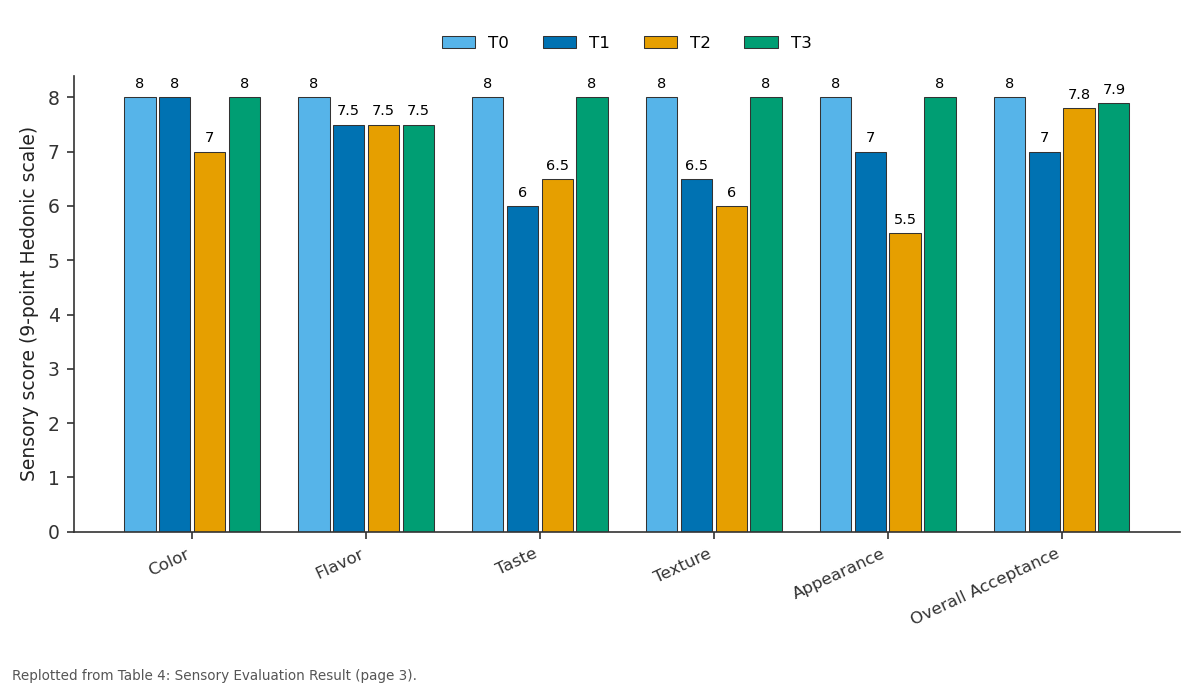
T0 and T1 and more: Color vs Flavor vs Taste vs Texture vs Appearance
Replotted from Table 4 (page 3) of the original paper. Every bar is the paper's own table value.
View source evidence ↗Figures & tables
From the original paper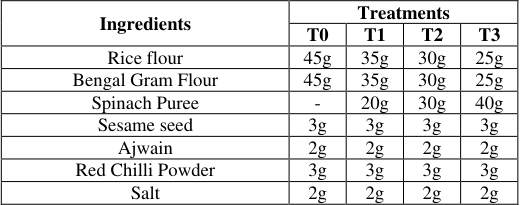 Table 1
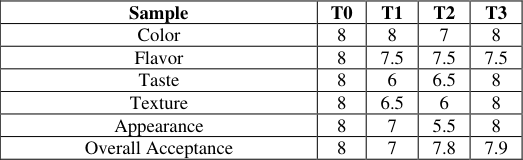 Table 4
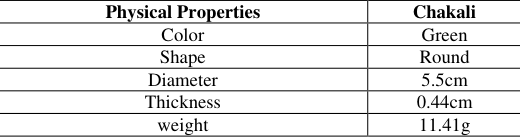 Table 2
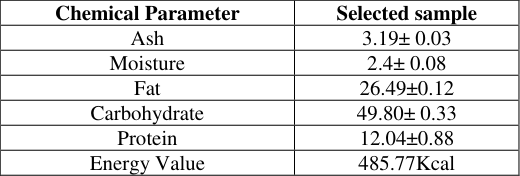 Table 3
Introduction
Chakali, a traditional savoury Product was identified as they are low in Protein and Mineral contents. It is also a deep Fat fried Product as a result of which its Fat content is significantly high. So, Chakali was prepared using conventional deep Fat frying for control and variable Products. (Sarangam et. al., 2015) [11] "Chakli'' is common term for a variety of fried snacks that can be made using different combination of ingredients. The main ingredient for all type of "Chakli'' is rice flour. " Chakli" are delicious savouries that are generally made at home and kept in airtight container for eating as fancied as well as enjoyable crunchy and satisfactory snack. They are exclusively south Indian, but a different version of "chakli'' is made in Western India under the name of chakkali; out of channa dal and sold as a packaged savoury (Anon.,2011) [2] . India market is so diverse and large with over 1000 different snack products and almost 300 types of sevoury items. In India, a number of snacks food items are prepared from a different raw materials like besan (Begal gram flour) Maida (refined wheat flour), Urad (black gram) dhal, Moong (green gram) dhal, alone or in combination with other cereals and legumes /pulses. Their manufacturing processes may include cleaning, pre-treatment, soaking, roasting, frying etc. (Ravi et. 2011) [8] . Murruku '' is a common term for a variety of fried Snacks that can be made using different combination of ingredients, The main ingredient for of all types " Murruku at h" are delicious savories that are generally made at home and kept in airtight containers for eating as fancied and enjoyable with crunchy satisfactory. They are exclusively South Indian but a different version of "Murruku" is made in western India under the name of chakli, out of channa dal and sold as a packaged savory (Masshoud, 2011) [7] . Spinach (Spinacia oleracea), belongs to Chenopodiaceous family, is one of the most important vegetables. [3] . Spinach is a rich source of fiber, vitamins A, C, K, E, B6, B2 and also magnesium, manganese, iron, calcium, potassium, copper, phosphorous, zinc, selenium, folate, betaine, folic acid, protein, niacin, omega -3 fatty acids, carotenoids beta -carotene and lutein, and bioflavonoid quercetin with many other flavonoids, spinach with poor source of fat is a suitable food for obese and diabetic people. It is also a good source of chlorophyll, which is known to aid in digestion (Roughani et al, 2011; Gaikwad et al, 2010; Verma, 2018) [9] . Spinach is a rich source of fiber, vitamins A, C, K, E, B6, B2 and also magnesium, manganese, iron, calcium, potassium, copper, phosphorous, zinc, selenium, folate, betaine, folic acid, protein, niacin, omega -3 fatty acids, carotenoids beta -carotene and lutein, and bioflavonoid quercetin with many other flavonoids, spinach with poor source of fat is a suitable food for obese and diabetic people. It is also a good source of chlorophyll, which is known to aid in digestion (Roughani et al, 2011; Gaikwad et al, 2010; Verma, 2018) [9] . Rice (Oryza sativa) is a dietary staple food, one of the most important cereal crop, especially for people in Asia. Rice is great source of complex Carbohydrates. The rice is one of the rich source of the Nutrient such as Moisture (13.7 %), carbohydrate (72.2%), protein (6.8%), fat (0.5%), crude fiber (0.2%) respectively. Gluten is major protein of Rice (Khetarpaul et.al. 2005) [5] . The protein content have can be increased and the flour preparation containing as much as 26% protein have been obtained. Aflatoxin is an Anti-nutritional factor may contain in rice (Manay and Shadaksharaswamy, 2008) [6] Rice has various health benefits such as it is an excellent food to include in a balanced diet. Rice has no Fat, no cholesterol and is Sodium free. Bengal gram or chick pea (cicer arietinum) is an annual legume of the family Fabaceae, subfamily Faboideae. It was a cultivated crop grown in tropical, subtropical and temperature regions. The plant grows to 20-50 cm (8-20 in) high and has, small feathery leaves on either side of the steam. Bengal gram is a cool season food legumes (Gaur et al., 2013) [4] . The chickpea is a good of Carbohydrate and Protein which together constitute about 80%of the dry mass. The nutritional value contain in Bengal gram are Energy (372 Kcal), Protein (20.8g), Fat (5.6g), calcium (56mg), Iron (9.1mg), Thiamine (0.48mg), riboflavin (0.18mg), Niacin (2.4mg), vit-C (1mg), & vit. A (129mcg) respectively Gopalan et, al., (1971) [3] . In chickpea, the Anti-nutritional factors are Trypsin (8.1-15.7%), chymotrypsin Inhibitor (6.1-8.8%), Amylase Inhibitor (5.0-9.7%), Polyphenols (1.9-6.1%) (Sultana et al., 2014) [12] . It could have beneficial effects on some of the important human diseases such as Cardio-vascular disease, Type 2 Diabetes, Digestive diseases and some Cancer (Jakanti et al., 2012). It is also used for blood purification, they can also assists in lowering of cholesterol in the blood steam (Sanghi, 2013) [10] . The need to develop new product is driven by the widening tastes of consumers who are looking for convenience, value -for money and variety without compromising on the nutritional aspects. The value added Chakali developed by rice flour, Bengal gram flour and Spinach Puree. It is like due to crunchy in texture therefore it's suitable even for young and old people. Hence, keeping this above information in view, the present investigation was undertaken basically increase the utilization of little millet by incorporating replacing it in Chakali -a highly preferred and most popular and deep fried snack of India and also to develop a nutritious snack with rice flour and spinach puree.
Material and Methods
Material and Methods
Procurement of Raw Material
Raw materials required during present investigation were procured from local market of Murbad such as Spinach, Rice flour, Bengal Gram flour, Red Chilli Powder, Ajwain, Sesame Seed, oil, Salt etc. the raw material were cleaned and made free from husk and other foreign matters. Most of the chemicals and equipment used in this investigation were of analytical grade which are obtained from college of Food Technology Saralgaon, Thane
Physical Properties of Chakali
The colour of Chakali was determined by visual observation. The Shape of Chakali was determined by visual observation. The Diameter of Chakali was determined by Measuring Scale and the Thickness of Chakali was determined by vernier calliper scale.
Chemical Properties of Chakali
Proximate composition such as moisture, ash, crude fat, Crude protein and crude fibre of all the Ingredients and Crackers was determined according to the procedures given in AOAC (2000). For moisture determination samples were dried in oven at 130ºC for 60 minutes. For ash Determination samples were placed in muffle furnace at550ºC to burn out all carbon compounds leaving in organic Part (ash). Fat was determined by fat extraction unit by using Hexane. For fibre determination, samples were treated with 1.25% Sulphuric acid and Sodium Hydroxide solution. After filtration of digested material it was washed with hot water and then ignited. By calculating loss of weight after ignition, crude fibre contents were determined. Protein contents were determined by using Kjeldahl's unit.
Sensory evaluation of Chakali
Prepared product were evaluated for sensory characteristics in terms of Appearance, color, flavour, after taste, texture and overall acceptability by 10 semi-trained panel members comprised of academic staff members using 9-point Hedonic scale. Judgments were made through rating the product on a point Hedonic scale with corresponding descriptive terms ranging from 9 'like extremely' to 1'dislike extremely'. The obtained results were recorded in sensory scored card.
Statistical Analysis of Chakali
The analysis of variance of the data obtained was done by using completely randomized design (CRD) for different treatments as per the method given by Panse and Sukhatme (1967). The analysis of variance revealed at significance of p<0.005 level S.E and C.D. at 5 percent level is mentioned wherever required.
Preparation of Flours
The Rice and Bengal gram were cleaned properly and then Rice and Bengal gram was grinded in household Flour mill. The flours were sieved through of BS 100mm-Mesh size. All the flours were stored in air tight container
Formulation of Chakali
Chakali prepared with incorporation varying levels of Spinach Puree with Rice flour and Bengal Gram flour were investigated. The formulation was made by varying levels of Rice flour, Bengal Gram flour and Spinach Puree, viz., 45g:45g:00g, 35g:35g:20g, 30g:30g:30g, and 25g:25g:40g percent respectively and data given are illustrated in table. It was concluded that sample T3 has highest Score as compared to other samples. The overall acceptability of sample T3 7.9 while other samples. T3 more acceptable on its sensory attributes.
Result and Discussion
Result and Discussion
Conclusion
In the present study finally it is concluded that Spinach Chakali prepared from different Variations of flour such as Rice Flour, Bengal Gram flour, and Spinach puree has high Nutrition quality and also it is rich source of Fiber, and Vitamins due to incorporation of spinach puree. The present investigation carried out T3 sample found more superior than other sample for information of spinach Chakali in which T1 and T2 so, T3 sample is more acceptable on its sensory attributes and consumer acceptable.
Figures and tables from the paper
| Ingredients | Treatments | — | — | — |
|---|---|---|---|---|
| T0 | T1 | T2 | T3 | |
| Rice flour | 45g | 35g | 30g | 25g |
| Bengal Gram Flour | 45g | 35g | 30g | 25g |
| Spinach Puree | - | 20g | 30g | 40g |
| Sesame seed | 3g | 3g | 3g | 3g |
| Ajwain | 2g | 2g | 2g | 2g |
| Red Chilli Powder | 3g | 3g | 3g | 3g |
| Salt | 2g | 2g | 2g | 2g |
Table text extracted from the original PDF; superscript letters are shown inline. The original table image is below.
View original table image
| Sample | T0 | T1 | T2 | T3 |
|---|---|---|---|---|
| Color | 8 | 8 | 7 | 8 |
| Flavor | 8 | 7.5 | 7.5 | 7.5 |
| Taste | 8 | 6 | 6.5 | 8 |
| Texture | 8 | 6.5 | 6 | 8 |
| Appearance | 8 | 7 | 5.5 | 8 |
| Overall Acceptance | 8 | 7 | 7.8 | 7.9 |
Table text extracted from the original PDF; superscript letters are shown inline. The original table image is below.
View original table image
| Physical Properties | Chakali |
|---|---|
| Color | Green |
| Shape | Round |
| Diameter | 5.5cm |
| Thickness | 0.44cm |
| weight | 11.41g |
Table text extracted from the original PDF; superscript letters are shown inline. The original table image is below.
View original table image
| Chemical Parameter | Selected sample |
|---|---|
| Ash | 3.19± 0.03 |
| Moisture | 2.4± 0.08 |
| Fat | 26.49±0.12 |
| Carbohydrate | 49.80± 0.33 |
| Protein | 12.04±0.88 |
| Energy Value | 485.77Kcal |
Table text extracted from the original PDF; superscript letters are shown inline. The original table image is below.
View original table image
References
12 in the original paper- Aless O, Najla S, Murshed R. Improvement of yield and quality of two Spinacia Oleracea L. varities by using different fertilizing approaches. Physiology and Molecular Biology of plants.2017:23(3):697-702.
- Anonymous. B. Sc., Project report the effect of addition of fish,2011.
- C Gopalan BV, Sastri SC, Balasubrumanian. Nutritive value if Indian food, First addition, proximate principle: common foods -50chicken on production of "murruku" Univ. Teknologi, MARA, Malaysia,1971.
- Gaur P, Juanti A, Samineni S, Chaturvedi S, Basu P. Climate Change and Plant Abiotic Stress Toleranc.2013:837-856.
- Khetarpaul N, Grewal R, food S. Bakery science and cereal Technology, Daya Publishing House. 2005:16.
- Manay S, shadaksharaswamy M. Food facts and Principals. Third Edition New Age International (P) Ltd., Publishers.2008:210-213.
- Masshoud FAB. The effect of addition of fish and chicken on production of "murruku" B. Sc. Project Report. University teknolgy MARA (Malasiya),2011.
- Ravi R, Singh VK, Prakash M. Projective mapping and poduct positioning of deep fat fried snacks. Food Nutri. Sci.2011:2:674-683.
- Roughani A, Miri SM, Kashi AK. Effect of colchicine, trifluraline and oryzaline on polyploid induction in spinach. MSc Thesis of Horticulture Science. Islamic Azad University, Karaj Branch,2011.
- Sanghi A. Formulation of Nutritious Mixes for Development of Dhokla and Their Quality Evaluation. Jawaharlal Neharu Krishi Vishwa Vidhylaya Jabalpur (M.P.),2013:1-58.
- Sarangam s, Chakraborty p, Chandrashekhar G. Development of Low Fat Multigrain Murukku -A Traditional savory product. International Journal of Reasaerch in Agriculture and Forestry.2015:2(4):15-24.
- Sultana A, Rahman R, Islam M, Rahman M, Alim. Evalution of Quality of chapaties of Enriched with Jackfruit seed Flour and Bengal Gram flour. IOSR Journal of environmental science, Toxicology and Food Technology.2014:8(5):73-78.