
Research article · 2019 · Full text
International Journal of Research in AgronomyHaruna Saleh and Murtala Mohammed Ruma
Volume 2(2) · Pages 10–16 · DOI: 10.33545/2618060x.2019.v2.i2a.17 ↗
Research areasAgricultural Economics and PracticesAgricultural risk and resilienceAgriculture and Rural Development Research
Abstract
Author-writtenThis research focused on the comparative study between the length of growing season, millet (Pennisetum americanum L.) and sorghum (Sorghum bicolor (L) moench) yields in Kano State, Nigeria in the period spanning from 1981 to 2010. The data for the investigation are daily rainfall records, millet and sorghum yields sourced from Nigerian Meteorological Agency (NiMet) at Aminu Kano International Airport and Kano State Agricultural and Rural Development Authority (KNARDA) respectively. The study attempted to identify the level of length of growing season, millet and sorghum yields in ton/ha, examine the trend of length of growing season, millet and sorghum yields and compare their trends. Data collected analyzed using decriptive statistics and least square regression model. Descriptive statistics was used to compute cumulative pentad rainfall and an ogive of cumulative rainfall pentad. Using Pentad and Julian day calendars, an annual ogive of cumulative pentad was drawn using Microsoft Excel and determined length of growing season in the study period. Least square regression model was used to determine linear trend line and trend directions of length of growing season, millet and sorghum yields. Results obtained indicate that as the trend of length of growing season increases, the trends of millet and sorghum yieds decreases. Based on these results, it recommended that agricultural stakeholders should encourange farmers toward intensive agriculture rather than extensive by providing adequate agricultural inputs at subsidize price.
Summary
Source-checkedPlain-language reading of the full paper, prepared with AI and checked against the text. Each point links to the authors' own words.
Why it matters
- Millet and sorghum are critical food sources in Nigeria, accounting for 80% of cereal production and providing essential calories and protein for millions of people. View evidence ↗
- The length of the growing season, the period where rainfall supports crop germination and development, is a key factor in determining which crops can be successfully grown in a specific area. View evidence ↗
- Agricultural productivity in Kano State is threatened by a lack of reliable empirical data regarding the relationship between the length of the growing season and the yields of millet and sorghum. View evidence ↗
The question
- The study aimed to compare the length of the growing season with the yields of millet and sorghum in Kano State. View evidence ↗
What they did
- The research analyzed data from Kano State, Nigeria, covering the period from 1981 to 2010. View evidence ↗
- Daily rainfall data were obtained from the Nigerian Meteorological Agency (NIMET), and annual crop yield records in tons per hectare were sourced from the Kano State Agricultural and Rural Development Authority (KNARDA). View evidence ↗
- The length of the growing season was determined using a pentad calendar and cumulative rainfall ogives, while least square regression was used to analyze the linear trends of the growing season and crop yields. View evidence ↗
What they found
- The length of the growing season in Kano State averaged 133 days, with a maximum of 181 days in 2010 and a minimum of 85 days in 1994. View evidence ↗
- The study found a positive linear trend, indicating that the length of the growing season increased over the study period. View evidence ↗
- Millet yields showed a decreasing linear trend, with yields ranging from a low of 0.62 Ton/ha in 1982 to a high of 5.81 Ton/ha in 1994. View evidence ↗
- Sorghum yields also exhibited a decreasing linear trend, with the highest yield of 4.28 Ton/ha in 1982 and the lowest of 0.98 Ton/ha in 2005. View evidence ↗
- The results indicate that a longer growing season does not necessarily lead to higher yields, as the years with the longest growing seasons did not correspond with the years of highest millet and sorghum yields. View evidence ↗
What it means
- The authors conclude that the decrease in crop yields despite an increasing growing season is likely due to other agricultural production factors. View evidence ↗
- The authors recommend that agricultural stakeholders encourage farmers to adopt intensive agriculture by providing subsidized agricultural inputs. View evidence ↗
Visual summary
2 visualsIllustrations explain the paper; charts are replotted from the paper's own table values.
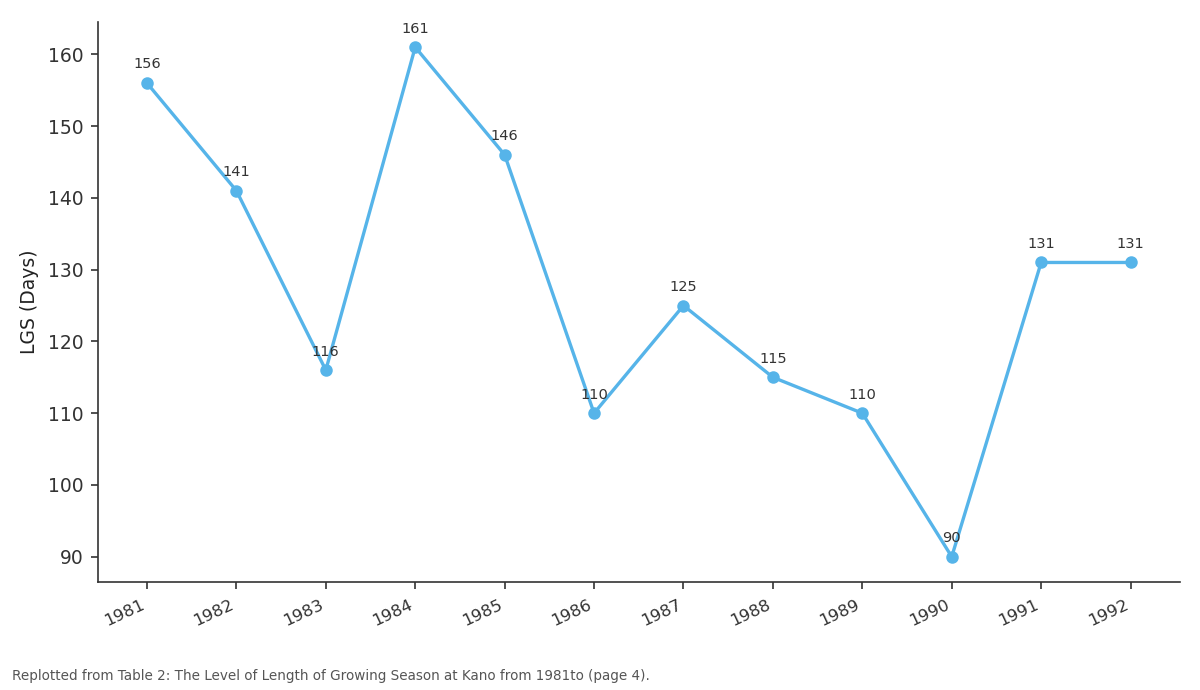
LGS (Days): 1981 vs 1982 vs 1983 vs 1984 vs 1985
Replotted from Table 2 (page 4) of the original paper. Every bar is the paper's own table value.
View source evidence ↗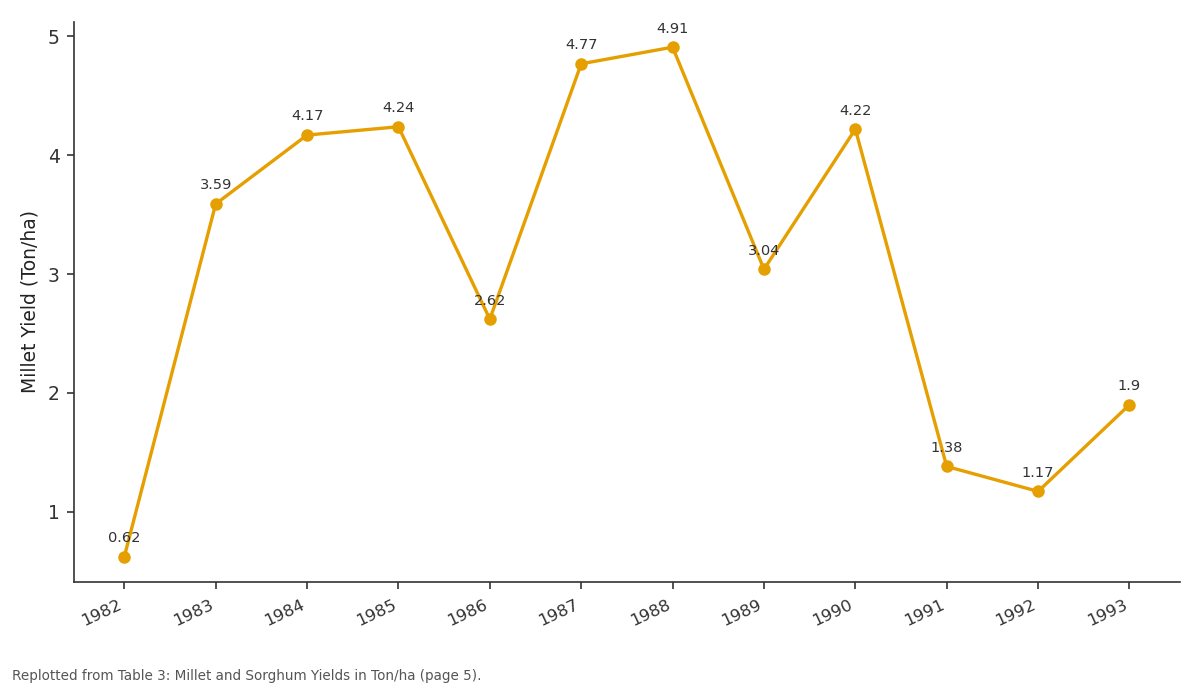
Millet Yield (Ton/ha) / NA: 1982 vs 1983 vs 1984 vs 1985 vs 1986
Replotted from Table 3 (page 5) of the original paper. Every bar is the paper's own table value.
View source evidence ↗Figures & tables
From the original paper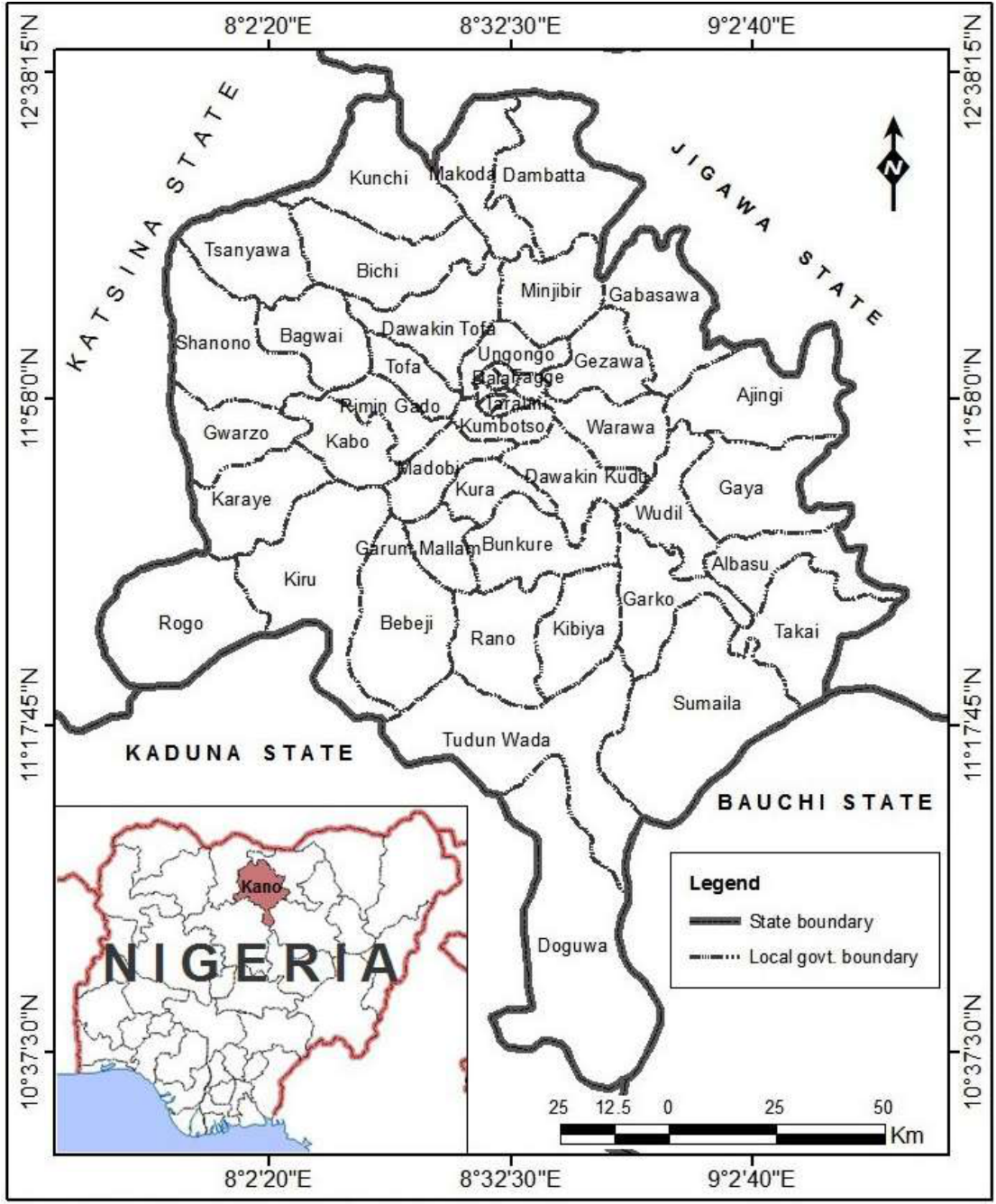 Figure 1
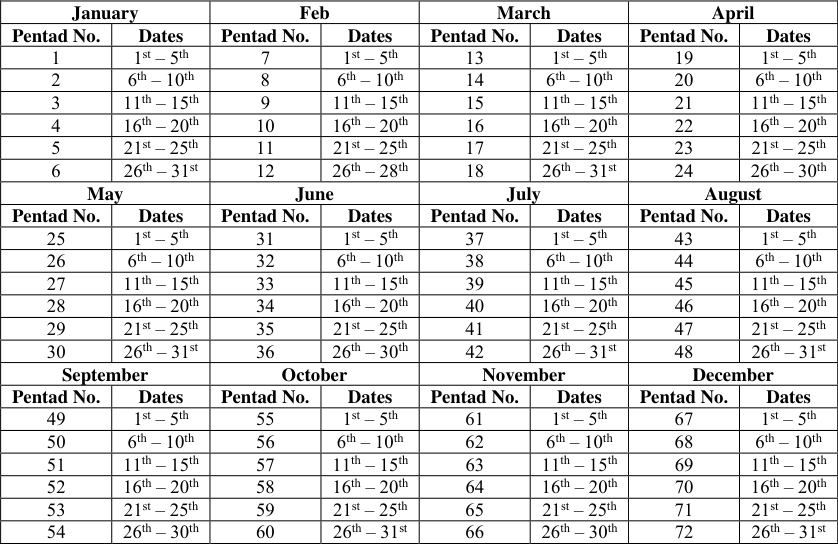 Table 1
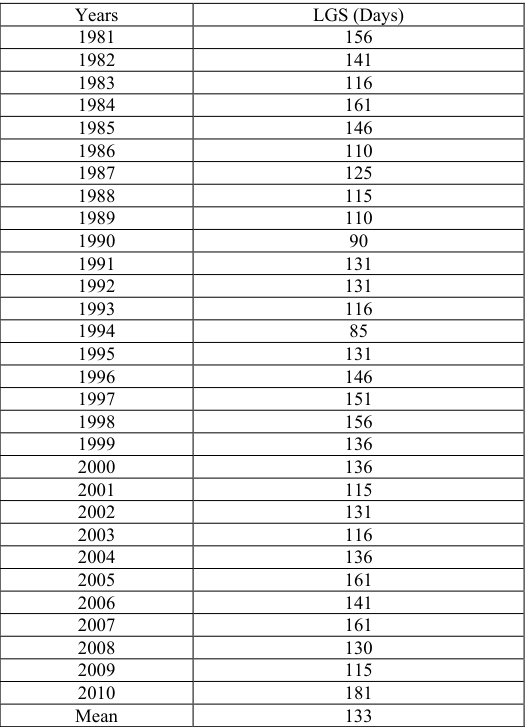 Table 2
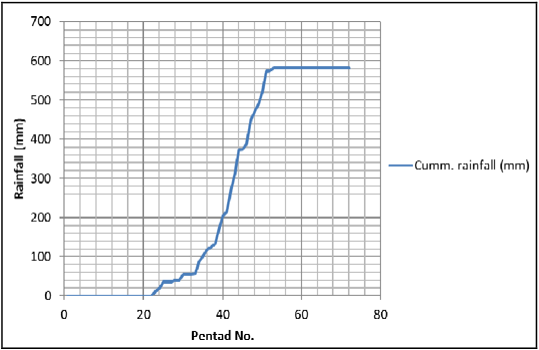 Figure 2
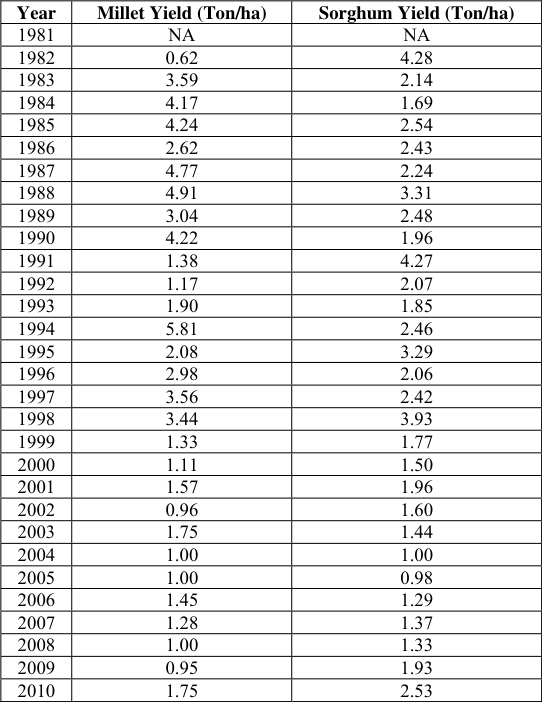 Table 3
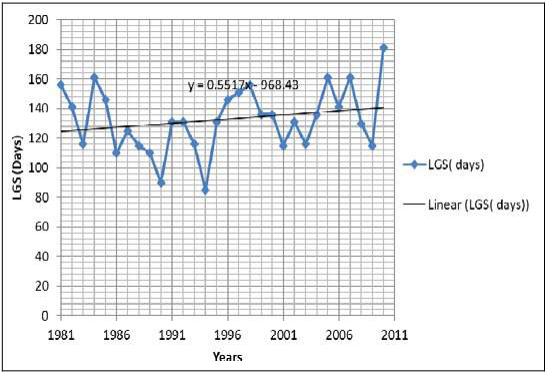 Figure 2
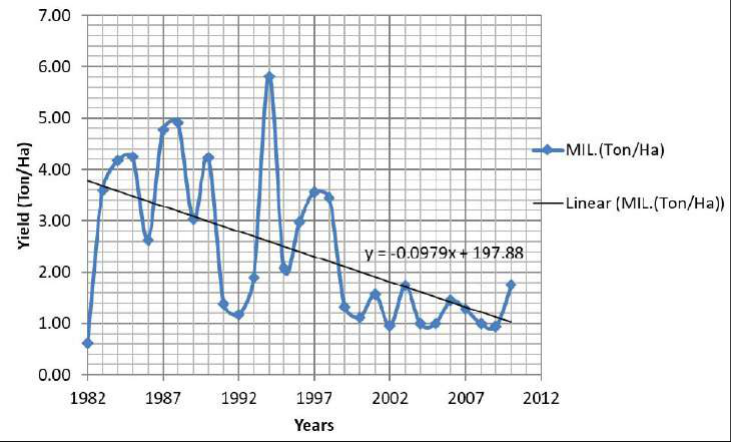 Figure 3
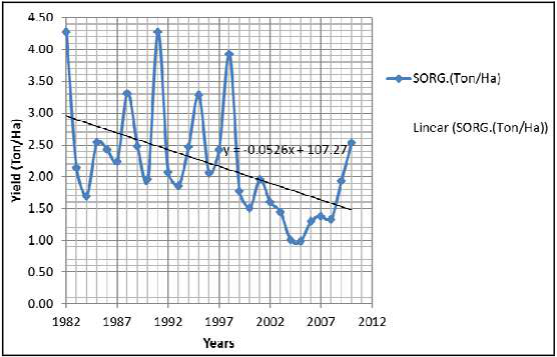 Figure 4
Introduction
Length of growing season defined as the period of the year during which rainfall distribution characteristics are suitable for crop germination, and full development (Odekunle, 2004) [12] . It is a period of the year categorized as rainy or wet season. The length of the growing season varies spatially and temporally. The length of growing season can be determined by subtracting for each year, the date at which the rains start from the date that it ends (Madeoye, 1986; Zargina, 1987) [9,23] . Oladipo and Kyari (1993) [13] in their study of growing season rainfall of Northern Nigeria indicated that the onset, cessation and length of growing season show latitudinal progress but with some disruptions due to geographic effect in the central area (Jos). Adefolalu (1993) [1] stated that the length of the growing season can be obtained by subtracting the onset pentad from the cessation pentad and multiplying by five. Aliyu (2009) [2] observed a downward trend in the duration (length) of the growing season in some locations in northern Nigeria from 1978 to 2007, with a significant variability in most of the stations north of latitude 9⁰N in Nigeria. Odekunle (2004) [12] also observed that rainfall during the crop-growing season determines crops germination, establishment and full development. He further defined growing season as period between onset and cessation of the rains. The length of the growing season (days) for a particular year considered as the difference between the Julian day number of the determined cessation date and determined onset for that year. Studies conducted in Semi-arid parts of West Africa indicated that, there is a significant relationship between the start of rains and the length of growing season (Sivakumar, 1988). Thus, earlier onset most often leads to longer length of growing season and late onset shorter length of growing season. This is an indication that the length of growing season is more dependent on rainfall onset than its cessation (Omotosho, 1992) [17] .
The length of growing season often determines which crops could grow in an area, as some crops require long growing seasons, while others mature rapidly. Among authors that have emphasized linkages of the growing season with reliable onset of rains are Dagga (1965) [7] , Bello (1996), Olaniran (1983 and 1984) [14,15] , Ati, et al (2002) [4] , Sawa and Ibrahim (2011) [20] . The Nigerian Savannah ecology is the major cereal production area in Nigeria. It accounts for about 665,600 square kilometers (about 67 million hectares), which also represent about 70% of the geographical area of Nigeria (Idem and Showemimo, 2004) [8] . The West African semi-arid tropics defined as those areas where rainfall exceeds potential evapotranspiration for two to seven months annually. This area encompasses the northern portions of Nigeria, with Kano State inclusived. Cereals occupy nearly 70 percent of total cultivated areas in this region and engage 50 to 80 percent of total farm-level resources (Matron, 1990) [11] . Millet and sorghum account for 80 percent of cereal production. During the last 25 years, growth in millet and sorghum production has been slow and the total output has been about one percent lower than the population per year. Average yield per unit area of millet and sorghum has declined during this period, and the small production increases have primarily resulted from expansion of cropped area. Matron (1990) [11] reported that, the potential for major increases in sorghum and millet supplies exist only in the Sudano-Guinean zone and to a lesser extent in the Sudanian zone. Sorghum is widely grown both for food and as a feed grain, while millet is produced almost entirely for food. Millet and Sorghum depend almost entirely on rainfall as their moisture supply. The amount and distribution of rainfall are important factors in determining the ultimate productivity of these crops. It estimated that Sorghum together with Millet accounts for over 60% of cereal production in Nigeria (Awoyemi, 1986) [5] . Millets and sorghum constitute a major source of calories and protein for millions people of Kano State and Nigeria at a large. The unreliable empirical knowledge between length of growing season, Millet (Pennisetum americanum L) and Sorghum (Sorghum bicolor (L) moench) Yields in Kano State often causes a great threat to agricultural productivity. Most a time these crops are planted without comparing their levels and trend with the levels and trend of length of growing season, consequently, often lead to uncertainty on the nature of their yields for many decades ago. It is against this background this paper aimed to compare length of growing season with Millet (Pennisetum americanum L) and sorghum (Sorghum bicolor (L) moench) yields in Kano State through the following objectives: 1. Identify the level of length of growing season from 1981 to 2010 2. Determine level of millet and sorghum yields in ton/ha in the study period 3. Assess the trend of length of growing season, millet and sorghum yields in the study period 4. Compare the trend of length of growing season with millet and sorghum yields
Materials and Methods
Materials and Methods
Study Area
Kano State extends from latitudes 10 0 3 ' N to 12 0 3 ' and longitudes 7 0 35 ' E to 9 0 20 ' E (Fig. 1). [19] . The climate of Kano is described as Aw by Koppen, with both annual and seasonal variabilities, wet years and dry years may record between 850 and 750mm (Olofin, 1987:14) [16] The Vegetaion of the study area is Sudan Savanna type. Olofin (1987) [16] observed that the natural vegetation of the study area is tropical grassland characterised by scattered trees, which hardly exceed 20 metres high. The soil of the region is tropical ferruginous rich in sand, while the zonal soils are also influenced by human munipulation to varying degrees (Olofin, 1987) [16] .
Types of Data Utilized
In this type of empirical study, daily rainfall records and annual records of millet and sorghum yields in ton/ha are required. The analysis of daily rainfall covers the period of study (1981 to 2010) and the length of growing season -1st May to 31st October, for this is the period when this State receives about 95% of total annual rainfall (Anyadike, 1993) [3] . The analysis of millet and sorghum yields in ton/ha did not cover the entire study period due to nonavailable of one-year record of millet and sorghum yields. Therefore, analysis of these crops covers the period from 1982 to 2010.
Sources of Data
Daily rainfall data for the study area sourced from the Nigerian Meteorological Agency (NIMET) at Aminu Kano International Airport Kano, Kano State. While, the annual records of millet and sorghum yields in ton/ha are sourced from Kano State Agricultural and Rural Development Authority (KNARDA)
Derivation the Level of Length of Growing Season
Daily rainfall data for the period 1981 to 2010 for Kano State that sourced from the Nigerian Meteorological Agency (NIMET) at Aminu Kano International Airport used to derive the level of length of growing season based on onset and cessation dates of rains. A method adopted by Adefolalu (1993) [1] which was based on relative defination adopted to derive the level of length of growing season in the study area. Using this method, the onset and cesssation dates of rains determined by dividing each year into pentads, making 72 pentads. Using pentad calendar (Table 1) cumulative pentads rainfall then calculated for each year in the study period from 1981 to 2010. Cumulative pentad rainfall was plotted against the number of pentad giving an ogive for each year in the study area. The points on the pentad axis corresponding to the first and last points of the maximum inflexion on the rainfall ogive correspond to the onset and cessation pentads respectively. The last date in the onset pentad gives the exact onset date and the first date in the cessation pentad gives the cessation date of the rainy season. The gap between onset and cessation pentads gives the length of growing season. This method adopted in the derivation of length of growing season in the study area. The method utilizes daily rainfall data that makes it more accurate and precise method for determining the length of growing season. The typology of this method in 1981 for the study area presented in Fig.
| January | — | Feb | — | March | — | April | — |
|---|---|---|---|---|---|---|---|
| Pentad No. | Dates | Pentad No. | Dates | Pentad No. | Dates | Pentad No. | Dates |
| 1 | 1st – 5th | 7 | 1st – 5th | 13 | 1st – 5th | 19 | 1st – 5th |
| 2 | 6th – 10th | 8 | 6th – 10th | 14 | 6th – 10th | 20 | 6th – 10th |
| 3 | 11th – 15th | 9 | 11th – 15th | 15 | 11th – 15th | 21 | 11th – 15th |
| 4 | 16th – 20th | 10 | 16th – 20th | 16 | 16th – 20th | 22 | 16th – 20th |
| 5 | 21st – 25th | 11 | 21st – 25th | 17 | 21st – 25th | 23 | 21st – 25th |
| 6 | 26th – 31st | 12 | 26th – 28th | 18 | 26th – 31st | 24 | 26th – 30th |
| May | June | July | August | ||||
| Pentad No. | Dates | Pentad No. | Dates | Pentad No. | Dates | Pentad No. | Dates |
| 25 | 1st – 5th | 31 | 1st – 5th | 37 | 1st – 5th | 43 | 1st – 5th |
| 26 | 6th – 10th | 32 | 6th – 10th | 38 | 6th – 10th | 44 | 6th – 10th |
| 27 | 11th – 15th | 33 | 11th – 15th | 39 | 11th – 15th | 45 | 11th – 15th |
| 28 | 16th – 20th | 34 | 16th – 20th | 40 | 16th – 20th | 46 | 16th – 20th |
| 29 | 21st – 25th | 35 | 21st – 25th | 41 | 21st – 25th | 47 | 21st – 25th |
| 30 | 26th – 31st | 36 | 26th – 30th | 42 | 26th – 31st | 48 | 26th – 31st |
| September | October | November | December | ||||
| Pentad No. | Dates | Pentad No. | Dates | Pentad No. | Dates | Pentad No. | Dates |
| 49 | 1st – 5th | 55 | 1st – 5th | 61 | 1st – 5th | 67 | 1st – 5th |
| 50 | 6th – 10th | 56 | 6th – 10th | 62 | 6th – 10th | 68 | 6th – 10th |
| 51 | 11th – 15th | 57 | 11th – 15th | 63 | 11th – 15th | 69 | 11th – 15th |
| 52 | 16th – 20th | 58 | 16th – 20th | 64 | 16th – 20th | 70 | 16th – 20th |
| 53 | 21st – 25th | 59 | 21st – 25th | 65 | 21st – 25th | 71 | 21st – 25th |
| 54 | 26th – 30th | 60 | 26th – 31st | 66 | 26th – 30th | 72 | 26th – 31st |
Table text extracted from the original PDF; superscript letters are shown inline. The original table image is below.
View original table image
2 Data presented in Fig. 2 reveal that the onset pentad falls on pentad 29 and the onset date of rainfall corresponds to 21-May in 1981 (Table 1). The cessation pentad falls on pentad 53 and the cessation date of rainfall corresponds to 25-September in 1981 (Table 1). Using Julian day and pentad calendar, the length of growing season in 1981 was 156 days (Table 2). Results for the other onset and cessation dates and length of growing season for the study period (1980 to 2010) obtained in similar manner using Julian day and pentad calendars.
| Years | LGS (Days) |
|---|---|
| 1981 | 156 |
| 1982 | 141 |
| 1983 | 116 |
| 1984 | 161 |
| 1985 | 146 |
| 1986 | 110 |
| 1987 | 125 |
| 1988 | 115 |
| 1989 | 110 |
| 1990 | 90 |
| 1991 | 131 |
| 1992 | 131 |
| 1993 | 116 |
| 1994 | 85 |
| 1995 | 131 |
| 1996 | 146 |
| 1997 | 151 |
| 1998 | 156 |
| 1999 | 136 |
| 2000 | 136 |
| 2001 | 115 |
| 2002 | 131 |
| 2003 | 116 |
| 2004 | 136 |
| 2005 | 161 |
| 2006 | 141 |
| 2007 | 161 |
| 2008 | 130 |
| 2009 | 115 |
| 2010 | 181 |
| Mean | 133 |
Table text extracted from the original PDF; superscript letters are shown inline. The original table image is below.
View original table image
Results and Discussion
Results and Discussion
Level of Millet and Sorghum Yields in Ton/ha
Results on the level of millet and sorghum yields in ton/ha for the study area determined and presented in Table 3. Data presented in Table 3 indicate the average millet and sorghum yields in ton/ha for Kano State from 1982 to 2010. Within the period of study, only record of 1981 of these crops was unavailable. The results indicate temporal variation in the level of millet and sorghum yields in Ton/ha among the studied the years. For instance the level of millet yield was 0.62Ton/ha in 1982, 3.59Ton/hs in 1983, 5.81Ton/ha in 1994 among other.
| Year | Millet Yield (Ton/ha) | Sorghum Yield (Ton/ha) |
|---|---|---|
| 1981 | NA | NA |
| 1982 | 0.62 | 4.28 |
| 1983 | 3.59 | 2.14 |
| 1984 | 4.17 | 1.69 |
| 1985 | 4.24 | 2.54 |
| 1986 | 2.62 | 2.43 |
| 1987 | 4.77 | 2.24 |
| 1988 | 4.91 | 3.31 |
| 1989 | 3.04 | 2.48 |
| 1990 | 4.22 | 1.96 |
| 1991 | 1.38 | 4.27 |
| 1992 | 1.17 | 2.07 |
| 1993 | 1.90 | 1.85 |
| 1994 | 5.81 | 2.46 |
| 1995 | 2.08 | 3.29 |
| 1996 | 2.98 | 2.06 |
| 1997 | 3.56 | 2.42 |
| 1998 | 3.44 | 3.93 |
| 1999 | 1.33 | 1.77 |
| 2000 | 1.11 | 1.50 |
| 2001 | 1.57 | 1.96 |
| 2002 | 0.96 | 1.60 |
| 2003 | 1.75 | 1.44 |
| 2004 | 1.00 | 1.00 |
| 2005 | 1.00 | 0.98 |
| 2006 | 1.45 | 1.29 |
| 2007 | 1.28 | 1.37 |
| 2008 | 1.00 | 1.33 |
| 2009 | 0.95 | 1.93 |
| 2010 | 1.75 | 2.53 |
Table text extracted from the original PDF; superscript letters are shown inline. The original table image is below.
View original table image
The sorghum yield was 4.28Ton/ha, 2.14Ton/ha and 2.46Ton/ha in 1982, 1983 and 1994 respectively and among other.
Trend of Length of Growing Season
Results on trend of length of growing season for the study area obtained and presnted in Fig. 2 Source: Data Analysis, 2013
Trend of Millet Yields in Ton/ha
Results on trend of millet in Ton/ha determined and presented in Fig. 3 Source: Data Survey, 2013
Comparing the Trend of Length of Growing Season with Millet and Sorghum Yields
Comparing the trend of length of growing (Fig. 2) and millet yields (Fig. 3), results obtained indicate that the linear trend slope for length of growing season was in positive direction, while for millet yields was in negative direction. This means as trend of length of growing season increases the trend of millet yields decreases over the study period. This type of scenario applies to the trend of length of growing season (Fig. 2) and sorghum yields (Fig. 4). As the trend of length of growing increases, the trend of sorghum yields also decreases over the study period. The longest length of growing season in Fig. 2 was 181 days in 2010 compared to the highest sorghum yield of 4.28 Ton/ha in 1982 (Fig. 4). In contrast, 181 days of growing season in 2010 (Table 2) corresponded to 2.53 Ton/ha of sorghum yields (Table 3) in 2010 respectively. Similarly, the longest length of growing season was 181 days in 2010 compared to the highest millet yield of 5.81 Ton/ha in 1994 (Fig. 3). In contrast, 181 days of growing season in 2010 corresponded to 1.75 Ton/ha of millet in 2010 (Fig. 3) respectively. These findings indicate that year with longest length of growing season do not correspond with the years of highest millet and sorghum yields in the study period. [2] who observed a downward trend in the duration (length) of the growing season in some locations in northern Nigeria from 1978 to 2007, with a significant variability in most of the stations north of latitude 9⁰N in Nigeria. The result is however in line with Climate models that consistently project an increase in global mean precipitation of between 3% and 15% as temperature increases from 1.5 0 C to 3.5 0 C (Schneider et al 1990) [21] . Therfore, an increasing trend in the length of growing season in Kano state could probably be due to an increase in temperature that resulted to increase in rainfall amounts. Beside these, data analyzed in Fig. 3 and 4 reveal deceasing trend in both millet and sorghum yields respectively in the study period. Result for deceasing trend on sorghum yield was in line with Maikasuwa M., A. and Ala A.L., (2013) [10] who studied trend analysis of area and productivity of sorghum in Sokoto State, Nigeria from 1993 to 2012 and reported that growth trend of sorghum yield for area was negative (-0.015). Meaning the growth trend of sorghum yield was decreasing in Sokoto State. The similarity of this result between Kano and Sokoto states could probably because these states are almost having the same climatic conditions. The decrease in the trend of millet and sorghum yields instead of increase as obtained from the foregoing could be due to other agricultural production factors. Based on these, it is concluded that agricultural stakeholders should encourange farmers toward intensive agriculture rather than extensive by providing adequate agricultural inputs at subsidize price.
Results obtained in
Results obtained in
Conclusion
Conclusion
References
23 in the original paper- Adefolalu OO. World meteorological organization lecture series, 1993; 1:1-4
- Aliyu UTU. Impact of the recent trends and variability in the duration of the growing season for food crop production in northern Nigeria, in: Nig. Meteorological society proceedings of the International Conference on climate and Sustainable Development, 6-11 th December, 2009, Osogbo, Nigeria, 2009, 17-21
- Ayandike RCN. Regional variations in fluctuations of seasonal rainfall over Nigeria, Theor. Appl. Climatology. 1993; 45:285-292
- Ati OF, Stigter CJ, Oladipo EO. A comparison of methods to determine the onset of growing season in Northern Nigeria, International Journal of Climatology. 2002; 10:839-848
- Awoyemi O. Meeting the challenges of cereals selfsufficiency in Nigeria with special reference to Rice, Maize, Millet and Sorghum, 4 th join NAFPP Workshop, Feb, 1986; Ibadan, Nigeria, 1986, 17-20
- Bello NJ. On the reliability of the methods of predicting the onset and cessation of the rains in tropical wet and dry climates, Ondo as a case study, Journal of Nigerian Meoteorological Society 1995; 1:41-55
- Dagg M. A rational approach to the selection of crops for areas of marginal rainfall in east Afriaca, East African Agric. Journal, 1965; 30:286-295
- Idem, NUA, Showemimo FS. Cereal Crop of Nigeria. 2004, 16-34
- Madeoye IJ. The statistical characteristics of rainfall in Lagos State, unpublished Bsc. Project Report, Dept. of Geog. University of Jos, Jos Plateau State, Nigeria, 1986.
- Maikasuwa MA, Alas AL. Trend Analysis of Area and Productivity of Sorghum in Sokoto State, Nigeria from 1993 to 2012: In European Scientific Journal. 2013; 9(16):69.
- Matron PJ. Improving productivity in Sorghum and Millet in Semi-arid Africa, Food Res. Inst. Stud. 1990; 22:1-43
- Odekunle TO. Rainfall and length of the growing season in Nigeria, Int. J. of Climatology. 2004; 24:731-742
- Oladipo EO, Kyari JD. Fluctuations in the onset, termination and length of the growing season in Northern Nigeria, in: Theor. Appl. Climatol., 1993; 47(4):50-241.
- Olaniran JO. The start and end of the growing season in Niger River Basin Development Authority of Nigeria, Malaysia Journal of Tropical Geography, 1983, 58-69
- Olaniran OJ. The start and end of the growing season in the Niger River Basin Development Authority area of Nigeria, Malaysian Journal of Tropical Geography, 1984, 49-58
- Olofin EO. Some Aspect of Physical Geography of Kano Region and Related Human Responses: Debis Press Kano, 1987.
- Omotosho JB. Long-range precipitation of onset and end of the rainy season in the west African Sahel, International Journal of Climatology 1992; 12:369-389
- Research and Documentation Directorate About Kano, in Kasuwa I.A (Eds): A Publication of Kano State. 1990.
- Sara B, Charles RCJ. Combine ETM/VES Geographical Methods for Siting Boreholes: Groundwater Journal of Groundwater Development Consultant Ltd Cambrige, 1988, 26(1)
- Sawa BA, Ibrahim AA. Climate change and derived precipitation effectiveness indices in Northern Nigeria: A current synthesis. A paper presented at 52 nd annual conference of the Association of Nigerian Geographers held from 14 th -17 th February, 2011, at Dept. of Geography Danfodio University, Sokoto, Nigeria, 2011.
- Schneider SH, Cleick PH, Means KO. Prospects for climate change, in: P.E Waggoner (eds), Climate change and U.S water resourcesic, J. Wiley and Sons Inc. New York, 1990, 41-73
- Sivakumar MVC. Predicting rainy season potential from the onset of rains in southern Sahelian and Sudanian climatic zones of West Africa, Journal of Agriculture and Forest Meteorology, 1988; 42:295-305
- Zargina AB. Onset of effective rainfall and characteristics of dry spell in Nigerian Savanna: Unpublished Bsc. Project Report, Dept. of Geog. A.B.U, Zaria, Nigeria, 1987.
Cited by 1
From OpenAlex, OpenCitations and reference lists read by Scinovex
- Modelling studies on energy use pattern in agriculture: A mini review
R Vasantha Kumar, M. Vijayabhama, Dadi Ramesh, Balaji Kannan, M Kalpana · International Journal of Statistics and Applied Mathematics · 2023
To meet out the demand of food production on decreasing arable land energy use of the crop is more important to attain self-sufficient in agriculture. Energy use efficiency and energy productivity for cereals, millet, fodder, oilseeds, commercial crop, sugar crop, plantation, vegetable and fruit shows energy utilized by crops at various stages differ by crop cultivation practice. Evolution of mathematical model to machine learning is rapidly increases over the decades. In machine learning, evolution of neural network algorithm is rapid than any other models. Mostly for energy auditing supervis