
Research article · 2019 · Full text
International Journal of Agriculture Extension and Social DevelopmentEgg quality characteristics and blood parameters of ISA brown layers fed with cashew (Anacardium occidentale L.) pulp meal diets
Volume 2(2) · Pages 52–55 · DOI: 10.33545/26180723.2019.v2.i2a.33 ↗
Research areasAnimal Nutrition and PhysiologyLivestock and Poultry ManagementGenetics and Plant Breeding
Abstract
Author-writtenSeventy-five (75) point of lay birds (19 weeks) were used for a feeding trial to determine effect of feeding graded levels of cashew pulp meal (CPM) replacement for maize on haematology, serum biochemistry and egg quality parameters of layers. Diets were formulated in which CPM replaced 0, 8, 16, 24 and 32% of dietary maize. The birds were randomly assigned to the five (5) diets in a Completely Randomized Design. Samples of eggs were collected for data collection when birds were 21 to 29 weeks old. Egg parameters measured were; weight, length, width, shell thickness, shell weight, albumen weight, yolk weight, yolk diameter, yolk height, yolk index and Haugh. Blood samples were collected at the end of the trial from two birds per replicate for evaluation of haematological and serum biochemical indices. Results observed for egg weight, egg height and egg shell weight were 50.77-53.39g, 3.15-3.99cm and 6.37-7.02g respectively. For internal quality of eggs, there were significantly (P<0.05) differences except for yolk diameter, haugh unit and yolk index. Values for egg content weight, albumen height, yolk height and yolk weight, and yolk Index ranged from 44.53-46.86g, 4.99-5.46cm, 1.59-2.55cm and 11.62-12.88g respectively. All haematological parameters evaluated were significantly (P<0.05) different among the treatments except for MCHC. Observed PCV, Hb, RBC, WBC, MCV and MCH ranged from 27.67-30.67%, 9.33-10.30g/dl, 2.55-2.80x10⁶/l, 222.17-246.839/l, 99.50-117.57fl and 33.50-39.97pg, respectively. The results of serum biochemical showed that AST and total protein were significantly (P<0.05) influenced by the treatments. Observed values ranged from 95.67-131.67 μ/l and 4.26-6.13g/dl respectively. It was observed that inclusion of CPM did not compromise the external, internal quality characteristics of eggs and the health of birds even at 32% replacement of maize. Farmers may include replace up to 32% of dietary maize with cashew pulp meal in layer diet.
Summary
Source-checkedPlain-language reading of the full paper, prepared with AI and checked against the text. Each point links to the authors' own words.
Why it matters
- Poultry production costs are increased by a feed crisis caused by competition between human and animal needs for grains. View evidence ↗
- Cashew pulp, an agro by-product of less importance to humans, is being evaluated as a potential alternative feed ingredient. View evidence ↗
- Blood parameters are used in animal nutrition to determine if a test ingredient, such as cashew pulp meal (CPM), is safe for the animal. View evidence ↗
The question
- The study aimed to determine how replacing maize with graded levels of cashew pulp meal (CPM) affects the blood parameters and egg quality of layers. View evidence ↗
What they did
- The trial used 75 point-of-lay birds (19 weeks old) fed five diets where maize was replaced by CPM at levels of 0%, 8%, 16%, 24%, and 32%. View evidence ↗
- Egg data were collected from the birds between the ages of 21 and 29 weeks. View evidence ↗
- At the end of the trial, blood samples were taken from eight birds per treatment (two per replicate). View evidence ↗
- Data were analyzed using a One Way Analysis of Variance (ANOVA) via SPSS software. View evidence ↗
What they found
- External egg quality varied across treatments, with egg weights ranging from 50.77 to 53.39g, heights from 3.15 to 3.99cm, and shell weights from 6.37 to 7.02g. View evidence ↗
- Internal egg quality parameters ranged from 44.53-46.86g for content weight, 4.99-5.46cm for albumen height, 1.59-2.55cm for yolk height, and 11.62-12.88g for yolk weight. View evidence ↗
- Haematological parameters were significantly different among treatments (except MCHC), with PCV ranging from 27.67-30.67% and Hb from 9.33-10.30g/dl. View evidence ↗
- Total protein levels decreased as CPM inclusion increased, suggesting that CPM-based diets may have poorer protein quality than the maize-based control. View evidence ↗
What it means
- The authors concluded that replacing maize with up to 32% cashew pulp meal does not compromise egg quality or bird health. View evidence ↗
- The authors recommend that farmers can replace up to 32% of dietary maize with cashew pulp meal in layer diets. View evidence ↗
Figures & tables
From the original paper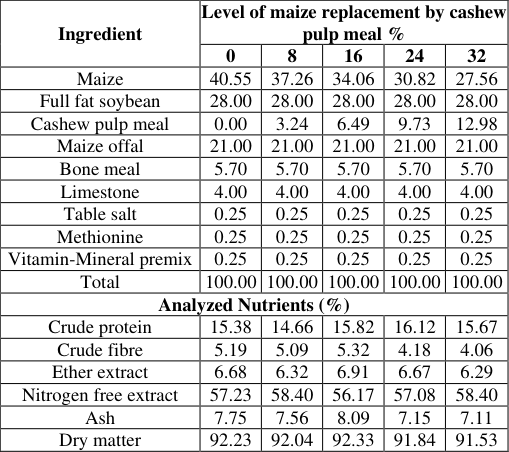 Table 1
 Table 2
 Table 3
 Table 4
 Table 5
Introduction
As world population continues to increase and Africa is at the fore of this growth, with a projected population of 1,308,064,195 billion by 2019 (United Nations World Population Prospect, 2017) [11] , the challenge will be that of not just providing food but quality food. Provision of quality nutrition has been the bane of most countries in Africa, including Nigeria whose citizens were reported to consume a meagre 3.2g of animal protein per person daily out FAO's recommended daily intake of 20g (Dafwang, 2006; FAO, 2014) [3,4] . Poultry is seen largely seen as the fastest means of filling up this gap. Unfortunately, the production of poultry meat and egg at reduced cost is being hampered by feed crisis arising from the need of human for grains which are also required in poultry feed production. In order to address this feed challenge, efforts are being put into evaluating agro by-products that are of less importance to human. One of such is cashew pulp which is obtained after the extraction of cashew juice from cashew fruit. Oyewole et al. (2019) [8] observed that dry cashew pulp contained 12.10% crude protein, 6.79% crude fibre, 5.68% ether extract, 55.37% nitrogen free extract and 11.09% ash. The workers recommended that cashew pulp meal (CPM) inclusion in the diets of layers resulted in better egg production than the control. Blood (haematological and biochemical) parameters are indicators of the response of animals to stress factors, which may be nutritional, physiological or environmental. In animal nutrition, blood parameters may indicate the safety or otherwise of a test ingredient such as CPM. The feeding trial was therefore conceived to ascertain the safety or otherwise of CPM in the diets of layers.
Objectives of the Study
The objectives of the feeding trial were to determine effect of feeding graded levels of CPM replacement for maize on haematology, serum biochemistry, and egg quality parameters of layers.
Materials and Methods
The feeding trial was conducted at the Livestock Teaching and Research Farm of Kogi State University, Anyigba. Anyigba lies between latitude 7 0 15'N and 7 0 21'E of the equator and longitude 7 0 11'N and 7 0 32'E of the Greenwich meridian with the attitude of about 420m above sea level. The zone is characterized by 6-7 months of average annual rainfall of about 1600mm and the daily temperature ranges between 25 0 C and 35 0 C (Ifatimehin et al., 2011). www.extensionjournal.com Cashew pulp was obtained from Anyigba and its environs. The juice in the pulp was expressed with the aid of mortar and pestle, and then decanted. The pulp was afterward sundried prior to milling and inclusion in the diets. Five (5) diets were formulated in which cashew pulp (apple) meal replaced 0, 8, 16, 24 and 32% of dietary maize (Oyewole et al., 2019) [8] .
Experimental birds and management
A total of seventy-five (75) point of lay birds (19 weeks) were used for the feeding trial. The birds were randomly assigned to the five (5) experimental diets in a Completely Randomized Design arrangement. Standard management practices were carried out; feed and water were given adlibitum. The birds were also vaccinated against Newcastle disease and de-wormed prior to the feeding trial (Oyewole et al., 2019) [8] . [8] . Blood samples were collected at the end of the trial from two birds per replicate and eight birds per treatment. The birds were bled in the morning between 0630-0900 hours to avoid excessive bleeding. Blood samples were collected from the wing vein using sterile disposable needle after the site of collection was sterilized with antiseptic. Specimens for haematological evaluation were collected into EDTA (ethylene diamine tetra acetic acid) treated tubes. The haematological indices determined were packed cell volume (PCV), red blood cell (RBC), white blood cell (WBC), haemoglobin (Hb), means corpuscular volume (MCV), means corpuscular haemoglobin (MCH) and mean corpuscular haemoglobin concentration (MCHC) using standard procedure (Jain, 1986) [6] . Samples for serum biochemistry were collected into EDTA free tubes prior to evaluation. Total protein, alanine amino-transferase (ALT) and aspartate aminotransferase (AST) were determined were determined as described by Schalm et al. (1975) [10] .
Statistical analysis
All data collected were statistically analyzed using One Way Analysis of Variance (ANOVA) contained in computer Statistical Software Package for Social Sciences (SPSS).
Results and Discussion
Results and Discussion
Results
Table 2 shows the external qualities of egg of birds fed diets containing graded levels of cashew pulp meal (CPM). Of all the parameters measured only average egg weight, average egg height and average shell weight were significantly (P<0.05) different. The values observed for egg weight (EW), egg height (EH) and egg shell weight (ESW) were 50.77-53.39g, 3.15-3.99cm and 6.37-7.02g respectively. The results of serum biochemical profile of the experimental birds are presented in Table 4. Asparte transaminase (AST) and total protein were significantly (P<0.05) influenced by the treatments. Observed values ranged from 95.67-131.67 μ/l and 4.26-6.13g/dl respectively.
| Parameter | Level of Cashew Pulp Meal % | — | — | — | — | — | — |
|---|---|---|---|---|---|---|---|
| 0 | 8 | 16 | 24 | 32 | SEM | LOS | |
| Packed Cell Volume (%) | 27.67d | 30.00b | 28.66c | 27.67d | 30.67a | 0.48 | * |
| Haemoglobin (g/dl) | 9.33d | 10.20a | 9.83c | 10.23a | 10.30a | 0.18 | * |
| Red Blood Cell (x106/l) | 2.79 | 2.55 | 2.62 | 2.80 | 2.79 | 0.30 | * |
| White Blood Cell (x109/l) | 239.00b | 246.83a | 226.43d | 233.57c | 222.17e | 2.84 | * |
| Mean Corpuscular Volume (fl) | 99.50c | 117.57a | 100.00c | 109.40b | 109.87b | 2.88 | * |
| MCH (pg) | 33.50 d | 39.97 a | 37.47 b | 36.40 c | 36.70 c | 0.80 | * |
| MCHC(g/dl) | 33.70 | 34.03 | 34.20 | 33.23 | 33.33 | 0.20 | NS |
Table text extracted from the original PDF; superscript letters are shown inline. The original table image is below.
View original table image
| Parameter | Level of Cashew Pulp Meal % | — | — | — | — | — | — |
|---|---|---|---|---|---|---|---|
| 0 | 8 | 16 | 24 | 32 | SEM | LOS | |
| Average Egg Weight (g) | 50.95c | 50.77cd | 53.39a | 52.51c | 52.72b | 1.82 | * |
| Average Egg Height (cm) | 3.15e | 3.75d | 3.96b | 3.87c | 3.99a | 0.19 | * |
| Average Egg Width (cm) | 2.76 | 2.79 | 2.77 | 2.79 | 2.77 | 0.11 | NS |
| Average Shell Weight (g) | 7.02a | 6.44bc | 6.51b | 6.40cd | 6.37bc | 0.41 | * |
| Average Shell Thickness (mm) | 0.63 | 0.64 | 0.58 | 0.60 | 0.58 | 0.03 | NS |
| Average Shape Index | 0.71 | 0.72 | 0.71 | 0.73 | 0.70 | 0.05 | NS |
Table text extracted from the original PDF; superscript letters are shown inline. The original table image is below.
View original table image
Discussion
The average egg weight between 50.77-53.39g observed in this study is lower than 63g (Chineke, 2001) [2] but within the range 50.35-54.81g (Oyewole et al., 2019) [8] . Observed egg weight values indicate that CPM inclusion did not adversely affect egg weight, an indication that the birds received sufficient protein from CPM for optimum egg weight. The observed egg height is within the range 3.75-3.99cm reported by Oyewole et al. (2019) [8] for layers on cashew pulp meal diets. The observed trend may suggest that CPM promoted longer/taller eggs. The pattern of results obtained for shell weight suggests that the control birds laid eggs with heavier shells, which may indicate lesser weight of edible egg content. Values observed for internal egg quality parameters; egg content weight, albumen height, yolk height and yolk weight suggest that CPM inclusion in the diet resulted in better internal egg quality parameters.
This may indicate that CPM is sufficient in terms of amino acid, soluble carbohydrates, vitamins and minerals required for good quality eggs (Oyewole et al., 2019) [8] . The values for packed cell volume ranged from 26.67-30. 67 %. Birds on cashew pulp meal based diets had higher values for packed cell volume when compared to the control. However, the range observed is within the 28.67-37.00 % for starter broilers fed CPM-based (Oyewole et al., 2017) [9] and also within the range of 24.90-45.20% for healthy birds (Mitruka and Rawnsley, 1977) [7] . The observed values suggest that the birds' health was not compromised by the inclusion of cashew pulp meal in the diets of the birds. Haemoglobin values obtained in this study ranged from 9.33-10.30g/dl and fall within the range of 7.40-13.10g/dl reported by Mitruka and Rawnsley (1977) [7] for healthy birds. These observed values suggest that the experimental birds received sufficient minerals from the diets, which www.extensionjournal.com enabled the synthesis of haemoglobin required for carbon dioxide and oxygen transportation in the blood. The values obtained for red blood cell (RBC) ranged from 2.55-2.80x10 6 /l and fall within 2.07x10 6 /l to 2.86x10 6 /l obtained with starter broilers on CPM diets (Oyewole et al., 2017) [9] . The observed values for WBC ranged from 222.17-246.83x10 9 /l. The observed trend for WBC did not suggest any negative effect of cashew pulp meal on the immune synthesis of the birds attributable to CPM. The values for MCV ranged from 99.50-109.87fl. The observed value range fall within the 100-129fl observed by Mitruka and Rawnsley (1977) [7] and 97.07-166.45fl reported by Ameen et al. (2007) [1] for healthy birds. The value range of 33.33-34.20 % observed for MCHC and 36.40-39.97pg for MCH are within reference ranges for healthy birds (Mitruka and Rawnsley, 1977) [7] . The observed MCHC, MCH and MCV values did not suggest that the birds were anaemic. All biochemical parameters observed for layers fed diets containing cashew pulp meal were significantly different (P < 0.05) except for ALT. The value for ALT ranged from 3.87-4.37 µ/l. This is an indication that birds on CPM did not suffer liver damage due to the treatments. The value for AST ranged from 95.67-131.67 µ/l. The observed value range is comparable to 115.00-121.33µ/l reported by (Oyewole et al., 2017) [9] for starter broilers fed cashew pulp meal based diets. The values for total protein ranged from 4.26-6.13 g/dl and decreased as the inclusion of cashew pulp meal in the diets increased. Observed total protein values may suggest that the protein quality CPM based diets was poorer that maize based diet (control).
Conclusion
Inclusion of cashew pulp meal (CPM) did not compromise the external and internal quality characteristics of egg even at 32% replacement of maize; neither did it affect the health of the birds adversely. Farmers may include replace up to 32% of dietary maize with cashew pulp meal in layer diet.
Figures and tables from the paper
| Ingredient | Level of maize replacement by cashew pulp meal % | — | — | — | — |
|---|---|---|---|---|---|
| 0 | 8 | 16 | 24 | 32 | |
| Maize | 40.55 | 37.26 | 34.06 | 30.82 | 27.56 |
| Full fat soybean | 28.00 | 28.00 | 28.00 | 28.00 | 28.00 |
| Cashew pulp meal | 0.00 | 3.24 | 6.49 | 9.73 | 12.98 |
| Maize offal | 21.00 | 21.00 | 21.00 | 21.00 | 21.00 |
| Bone meal | 5.70 | 5.70 | 5.70 | 5.70 | 5.70 |
| Limestone | 4.00 | 4.00 | 4.00 | 4.00 | 4.00 |
| Table salt | 0.25 | 0.25 | 0.25 | 0.25 | 0.25 |
| Methionine | 0.25 | 0.25 | 0.25 | 0.25 | 0.25 |
| Vitamin-Mineral premix | 0.25 | 0.25 | 0.25 | 0.25 | 0.25 |
| Total | 100.00 | 100.00 | 100.00 | 100.00 | 100.00 |
| Analyzed Nutrients (%) | |||||
| Crude protein | 15.38 | 14.66 | 15.82 | 16.12 | 15.67 |
| Crude fibre | 5.19 | 5.09 | 5.32 | 4.18 | 4.06 |
| Ether extract | 6.68 | 6.32 | 6.91 | 6.67 | 6.29 |
| Nitrogen free extract | 57.23 | 58.40 | 56.17 | 57.08 | 58.40 |
| Ash | 7.75 | 7.56 | 8.09 | 7.15 | 7.11 |
| Dry matter | 92.23 | 92.04 | 92.33 | 91.84 | 91.53 |
Table text extracted from the original PDF; superscript letters are shown inline. The original table image is below.
View original table image
| Parameter | Level of Cashew Pulp Meal % | — | — | — | — | — | — |
|---|---|---|---|---|---|---|---|
| 0 | 8 | 16 | 24 | 32 | SEM | LOS | |
| Egg Content Weight (g) | 44.53bc | 44.89b | 46.86a | 46.06ab | 46.44ab | 1.66 | * |
| Albumen Height (cm) | 4.99b | 5.46a | 5.33ab | 5.40ab | 5.25ab | 0.06 | * |
| Yolk Height (cm) | 1.59bc | 2.55a | 1.64bd | 1.74b | 1.73bc | 0.61 | * |
| Yolk Diameter (cm) | 2.11 | 2.12 | 2.15 | 2.22 | 2.26 | 0.08 | NS |
| Yolk Weight (g) | 11.62d | 12.23c | 12.44b | 12.88a | 12.87ab | 0.54 | * |
| Yolk index | 0.76 | 0.74 | 0.77 | 0.78 | 0.77 | 0.04 | NS |
| Haugh Unit | 105.05 | 105.00 | 105.94 | 106.42 | 106.85 | 0.75 | NS |
Table text extracted from the original PDF; superscript letters are shown inline. The original table image is below.
View original table image
| Parameter | Level of Cashew Pulp Meal % | — | — | — | — | — | — |
|---|---|---|---|---|---|---|---|
| 0 | 8 | 16 | 24 | 32 | SEM | LOS | |
| ALT (µ/l) | 3.87 | 3.92 | 4.30 | 4.35 | 4.37 | 0.45 | NS |
| AST(µ/l) | 95.67e | 127.33b | 118.33d | 126.33c | 131.67a | 3.7 | * |
| Total Protein (g/dl) | 6.13a | 5.27b | 4.70c | 4.83c | 4.26d | 0.20 | * |
Table text extracted from the original PDF; superscript letters are shown inline. The original table image is below.
View original table image
References
10 in the original paper- Ameen SA, Adedeji OS, Akingbade AA, Olayemi TB, Oyedapo LO, Aderinola OA. The effect of different feeding regimes on haematological parameters and immune status of commercial broilers in derived savannah zone of Nigeria. Proceeding of the 32 nd annual conference of the Nigeria Society for Animal Production. 2007, 176-178.
- Chineke CA. Interrelationships existing between body weight and egg production traits in Olympia black layers. Nigerian Journal of Animal Production. 2001; 28(1):1-8.
- Dafwang II. Meat, eggs and milk from farm wastes: Explorations in Animal Nutrition Research and Extension. An Inaugural Lecture delivered at NEARLS, Ahmadu Bello University, Zaria, 2006, 61p.
- FAO. Meat Consumption. Agriculture and Consumer Protection Department, 2014. http://www.fao.org/ag/againfo/themes/en/meat/backgro und.html.
- Ifatimehin OO, Musa SD, Adeyemi JO. Managing land use transformation and land surface temperature change in Anyigba town, Kogi state, Nigeria. Journal of Geography and Geology. 2006; 3:77-85.
- Jain CN. Schalms Veterinary Haematology. 4th edition, Lea and Febiger Publishers, Philadephia, 1986, 564575.
- Mitruka HM, Rawnsley SK. Chemical, Biochemical and Haematological Reference Values in Normal Experimental Animals. Masson Publishing, New York, USA, 1997, 35-55.
- Oyewole BO, Oyewumi DO, Adegoroye O. Performance and Egg Quality of Layers Fed Diets Containing Graded Levels of Cashew (Anarcadium occidentale L.) Pulp Meal. IOSR Journal of Agriculture and Veterinary Science (IOSR-JAVS) 2019; 12(6):5357. DOI: 10.9790/2380-1206015357. www.iosrjournals.org
- Oyewole BO, Rotimi EA, Anthony FO, Adewumi J. Performance and blood parameter of starter broilers fed diets containing cashew pulp meal. FUDMA Journal of Agriculture and Technology. 2017; 3(1):87-92.
- Schalm OW, Jain NC, Carroll EJ. Veterinary Haematology. 3rd edition, Publishers: Lea and Febiger, Philadelphia, USA, 1975, 254-255.