
Research article · 2020 · Full text
International Journal of Veterinary Sciences and Animal HusbandryInfluence of climate change and breeding mode on the reproductive parameters of cattle herds in the agro-pastoral cotton production zone of the commune of Banikoara in North Benin
Volume 5(6) · Pages 55–63 · DOI: 10.22271/veterinary.2020.v5.i6a.311 ↗
Research areasAgriculture and Rural Development ResearchRangeland Management and Livestock Ecology
Abstract
Author-writtenHeat stress, increased morbidity and mortality most often characterize the direct impact of climate change on livestock farming and modify the conditions of animal production. The present study aims to analyze the influence of climate change (CC) and breeding modes on the reproductive parameters of cattle herds in the cotton zone of North Benin over the last 32 years as well as the local perception of CC by farmers. It was based on a sample of 694 breeders in all ten districts of the commune of Banikoara in North Benin. The generalized linear model based on the Beta distribution was used to test the effect of climate change and breeding modes on the reproductive parameters of the cattle herds (apparent fertility rate, numerical productivity at, fertility rate, farrowing rate and abortion rate). Principal Component Analysis (PCA) was used to describe the criteria that determine the local perception of climate change by livestock farmers. The study revealed a significant decrease in fertility, calving and abortion rates among cattle herds in the commune of Banikoara, regardless of the farming mode (Bariba, Peulh) on the one hand and on the other, according to climate variations observed from 1988 to 2020. The apparent fertility rates according to the breeding modes and the time gap are not significant at the 5% threshold, but only the numerical productivity at weaning varied very significantly between 1988 and 2020 (p
Summary
Source-checkedPlain-language reading of the full paper, prepared with AI and checked against the text. Each point links to the authors' own words.
Why it matters
- Climate change directly impacts livestock farming through heat stress and increased rates of morbidity and mortality, which alters animal production conditions. View evidence ↗
- Cattle reproductive performance is influenced by climatic factors, specifically temperature and humidity, as well as pathologies and the availability of food. View evidence ↗
- Temperature projections for the Banikoara Commune by 2050 indicate minimums between 19 and 29°C and maximums between 27 and 40°C. View evidence ↗
The question
- The study aims to analyze how breeding modes and climate change have influenced cattle reproductive parameters in North Benin's cotton zone over the past 32 years, while also assessing farmers' perceptions of climate change. View evidence ↗
What they did
- The research sampled 694 breeders across all ten districts of the Banikoara commune in North Benin. View evidence ↗
- Data were collected using accelerated participatory research methods (MARP) and a cross-sectional retrospective method for demographic parameters. View evidence ↗
- A generalized linear model based on the Beta distribution was employed to test the effects and interactions of breeding modes and the time gap (climate change) on reproductive parameters. View evidence ↗
- Principal Component Analysis (PCA) and relative frequency calculations were used to analyze the criteria determining farmers' local perceptions of climate change. View evidence ↗
What they found
- Climate variations over the last 30 years and the chosen rearing method significantly influenced the abortion, farrowing, and fertility rates (p<0.05). View evidence ↗
- Numerical productivity at weaning showed a very significant variation between 1988 and 2020 (p<0.001). View evidence ↗
- The time gap and breeding modes did not have a statistically significant effect on apparent fertility rates at the 5% threshold. View evidence ↗
- Regarding reproduction, herders most frequently reported an increase in abortions (95.28%), a decrease in fertility (89.82% and 89.53%), a decrease in farrowing (75.37%), and a decrease in weaning productivity (64.45%). View evidence ↗
What it means
- The authors conclude that it is essential to develop strategies that minimize calving losses and create conditions that protect the reproductive capacity of cattle. View evidence ↗
- The authors recommend using bulls with known weight and birth characteristics for insemination and selecting dams based on fertility and calving ease. View evidence ↗
Visual summary
2 visualsIllustrations explain the paper; charts are replotted from the paper's own table values.
Climate Impact Flow
AI-generated conceptual illustration (Zebu cattle in a West African savanna landscape). It explains the idea and does not show study data.
View source evidence ↗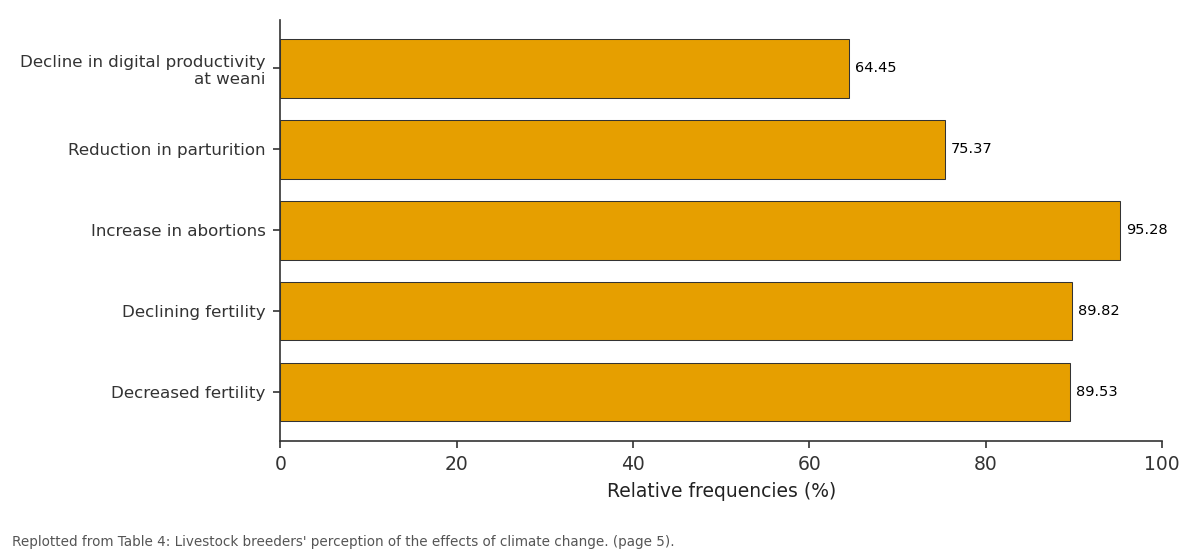
Relative frequencies (%): Decline in digital... vs Reduction in parturition vs Increase in abortions vs Declining fertility vs Decreased fertility
Replotted from Table 4 (page 5) of the original paper. Every bar is the paper's own table value.
View source evidence ↗Figures & tables
From the original paper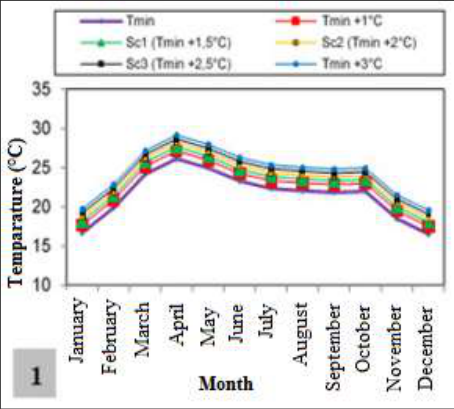 Figure 1
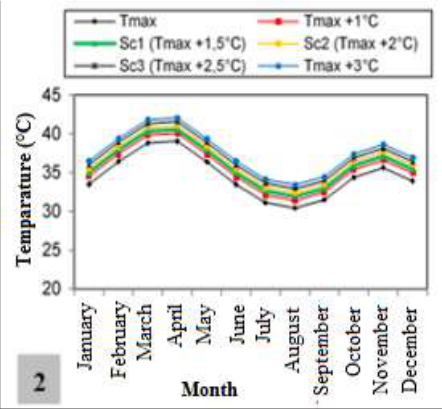 Figure 1
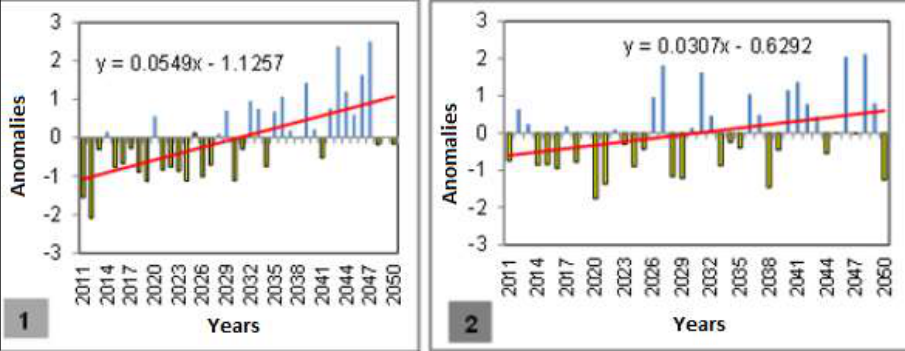 Figure 2
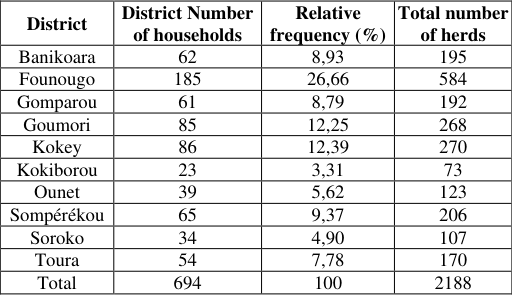 Table 2
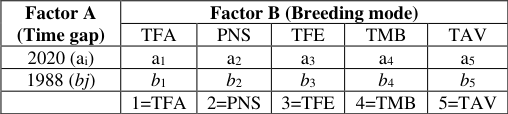 Table 1
 Table 3
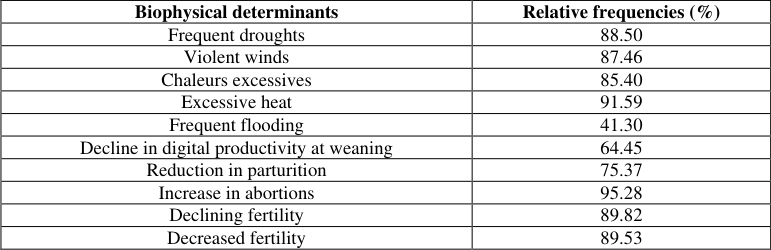 Table 4
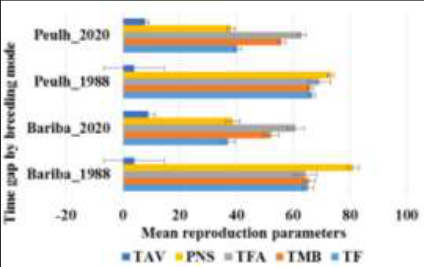 Figure 3
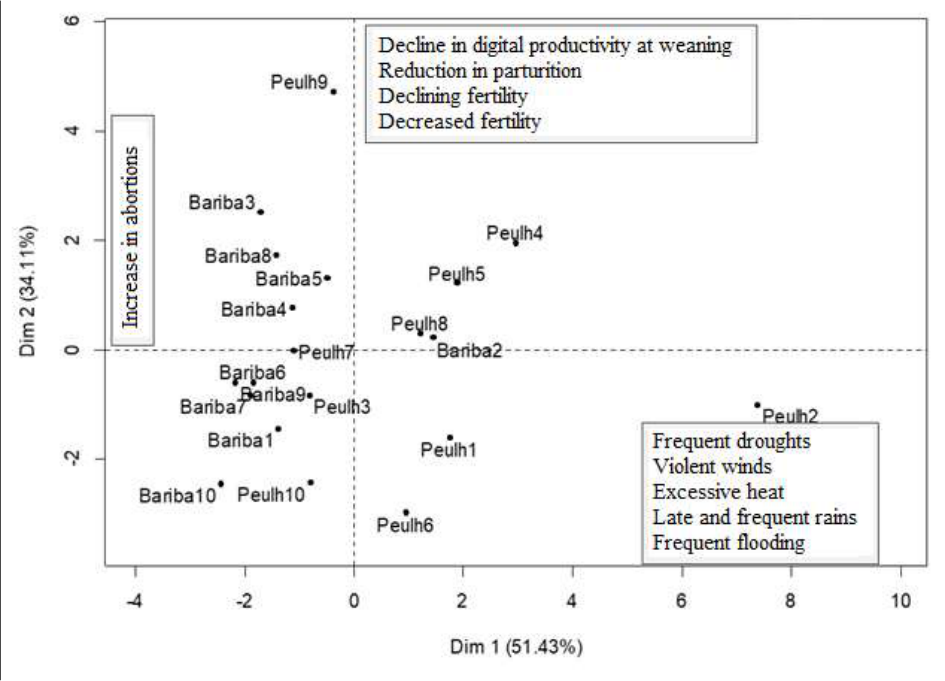 Figure 4
Introduction
Current and projected climate change is, along with loss of biodiversity and soil fertility, deforestation and land cover degradation (Lambin et al. 2001) [3] , one of the major new challenges facing humanity (Kolawolé et al. 2011, Cook et al. 2013) [4,6] and will continue to do so (Wood, 2008; IPCC, 2001 and 2007) [7,8,9] . Observations have shown that the global ambient temperature of the Earth's surface has increased by 0.74°C compared to that of the last century (Hulme et al. 2001, Salvi et al. 2011, Kotir 2011, IPCC 2013) [12,13,11,10] . Predictions have revealed increases in the ambient temperature of the Earth's surface in the order of 1.5°C to 4.5°C by 2050 (Peng et al. 2004) [56] . Climate change is likely to affect the majority of human and natural systems, especially those highly dependent on climate (IPCC, 2001 and 2007) [8,9] . As part of biophysical systems, cattle breeding is affected by climate change (Dimon, 2008; Kate, 2017) [14,16] . The reproductive performance of cattle is linked on the one hand to climatic factors (temperature and humidity especially) and on the other hand to food availability and pathologies (Meyer, 2009) [17] .
The future evolution of monthly temperatures in Banikoara Commune by 2050 compared to those of the period 1981-2012 shows that minimum and maximum temperatures will vary between 19 and 29° C for minimums and 27 and 40° C for maximums depending on the extent of global warming over the next few decades in the cotton-producing agropastoral zone of Banikoara Commune (Kate, 2020) [15] . When we refer to the body temperature of domestic animals in tropical environments (Pagot, 1985) [25] , we can see that the limits have already been exceeded for animal species, particularly bulls and zebus. Under these conditions, the thermal factor could constitute a limiting factor for the reproduction of cattle in the study area. The concepts of fertility, fertility, childbirth, abortion and numerical productivity are not easy to define in a consensual way. However, establishing a precise definition of these terminologies is necessary before starting to study the influence of climate change on the reproductive performance of cattle herds. According to the Dictionary of Pharmaceutical and Biological Sciences, fertility is defined as: "the ability to procreate in both males and females" (ANP, 1997) [24] . For the male, it represents the ability to fertilize the female and thus, among other things, to produce fertilizing spermatozoa. Generally speaking, the term infertility is used to designate a permanent inability to procreate, the term sub-fertility to designate diminished fertility and the term infertility for temporary inability to procreate (Barth et al., 2018) [18] . For the female, fertility is the ability to be fertilized at the time of conception (Tillard et al., 2007) [20] . The fertility rate is defined as the ratio between the number of females giving birth and the number of females put to reproduction (Dudouet, 2014) [19] . At the collective level, fertility is the number of fertilized females per 100 females given birth (CIRAD-GRET, 2002) [57] . This is a difficult criterion to estimate among breeders, as early abortions go unnoticed. For dairy cows, fertility is represented by the number of AI required to achieve pregnancy (Hanzen, 1994) [58] . This definition could therefore be extrapolated to suckler cows in natural breeding by the number of matings needed to achieve fertilization. Unlike fertility, fecundity cannot be defined for a male. Fertility is the ability of a cow to be pregnant and give birth to a live calf. It is the ability of a female to give birth (number of live animals a female has given birth to per year or during her career) (Ringuet, 2019) [50] . Indeed, the fertility rate is defined by the number of calves born alive divided by the number of females put to reproduction (Dudouet, 2014) [19] . However, there is a temporal notion in the notion of fecundity. Indeed, fertility represents the ability of a female to be fertilized within a given time frame (Tillard et al., 2007) [20] . For several authors, it is therefore defined for a lactating cow as the capacity to give birth to a live calf every year (Hanzen, 1994; Noakes, 2019) [58,21] . Pregnancy rate is also an important criterion in suckling breeding. It expresses the fertility of the animal. It is calculated over 12 months and corresponds to the number of pregnant females over the number of females put to reproduction. The objective is that it should be higher than 92% (Utt MD, 2016). However, like the IVV, it does not take into account animal movements (culling, mortality, purchase) within the farm during these 12 months. For this reason, another formula for integrating these factors has been proposed (Singh et al., 2015) [23] . Among cattle farmers, calving is the term used to refer to the birth of the female. The calving rate is the ratio of the number of cows that have calved to the total number of breeding females (CIRAD-GRET, 2002) [57] . Abortion is the termination of a pregnancy before it is full term. The fetus or runt is then expelled before it is fully formed. In practice, an abortion is an interruption of gestation during the fetal period (after a minimum of 42 days of gestation). The abortion rate is therefore the percentage expressing the ratio between the number of cows whose gestation is terminated and the total number of pregnant females (Sokouri et al., 2010) [26] . The numerical productivity rate in lactating livestock is the number of calves weaned or sold out of the number of females put to reproduction. This factor makes it possible to evaluate the results of reproduction but, in practice, it mainly makes it possible to evaluate the economic impact of fecundity (Guerin, 2008) [27] . Data on the direction and magnitude of the likely effects of climate change and livestock husbandry patterns on the reproductive performance of cattle herds are essential for the implementation of adaptation strategies. It is with this in mind that the present study was initiated. Specifically, it will focus on: (i) calculate the reproductive parameters of cattle herds; (ii) determine the effects of the time gap (between 1988 and 2020) on the reproductive parameters of the commune's cattle herds; and (iii) analyze the perceptions of breeders on climate change.
Materials and Methods
Materials and Methods
Study area
The cotton-producing agropastoral zone of the commune of Banikoara covers an area of 4,397.2 km² of which about 49% is arable land and 50% is protected areas (W National Park of Niger and the Atacora hunting zone). It is located in the northwest of the Alibori Department, between 2º05' and 2º46' east longitude and between 11º02' and 11º34' north latitude, and is bordered to the north by the Commune of Karimama, to the south by the Communes of Kérou and Gogounou, to the east by the Commune of Kandi, and to the west by Burkina-Faso. The farming system is traditionally extensive. It is dominated by two natural pasture systems. On the one hand, the transhumant system, characterized by high mobility and a weak link with agriculture. On the other hand, the sedentary system, where livestock associated with different crops (subsistence or cash crops) occupy the areas around the villages (Kate et al., 2017) [16] .
Temperature status in the cotton-producing agropastoral zone of Banikoara
Examination of Figure 1 shows that minimum and maximum temperatures will increase with the magnitude of global warming over the next few decades in the cotton-producing agropastoral zone of Banikoara Commune. [15] .
From the analysis of Figure 2, it appears that the magnitude of the anomalies of mean minimum temperature which is -2.08° to +2.5° C and of mean maximum temperature which is -1.76° to 2.12° C in Banikoara Commune with some nuances, confirm the thermal warming trend. [15] .
Communities practicing cattle breeding in the study area
The Baribas and the Peulh are the two communities involved in cattle rearing activities in the commune of Banikoara. The Baribas, the main landowners, are farmers by tradition and, in their concern to have draught animals, they have built up cattle herds with the income from cotton. Originally, the herds were entrusted to a Peulh herder, but nowadays, more and more, the Baribas are driving their herds themselves. The production system practiced is sedentary, combining semi-improved livestock farming with various crops (subsistence and cash crops) including cotton (Djenontin et al. 2000) [29] . In this system, only the land is exploited, there is a low level of animal movement and supplementary feeding based on fodder reserves during the dry season. As for the Peulh, they are traditional herders. Their herd is made up not only of their own animals, but also sometimes of cattle belonging to different owners and whose management they are in charge of according to particular types of contracts. The Peulh (transhumant) system is characterized by high mobility and a weak link with agriculture (Kate et al., 2017) [16] . It is an extensive farming system. During the dry season, fodder is scarce and herds are transhumant over long distances.
Cattle herd management
The herds are mainly made up of Borgou Taurins. This breed is derived from the stabilized crossbreeding of the Lagoon Taurin or Somba of West Africa by the white Zebu Fulani (Felius, 1985) [30] . In general, the cattle are kept by young herdsmen, under the responsibility of a professional herdsman. During the day, the animals are taken to pasture, except for calves under 4 months of age, which are herded in the vicinity of the camp. At night, the animals are tied to the post with a rope, except for bulls that can move freely among the females of the different herds on the one hand, and calves that are deprived of suckling when their mother's milk is intended for human consumption on the other hand. On annual average, cattle are out for eight hours a day, 20% of this time is lost in travel, with grazing and resting/watering accounting for 75% and 5% respectively of the overall time. In the dry season, animals move after early morning milking at around 8-9am and return at around 6-7pm, or about 10 hours of grazing. They will drink between 12 and 13 hours. In the rainy season, agricultural work requires all the valid arms.
95% of the herders in the area practice self-consumption agriculture, and therefore the animals are only released after field work. The grazing period decreases sharply, the cattle leave around 10-11 am and return earlier, around 4-5 pm. In addition, health monitoring is provided partly by public services and partly by private para-veterinarians working in the commune and surrounding villages. Reproduction is based on free riding and births are recorded throughout the year.
Search device
To assess the effect of climate change (time gap) and breeding modes (Peulhs, Baraiba) on the reproductive parameters of cattle herds (Apparent Fertility Rate (AFR), Numerical Weaning Productivity (NWP), Fertility Rate (TFE), Calving Rate (TMB) and Abortion Rate (AVR)) in the farming environment, The data from 1988 and those collected in 2020 have been exploited according to a device relating to the crossover between fixed time gap factors and farming methods (Table 2) with 10 repetitions (each repetition represents a district of the commune of Banikoara). Table 2: Device for evaluating the effect of climate change and farming mode on herd reproduction parameters between 1988 and 2020.
| District | District Number of households | Relative frequency (%) | Total number of herds |
|---|---|---|---|
| Banikoara | 62 | 8,93 | 195 |
| Founougo | 185 | 26,66 | 584 |
| Gomparou | 61 | 8,79 | 192 |
| Goumori | 85 | 12,25 | 268 |
| Kokey | 86 | 12,39 | 270 |
| Kokiborou | 23 | 3,31 | 73 |
| Ounet | 39 | 5,62 | 123 |
| Sompérékou | 65 | 9,37 | 206 |
| Soroko | 34 | 4,90 | 107 |
| Toura | 54 | 7,78 | 170 |
| Total | 694 | 100 | 2188 |
Table text extracted from the original PDF; superscript letters are shown inline. The original table image is below.
View original table image
Data Collection Methods
The methodological approach to data collection is subdivided into three (03) major steps.
Step 1: A census of farms, including their place of residence, the status of their cropland, their breeding mode (transhumance or sedentary) and farming equipment (plough, cart, etc.) was carried out. An initial classification of the farms according to herd size was therefore carried out.
Step 2: Focus groups were carried out at the level of each district in order to have global information on the impact of climate change on the structure and evolution of the herd.
Step 3: A questionnaire was developed for the diagnosis at farm and herd level. The sample size (number of farm households with herds to be surveyed) for the study was determined using Dagnellie's (1998) [31] formula.
represents the proportion of households with herds; = 20, 44% (10703 farm households, RGPH2) for 2188 farm households with herds. The sample size found from these data is 694 herder-farm households. The size of the surveyed herder farm households by district was determined by considering the proportion of farm households in each district in relation to the total number of farm households for the entire Commune of Banikoara. The data collection method was drawn from the range of accelerated participatory research methods (MARP). To provide information on demographic parameters, the crosssectional retrospective method was used (Lesnoff, 2013) [48] .
The data obtained made it possible to calculate herd population rates according to the formulas of Ferraton and Touzard (2009) [49] .
Statistical treatment of the data
The generalized linear model based on the Beta distribution was used to test the effect of climate change (time gap) and livestock husbandry patterns and their interaction on the reproductive parameters of cattle herds such as: Apparent fertility Rate (TFR), numerical productivity at weaning (PNS), fertility rate (TFE), Birth Rate (TMB) and abortion rate (TAV). The ''betareg'' function of the ''betareg'' package (Gruen et al., 2012) [45] associated with the ''logit'' link function of the software R 3.3.2 (R Development Core Team, 2016) [46] was used to implement this model. In case of a significant difference at the 5% threshold. Graphs based on mean values with standard errors (organ pipe diagram with error bar) are produced. The relative frequencies of citation of farmers' perceptions of climate change have been calculated and a principal component analysis (PCA) has been performed to describe the criteria that determine farmers' local perceptions of climate change.
Results
Results
Effect of climate change and breeding modes on the reproductive parameters of herds between 1988 and 2020.
The synergy between climatic variations from 1988 to 2020 and the modes of cattle rearing (Peulh, Bariba) in the peasant environment in the commune of Banikoara has no effect on the different reproductive parameters studied at the 5% threshold (Table 3). However, the climatic variations observed over the last 30 years and the livestock rearing method significantly influence the fertility rate (TF), Farrowing rate (TMB) and abortion rate (TAV) of the herds (p<0.05). These results reflect a significant decrease in these rates among cattle herds in the farming environment in the commune of Banikoara, regardless of the farming mode on the one hand and on the other, depending on the climate change gap. Moreover, the apparent fertility rate (TFA) and the numerical productivity at weaning (PNS), as a function of the farming mode as well as the climate change gap are not significant at the 5% threshold, but only the numerical Productivity at Weaning (PNS), varied very significantly between 1988 and 2020 (p<0.001). A comparison of the average values of the reproduction parameters between the time gap (1988 and 2020) for the same breeding mode (Ethnicity) leads to the conclusion that there has been a decrease in these parameters (Figure 3). The results of the principal component analysis of the 10 perceptions of livestock owners with regard to the livestock farming mode in the 10 districts of Banikoara commune reveal that the first two principal components explain 85.53% of the information submitted to them, which guarantees accuracy of interpretation (Figure 4). The correlations between the variables and the main components reveal that the variables frequent droughts, strong winds, excessive heat, late and frequent rainfall are positively correlated with axis 1, while the variables decrease in numerical productivity at weaning, decrease in farrowing, decrease in fertility and decrease in fertility are positively correlated with axis 2. However, the variable increase in abortions is negatively correlated with axis 1 (Figure 4).
Discussion
From 1988 to 2020, climate change induced a significant and significant decrease in the reproductive performance of the herds studied. The drastic decrease in the reproductive parameters of the herds surveyed would certainly result from the increase in the frequency and duration of pockets of drought and especially excessive heat. Analysis of the minimum and maximum temperature indices for the period 2050 compared to the period 1971-2010 for Banikoara commune reveals that the magnitude of the anomalies in mean minimum temperature, which is -2.08° to +2.5° C, and mean maximum temperature, which is -1.76° to 2.12° C, confirms the thermal warming trend (Kate et al., 2020) [15] . Global warming has thus had negative impacts over 32 years on the reproduction of Borgou cattle herds in the cottonproducing agropastoral zone of Banikoara. Thus, all the breed herds in Banikoara Commune that had average rates of reproductive parameters in 1988 have now fallen to very low performance levels. Apart from apparent fertility (AF) which has remained at average levels. That is to say that none of the breeding methods used by the ethnic group (Bariba and Peulh) has been able to raise or maintain the reproductive performance of the herds. [32,28,33,35,34,37,16] and in the West African sub-region ( [38,48,1,26,54] . During the period the lowest fertility rate was recorded in Kokey, a locality in the study area by Djenontin et al. in 2000. This situation is thought to result from the fact that 2000 was the driest year in the commune between 1970 and 2014, with an increase in minimum and maximum temperatures (Sare et al., 2015) [53] , and this long pocket of drought experienced by the area that year was a limiting factor for livestock production in the commune.
Agabriel and Doreau (2003) [41] for their part revealed that excessive heat leads to a disturbance of the animal organism in the sense that the animal is no longer able to regulate its rising body temperature. They add that the animal in a situation of thermal discomfort eats less and that the increase in temperature from 25 to 40° C can reduce food consumption by 40 to 60%. All in all, climate has an influence on animal fecundity (CDA58). For example, in times of drought, there is a risk of reduced fertility as a result of food and water deficits. Abortions may occur or there may be no return to heat as happened in 2003 (CDA71; FRGDS; CYALIN). Jordan (2003) [52] reports a decrease in the duration and intensity of estrus, and poorer development of follicles and embryos during heat stress conditions in dairy cows.
Results obtained by Chemineau and Delgado (1994) [42] revealed that temperature, especially high temperatures, affect reproduction in both males and females in all species. Ingraham et al. (1974) [59] observed a drop in gestation rate from 55 to 10% as the temperature and relative humidity index increased from 70 to 84. On the other hand, in sedentary trypanotolerant Baule and N'Dama village bulls, fertilisation is more numerous in the cool part of the dry season when live weight is regained). They then result in calving at the end of the year, when grass is abundant and calves are most viable.
The abortion rate calculated in this study was significantly higher, particularly among the Peulh. Much more than a simple temporary discomfort, high temperatures penalise reproduction in the long term and weaken the health of the cattle. Less good egg development, less heat expression, risk of abortion at the beginning of gestation or an increased risk of infection are all consequences that can occur following a heat episode. Periods of high heat and drought complicate reproduction. It is estimated that the abortion rate should be less than 5% of the number of cows on the farm. Beyond that, a plan to combat the disease should be considered. All too often, the herder blames the grouping of animals, slips, falls and shocks between animals for this pathology. It should be noted that the vast majority of abortions in cattle are of infectious or parasitic origin (99%). Indeed, when their body temperature rises, cows will undergo hormonal changes, which will lead to a poorer development of the ovules, a lesser expression of heat. The same is true for bulls, for whom heat stress degrades spermatogenesis. A heat wave episode increases the risk of abortion in early pregnancy, or even up to mid-gestation if the episode lasts. "If the body temperature exceeds 39° C during the first 51 days after AI, the survival of the embryo is uncertain. "Pregnancy checks should be carried out after an episode of high heat," recommends Annette Fichtl (2019), "and embryo transfers should be scheduled for a cooler period". The numerical productivity rate in lactating livestock farming is a factor in assessing reproductive outcomes but, in practice, it is mainly used to assess the economic impact of fertility (Ringuet, 2019) [50] . The number of stillborn calves (calves that die before birth) and calf mortality (mortality due to animal pathologies) between birth and weaning contribute to the reduction of SNP. According to Dehoux & Hounsou-Ve (1993) [32] in traditional farming, 23.1% of calves die before the age of one year, particularly during the first weeks of life (55% of mortality) and at weaning (30% of mortality).
In domestic cattle, reproductive efficiency is linked to direct effects of climate (the heat stress mentioned above) and to indirect effects: the availability of feed linked to rainfall, with a variable relationship between these effects depending on the type of animal (Berbigier, 1988) [60] . Similarly, many diseases can disturb reproductive performance, whether general or specific to the reproductive system. Some diseases are seasonal, particularly parasitic diseases and vector-borne diseases, the presence of which varies seasonally. All in all, it is urgent that farmers should therefore endeavour to limit losses at calving and to put cattle in conditions that do not penalise their reproductive capacity.
Conclusion
Climate change is a reality in Benin. Agropastoral production zones are suffering from seasonal shifts with late and short rains, excessive heat and waves of strong winds. This situation affects cattle production and household food and nutritional security. The present study showed a significant decrease in reproductive parameters such as fertility rate, calving rate and abortion rate among cattle herds in farming areas, regardless of the type of farming (Bariba, Peulh) and according to the climatic variations observed from 1988 to 2020. While the apparent fertility rate as a function of rearing methods and time gap are not significant at the 5% threshold, only numerical productivity at weaning varied very significantly between 1988 and 2020 (p<0.001). The local perception of farmers in the agro-pastoral zone of cotton production is characterised by frequent droughts, strong winds, excessive heat, late and frequent rainfall, which leads to a drop in weaning productivity, reduced births, lower fertility and fertility but increased abortions. Therefore, it is imperative to develop strategies to limit calving losses and conditions that do not penalise their reproductive capacity. In addition, the application of techniques such as insemination of heifers and adult cattle with bulls that are accurately known about weight characteristics and birth conditions is necessary. Likewise, the objectives of selecting dams based on calving ease and fertility criteria should be encouraged in a context of climate change.
Figures and tables from the paper
| Factor A (Time gap) | Factor B (Breeding mode) | — | — | — | — |
|---|---|---|---|---|---|
| TFA | PNS | TFE | TMB | TAV | |
| 2020 (ai) | a1 | a2 | a3 | a4 | a5 |
| 1988 (bj) | b1 | b2 | b3 | b4 | b5 |
| 1=TFA | 2=PNS | 3=TFE | 4=TMB | 5=TAV |
Table text extracted from the original PDF; superscript letters are shown inline. The original table image is below.
View original table image
| Biophysical determinants | Relative frequencies (%) |
|---|---|
| Frequent droughts | 88.50 |
| Violent winds | 87.46 |
| Chaleurs excessives | 85.40 |
| Excessive heat | 91.59 |
| Frequent flooding | 41.30 |
| Decline in digital productivity at weaning | 64.45 |
| Reduction in parturition | 75.37 |
| Increase in abortions | 95.28 |
| Declining fertility | 89.82 |
| Decreased fertility | 89.53 |
Table text extracted from the original PDF; superscript letters are shown inline. The original table image is below.
View original table image
References
59 in the original paper- Ba A, Lesnoff M, Moulin CH. Demographic dynamics and off-take of cattle herds in south Mali. Trop Anim. Trop. Health Prod 2011;43:1101-1109.
- Lsenoff M, Saley M, Adamou K, N'djafa H. Enquête démographique 2006 sur le cheptel domestique au Niger: sites du Fakara, de Gabi et de Zermou. Rapport préliminaire. Nairobi, Kenya, ILRI 2007.
- Lambin EF, Turner BL, Geist HI. The causes of land-use and land-coyer change: Moving beyond the myths. Global Environmental Change Il 2001, 261-269.
- Kolawolé, et al. International archives of medicine. 2011;4(10):4-10.
- Dedjan YS. Changements climatiques et évolution des périodes de semis des principales cultures dans l'Alibori: cas des communes de Malanville et de Banikoara. Mémoire Economie et Sociologie Rurales: Université de Parakou 2010, 122 p.
- Cook, et al. The need for historical perspectives on endemism; the mammals of the North Pacific Coast of North America. Biological conservation 2013;97:207213.
- Wood EJ. The social processes of civil war: the wartime transformation of social networks. Annual Reviews Mobile 2008;11:539-561 p.
- IPCC. Climate change: The scientific basis. Contribution of Working Group I to the Third Assessment Report of the Intergovernmental Panel on Climate Change. Cambridge University Press, Cambridge, United Kingdom, New York, NY, USA, Melbourne, Australia, Madrid, Spain and Cape Town, South Africa 2001.
- IPCC. Climate Change: The physical science basis. Contribution of Working Group l to the Fourth Assessment Report of the Intergovernmental Panel on Climate Change. Cambridge University Press, Cambridge, United Kingdon: and New York, NY, USA 2007.
- IPCC. Climate Change: The Physical Science Basis. Contribution of Working Group I to the fifth assessment report of the Intergovernmental Panel on Climate Change. Cambridge University Press, Cambridge, United Kingdom and New York, NY, USA 2013.
- Kotir JH. Climate change and variability in Sub-Saharan Africa: A review of current and future trends and impacts on agriculture and food SE curity. Environment, Development and Sustainability 2011;13:587-605.
- Hulme M, Doherty R, Ngara T. African climate change: 1900-2100. Climate research 2001;17:145-168p.
- Salvi K, Karman S, Ghosh S. Statistical downscaling and bias correction for projections of Indian rainfall and temperature in climate change studies. 4th International Conference on Environmental and Computer Science. IACSIT Press 2011, 7-11
- Dimon R. Adaptation aux changements climatiques: Perceptions, savoirs locaux et stratégies d'adaptation 'ingénieur agronome. UAC/FSA 2008, 130 p.
- Katé S, Hounmenou GC, Ogouwalé E, Tinté B. Simulation of the future climate in the agro-pastoral zone of cotton production of the Municipality of Banikoara in North Benin. International Journal of Agriculture and Environmental 2020;7(5):96-101.
- Kate S, Hounmenou GC, Agbangba EC, Deguenon DSD, Gbaguidi M, Nakou GKL, et al. Effets de l'indice de température et d'humidité relative de l'air sur la fécondité des bovins en zone agropastorale de Banikoara (NordBénin), e-Journal of Sciences and Technology 2017;12(3).
- Meyer C. Les variations saisonnières de la reproduction des bovins domestiques en zone tropicale -Synthèse, CIRAD, Montpellier 2009, 26p
- Barth AD. Review: The use of bull breeding soundness evaluation to identify subfertile and infertile bulls. Anim Int J Anim Biosci. 2018;12(1):158-64.
- Dudouet C. La production des bovins allaitants. 4ème édition. Paris: France Agricole 2014.
- Tillard E, Humblot P, Lecomte P, Bocquier F. Les facteurs nutritionnels antepartum sont associés à l'infertilité/infécondité dans les élevages bovins laitiers: exemple de l'île de la Réunion. Renc Rech Ruminants 2007, 363-6.
- Noakes DE, Parkinson TJ, England GCW. rédacteurs. Veterinary reproduction and obstetrics. Tenth edition. Amsterdam: Elsevier 2019.
- Utt MD. Prediction of bull fertility. Anim Reprod Sci 2016;169:37-44.
- Singh S, Bhakat M, Mohanty TK, Kumar A, Gupta AK, Chakravarty AK, et al. Sexual behavior and its relationship with semen quality parameters in Sahiwal breeding bulls. Vet World 2015;8(6):745-9.
- ANP (Académie Nationale de Pharmacie), rédacteur. Dictionnaire des sciences pharmaceutiques et biologiques. 2: Dope-Orel. Vol. 2. Paris: Éditions Louis Pariente 1997, 572 p.
- Pagot J. L'élevage en pays tropicaux. Paris: maisonneuve et Larose, 527p. (Technique agricoles et production tropicales. Série élevage 1985;1:34.
- Sokouri DP, Yapi-Gnaore CV, N'guetta ASP, Loukou NE, Kouao BJ, Toure G, et al. Performances de reproduction des races bovines locales de Côte d'Ivoire. Journal of Applied Biosciences 2010;36:2353-2359.
- Guerin D. Reproduction en troupeau allaitant: quelles données pour quelle valorisation? Journ Natl GTV Nantes. 2008;1033-6.
- Djenontin AJ, Amidou M, Baco MN, Wennink B. Diagnostic de gestion de troupeau: gestion des ressources pastorales dans le terroir villageois. Communication présentée à l'atelier scientifique Nord, 5-6 mars 2002, Parakou, Bénin 2002.
- Djenontin AJ, Amidou M, Baco NM, Wennink B. Diagnostic gestion de troupeau dans les terroirs villageois au nord du Bénin. Rapport technique, RD Borgou/CRANord/INRAB 2000.
- Felius M. Genus Bos: Cattle Breeds of the World, Rahway (USA), MSDAGVET 1985, pp.234.
- Dagnelie P. Théories et Modèles Statistiques, Applications Agricoles, Tome 2, 21ème Édition 1998, 464 pp.
- Dehoux JP, Hounsou-Ve G. Productivité de la race bovine Borgou selon les systèmes d'élevage traditionnels au nord-est du Bénin. Revue mondiale de zootechnie 1993;74/75:36-48.
- Koutinhouin GB, Youssao AKI, Tobada P, Kpodekon TM, V Adimatin. Influence de l'indice de température et d'humidité relative de l'air sur la fécondité de la vache Borgou élevée selon deux modes d'élevage au Bénin. Int. J Biol. Chem. Sci 2009;3(6):1336-1345.
- Alkoiret IT, Awohouedji DYG, Gbangboche AB, Bosma RH. Productivité des systèmes d'élevage bovin de la commune de Gogounou au nord-est du Bénin. Ann. Sci. Agro 2010;14(2):145-163.
- Gbangboché AB, Alkoiret TI. Reproduction et production de lait des bovins de race Borgou et N'Dama au Bénin. J. Appl. Biosci 2011;46:3185-3194.
- Chabi Toko R, Adégbidi A, Lebailly P. Démographie et performances zootechniques des élevages bovins traditionnels au Nord Bénin. Rev. Elev. Med. Vet. Pays Trop 2016;69(1):33-39.
- Azalou M, Alkoiret TI, Toukourou Y, Et Assogba. BGC. Paramètres démographiques des troupeaux bovins en transhumance dans la Commune de Djidja au Sud Bénin. Ann. Sci. Nat. Agron 2017;7(1):10-18.
- Otte MJ, Chilonda P. Cattle and small ruminant production systems in sub-Saharan Africa: A systematic review. Livestock Information Sector Analysis and Policy Branch. FAO, Rome, Italy 2002, 98p.
- Ejlertsen M, Marshall K, Poole J. Gestion durable du bétail ruminant endémique d'importance mondiale en Afrique de l'Ouest: estimation des paramètres démographiques du cheptel au Sénégal. Rapport de recherche. ILRI, Nairobi, Kenya 2011, 39 p.
- R Core Team. R: A language and environment for statistical computing. R Foundation for Statistical Computing, Vienna, Austria 2018. https://www.Rproject.org/.
- Agabriel J, Doreau M. Conséquences sur les performances; cas des troupeaux allaitants. Unité de recherche sur les Herbivores, INRA 2003, 5p.
- Chemineau P, Delgadillo JA. Neuroendocrinologie de la reproduction chez les caprins. Productions Animales, Paris: INRA 1994;7(5):315-326.
- Ingraham RH, Gilette DD, Wagner WD. Relationship of temperature and humidity to conception rate of Holstein cows in subtropical climate. J diary Sci 1974;57:476-481.
- Fichtl, Annette. Pratiques d'élevage et stratégies paysannes sur le front pionnier de la transamazonienne 1999.
- Bettina Gruen, Ioannis Kosmidis, Achim Zeileis. Extended Beta Regression in R: Shaken, Stirred, Mixed, and Partitioned. Journal of Statistical Software 2012;48(11):1-25. http://www.jstatsoft.org/v48/i11/.
- R Development Core Team. R: A language and environment for statistical computing. R Foundation for Statistical Computing, Vienna, Austria 2016. www.rproject.org
- Igboeli G, Nwakalor LN, Orji BI, Onuora GI. Seasonal variation in the semen haracteristics of Muturu (Bos brachyceros) bulls. Anim. Reprod. Sci 1987;14(1):31-38.
- Lesnoff M. Survey methods to estimate demographic rates of tropical ruminant livestock herds. Review, limits and prospects. Rev. Elev. Med. Vet. Pays Trop 2013;66(2):57-67.
- Ferraton N, Touzard I. Comprendre l'agriculture familiale. Diagnostic des systèmes de production. Quae, Versailles, France 2009, 123 p.
- Ringuet M. L'infécondité en élevage bovin allaitant: démarche dans le cadre de la réalisation d'un audit. Thèse de Doctrat en Médecine -Pharmacie, option: Vétérinaire à l'Université Claude-Bernard-Lyon 2019, 158 p.
- Du Preez J, Giesecke W, Maree C, Soudage M, See fewer. Effet du stress thermique sur la conception dans un modèle de troupeau laitier dans des conditions sudafricaines 1991, 1039-1049pp.
- Jordan. Effet du stress thermique sur la fertilité des vaches et sur les paramètres sémiologiques de taureaux d'insémination du Sud-Ouest de la France Renc. Rech. Ruminants 2003-2016, 23. 4p.
- Sare BA, Totin VSH, Houssou CS, Sinsin B. Variation 'Association Internationale de Climatologie, Liège 2015.
- Akpa GN, Alphonsus C, Abdulkareem A. Evaluation of herd structure of white Fulani cattle holdings in ZariaNigeria. Afr. J. Anim. Biomed. Sci 2012;7(1):128-131.
- Sekoni VO, kumi-Diaka J, Saror DI, Njoku CO, Olorunju SA. Seasonal and monthly variations in the incidence of morphological abnormalities in bovine spermatozoa in Shika, Zaria, Northern Nigeria. Anim. Reprod. Sci 1988;17(1-2):61-67.
- Peng S., Huang J, Sheehy JE, Laza RC, Visperas R, Zhong X, et al. Rice yields decline with higher night temperature from global warming. PNAS 2004;101:9971-9975.
- CIRAD -FRA, GRET -FRA. Ministère des affaires étrangères (France) -FRA.. Mémento de l'agronome. Versailles : Ed. Quae, 1691, 2009.
- Ingraham RH, Gillette DD, Wagner WD. Relationship of temperature and humidity to conception rate of Holstein cows in subtropical climate. J. Dairy Sci 1974;57:476481.
- Berbigier P. Bioclimatologie des ruminants domestiques en zone tropicale [Internet]. INRA; [cité 1 déc 2020] 1988, 237p. Disponible sur: https://hal.inrae.fr/hal02858373
Cited by 3
From OpenAlex, OpenCitations and reference lists read by Scinovex
- Indigenous agroecological knowledge and practices for climate change adaptation in the forest-savanna transition zone at Batchenga in the Centre Region of Cameroon ↗
Pierre Marie Chimi, William Armand Mala, Bienvenu Léonnel Tchonang Djoumbi, Jean Louis Fobane, Franck Ulrich Fankam Kenmoe, Karimou Ngamsou Abdel et al. · Discover Environment · 2025
This study elucidates how local communities' ecological knowledge can enhance resilience and adaptation in the face of changing climatic conditions. This study collected both quantitative and qualitative data. Quantitative data from household questionnaires were carefully analyzed, while qualitative data from interviews and focus groups were coded and indexed to identify key themes. The study also used Excel's pivot table function…
❝ 27PDF - Effect of Co-exposure to Heat and Psychological Stressors on Sperm DNA and Semen Parameters ↗
Farnaz Abdollahi, Somayeh Farhang Dehghan, Saeid Amanpour, Abbas Haghparast, Siamak Sabour, Rezvan Zendehdel · Toxicology Reports · 2021
The present study aims to investigate the effects of co-exposure to heat and psychological stress on sperm DNA and semen parameters among male rats. The study was conducted on 40 healthy adult male Wistar rats. The rats were randomly categorized into four groups of same size consisting of a control group, a heat stress, psychological and co-exposure groups. The heat…
❝ 5PDF - Navigating Climate Challenges: Insights from Smallholder of Mbangassina's Local Communities in the Centre Cameroon Region ↗
Pierre Marie Chimi, William Armand Mala, Jean Louis Fobane, Lethicia Flavine Feunang Nganmegni, Jemisson Medoh Mbefoyo, Karimou Ngamsou Abdel et al. · Research Square · 2024
❝ 0PDF