
Research article · 2020 · Full text
International Journal of Veterinary Sciences and Animal HusbandryChemical composition and nutrient digestibility of umucass 36 cassava root meal by indigenous grower turkeys
Volume 5(2) · Pages 36–40
Research areasAnimal Nutrition and PhysiologyCassava research and cyanideLivestock and Poultry Management
Abstract
Author-writtenThis trial was carried out to evaluate the proximate composition and nutrient digestibility of Umucass 36 cassava root meal, generally known as ‘gari’ in indigenous grower turkey diets under a warm humid tropical condition. A hundred and thirty-five (135) turkey poults were randomly allocated to five (5) treatment diets, with each dietary group having 27 poults that were replicated thrice (9 birds/replicate). The birds were fed and watered ad-libitum for a period of 16 weeks. Two birds per replicate were moved into the metabolic cage by the 14/15th week, thereafter both the feed and the feacal collected were appropriately evaluated. The results showed that Umucass 36 cassava root meal is rich in dietary nutrients but when added to the diets of turkey, it depresses nutrient utilization which in-turn negatively affected the turkey’s growth. The results of the nutrient digestibility showed that all the parameters considered were significantly (P
Summary
Source-checkedPlain-language reading of the full paper, prepared with AI and checked against the text. Each point links to the authors' own words.
Why it matters
- Maize is a primary energy source for poultry, but its availability is limited due to competition between human consumption, livestock production, and industrial use. View evidence ↗
- Cassava is an energy-dense tuber that is considered a promising alternative to maize in poultry diets. View evidence ↗
- Umucass 36 is a specific yellow-fleshed cassava variety used in Africa to help reduce Vitamin A deficiency. View evidence ↗
The question
- The study aimed to evaluate the nutrient composition and digestibility of Umucass 36 cassava root meal (gari) when used in diets for indigenous grower turkeys in tropical conditions. View evidence ↗
What they did
- The experiment used 135 turkey poults divided into five treatment groups of 27 birds each, with three replicates per group. View evidence ↗
- Cassava meal was used to replace maize at five different levels: 0%, 25%, 50%, 75%, and 100% during both the starter and grower phases. View evidence ↗
- The turkeys were provided with food and water freely for a total duration of 16 weeks. View evidence ↗
- To measure nutrient digestibility, two birds per replicate were moved to metabolic cages in the 14th week, with feed and fecal data collected between weeks 15 and 16. View evidence ↗
What they found
- All measured nutrient digestibility parameters were significantly influenced by the level of cassava substitution, except for dry matter content. View evidence ↗
What it means
- The authors recommend that gari should not replace more than 50% of maize in turkey diets to avoid negative effects on growth and nutrient utilization. View evidence ↗
Visual summary
1 visualsIllustrations explain the paper; charts are replotted from the paper's own table values.
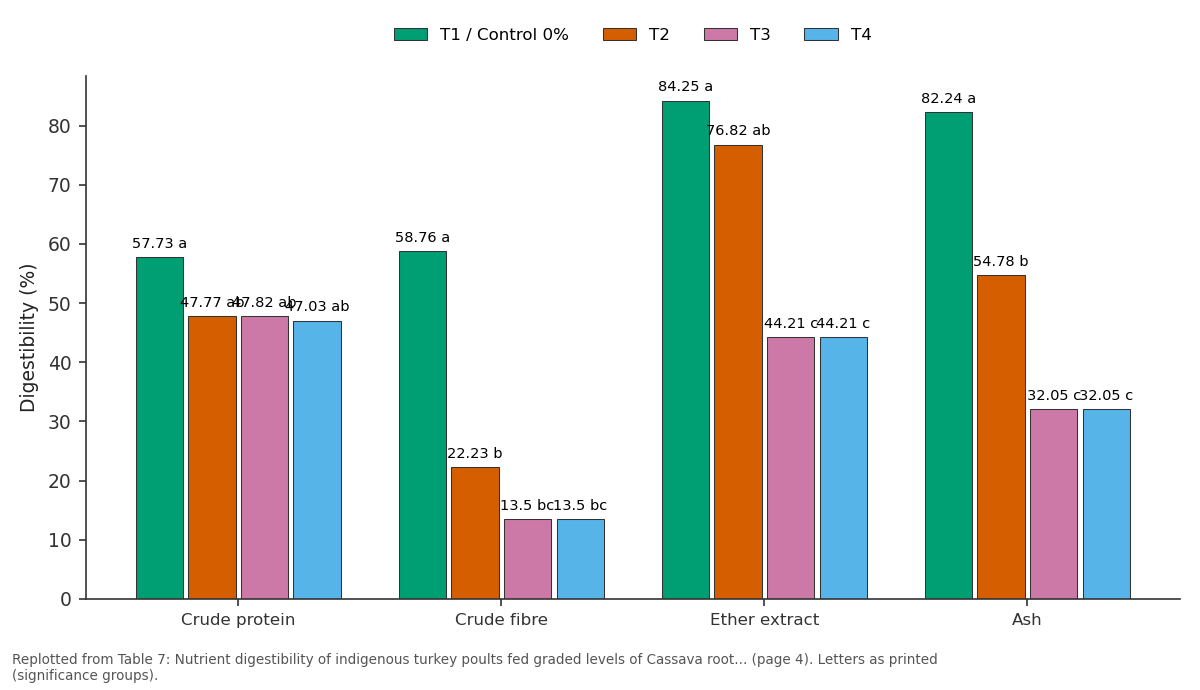
T1 / Control 0% and T2 and more: Crude protein vs Crude fibre vs Ether extract vs Ash
Replotted from Table 7 (page 4) of the original paper. Every bar is the paper's own table value.
View source evidence ↗Figures & tables
From the original paper Table 1
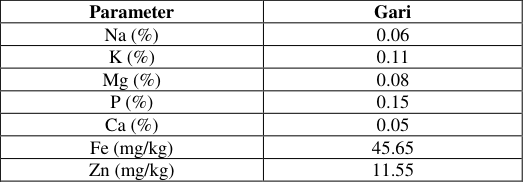 Table 2
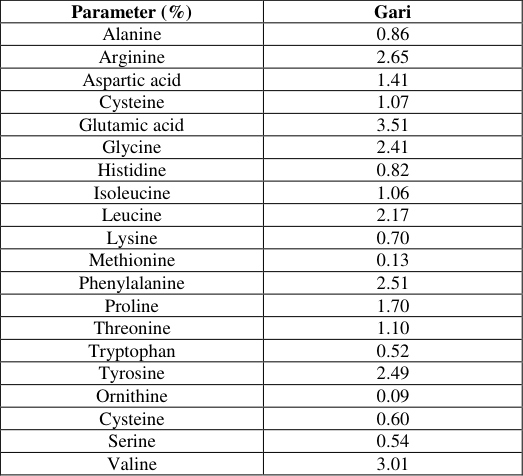 Table 3
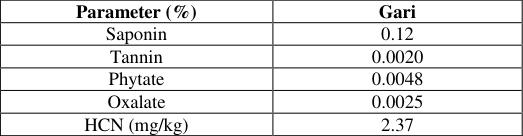 Table 4
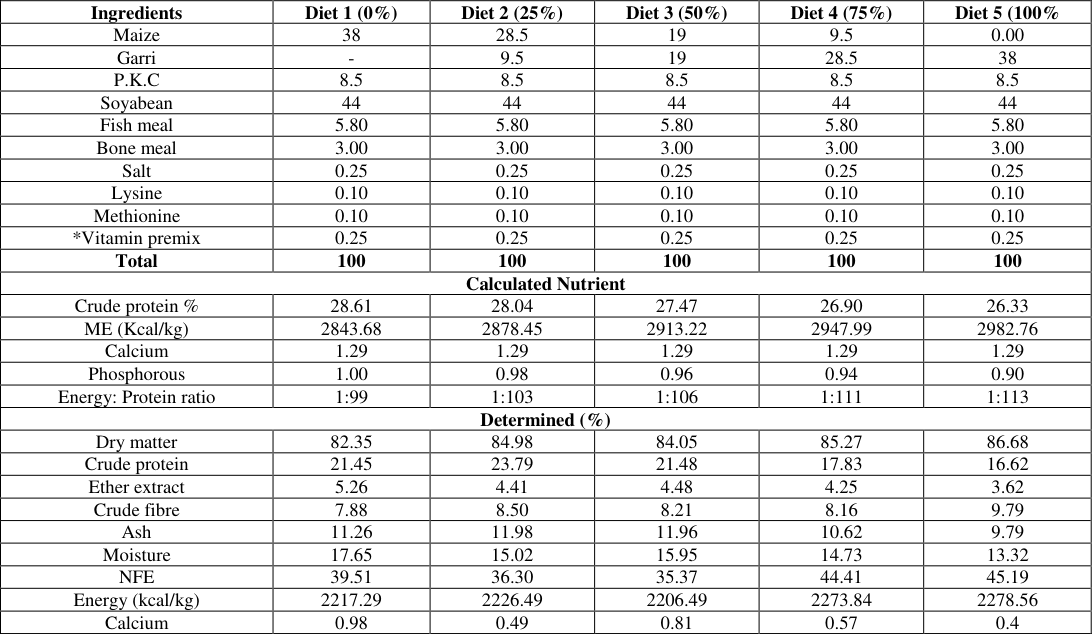 Table 5
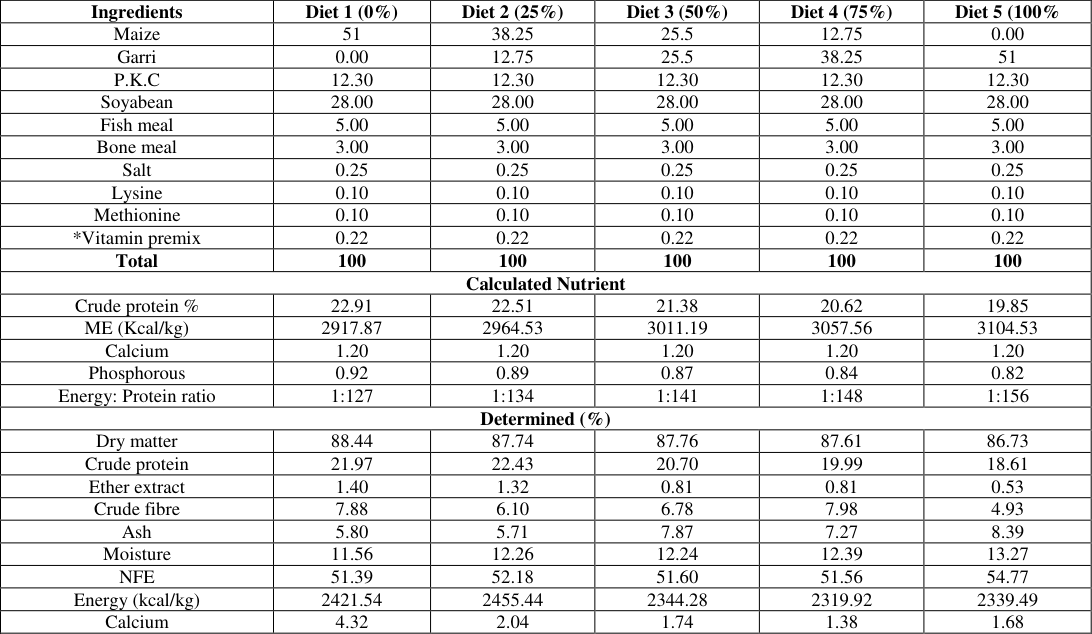 Table 6
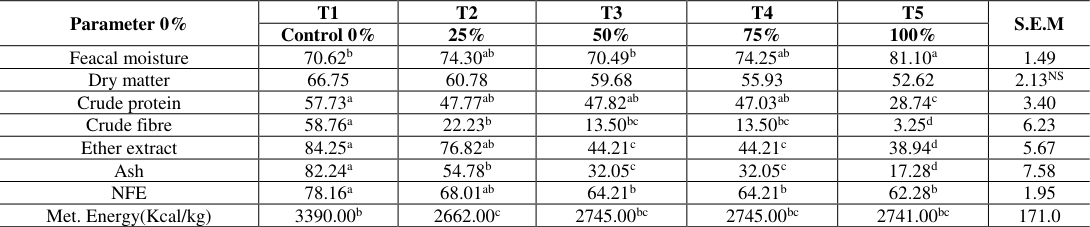 Table 7
 Table 8
Introduction
Maize, a major source of dietary energy in both domestic and commercial poultry nutrition is being daily competed for by humans, livestock producers and several industries. The increasing demand for maize without corresponding increase in its production has led to price instability, inavailability or scarcity and the need to search for comparable alternative if poultry production in Nigeria and some other African countries would be sustained. Cassava (Manihot esculenta crantz), which is an energy-dense reserved tuber crop has shown great promise as a comparable maize substitute in poultry nutrition. Cassava remains the most vital food in terms of carbohydrates (Ojo and Akande, 2013) [16] and can be processed into various forms such as "gari", "fufu" and "tapioca" (Okechukwu and Okoye, 2010) [17] . Umucass 36 is a yellow fleshed root cassava variety being propagated in Nigeria and the entire African continent in order to mitigate dietary Vitamin A deficiency. Nigeria, being the largest world producer has been targeting the domestic and international food market (IITA, 2011) [9] with the intention of increasing its production throughout Africa. Cassava root meal has been fed variously without any deleterious effect on bird's performance (Ojewola, 2017) [15] , thus ascertaining the suitability of cassava tuber meal as a partial and or complete substitute for maize in poultry diets. Efforts, therefore need be intensified to improve its processing so as to efficiently and profitably exploit its nutritive benefits. Gari, is a widely known and accepted, grated, fermented and toasted food product derived from cassava root meal with potential for meeting human, industrial and livestock needs. It is also pertinent to enlarge the scope of poultry business by looking beyond the production of broiler chickens and laying hens to meet the ever increasing animal protein demands of the Nigerian populace and Africa as a whole. This also becomes necessary, especially now that indigenous turkey production enterprise is gradually receiving reasonable investment attention in most of the African nations.
It is on this premise that efforts were made in this experiment to evaluate the nutritive and anti-nutritive contents of Umucass 36 Cassava variety and its substitutional value for maize in indigenous growing turkey.
Materials and Methods
Materials and Methods
Processing of the Test Material
Umucass 36 cassava root tuber was peeled, washed, grated, bagged and hydraulically pressed between wooden platforms for 3 days to expel excess liquid from the pulp. The dewatered and fermented lumps of the pulp were crumbled with hands while fibrous materials were removed. The remaining mass of cassava was sieved and thereafter toasted in an iron pan over gentle flames of fire for about 10 to 15 minutes. Thereafter, the gari was packed into bags after cooling and thereafter stored in a safe place.
Laboratory Evaluation of the Test Material
Samples of the toasted cassava meal were analyzed for their proximate (AOAC, 1984) [2] , mineral (AOAC, 1980) [1] and amino acids (AOAC 2006, method 982.30) [3] contents, while the gross energy was determined by the use of the Gallenkamp Ballistic Bomb Calorimeter. The metabolizable energy of the test material was evaluated using the equation described by Jansen (1989) [10] . ME (Kcal/kg) = 38.55 x Dry Matter-394.59 x Tannic Acid. The Hydrogen cyanide (HCN), tannic and phytic acids were respectively determined using the non-laborious spectrophotometric method of Bradbury et al. (1999) [4] , Maya (1982) [13] and Markkah et al. (1993) [12] .
Nutritional Study
Five diets were respectively formulated for the starter and grower phases. The well processed Umucass 36 cassava meal (garri) was included in the diets as substitute for maize at 0, 25, 50, 75 and 100% respectively at both the starter and the grower phases. Starter phase lasted 8 weeks (0-8weeks), while the finisher phase was between the 8 th and 16 th week. A hundred and thirty five turkey poults raised on deep litter were randomly allocated to the five dietary treatments in a Completely Randomized Design (CRD), with each dietary group having 27 poults replicated thrice, the birds were fed and watered ad libitum for a period of 16 weeks. The percent nutrient digestibility of each of the diets were thereafter evaluated. At the end of the 14 th week, 2 birds were randomly picked from each of the dietary replicates and were transferred into the well prepared metabolic cages without disrupting the experimental design. They were kept in the cages for the first 7 days (14-15weeks) to enable them acclimatize to the new environment while being fed same diet throughout. Between the 15 th and the 16 th week, records of feed intake and feacal output were taken. The feacal output were collected daily, dried in the oven for 24 hours 105 0 C and were stored until the experiment was terminated. Thereafter, both the dietary and feacal samples were evaluated for their proximate composition using the procedure described by AOAC (1984) [2] .
Data Analysis
Data obtained from the nutrient digestibility of growing turkey poults fed graded levels of gari meal were subjected to analyses of variance in a Complete Randomized Design according to Steel and Torrie (1980) [19] using SPSS version 20.0 and the differences between the treatment means were compared using the Duncan Multiple Range test (1955) [5] .
Results and Discussion
The results of the laboratory evaluation of the proximate composition, gross energy, mineral, anti-nutrients of the test material and percent nutrient digested when the test material was fed to growing indigenous turkey poults are herein presented in tables 1, 2, 3 and 4 respectively. The dietary tables for the starter and grower phases are presented in tables 5 and 6, while the nutrient utilization table is presented in table 7. 4 *Each 2.5 kg vitamin-mineral premix provided the following: A 8,000,000 iu, D3 2,000,000 iu, E 5000 mg, K3 2000 mg, Folic acid 500 mg, Niacin 15,000mg, Calpan 5,000 mg, B2 8000 mg, B12 10,000 mg, B1 1,500 mg, B6 1,500 mg, Biotin 20 mg. *Each 2.5 kg vitamin-mineral premix provided the following: A 8,000,000 iu, D3 2,000,000 iu, E 5000 mg, K3 2000 mg, Folic acid 500 mg, Niacin 15,000mg, Calpan 5,000mg, B2 8000mg, B12 10,000 mg, B1 1,500 mg, B6 1,500 mg, Biotin 20 mg. The determined percent protein value of gari is 2.23. This is numerically higher than 0.7% reported by Ngiki et al. (2014) [14] in root tubers, but lower than 10% crude protein content reported for maize by Gil and Butrago (2002). This may be the reason why cassava-based poultry diets need be supplemented with protein sources that can provide adequate supply of some of the essential amino acids. According to Gomes et al. (2005). The high fat content of 3.54% obtained could be attributed to the processing method, while 1.4% crude fibre and 1.77% moisture fall within the recommended level prescribed by Gil and Buitrago (2002) [6] and Igbeka (1987) [8] . The ash contents value (1.88%) was higher than 1.7% reported. The gross energy value (3.52kcal/kg obtained was lower than 3.84kcal/kg obtained by Oyenuga (1968) [18] . The results of the mineral composition and amino acids profile of the Umucass 36 Cassava root meal showed that the test material has a conglomerate of nutrients to contribute when added to poultry diets, either partially or completely. The various differences obtained could be attributed to one or combination of the following parameters, which includes species of cassava, soil type and available nutrients, age at harvesting, processing method and other factors such as intensity of rainfall, ambient temperature and storage type and duration.
| Parameter 0% | T1 | T2 | T3 | T4 | T5 | S.E.M |
|---|---|---|---|---|---|---|
| Control 0% | 25% | 50% | 75% | 100% | ||
| Feacal moisture | 70.62b | 74.30ab | 70.49b | 74.25ab | 81.10a | 1.49 |
| Dry matter | 66.75 | 60.78 | 59.68 | 55.93 | 52.62 | 2.13NS |
| Crude protein | 57.73a | 47.77ab | 47.82ab | 47.03ab | 28.74c | 3.40 |
| Crude fibre | 58.76a | 22.23b | 13.50bc | 13.50bc | 3.25d | 6.23 |
| Ether extract | 84.25a | 76.82ab | 44.21c | 44.21c | 38.94d | 5.67 |
| Ash | 82.24a | 54.78b | 32.05c | 32.05c | 17.28d | 7.58 |
| NFE | 78.16a | 68.01ab | 64.21b | 64.21b | 62.28b | 1.95 |
| Met. Energy(Kcal/kg) | 3390.00b | 2662.00c | 2745.00bc | 2745.00bc | 2741.00bc | 171.0 |
Table text extracted from the original PDF; superscript letters are shown inline. The original table image is below.
View original table image
Animal functions at their best when their requirements for dietary essentials (energy, proteins, minerals and vitamins) are met. These essentials must also be biologically available and efficiently utilized within the confine of suitable environment. Furthermore, it is also important to recognize the fact that emphasis should not be placed just on meeting the minimum requirement but on having continuous relationship between intake and the animal's performance. The result presented on table 7 showed significant (P<0.05) difference on all the parameters considered, only with the exception of the dry matter content. Percent crude protein, crude fibre, ether extract, ash and nitrogen free extract were depressed (P<0.05) as the dietary inclusion of gari in the grower turkey diets increased from 0 to 100% substitution level. This agrees with the report of Khempaka et al. (2009) [11] . Cassava is low in protein, which oftentimes could hardly be sufficiently ameliorated by supplementation with expensive synthetic amino acids (Tables 5 and6) coupled with increasing hard-to-digest dietary crude fibre and residues of hydrocyanide which hinders the digestion and utilization of some other dietary nutrients. The effects of the graded substitution of maize with cassava on the bird's live weight at 16 weeks (Table 8) showed a numerically consistent depression as the level of substitution increased from 0% to 100%. From the foregoing, it is important to know that Umucass 36 cassava root meal gari is rich in some nutrients and we can take advantage of these nutrients by including it in starter and grower indigenous turkey diets up-to-50% wherever maize is not available in sufficient quantity and or very expensive. It is therefore recommended.
| Parameter (g) | T1 | T2 | T3 | T4 | T5 | S.E.M |
|---|---|---|---|---|---|---|
| 0% | 25% | 50% | 75% | 100% | ||
| Initial weight | 49.00 | 50.67 | 48.85 | 49.39 | 48.70 | 0.29 NS |
| Final live weight | 2316.67 | 2183.33 | 2233.33 | 1916.67 | 1850.00 | 71.88NS |
Table text extracted from the original PDF; superscript letters are shown inline. The original table image is below.
View original table image
Figures and tables from the paper
| Parameter | Gari |
|---|---|
| Na (%) | 0.06 |
| K (%) | 0.11 |
| Mg (%) | 0.08 |
| P (%) | 0.15 |
| Ca (%) | 0.05 |
| Fe (mg/kg) | 45.65 |
| Zn (mg/kg) | 11.55 |
Table text extracted from the original PDF; superscript letters are shown inline. The original table image is below.
View original table image
| Parameter (%) | Gari |
|---|---|
| Alanine | 0.86 |
| Arginine | 2.65 |
| Aspartic acid | 1.41 |
| Cysteine | 1.07 |
| Glutamic acid | 3.51 |
| Glycine | 2.41 |
| Histidine | 0.82 |
| Isoleucine | 1.06 |
| Leucine | 2.17 |
| Lysine | 0.70 |
| Methionine | 0.13 |
| Phenylalanine | 2.51 |
| Proline | 1.70 |
| Threonine | 1.10 |
| Tryptophan | 0.52 |
| Tyrosine | 2.49 |
| Ornithine | 0.09 |
| Cysteine | 0.60 |
| Serine | 0.54 |
| Valine | 3.01 |
Table text extracted from the original PDF; superscript letters are shown inline. The original table image is below.
View original table image
| Parameter (%) | Gari |
|---|---|
| Saponin | 0.12 |
| Tannin | 0.0020 |
| Phytate | 0.0048 |
| Oxalate | 0.0025 |
| HCN (mg/kg) | 2.37 |
Table text extracted from the original PDF; superscript letters are shown inline. The original table image is below.
View original table image
| Ingredients | Diet 1 (0%) | Diet 2 (25%) | Diet 3 (50%) | Diet 4 (75%) | Diet 5 (100% |
|---|---|---|---|---|---|
| Maize | 38 | 28.5 | 19 | 9.5 | 0.00 |
| Garri | - | 9.5 | 19 | 28.5 | 38 |
| P.K.C | 8.5 | 8.5 | 8.5 | 8.5 | 8.5 |
| Soyabean | 44 | 44 | 44 | 44 | 44 |
| Fish meal | 5.80 | 5.80 | 5.80 | 5.80 | 5.80 |
| Bone meal | 3.00 | 3.00 | 3.00 | 3.00 | 3.00 |
| Salt | 0.25 | 0.25 | 0.25 | 0.25 | 0.25 |
| Lysine | 0.10 | 0.10 | 0.10 | 0.10 | 0.10 |
| Methionine | 0.10 | 0.10 | 0.10 | 0.10 | 0.10 |
| *Vitamin premix | 0.25 | 0.25 | 0.25 | 0.25 | 0.25 |
| Total | 100 | 100 | 100 | 100 | 100 |
| Calculated Nutrient | |||||
| Crude protein % | 28.61 | 28.04 | 27.47 | 26.90 | 26.33 |
| ME (Kcal/kg) | 2843.68 | 2878.45 | 2913.22 | 2947.99 | 2982.76 |
| Calcium | 1.29 | 1.29 | 1.29 | 1.29 | 1.29 |
| Phosphorous | 1.00 | 0.98 | 0.96 | 0.94 | 0.90 |
| Energy: Protein ratio | 1:99 | 1:103 | 1:106 | 1:111 | 1:113 |
| Determined (%) | |||||
| Dry matter | 82.35 | 84.98 | 84.05 | 85.27 | 86.68 |
| Crude protein | 21.45 | 23.79 | 21.48 | 17.83 | 16.62 |
| Ether extract | 5.26 | 4.41 | 4.48 | 4.25 | 3.62 |
| Crude fibre | 7.88 | 8.50 | 8.21 | 8.16 | 9.79 |
| Ash | 11.26 | 11.98 | 11.96 | 10.62 | 9.79 |
| Moisture | 17.65 | 15.02 | 15.95 | 14.73 | 13.32 |
| NFE | 39.51 | 36.30 | 35.37 | 44.41 | 45.19 |
| Energy (kcal/kg) | 2217.29 | 2226.49 | 2206.49 | 2273.84 | 2278.56 |
| Calcium | 0.98 | 0.49 | 0.81 | 0.57 | 0.4 |
Table text extracted from the original PDF; superscript letters are shown inline. The original table image is below.
View original table image
| Ingredients | Diet 1 (0%) | Diet 2 (25%) | Diet 3 (50%) | Diet 4 (75%) | Diet 5 (100% |
|---|---|---|---|---|---|
| Maize | 51 | 38.25 | 25.5 | 12.75 | 0.00 |
| Garri | 0.00 | 12.75 | 25.5 | 38.25 | 51 |
| P.K.C | 12.30 | 12.30 | 12.30 | 12.30 | 12.30 |
| Soyabean | 28.00 | 28.00 | 28.00 | 28.00 | 28.00 |
| Fish meal | 5.00 | 5.00 | 5.00 | 5.00 | 5.00 |
| Bone meal | 3.00 | 3.00 | 3.00 | 3.00 | 3.00 |
| Salt | 0.25 | 0.25 | 0.25 | 0.25 | 0.25 |
| Lysine | 0.10 | 0.10 | 0.10 | 0.10 | 0.10 |
| Methionine | 0.10 | 0.10 | 0.10 | 0.10 | 0.10 |
| *Vitamin premix | 0.22 | 0.22 | 0.22 | 0.22 | 0.22 |
| Total | 100 | 100 | 100 | 100 | 100 |
| Calculated Nutrient | |||||
| Crude protein % | 22.91 | 22.51 | 21.38 | 20.62 | 19.85 |
| ME (Kcal/kg) | 2917.87 | 2964.53 | 3011.19 | 3057.56 | 3104.53 |
| Calcium | 1.20 | 1.20 | 1.20 | 1.20 | 1.20 |
| Phosphorous | 0.92 | 0.89 | 0.87 | 0.84 | 0.82 |
| Energy: Protein ratio | 1:127 | 1:134 | 1:141 | 1:148 | 1:156 |
| Determined (%) | |||||
| Dry matter | 88.44 | 87.74 | 87.76 | 87.61 | 86.73 |
| Crude protein | 21.97 | 22.43 | 20.70 | 19.99 | 18.61 |
| Ether extract | 1.40 | 1.32 | 0.81 | 0.81 | 0.53 |
| Crude fibre | 7.88 | 6.10 | 6.78 | 7.98 | 4.93 |
| Ash | 5.80 | 5.71 | 7.87 | 7.27 | 8.39 |
| Moisture | 11.56 | 12.26 | 12.24 | 12.39 | 13.27 |
| NFE | 51.39 | 52.18 | 51.60 | 51.56 | 54.77 |
| Energy (kcal/kg) | 2421.54 | 2455.44 | 2344.28 | 2319.92 | 2339.49 |
| Calcium | 4.32 | 2.04 | 1.74 | 1.38 | 1.68 |
Table text extracted from the original PDF; superscript letters are shown inline. The original table image is below.
View original table image
References
19 in the original paper- AOAC. Association of Official Analytical Chemists. Official Method of Analysts (13 th Edition), Washington D.C. USA, 1980.
- AOAC. Association of Official Analytical Chemistry. 974.24 Washington D.C. USA, 1984.
- AOAC. Official Method of Analysis, 18 th Ed. Association of Official Analytical Chemists, Washington D.C. USA, 2006.
- Bradbury MGS, Egen V, Bradbury JH. Determination of all forms of Cyanogens in Cassava roots and cassava products using picrate paper kits, 1999.
- Duncan DB. New Multiple F-tests. Biometrics. 1955; 11:1-14.
- Gil JL, Buitrago AJA. La yucca en la alimentacion animal. In OspinaB, CeballosH, editors. La yuca en el terces milenio: sistemas modemos de produccion, processamiento, utilization comercializacion. Cali, Colombia: Centro Internacional de Agricultura Tropical, 2002, 527-569.
- Gomes E, Souza SR, Grandi RP, Silva RD. Production of thermostable glycomylase by newly Isolated Aspergillus flavus AI.I and thermomyces Lanuginosis A13.37 Braz. J. Microbiology. 2005; 36:75-82.
- Igbeka JC. Simulation of moisture profile stored in gari. Journal of food and Agriculture. 1987; 1:5-9.
- IITA, 2011. https://www.iita.org/news-item/nigeriareleases-cassava-higher-pro-vitamin-fight-micronutrientdeficiency/
- Janssen WW. WWMA(ed): European table of Energy Value for poultry Feedstuffs. 3 rd Edition. Beckbergen, Netherland: Spelderholt Centre for Poultry Research and Information Services, 1989.
- Khempaka S, Molee W, Guillaume M. Dried cassava pulp as an alternative feedstuff for broilers: Effect on growth performance, carcass traits, digestive organs and nutrient digestibility. Journal of Applied Poultry Reserve. 2009; 18:487-493.
- Markkah HPS, Blummer M, Browy NK, Becker K. Gravimetric of Tannins and their correlation with chemical and protein recitation methods, 1993.
- Maya JA. Phytate, its chemistry occurrence, food interaction, nutritional significance and method analysis. Journal of Agriculture and Food Chemistry. 1982; 30:1.
- Ngiki YU, Igwebuike JU, Moruppa SM. Effects of replacing maize with cassava root-meal mixture on the performance of broiler chickens. International Journal of Science and Technology. 2014; 3(6):352-362.
- Ojewola GS. Single use, resource recovery and environmental wholesomeness: An issue of growing importance in livestock production. Inaugural lecture, Michael Okpara University of Agriculture, Umudike, Abia State Nigeria, 2017.
- Ojo A, Akande EA. Quality evaluation of "gari" produced from cassava and potato tuber mixes. African Journal of Biotechnology. 2013; 12:4920-4924.
- Okechukwu DE, Okoye IC. Evaluation of soaking time on the cyanide content of "Abacha" slices. 34 th Annual conference and general meeting of Nigerian Institute of Food Science and Technology (NIFST) Port-Harcourt, 2010, 136-13.
- Oyenuga VA. Nigerian feeds and feeding stuffs, Nigeria. Sept. 16-17, Lagos Airport Hotel, Ikeja. Their chemistry and nutritive value. Ibadan/Lagos University Press, 1968.
- Steel RGD, Torrie JH. Principles and proceedings of Statistics: A biometrical approach, 2 nd Edn. McGraw hill Books Co. Inc. New York, USA, 1980.