
Research article · 2018 · Full text
International Journal of Agriculture Extension and Social DevelopmentAnalysis of the perceived problems of oil palm production and processing in Imo state, Nigeria
Volume 1(2) · Pages 07–09 · DOI: 10.33545/26180723.2018.v1.i2a.81 ↗
Research areasOil Palm Production and Sustainability
Abstract
Author-writtenThis study was carried out in Imo State to examine the perceived problems of oil palm production. A total of 124 millers were selected randomly and given questionnaire. Data collected were analyzed using percentage, mean and standard deviation. The findings of the study revealed that the problems facing oil palm production include lack of adequate land space, inadequate storage facilities which results in low production of oil palm, inadequate finance. While its prospects include that the cultivation of oil palm is an inevitable means of shifting the nation’s dependence on oil and a means of discouraging urban drift. It was recommended that governments at all levels should provide loans specifically to oil palm producers, cooperative societies should also be encouraged to ensure easy milling of oil palm, adequate market information be given to millers for profitable income and land tenure reform be taken to ease land problems.
Summary
Source-checkedPlain-language reading of the full paper, prepared with AI and checked against the text. Each point links to the authors' own words.
Why it matters
- Oil palm is a high-yielding oil crop that serves as a significant sector of the Nigerian economy by providing food and raw materials for various industries. View evidence ↗
- Despite Imo State being one of the largest producers of palm oil in Nigeria, the region lacks adequate storage and export capabilities. View evidence ↗
The question
- The primary goal of this study was to evaluate the problems and prospects associated with oil palm production in Imo State. View evidence ↗
What they did
- The researchers used purposive random sampling to select 124 millers (10% of the registered population of 1,240) in Imo State. View evidence ↗
- Data were collected using questionnaires and oral interviews. View evidence ↗
- The study analyzed the collected data using descriptive statistics, including percentages, means, and standard deviations. View evidence ↗
What they found
- Pounding in a mortar was the most common processing method, used by 90.3% of the respondents. View evidence ↗
- Fermentation was a universal step in the processing sequence, utilized by 100% of the millers. View evidence ↗
- Land tenure problems were perceived as the most significant issue, recording the highest mean response of 3.5. View evidence ↗
- Insufficient funding was identified as a major problem with a mean response of 3.0. View evidence ↗
- Poor produce quality, the labor-intensive nature of the work, and harvesting difficulties were all rated as significant problems, each with a mean of 2.8. View evidence ↗
- Improving access to credit was identified as the top strategy for improvement, with a mean response of 3.5. View evidence ↗
- Ensuring the availability of land was seen as a key improvement strategy, with a mean response of 3.0. View evidence ↗
What it means
- The authors recommend that governments provide specific loans to producers, encourage cooperatives for easier milling, provide better market information, and implement land tenure reforms. View evidence ↗
Visual summary
3 visualsIllustrations explain the paper; charts are replotted from the paper's own table values.
Cycle of Production Barriers and Solutions
AI-generated conceptual illustration (Oil palm trees and palm fruit processing equipment). It explains the idea and does not show study data.
View source evidence ↗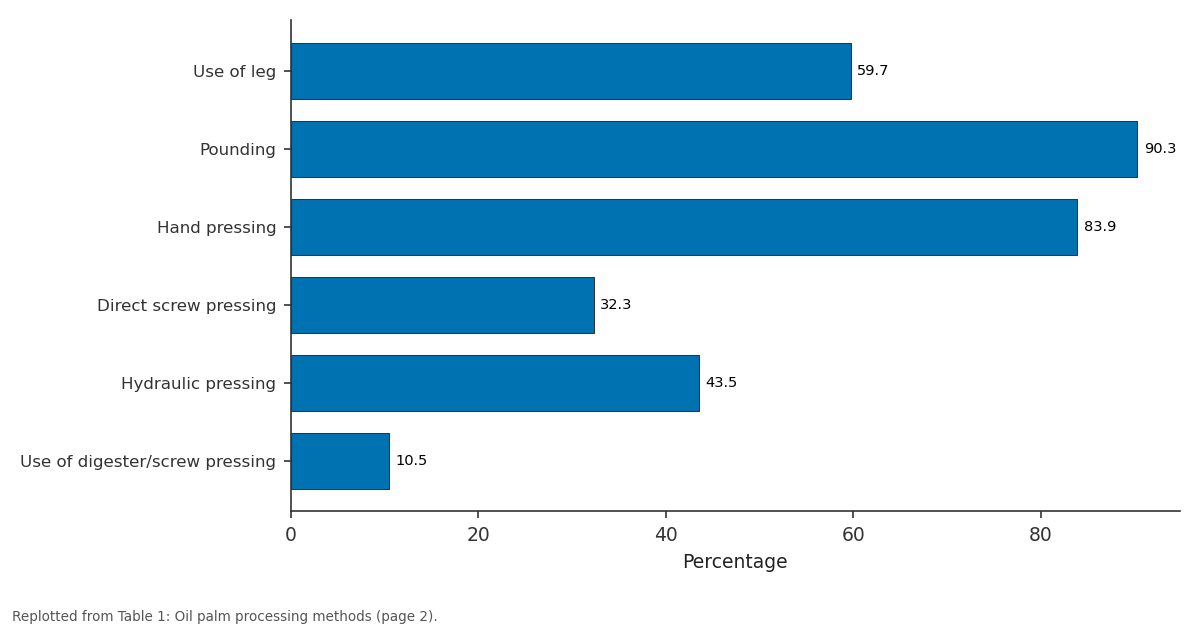
Percentage: Use of leg vs Pounding vs Hand pressing vs Direct screw pressing vs Hydraulic pressing
Replotted from Table 1 (page 2) of the original paper. Every bar is the paper's own table value.
View source evidence ↗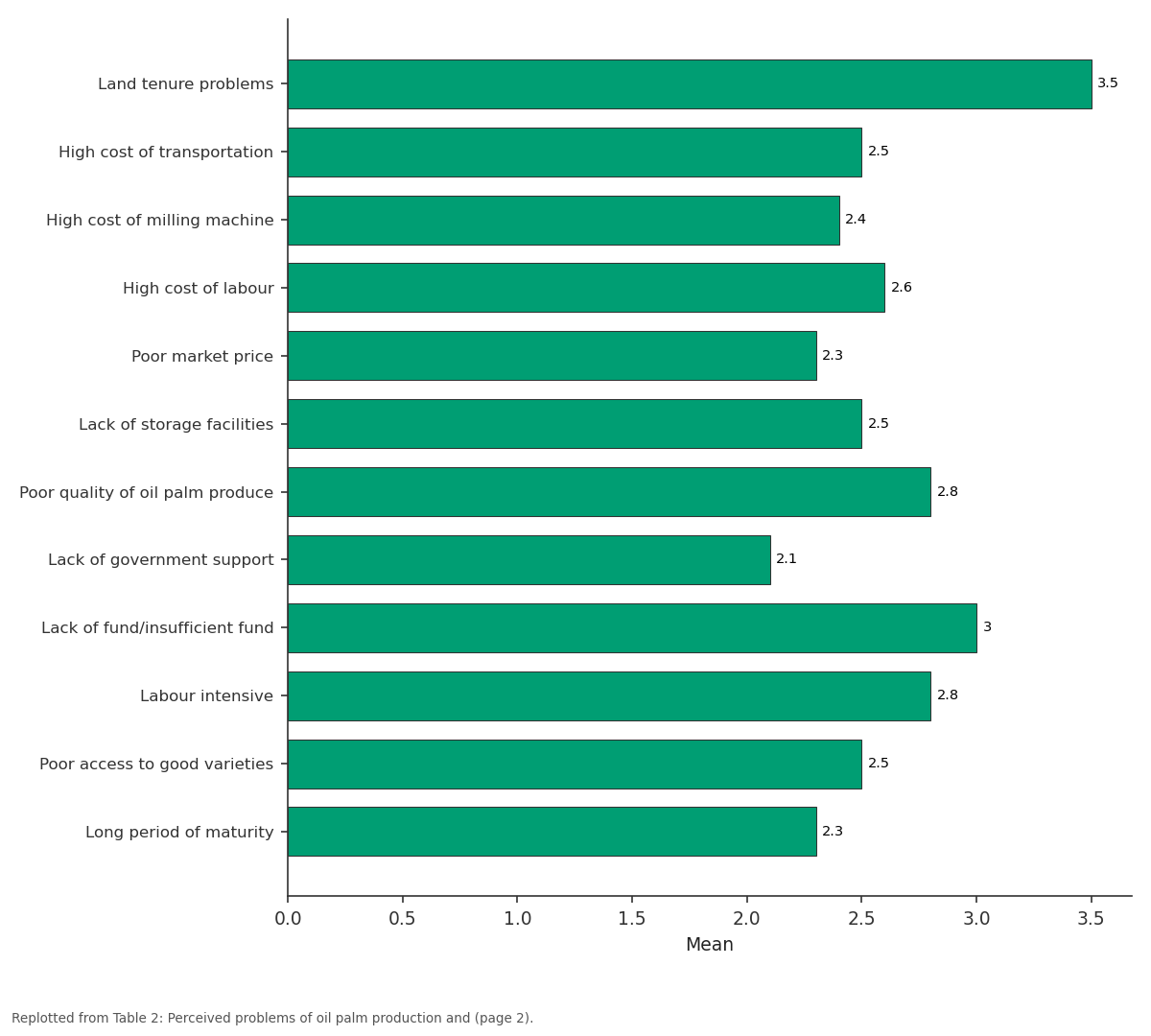
Mean: Land tenure problems vs High cost of... vs High cost of milling... vs High cost of labour vs Poor market price
Replotted from Table 2 (page 2) of the original paper. Every bar is the paper's own table value.
View source evidence ↗Figures & tables
From the original paper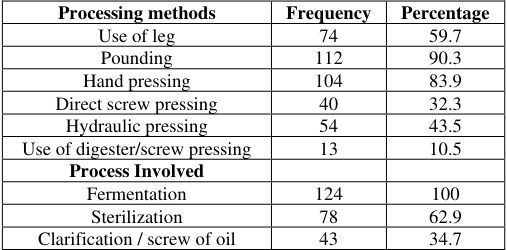 Table 1
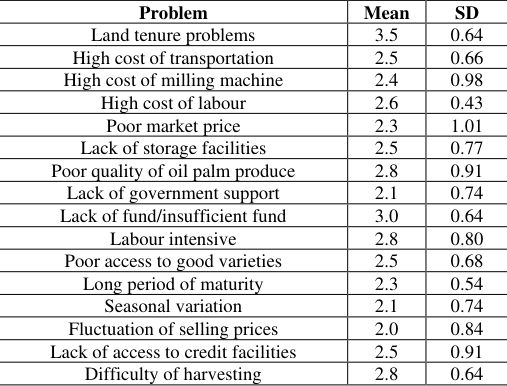 Table 2
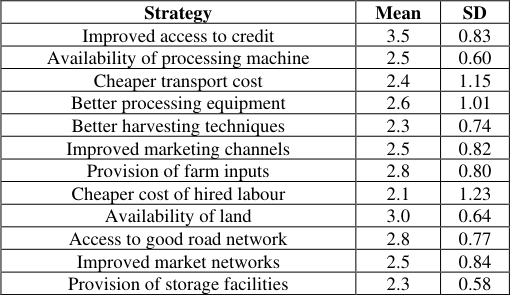 Table 3
Introduction
The oil palm (Elaeis guinensis) is a perennial monocotyledonous plant which belongs to the family palmae (Hartley, 1988) [2] . The African oil palm Elaeis guinensisis is native to West African and South West African occurring between Angola and Gambia. In West Africa, the oil palm grows naturally throughout the rainforest belt. Many plantations of oil palm have and are being established in West African belt, most palm produce is obtained from growing wild (Mathew, 2009) [7] . The oil palm is indigenous to Nigeria and has consequently been exploited in its natural grooves and homestead in the country from time immemorial. In Nigeria the two varieties of oil palm grown are identified as Dura and Tenera (Mathew, 2009) [7] . Dura is the common wild palm found all over Nigeria. The fruit has a thick shell and a large kernel, it gives a low amount of oil and begins to bear fruits 6-7 years after planting. Tenera has a thin shell and small kernel. It produces a high quantity of oil palm. It bears fruit 3-5 years after planting. The oil palm requires abundant rainfall of about 2,000 mm/ annum ,well distributed throughout the year (Hartley, 1988) [2] . Generally, oil palm can be grown in a wide range of soils, however, they thrive best in a well drained deep loamy alluvial soils rich in organic matter. The crop does not tolerate highly alkaline, saline, water logged and coastal sandy soils. It tolerates temperate between 29-30 centigrade, humidity of 80 percent is required (Hartley, 1988) [2] . The fruit pulp and nut provide palm oil and kernel respectively, made oil palm a high yielding oil producing crop (Handerson et al, 2000, Corley et al. 2009). The industry constitutes significant sector of the Nigeria economy providing food, raw materials for the confectionary, processing and Oleo-chemical industries. As a result of the intensive nature of its cultivation, it produces gainful employment for many Nigerians. At present oil palm production is second to that of soyabean (Glycin max) oil in terms of world vegetable oil production and the demand for oil palm is expected to increase in future (Ho and Tan, 2007, Yuso, 2007, Corley, 2009) [10] . Nigeria production during the late fifties and early sixties accounted for about 39 percent and 40 percent of the world production of palm oil and palm kernel respectively (Usoro 1994, Omoti, 2009) [5] . All of the production came mainly from the natural and semi-natural groves and form about 10,073 hectares established plantations and 4,674 hectares of small holder planting in the country (Omoti, 2009) [5] . The export of palm oil and palm kernel from Nigeria in recent years have widened significantly due to number of factors including increased domestic consumption, as a result of population growth, slow pace of growth of new plantings and declining exploitation, area and productivity of the groves (Hartley, 1988, Omoti, 2009) [2,5] . Imo state is one of the oil palm producing area in Nigeria, and is noted as one of the largest producers of palm oil in Nigeria, yet there is no storage of palm oil and kernel in Nigeria not to talk of export which is used to boast the nation revenue when it is falling. It is therefore the concern of the study to identify the reason responsible for the falling of oil palm production in the area and to consider the solution. The major objective of the study is to evaluate the problems and prospect of oil palm production in Imo State. The specific objectives of the study were to: a. Identify processing methods used by the respondents, www.extensionjournal.com b. Examine perceived problem affecting production/processing of oil palm in the study area. c. Determine perceived strategies for improving the production/processing of oil palm in the study area. [3] . An average annual temperature above 20 °C (68.0 °F) creates an annual relative humidity of 75%, with humidity reaching 90% in the rainy season. The dry season experiences two months of Harmattan from late December to late February (IMSG, 2010) [3] . The hottest months are between January and March. The estimated population is 5.8 million and the population density varies from 230-1,400 people per square kilometer (NPC, 2006) [4] .
Methodology
The research covers all the oil palm millers/processors in Imo State. This study employed the purposive random sampling techniques in selecting respondents for the study.
A list of registered millers/processors was obtained from millers cooperatives in Owerri, the Headquarters Office.
The list has a total of 1,240 millers and 124 members were selected randomly which gives 10 percent of the population.
The instrument that was used in data collection in this study was the questionnaire complimented with oral interview. Data collected were analyzed using descriptive statistical tools like percentage, mean and standard deviation. Objective 1 was analyzed using percentage presented in frequency tables, while Objectives 2 and 3 were analyzed on a 3 point likert -type scale of strongly agreed, agree and disagree, assigned weight of 3, 2 and 1.The scores were added to give 6 divided by 3 to give a mean value of 2.0. Any mean value of 2.0 and above was assigned a problem and strategy for improvement, while mean less than 2.0 was not a problem and or improvement strategy.
Results and Discussion
Oil palm Processing methods in the study area Table 1 showed the various methods of processing oil palm and the processes involved in the study area. To produce oil, the respondents used a variety of methods. Majority (90.3%) to process oil by pounding in mortar with a long strong pistle modified for smashing the cooked fruits. They are followed by 83.9% who process by the use of hand press. This method requires a lot of strength, energy and family labour. This method is tedious and time consuming and large quantity is not produced at a time as it takes days to turn out large quantity oil. Again, 43.5% and 32.3% uses hydraulic pressing and direct screw pressing respectively. These two methods are better though expensive to purchase, but when available, are capable of producing large quantities and high quality palm oil. Other methods includes use of leg (59.7%), use of digester/screw pressing (10.5%). On the other hand three common processes are involved in product processing namely, fermentation (100%) which is done by all the millers/processors, sterilization (62.9%) and clarification (34.7%) which include boiling and sieving of oil for the removal of impurities.
| Processing methods | Frequency | Percentage |
|---|---|---|
| Use of leg | 74 | 59.7 |
| Pounding | 112 | 90.3 |
| Hand pressing | 104 | 83.9 |
| Direct screw pressing | 40 | 32.3 |
| Hydraulic pressing | 54 | 43.5 |
| Use of digester/screw pressing | 13 | 10.5 |
| Process Involved | ||
| Fermentation | 124 | 100 |
| Sterilization | 78 | 62.9 |
| Clarification / screw of oil | 43 | 34.7 |
Table text extracted from the original PDF; superscript letters are shown inline. The original table image is below.
View original table image
Problems of oil palm produce processing.
Table 2 reveals the plenty problems of palm oil produce processing with a disseminating index of 2.0, all sixteen items were accepted as problems of processing oil palm. They include land tenure problems with a mean (M) response of 3.05, high cost of transportation (M=2.5), high cost of milling machine (M=2.4), high cost of labour (M=2.6), poor market price (M=2.3), lack of storage facilities (M=2.5), poor quality of oil palm produce (M=2.8), lack of government support (M=2.1), lack of funds/insufficient funds (M=3.0), labour intensive (M=2.8), poor access to good varieties (M=2.5), long period of maturity (M=2.3), seasonal variation (M=2.1), fluctuation of selling prices (M=2.0), lack of access to credit facilities (M=2.5), and difficulty in harvesting during rainy season (M=2.8). The mean response of the items agrees with the standard deviation scores which are not far from the mean. Therefore since the deviation scores which are not far, the results are accepted as true.
| Problem | Mean | SD |
|---|---|---|
| Land tenure problems | 3.5 | 0.64 |
| High cost of transportation | 2.5 | 0.66 |
| High cost of milling machine | 2.4 | 0.98 |
| High cost of labour | 2.6 | 0.43 |
| Poor market price | 2.3 | 1.01 |
| Lack of storage facilities | 2.5 | 0.77 |
| Poor quality of oil palm produce | 2.8 | 0.91 |
| Lack of government support | 2.1 | 0.74 |
| Lack of fund/insufficient fund | 3.0 | 0.64 |
| Labour intensive | 2.8 | 0.80 |
| Poor access to good varieties | 2.5 | 0.68 |
| Long period of maturity | 2.3 | 0.54 |
| Seasonal variation | 2.1 | 0.74 |
| Fluctuation of selling prices | 2.0 | 0.84 |
| Lack of access to credit facilities | 2.5 | 0.91 |
| Difficulty of harvesting | 2.8 | 0.64 |
Table text extracted from the original PDF; superscript letters are shown inline. The original table image is below.
View original table image
Strategies for improving oil palm produce processing
Table 3 showed strategies that could improve the production and processing of oil palm in the study area. The strategies were improved access to credit with a mean response of 2.7, availability of processing machine (M=2.8), cheaper transportation cost (M=2.4), better processing equipment www.extensionjournal.com (M=2.9), better harvesting techniques (M=2.3), improved marketing channels (M=2.7), provision of farm inputs (M=2.6), cheaper cost of hired labour ((M=2.1), availability of land (M=2.3), access to good road network (M=2.8), improve market network (M=2.7), and provision of adequate storage facilities (M=3.1).
| Strategy | Mean | SD |
|---|---|---|
| Improved access to credit | 3.5 | 0.83 |
| Availability of processing machine | 2.5 | 0.60 |
| Cheaper transport cost | 2.4 | 1.15 |
| Better processing equipment | 2.6 | 1.01 |
| Better harvesting techniques | 2.3 | 0.74 |
| Improved marketing channels | 2.5 | 0.82 |
| Provision of farm inputs | 2.8 | 0.80 |
| Cheaper cost of hired labour | 2.1 | 1.23 |
| Availability of land | 3.0 | 0.64 |
| Access to good road network | 2.8 | 0.77 |
| Improved market networks | 2.5 | 0.84 |
| Provision of storage facilities | 2.3 | 0.58 |
Table text extracted from the original PDF; superscript letters are shown inline. The original table image is below.
View original table image
Conclusion
The processing methods used included use of leg pounding, hand processing, hydraulic press, and direct screw among others. The following problems affect them, land tenure, high cost of transportation, lack of storage facilities, lack of fund/insufficient funds, among many others. To improve upon produce processing, access to credit be improved, better processing technique, better harvesting equipment be supplied. Governments at all levels provide loans specifically to oil palm producers, Cooperative should also be encouraged to ensure easy milling of oil palm, adequate market information be given to millers for profitable income, land tenure reform be taken to ease land problems
References
9 in the original paper- Corley RHV, Wood BJ, Hardon JJ. Future Development in Oil Palm Culture in Development in Crop Science (1) Oil Palm Research Elsevier Scientific Publishing Company 1976, 507-511
- Hartley CWS The origin and development of the Oil Palm Industry (Elaeis guineensis) 3 rd Edition 1988, 143.
- Imo State Government (IMSG) Examination ethics commission, ministry of education, Owerri. Government Printers, Owerri 2010.
- Omoti U. Oil palm sector analysis in Nigeria. Main Report, Submitted to the United Nations Industrial Development Organization (UNIDO), Abuja 2009;64(18):275.
- Usoro MG. The Nigerian Oil Palm Industry. Ibadan University Press 1994, I-10.
- Mathew O. Edible Oil Today Section of Manufacturer Association of Nigeria; Nigeria Palm Oil Today and Future Outlook. Paper presented at Nigerian Institute for Oil Palm Research Workshop 2009.
- Henderson J, Davies HA, Heyes SJ, Osborne DJ. The study of a monocotyledon abscission zone using microscopic, chemical, enzymatic and solid state 13 C CP/MAS NMR analyses. Phytochemistry 2001;56:131139 10.1016/S0031-9422(00)00447-7 [PubMed] [CrossRef] [Google Scholar]
- Ho CL, Tan YC. Molecular defense response of oil palm to Ganoderma infection. Phytochemistry 2014. 10.1016/j.phytochem.2014.10.016 [Epub ahead of print]. [PubMed] [CrossRef] [Google Scholar
- Yusof B. Palm oil production through sustainable plantations. European Journal of Lipid Science and Tecchnology 2007;109(4):289-295.
Cited by 1
From OpenAlex, OpenCitations and reference lists read by Scinovex
- Review of conceptual frameworks for smallholder farmers to achieve sustainable palm oil production ↗
Lacour Mody Ayompe, Raymond Ndip Nkongho, Ada Na'bila Acobta, Emmanuel E. Tambasi, Cargele Masso, Benis Nchine Egoh · Journal of Cleaner Production · 2025
❝ 10