
Research article · 2019 · Full text
International Journal of Veterinary Sciences and Animal HusbandryImpact of Moringa oleifera Seed extract (MSE) on bacterial load and sensory evaluation of raw milk
Volume 4(1) · Pages 45–49
Research areasMoringa oleifera research and applicationsAnimal Diversity and Health StudiesProteins in Food Systems
Abstract
Author-writtenThis study was carried out to evaluate the impact of Moringa oleifera seed extract (MSE) on bacterial load and sensory evaluation of raw milk. Moringa seed extract (MSE) was added to five treatment groups of 100ml each of raw milk at different levels; Control, 10%, 20%, 30% and 40% which represented T1, T2, T3, T4 and T5 respectively. The treated milk samples were examined for microbial load at room temperature and analysis for the microbial load was carried out after 24, 48 and 72 hours. The samples were serially diluted and inoculated using the pour plate method. The result obtained indicated that inclusion of 40% MSE (T5) reduced average total coliform count significantly (P0.05). Nevertheless, the total Coliform counts and total viable bacterial counts were 5x10³ and 1.5x10³ respectively which was lower than that obtainable from the analyzed raw milk result which was 2.42x10⁴ and 2.73x10⁴. However, sensory evaluation result revealed that 10% Moringa inclusion level scored highest implying most preferred compared to 20%, 30% and 40% inclusion levels. The organisms isolated were clostridium, pseudomonas, E. coli, Serratia, Aeromonas, Shigella and Bacillus.
Summary
Source-checkedPlain-language reading of the full paper, prepared with AI and checked against the text. Each point links to the authors' own words.
Why it matters
- Preserving raw milk from microbial spoilage is a key concern in the dairy industry, with a growing demand for natural alternatives to synthetic preservatives due to health concerns. View evidence ↗
- Moringa oleifera is considered a cheap and accessible plant that could potentially serve as a cost-effective method for obtaining microbe-free raw milk. View evidence ↗
The question
- The study aimed to determine how different concentrations of Moringa seed extract (MSE) influence the bacterial load in raw milk. View evidence ↗
What they did
- Raw milk was randomly collected from three Bunaji cows at a university livestock teaching and research farm. View evidence ↗
- Microbial load was analyzed at room temperature at intervals of 24, 48, and 72 hours. View evidence ↗
- A panel consisting of 9 judges was used to perform sensory evaluation of the milk's palatability. View evidence ↗
What they found
- Total coliform and total viable bacterial counts in treated samples (5x10³ and 1.5x10³ respectively) were lower than those in the analyzed raw milk (2.42x10⁴ and 2.73x10⁴). View evidence ↗
- Sensory evaluation indicated that the 10% MSE inclusion level was the most preferred among the treated samples. View evidence ↗
- The 40% MSE inclusion received the lowest sensory scores, suggesting that higher concentrations of the extract negatively affect the taste of raw milk. View evidence ↗
- The bacteria isolated from the MSE-fortified raw milk included Bacillus, Serratia, Aeromonas, Pseudomonas, Shigella, Clostridium, and Escherichia. View evidence ↗
What it means
- The authors concluded that a 40% concentration of Moringa Seed Extract is effective at reducing the microbial load of raw milk between 0 and 24 hours. View evidence ↗
- The authors recommend using more than 20g of Moringa Seed Meal when preparing the seed extract. View evidence ↗
Visual summary
3 visualsIllustrations explain the paper; charts are replotted from the paper's own table values.
MSE Concentration Trade-off
AI-generated conceptual illustration (raw cow milk and Moringa oleifera seeds). It explains the idea and does not show study data.
View source evidence ↗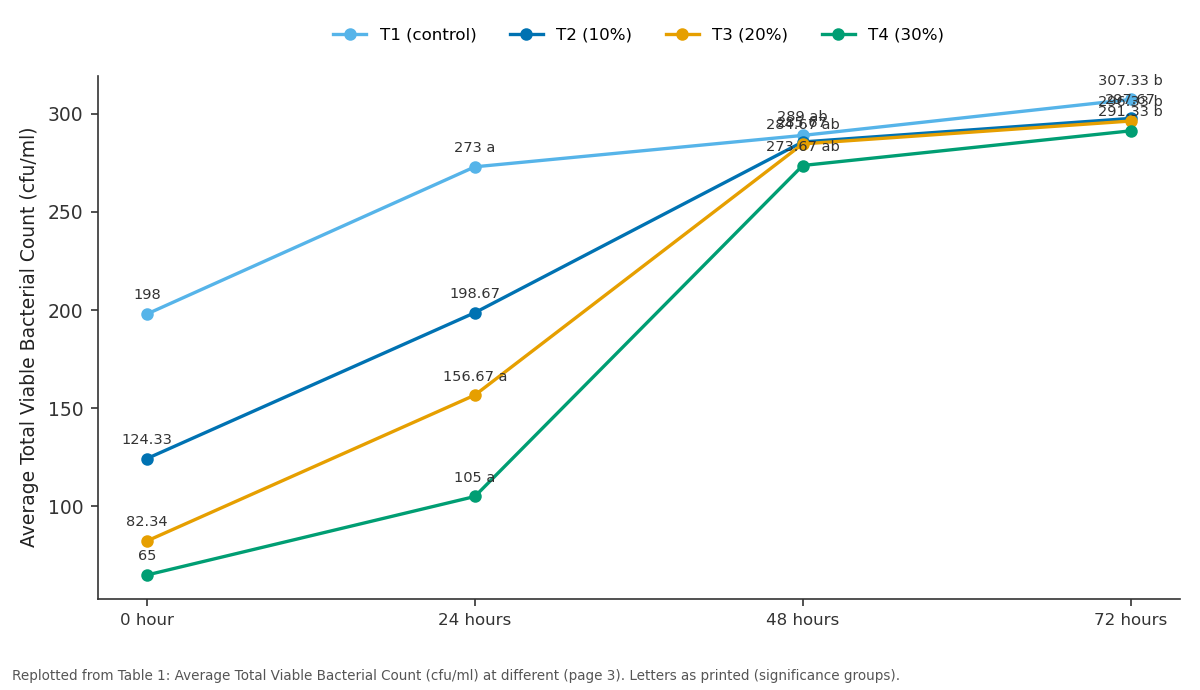
T1 (control) and T2 (10%) and more: 0 hour vs 24 hours vs 48 hours vs 72 hours
Replotted from Table 1 (page 3) of the original paper. Every bar is the paper's own table value.
View source evidence ↗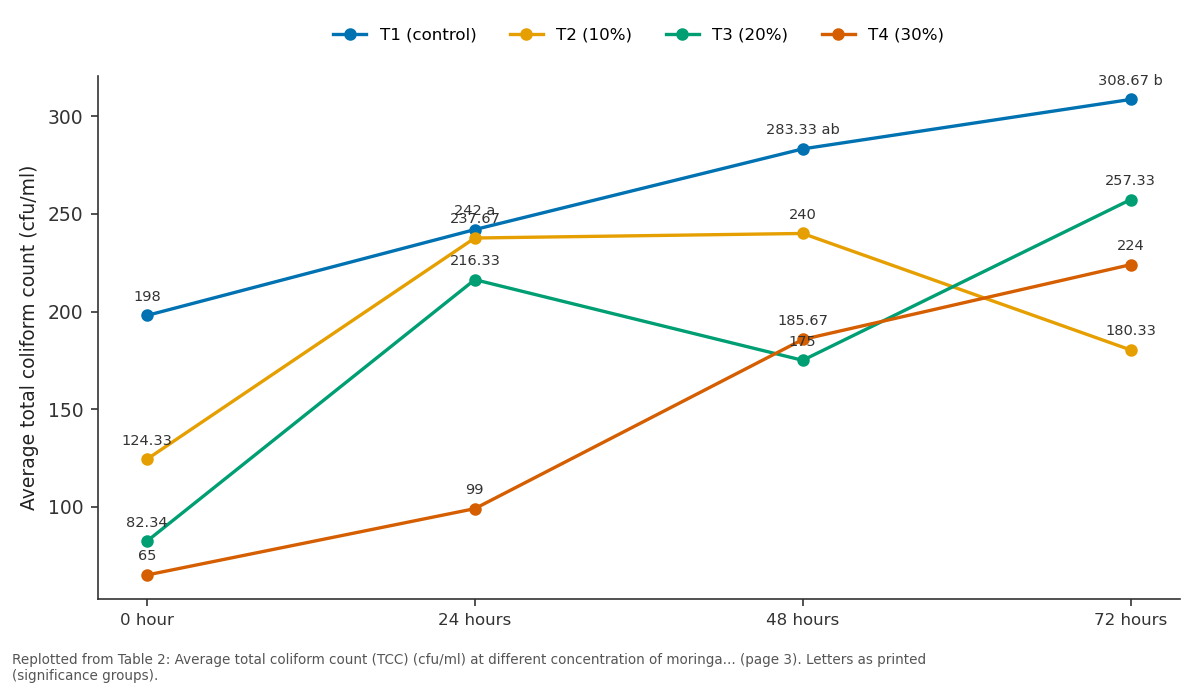
T1 (control) and T2 (10%) and more: 0 hour vs 24 hours vs 48 hours vs 72 hours
Replotted from Table 2 (page 3) of the original paper. Every bar is the paper's own table value.
View source evidence ↗Figures & tables
From the original paper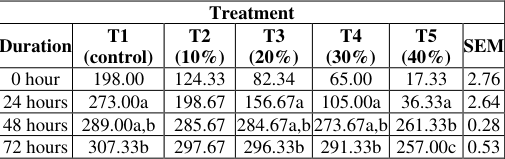 Table 1
 Table 2
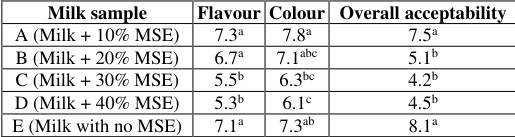 Table 3
 Table 4
 Table 5
Introduction
Milk is one of the main foodstuffs consumed by humans, and an important starting base for young ones of mammals. Milk is a white liquid nutrient rich food produced by the mammary glands of mammals. As one of the animal product, milk is gotten from Cattle, Goat, Sheep and Buffalo soon after parturition. However, Cow's milk dominates commercial production compared to Goat, Sheep and Buffalo. (Gerosa and Skoet, 2012) [12] . Nigeria is among the largest producer of cow milk in West Africa. Raw milk is used for different purposes such as production of cream, butter, yoghurt, kefir, ice-cream and cheese. Modern industries process milk into casein, whey protein, lactose, condensed milk, powdered milk, evaporated milk etc. Preservation of raw milk from microbial deterioration has traditionally been an important concern in dairy industry even as the demand for partial or complete substitution of synthetic preservative has been on an increase due to their adverse health effects. Consequently, emerging interest in discovering therapeutic plants that could inhibit microbial activities in raw milk for some hours after milking is advocated. (Bukar et al., 2010; Aora et al., 2013) [7] . In recent years, the use of plants as become popular in the food industry thereby focusing on the use of eco-friendly and bio-friendly plants which has antioxidant and antimicrobial effects that enhances shelf-life and safety of raw milk. The possibility of use of plants that are cheap and easily available such as Moringa oleifera plays function through pasteurization thereby serving as a cheaper source of microbes-free raw milk (Saadabi et al., 2006) [25] .Studies have also proven that diet rich in phenolic antioxidants have many health benefits thus confer longer life expectancy. Phenolic antioxidants are mainly present in leaves and seeds of some plants which prevent free radical mechanism in raw milk. Moringa oleifera is a good source of antioxidants and oil which is highly resistant to oxidation (Anwar et al., 2007) [3] . Moringa seeds possesses antimicrobial properties such as Lectin, Silvernano-particles, n-4 (α-Lrhamnopyranosyloxy)benzyl carbamate, 4 [18,20,23,10] . The aim of this research therefore is to determine the influence of different levels of Moringa seed extract on bacterial load of raw milk.
Methodology
The Study was carried out in Akwa Ibom State University, Nigeria. Akwa Ibom State falls within the rainforest zone of the humid tropics which is characterized by hot and humid climate. It is in the Niger Delta region of the South-South coastal part of Nigeria, lying 70m above sea level, located between latitude 4 o 58/ and 5 o 08/N and longitude 8 o 02/and 9 o 47/E, temperature range between 25.0 o C and 26.0 o C with average relative humidity of 75-80% while mean annual rainfall vary from 2250mm to 2926mm in a year (SLUS-AK, 1994) [29] . Raw milk was randomly collected from three (3) Bunaji cows at the livestock teaching and Research farm of the university. The milk was collected at 8.00am hours and immediately transferred to the laboratory before treated with different levels of Moringa Seed Extract.
Moringa seed collection, processing and preparation of extract 70 grams of Moringa seed was bought from Uyo main market in Akwa Ibom State, Nigeria. The seeds were dehulled and sundried for (3) three days before ground into powder and stored in an air-tight container. Twenty (20) grams of the powder was scooped and introduced into 100ml of distilled water, shaken vigorously and left for about 1 hour. The suspension was thereafter filtered using a Whatman filter paper No. 1. (Olayemi and Alabi 1994).
Preparation of treatment samples
Raw milk collected was shared into 5 containers of 100ml each labeled 1 to 5. The Moringa extract was subsequently added to 4 of the 100ml milk quantity at the rate of 10ml, 20ml, 30ml and 40ml and labeled as T 1 (without Moringacontrol) T 2 , T 3 , T 4 , T 5 treatment groups respectively. Each container was shaken to mix thoroughly before subjected to organoleptic and microbiological tests. Also, 100ml from the collected milk sample was pasteurized and subjected to microbiological tests.
Organoleptic taste
A panel of 9 judges was set up to carry out the palatability taste. Each member was given treatment samples to score accordingly.
Microbiological analysis of sample Culture Media:
The culture media used for the analysis were Nutrient and MacConkey agar. Differential media was used for identification of organisms.
Processing of sample: Samples were serially diluted before estimation of microbial-densities. The Total Viable Count (TVC) of bacterial and Total Coliform Count (TCC) were determined by the pouring plate and surface spread method respectively (APHA, 1992) [2] using the media mentioned above.
Incubation and growth for purification:
The inoculated plates of Nutrient Agar and MacConkey Agar were incubated at 37 0 c for the expected hours respectively. Colonies were counted after the incubated period. Growth from each plate was sub-cultured to have pure isolates for the characterization according to Perterson and Finegold (1990) [21] and Domsch et al., (1980) [9] .
Identification of bacteria isolates:
The cellular morphology and biochemical characteristics of the microbial isolates were used for the identification of the isolates according to Garrity and Holt, (2001) [11] . Cultural characteristics like shape, colour, elevation, surface, edge as well as microscopic features were used for identification. The Bergey's manual of determinative bacteriology by Buchanan and Gibbons (1974), was used to compare the characteristics with the result obtained.
Gram Staining: A wet mount of each isolate was prepared, stained with crystal violet for 60 seconds, 10dine was then added for 60 second, the wet mount was subsequently flooded with 95% ethanol for 30 seconds, washed and SAFRANIN was added to counter stain for 1 min. It was rinsed with water, air dried and examined under a light microscope using x100 oil immersion objective lens. Gram positive organism appeared purple, violet while gram negative organisms appeared red or pink (Momea, 2004).
Catalase Test:
The test demonstrated the presence of catalase enzyme characterized with the release of oxygen from hydrogen peroxide (H 2 O 2 ). A drop of 3% of H 2 O 2 solution was added to the microscope slide and a loopful of the organism was made to touch the drop of H 2 O 2. Catalase production gave prompt effervescence of oxygen while absence of effervescence showed negative reaction (Sohani and Sanjeeda, 2012) [27] .
Motility test: Methods as described by Sohani and Sanjeeda (2012) [27] , was used. The test tubes were inoculated with the test organisms aseptically and were incubated at 37 0 c for 3-5 day for motility test, the turbidity from the surface movement down ward indicated to that the organisms were motile.
Indole test: This was carried out through the addition of 0.5ml of Kovac's reagent on the test organisms for the examination of red colour change after 10mins. The observation of red colour indicated positive while negative was indicated by no colour charge.
Oxidase Test: Filter paper was used for this test. At loop full test of organism was placed on the filter paper and soaked with the oxidase reagent, the presence of purple colour indicated positive while the reverse negative.
Voges-proskaver test:
To the 2-5ml suspension of the tested organism, 0.6ml of the Voges-Proskaver reagent. A was added followed by 0.2ml of Voges-Proskaver B. The suspension of the tested organisms was shook and allowed to sit for 15mins. The observation of a pink to red colour indicated positive while yellow or colourless indicated negative.
Data Collection:
Data was collected at the expiration of 24 hours incubation period of each sample inoculated in different media plates. The different colony growth was counted and recorded thrice as Total Viable Bacterial Count (TVBC) and Total Coliform Count (TCC) as the samples were kept for 72 hours duration.
Statistical analysis:
Statistical analysis was performed using IBM SPSS version 20.Data was analyzed utilizing one way analysis of variance (ANOVA) with the test of assumption of homogenous of variance. Post hoc analysis for pair wise comparison was done for statistical significant difference. Least significance difference (LSD) was used where the assumption of homogenous of variance was assumed and Games-Howel where assumption was violated. Mean difference was considered significant at p-value less than 0.05 (P<0.005).Pair wise comparison between groups were indicated in superscripts, values with the same superscript was not significant while the values with different superscript were significant at p-value less than 0.05 The results in Table 1 indicate impact of moringa seed extract on average total viable bacterial count and total coliform count of milk. The average colony count at different concentration of Moringa seed extract across 72 hours duration. At T 2 concentration, the mean colony count increased with duration although the difference between the means was statistically not different (P> 0.05). At T 3 concentration, the mean difference of the colony count was significant (P < 0.001), on post-hoc analysis the mean count at 72 hours was significantly higher than 24 hour but not higher than 48 hours. Result from table 2 showed the mean Coliform count at different MSE concentrations across the duration of 72 hours. The average Coliform count across the duration in the first three treatments (T 2 , T 3 and T 4 ) was nonsignificant (P> 0.05), but however, became significant at T 5 as it showed an ascending order of Coliform increase. The colony counts at 48 and 72 hours were significantly higher than 24 hours duration; this finding suggests that the microorganisms might have been suppressed by the MSE at 0 and 24 hours. Furthermore, increase in microbial load of milk as shown in Table 1 and Perhaps water extract is different from other solvents which have compounds that may interact antagonistically in their overall activities. In addition to this, the active compounds of plant materials are not readily extractable in water. Nevertheless, the reduced activity of water extracts against microbes is in agreement with previous studies that showed that aqueous extracts of plants generally exhibit little or no antimicrobial activities (Ashafa et al., 2009, Aiyegoro et al., 2012) [5,1] .
| Treatment | — | — | — | — | — | — |
|---|---|---|---|---|---|---|
| Duration | T1 (control) | T2 (10%) | T3 (20%) | T4 (30%) | T5 (40%) | SEM |
| 0 hour | 198.00 | 124.33 | 82.34 | 65.00 | 17.33 | 2.76 |
| 24 hours | 242.00a | 237.67 | 216.33 | 99.00 | 36.33 a | 2.89 |
| 48 hours | 283.33a,b | 240.00 | 175.00 | 185.67 | 178. 33b | 1.30 |
| 72 hours | 308.67 b | 180.33 | 257.33 | 224.00 | 211.33b | 1.28 |
Table text extracted from the original PDF; superscript letters are shown inline. The original table image is below.
View original table image
| Treatment | — | — | — | — | — | — |
|---|---|---|---|---|---|---|
| Duration | T1 (control) | T2 (10%) | T3 (20%) | T4 (30%) | T5 (40%) | SEM |
| 0 hour | 198.00 | 124.33 | 82.34 | 65.00 | 17.33 | 2.76 |
| 24 hours | 273.00a | 198.67 | 156.67a | 105.00a | 36.33a | 2.64 |
| 48 hours | 289.00a,b | 285.67 | 284.67a,b | 273.67a,b | 261.33b | 0.28 |
| 72 hours | 307.33b | 297.67 | 296.33b | 291.33b | 257.00c | 0.53 |
Table text extracted from the original PDF; superscript letters are shown inline. The original table image is below.
View original table image
Results and Discussion
Results and Discussion
Sensory Evaluation of Raw Milk Fortified with MSE
Result from Table 3, shows the mean values of the sensory scores for raw milk mixed with Moringa seed extract (MSE). The analysis of variance in appendix 4, 5 and 6 showed significant differences for colour, flavour and overall acceptability (P< 0.05). The results however reveals that milk not treated with MSE (E) was more preferred than others. This was followed by milk fortified with 10% of MSE (A), 20% of MSE (B) then 30% MSE (C) and lastly 40% MSE (D). The reason for the consumers scoring milk with 40% MSE inclusion lowest suggests the higher quantity of MSE inclusion which must have affected the taste of the raw milk; however, no adverse effect was caused by MSE on the colour, taste and overall acceptability of raw milk.
| Milk sample | Flavour | Colour | Overall acceptability |
|---|---|---|---|
| A (Milk + 10% MSE) | 7.3a | 7.8a | 7.5a |
| B (Milk + 20% MSE) | 6.7a | 7.1abc | 5.1b |
| C (Milk + 30% MSE) | 5.5b | 6.3bc | 4.2b |
| D (Milk + 40% MSE) | 5.3b | 6.1c | 4.5b |
| E (Milk with no MSE) | 7.1a | 7.3ab | 8.1a |
Table text extracted from the original PDF; superscript letters are shown inline. The original table image is below.
View original table image
Identification of Bacteria and Coliform Isolates from Raw Milk Fortified with MSE
The biochemical characteristics of bacterial isolates from raw milk fortified with MSE samples are represented in Table 4 and 6. The probable organisms identified were Bacillus, Serratia, Aeromonas, Pseudomonas, Shigella, Clostridium and Escherichia. The result supports The biochemical characteristics of bacterial isolates from raw milk fortified with MSE samples are represented in Table 4 and 5. The probable organisms identified were Bacillus, Serratia, Aeromonas, Pseudomonas, Shigella, Clostridium and Escherichia. The result supports the findings of Upman (2002) [28] who reported the frequent occurrences of these microbes in milk. From the result, an indole positive and oxidase negative indicated the presence of Escherichia coli that possessed a gram negative reaction. The other probable organisms detected such as Bacillus, Clostridium and Shigella tested negative respectively in the indole reagent and gram reaction. This result supports the study by Nwankwo et al., (2015) [17] . It is important to note that the presence of Escherichia coli in the result does not necessarily indicate a direct faecal contamination of milk, but is considered to be an indicator of poor hygiene and sanitation during milking and post manipulation. The presence of these bacteria in milk can also be linked to contamination of water used (Chyee et al., 2004) [8] . Also, the presence of Pseudomonas specie and Coliform has been elucidated by Kletor (1984) which supports this finding.
| Gram reaction | Shape | Catalase | Indole | oxidase | Motility | Probable organism |
|---|---|---|---|---|---|---|
| - | Circular | + | - | - | - | Bacillus |
| - | Rod | + | - | - | - | Shigella |
| - | Rod | + | + | + | + | E. coli |
Table text extracted from the original PDF; superscript letters are shown inline. The original table image is below.
View original table image
Conclusion
In conclusion, the results obtained showed that Moringa Seed Extract at 40% could reduce the microbial load of raw milk from 0 to 24 hours. It is therefore recommended that more than 20g of Moringa Seed Meal could be used in preparing the seed extract.
Figures and tables from the paper
| Gram reaction | Shape | Catalase | Indole | Oxidase | Mortility | Protable organism |
|---|---|---|---|---|---|---|
| - | Curve | + | - | - | + | Serratia |
| - | Rod | + | + | + | + | Aeromonas |
Table text extracted from the original PDF; superscript letters are shown inline. The original table image is below.
View original table image
References
29 in the original paper- Aiyegoro OA, Akinpelu DA, Afolayan A, Jard Okoh A. Chemical Analysis and Investigative Study in Water Disinfecting Properties of (Moringa oleifera) J. Pharmacol. 2012; 3:530-534.
- American Public Health Association (APHA). Standard Methods for the Examination of Water and Waste Water. 19 th editions, 1992.
- Anwar FS, Ashraf LM, Gilani AH. Moringa oleifera: A Food Plant with Multi-Purpose Uses. Phytother. Res. 2007; 21:17-25.
- Arora DS, Onsare JG, Kare H. Bioprospecting of Moringa, Microbiological Perspective. J. Pharmacogn. Phytochem. 2013; 1:193-213.
- Ashafa AOT, Afolayan AJ. Screening the Root Extracts from Biden pilosa L. Var. Radiate for Antimicrobial Potentials. J Med. Plant Res. 2009; 3:568-572.
- Buchanan RE, Gibbsons NE. Bergey's Manual of Determination Bacteriology, 8 th Edition, 1974, 68.
- Bukar A, Uba A, Oyeyi TI. Antimicrobial Profile of Moringa oleifera Extracts against some Food Borne Microorganisms. J Pure Applied Sci. 2010; 3:43-48.
- Chyee FY, Adbullah A, Agob MK. Bacteriological Quality and Safety of Raw Milk in Malaysia. Food Microbiology. 2004; 21:535-541.
- Domsch HG. General Microbiology. 7 th Edition. Cambrige University Press, 1980, 481.
- Dzotam JK, Touani FK, Kacte V. Antibacterial and Antibiotic Modifying Activities of Moringa oleifera against Multi-resistant (MOR) Gram-negative Bacteria. J Folia Microbiological. 2016; 16:1-4.
- Garvity GM, Holt JG. Begey's Manual of Systematic Bacteriology, 2 nd ed. Springerverlag. New York, 2010.
- Gerosa, Skoet. Milk availability -Trends in Production and Demand. Food and Agriculture Organization, United Nations, 2012.
- Ghebremichael KA, Gunaratna KR, Hennksson H, Brumer H, Dalhammar, G. Asiaple punfication and activity aslay of a coagulant protein from Moringa olerifera seed. Weter res. 2005; 39:2338-2344
- Kletor G. The Bacterial Flora in Aseptically Drawn Milk. Milk Diary Journal. 1984.; 28(304):220-237.
- Martini ND, Eloff JN. The Preliminary Isolation of Several Antibacterial Compounds from Combretum erythrophyllum. J Ethnpharmacol. 1998; 625:255-263.
- Masika PJ, Afolayan AJ. Antimicrobial Activity of some Plants used for the Treatment of Livestock Disease in the Eastern Cape, South Africa. Journal of Ethnopharmacology. 2002; 83:129-134.
- Nwankwo IU, Amacchi NA, Winnie A. Microbial Evaluation of Raw Milk from Dairy Farms in Udi L.G. A. Enugu State, Nigeria. Journal of Agriculture and Veterinary Science. 2015; 863:60-65.
- Oluduro OA, Aderiye BI, Connolly JD, Akintayo EA, Famureuwa O. Characterized and Antimicrobial Activity of Novel Bioactive Compound from Moringa oleifera Seed Extract. J Folia. Microbiologica. 2010; 55:422-426.
- Paz EA, Cerdeiras, MP, Fernadez J, Moyna P, Soube M, Vazquez A, Vero Sand, Zunio, L. Screening of Uniguan Medicinal Plants for Antimicrobial Activity. J Ethnpharmacol. 1995; 45:67-70.
- Peixoto JR, Silva GC, Cossta RA, Vieira. In-vitro Antibacterial Effect of Aqeuous and Ethanolic Moringa Seed Extracts. Asian Pacific Journal of Tropical Medicine. 2011; 4:201-204.
- Peterson LR, Finegold SM. Diagnostic Microbiology, 9 th edition, Vonhoffmann Press, 1990, 250.
- Quinn PJ, Carter ME, Markey B, Carter GR. Clinical Veterinary Microbiology, 2002, 56.
- Rim Jeon S, Halce K, Ha shin, D Sang, Kwon S, Sung Hwang J. Synergistic Antimicrobial Efficacy of Moringa oleifera Seed. Journal of General and Applied Microbiology. 2014; 60:251-255.
- Ruegg PL, Reinemann DT. Milk quality and Mastitis test. Univ. Wisconsin extension service Bonric practitioner. 2002; 36:1-13.
- Saadabi AM, Al sehemi AG, Al zailaie KA. Vitro Antimicrobial Activity of some Saudi-arabian Plants used in Folkloric Medicine. International Journal of Botany. 2006; 2:201-204.
- Sahan N, Konar A, Kleebeger A. Effects of H2O2 Addition and Heat Treatment on some Physical, Chemical and Microbial Quality of Milk. Turk J Agric. For. 1996; 20:1-7.
- Sohani S, Sanjeeda I. Microbiological Analysis of Surface Water in Indone. Research Journal of Recent Sciences. 2012; (1):323-325.
- Upman M, Bonaparte C. Rapid Methods for Food Hygiene Inspection. Encyclopedia of Food Microbiology Acad. Press. 1993, 1887-1895.
- SLUS AK. Soil and Land Use Studies. Government print office Uyo, Akwa Ibom State, soil survey staff. Key to soil Taxonomy, soil management support service (SMSS), Tech monogr. 1994; 19:306.
Cited by 1
From OpenAlex, OpenCitations and reference lists read by Scinovex
- A New Approach in using Moringa Oil (Mo) and Nano-Mo as a Bio Preservative in White Cheese ↗
Dina N. Ali, Sayed H. Elhabty, Manal Mohammed Amin · Advances in Animal and Veterinary Sciences · 2022
C heese is considered a rich source of essential nutri- ents such as protein, vitamins, minerals, short chain fatty acids and some trans fatty acids; it plays an important role in human nutrition in many parts of the world (Khorshidian et al., 2018), but is also prone to contamination by different harmful bacteria; thus the world intended to use preservatives…
❝ 1PDF